DOI : https://doi.org/10.32628/CSEIT19529
Robust Iris Classification Based on Deep Neural Network (DNN) and
Stationary Wavelet Transform (SWT)
Priyanka S*1, Pavithra V2, Pavithra M1, Dr. S. Bhuvana2
1Department of Computer science and Engineering, Sri Krishna College of Technology, Coimbatore, Tamil
Nadu, India
2Associate Professor, Department of Computer science and Engineering, Sri Krishna College of Technology
Coimbatore, Tamil Nadu, India
ABSTRACT
The eye is a vital part of our body. It consists of several layers like sclera, retina, tunica, and iris. Among these several layers, Iris plays a vital role in human visionary. There are various infections which affect the Iris functioning. The sign, symptoms, and diagnosis of this is still a challenge for doctors. To overcome this many techniques and technologies have been introduced. But still, the existing system has several drawbacks in recognition like a huge amount of dataset, classification, extraction, etc. To overcome this we propose a system where Deep Neural Network plays a major part. It classifies the iris disease in our eyes in a more clear and precise manner. In additional to Deep Neural Network several other algorithms have been used like Stationary Wavelet Transform, for image selection and recognition, Local Binary Pattern, for Feature extraction and at a final stage Deep Neural Network for classification of Iris images.
Keywords : SWT, Switching Median Filter, LBP, DNN
I. INTRODUCTION
Iris Recognition is an automated method of biometric identification that uses mathematical pattern recognition techniques on video images of one or both of the irises of an individual eyes. A biometric system provides automatic identification of an individual, which is usually based on a unique feature or characteristic possessed by the individual. Among the available biometric identification system. Iris recognition is regarded as the most reliable and accurate in many fields like biometrics. Iris Recognition is one of the most challenging and fastest growing areas in the field of biometrics identification. Iris recognition systems take high resolution images
of the iris of a person’s eye and then utilize pattern
recognition for reading and matching his iris patterns
against the patterns stored in the biometric database. Iris recognition is a method of identifying people based on unique patterns within the ring-shaped region surrounding the pupil of the eye. The iris has a brown, gray, blue or greenish color, which are of complex patterns, visible upon close inspection.
Since it makes use of biological characteristic, iris recognition can be considered a form of biometric verification.
Prediction, Classification Result Negative, Accuracy of Iris Recognition is very Low.
In view of this, Iris Recognition and Classification system have been developed to address these shortcomings. Iris Recognition and Classification system makes use of three different algorithms like Stationary Wavelet Transform (SWT) ,Local Binary Pattern(LBP),Deep Neural Network(DNN).The iris images are captured and are grouped and selected based on Stationary Wavelet Transform algorithm. Then useful images are then extracted using Local Binary Pattern algorithm. And at last these are classified into normal and abnormal stage with the help of Deep Neural Network algorithm. Many research works have been carried on in iris image, such as Stationary Wavelet Transform (SWT) [1, 13], Switching Median Filter (SMF) [9], Local Binary Pattern (LBP) [11, 10], Deep Neural Network (DNN) [7, 5].
Iris recognition biometric approach is being used in various fields like substituting for passports in automated border crossing, security screening in airports, accessing to restricted areas, school and hospital settings for matching the mother and infant in maternity cases [1, 15]. The focus of this paper is to identify whether the iris image is normal or abnormal iris by using Deep Neural Network (DNN).
II. RELATED WORKS
Previously several methods have been proposed for Iris detection and classification. In this section,we present a few papers among them. Mohtashim Baqar et.al.,[8] proposed Iris recognition method based on deep learning. Gaussian filtering is used for preprocessing technique that helps to remove specular highlight from an Iris image. Weighted centroid-of-eye is used as reference for extracting contour points. RVLR-NN is used as classifier for classification purpose. Experiments were conducted
on CASIA Iris database and the results obtained from the proposed model shows superior results with recognition rate of 99.92%. Habiebeh Naderi et.al, [4] author presented a trimodal biometric recognition system combining Iris, Palmprint, and fingerprint. Canny edge detection and Hough Transform used to detect and select the area of interest. Wavelet transform and Gabor filter to extract features of the image. Hamming Distance used for classification purpose. Experiments were conducted and shows improved better rate of MIR with CASIA database. B H Shekar et.al., [3] proposed novel technique for feature extraction and encoding purpose. Extracting the features from both left and right iris where further encoding procedure should be carried separately for both of them that perform bit level fusion. Experiments were conducted on IITD, MMU v-2 and CASIA v-4 database. The results obtained from the proposed technique gets better recognition rate of 99%, 95.62% and 91.27% respectively. Raghavender Jillela Arun Ross [12] proposed an iris recognition system exploits the perceived uniqueness of this pattern to distinguish individuals. Local Binary Patterns (LBPs) are used as the periocular texture measure. Although higher iris recognition performance was reported for the MBGC portal challenge, the target images used in the MBGC experiments were still images of relatively higher quality.
2.1. Motivation
images. Local Binary Pattern [10] feature extraction is used for extracting the features which are used for image classification. Deep Neural Network (DNN) [7, 15] classifier for further classifying the images into several classes. By contrast, the proposed method is applicable for an important step towards an accurate, reliable and early detection system for iris.
III. PROPOSED WORK
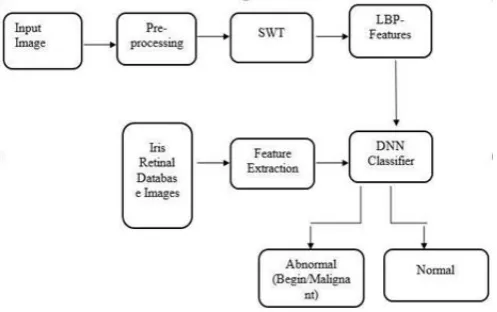
The goal of the proposed system iris recognition system in order to identify whether the iris is normal or abnormal. Figure 1 depicts the overall process of the proposed system. The proposed system consists of the following phases: iris images are selected using Stationary Wavelet Transform (SWT), extraction of features using Local Binary Pattern (LBP), iris images are classified into normal or abnormal using Deep Neural Network (DNN).
Figure 1. Overall process of the proposed system
Reading the input image and preprocessing the image using Grayscale Color Conversion, Switching Median Filter (Denoising). The second step is Apply Stationary Wavelet Transform (SWT) to select image features such Texture, Edge information and contrast. The third step is extracting the features using Local Binary Pattern (LBP). The images are converted into a 3*3 matrix. The center image is taken and compared with the neighboring images. The fourth step is iris
images are classified into normal and abnormal using Deep Neural Network (DNN).
3.1. Pre-processing
Preprocessing the image using Gray scale Color Conversion, Switching Median Filter (Denoising). A pixel color in an image is a combination of three colors Red, Green, and Blue (RGB). Conversion of a color image to a grayscale image by using Gray Scale Color Conversion. The Red, Green, Blue color values are represented in three dimensions XYZ, illustrated by the attributes of lightness, chroma, and hue.
The Pre-processing technique is summarized into following steps
• Preprocessing is the process of converting the color image to a grayscale image.
• Unwanted parts of the iris images are removed.
• The input image is resized into a 256*256 matrix.
• Matrix scaling is done to scan the image into various pixel.
3.2. Image Selection
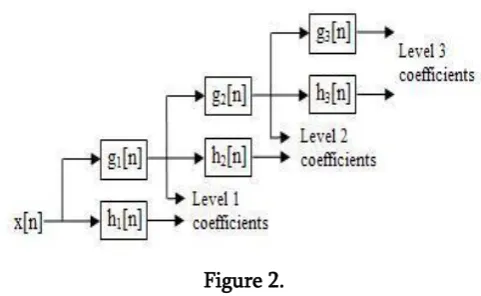
The iris images are captured and are grouped and selected ased on Stationary Wavelet Transform algorithm.
subband images, which gives approximation of the
image, vertical details, horizontal details and diagonal details.
Stationary wavelet transform uses the high and low pass filters. SWT apply high and low pass filters to the data at each level and next stage produces two sequences. The two new sequences are having same length as the original sequence. It is used to select and group various images in the initial stage of preprocessing. In SWT, instead of decimation we modify the filters at each level by padding them with zeros.
The image selection involves the following steps:
✓ The output image obtained from pre-processing is selected.
✓ Applying Stationary Wavelet Transform, images are selected based on texture, size, and contrast.
✓ It decomposes the original image into sub-images.
✓ Each sub-image is assigned a value.
Figure 2. 3.3. Feature Extraction
Useful images are extracted using Local Binary Pattern algorithm. Local Binary Pattern (LBP) is a simple very efficient texture operator which labels the pixels of an image by thresholding the neighborhood of each pixel and considers the result as a binary number. Iris provides abundant texture information a feature vector is formed which consists
of the ordered sequence of features extracted from various representation of the iris images. The local binary pattern (LBP) operator is defined as gray scale invariant texture measure, derived from a general definition of texture in a local neighborhood. Through its recent extensions, the LBP operator has been made into a really powerful measure of image texture, showing excellent results in many empirical studies. The LBP operator can be seen as unifying approach to the traditionally divergent statistical and structural models of texture analysis. Perhaps the most important property of the LBP operator in real world applications is invariance against monotonic gray level changes. Another important is its computational simplicity, which makes it possible to analyze images in challenging real time.
The Feature Extraction technique is summarized into following steps:
✓ The images are converted into a 3*3 matrix.
✓ The center image is taken and compared with the neighboring images.
✓ If the center image pixel value is greater than neighboring image value, then the value is 0.
✓ If the center image pixel value is lesser than neighboring image value, then the value is 1.
3.4. DNN Classification
Network (DNN). DNN finds correct mathematical manipulation to turn the input into the output, whether it be a linear relationship or non-linear relationship. The network moves through layers calculating the probability of each output. The user can review the results and select which probabilities the network should display and return the proposed label. The goal is that eventually, the network will be trained to decompose the image into features, identify trends that exist across all samples and classify new images by their similarities without requiring human input.
Comparing given iris image value with database values. If resultant value is above 7.5 then it is normal iris, if resultant value is below 7.5 then it is abnormal iris.
1. Training
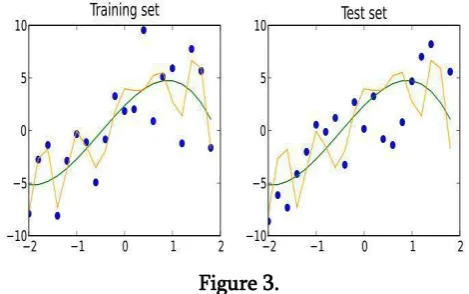
Training set is the one on which we train and fit our model basically to fit the parameters. Training data is used to fit your model. The model is trained on the training dataset using a supervised learning method. The training dataset often consist of pairs of an input vector (scalar) and the corresponding output vector (scalar), which is commonly denoted as the target (label). The current model is run with training dataset and produces a result, which is then compared with the target, for each input vector in the training dataset. Based on the result of the comparison and specific learning algorithm being used, the parameters of the model are adjusted. The model fitting can include both the variable selection and parameter estimation.
2. Testing
Test data is used only to assess performance of model. Test data is used to validate our model and a smaller portion of the data is used for testing. A test dataset is
a dataset that is independent of the training dataset, but follows the same probability distribution as the training dataset. If a model fit to the training dataset also fits the test dataset, minimal overfitting has taken place. A better fitting of the training dataset is opposed to the test dataset usually points to overfitting. Finally, the test dataset is used to provide an unbiased evaluation of a final model fit on the training dataset.
Figure 3.
IV.RESULTS AND DISCUSSION
The proposed iris recognition framework is implemented using MATLAB 8.1.604 (R2013a) platform. Figure 4 shows the sample database images.
This iris image database mainly consists of the iris images collected from the students and staff at IIT Delhi, India. This database has been acquired in the Biometrics Research Laboratory during January - July 2007 using JIRIS, JPC1000, digital CMOS camera.
The database of 2240 images is acquired from 224 different users and made available freely to the researchers. All the images in the database are in the age group 14-55 years comprising of 176 males and 48 females. The resolution of these images is 320 x 240 pixels and all these images were acquired in indoor environment. Majority of images were acquired from the left eyes while the rest images were acquired from right eye. Now the database has a label 'L' or 'R' which designates left or right eye. There are 1288 images from 224 subject are from left eyes while the
rest images from 211 subjects are from right eyes. The
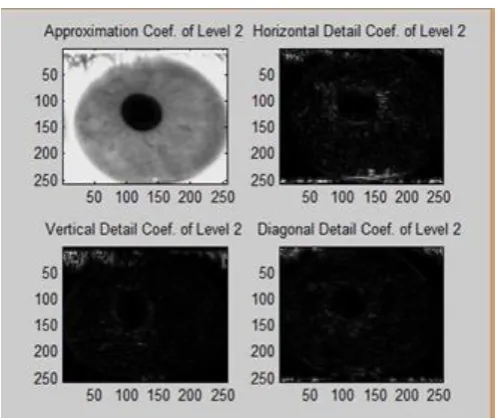
database holds red, blue, green color images of various format as bmp, jpg, tif, png. The input image is resized into 256*256 matrix. Figure 5 depicts the image selection by using Stationary Wavelet Transform (SWT).
Figure 5. Image Selection
A feature extraction of the image has been depicted in Figure 6. The selected image is deployed for feature extraction using Local Binary Pattern (LBP).
Local Binary Pattern (LBP) is a simple very efficient texture operator which labels the pixels of an image by thresholding the neighborhood of each pixel and considers the result as a binary number. The images are converted into a 3*3 matrix.
Figure 6. Features of a image
The extracted LBP feature vector is then fed into the classification module. Classify the image as normal or abnormal iris by using Deep Neural Network (DNN). The model is trained on the training dataset using a supervised learning method.
After training is completed test the images. Test data is used only to assess performance of model. Test data is used to validate our model and a smaller portion of the data is used for testing. Comparing given iris image value with database values. If resultant value is above 7.5 then it is normal iris, if resultant value is below 7.5 then it is abnormal iris.
V.CONCLUSION
iris accuracy. The Iris recognition system is developed by using image processing toolbox of Matlab software. Initially after pre-processing, using the algorithms features are extracted forming a 3*3 matrix pattern and classification is done. The proposed approach gave promising results, outperforming the state of the art on a very challenging dataset of 5000 iris images from different hospitals and scanners. Present method relies on DWT based features and feature matching classification. The experimental result is encouraging. In order to evaluate the performance of the proposed method, the database is used. This database has different characteristics like illumination change, bad focus, image noises etc. The future research work is
Recognition of Image-Orientation-Based Iris
Spoofing”. Reminiscence of “Mastermind”: Iris/Periocular Biometrics by “In-Set” CNN Iterative Analysis”. [6]. Jianxu Chen, Feng Shen, Danny Ziyi Chen
(2016)” Iris Recognition Based on Human
-Interpretable Features”.
[7]. Kien Nguyen, Clinton Fookes, Arun Ross, Sridha
Sridharan (2017 “Iris Recognition with Off
-The-Shelf CNN Features: A Deep Learning
Perspective”.
[8]. Mohtashim Baqar, Azfar Ghani, Azeem Aftab,
Saira Arbab, Sajid Yasin (2016)” Deep Belief
Networks for Iris Recognition Based on Contour
Detection”.
[9]. Pattabhi Ramaiah Nalla and Ajay Kumar (2017)
“Toward More Accurate Iris Recognition Using
Cross-Spectral Matching”.
[10].Peizhong Liu, Jing-Ming Guo, Szu-Han Tseng,
KokSheik Wong (2016)” Ocular Recognition for Blinking Eyes”.
[11].Qi Zhang, Haiqing Li, Zhenan Sun (2018) “Deep
Feature Fusion for Iris and Periocular Biometrics
on Mobile Devices”.
[12].Raghavender Jillela Arun Ross, Damon L.
Woodard (2010)”On the Fusion of Periocular
and Iris Biometrics in Non-ideal Imagery”.
[13].Shervin Minaee, Amirali Abdolrashidi and Yao
Wang” An Experimental Study of Deep Convolutional Features for Iris Recognition”.
[14].Sunil.S.Harakannanavar, Veena I Puranikmath
(2017)” Comparative Survey of Iris Recognition”.
[15].Zhenan Sun, Hui Zhang, Tieniu Tan, and Jianyu
Wang (2014)” Iris Image Classification Based on
Hierarchical Visual Codebook”.
Cite this article as :