CSEIT1723335 | Received : 01 July 2017 | Accepted : 10 July 2017 | July-August-2017 [(2)4: 60-65]
International Journal of Scientific Research in Computer Science, Engineering and Information Technology © 2017 IJSRCSEIT | Volume 2 | Issue 4 | ISSN : 2456-3307
60
An Implementation of Hybrid Cloud Approach for Secure
Authorized Deduplication
Parvati R. Shahu
1, Prof. Gurudev B. Sawarkar
21M.Tech Student, Department of Computer Science & Engineering, V. M. Institute Of Engineering & Technology, Nagpur , Madhya Pradesh, India
2Assistant Professor, Department of Computer Science & Engineering, V. M. Institute Of Engineering & Technology, Nagpur , Madhya Pradesh, India
ABSTRACT
Data Deduplication is a strategy for diminishing the measure of storage room an association needs to spare its data. In many associations, the capacity frameworks contain duplicate duplicates of many bits of data. For instance, various clients might spare a similar record in a few better places, or at least two documents that aren't indistinguishable may in any case incorporate a great part of similar data. Deduplication dispenses with these additional duplicates by sparing only one duplicate of the data and supplanting alternate duplicates with pointers that lead back to the first duplicate. Organizations every now and again utilize Deduplication in reinforcement and calamity recuperation applications; however, it can be utilized to free up space in essential stockpiling also. To dodge this duplication of data and to keep up the classification in the cloud we utilizing the idea of Hybrid cloud. To ensure the privacy of touchy data while supporting Deduplication, the joined encryption strategy has been proposed to encrypt the data before outsourcing. To better ensure data security, this paper makes the principal endeavor to formally address the issue of authorized data Deduplication.
Keywords: Deduplication, Authorized Duplicate Check, Confidentiality, Hybrid Cloud
I.
INTRODUCTION
In registering, data Deduplication is a specific data pressure method for disposing of duplicate duplicates of rehashing data. Related and to some degree synonymous terms are canny (data) pressure and single-occasion (data) stockpiling. This system is utilized to enhance stockpiling usage and can likewise be connected to arrange data exchanges to decrease the quantity of bytes that must be sent. In the Deduplication procedure, exceptional pieces of data, or byte designs, are distinguished and put away amid a procedure of examination. As the examination proceeds, different pieces are contrasted with the put away duplicate and at whatever point a match happens, the repetitive lump is supplanted with a little reference that focuses to the put away lump. Given that a similar byte example may happen handfuls, hundreds, or even a large number of times (the match recurrence is reliant on the piece measure), the measure of data that must be put away or exchanged can be incredibly decreased.
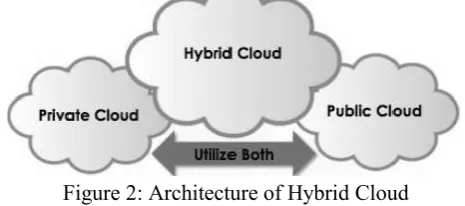
A Hybrid Cloud is a joined type of private clouds and open clouds in which some basic data lives in the venture's private cloud while other data is put away in and available from an open cloud. Hybrid clouds try to convey the upsides of adaptability, unwavering quality, quick arrangement and potential cost investment funds of open clouds with the security and expanded control and administration of private clouds. As cloud registering winds up noticeably well-known, an expanding measure of data is being put away in the cloud and utilized by clients with determined benefits, which characterize the get to privileges of the put away data.
Figure 1: Architecture of Cloud Computing
The data is encrypted before outsourcing it on the cloud or system. This encryption requires additional time and space prerequisites to encode data. In the event of vast data stockpiling the encryption turns out to be significantly more intricate and basic. By utilizing the data Deduplication inside a hybrid cloud, the encryption will end up noticeably more straightforward.
Figure 2: Architecture of Hybrid Cloud
As we as a whole realize that the system is, comprise of plentiful measure of data, which is being shared by clients and hubs in the system. Numerous vast scale arrange utilizes the data cloud to store and offer their data on the system. The hub or client, which is available in the system have full rights to transfer or download data over the system. Nevertheless, ordinarily extraordinary client transfers similar data on the system. This will make duplication inside the cloud. On the off chance that the client needs to recover the data or download the data from cloud, each time he needs to utilize the two encrypted records of same data. The cloud will do same operation on the two duplicates of data records. Because of this, the data secrecy and the security of the cloud are disregarded. It makes the weight on the operation of cloud.
To stay away from this duplication of data and to keep up the classification in the cloud we utilizing the idea of Hybrid cloud. It is a blend of open and private cloud. Hybrid cloud stockpiling consolidates the upsides of adaptability, dependability, quick sending and potential
cost funds of open cloud stockpiling with the security and full control of private cloud stockpiling.
II.
LITERATURE SURVEY
"A safe cloud reinforcement framework with guaranteed erasure and form control. A. Rahumed", H. C. H. Chen, Y. Tang, P. P. C. Lee, and J. C. S.Lui [1],has exhibited Cloud stockpiling is a rising administration show that empowers people and endeavors to outsource the capacity of data reinforcements to remote cloud suppliers requiring little to no effort. Subsequently comes about demonstrates that Fade Version just includes insignificant execution overhead over a customary cloud reinforcement benefit that does not bolster guaranteed cancellation.
"A turn around Deduplication stockpiling framework
streamlined for peruses to most recent
reinforcements", C. Ng and P. Lee. Revdedup [2] had introduced RevDedup, a de-duplication framework intended for VM circle picture reinforcement in virtualization conditions. RevDedup has a few outline objectives: high stockpiling proficiency, low memory utilization, high reinforcement execution, and high reestablish execution for most recent reinforcements. They widely assess our RevDedup model utilizing diverse workloads and approve our outline objectives.
"Part based get to controls", D. Ferraiolo and R. Kuhn [3],has depicted the Mandatory Access Controls (MAC) are fitting for multilevel secure military applications, Discretionary Access Controls (DAC) are regularly seen as meeting the security preparing necessities of industry and non-military personnel government.
"Recovering space from duplicate documents in a server less appropriated record framework", J. R. Douceur, A. Adya, W. J. Bolosky, D. Simon, and M. Theimer. [5],has displayed the Farsite conveyed document framework gives accessibility by imitating each record onto various desktop PCs. Estimation of more than 500 desktop document frameworks demonstrates that almost 50% of all devoured space is involved by duplicate records. The system incorporates 1) merged encryption, which empowers duplicate records to blended into the space of a solitary document, regardless of the possibility that the documents are encrypted with various clients' keys, and 2) SALAD, a Self Arranging, Lossy, Associative Database for conglomerating document substance and area data in a decentralized, adaptable, fault tolerant way.
"A safe data Deduplication conspire for cloud stockpiling", J. Stanek, A. Sorniotti, E. Androulaki, and L. Kencl [6],has gave the private clients outsource their data to cloud stockpiling suppliers, late data break episodes make end-toend encryption an
undeniably conspicuous prerequisite data
deduplication can be viable for mainstream data, while semantically secure encryption ensures disliked substance.
"Frail spillage flexible client side Deduplication of encrypted data in cloud stockpiling", J. Xu, E. - C. Chang, and J. Zhou [7], has portrayed the safe customer side Deduplication plot, with the accompanying favorable circumstances: our plan ensures data privacy (and some halfway data) against both outside foes and legitimate yet inquisitive cloud stockpiling server, while Halevi et al. trusts cloud stockpiling server in data classification.
"Secure and steady cost open cloud stockpiling evaluating with Deduplication", J. Yuan and S. Yu[8] has proposed, Data respectability and capacity proficiency are two critical necessities for cloud stockpiling. The creator proposed conspire is additionally described by steady real-time correspondence and computational cost on the client side.
"Protection mindful data escalated processing on hybrid clouds", K. Zhang, X. Zhou, Y. Chen, X.Wang, and Y. Ruan [9] has proposed, the rise of savvy cloud administrations offers associations incredible chance to lessen their cost and increment productivity. The framework, called Sedic, use the uncommon components of Map Reduce to naturally parcel a figuring work as indicated by the security levels of the data it works.
"Gq and schnorr ID plans Proofs of security against pantomime under dynamic and simultaneous assaults", M. Bellare and A. Palacio[10] has given, the verification for GQ in view of the accepted security of RSA under one more reversal, an augmentation of the standard onewayness suspicion that was presented. Both outcomes reach out to set up security against pantomime under simultaneous assault.
III.
PROPOSED SYSTEM
In Proposed framework, Convergent encryption has been utilized to implement data classification. Data duplicate is encrypted under a key determined by hashing the data itself. This merged key is utilized for encrypt and unscramble a data duplicate. Besides, such unauthorized clients cannot unscramble the figure message even intrigue with the S-CSP (storage cloud specialist co-op). Security examination shows that that framework is secure regarding the definitions determined in the proposed security demonstrate.
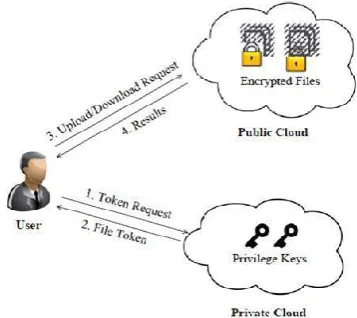
Figure 3: Architecture for Authorized Deduplication
organization ready to perform operations, for example, record transfer download and duplicate keeps an eye on the documents in light of his benefits. There are three substances characterize in hybrid cloud design of authorized Deduplication.
Data Users: A client is an element that needs to
outsource data stockpiling to the S-CSP (storage cloud specialist organization) and get to the data later. In a capacity framework supporting Deduplication, the client just transfers exceptional data yet does not transfer any duplicate data to spare the transfer transmission capacity, which might be claimed by a similar client or diverse clients. Each document is secured with the joined encryption key and benefits keys to understand the authorized Deduplication with differential benefits.
Private Cloud: This is new substance for encouraging
clients secure utilization of cloud administrations. The private keys for benefits are overseen by private cloud, which gives the document token to clients. In particular, since the registering assets at data client/proprietor side are confined and general society cloud is not completely confided by and by, private cloud can give data client/proprietor with an execution domain and foundation filling in as an interface amongst client and the general population cloud.
S-CSP (storage cloud benefit provider): This is an
element that gives a data stockpiling administration openly cloud. The SCSP gives the data outsourcing administration and stores data in the interest of the clients. To lessen the capacity cost, the SCSP dispenses with the capacity of repetitive data by means of Deduplication and keeps just one of a kind data. In this paper, we expect that S-CSP is constantly on the web and has plenteous capacity limit and calculation control.
IV.
METHODS AND MATERIAL
A. Algorithm
In the proposed system convergent key for each file is generated by using secure hashing algorithm-1 the steps of this algorithm is given below
Step1: Padding
zeroes until the final block has 448 bits.
unsigned 64-bit integer.
Step2: Initialize the 5 hash blocks (h0, h1, h2, h3, h4) to the specific constants defined in the SHA1 standard. Step3: Hash (for each 512bit Block)
○ Allocate an 80 word array for the message schedule
■ Set the first 16 words to be the 512bit block split into 16 words.
■ The rest of the words are generated using the following algorithm
step4: word [i3] XOR word [i8] XOR word [i14] XOR word [i16] then rotated 1 bit to the left.
○ Loop 80 times doing the following.
■ Calculate SHAfunction() and the constant K (these are based on the current round number.
■ e=d
■ d=c
■ c=b (rotated left 30)
■ b=a
■ a = a (rotated left 5) + SHAfunction() + e + k + word[i]
○ Add a,b,c,d and e to the hash output.
step5: Output the concatenation (h0, h1, h2, h3, h4) which is the message digest.
B. Implementation
The private keys for the benefits are overseen by the private cloud, who answers the record token solicitations from the clients and this interface offered by the private cloud enables client to submit documents and inquiries to be safely put away and registered separately.
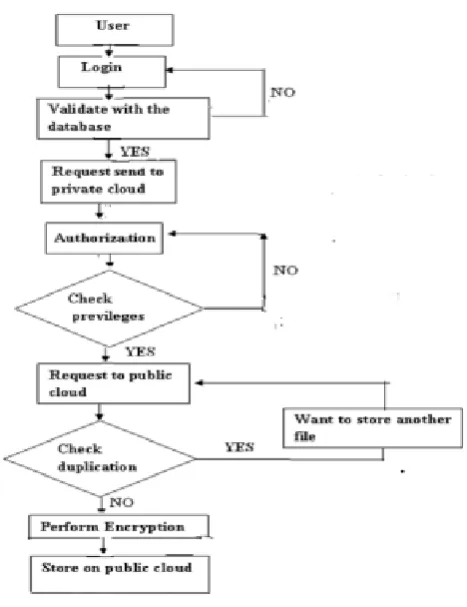
Figure 4: Flow Diagram of the Proposed Work
Deduplication of document. The private keys for benefits will not be issued to clients specifically, which will be kept and overseen by the private cloud server. The client needs to send a demand to the private cloud server to get a document token. The client needs to get the record token from the private cloud server to play out the duplicate check for some document. The clients either transfer this document or demonstrate their possession in view of the aftereffects of duplicate check. In the event that it is passed, the private cloud server will locate the comparing benefits of the client from its put away table rundown and send to the client then client can transfer his records. A similar way client can download his record from capacity cloud.
V.
RESULTS AND DISCUSSION
We lead test construct assessment in light of our model. Our assessment concentrates on looking at the overhead instigated by approval steps, including document token era and offer token era, against the concurrent encryption and record transfer steps. We assess the over-head by changing distinctive components. The administrator can include distinctive worker information. Hence, the Admin enlisting a work as a chief. After the getting a substantial data from a business. The administrator chooses a group pioneer.
Presently every client can transfer the records onto the cloud and furthermore they give the get to authorizations to transfer and download a document into cloud. The get to authorization can be given to the different needs like group pioneer, engineers and so forth. Later the document has transfer into the Amazon cloud, and later the records get the required data from the hybrid cloud that contains i.e. representative’s name and all and so on. Later they transfer the record. Subsequently the record is put away and encrypted shape a picture is been produced.
In the back end enlisted workers can be shown and the token created by private cloud for the records .If a similar document is given to other client same token is produced by the private cloud and a tag is created for the duplicate document. One of a kind records having no labels and it is spoken to as none.
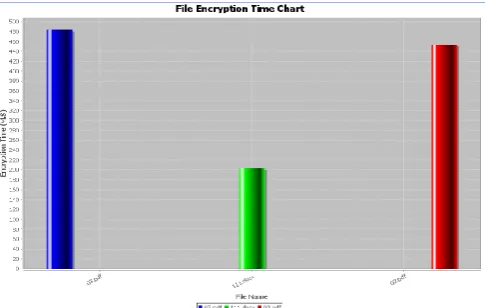
Figure 5: File Encryption Time Chart
In this venture work, the time required to encrypt and to store the records in the amazon cloud is computed and it is appeared in the document encryption diagram by taking the document name along x-hub and encryption time in milliseconds along y-pivot. In the event that three records of various sizes, for example, 427kb, 672kb and 2.15mb are transferred to the cloud the documents are put away in encrypted shape in the amazon cloud and the time required to encrypt these documents depends on arrange speed and it is 453ms separately for these records and the time is noted in the scratch pad and this can be appeared in figure 5.
VI.CONCLUSION
In this Project, the idea of authorized data deduplication was proposed to ensure the data security by including differential benefits of clients in the duplicate check. In this venture we play out a few new Deduplication developments supporting authorized duplicate check in hybrid cloud design, in which the duplicate-check tokens of records are produced by the private cloud server with private keys. As a proof of idea in this venture we execute a model of our proposed authorized duplicate check plan and lead testbed investigates our model. From this venture we demonstrate that our authorized duplicate check plot brings about insignificant overhead contrasted with united encryption and system exchange.
VII.
REFERENCES
[1] C. Ng and P. Lee. Revdedup: A reverse deduplication storage system optimized for reads to latest backups. In Proc. of APSYS,Apr 2013. [2] J. Li, X. Chen, M. Li, J. Li, P. Lee, andW. Lou.
Secure deduplication with efficient and reliable
convergent key management. In IEEE
Transactions on Parallel and Distributed Systems, 2013.
[3] J. Stanek, A. Sorniotti, E. Androulaki, and L. Kencl. A secure datadeduplication scheme for cloud storage. In Technical Report, 2013.
[4] J. Xu, E.-C. Chang, and J. Zhou. Weak leakage-resilient client-side deduplication of encrypted data in cloud storage. In ASIACCS,pages 195– 206, 2013.
[5] J. Yuan and S. Yu. Secure and constant cost public cloud storage auditing with deduplication. IACR Cryptology ePrint Archive, 2013:149, 2013.
[6] K. Zhang, X. Zhou, Y. Chen, X.Wang, and Y. Ruan. Sedic: privacy aware data intensive computing on hybrid clouds. In Proceedings of the 18th ACM conference on Computer and communications security,CCS’11, pages 515– 526, New York, NY, USA, 2011. ACM.
[7] M. Bellare, S. Keelveedhi, and T. Ristenpart. Dupless: Serveraided encryption for deduplicated storage. In USENIX Security Symposium, 2013. [8] M. Bellare, S. Keelveedhi, and T. Ristenpart.
Messagelocked encryption and secure
deduplication. In EUROCRYPT, pages 296–312, 2013.
[9] M. W. Storer, K. Greenan, D. D. E. Long, and E. L. Miller. Secure data deduplication. In Proc. of StorageSS, 2008.
[10] P. Anderson and L. Zhang. Fast and secure laptop backups with encrypted de-duplication. In Proc. of USENIX LISA, 2010.
[11] R. D. Pietro and A. Sorniotti. Boosting efficiency and security in proof of ownership for deduplication. In H. Y. Youm and Y. Won, editors, ACM Symposium on Information, Computer and Communications Security, pages 81–82. ACM, 2012.
[12] S. Bugiel, S. Nurnberger, A. Sadeghi, and T. Schneider. Twin clouds: An architecture for secure cloud computing. In Workshop on
Cryptography and Security in Clouds
(WCSC2011), 2011.
[13] S. Halevi, D. Harnik, B. Pinkas, and A. Shulman-Peleg. Proofs of ownership in remote storage systems. In Y. Chen, G. Danezis, and V. Shmatikov, editors, ACM Conference on Computer and Communications Security, pages 491–500. ACM, 2011.
[14] W. K. Ng, Y. Wen, and H. Zhu. Private data deduplication protocols in cloud storage. In S. Ossowski and P. Lecca, editors, Proceedings of the 27th Annual ACM Symposium on Applied Computing, pages 441– 446. ACM, 2012.