Needle in a Haystack: Reducing the Costs of Annotating Rare-Class
Instances in Imbalanced Datasets
Emily K. Jamison‡and Iryna Gurevych†‡ ‡Ubiquitous Knowledge Processing Lab (UKP-TUDA), Department of Computer Science, Technische Universit¨at Darmstadt
†Ubiquitous Knowledge Processing Lab (UKP-DIPF), German Institute for Educational Research http://www.ukp.tu-darmstadt.de
Abstract
Crowdsourced data annotation is noisier than annotation from trained workers. Previ-ous work has shown that redundant annota-tions can eliminate the agreement gap be-tween crowdsource workers and trained work-ers. Redundant annotation is usually non-problematic because individual crowdsource judgments are inconsequentially cheap in a class-balanced dataset.
However, redundant annotation on class-imbalanced datasets requires many more la-bels per instance. In this paper, using three class-imbalanced corpora, we show that an-notation redundancy for noise reduction is very expensive on a class-imbalanced dataset, and should be discarded for instances receiv-ing a sreceiv-ingle common-class label. We also show that this simple technique produces an-notations at approximately the same cost of a metadata-trained, supervised cascading ma-chine classifier, or about 70% cheaper than 5-vote majority-5-vote aggregation.
1 Introduction
The advent of crowdsourcing as a cheap but noisy source for annotation labels has spurred the devel-opment of algorithms to maximize quality and mini-mize cost. Techniques can detect spammers (Oleson et al., 2011; Downs et al., 2010; Buchholz and La-torre, 2011), model worker quality and bias during label aggregation (Jung and Lease, 2012; Ipeirotis et al., 2010) and optimize obtaining more labels per in-stance or more labelled inin-stances (Kumar and Lease, 2011; Sheng et al., 2008). However, much previ-ous work for quality maximization and cost limita-tion assumes that the dataset to be annotated is class-balanced.
Class-imbalanced datasets, or datasets with dif-ferences in prior class probabilities, present a unique problem during corpus production: how to include enough rare-class instances in the corpus to train a machine learner? If the orginal class distribution is maintained, a corpus that is large enough for a machine learner to identifycommon-class(i.e., fre-quent class) instances may suffer from a lack of rare-class(i.e., infrequent class) instances. Yet, it can be cost-prohibitive to expand the corpus until enough rare-class instances are included.
Content-based instance targeting can be used to select instances with a high probability of being rare-class. For example, in a binary class annota-tion task identifying pairs of emails from the same thread, where most instances are negative, cosine text similarity between the emails can be used to identify pairs of emails that are likely to be posi-tive, so that they could be annotated and included in the resulting class-balanced corpus (Jamison and Gurevych, 2013). However, this technique renders the corpus useless for experiments including token similarity (or ngram similarity, semantic similarity, stopword distribution similarity, keyword similarity, etc) as a feature; a machine learner would be likely to learn the very same features for classification that were used to identify the rare-class instances during corpus construction. Even worse, Mikros and Argiri (2007) showed that many features besides ngrams are significantly correlated with topic, including sen-tence and token length, readability measures, and word length distributions. The proposed targeted-instance corpus is unfit for experiments using sen-tence length similarity features, token length simi-larity features, etc.
identi-fying other potential rare-class instances for annota-tion that are very similar to the rare-class instances in the seed dataset. Rare-class instances may never be selected for labelling if they are very different from those in the seed dataset.
In this paper, we explore the use of cascad-ing machine learner and cascadcascad-ing rule-based tech-niques for rare-class instance identification during corpus production. We avoid the use of content-based targeting, to maintain rare-class diversity, and instead focus on crowdsourcing practices and metadata. To the best of our knowledge, our work is the first work to evaluate cost-effective non-content-based annotation procedures for class-imbalanced datasets. Based on experiments with three class-imbalanced corpora, we show that re-dundancy for noise reduction is very expensive on a class-imbalanced dataset, and should be discarded for instances receiving a single common-class la-bel. We also show that this simple technique pro-duces annotations at approximately the same cost of a metadata-trained machine classifier, or about 70% cheaper than 5-vote majority-vote aggregation, and requires no training data, making it suitable for seed dataset production.
2 Previous Work
The rise of crowdsourcing has introduced promising new annotation strategies for corpus development.
Crowdsourced labels are extremely cheap. In a task where workers gave judgments rating a news headline for various emotions, Snow et al. (2008) collected 7000 judgments for a total of US$2. In a computer vision image labelling task, Sorokin and Forsyth (2008) collected 3861 labels for US$59; access to equivalent data from the annotation ser-vice ImageParsing.com, with an existing annotated dataset of 49,357 images, would have cost at least US$1000, or US$5000 for custom annotations.
Crowdsourced labels are also of usable quality. On a behavioral testing experiment of tool-use iden-tification, Casler et al. (2013) compared the per-formance of crowdsource workers, social media-recruited workers, and in-person trained workers, and found that test results among the 3 groups were almost indistinguishable. Sprouse (2011) collected syntactic acceptability judgments from 176 trained
undergraduate annotators and 176 crowdsource an-notators, and after removing outlier work and in-eligible workers, found no difference in statistical power or judgment distribution between the two groups. Nowak and R¨uger (2010) compared anno-tations from experts and from crowdsource workers on an image labelling task, and they found that a single annotation set consisting of majority-vote ag-gregation of non-expert labels is comparable in qual-ity to the expert annotation set. Snow et al. (2008) compared labels from trained annotators and crowd-source workers on five linguistic annotation tasks. They created an aggregatedmeta-labellerby averag-ing the labels of subsets ofnnon-expert annotations. Inter-annotator agreement between the non-expert meta-labeller and the expert labels ranged from .897 to 1.0 withn=10 on four of the tasks.
Sheng et al. (2008) showed that although a ma-chine learner can learn from noisy labels, the num-ber of needed instances is greatly reduced, and the quality of the annotation improved, with higher quality labels. To this end, much research aims to increase annotation quality while maintaining cost.
Annotation quality can be improved by removing unconscientious workers from the task. Oleson et al. (2011) screened spammers and provided worker training by embedding auto-selectedgold instances (instances with high confidence labels) into the an-notation task. Downs et al. (2010) identified 39% of unconscientious workers with a simple two-question qualifying task. Buchholz and Latorre (2011) ex-amined cheating techniques associated with speech synthesis judgments, including workers who do not play the recordings, and found that cheating be-comes more prevalent over time, if unchecked. They examined the statistical profile of cheaters and de-veloped exclusion metrics.
level of confidence, with fewer total labels. Tarasov et al. (2014) dynamically estimated annotator relia-bility with regression using multi-armed bandits, in a system that is flexible to annotator unavailability, no gold standard, and a variety of label types. Dawid and Skene (1979) used an EM algorithm to simulta-neously estimate worker bias and aggregate labels. Ipeirotis et al. (2010) separately calculated bias and error, enabling better quality assessment of a worker. Some research explores the decision between ob-taining more labels per instance or more labelled instances. Sheng et al. (2008) evaluated machine learning performance with different corpus sizes and label qualities. They evaluated four algorithms for use in deciding between redundant labelling and more labelled instances. Kumar and Lease (2011) built on the model by Sheng et al. (2008), adding knowledge of annotator quality for faster learning.
Other work focuses on correcting labels at the instance level. Dligach and Palmer (2011) used annotation-error detection and ambiguity detection to identify instances in need of additional annota-tions. Hsueh et al. (2009) modelled annotator qual-ity and ambiguqual-ity rating to select highly informative yet unambiguous training instances.
Alternatively, class imbalance can be accommo-dated during machine learning, by resampling and cost-sensitive learning. Das et al. (2014) used density-based clustering to identify clusters in the instance space: if the clusters exceeded a thresh-old of majority-class dominance, they are undersam-pled to increase class-balance in the dataset. Batista et al. (2004) examined the effects of sampling for class-imbalance reduction on 13 datasets and found that oversampling is generally more effective than undersampling. They evaluated oversampling tech-niques to produce the fewest additional classifier rules. Elkan (2001) proved that class balance can be changed to set different misclassification penalties, although he observed this is ineffective with certain classifiers such as decision trees and Bayesian clas-sifiers, so he also provided adjustment equations for use in such cases.
One option to reduce annotation costs is the clas-sifier cascade. The Viola-Jones cascade machine learning-based framework (Viola and Jones, 2001) has been used to cheaply classify easy instances while passing along difficult instances for more
costly classification. Classification of annotations can use annotation metadata: Zaidan and Callison-Burch (2011) used metadata crowdsource features to train a system to reject bad translations in a transla-tion generatransla-tion task. Cascaded classifiers are used by Bourdev and Brandt (2005) for object detection in images and Raykar et al. (2010) to reduce the cost of obtaining expensive (in money or pain to the pa-tient) features in a medical diagnosis setting. In this paper, we evaluate the use of metadata-based classi-fier cascade, as well as rule cascades, to reduce an-notation costs.
3 Three Class-Imbalanced Annotation Tasks
We investigate three class-imbalanced annotation tasks; all are pairwise classification tasks that are class-imbalanced due to factorial combination of text pairs.
Pairwise Email Thread Disentanglement A pairwise email disentanglement task labels pairs of emails with whether or not the two emails come from the same email thread (a positive or nega-tive instance). The Emails dataset1 consists of 34 positive and 66 negative instances, and simulates a server’s contents in which most pairs are negative (common class). The emails come from the Enron Email Corpus , which has no inherent header thread labelling. Annotators were shown both texts side-by-side and asked “Are these two emails from the same discussion/email thread?” Possible answers wereyes,can’t tell, andno.
Pairwise Wikipedia Discussion Turn/Edit Align-ment Wikipedia editors discuss plans foreditsin an article’sdiscussionpage, but there is no inherent mechanism to connect specific discussion turns in the discussion to the edits they describe. A corpus of matched turn/edit pairs permits investigation of relations between turns and edits. The Wiki dataset2 consists of 750 turn/edit pairs. Additional rare-class (positive) instances were added to the corpus, re-sulting in 17% positive instances. Annotators were
1
www.ukp.tu-darmstadt.de/data/text-similarity/email-disentanglement/
2www.ukp.tu-darmstadt.de/data/
Sentence1:Cord is strong, thick string.
Sentence2: A smile is the expression that you have on your face when you are pleased or amused, or when you are being friendly.
Figure 1: Sample text pair from text similarity corpus, classi-fied by 7 out of 10 workers as1on a scale of 1-5.
shown the article topic, turn and thread topic, the edit, and the edit comment, and asked, “Does the Wiki comment match the Wiki edit?” Possible an-swers wereyes,can’t tell, andno.
Sentence Pair Text Similarity Ratings To rate sentence similarity, annotators read 2 sentences and answered the question, “How close do these sen-tences come to meaning the same thing?” Annota-tors rated text similarity of the sentences on a scale of 1 (minimum similarity) to 5 (maximum similar-ity). This crowdsource dataset was produced by B¨ar et al. (2011). An example sentence pair is shown in Figure 1. The SentPairs dataset consists of 30 sen-tence pairs.
The original classification was calculated as the mean of a pair’s judgments. However, on a the-oretical level, it is unclear that mean, even with a deviation measure, accurately expresses annotator judgments for this task. Our experiments (see Sec-tions 6 and 7) use mode score as the gold standard, which occasionally results in multiple instances de-rived from one set of ratings.
From the view of binary classification, each one of the 5 classes constitutes a rare class. For the purposes of our experiments, we treat each class in turn as the rare-class, while neighboring classes are treated ascan’t tellclasses (with estimated normal-ization for continuum edge classes1and5), and the rest as common classes. For example, experiments treating class 4 as rare treated classes 3 and 5 as “can’t tell” and classes1and2as common.
4 How severe is class imbalance?
The Emails and Wiki datasets consist of two texts paired in such a way that a complete dataset would consist of all possible pair combinations (Cartesian product). Although the dataset for text similarity rat-ing does not require such pairrat-ing, it is still heavily class imbalanced.
Consider an email corpus with a set of threadsT
and each t 2 T consisting of a set of emails Et,
where rare-class instances are pairs of emails from
the same thread, and common-class instances are pairs of emails from different threads. We have the following number of rare-class instances:
|Instancesrare|=
|T| X
i=1
|EXi| 1
j=1
j
and number of common-class instances:
|Instancescommon|=
|T| X
i=1
|Ei|
X
j=1
|T| X
k=(i+1) |Ek|
For example, in an email corpus with 2 threads of 2 emails each, 4 (67%) of pairs are common-class instances, and 2 (33%) are rare-common-class instances. If another email thread of two emails is added, 12 (80%) of the pairs are common-class instances, and 3 (20%) are rare-class instances.
To provide a constant value for the purposes of this work, we standardize rare-class frequency to 0.01 unless otherwise noted. This is different from our datasets’ actual class imbalances, but the con-clusions from our experiments in Section 7 are inde-pendent of class balance.
5 Baseline Cost
The baseline aggregation technique in our experi-ments (see Sections 6 and 7) is majority vote of the annotators. For example, if an instance receives at least 3 out of 5 rare-class annotations, then the base-line consensus declares it rare-class.
Emails Dataset Cost For our Emails dataset, we solicited 10 Amazon Mechnical Turk (MTurk)3
an-notations for each of 100 pairs of emails, at a cost of US$0.0334per annotation. Standard quality
mea-sures employed to reduce spam annotations included over 2000HITs (MTurk tasks) completed, 95% HIT acceptance rate, and location in the US.
Assuming 0.01 rare-class frequency5and 5
anno-tations6, the cost of a rare-class instance is: U S$0.033⇥5annotators
0.01freq =U S$16.50
3www.mturk.com
4Including approx. 10% MTurk fees
5Although this paper proposes a hypothetical 0.01 rare-class frequency, the Emails and Wiki datasets have been partially bal-anced: the negative instances merely functioned as a distractor for annotators, and conclusions drawn from the rule cascade ex-periments only apply to positive instances.
Wiki Dataset Cost For our Wiki dataset, we so-licited five MTurk annotations for each of 750 turn/edit text pairs at a cost of US$0.044 per anno-tation. Measures for Wikipedia turn/edit pairs in-cluded 2000 HITs completed, 97% acceptance rate, age over 18, and either preapproval based on good work on pilot studies or a high score on a qualifi-cation test of sample pairs. The cost of a rare-class instance is:
U S$0.044⇥5annotators
0.01freq =U S$22
SentPairs Dataset Cost The SentPairs datset con-sists of 30 sentence pairs, and 10 annotations per pair. The original price of B¨ar et al. (2011)’s sentence pairs corpus is unknown, so we esti-mated a cost of US$0.01 per annotation. The an-notations came from Crowdflower7. B¨ar et al.
(2011) used a number of quality assurance mech-anisms, such as worker reliability and annota-tion correlaannota-tion. The cost of a rare-class in-stance varied between classes, due to class fre-quency variation, from instanceclass2=US$0.027 to
instanceclass5=US$0.227.
Finding versus Confirming a Rare-Class Instance It is cheaper to confirm a rare-class instance than to find a suspected rare-class instance in the first place. We have two types of binary decisions: finding a suspected rare-class instance (“Is the instance a true positive (TP) or false negative (FN)?”) and confirm-ing a rare-class instance as rare (“Is the instance a TP or false positive (FP)?”). Assuming a 0.01 rare-class frequency, 5-annotation majority-vote decision, and 0.5 FP frequency, the cost of the former is:
1annotation 0.01freq +
1annotation
0.99freq = 101annotations and the latter is:
5annotations
0.5freq = 10annotations
Metrics We used the following metrics for our ex-periment results:
TPis the number of true positives (rare-class) dis-covered. The fewer TP’s discovered, the less likely the resulting corpus will represent the original data in an undistorted manner.
Prare is the precision over rare instances: T PT P+F P
Lower precision means lower confidence in the pro-duced dataset, because the “rare” instances we found might have been misclassified.
7crowdflower.com
AvgAis the average number of annotations needed for the system to label an instance common-class. The normalized costis the estimated cost of acquir-ing a rare instance: AvgAclassImbalance⇥annoCost
Recallrare
Savingsis the estimated cost saved when identifying rare instances, over the baseline. Includes Standard Deviation.
6 Supervised Cascading Classifier Experiments
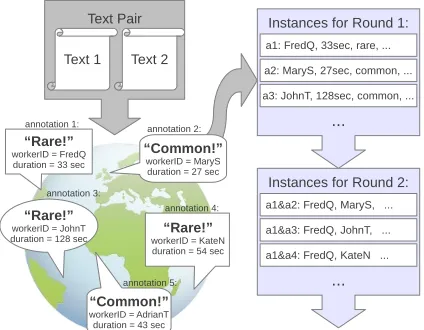
Previous work (Zaidan and Callison-Burch, 2011) used machine learners to predict which instances to annotate based on annotation metadata. In this sec-tion, we used crowdsourcing annotation metadata (such as time duration) as features for a cascading logistic regression classifier to choose whether or not an additional annotation is needed. In each of the five cascade rounds, an instance was classified as eitherpotentially rareorcommon. Instances clas-sified as potentially rare received another annotation and continued through the next cascade, while in-stances classified as common were discarded. Dis-carding instances before the end of the cascade can reduce the total number of needed annotations, and therefore lower the total cost. This cascade mod-els the observation (see Section 5) that it is cheap to confirm suspected rare-class instances, but it is ex-pensive to weed out common-class instances.
Experiments from this section will be compared in Section 7 to a rule-based cascading classifier sys-tem that, unlike this supervised syssys-tem, does not need any training data.
6.1 Instances
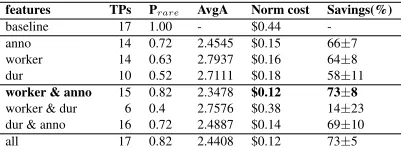
Each experimental instance consisted of features de-rived from the metadata of one or more crowd-sourced annotations from a pair of texts. A gold standard rare instance has>80% rare annotations.
features TPs Prare AvgA Norm cost Savings(%)
baseline 17 1.00 - $0.44
-anno 14 0.72 2.4545 $0.15 66±7
worker 14 0.63 2.7937 $0.16 64±8
dur 10 0.52 2.7111 $0.18 58±11
worker & anno 15 0.82 2.3478 $0.12 73±8
worker & dur 6 0.4 2.7576 $0.38 14±23 dur & anno 16 0.72 2.4887 $0.14 69±10
all 17 0.82 2.4408 $0.12 73±5
Table 4:SentPairsc5results on the trained cascade.
ID (US$0.39 and US$0.12, respectively), which pro-duced a 73% cost savings; for class 5, adding du-ration minimally decreased the standard deviation. Annotation and worker ID were only marginally bet-ter than annotation alone for class 1.
7 Rule-based Cascade Experiments
Although the meta-data-trained cascading classifier system is effective in reducing the needed number of annotations, it is not useful in the initial stage of an-notation, when there is no training data. In these ex-periments, we evaluate a rule-based cascade in place of our previous trained classifier. The rule-based cascade functions similarly to the trained classifier cascade except that a single rule replaces each clas-sification. Five cascades are used.
Each rule instructs when to discard an instance from further annotation. For example,no>2means, “if the count of no (i.e., common) annotations be-comes greater than 2, we assume the instance is common and do not seek further confirmation from more annotations.” A gold standard rare instances has>80% rare annotations.
For our rule-based experiments, we define AvgA for each instance iand for annotationsa1i, a2i, ...,
a5i and the probability (Pr) of five
non-common-class annotations. Classcis the common class. We
always need a first annotation:Pr(a1i 6=c) = 1.
AvgAi=
5
X
j=1
j Y
k=1
Pr(aki6=c)
We definePrecisionrare(Prare) as the probability
that instanceiwith 5 common8annotationsa1i,a2i,
...,a5i is not a rare-class instance:
Prarei= Pr(TP|(a1...5i =rare))
= 1 Pr(FP|(a1...5i =rare))
Thus, we estimate the probability of seeing other FPs based on the class distribution of our annota-tions. This is different from our supervised cascade experiments, in which Prare= T PT P+F P.
8This may also includecan’t tellannotations, depending on
the experiment.
7.1 Results
Table 5 shows the results of various rule systems on reducing cost on the wiki data.
While it might appear reasonable to allow one or two careless crowdsource annotations before dis-carding an instance, the tables show just how costly this allowance is: each permitted extra annotation (i.e., no>1, no>2, ...) must be applied system-atically to each instance (because we do not know which annotations are careless and which are accu-rate) and can increase the average number of annota-tions needed to discard a common instance by over 1. The practice also decreases rare-class precision, within ann-annotations limit. Clearly the cheapest and most precise option is to discard an instance as soon as there is a common-class annotation.
When inherently ambiguous instances are shifted from rare to common by including can’t tell as a common annotation, the cost of a rare Wiki in-stance falls from US$7.09 (68% savings over base-line) to US$6.10 (72% savings), and the best per-forming rule is (no+ct)>0. A rare email in-stance barely increases from US$3.52 (79% savings) to US$3.65 (78% savings). However, in both cases, TP of rare-class instances falls (Wiki: 39 instances to 22, Emails: 32 instances to 30). This does not affect overall cost, because it is already included in the equation, but the rare-class instances found may not be representative of the data.
There was not much change in precision in the Wiki dataset whencan’t tellwas included as a rare annotation (such asno>0) or a common annotation (such as(no+ct)>0), so we assume that the pop-ulations of rare instances gathered are not different between the two. However, when a reduced num-ber of TPs are produced from treatingcan’t tellas a common annotation, higher annotation costs can re-sult (such as Table 5,no>0cost of US$7.09, versus
(no+ct)>0cost of US$10.56).
Removing ambiguous instances from the test cor-pus does not notably change the results (see Table 6). Ambiguous instances were those where the majority class wascan’t tell, the majority class was tied with can’t tell, or there was a tie between common and rare classes.
Class = N if: TP Prare AvgA NormCost Savings(%)
baseline 128 1.00 - $22.0
-no>0 39 0.95 1.61 $7.09 68±16
no>1 39 0.85 2.86 $12.6 43±19 no>2 39 0.73 3.81 $16.75 24±15 (no+ct)>0 22 0.98 1.35 $10.56 52±20 (no+ct)>1 33 0.93 2.55 $13.25 40±18 (no+ct)>2 35 0.85 3.56 $17.44 21±15
Table 5: Wiki results: rule-based cascade. All instances in-cluded.
Class = N if: TP Prare AvgA NormCost Savings(%)
baseline 128 1.00 - $22.0
-no>0 35 0.96 1.46 $6.43 71±14
no>1 35 0.9 2.67 $11.76 47±17 no>2 35 0.81 3.66 $16.11 27±14 (no+ct)>0 22 0.98 1.33 $9.34 58±19 (no+ct)>1 33 0.92 2.5 $11.66 47±17 (no+ct)>2 35 0.85 3.49 $15.36 30±13
Table 6:Wiki results: no ambiguous instances.
baseline, they save about as much money as super-vised cascade classification.
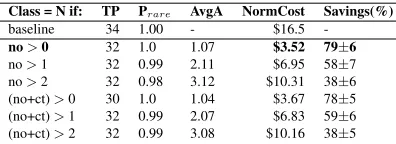
Table 7 shows results from the Emails dataset. Results largely mirrored those of the Wiki dataset, except that there was higher inter-annotator agree-ment on the email pairs which reduced annotation costs. We also found that, similarly to the Wiki ex-periments, weeding out uncertain examples did not notably change the results.
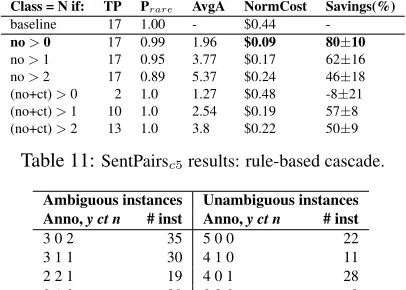
Results of the rule-based cascade on SentPairs are shown in Tables 8, 9, 10, and 11. Note there were no instances with a mode gold classification of 3. Also, there are more total rare instances than sen-tence pairs, because of the method used to identified a gold instance: annotations neighboring the rare class were ignored, and an instance was gold rare if the count of rare annotations was>0.8 of total
anno-tations. Thus, an instance with the count{class1=5,
class2=4, class3=1, class4=0, class5=0}counts as a
gold instance of both class 1 and class 2.
The cheapest rule wasno>0, which had a recall
of 1.0, Prareof 0.9895, and a cost savings of 80-83%
(across classes 1-5) over the 10 annotators originally used in this task.
Class = N if: TP Prare AvgA NormCost Savings(%)
baseline 34 1.00 - $16.5
-no>0 32 1.0 1.07 $3.52 79±6
no>1 32 0.99 2.11 $6.95 58±7 no>2 32 0.98 3.12 $10.31 38±6 (no+ct)>0 30 1.0 1.04 $3.67 78±5 (no+ct)>1 32 0.99 2.07 $6.83 59±6 (no+ct)>2 32 0.99 3.08 $10.16 38±5
Table 7:Email results: rule-based cascade.
Class = N if: TP Prare AvgA NormCost Savings(%)
baseline 5 1.00 - $1.5
-no>0 5 0.99 1.69 $0.25 83±10
no>1 5 0.96 3.27 $0.49 67±17 no>2 5 0.9 4.66 $0.7 53±21 (no+ct)>0 0 1.0 1.34 - -(no+ct)>1 2 0.98 2.63 $0.98 34±31 (no+ct)>2 4 0.96 3.83 $0.72 52±19
Table 8:SentPairsc1results: rule-based cascade.
Class = N if: TP Prare AvgA NormCost Savings(%)
baseline 2 1.00 - $3.75
-no>0 2 0.98 1.95 $0.73 81±12
no>1 2 0.93 3.68 $1.38 63±20 no>2 2 0.86 5.12 $1.92 49±23 (no+ct)>0 0 1.0 1.1 - -(no+ct)>1 0 1.0 2.2 - -(no+ct)>2 0 1.0 3.29 -
-Table 9:SentPairsc2results: rule-based cascade.
7.2 Error Analysis
A rare-class instance with many common anno-tations has a greater chance of being labelled common-class and thus discarded by a single crowd-source worker screening the data. What are the traits of rare-class instances at high risk of being discarded? We analyzed only Wiki text pairs, be-cause the inter-annotator agreement was low enough to cause false negatives. The small size of SentPairs and the high inter-annotator agreement of Emails prevented analysis.
Wiki data The numbers of instances (750 total)
with various crowdsource annotation distributions are shown in Table 12. The table shows annotation
distributions ( i.e., 302 = 3 yes, 0 can’t tell and 2
no) for rare-class instance numbers with high and
low probabilities of being missed.
We analyzed the instances from the category most
likely to be missed (302) and compared it with
the two categories least likely to be missed (500,
410). Of five random302 pairs, all five appeared
highly ambiguous and difficult to annotate; they were missing context that was known (or assumed to be known) by the original participants. Two of the turns state future deletion operations, and the
ed-Class = N if: TP Prare AvgA NormCost Savings(%)
baseline 16 1.00 - $0.47
-no>0 16 0.99 1.98 $0.09 80±9
no>1 16 0.96 3.83 $0.18 62±15 no>2 16 0.9 5.47 $0.26 45±17 (no+ct)>0 0 1.0 1.23 - -(no+ct)>1 0 1.0 2.45 - -(no+ct)>2 1 0.99 3.65 $2.74 -484±162
Class = N if: TP Prare AvgA NormCost Savings(%)
baseline 17 1.00 - $0.44
-no>0 17 0.99 1.96 $0.09 80±10
no>1 17 0.95 3.77 $0.17 62±16
no>2 17 0.89 5.37 $0.24 46±18
(no+ct)>0 2 1.0 1.27 $0.48 -8±21
(no+ct)>1 10 1.0 2.54 $0.19 57±8
(no+ct)>2 13 1.0 3.8 $0.22 50±9
Table 11:SentPairsc5results: rule-based cascade.
Ambiguous instances Unambiguous instances Anno,y ct n # inst Anno,y ct n # inst
3 0 2 35 5 0 0 22 3 1 1 30 4 1 0 11 2 2 1 19 4 0 1 28 2 1 2 39 3 2 0 2 Table 12:Anno. distributions and instance counts.
its include deleted statements, but it is unknown if the turns were referring to these particular deleted statements or to others. In another instance, the turn argues that a contentious research question has been answered and that the user will edit the article ac-cordingly, but it is unclear in which direction the user intended to edit the article. In another instance, the turn requests the expansion of an article section, and the edit is an added reference to that section. In the last pair, the turn gives a quote from the article and requests a source, and the edit adds a source to the quoted part of the article, but the source clearly refers to just one part of the quote.
In contrast, we found four of the five 500 and
410 pairs to be clear rare-class instances. Turns quoted text from the article that matched actions in the edits. In the fifth pair, a500 instance, the edit was first made, then the turn was submitted com-plaining about the edit and asking it to be reversed. This was a failure by the annotators to follow the directions included with the task, of which types of pairs are positive instances and which are not.
8 Conclusion
Crowdsourcing is a cheap but noisy source of an-notation labels, encouraging redundant labelling. However, redundant annotation on class-imbalanced datasets requires many more labels per instance. In this paper, using three class-imbalanced corpora, we have shown that annotation redundancy for noise re-duction is expensive on a class-imbalanced dataset, and should be discarded for instances receiving a single common-class label. We have also shown that this simple technique, which does not require
any training data, produces annotations at approxi-mately the same cost of a metadata-trained, super-vised cascading machine classifier, or about 70% cheaper than 5-vote majority-vote aggregation. We expect that future work will combine this technique for seed data creation with algorithms such as Active Learning to create corpora large enough for machine learning, at a reduced cost.
Acknowledgments
This work has been supported by the Volkswagen Foundation as part of the Lichtenberg-Professorship Program under grant No. I/82806, and by the Cen-ter for Advanced Security Research (www.cased. de).
References
Daniel B¨ar, Torsten Zesch, and Iryna Gurevych. 2011. A reflective view on text similarity. InProceedings of the International Conference on Recent Advances in
Natural Language Processing, pages 515–520, Hissar,
Bulgaria.
Gustavo E.A.P.A. Batista, Ronaldo C. Prati, and Maria Carolina Monard. 2004. A study of the behav-ior of several methods for balancing machine learning training data. ACM Sigkdd Explorations Newsletter, 6(1):20–29.
Lubomir Bourdev and Jonathan Brandt. 2005. Robust object detection via soft cascade. In Proceedings of the 2005 IEEE Computer Society Conference on
Com-puter Vision and Pattern Recognition, volume 2, pages
236–243, Washington D.C., USA.
Sabine Buchholz and Javier Latorre. 2011. Crowdsourc-ing preference tests, and how to detect cheatCrowdsourc-ing. In
Proceedings of the 12thAnnual Conference of the In-ternational Speech Communication Association
(IN-TERSPEECH), pages 3053–3056, Florence, Italy.
Krista Casler, Lydia Bickel, and Elizabeth Hackett. 2013. Separate but equal? A comparison of participants and data gathered via Amazons MTurk, social media, and face-to-face behavioral testing. Computers in Human
Behavior, 29(6):2156–2160.
Barnan Das, Narayanan C. Krishnan, and Diane J. Cook. 2014. Handling imbalanced and overlapping classes in smart environments prompting dataset. In Katsutoshi Yada, editor,Data Mining for Service, pages 199–219. Springer, Berlin Heidelberg.
Dmitriy Dligach and Martha Palmer. 2011. Reducing the need for double annotation. In Proceedings of the 5th Linguistic Annotation Workshop, pages 65–73, Stroudsburg, Pennsylvania.
Julie S. Downs, Mandy B. Holbrook, Steve Sheng, and Lorrie Faith Cranor. 2010. Are your participants gam-ing the system?: Screengam-ing Mechanical Turk workers. InProceedings of the SIGCHI Conference on Human Factors in Computing Systems, pages 2399–2402, At-lanta, Georgia.
Charles Elkan. 2001. The foundations of cost-sensitive learning. In Proceedings of the 17th International Joint Conference on Artificial Intelligence, pages 973– 978, San Francisco, California.
Pei-Yun Hsueh, Prem Melville, and Vikas Sindhwani. 2009. Data quality from crowdsourcing: a study of annotation selection criteria. In Proceedings of the NAACL HLT 2009 workshop on active learning for natural language processing, pages 27–35, Boulder, Colorado.
Panagiotis G. Ipeirotis, Foster Provost, and Jing Wang. 2010. Quality management on Amazon Mechanical Turk. In Proceedings of the ACM SIGKDD work-shop on human computation, pages 64–67, Washing-ton D.C., USA.
Emily K. Jamison and Iryna Gurevych. 2013. Header-less, quoteHeader-less, but not hopeless? using pairwise email classification to disentangle email threads. In Pro-ceedings of the International Conference Recent Ad-vances in Natural Language Processing RANLP 2013, pages 327–335, Hissar, Bulgaria.
Hyun Joon Jung and Matthew Lease. 2012. Improving quality of crowdsourced labels via probabilistic matrix factorization. InProceedings of the 4th Human Com-putation Workshop (HCOMP) at AAAI, pages 101– 106, Toronto, Canada.
Abhimanu Kumar and Matthew Lease. 2011. Model-ing annotator accuracies for supervised learnModel-ing. In
Proceedings of the Workshop on Crowdsourcing for Search and Data Mining (CSDM) at the Fourth ACM International Conference on Web Search and Data Mining (WSDM), pages 19–22, Hong Kong, China. George K. Mikros and Eleni K. Argiri. 2007.
Inves-tigating topic influence in authorship attribution. In
Proceedings of the SIGIR 2007 International Work-shop on Plagiarism Analysis, Authorship Identifica-tion, and Near-Duplicate DetecIdentifica-tion, PAN 2007, Am-sterdam, Netherlands. Online proceedings.
Stefanie Nowak and Stefan R¨uger. 2010. How reli-able are annotations via crowdsourcing: a study about inter-annotator agreement for multi-label image anno-tation. InProceedings of the international conference on Multimedia information retrieval, pages 557–566, Philadelphia, Pennsylvania.
David Oleson, Alexander Sorokin, Greg P. Laughlin, Vaughn Hester, John Le, and Lukas Biewald. 2011. Programmatic gold: Targeted and scalable quality assurance in crowdsourcing. Human computation, 11:11.
Vikas C. Raykar, Balaji Krishnapuram, and Shipeng Yu. 2010. Designing efficient cascaded classifiers: trade-off between accuracy and cost. In Proceedings of the 16th ACM SIGKDD international conference on Knowledge discovery and data mining, pages 853– 860, New York, NY.
Victor S. Sheng, Foster Provost, and Panagiotis G. Ipeiro-tis. 2008. Get another label? Improving data qual-ity and data mining using multiple, noisy labelers. In
Proceedings of the 14th ACM SIGKDD international conference on Knowledge discovery and data mining, pages 614–622, Las Vegas, Nevada.
Rion Snow, Brendan O’Connor, Daniel Jurafsky, and Andrew Y. Ng. 2008. Cheap and fast—but is it good?: Evaluating non-expert annotations for natural language tasks. InProceedings of the conference on Empirical Methods in Natural Language Processing, pages 254–263, Honolulu, Hawaii.
Alexander Sorokin and David Forsyth. 2008. Utility data annotation with Amazon Mechanical Turk. Urbana, 51(61):820.
Jon Sprouse. 2011. A validation of Amazon Me-chanical Turk for the collection of acceptability judg-ments in linguistic theory. Behavior research methods, 43(1):155–167.
Alexey Tarasov, Sarah Jane Delany, and Brian Mac Namee. 2014. Dynamic estimation of worker reliability in crowdsourcing for regression tasks: Making it work. Expert Systems with Applications, 41(14):6190–6210.
Paul A. Viola and Michael J. Jones. 2001. Rapid object detection using a boosted cascade of simple features. In2001 IEEE Computer Society Conference on Com-puter Vision and Pattern Recognition, pages 511–518, Kauai, Hawaii.
Peter Welinder and Pietro Perona. 2010. Online crowdsourcing: rating annotators and obtaining cost-effective labels. In Proceedings of IEEE Computer Society Conference on Computer Vision and Pattern Recognition Workshops, pages 25–32, San Francisco, California.