Scholar Commons
Theses and Dissertations
12-14-2015
A Comparison of Three Levels of Verbal
Redundancy in Multimedia Learning and Its
Effects on Memory Retention and Transfer in Legal
Professionals
Angela Mizell Dooley
University of South Carolina - Columbia
Follow this and additional works at:https://scholarcommons.sc.edu/etd Part of theEducational Psychology Commons
This Open Access Dissertation is brought to you by Scholar Commons. It has been accepted for inclusion in Theses and Dissertations by an authorized administrator of Scholar Commons. For more information, please [email protected].
Recommended Citation
A COMPARISON OF THREE LEVELS OF VERBAL REDUNDANCY IN MULTIMEDIA LEARNING AND ITS EFFECTS ON MEMORY RETENTION AND
TRANSFER IN LEGAL PROFESSIONALS
by
Angela Mizell Dooley
Bachelor of Science Winthrop University, 1997
Master of Health Administration University of South Carolina, 2001
Master of Business Administration Baker College, 2006
Submitted in Partial Fulfillment of the Requirements
For the Degree of Doctor of Philosophy in
Educational Psychology and Research
College of Education
University of South Carolina
2015
Accepted by:
Kellah Edens, Major Professor
Matthew Irvin, Committee Member
Kate Neihaus, Committee Member
Cheryl Wissick, Committee Member
ii
iii
DEDICATION
To Ty and Ashley, two incredibly smart kids who are more awesome than their
iv
ABSTRACT
This study sought to examine verbal redundancy in multimedia learning and its
effects on memory retention and transfer in legal professionals who were randomly
assigned to watch one of three multimedia videos. Tests of ANOVA showed no
significant differences in performance, mental load, or combined efficiency scores among
the three instructional groups, but participants in the complementary text group rated the
video with complementary slides as significantly more helpful than the videos with
redundant, overloaded text slides and spoken words only. Factorial ANOVA also
revealed that the redundant text group with fewer than five years of experience scored
significantly lower than other groups. The cognitive load of the learners was discussed
and recommendations included assessing the prior knowledge of learners, reducing
v
TABLE OF CONTENTS
DEDICATION ... iii
ABSTRACT ...v
LIST OF TABLES ... viii
CHAPTER ONE: NATURE AND SIGNIFICANCE OF THE PROBLEM...1
THE GROWTH OF MULTIMEDIA INSTRUCTION ...1
VERBAL REDUNDANCY IN MULTIMEDIA INSTRUCTION ...3
VERBAL REDUNDANCY AND FOUR THEORETICAL MODELS OF COGNITION ...5
OVERVIEW OF RESEARCH METHODOLOGIES ...6
THE PRESENT STUDY ...9
CHAPTER TWO: REVIEW OF RELEVANT LITERATURE ...16
VERBAL REDUNDANCY AND FOUR THEORETICAL MODELS OF COGNITION ...16
CURRENT RESEARCH ON VERBAL REDUNDANCY AND COGNITIVE LOAD ...20
SUMMARY AND LIMITATIONS OF CURRENT RESEARCH ...28
JUSTIFICATION FOR THE PRESENT STUDY ...29
CHAPTER THREE: METHODS ...30
RESEARCH QUESTIONS, HYPOTHESES, AND VARIABLES ...30
PARTICIPANTS AND PROCEDURES ...32
vi
INSTRUMENTATION ...35
PILOT STUDY METHODS AND RESULTS...37
FINAL STUDY DATA ANALYSIS ...42
CHAPTER FOUR: ANALYSIS ...44
TEST PERFORMANCE ...44
MENTAL LOAD AND EFFICIENCY ...46
HELPFULNESS OF MATERIALS ...48
SUMMARY ...50
CHAPTER FIVE: CONCLUSIONS ...52
RESEARCH QUESTIONS ONE AND TWO ...52
RESEARCH QUESTION THREE ...54
RESEARCH QUESTION FOUR ...55
IMPLICATIONS FOR TEACHING AND TRAINING ...57
RESEARCH LIMITATIONS ...59
AREAS FOR FURTHER RESEARCH...60
REFERENCES ...62
APPENDIX A: INITIAL EMAIL TO PARTICIPANTS ...71
APPENDIX B: VERBAL INSTRUCTIONS TO GROUPS ...72
APPENDIX C: SAMPLE FRAMES FROM MULTIMEDIA VIDEOS ...73
APPENDIX D: SAMPLE SNAP ASSESSMENT ...75
APPENDIX E: SAMPLE SUBJECT MATTER EXPERT’S COMMENTS ...81
APPENDIX F: SAMPLE SNAP PILOT ASSESSMENT...86
vii
LIST OF TABLES
Table 1.1 Measures of Cognitive Load ...6
Table 3.1 Table of Specifications ...36
Table 3.2 Difficulty and Discrimination Indices ...40
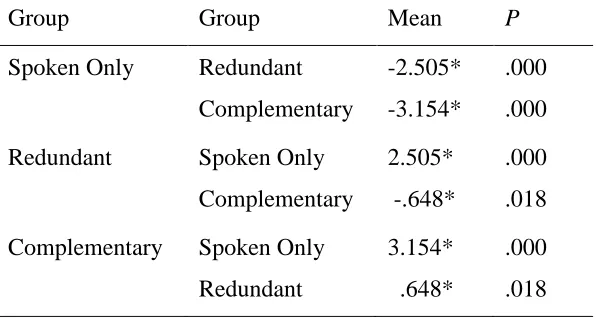
Table 4.1 Mean Differences in Test Scores Among Groups ...45
Table 4.2 Descriptive Statistics for Group and Experience ...46
Table 4.3 Mean Differences in Mental Load Scores Among Groups ...47
Table 4.4 Mean Differences in Efficiency Scores Among Groups ...48
Table 4.5 Mean Differences in Helpfulness of Materials Scores Among Groups...49
Table 4.6 Post Hoc Comparisons of Helpfulness of Materials Scores ...49
1
CHAPTER ONE
NATURE AND SIGNIFICANCE OF THE PROBLEM
The Growth of Multimedia Instruction
Multimedia presentations, or presentations that use both words and pictures,
abound in today’s instructional environments (Clark & Mayer, 2001; Mayer, 2009,
2005). Live and recorded multimedia presentations have become standard in many
realms of K-12 and higher education, government, and industry as a means to effectively
and efficiently convey information and promote retention and learning (Issa, Schuller,
Santacaterina, Shapiro, Wang, Mayer, & DaRosa, 2011; Strauss, Corrigan, & Hofacker,
2011; Yue, Bjork, & Bjork, 2013). For example, Paoletti, Bortolotti, and Zanon (2012)
found that university teachers used multimedia slides to help students better understand
what is being said and to provide a concise structure for the lecture. Also, Bergen,
Grimes, and Potter (2005) reported that television producers have adopted multimedia
messaging (e.g., reporters, graphics, and scrolling text) for entertainment, news, sports,
and business programming as an effective way to attract and inform television watchers.
Additionally the United States Patent and Trademark Office (2013) indicated that their
use of multimedia learning has grown tremendously over the past decade due to the
overall effectiveness and efficiency of multimedia in dealing with security, budget, and
travel constraints.
Despite this abundance of multimedia and the various reasons for its growth, an
2
under what conditions are multimedia presentations effective at promoting learning?
Multimedia strategies provide instructors with the ability to share a great deal of
information simultaneously, but are these redundant ways of presenting information
helpful? Or do they provide a level of cognitive overload that hampers the learner’s
ability to retain and transfer information? More specifically does verbal redundancy, or
when spoken words and written text are presented at the same time, enhance or impede
learning? The research in this area is broad and mixed, and more is still needed (Adesope
& Nesbit, 2011; Mayer, 2005, Mayer & Johnson, 2008; Sweller, 2005b). This study
seeks to contribute to research and help answer and clarify the questions about learning
by looking at multimedia redundancy, specifically verbal redundancy and its effects on
memory retention and transfer in legal professionals.
Multimedia Instruction in Legal Education
Multimedia instruction in legal education and legal practice has also seen recent
growth. Legal education researchers have examined the instructional delivery methods
for law schools and law school professors, finding an increase in the use of multimedia
technology in law school classrooms including online classrooms (Nievelstein, van Gog,
Dijck, & Boshuizen, 2011; Sullivan, Colby, Wegner, Bon, & Shulman, 2007).
Professional legal education for practicing attorneys has also incorporated multimedia
instruction into practice (Faulconbridge & Muzio, 2009; Matasar, 2010). For example,
the United States Department of Justice’s National Advocacy Center, the national
training center for federal legal personnel, has incorporated principles of multimedia into
its faculty development training; however, its effects on learning have not been
3
Additionally, there is recent research on the benefits of including multimedia instruction
when attorneys and judges are dealing with jurors (Hewson & Goodman-Delahunty,
2008; Otto, Applegate, & Davis, 2007; Reisburg, 2007).
This growth in multimedia instruction may not have come without a cost. As
Stuckey (2007) noted, although many multimedia methods are available, “virtually no
legal educators have educational training or experience when they are hired, and few law
schools provide more than cursory assistance to help new faculty develop their teaching
skills (p.106).” Similar to what Stuckey has suggested with legal schools, Devlin and
Downie (2012) recommend that “as the legal profession begins to design and deliver
these [programs] it should take into consideration the insights of the educational literature
on lifelong learning (p. 9).” Unfortunately, these insights gleaned from educational
literature may or may not be generalizable to legal professionals, such as attorneys; the
research for this particular group is scant. Many researchers call for additional research
for specific types of learners (Adesope & Nesbit, 2011; Mayer, Heiser, & Lonn, 2001;
Mayer & Johnson, 2008; Yue, Bjork, & Bjork, 2013).
Verbal Redundancy in Multimedia Instruction
A typical multimedia presentation may include in any combination lecture or
spoken text as well as accompanying overhead slides (e.g., PowerPoint slides), videos,
and handouts that contain written text, images, charts, and or graphs (Clark & Mayer,
2011; Schnotz, 2005). Often instructors think that by providing multiple representations
of the same material (e.g., spoken words, written words, pictures) the learner is kept
interested and can choose his or her preference for learning, resulting in better learning
4
prefer redundant information, often by the inclusion of lecture, slides, and handouts,
stating that instructors who provide this type of multimedia are more interesting and
easier to follow (Fenesi, Heisz, Savage, Shore, & Kim, 2013; Paoletti, Bortolotti, &
Zanon, 2012). Again, the question arises whether multimedia presentations are effective
learning methods, and if so, what types of multimedia presentations are most effective
(i.e., best promote learning)?
Verbal redundancy in multimedia occurs when learners are simultaneously
presented with text and speech, most commonly through concurrent lecture (live or
recorded) and accompanying overhead slides (Adesope & Nesbit, 2011; Cooper, 2009;
Savoy, Proctor, & Salvendy, 2009). Three primary forms of verbally redundant
multimedia presentations have been commonly observed and researched: (1) a verbal
lecture with text-laden, on-screen slides that are read verbatim; (2) a verbal lecture with
text-laden, on-screen slides that are summarized or paraphrased; and (3) a verbal lecture
with shorter, on-screen slides containing key points, takeaways, and/or short summaries
of information (Adesope & Nesbit, 2011; Ardac & Unal, 2008; Mayer & Johnson, 2008;
Moreno & Mayer, 2000). Teachers and students tend to agree that redundant information
that is a concise, organized summary of key points (referred to as complementary verbal
redundancy) is preferred. This has also been confirmed by multiple research studies
(Adesope & Nesbit, 2011, Mayer & Johnson, 2008; Paoletti, Bortolotti, & Zanon, 2012).
However, others have found that although students prefer redundant information, they
actually learn less as indicated by retention and transfer tests (Amare, 2006; Savoy,
5
other findings tend to focus on the working memory, cognitive load, and multimedia
learning theories and models.
Verbal Redundancy and Four Theoretical Models of Cognition
Learning from multiple modes of information delivery, such as is the case with
verbal redundancy, is based on the ability to process disparate sources of information and
this ability is constrained or limited (Gyselinch, Jamet, & Dubois, 2008; Mayer, 2005;
Sweller, 2010). Verbal redundancy and how it relates to learning and learning constraints
is based on four theoretical models: (1) Baddeley’s (2000) working memory model, or
the idea that working memory is controlled by four components that work together to
temporarily store and process information; (2) Sweller’s (2005a; 2010) cognitive load
theory, the theory that working memory is limited in the amount of information that can
be processed at one time; (3) Mayer’s (2005) cognitive theory of multimedia learning, the
theory that information is processed in limited-in-capacity visual and verbal channels;
and (4) Schnotz’ (2005) integrative model of text and picture comprehension, or the idea
that learners build mental models and representations by combining or integrating visual
and verbal channels.
All four models posit that regardless of the type of information and how it is
conveyed through multimedia instruction, the learner must still process and integrate
separate pieces of information into a coherent, understandable whole (Mayer 2009;
Schnotz, 2005; Sweller, 2010). This processing requires cognitive resources and is
limited in the amount that can be processed in working memory components (verbal and
visual) at any one time. Therefore, presenting redundant sources of information becomes
6
more sources of information. With verbal redundancy, which primarily involves written
and spoken text, the learner must choose and coordinate between reading and listening
and this takes away from the cognitive resources available for learning. This effect has
been demonstrated in research with mixed results (Adesope & Nesbit, 2011; Jamet & Le
Bohec, 2007; Leahy, Chandler, & Sweller, 2003; Mayer, Heiser, & Lonn, 2001).
Overview of Research Methodologies
Measuring multimedia learning and creating multimedia instruction involves
assessing the cognitive load of learners (Clark, Nguyen, & Sweller, 2006; DeLeeuw &
Mayer, 2008; Paas, Tuovinen, Tabbers, & Van Gerven, 2003). Brunken, Plass, and
Leutner (2003, p. 55) define cognitive load as “a theoretical construct, describing the
internal processes of information processing that cannot be observed directly.” They
posit that there is no ideal single measure, but rather four specific measures of cognitive
load according to objectivity (subjective or objective) and causal relationship (indirect or
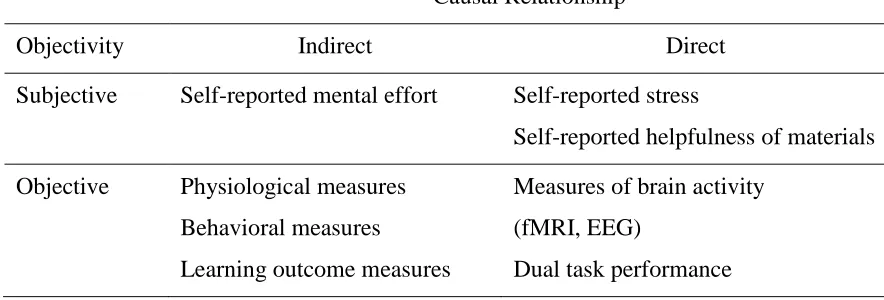
direct). Table 1.1 includes specific measures of each.
Table 1.1
Measures of Cognitive Load
Causal Relationship
Objectivity Indirect Direct
Subjective Self-reported mental effort Self-reported stress
Self-reported helpfulness of materials
Objective Physiological measures
Behavioral measures
Learning outcome measures
Measures of brain activity
(fMRI, EEG)
7
Objective Measures
According to Mayer (2005), two major goals for multimedia learning are
remembering and understanding. Remembering is commonly measured through
retention testing, and understanding is commonly measured through transfer testing
(Mayer & Johnson, 2008). Retention and transfer testing are learning outcome measures,
or indirect, objective measures of cognitive load. These types of measures have been
used in numerous, published studies as valid and reliable measures of cognitive load
(Leahy, Chandler, & Sweller, 2003; Mayer & Johnson, 2008; Moreno & Mayer, 2000).
However, Brunken, Plass, & Leutner (2003) suggest that differences in learning outcome
measures could also be associated with the measurements themselves or the traits and
prior knowledge of the learners. Prior knowledge in particular has been shown to affect
intrinsic cognitive load (Adesope & Nesbit, 2011; Clark, 2008; Gyselinck, Jamet, &
Dubois, 2008; Leahy, Chandler, & Sweller, 2003; Sweller, 2005).
Although more difficult to measure, researchers can also use neuroimaging
measures of brain activity (fMRIs or EEGs) or dual task performance to reach beyond
measures of learning to a more direct, objective measure of cognitive load. Dual task
performance involves simultaneously performing two tasks that involve the same visual
or verbal components of working memory (Brunken, Plass, & Leutner, 2003). This
approach has been commonly used to assess working memory and, more recently, in
cognitive load research (Kalyuga, Chandler, & Sweller, 2004; Schuler, Scheiter, &
Genuchten, 2011). However, dual task performance is not the ideal measure to assess
learning outcomes, because the learning outcomes are purposely manipulated by the dual
8
Subjective Measures
Common, subjective measures of cognitive load include self-evaluations of how
much mental effort was involved in the activity (an indirect, subjective measure), how
much stress was involved in the activity (a direct, subjective measure), and the perceived
helpfulness of the materials in contributing to understanding and learning (a direct,
subjective measure) (Brunken, Plass, & Leutner, 2003; Paas, Tuovinen, Tabbers, & Van
Gerven, 2003). Although these measures are easy to create and implement, it has not
been made clear how subjective measures relate to actual cognitive load and whether
learners are valid evaluators of themselves (Brunken, Plass, & Leutner, 2003; Fenesi,
Heisz, Savage, Shore, & Kim; Savoy, Proctor, & Salvendy, 2009). Paas, Tuovinen,
Tabbers, and Van Gerven (2003) and Paas and Van Merrienboer (1994), however, posit
that valid and reliable measures of cognitive load have been obtained through a
unidimensional, subjective scale assessing perceived amount of mental effort.
Combining Objective and Subjective Measures
Because of their questioned validity, subjective measures have been used in
multiple studies as an additional measure of cognitive load, in complement and
comparison to objective measures, in order to determine mental efficiency (Cooper,
2009; Diao & Sweller, 2007; Paoletti, Bortolotti, & Zanon, 2012; Yue, Bjork, & Bjork,
2013). According to Paas, Tuovinen, Tabbers, and Van Gerven (2003, p. 63), “the
combination of performance and cognitive load measures has been identified to constitute
a reliable estimate of the mental efficiency of instructional methods.” In this article, the
9
subjective mental effort and performance to determine a relative condition efficiency
measure, a measure that has been used successfully in multiple empirical studies.
Research Designs
To measure cognitive load, researchers commonly conduct experimental
comparisons based on random assignment and control, where one group receives the
instructional method and the other does not (Adesope, & Nesbit, 2011; Mayer, 2005).
Results are typically analyzed for statistical significance through comparisons of mean
retention and transfer scores of the experimental group and the comparison group (p <
.05, or the probability that the difference between the two groups is due to chance is less
than 5%). Researchers measure learning outcome measures (mean retention and transfer
scores) by asking questions such as “Describe how lightning strikes” (for retention) and
“What can you do to prevent lightning strikes?” (for transfer). Results can be measured
immediately after the learning event or after a certain amount of time (e.g., 1 month after
the event). Efficiency in cognitive load is often measured through the following measure
of efficiency (E): E = (P – ML)/√2, where P is the measure of performance and ML is
the measure of mental load (Clark, Nguyen, & Sweller, 2006; Paas, Tuovinen, Tabbers,
& Van Gerven, 2003; Paas and van Merrienboer’s, 1993).
The Present Study
More research is needed to help validate theories of working memory, cognitive
load, and cognitive theories of multimedia learning (Adesope & Nesbit, 2011; Schuler,
Scheiter, & van Genuchten, 2011). The goal of this study is to contribute to and expand
current empirical research in these areas and address the four problems aforementioned:
10
for comparing multimedia instructional design models and their effects on cognitive load
and learning; (3) that there is a need for more valid research designs with a well-defined
control group; and (4) that there is little research specifically focused on verbal
redundancy and learning.
Observations of Verbal Redundancy in Legal Education
The interest in this work was sparked by working as an instructional specialist at a
national legal training center for attorneys and legal professionals (e.g., paralegals, legal
assistants, administrative support staff). After years of observing presentations/lectures
primarily by attorneys, particularly lectures regarding rules, laws, and statutes, it was
observed that instructional methods consisted predominantly of lecture accompanied by
text-dense slides, which were both displayed on an overhead projector and included in the
materials. During these presentations, the instructor would discuss the rule or statute
while the rule or statute was displayed, would discuss case cites that supported the rule or
statutes while a description of the case was displayed, and would discuss
recommendations for practice while the recommendations for practice were displayed.
This practice seemed to contrast with many of the recommendations and findings
in regard to theories about human cognition and learning, particularly in the area of
cognitive load and cognitive theories of learning (Mayer, 2005; Mayer & Johnson, 2008;
Mayer & Moreno, 2003). Evaluation comments also indicated that many students did not
particularly like this method of lecture and text and would write statements such as “The
slides are too dense,” “This is information overload,” or “Why do we need the instructor
if all his material is included on the slide?” These observations were a catalyst for
11
through verbal redundancy. Also, even if by description this instructional method
(lecture and verbose on-screen text) may be considered verbal redundancy, was it
impeding learning for the attorney, someone who is both educated and skilled in reading
comprehension, verbal persuasion, and writing prowess (Stuckey, 2007; Sullivan, Colby,
Wegner, Bon, & Shulman, 2007)?
Research Questions
Four questions regarding cognitive load and learning drove this research: (1)
What level of verbal redundancy (spoken words only, overloaded verbal redundancy, or
complementary verbal redundancy) leads to more effective retention and transfer of
learning in adult legal professionals?; (2) What level of verbal redundancy leads to more
efficient learning (a combination of performance and mental load) in adult legal
professionals?; (3) What level of verbal redundancy do adult legal professionals find
most helpful for understanding and learning?; and (4) Does prior legal knowledge and
experience affect cognitive load?
Implications of the Current Study
The implications of this work are mutually beneficial to human cognition and
instructional design. Through research on cognitive load and multimedia learning,
researchers are finding out more about the human cognitive processes involved in
learning (Adesope & Nesbit, 2011; Mayer & Johnson, 2008). Researchers are then
taking what is learned about human cognition and development and developing
recommendations/prescriptions for instruction and managing load that, in turn, support,
leverage, and make efficient use of those same cognitive processes. This work has
12
practices, and materials development. As Sweller (2005a) suggests, “Good instructional
design is driven by our knowledge of human cognitive structures and the manner in
which those structures are [organized] into a cognitive architecture (p. 19).”
Additionally, by understanding more closely the outcomes of learning such as
retention and transfer, as well as the variables contributing to both, researchers can test
traditional theories and hypotheses about the notion of cognition that may perhaps change
the way we think about learning and cognitive development. For example, Moreno and
Mayer (2000) found through several studies that concurrent music and written text did
not affect dual-task performance, leading them to question whether and how much the
phonological loop (the verbal component of working memory) is involved in the
processing of written text. According to Adesope and Nesbit (2011), “researchers,
teachers, and instructional designers lack a comprehensive account of the different
conditions under which spoken-written materials facilitate or inhibit learning and have
little empirical guidance toward a theory of how learning processes are affected by verbal
redundancy (p. 251).”
Examining how legal professionals process verbal redundancy can help create
valid recommendations for how instructors develop and deliver instruction to these same
legal professionals, while also validating and/or questioning current theories of cognition.
For example, the cognitive theory of multimedia learning currently recommends the
following two prescriptions (there are a total of twelve) for learning, based upon research
findings: (1) people learn better when extraneous information is omitted (according to the
coherence principle); and (2) people learn better when redundant information, or
13
principle). If this prescription holds for legal professionals, then delivering instruction
could consist of non-redundant, intrinsic-only information, an instructional design
method that is not as common as the redundant lectures described earlier. However, if
this prescription does not hold for legal professionals, perhaps there are different or
additional considerations for cognition that need to be considered.
Lastly, this work can be particularly helpful to learning and training in the
workplace, where resources are always at a premium and organizations are requiring
training to show a return on learning investment. In addition, people are being asked to
do more complex tasks, and information overload abounds. Improved learning processes
can help people do their jobs more effectively and efficiently, and organizations can look
to scientific findings to apply to their situations and justify training in the workplace.
Limitations of the Current Study
As with all research, there is a limit on what can be collected, compared, and
analyzed. This study seeks to compare only verbal redundancy and will not specifically
examine or address visual redundancy (e.g., graphics) or visual processes that may be and
are likely involved. Also, this study compares only three selected instructional design
models – lecture with no on-screen text, lecture with complementary text, and lecture
with redundant overloaded text. There are certainly many more instructional methods
that can test verbal redundancy. This study also only uses three of the four types of
measures of cognitive load – an indirect, objective measure of retention and transfer; an
indirect, subjective measure of perceived mental effort; and a direct, subjective measure
of perceived helpfulness of materials. Direct, objectives measures of cognitive load, such
14
this study looks at only legal professionals; therefore the results may not be generalized
to a different population.
Document Organization and Definitions
This document is organized into five chapters. Chapter one has described the
nature and significance of the problem. Chapter two reviews the literature on verbal
redundancy and the four theories of cognition mentioned earlier, as well as provides a
justification for the current study. Chapter three outlines the methods used in the study.
Chapters four and five present the findings and discuss the results and implications for
multimedia instruction based on four theories of cognition. For purposes of this study,
the following definitions apply:
(1) Multimedia Instruction – Instruction that includes, in any combination, lecture or
spoken text, as well as accompanying overhead slides (e.g., PowerPoint slides),
videos, and handouts that contain written text, images, charts, and or graphs
(Clark & Mayer, 2011; Schnotz, 2005).
(2) Redundancy (in multimedia instruction) – The concurrent presentation of
identical information either through the auditory channel (verbal redundancy, see
below) or the pictorial channel (visual redundancy) (Mayer & Johnson, 2008;
Sweller, 2005b)
(3) Complementary Redundancy (in multimedia instruction ) – The concurrent
presentation of summary or similar, but not identical, information through either
the auditory or pictorial channels (Fenesi, Heisz, Savage, Shore, & Kim, 2013;
15
(4) Verbal Redundancy (in multimedia instruction) – The condition when learners are
simultaneously presented with text and speech, most commonly through
concurrent lecture (live or recorded) and accompanying overhead slides (Adesope
& Nesbit, 2011; Cooper, 2009; Savoy, Proctor, & Salvendy, 2009).
(5) Legal Professionals –Employees (attorneys, paralegals, legal assistants, and
administrative support staff) who work in offices, divisions, and/or agencies
16
CHAPTER TWO
REVIEW OF RELEVANT LITERATURE
Verbal Redundancy and Four Theoretical Models of Cognition
As mentioned in chapter one, verbal redundancy and how it relates to learning and
learning constraints is based on four theoretical models: (1) Baddeley’s working memory
model, (2) cognitive load theory, (3) the cognitive theory of multimedia learning, and (4)
the integrative model of text and picture comprehension (Baddeley, 2000; Gyselinck,
Jamet, & Dubois, 2008; Mayer, 2005; Schnotz, 2005). This chapter describes each of
those theories and how they relate to verbal redundancy, then looks at recent literature
and the learning outcomes associated with verbal redundancy to justify and explain the
framework for the current study.
Baddeley’s Working Memory Model
The working memory framework conceptualized by Baddeley (2000) consists of
four components that work together to temporarily store and process information,
contributing to learning and long-term memory recall. The four components of working
memory are: (1) the phonological loop, for processing spoken words and sounds; (2) the
visuospatial sketchpad, for processing printed words and pictures; (3) the episodic buffer,
for temporarily storing information from the phonological loop and the visuospatial
sketchpad, and; (4) the central executive, which controls and directs all the other
17
and the visuospatial sketchpad, then combined by the central executive (with temporary
help from the episodic buffer) to send the new information to long-term memory.
With respect to multimedia learning and verbal redundancy, the working memory
model and its components are limited in capacity; therefore an overload of information
can compromise any or all of the four components. For example, when adult learners
read, they mentally rehearse the written text they see, transferring information from the
visuospatial sketchpad to the phonological loop. If learners are presented with additional
auditory information, such as narration (e.g., a lecture or narrated video), the
phonological loop may become overloaded, thereby reducing the amount of information
received and processed (Baddeley, 2000; Gyselinck, Jamet, & Dubois, 2008; Schuler,
Scheiter, & van Genuchten, 2011).
Cognitive Load Theory
Sweller’s Cognitive Load Theory (2005a, 2010) builds on Baddeley’s Working
Memory Model and the idea that working memory is limited in the amount of
information that can be processed at one time. As a result, the learner can become
cognitively overloaded based on the following three types of load: (1) intrinsic load, or
the mental effort imposed by the content or subject matter itself and the learner’s prior
knowledge and interactivity among elements of the content; (2) extraneous
(non-essential) load, or the mental effort imposed by the instruction that does not support the
content or the learning outcomes; and (3) germane (essential) load, or the mental effort
imposed by the structure of the instruction that supports essential learning and learning
18
Sweller, 2006; Sweller, 2005b), which can be brought about by reducing the extraneous
load, managing the intrinsic load, and increasing the germane load.
According to Sweller (2005a), verbal redundancy “deals with multiple sources of
information in which one source is sufficient to allow understanding and learning while
the other sources merely reiterate the information of the first source in a different form”
(p. 27). Instructors can reduce extraneous load by eliminating the redundancy. For
verbal redundancy, this would involve paring down to only one mode of instruction, for
example, lecture or narration without accompanying written text, such as on-screen
slides. Sweller (2005a) does state, however, that cognitive load is additive, so there may
be instances where redundancy does not hamper learning. For example, intrinsic
cognitive load is influenced by the prior knowledge of the learner. For those with high
prior knowledge, intrinsic load may be reduced, offsetting the overall effects of the
redundancy/extraneous load.
Cognitive Theory of Multimedia Learning
The Cognitive Theory of Multimedia Learning supports both Baddeley’s working
memory model and Sweller’s theory of cognitive load and expands upon that with the
following three assumptions about human cognition: (1) information is dually processed
in separate verbal and visual channels; (2) each channel is limited in the amount of
information that can be processed at one time; and (3) the mind must actively and
selectively, process, encode, store, and retrieve information. The goal of the Cognitive
Theory of Multimedia Learning is to determine through research how humans cognitively
process information and how instructors can leverage those different ways to produce the
19
Regarding the processing of spoken and written text (Mayer, 2005), spoken words
are initially received by the ears and then processed in the verbal component of working
memory. Printed words are initially received by the eyes, but then are also processed in
the verbal component of working memory. Therefore, with redundant text, there may be
overload in the verbal component of working memory due to the two inputs of
information. The visual channel could also be overloaded if text and graphics are shown
at the same time. Two of Mayer’s recommendations for multimedia instruction address
verbal redundancy. The first is the redundancy principle, which states that “People learn
more deeply from graphics and narration than from graphics, narration, and on-screen
text…except when the on-screen text is short, highlights the key action described in the
narration, and is placed next to the portion of the graphic it describes” (Mayer & Johnson,
2008). The second is the coherence principle, which indicates that “people learn more
deeply from a multimedia message when extraneous material is excluded rather than
included” (Mayer, 2005, p. 183). Despite these prescriptions, other factors such as prior
knowledge, pacing of the presentation, and the level of redundancy, may reduce the
tendency for overload to occur.
Integrative Model of Text and Picture Comprehension (Schnotz, 2005)
Schnotz’s (2005) integrated model of picture and text comprehension builds upon the
previous three concepts and theories and makes the following four assumptions: (1)
comprehending text and pictures takes place in a limited-in-capacity working memory, a
sensory/input register, and in a long-term memory; (2) written and spoken text is
processed in the verbal channel of working memory, and visual pictures and sounds are
20
channels of working memory are limited; and (4) to comprehend or learn, individuals
must build mental models and representations by combining all available working
memory with long-term memory. The model specifically addresses reading
comprehension, listening comprehension, visual picture comprehension, and sound
comprehension, as well as the combination of these different processes to bring about
meaningful learning.
Verbally redundant information, according to Schnotz (2005), would include any
combination of written and spoken text. Both would be processed in the verbal
component of working memory and could contribute to increased cognitive load due to
the learner attempting to synchronize what is being said with what is being heard. Since
we do not read and listen at the same rate, this introduces an extra cognitive load on the
learner’s working memory, and in effect, learning.
As mentioned, verbal redundancy primarily involves written and spoken text, and
the learner must choose and coordinate between reading text and listening to spoken
narration. According to the four theories and models of cognition, this coordinated effort
should limit the cognitive resources available for learning; however, this effect has been
demonstrated in research with mixed results (Adesope & Nesbit, 2011; Ardac & Unal,
2008; Jamet & Le Bohec, 2007; Leahy, Chandler, & Sweller, 2003; Mayer, Heiser, &
Lonn, 2001). The next section will discuss these findings.
Current Research on Verbal Redundancy and Cognitive Load
The following recent studies are relevant to and provide a foundation for the
21
justification for this study and how this study seeks to contribute to and move beyond the
current body of research.
Partially Redundant On-Screen Text
Previous experiments on verbal redundancy focused mainly on narration and
on-screen or written text. Findings were mixed with some outcomes supporting
non-redundant information (Jamet & Le Bohec, 2007; Kalyuga, Chandler, & Sweller, 2004;
Mayer, 2005; Sweller 2005b) and others supporting verbally redundant information
(Mayer, Heiser, & Lonn, 2001; Moreno & Mayer, 2002). Two experiments by Mayer
and Johnson (2008) expanded the definition of redundant information to include short,
key phrases instead of identical text (complementary text) and led to Mayer’s revision of
the redundancy principle and the cognitive theory of multimedia learning. In these two
experiments, college students watched short, multimedia presentations on how lightning
and brakes work, and each presentation contained narration, diagrams, and either partially
redundant or non-redundant on-screen text. Results indicated that the group who
watched the presentation with partially redundant text (i.e., short, key phrases placed next
to the on-screen diagram) performed better than the non-redundant group on retention of
information (d = 0.45 for experiment one, d = 0.70 for experiment two). There was no
significant effect for transfer outcomes. Prior knowledge was not assessed, as those with
prior knowledge of the subject matter were eliminated from the study.
Mayer and Johnson concluded that short, redundant text that highlights key
learning points (complementary text) supports learning because it encourages essential
and generative processing (i.e., selecting and processing relevant words and images)
22
related to the current study were that students were all college students who were tested
in laboratory-type conditions, the instructional presentation was very short (less than ten
minutes), and the retention and transfer tests assessed only factual and conceptual
knowledge (Anderson & Krathwohl, 2001). In addition, it is not clear from the study the
extent to which the verbal redundancy contributed to the overall improved outcomes or
whether and to what extent the graphics that were included in the instructional message
also contributed to improved outcomes.
Issa et al. (2011) looked specifically at medical students and the effects of
multimedia instruction by comparing pre-test and post-test retention and transfer scores
from two lectures – a “traditional” lecture containing verbally redundant and overloaded
information, and an “improved” lecture with reduced on-screen text (partially redundant)
and increased use of graphics based on the cognitive theory of multimedia learning.
Researchers found through repeated-measures ANOVA analysis that the improved
lecture group significantly improved retention and transfer scores compared to the
traditional lecture group (F = 10.2, p = 0.016 and F = 7.13, p = 0.0081, respectively).
Similarities of this study to the current study are that: (1) the participants for this
study (medical students) were slightly closer in age to young, legal professionals than
undergraduate college students; (2) the instructional lectures were longer in duration than
other similar studies (fifty minutes versus less than ten minutes); and (3) the lectures were
conducted in a real classroom environment as opposed to a laboratory environment.
However, as with the experiments by Mayer and Johnson, only factual and conceptual
23
and verbal modifications, it is not known to what extent the reduction of verbal
redundancy contributed to the improved retention and transfer outcomes.
Varying Levels of Verbal Redundancy
To expand verbal redundancy beyond identical narration and text, other
researchers have looked at three or more varying levels of verbal redundancy. Paoletti,
Bortolotti, and Zanon (2012) examined the use of three types of slide presentations in
university lectures, looking specifically at varying levels of verbal redundancy.
University students (N =163) watched one of three redundant presentations: (1) an oral
lecture with fully redundant text slides, (2) an oral lecture with partially redundant text
slides containing key words, and (3) an oral lecture with paraphrased slides. Results of
an assessment of recall and transfer (factual, conceptual, and procedural knowledge)
showed that text slides containing key words best promoted learning, followed by the
fully redundant presentation. The paraphrased presentation resulted in the smallest
amount of recall and transfer. Results for the paraphrased group were significantly lower
than the other two groups for both recall (p < 0.00001) and transfer (p < 0.00001). This
corresponds with Mayer and Johnson (2008) that a certain type of verbal redundancy is
best for learning – lecture combined with written key text and summaries. Interestingly,
although there were differences in learning outcomes, there were no significant
differences between learners’ perceptions of the comprehensibility of the conditions; all
three were judged to be comprehensible. The researchers reasoned that verbal
redundancy, although beneficial when partially redundant, reaches a threshold level
24
cognitive load, or his or her ability to integrate written and spoken text, as well as
extraneous material.
Although a good comparison of verbal redundancy, the researchers did not look at
non-redundancy, or verbal lecture only. Participants were also Italian university students
who were required to participate for a course assignment. Students in each group listened
to a live in-class lecture, and it is unclear if the presentations were exactly the same or if
the instructor controlled or constrained questions. Perhaps the addition of questions,
pacing, or learners’ prior knowledge (which was not addressed) affected outcomes.
Yue, Bjork, and Bjork (2013) also looked specifically at the amount of verbal
redundancy in multimedia learning, or “the extent to which varying degrees of
correspondence between on-screen text and narration in a multimedia lesson affect recall
and transfer” (p. 266). In two experiments, researchers showed undergraduate
psychology college students a multimedia presentation about the life cycle of a star with
varying levels of narration and on-screen text. In both experiments, groups who were
shown presentations with a small amount of discrepancy between narration and on-screen
text performed better on measures of learning and retention than groups who watched
either identical on-screen text and narration or presentation with abundant and discrepant
on-screen text (pre-tests were given to assess prior knowledge). The researchers posited
that a minimal amount of verbal redundancy (e.g., including key words and short
sentences on on-screen text) was a “desirable difficulty,” as it provided a signal to the
learner for what was important but did not overload the cognitive resources needed to
25
Cooper, 2009; Savoy, Proctor, & Salvedy, 2009), even though they learned better with
abridged on-screen text, students preferred identical narration and on-screen text.
Limitations of this study, as identified by the researchers, included non-significant
findings for transfer of information in both experiments (p = .06, p = .08), the elimination
of learners with high prior knowledge, and the short length of the instructional segments
(less than ten minutes in duration). Also, results were not compared with an audio-only
group, and only factual and conceptual knowledge was assessed.
A third study of varying levels of verbal redundancy by Savoy, Proctor, and
Salvendy (2009) examined the use of PowerPoint slides and retention of information.
Sixty-one university students listened to either a traditional lecture with no accompanying
text or a lecture accompanied with on-screen text through the use of PowerPoint slides.
Students in the traditional lecture with no PowerPoint group scored fifteen percent higher
on a text of retention and transfer than students in the lecture with PowerPoint group;
however, the differences in scores were not significant. As mentioned with earlier
studies, even though students in the non-PowerPoint lecture scored higher, they preferred
having the lecture with the PowerPoint slides. A significant limitation of this study was
that the traditional lecture was referred to as “chalk and talk,” so the professor may have
included written text on the chalkboard. Additionally, there was no indication of the
amount of text included on the PowerPoint slides and whether principles of multimedia
instruction were followed when creating PowerPoint slides. There was also no pre-test
assessment conducted to determine prior knowledge, and participants were only assessed
26
Lastly, Fenesi, Heisz, Savage, Shore, and Kim (2013) compared outcomes for
audio only presentations, verbally identical or redundant presentations, and
complementary presentations, or presentations that included narration and short, key
words, phrases, and sentences. They found that the complementary or non-redundant
group performed significantly better on a test of understanding than the audio only group
(t(64) = 2.44, p < .05, d = 0.61) and the redundant group (t(64) = 2.96, p < .01, d = 0.81).
Both the redundant group and the complementary group perceived that they understood
more of the instruction than they actually did, supporting the idea that although students
may prefer redundant information, it does not translate into an increased understanding of
the information. Results were in alignment with Mayer and Johnson’s (2008) revised
redundancy principle of the cognitive theory of multimedia learning, or that adding short,
key word redundancy to presentations does not hamper learning. Three limitations for
this study were that: (1) the participants were undergraduate psychology students (who
may or may not be similar in characteristic to legal professionals); (2) there was no
pre-test assessment conducted to determine prior knowledge; and (3) only factual and
conceptual knowledge (no procedural knowledge) was assessed.
A Meta-Analysis of Verbal Redundancy in Multimedia Learning
Perhaps the largest collection of research on verbal redundancy in multimedia
learning environments is Adesope and Nesbit’s (2011) meta-analysis of fifty-seven
independent experimental studies focusing on spoken-written presentations, spoken-only
presentations (presentations with no written or on-screen text), and written-only
presentations. These two researchers found a significant advantage for learners when
27
was no significant advantage for spoken-written presentations over written-only
presentations). However, the effect size for spoken-written presentations was not large
(E = 0.29, p < .05), and the mixed results were found to be related to variables such as
learners’ prior knowledge, the pacing of the instruction, and the inclusion/exclusion of
graphics. Spoken and written presentations were most effective for learners with little
prior knowledge, presentations that were system-paced, and presentations that did not
contain graphics. Presentations that contained key terms and summaries accounted for
most of the advantage of spoken-written presentations, and Adesope and Nesbit
concluded that these types of presentations provide signaling for the learner. Signaling is
prescribed in the cognitive theory of multimedia learning as a way to direct the learner to
important concepts and takeaways.
Limitations of these studies as related to the current study are that most of the
research participants were undergraduate college students (the remainders were
elementary and middle school students), and the domain areas examined were general
subject areas, such as computer literacy, meteorology, and reading. None of the studies
focused on adult professionals in the workplace, and none of the domain areas focused on
legal information. Also, the researchers’ conclusion that signaling helped learners did not
address extraneous information as suggested by cognitive load theory or the overload of
the verbal channel as described by the cognitive theory of multimedia learning and the
integrated model of text and picture comprehension. Examining adults and legal
professionals may help determine if variables such as prior knowledge, pacing, and
inclusion of graphics affect adult learners’ retention and transfer from multimedia
28
Additionally, legal professionals (particularly attorneys) are trained to “think like
lawyers,” or read and analyze complex facts and information for precise understanding
(Stuckey, 2007), and as a result may be better equipped to integrate and comprehend
verbally redundant pieces of information and ignore extraneous information. This
construct is called perceptual grouping, and several researchers have found that
higher-knowledge learners were able to do this with minimal cognitive effort (Ardac & Unal,
2008; Kalyuga, Chandler, & Sweller, 2004, 2000; Van Gog & Scheiter, 2010). However,
others have found that verbal redundancy coupled with difficult material (a high intrinsic
load) can still have detrimental effects despite learners’ capabilities for processing
information (Bergen, Grimes, & Potter, 2005; Gyselinck, Jamet, & Dubois, 2008;
Sweller, 2010).
Summary and Limitations of Current Research
Based on recent research findings, verbal redundancy in the form of key words
and short sentences (complementary verbal redundancy) seems to best promote retention
and transfer in learners. This effect holds true when compared to: (1) exact or identical
verbal redundancy; (2) abundant paraphrasing or overly detailed verbal redundancy; and
(3) non-redundancy or narration-only presentations (Adesope & Nesbit, 2011; Fenesi,
Heisz, Savage, Shore, & Kim, 2013; Issa, et al., 2011; Mayer & Johnson, 2008; Paoletti,
Bortolotti, & Zanon, 2012; Savoy, Proctor, & Salvendy, 2009; Yue, Bjork, & Bjork,
2013). When relating these results to the cognitive theories mentioned, complementary
verbal redundancy contributes to learning and prevents cognitive overload in the
following ways: (1) it allows the learner to connect and process two forms of verbal input
29
(2) it helps the learner form the needed schema for learning without cognitively
overloading the learner with extraneous information (cognitive load theory); (3) it signals
the learner without overloading the verbal channel (cognitive theory of multimedia
learning); and (4) it allows the learner to build mental models and representations without
overloading the verbal channel (integrated theory of multimedia learning). Verbatim
verbal redundancy and verbal overload do not allow the learner to efficiently and
effectively process information because the learner over-extends his or her cognitive
resources to connect and make sense of disparate information.
Limitations in the studies mentioned included the homogeneity of the participants
who were namely undergraduate students, the lack of participants with prior knowledge,
the short lesson lengths (most were less than ten minutes), the assessment of only factual
and/or conceptual knowledge (no procedural knowledge), and the inclusion of graphics in
the research, making it difficult to isolate the effects of verbal redundancy.
Justification for the Current Study
This study seeks to address the limitations mentioned in the previous section in
the following ways: (1) by focusing on legal professionals, who may have an advanced
level of education and skillset in understanding and processing complex information; (2)
by assessing prior knowledge and experience when looking at verbal redundancy and
retention and transfer outcomes; (3) by using an actual and longer-in-duration training
module that focuses on conceptual and procedural knowledge; and (4) by eliminating all
graphics (e.g., images, charts, graphs) from the presentation to isolate the effects of
30
CHAPTER THREE
METHODS
Research Questions, Hypotheses, and Variables
As mentioned earlier, three questions regarding cognitive load and learning drove
this research: (1) What level of verbal redundancy (spoken words only, overloaded
verbal redundancy, or complementary verbal redundancy) leads to more effective
retention and transfer of learning in adult legal professionals?; (2) What level of verbal
redundancy leads to more efficient learning (a combination of performance and mental
load) in adult legal professionals?; (3) What level of verbal redundancy do adult legal
professionals find most helpful for understanding and learning?; and (4) Does prior legal
knowledge and experience affect cognitive load?
The hypotheses to the first three research questions were that spoken words with
complementary text will (1) lead to more effective retention and transfer of learning, (2)
lead to more efficient learning, and (3) be perceived as most helpful for understanding
and learning. The spoken words only condition is predicted to be the next most effective,
efficient, and helpful level of verbal redundancy, followed by the spoken words with
redundant, overloaded text condition, which is predicted to result in the least amount of
retention and transfer of learning, the least efficient learning, and the least helpful method
for understanding and learning. According to the theoretical foundations and research
31
sentences (complementary verbal redundancy) best promotes retention and transfer in
learners when compared to overloaded verbal redundancy and spoken words only
(Adesope & Nesbit, 2011; Fenesi, Heisz, Savage, Shore, & Kim, 2013; Issa, et al., 2011;
Mayer & Johnson, 2008; Paoletti, Bortolotti, & Zanon, 2012; Savoy, Proctor, &
Salvendy, 2009; Yue, Bjork, & Bjork, 2013). Complementary verbal redundancy allows
the learner to connect and process two forms of verbal input without overload and form
the needed schema and mental models for learning (Baddeley, 2000; Sweller, 2005a;
Mayer, 2005; Schnotz, 2005).
The hypothesis to the fourth question is that prior legal knowledge and experience
will not affect the cognitive load of the learners in this research. In Chapter 2, many
studies posited that prior domain knowledge d been shown to affect intrinsic cognitive
load (Adesope & Nesbit, 2011; Clark, 2008; Gyselinck, Jamet, & Dubois, 2008; Leahy,
Chandler, & Sweller, 2003; Sweller, 2005). However, no studies measured or remarked
upon the effect of prior general knowledge and experience on cognitive load. Therefore,
it is predicted that those with general prior legal knowledge and experience will equally
be affected by verbal redundancy and its effects on learning and transfer.
This research involved three dependent variables: (1) performance, measured by
learning outcomes scores on a test of knowledge and application of the topic
“Fundamental Principles of Bankruptcy” (an indirect, objective measure); (2) perceived
mental effort (an indirect, subjective measure) measured by subjective scale; and (3)
helpfulness of the materials (a direct, subjective measure) also measured by subjective
32
instructional methods as described in the first research question above, and (2) years of
experience in the legal profession.
Participants and Procedures
Participants included a total of 394 legal professionals who enrolled in legal
courses at the training center between October 2014 and March 2015. Power analysis
using G*Power (Faul, Erdfelder, Buchner, & Lang, 2009) resulted in a minimum sample
size of 147. 273 of the 394 professionals participated in the final study, and 121
participated in a pilot study designed to assess the viability of the final study procedures
and validate and test the reliability of the assessment used in the final study. Pilot study
participants, procedures, and results are presented in a subsequent section titled “Test
Construction and Validation.”
To ensure a mix of criminal, civil, and appellate attorneys and legal support staff
with varying levels of practice and experience, legal professionals attending twenty-four
different training courses (a total of 1601 people) were invited to participate. To solicit
their participation, an individually addressed email was sent describing the study and
requesting assistance. Participation was voluntary, and individuals were informed that
they would not receive any payment or credit for their participation. Those invited were
also informed that the topic of the research would be fundamental principles of
bankruptcy and that only those with very little knowledge of bankruptcy were
desired/needed for the study. A sample of the initial email request is included in
Appendix A.
Participants were randomly assigned to one of three instructional conditions: (1) a
33
overloaded verbal redundancy condition, watching a video presentation with verbose
on-screen slides containing multiple, paraphrased sentences and complex terminology; and
(3) a complementary verbal redundancy condition, watching a video presentation with
on-screen slides containing key points and short summaries. Twelve individuals
requested to attend a specific day due to scheduling conflicts and were placed in the
instructional condition slated for their requested day. None of the participants knew in
advance which instructional condition they were assigned but were rather given a date,
time, and location to attend. All sessions started at 7:30 am, and instructional
conditions/day assignments were rotated over the course of the research to avoid
same-day testing bias. Late attendees were not allowed to participate and were not reassigned
to another condition or day.
Participants watched in groups a 16-minute recorded, multi-media instructional
session on the fundamental principles of bankruptcy. A recorded video was used to
control for content, multimedia design manipulations (conditions), and pacing of the
presentation. Immediately after the video, participants completed an electronic
comprehension (retention and transfer) test to evaluate factual, conceptual, and
procedural knowledge of the information, as well as a questionnaire to determine their
perceived satisfaction with the assigned video and information and their perceived
helpfulness of the materials (on-screen slides). An additional question assessed whether
the video or content had been previously viewed; none of the 291 study participants
indicated that they had previously seen the video and/or content.
The entire process took approximately thirty minutes. The researcher introduced
34
and take no notes during the video, after the video, and prior to the post-test and
questionnaire. Participants were also told that they could opt out of any part of the
procedures at any time; none did. Verbal instructions given to all participants and all
groups are included in Appendix B.
Instructional Methods
The three videos used in this research study were modified versions of an actual
video created by the training center during 2013. The original video was a sixteen minute
lecture by an expert attorney on fundamental principles of bankruptcy. The original
video included frames of the expert talking, interspersed with slides containing text and
graphics to help visualize and explain the major areas of bankruptcy. In order to isolate
the effects of verbal redundancy, these slides and graphics were removed before creating
the modified videos. The remaining “talking head” lecture became the video used for the
spoken word only condition.
For the other two experimental conditions the modified video was further
modified by adding on-screen text in the form of presentation slides. These slides were
interspersed throughout the video as related to the framing and topics of the conversation.
The video used for the complementary verbal redundancy condition was created by
adding section header slides, key-point, and short-summary takeaway slides that
complemented the conversation in the video. The video used for the overloaded verbal
redundancy condition was created by adding multiple, redundant sentences, complex
terminology and definitions, and additional information. Both conditions were similar to
conditions created in other studies (Fenesi, Heisz, Savage, Shore, & Kim, 2013; Issa, et
35
Bjork, 2013). All three modified videos were reviewed for accuracy and flow and
approved by the subject matter expert in the original video. Sample video frames and
slides incorporated into the videos used for the overloaded verbal redundancy condition
and the complementary verbal redundancy condition are included in Appendix C.
Instrumentation
The instrumentation for this study consisted of: (1) a questionnaire to collect
demographic information (e.g., criminal/civil practice, experience as an attorney/legal
professional); (2) a test to assess retention and transfer of the information presented in the
video; and (3) a questionnaire to assess perceived mental effort and helpfulness of
materials. Assessments for each experimental condition were created using SNAP
Surveys evaluation software. A sample electronic assessment (for the complementary
verbal redundancy condition) is included in Appendix D.
Test Construction and Validation
The test to measure understanding and application was developed in conjunction
with the subject matter expert in the video and was based on Bloom’s revised taxonomy
of educational objectives (Anderson & Krathwohl, 2001) and multiple-choice test
development methods (Gronlund & Waugh, 2009; Haladyna, 2004; Rivera, 2007; Shrock
& Coscarelli, 2007). Test construction procedures included the following steps: (1)
determining the instructional intent, (2) specifying the domain, (3) item development, (4)
item review, and (5) test development.
The first step in developing the bankruptcy examination involved articulating a
clear learning outcome, which in this case, was the acquisition of knowledge and
36
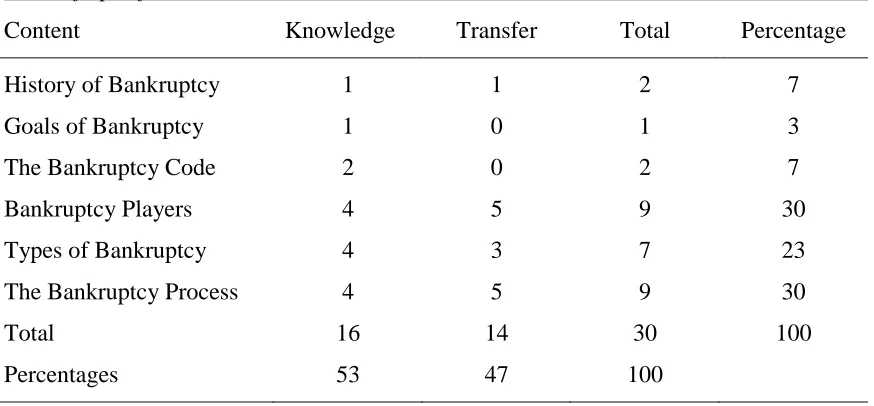
shown in Table 3.1, was then created to specify the appropriate sample of tasks to
represent the domain (evidence of content validity). The domain was based on materials
for the teaching portion of the video. Retention and transfer questions included
assessments of the fundamental principles of bankruptcy, as well as the ability to transfer
new information to hypothetical bankruptcy scenarios. Lastly, the test questions were
written by closely following the set of specifications and item writing guidelines
contained in earlier-referenced multiple-choice test development methods.
Table 3.1
Table of Specifications
Content Knowledge Transfer Total Percentage
History of Bankruptcy 1 1 2 7
Goals of Bankruptcy 1 0 1 3
The Bankruptcy Code 2 0 2 7
Bankruptcy Players 4 5 9 30
Types of Bankruptcy 4 3 7 23
The Bankruptcy Process 4 5 9 30
Total 16 14 30 100
Percentages 53 47 100
The initial set of questions was sent to two subject matter experts to ensure that
questions (1) were adequate and appropriate for the domain; (2) functioned as intended,
avoiding irrelevance, unsuitable difficulty, ambiguity, clues, or bias; and (3) were
arranged properly with clear directions. A sample set of initial questions and subject
matter experts’ comments and changes are included in Appendix E. All final changes
were approved by the principal subject matter expert who created the original bankruptcy
37
Two questions were used to assess perceived mental effort and helpfulness of
materials. The question used to assess perceived mental effort was the question
developed and used by Paas and van Merrienboer (1993) – “In answering the preceding
questions/problems, I invested…” Responses were recorded on a nine-point category
scale from (1) very, very low mental effort to (9) very, very high mental effort.
Cronbach’s alpha, or the reliability coefficient, was α = 0.90 for this question. The
question used to assess helpfulness of materials was patterned after the Pass and van
Merrienboer (1993) format, and was written as “Were the PowerPoint slides shown in the
video (or ‘Were the absence of PowerPoint slides in the video’) helpful or hindering in
understanding the lecture material?” Answers were recorded using a similar nine-point
category scale with responses ranging from (1) very, very hindering to (9) very, very
helpful. Only two questions were used to assess perceived mental effort and helpfulness
of materials (one question for each measure) because according to Paas, Tuovinen,
Tabbers, and van Gerven (2003, p. 66), “reliable measures can also be obtained with
unidimensional scales.”
Pilot Study Methods and Results
As mentioned, 121 legal professional participated in a pilot study designed to
assess the viability of the final study procedures and validate and test the reliability of the
assessment used in the final study. The importance of pilot studies has been
demonstrated by many researchers, and the procedures followed in this pilot were
adopted based on their common recommendations and findings (Baker, 1994; Lancaster,
Dodd, & Williamson, 2004; Simon, 2011; van Teijlingen & Hundley, 2011). Pilot study