Differential Analysis on Block Cipher PRIDE
Jingyuan Zhao1, Xiaoyun Wang1, Meiqin Wang1, and Xiaoyang Dong1
1
Key Laboratory of Cryptologic Technology and Information Security, Ministry of Education, Shandong University, Jinan 250100, China
Abstract. The lightweight block cipher PRIDE designed by Albrecht et al., appears in CRYPTO 2014. The designers claim that their method of constructing linear layer is good both in security and efficiency. In this paper, we find 16 different 2-round iterative characteristics utilizing the weaknesses of S-box and linear layer, construct several 15-round differ-entials. Based on one of the differentials, we launch differential attack on 18-round PRIDE. The data, time and memory complexity are 260, 266 and 264, respectively.
Keywords: Differential Analysis, Block Cipher, PRIDE
1
Introduction
Lightweight cryptography has become an attractive and active field nowadays, and a lot of lightweight block ciphers are published during the last decade, such as PRESENT[1], LED[2], PRINCE[3], NSA standard SIMON and SPECK[4] etc.
PRIDE[5] is designed by Albrecht et al. in CRYPTO 2014, and they aim to design a software-friendly and hardware-friendly lightweight block cipher which is comparable to SIMON and SPECK both in speed and memory size, so far as to outperform all the other existing block ciphers of similar key-sizes.
Differential analysis[6] proposed by Biham and Shamir is a basic and effective attack on block cipher. This method focuses on differences of plaintext pairs and their difference evolution during the encryption process. Analysts usually start from finding difference propagation of one round and extending it for more rounds, then the sequence of intermediate differences for all rounds and their associated probabilities is called differential characteristic. By adding several rounds before and after the differential characteristic, guessing subkeys used in these rounds, encrypting and decrypting plaintexts and ciphertexts, we can determine the right key by the advantage of the probability.
Our Contribution. In this paper, we concern the new lightweight block cipher PRIDE and study its security. We find that there are several weaknesses on PRIDE
– There are 3 fixed points in S-box, they areS(0x5) = 0x5, S(0xa) = 0xa,
S(0xd) = 0xd.
– For difference propagation of 1-bit to 1-bit cases in S-box, the diffusion ofP
can offset diffusion effort ofP−1.
Based on the these weaknesses, we find 16 different 2-round iterative characteris-tics and construct several 15-round differentials. Finally, we attack 18 rounds of PRIDE with 260chosen plaintexts, 266 encryptions and 264 bytes, respectively.
The rest of this paper is organized as follows. We introduce the notations in Section 2, and give a brief description of PRIDE in Section 3. Section 4 shows the differential characteristics of PRIDE and we describe differential attack on 18-round PRIDE in Section 5. Section 6 concludes this paper.
2
Notations
The following notations are used in this paper:
Ir the input of ther-th round
Xr the state after the key addition layer of ther-th round
Yr the state after the S-box layer of ther-th round input
Zr the state after the P permutation layer of the r-th round
Wr the state after the matrix layer of ther-th round
Or the output of the r-th round
C the ciphertext of block cipher PRIDE
∆X the XOR difference ofX andX0
⊕ bitwise exclusive OR (XOR)
x||y bit string concatenation ofxandy
X[n1, n2, ...] then1,n2,...-th nibbles of stateX, 1≤n1< n2< ...≤16
X{b1, b2, ...} theb1,b2,...-th bits of state X, 1≤b1< b2< ...≤64,
numbered from the left to right
3
Description of PRIDE
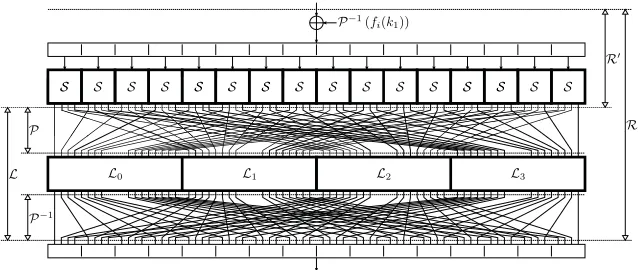
PRIDE designed by Albrecht et al. is a SPN structure block cipher with 64-bit block and 128-bit key. The 64-bit input of the round function is splitted into 16 4-bit nibbles, XORed with the round key, and fed into 16 parallel 4-bit Sboxes and then permuted and processed by the linear layer, see Fig. 3. The cipher has 20 rounds, the first 19 rounds of which are identical, and the linear layer of the last round is omitted, see Fig. 2.
3.1 S-box of Block Cipher PRIDE
The PRIDE S-box is given in Table 1:
3.2 The Linear Layer of Block Cipher PRIDE
Fig. 1.The Round FunctionRof PRIDE
Fig. 2.Overall Structure of the PRIDE
which is the inverse ofP:
M:L0× L1× L2× L3
L:P−1◦ M ◦ P
The detailed definitions ofP,P−1, Li(i= 0,1,2,3) are in Appendix.
3.3 Key Schedule of Block Cipher PRIDE
The 128-bit master key for block cipher PRIDE is (k0||k1), the sizes ofki(i= 0,1)
are 64. k0 is used for pre-whitening and post-whitening, while k1 is used to
produce the subkeyfr(k1) for roundr.
fr(k1) =k1,1||gr(1)(k1,2)||k1,3||gr(2)(k1,4)||k1,5||gr(3)(k1,6)||k1,7||gr(4)(k1,8)
As the subkey derivation function with four byte-local modifiers of the key as
gr(1)(x) = (x+ 193r) mod 256
gr(2)(x) = (x+ 165r) mod 256
gr(3)(x) = (x+ 81r) mod 256
gr(4)(x) = (x+ 197r) mod 256
Table 1.S-box of Block Cipher PRIDE
x 0x0 0x1 0x2 0x3 0x4 0x5 0x6 0x7 0x8 0x9 0xa 0xb 0xc 0xd 0xe 0xf S(x) 0x0 0x4 0x8 0xf 0x1 0x5 0xe 0x9 0x2 0x7 0xa 0xc 0xb 0xd 0x6 0x3
3.4 Discussion on PRIDE
Since pre-whitening and post-whitening only use 64 bits key and the other 64 bits are used as round keys. Without security claim as PRINCE, we can attack 20 rounds of PRIDE by Meet-in-the-Middle method with 232 known plaintexts,
296table look-up and 241 bytes, respectively.
The Meet-in-the-Middle attack presented by Diffie and Hellman[7] have been successfully used against several block ciphers. It devotes to splitting the whole cipherEk intoEk=E2k2 ·E
1
k1, and guessingk1 andk2 respectively to compute and check whetherE1
k1(m) equal toE
2−1
k2(c) or not. IfE
1
k1(m)=E
2−1
k2(c), the key guessed is the right one. Meet-in-the-Middle attack is also very effective when applied to PRIDE.
Fig. 3.Abstract Structure of PRIDE
1. Collect 232pairs of (m, c)
2. For each of 264 possible values ofk 1:
(a) Randomly choose 232values ofx, calculate the correspondingF(x), store
(x,F(x), x⊕ F(x)) in a hash tableHindexed byx⊕ F(x),
(b) For each (m, c) pair, calculate P−1(m⊕c) and choose the item in H
wherex⊕ F(x) =P−1(m⊕c), calculatek
0=P−1(m)⊕x,
(c) Encrypt a plaintext m using (k0, k1). If we get the right ciphertext c,
(k0, k1) is the right key.
The data complexity of this process is 232, the time complexity is 296table look-up, and the memory complexity is 241bytes. Since the size of key is 128 bits, and
this structure can not reach the security level expected. We propose the designer usek0andk1 as round keys iteratively.
4
Differential Characteristic of Block Cipher PRIDE
1-bit to 1-1-bit. Mounting 2-round iterative differential characteristics in Table 3, we find the 15-round differential characteristic in Table 5.
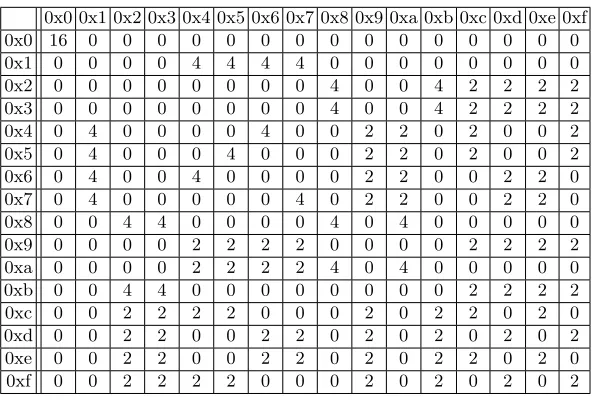
Table 2.XOR Difference Distribution Table for PRIDE S-box
0x0 0x1 0x2 0x3 0x4 0x5 0x6 0x7 0x8 0x9 0xa 0xb 0xc 0xd 0xe 0xf 0x0 16 0 0 0 0 0 0 0 0 0 0 0 0 0 0 0 0x1 0 0 0 0 4 4 4 4 0 0 0 0 0 0 0 0 0x2 0 0 0 0 0 0 0 0 4 0 0 4 2 2 2 2 0x3 0 0 0 0 0 0 0 0 4 0 0 4 2 2 2 2 0x4 0 4 0 0 0 0 4 0 0 2 2 0 2 0 0 2 0x5 0 4 0 0 0 4 0 0 0 2 2 0 2 0 0 2 0x6 0 4 0 0 4 0 0 0 0 2 2 0 0 2 2 0 0x7 0 4 0 0 0 0 0 4 0 2 2 0 0 2 2 0 0x8 0 0 4 4 0 0 0 0 4 0 4 0 0 0 0 0 0x9 0 0 0 0 2 2 2 2 0 0 0 0 2 2 2 2 0xa 0 0 0 0 2 2 2 2 4 0 4 0 0 0 0 0 0xb 0 0 4 4 0 0 0 0 0 0 0 0 2 2 2 2 0xc 0 0 2 2 2 2 0 0 0 2 0 2 2 0 2 0 0xd 0 0 2 2 0 0 2 2 0 2 0 2 0 2 0 2 0xe 0 0 2 2 0 0 2 2 0 2 0 2 2 0 2 0 0xf 0 0 2 2 2 2 0 0 0 2 0 2 0 2 0 2
Observation 1 If the input difference of S-box is 0x8, the output difference is
0x8with probability 1
4. We can obtain 2-round iterative differential characteristic
holding with probability 2−8 as in Table 3:
Table 3.2-Round Differential Characteristic for PRIDE
∆Ir 0x0 0x8 0x0 0x0 0x0 0x0 0x0 0x0 0x0 0x0 0x0 0x0 0x0 0x0 0x0 0x0 ∆Xr 0x0 0x8 0x0 0x0 0x0 0x0 0x0 0x0 0x0 0x0 0x0 0x0 0x0 0x0 0x0 0x0 ∆Yr 0x0 0x8 0x0 0x0 0x0 0x0 0x0 0x0 0x0 0x0 0x0 0x0 0x0 0x0 0x0 0x0 ∆Zr 0x4 0x0 0x0 0x0 0x0 0x0 0x0 0x0 0x0 0x0 0x0 0x0 0x0 0x0 0x0 0x0 ∆Wr 0x0 0x4 0x4 0x4 0x0 0x0 0x0 0x0 0x0 0x0 0x0 0x0 0x0 0x0 0x0 0x0 ∆Ir+1 0x0 0x0 0x0 0x0 0x0 0x8 0x0 0x0 0x0 0x8 0x0 0x0 0x0 0x8 0x0 0x0
∆Xr+1 0x0 0x0 0x0 0x0 0x0 0x8 0x0 0x0 0x0 0x8 0x0 0x0 0x0 0x8 0x0 0x0
∆Yr+1 0x0 0x0 0x0 0x0 0x0 0x8 0x0 0x0 0x0 0x8 0x0 0x0 0x0 0x8 0x0 0x0
∆Zr+1 0x0 0x4 0x4 0x4 0x0 0x0 0x0 0x0 0x0 0x0 0x0 0x0 0x0 0x0 0x0 0x0
∆Wr+1 0x4 0x0 0x0 0x0 0x0 0x0 0x0 0x0 0x0 0x0 0x0 0x0 0x0 0x0 0x0 0x0
∆Ir+2 0x0 0x8 0x0 0x0 0x0 0x0 0x0 0x0 0x0 0x0 0x0 0x0 0x0 0x0 0x0 0x0
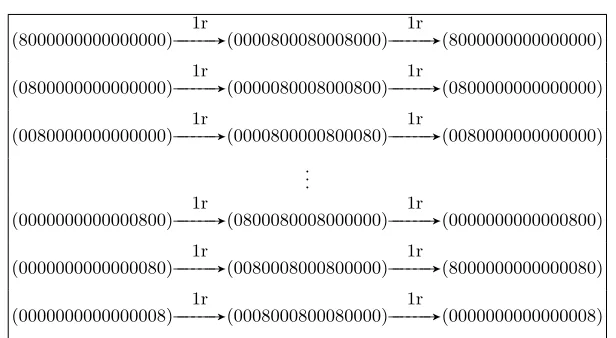
Table 4.16 2-Round Differential Characteristics
(8000000000000000) 1r
GGGGGGA(0000800080008000) 1r
GGGGGGA(8000000000000000)
(0800000000000000) 1r
GGGGGGA(0000080008000800) 1r
GGGGGGA(0800000000000000)
(0080000000000000) 1r
GGGGGGA(0000800000800080) 1r
GGGGGGA(0080000000000000) .
. .
(0000000000000800) 1r
GGGGGGA(0800080008000000) 1r
GGGGGGA(0000000000000800)
(0000000000000080) 1r
GGGGGGA(0080008000800000) 1r
GGGGGGA(8000000000000080)
(0000000000000008) 1r
GGGGGGA(0008000800080000) 1r
GGGGGGA(0000000000000008)
Based on Observation 1, we iterative the 2-Round differential characteristic in Table 3 for 7 times and then attach anther one round behind them, we can obtain 15 rounds differential characteristic with probabilityp=2158. The starting and the ending points are listed in Table 5.
Table 5.15-Round Differential Characteristic for PRIDE
∆Ir 0x0 0x8 0x0 0x0 0x0 0x0 0x0 0x0 0x0 0x0 0x0 0x0 0x0 0x0 0x0 0x0 ∆Xr+15 0x0 0x0 0x0 0x0 0x0 0x8 0x0 0x0 0x0 0x8 0x0 0x0 0x8 0x0 0x0 0x0
Observation 2 If the input difference ofL−10 is∆Wr[1, 2,. . . , 16]=(0?00 0?00
0?00 0?00), the output difference is ∆Zr[1, 2,. . . , 16]=(0000 0?00 0?00 0?00)
with probability 1
2; If the input difference ofL −1
3 is∆Wr[49, 50,. . . , 64]=(0?00
0?00 0?00 0?00), the output difference is∆Zr[49, 50,. . . , 64]=(0000 0?00 0?00
0?00) with probability 12. (“?” is the undermined value)
Since ∆Zr[1, 2,. . . , 16]=L−10 ×∆Wr[1, 2,. . . , 16]=L−10 × (0?00 0?00 0?00
0?00)=(0?00 0?00 0?00 0?00), and (0?00 0?00 0?00 0?00)=(0000 0?00 0?00 0?00) with probability 12;L−13 situation is the same asL−10 .
Observation 3 If the input difference of L−11 is ∆Wr[17, 18,. . . , 32]=(00?0
???0 0??0 0??0), the output difference is∆Zr[17, 18,. . . , 32]=(0000 0?00 0?00
0?00) with probability 215; If the input difference of L
−1
2 is ∆Wr[33, 34,. . . ,
48]=(???0 00?0 0??0 0??0), the output difference is∆Zr[33, 34,. . . , 48]=(0000
0?00 0?00 0?00) with probability 215.
Proof. Since∆Zr[17,18, . . . ,32]T=L−1
1 ×∆Wr[17,18, . . . ,32]T, the input
Table 6.Differential Analysis on 18-round PRIDE
∆I1 0000 0000 0000 0000 0000 ???? 0000 0000 0000 ???? 0000 0000 0000 ???? 0000 0000
∆X1 0000 0000 0000 0000 0000 ???? 0000 0000 0000 ???? 0000 0000 0000 ???? 0000 0000 ∆Y1 0000 0000 0000 0000 0000 1000 0000 0000 0000 1000 0000 0000 0000 1000 0000 0000 ∆Z1 0000 0100 0100 0100 0000 0000 0000 0000 0000 0000 0000 0000 0000 0000 0000 0000
∆W1 0100 0000 0000 0000 0000 0000 0000 0000 0000 0000 0000 0000 0000 0000 0000 0000 ∆I2 0000 1000 0000 0000 0000 0000 0000 0000 0000 0000 0000 0000 0000 0000 0000 0000
∆X17 0000 0000 0000 0000 0000 1000 0000 0000 0000 1000 0000 0000 0000 1000 0000 0000
∆Y17 0000 0000 0000 0000 0000 ???? 0000 0000 0000 ???? 0000 0000 0000 ???? 0000 0000 ∆Z17 0000 0?00 0?00 0?00 0000 0?00 0?00 0?00 0000 0?00 0?00 0?00 0000 0?00 0?00 0?00
∆W17 0?00 0?00 0?00 0?00 00?0 ???0 0??0 0??0 ???0 00?0 0??0 0??0 0?00 0?00 0?00 0?00 ∆I18 00?0 ?0?? 0??0 0000 0?00 ??0? 0??0 0000 0000 ???? 0??? 0000 0000 ???? 0?00 0000 ∆X18 00?0 ?0?? 0??0 0000 0?00 ??0? 0??0 0000 0000 ???? 0??? 0000 0000 ???? 0?00 0000
∆Y18 ???? ???? ???? 0000 ???? ???? ???? 0000 0000 ???? ???? 0000 0000 ???? ???? 0000 ∆O18 ???? ???? ???? 0000 ???? ???? ???? 0000 0000 ???? ???? 0000 0000 ???? ???? 0000
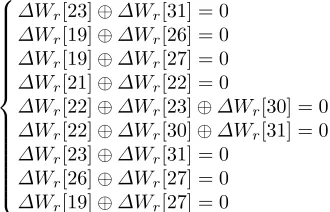
construct a linear equation set as follows:
∆Wr[23]⊕∆Wr[31] = 0
∆Wr[19]⊕∆Wr[26] = 0
∆Wr[19]⊕∆Wr[27] = 0
∆Wr[21]⊕∆Wr[22] = 0
∆Wr[22]⊕∆Wr[23]⊕∆Wr[30] = 0
∆Wr[22]⊕∆Wr[30]⊕∆Wr[31] = 0
∆Wr[23]⊕∆Wr[31] = 0
∆Wr[26]⊕∆Wr[27] = 0
∆Wr[19]⊕∆Wr[27] = 0
Considering the rank this equation set can be simplified as follows:
∆Wr[19]⊕∆Wr[26] = 0
∆Wr[21]⊕∆Wr[22] = 0
∆Wr[22]⊕∆Wr[23]⊕∆Wr[30] = 0
∆Wr[22]⊕∆Wr[30]⊕∆Wr[31] = 0
∆Wr[19]⊕∆Wr[27] = 0
We can get the output difference ∆Zr[17, 18,. . . , 32]=(0000 0?00 0?00 0?00) if the 5 equations are satisfied. The probability is 2−5.
Since the proof ofL−12 is similar, we omitted it here. ut
5
Differential Attack on 18-Round PRIDE
In this section, we put our 15-round differential characteristic from the second round to the 16 round, extending 1 round backward and 2 rounds forward, and analyze 18-th block cipher PRIDE.
– Data Collection Phase. Choose 2nstructures, in each of which, plaintexts fix in nibbles 1, 2, 3, 4, 5, 7, 8, 9, 11, 12, 13, 15, 16 and traverse in nibbles 6, 10, 14. There are 212 plaintexts and their corresponding ciphertexts which
consist of 223 pairs. After 18-round encryption, the ciphertext difference
– Key Recovery Phase. 264key bits corresponding to (k
0⊕ P−1(f1(k1)))[6],
(k0⊕ P−1(f1(k1)))[10], (k0⊕ P−1(f1(k1)))[14] in the 1st round, k0[1,2,3],
k0[5,6,7],k0[10,11] andk0[14,15] of the post-whitening, and 12 bits
equiva-lent key (M ◦ P)−1(fr(k1))[6], (M ◦ P)−1(fr(k1))[10], (M ◦ P)−1(fr(k1))[14]
are guessed in this phase, we build 264counters for each of them.
• Step 1. Guess (k0⊕P−1(f1(k1)))[6], encrypt the 6-th nibble of plaintexts
partially, and sieve 24pairs whose S-box output difference∆Y1[6] = 0x8,
which makes 2−5 pairs remain.
• Step 2. Guess (k0⊕ P−1(f1(k1)))[10], encrypt the 10-th nibble of
plain-texts partially, and sieve 24pairs whose S-box output difference∆Y1[10] =
0x8, and 2−9 pairs left.
• Step 3. Guess (k0⊕ P−1(f1(k1)))[14] encrypt the 14th nibble of
plain-texts partially, and sieve anther 24 pairs whose S-box output difference
∆Y1[14] = 0x8, 2−13 pairs fulfil our condition.
• Step 4. Guess k0[i](i = 1,2,3,5,6,7,15,11,10,14) one by one, decrypt
the corresponding nibbles of ciphertexts partially, and sieve pairs by factors 2−3, 2−1, 2−2, 2−3, 2−1, 2−2, 2−1, 2−3, 1 and 1, respectively, 2−29pairs left.
• Step 5. According to Observation 2 and 3, decrypt the remaining pairs and sieve them by 212 factor without guessing any key bits and 2−41 pairs left after this process.
• Step 6. For each pairs left, guess (M ◦ P)−1(f
r(k1))[6], decrypt the
6-th nibble of∆Y17[6] partially, and sieve pairs by factor 24 whose S-box
input difference∆X17[6] = 0x8, on average 2−45right pairs remain.
• Step 7. For each pairs left, guess (M ◦ P)−1(fr(k
1))[10], decrypt the
10-th nibble of∆Y17[10] partially, and sieve pairs by factor 24whose S-box
input difference∆X17[10] = 0x8, on average 2−49 right pairs remain.
• Step 8. For each pairs left, guess (M ◦ P)−1(fr(k1))[6], decrypt the
14-th nibble of∆Y17[14] partially, and sieve pairs by factor 24whose S-box
input difference∆X17[14] = 0x8, on average 2−53 right pairs remain. If
any pairs left for some key value, increment the corresponding counter. In order to distinguish the right key from the wrong ones, we expect two pairs satisfy our differential path which requirento be 48 since the probability of our differential path is 2−58. In this way, about 2−5 pairs expected to left for the wrong keys.
• Step 9. Exhaustively search the rest 64 bits key which are not guessed in the former process.
– Data/Time/Memory Complexity • Data Complexity: 260chosen plaintexts.
• Time Complexity: Data collection phase: 260 encryptions/Key recovery
phase: 266 encryptions.
∗ Step 1. For 24 possible key values, encrypt the 6-th nibble for each
plaintexts of the left pairs, when considering our 18-round PRIDE, the time complexity is 2×247×24× 1
16 × 1 18 ≈2
∗ Step 2. The time complexity of this step is similar with that of Step 1. 2×243×24×24× 1
16× 1 18≈2
43encryptions.
∗ Step 3. Similar with Step 1. the time complexity is about 2×239×
28×24× 1 16×
1 18 ≈2
43 encryptions.
∗ Step 4. The dominant time complexity of this step is the last nibble operation, since the sieved pairs is less than key bits guessed for the former nibbles operations, it is about 2×219×248×24×1
16× 1 18 ≈2
62
encryptions.
∗ Step 5. For each key guessed in former steps decrypt each middle state of the left pairs fromO17toY17, the time complexity is about
2×219×252×1 4×
1 18 ≈2
66encryptions.
∗ Step 6. Similar with Step 1. the time complexity is about 2×27× 252×24× 1
16× 1 18 ≈2
55 encryptions.
∗ Step 7. Similar with Step 1. the time complexity is about 2×23×
256×24× 1 16×
1 18 ≈2
55 encryptions.
∗ Step 8. Similar with Step 1. the time complexity is about 2×2−1× 260×24× 1
16× 1 18 ≈2
55 encryptions.
∗ Step 9. 264 encryptions.
• Memory Complexity: 264bytes.
– Success Probability According to [8], the success probability for differen-tial analysis is
Ps= Z ∞
− √
µS/N−φ−1 (1−2−a)
√
S/N+1
φ(x)dx≈0.61
whereais the number of key bits guessed andµis the number of right pairs.
6
Conclusion
By observing properties of S-box and linear layer of PRIDE, we find 16 differ-ent 2-round iterative characteristics and construct several 15-round differdiffer-entials for block cipher PRIDE. Based on one of the differentials, we attack 18-round PRIDE using 260 chosen plaintexts 266 encryptions and 264 bytes. This is the
first analysis result on PRIDE.
References
1. A. Bogdanov, L. Knudsen, G. Leander, C. Paar, A. Poschmann, M. Robshaw, Y. Seurin, C. Vikkelsoe: Present: An ultra-lightweight block cipher. In Proc. CHES 2007, LNCS 4727, pp. 450-466, Springer, 2007.
2. J. Guo, T. Peyrin, A. Poschmann, M. Robshaw: The LED Block Cipher. In Proc. CHES 2011, LNCS 6917, pp. 326-341, Springer, 2011.
4. Ray Beaulieu, Douglas Shors, Jason Smith, Stefan Treatman-Clark, Bryan Weeks and Louis Wingers: The SIMON and SPECK Families of Lightweight Block Ci-phers. IACR Cryptology ePrint Archive, 2013:414, 2013.
5. Martin R. Albrecht, Benedikt Driessen, Elif Bilge Kavun, Gregor Leander, Christof Paar, Tolga Yalcin: Block Ciphers - Focus On The Linear Layer (feat. PRIDE) . Pre-proceeding of CRYPTO 2014.
6. E. Biham and A. Shamir: Differential Cryptanalysis of DES-like Cryptosystems, Journal of Cryptology, vol. 4, no.1, pp. 3-72, Springer, 1991.
7. W. Diffie, M.E. Hellman: Exhaustive Cryptanalysis of the NBS Data Encryption Standard. Computer, vol. 10(6), pp. 74–84, IEEE Computer Society Press, 1977.
8. A.A. Sel¸cuk, A. Bi¸cak: On probability of success in linear and differential crypt-analysis. In: Cimato, S., Galdi, C., Persiano, G. (eds.) SCN 02: 3rd International Conference on Security in Communication Networks. LNCS 2576, pp. 174-185. Springer, 2002.
Appendix
L0=L−10 =
0 0 0 0 1 0 0 0 1 0 0 0 1 0 0 0 0 0 0 0 0 1 0 0 0 1 0 0 0 1 0 0 0 0 0 0 0 0 1 0 0 0 1 0 0 0 1 0 0 0 0 0 0 0 0 1 0 0 0 1 0 0 0 1 1 0 0 0 0 0 0 0 1 0 0 0 1 0 0 0 0 1 0 0 0 0 0 0 0 1 0 0 0 1 0 0 0 0 1 0 0 0 0 0 0 0 1 0 0 0 1 0 0 0 0 1 0 0 0 0 0 0 0 1 0 0 0 1 1 0 0 0 1 0 0 0 0 0 0 0 1 0 0 0 0 1 0 0 0 1 0 0 0 0 0 0 0 1 0 0 0 0 1 0 0 0 1 0 0 0 0 0 0 0 1 0 0 0 0 1 0 0 0 1 0 0 0 0 0 0 0 1 1 0 0 0 1 0 0 0 1 0 0 0 0 0 0 0 0 1 0 0 0 1 0 0 0 1 0 0 0 0 0 0 0 0 1 0 0 0 1 0 0 0 1 0 0 0 0 0 0 0 0 1 0 0 0 1 0 0 0 1 0 0 0 0
L1=
1 1 0 0 0 0 0 0 0 0 0 1 0 0 0 0 0 1 1 0 0 0 0 0 0 0 0 0 1 0 0 0 0 0 1 1 0 0 0 0 0 0 0 0 0 1 0 0 0 0 0 1 1 0 0 0 0 0 0 0 0 0 1 0 0 0 0 0 1 1 0 0 0 0 0 0 0 0 0 1 0 0 0 0 0 1 1 0 1 0 0 0 0 0 0 0 0 0 0 0 0 0 1 1 0 1 0 0 0 0 0 0 1 0 0 0 0 0 0 1 0 0 1 0 0 0 0 0 1 0 0 0 0 0 0 0 0 0 0 1 1 0 0 0 0 1 0 0 0 0 0 0 0 0 0 0 1 1 0 0 0 0 1 0 0 0 0 0 0 0 0 0 0 1 1 0 0 0 0 1 0 0 0 0 0 0 0 0 0 0 1 1 0 0 0 0 1 0 0 0 1 0 0 0 0 0 0 1 0 0 0 0 0 1 0 0 1 1 0 0 0 0 0 0 0 0 0 0 0 0 1 0 0 1 1 0 0 0 0 0 0 0 0 0 0 0 0 1 0 0 1 1 0 0 0 0
L2=
0 0 0 0 1 1 0 0 0 0 0 0 0 0 0 1 0 0 0 0 0 1 1 0 1 0 0 0 0 0 0 0 0 0 0 0 0 0 1 1 0 1 0 0 0 0 0 0 1 0 0 0 0 0 0 1 0 0 1 0 0 0 0 0 1 1 0 0 0 0 0 0 0 0 0 1 0 0 0 0 0 1 1 0 0 0 0 0 0 0 0 0 1 0 0 0 0 0 1 1 0 0 0 0 0 0 0 0 0 1 0 0 0 0 0 1 1 0 0 0 0 0 0 0 0 0 1 0 0 0 0 0 1 0 0 0 1 0 0 0 0 0 0 1 0 0 0 0 0 1 0 0 1 1 0 0 0 0 0 0 0 0 0 0 0 0 1 0 0 1 1 0 0 0 0 0 0 0 0 0 0 0 0 1 0 0 1 1 0 0 0 0 1 0 0 0 0 0 0 0 0 0 0 1 1 0 0 0 0 1 0 0 0 0 0 0 0 0 0 0 1 1 0 0 0 0 1 0 0 0 0 0 0 0 0 0 0 1 1 0 0 0 0 1 0 0 0 0 0 0 0 0 0 0 1 1
L3=L−13 =
1 0 0 0 1 0 0 0 0 0 0 0 1 0 0 0 0 1 0 0 0 1 0 0 0 0 0 0 0 1 0 0 0 0 1 0 0 0 1 0 0 0 0 0 0 0 1 0 0 0 0 1 0 0 0 1 0 0 0 0 0 0 0 1 1 0 0 0 1 0 0 0 1 0 0 0 0 0 0 0 0 1 0 0 0 1 0 0 0 1 0 0 0 0 0 0 0 0 1 0 0 0 1 0 0 0 1 0 0 0 0 0 0 0 0 1 0 0 0 1 0 0 0 1 0 0 0 0 0 0 0 0 1 0 0 0 1 0 0 0 1 0 0 0 0 0 0 0 0 1 0 0 0 1 0 0 0 1 0 0 0 0 0 0 0 0 1 0 0 0 1 0 0 0 1 0 0 0 0 0 0 0 0 1 0 0 0 1 0 0 0 1 1 0 0 0 0 0 0 0 1 0 0 0 1 0 0 0 0 1 0 0 0 0 0 0 0 1 0 0 0 1 0 0 0 0 1 0 0 0 0 0 0 0 1 0 0 0 1 0 0 0 0 1 0 0 0 0 0 0 0 1 0 0 0 1
L−11 =
0 0 0 0 0 0 1 1 0 0 0 0 0 0 1 0 1 0 0 0 0 0 0 1 0 0 0 0 0 0 0 1 1 1 0 0 0 0 0 0 1 0 0 0 0 0 0 0 0 1 1 0 0 0 0 0 0 1 0 0 0 0 0 0 0 0 1 1 0 0 0 0 0 0 1 0 0 0 0 0 0 0 0 1 1 0 0 0 0 0 0 1 0 0 0 0 0 0 0 0 1 1 0 0 0 0 0 0 1 0 0 0 0 0 0 0 0 1 1 0 0 0 0 0 0 1 0 0 0 0 0 1 0 0 0 0 0 0 0 1 1 0 0 0 0 0 0 0 1 0 0 0 0 0 0 0 1 1 0 0 0 0 0 0 0 1 0 0 0 0 0 0 0 1 1 0 0 0 0 0 0 0 1 0 0 0 0 0 0 0 1 1 0 0 0 0 0 0 0 1 1 0 0 0 0 0 0 1 1 0 0 0 0 0 0 0 1 1 0 0 0 0 0 0 0 1 0 0 0 0 0 0 0 1 1 0 0 0 0 0 0 0 1 0 0 0 0 0 0 0 1 1 0 0 0 0
L−12 =
0 0 1 1 0 0 0 0 0 0 1 0 0 0 0 0 0 0 0 1 1 0 0 0 0 0 0 1 0 0 0 0 0 0 0 0 1 1 0 0 0 0 0 0 1 0 0 0 0 0 0 0 0 1 1 0 0 0 0 0 0 1 0 0 0 0 0 0 0 0 1 1 0 0 0 0 0 0 1 0 1 0 0 0 0 0 0 1 0 0 0 0 0 0 0 1 1 1 0 0 0 0 0 0 1 0 0 0 0 0 0 0 0 1 1 0 0 0 0 0 0 1 0 0 0 0 0 0 0 0 0 0 0 0 0 1 1 0 0 0 0 0 0 1 1 0 0 0 0 0 0 0 1 1 0 0 0 0 0 0 0 1 0 0 0 0 0 0 0 1 1 0 0 0 0 0 0 0 1 0 0 0 0 0 0 0 1 1 0 0 0 0 0 0 0 1 0 0 0 0 0 0 0 1 1 0 0 0 0 0 0 0 1 0 0 0 0 0 0 0 1 1 0 0 0 0 0 0 0 1 0 0 0 0 0 0 0 1 1 0 0 0 0 0 0 0 1 0 0 0 0 0 0 0 1 1
Table 7.PermutationP(x) of Block Cipher PRIDE
x 1 2 3 4 5 6 7 8 9 10 11 12 13 14 15 16
P(x) 1 17 33 49 2 18 34 50 3 19 35 51 4 20 36 52
x 17 18 19 20 21 22 23 24 25 26 27 28 29 30 31 32
P(x) 5 21 37 53 6 22 38 54 7 23 39 55 8 24 40 56
x 33 34 35 36 37 38 39 40 41 42 43 44 45 46 47 48
P(x) 9 25 41 57 10 26 42 58 11 27 43 59 12 28 44 60
x 49 50 51 52 53 54 55 56 57 58 59 60 61 62 63 64
P(x) 13 29 45 61 14 30 46 62 15 31 47 63 16 32 48 64
Table 8.Permutation P−1 of Block Cipher PRIDE
x 1 2 3 4 5 6 7 8 9 10 11 12 13 14 15 16
P−1(x) 1 5 9 13 17 21 25 29 33 37 41 45 49 53 57 61
x 17 18 19 20 21 22 23 24 25 26 27 28 29 30 31 32
P−1
(x) 2 6 10 14 18 22 26 30 34 38 42 46 50 54 58 62
x 33 34 35 36 37 38 39 40 41 42 43 44 45 46 47 48
P−1
(x) 3 7 11 15 19 23 27 31 35 39 43 47 51 55 59 63
x 49 50 51 52 53 54 55 56 57 58 59 60 61 62 63 64