Towards
the
Absolute Zero
THE USE OF CONVENTIONAL AND SELF-CALIBRATING
RHODIUM-IRON RESISTANCE THERMOMETERS
By
R . L. Rusby
\ational Phvsical Laboratory, Teddington, England
T h e wide range of use of the platinum resistance thermometer, roughly 10 to 1000 K , is by no means enough to satisfy all demands f o r temperature standards. T e n years ago thermometers modelled o n the capsule-type platinum thermometer but using an alloy of rhodium with 0.5 per cent iron were developed at the National Physical Laboratory specifically to provide standards f o r lower temperatures, and these are now widely used down to 0.5 K . I n a recent joint experiment between the 0.S. Yational Bureau of Standards and
N.P.L.,
rhodium-iron has been used down to 0.01 K b y coupling a small sample o f the alloy to a resistive S Y C 11). Such a device is capable of measuring accurately voltages of less than one nanovolt, and also of measuring the noise voltage in the resistor. Since the latter is dependent o n the absolute temperature i n a way that could be calculated, the device was able to prouide its own calibration.In 1964 Professor Bryan Coles reported some measurements of the low temperature resistivity of rhodium containing less than one atomic per cent of iron ( I ) . He found that the iron gave rise to a strongly temperature dependent resistivity whose temperature coefficient was, contrary to all expectations, positive. Thus the total resistivity of the alloy, roughly the sum of the ideal resistivity of pure rhodium and of the impurity resistivity, falls continuously on cooling from ambient temperature and indeed falls most rapidly near
I K, the lower limit of Coles’ experiments. The discovery of this effect gave rise to considerable theoretical and experimental activity, not least in following up Coles’ suggestion that “these materials could form very useful resistance thermometers down to very low temperatures”.
Hesistivit y-Temperature
Characteristics
The resistivity-temperature characteristic is plotted in Figure I which shows the dominance of the ideal resistivity above 30 K and of the
impurity resistivity below this. In fact the sensitivity of rhodium-iron is somewhat less than of platinum above 30 K and considerably less than that of doped germanium used at lower temperatures. The advantages looked for
in developing a thermometer based on rhodium- iron were that it would be able to cover virtually the whole cryogenic range, that the characteristic might be fitted by fairly simple equations, and that as with other wire-wound thermometers, the long term reproducibility would be good.
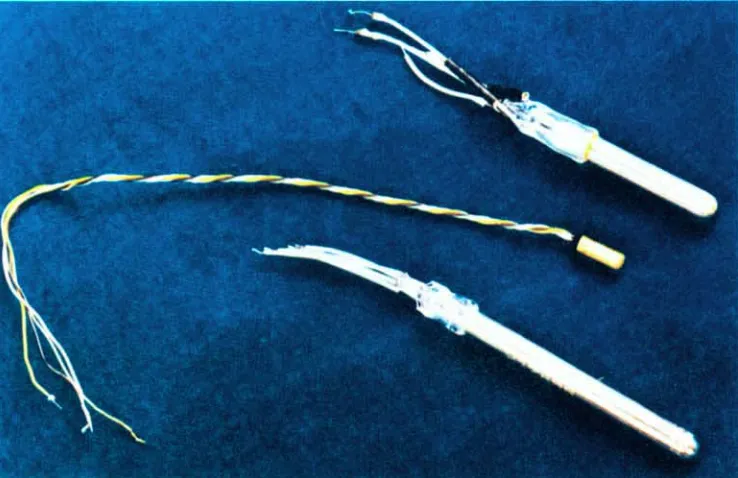
The first thermometers were made about ten years ago, following the procedure used in making platinum-sheathed platinum resistance thermometers. Two sizes of thermometer incorporating high-purity rhodium-iron wire are produced by H. Tinsley and Co Limited, and are shown in Figure 2; the resistance of the smaller, which is enclosed in a sheath 35 mm long, is about 5 0 ohms at room temperature but falls to 6 ohms at 20 K, and to 2.5 ohms a t
0.5 K. The capsule of the larger device is
approximately twice those of the smaller ther- mometer. With either of these thermometers the voltage sensitivity dV/dT a t an acceptable measuring current (normally o.5mA) is compar- able with that of capsule-type platinum ther- mometers. However, due to the impurity effect, the rhodium-iron thermometer gives its best results in the liquid helium region, that is, below 4 K, long after the platinum thermometer has faded out.
The initial development at N.P.L. was encouraging, particularly as regards stability of
calibration, and in 1973 the first three full-sized thermometers were procured specifically for the purpose of recording the results of some uni- quely accurate gas thermometry in the range
2.6 K to 27 K, from which was derived the scale now known as NPL-75. Subsequently the scale was extended to 0.5 K by magnetic ther- mometry. In this the temperature was obtained from measurements of the susceptibility,
x,
of a paramagnetic salt which accurately obeys the Curie law,x
= C/T. These experiments played an important part in the derivation of the EPT-76, the new international scale for the range
0.5 K to 27 K. The scales have been transferred to other rhodium-iron thermometers which are
now used as standards in the U.K., continental Europe, the U.S.A., China, Japan and Australia. The remarkable fact is that after seven years the original three agree among themselves to within 0.0001 K at 4 K and with
a platinum thermometer at 20 K to within
0.0004 K. In reality, despite much use and many coolings, the thermometers have remained stable to the limit of our ability to detect changes. This also applies without excep tion to other rhodium-iron thermometers for which stability checks have been made, and contrasts with the difficulty of finding ger- manium thermometers which are stable enough for the most accurate use.
The inset in Figure I shows that the
Fig. 2 Two platinum-sheathed rhodium-iron thermometers ns used in th(. c.xpcJriments d(~srribc~d in
this pnpr’r. A l s o in th(J illustration is IZ gold-plntc:d grrmnnium. thr~rrnnrnt~tcr comm~nnly uscd at very
low ternpcmturcs, but having u nnrrouw lemperature rung(’
were obtained by immersing a rhodium-iron wire directly in the mixing chamber of an ingenious machine known as a dilution refrigerator. Since the first successful operation of such machines, dilution refrigerators have become indispensible tools for research below 0.5 K. They function by obliging liquid We (an isotope produced in the decay of W) to dissolve into liquid 4He, a process which is accompanied by a cooling. The ?He then migrates in the 4He along fine tubes and through heat exchangers until it reaches a still at about 0.6 K where it can be evaporated and re-cycled. By this means continuous cooling of the mixing chamber can be achieved. Today refrigerators can be purchased that are capable of maintaining temperatures as low as 0.005 K more or less indefinitely (2).
Superconductive Quantum
Interference Devices
Unfortunately it is not really desirable to build one’s thermometer into the equipment to such an extent, and the next advance in using
rhodium-iron below 0.5 K came through the use of a device capable of measuring such small voltages that the resistance could be measured with negligible self-heating even with the thermometer mounted outside the mixing chamber of the refrigerator. The device, moreover, could also detect the electrical noise in the resistor, from which the absolute temperature could be deduced. ’Thus such a resistance thermometer would be self- calibrating by the technique of noise ther- mometry.
The device rejoices in the name resistive
s ~ r : r n
(Superconductive Quantum Interference Device) and comprises a small ring of superconductor broken at one place by a section of resistive material (the rhodium-iron) and at another by a weak superconductive link, orJosephson junction (3). A d.c. voltage V applied to such a junction causes it to emit radiation at a frequency f given by zeV/h, where e is the electronic charge and h is Planck’s constant. This is the d.c. Josephson effect. In the resistive
arising from the passage of a small bias current
In
in the resistor R, and a fluctuating term Vdt) representing the noise. It follows that the fre- quency of emission can be written as the sum of two terms, f = f,,+
f,lt). The measurement technique is to make many counts of the fre- quency each lasting a short time, I second or less. The resistance can be determined from the average count f,, since this is equal to 2e10R/h, while the statistical variance u of the count gives information on the absolute temperature through the equation (based on Nyquist's law):0 2 =
C
(f, - fJ2/" (Y R I h1
where N is the number of counts made, t is the duration of each count and CY is a product of fundamental constants.
Kesistive S ~ ~ J I I , noise thermometry has been practised in the temperature range 0.01 K to
0.5 K at the National Bureau of Standards, Washington D.C., for several years with impressive results. A recent comparison with an independent thermometer gave agreement to
-
+
3.5 per cent (4 t a n unusual occurrence in this difficult temperature range. Hitherto the noise resistor had been carefully chosen for minimal temperature coefficient but in a recent collaborative experiment between N.B.S. and N.P.L. a sample of rhodium-iron was mountedin place of the usual copper-silicon alloy specifically to produce a resistance thermometer which could be self-calibrating by using noise thermometry
(5).
The advantage of doing this is that the noise thermometer is too slow for practical purposes, whereas the measurement of resistance takes only a few minutes. Therefore once the device is calibrated, its subsequent use is relatively simple.In the N.R.S.-N.I'.l,. pilot experiment the rhodium-iron resistor was in the form of a small foil which had been hot-rolled from a spark-cut disc. Its resistance, which had to be small com- pared with the effective resistance of the Josephson junction which it shunted, was about 17 micro ohms. With a bias current of 1 0 - 5 amps the voltage Vowas 1.7 x 10 "'volts, and f,, was about 80 kHz. Then 200 counts of I second each were sufficient to average out the noise
and allow measurement o f f , and R with a preci- sion of a few parts per million. The precision of the device as a resistance thermometer was then about 0.4mK and the implied voltage sensitivity was less than 10 I' volts. The RMS
noise voltage itself was at most 2 x 10 14volts for a I second count, depending on the temperature. T h e relative accuracy of noise thermometry, AT/T, was roughly given by
d(2N).
Thus a measurement of T to I per cent required 20,000 counts and if each took I second, 6 hours or more were needed. The counting perforce was automated and often took place overnight. This situation was acceptable at the lower part of the range where I per cent represents good accuracy, for example 0.1 mK at 0.01 K. At higher temperatures, say above0.1 K, I per cent is not so acceptable, but
fortunately the time per count could be reduced
to 0 . I or even 0.0 I second because although the
count was reduced in proportion, the noise was greater and still reghered as fluctuations in the count; the relationship between the variance and the time per count is complicated by round- off errors because only whole cycles are counted, but proper allowance can be made for this effect.
Conclusions
In conclusion one should ask to what extent the aims of the pilot experiment were realised, and what of the future? First the resistance measurement demanded considerable improve- ment in performance compared with previous experiments, and this was largely achieved. Secondly the statistical uncertainty in the noise thermometry was as predicted, but systematic errors were never much less than I per cent and at temperatures above 0.4 K they were well in excess of this. They arose, in the main, because r h o d i u m - i r o n h a s a n a p p r e c i a b l e thermopower-for much the same reason as it has a temperature dependent resistivity. All thermopowers dwindle to zero as T approaches zero, but at 0.4 K that of rhodium-iron is still about 10 hvolt/K. Remembering that the
s ~ r r r n
could resolve 10 ' 5 volts, one can see that awould give rise to a detectable thermal e.m.f. In reality the gradients may have been 1000 times this and not particularly steady. It seems that the averaging involved in the resistance measurement, coupled with the usual trick of current reversal, did reduce the parasitic effect to manageable proportions, but in the noise thermometry the fluctuations in thermal e.m.f. became progressively more damaging as 1‘ and the thermopower increased. Improvements could be made-increasing
K
and I(, would increase V o without increasing the thermal e.m.f., and of course better temperature regula- tion would help. However, it is also desirable to make improvements in the general technique of noise thermometry, especially in speeding it up. A successor to the pilot experiments described here would best wait for these to materialise. Astonishing as the present capabilities of SQIJID devices are, their exploitation is incomplete andadvances in noise thermometry will surely come. It may never reach the stage of push- button simplicity, but it would be surprising if the N.H.S.-N.P.L. experiment were to be the end of the story.
References
I R. R. Coles, Phys. Ixtt., 1964, 8, (4), 243
z In the LJ.K. from the Oxford Instrument Company. From the physicists’ point of view cooling from 0.5 K to 0.005 K is as significant as
cooling from 50 K to 0.5 K. Dilution refrigerators
themselves are commonly used as a mere spring- board for further coolings; see D. S. Betts, “Kefrigeration and Thermomctty below O n e Kelvin”, Sussex University Press and Chatto and Windus I.td., Inmdon 1976. While concentrating
o n techniques, this book gives some inkling ofthe peculiar fascination of low temperature physics. 3 B. W. I’etley, Contemp. Phys., 1980,~1, (6), 607
4 K. J . Soulen and H. Marshak, C y o g e n i a , 1980,
5 K. J. Soulen, R . I,. Rusby and D. Van L’echten,
3.
2 0 , ( 7 1 3 408Inm Temp. Phys., 1980,40, (5/6), 5 5 3
Platinum Activated Alumina
Spheres
EFFICIENT CATALYSTS FOR CONTROLLING ORGANIC AIR POLLUTANTS
When organic solvents are removed from an industrial process by evaporation there is an obvious need to avoid the discharge o f any toxic or malodorous emissions that may constitute a hazard to health or be a nuisance to people working or living in the affected area. Such fumes consist basically of carbon and hydrogen and therefore the most effective control is provided by burning them to carbon monoxide and water. In this way the possibility of secondary pollution, which may occur with other forms of pollution control is avoided. Catalytic combustion over a supported platinum metal enables the oxidising reaction to take place in a shorter time and at a lower temperature than straight thermal incineration, and is therefore a more fuel-efficient way of controlling such gaseous process effluents; as even very low levels of odorous pollutants may be detected, this is a demanding application.
In order to minimise pressure drop through the catalyst unit many types of support have been designed, including ceramic honeycombs that are wash-coated with alumina prior to activation with the platinum catalyst. In a recent paper J. G. Irwin and R. L. Moss of the Warren Spring Laboratory, Stevenage,
England, now consider the possibility that beds of small spheres could be more efficient than other supports despite the increased pressure drop,
(‘3.
Chem. Tech. Biotechnol., I 980, 30,( I 2), 657-666). They describe work concerned
with the location, dispersion and amount of platinum used to activate alumina supports by creating sufficient platinum surface at, or near, the periphery of the spheres, so that the molecules to be oxidised can readily find vacant platinum sites where the reaction will take place, when the temperature is high enough.
Experimental conditions of catalyst prepara- tion, characterisation, and testing with both dimethyl sulphide and n-butanal are given.