Using Software Agents for Improved e-Governance Model Using Data Mining
S. Anuradha
PhD Research Scholar-Full Time
School of Computer Science, Engg..&Applications Bharathidasan University
Tiruchirappalli-620024
Dr.E. KirubakaranB.E.(Hons.,)M.E.,M.B.A.,Ph.D., Additional General Manager
Bharat Heavy Electricals Limited Tiruchirappalli-620 014
ABSTRACT
The higher educational institutions uses the information systems for all their academic purposes. e-Governance is used in all the aspects of the higher education sector. Decision making is the key challenge in the current scenario. These institutions have tera bytes of data and using this data for key decision making is the critical issue. If these institutions uses the available data for better planning for their courses, this would be of much useful to the students. This research proposes of use of data mining algorithms and software agents for improving the e-Governance in higher educational institutions.
Keywords: e-Governance, Data Mining, Software Agents.
1. Introduction
A worldwide revolution in information and communications technologies(ICT) is in place. The Internet and the mobile phone are fundamentally changing our lives - affecting the way we work, learn and interact. Governments around the world are recognizing the value of e-Government. Properly designed and implemented, e-Government can improve efficiency in the delivery of government services, simplify compliance with government regulations, strengthen citizen participation and trust in government, and yield cost savings for citizens, businesses and the government itself. Not surprisingly, therefore, policymakers and managers are looking to adopt e-Government in countries around the world - ranging from the most developed to the least developed [1].
eGovernment and e-governance can be defined as two very distinct terms. e-Governance is a broader topic that deals with the whole spectrum of the relationship and networks within government regarding the usage and application of ICTs.e-Government is actually a narrower discipline dealing with the development of online services to the citizen, more the e on any particular government service – such as e-tax, e-transportation or e-health[2].
Data mining is generally thought of as a process of finding hidden, non-trivial and previously unknown information in a large collection of data. Association rule mining is an important component of data mining. Association rules are an important class of methods of finding patterns in data. Association rule mining has been used in many application domains.
education is one such concept that can empower the governing bodies to administer the progress of the education plan in the whole country and serves various stakeholders in a much better way [3]. 2. Review of Literature
Devising a successful curriculum plan is very important in any higher education system. A good curriculum plan gives a successful career path to the students. As most of the universities used Information Systems for their successful e-Governance tasks, it is the appropriate time for the universities to use their historical data for better decision making in all the levels.
Introducing technology to the student decision making process aims at leveraging repetitive tasks on software and dedicating time to helping a student plan his/her education road map. An automated system for decision making or a technology-based advisory system helps a student plan the proper courses to take, by checking and listing courses for which he/she has satisfied the prerequisites, allowing students to do the work themselves, without referring to their advisors [4]. E-advising answers the question of how to provide timely, high-quality advising services to geographically separated online students and/or onsite students with conflicting work or family schedules that cannot readily come to office hours [5].
It is important that, the University need to facilitate the students by giving the most current information regarding course selection, educational history and as well as current and future educational and career demands. At present most of the Universities maintain the database of the student performance for many years and have terabytes of data. Using these information systems, the student can select the courses based on the approved curriculum. Few Universities also implemented E-advising systems at certain level. These systems lacks proper decision making. If data mining is used in this decision making process, it helps the student in preparing effective educational plans. This is the appropriate time for the Universities to apply data mining in their data and retrieve useful knowledge and share it with all the stake holders [6].
The proposed E-advising system uses software agents for better decision making. The proposed architecture with the developed agents are implemented using a prototype.
3. Objective and Scope of Research
The following are the objectives of this research
a) To improve the decision making in the existing e-Governance models in higher education systems with reference to academic monitoring.
b) Propose an architecture by including the appropriate data mining techniques and software agents c) To apply data mining techniques for discovering the hidden relationships in the archive database. d) Using the software agents to create a dynamic output environment.
e) To incorporate the specialized database such as input data related to recent trends from the external sources, trends in existing information systems etc., for better decision making.
Scope of the Research Work
this research work. In order to further enhance the decision making, a new data structure is designed to serve as an expert assistance for the developed model. This new data structure contains the information from the industry experts which includes the current trends, expectations and job potentials in the chosen stream.
4. Intelligent Agent Architecture
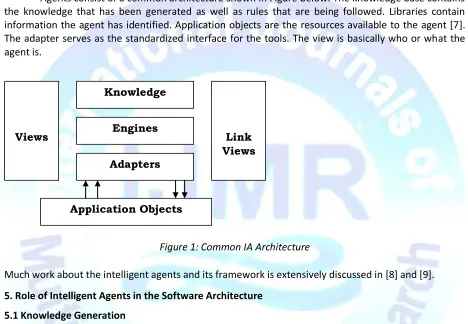
Agents consist of a common architecture shown in Figure below. The knowledge base contains the knowledge that has been generated as well as rules that are being followed. Libraries contain information the agent has identified. Application objects are the resources available to the agent [7]. The adapter serves as the standardized interface for the tools. The view is basically who or what the agent is.
Figure 1: Common IA Architecture
Much work about the intelligent agents and its framework is extensively discussed in [8] and [9].
5. Role of Intelligent Agents in the Software Architecture
5.1 Knowledge Generation
In the proposed e-Governance model, the user performs the decision-making process by using the three data mining algorithms for meeting the objective. The given problem is solved by applying all the three algorithms sequentially. The above process is general for all the data mining techniques discussed in this research work.
5.2 Attribute Selection
Attribute association enables the determination of important relationships within the data [10]. However, particularly if the data set is very large and dependent on many attributes, then the first step might be in precisely ascertaining which attributes are important, rather than just some important relationships linking. This type of analysis is called attribute selection. In some cases, all the attributes may be equally critical, in which case there will be nothing gained from performing the attribute selection. In other cases, however, some of the attributes may be relatively redundant, and attribute selection enables the data miner to select just the critical subset of attributes which the data is dependent on. Given that data corpuses can be gigantic, any technique which restricts the search within the corpus can potentially be very beneficial.
Views Link
Views Knowledge
Engines
Adapters
Since the given database consists only the numeric and character type of data, attribute selection in the research work involves only minimal time. Also, it is found that, the duplicated fields if any are not considered in any type of data mining techniques used in this research work by the intelligent agent.
6. Intelligent Agents Characteristics
As given in [11], the intelligent agents differs from any other software in many ways. The following are some of the characteristics considered in the intelligent agent point of view in this research work while developing the proposed architecture of the e-Governance model.
a. Autonomous: An agent has control over its own actions. This is good, because when we delegate something to the agent, we expect it to have the independence to work on our request, no matter what happens around it.
This is true always, since the proposed e-Governance architecture always gives the possible relations / clusters / classification trees, while taking the decision by referring the archival database and consulting the expert database.
b. Goal driven: Agents have a purpose, and act in accordance with that purpose. There are several ways of making goals known to an agent however; a rudimentary agent could be driven by a script, which pre-defines its actions. The script would then define the agent’s goals. An agent could also be a program, as long as the program is driven by goals, and shares the other characteristics of agents.
In the approach used in purposed e-Governance model, every mining process in goal oriented. The entire process in controlled in the back end by the intelligent agent.
c. Driven by rules, which is a more general way of defining the agent’s goals. There are even more sophisticated ways of embedding agent goals, such as ‘planning’ methodologies [12] and in some cases, the agent may even have flexibility to change its own goals over time.
While selecting the possible association rule mining parameters, clustering parameters and the classification parameters automatically, the above characteristics are taken into account.
d. Reactive. An agent senses changes in its environment and responds in a timely fashion to these changes. This characteristic property of agents is also at the core of delegation and automation.
In this case, whenever the decision is taken and found to be useful in the chosen environment, the intelligent program will help in getting the desired result.
The four characteristics above are always true for intelligent agents, which is incorporated in the research work.
7. Agent Training process in e-Governance model
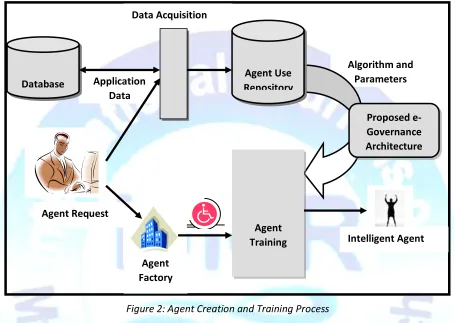
This process provides the agent’s intelligent behaviour, depending on the user’s navigation and the interest. The agent will be finally trained, interacting with the Agent Training Module, which will embed the intelligent behaviour on the agent in the form of decision rules [13]. The whole creation process needs to be repeated for each agent in a multi-agent system. In such systems, some agents may be learning agents and others may only preserve their static initial behaviour throughout time [14].
used by e-Governance system. The rules to be followed by the agent will be given by the Agent factory and the agent is trained according to that.
Figure 2: Agent Creation and Training Process
In the initial process, the user is submitting a job to the developed system. The application data is retrieved from the given repository. In this case, it is assumed that the data is already cleaned and transformed into the necessary form. The properties to be used and characteristics of the agents are defined already and stored in the Agent Use Repository. Depending upon the problem domain, the available data mining algorithms are chosen with the necessary parameters. This archival database is also referred by the intelligent agent program, before the system gives the final result to the user. In order to produce better and accurate results, the intelligent agents are trained and the results are analysed more deeply.
Intelligent agents can be fired off to collect necessary information from a variety of sources. In addition, information agents can be activated remotely over the network or can trigger on the occurrence of a certain event and start an analysis operation. Finally, agents can help navigate and model the World-Wide Web [15], another are a growing in importance.
8.Proposed Algorithms
User Interface Agent
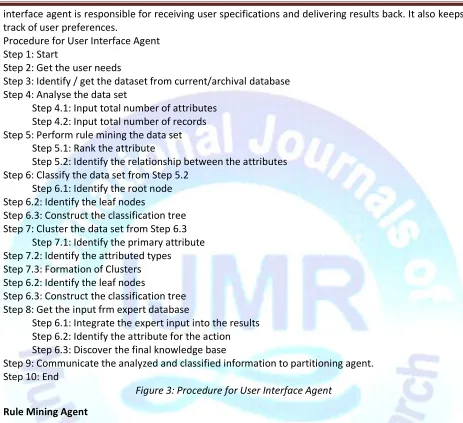
The user interface agent interacts with the user in assisting the use to perform data analysis The user can provide a general description of the problem at hand in terms of high level goals and objectives, or provide specific details about the data analysis or mining task to be performed. The user
Agent Request
Algorithm and Parameters Application
Data
Data Acquisition
Database Repository Agent Use
Agent Training
Proposed e-Governance Architecture
Intelligent Agent
interface agent is responsible for receiving user specifications and delivering results back. It also keeps track of user preferences.
Procedure for User Interface Agent Step 1: Start
Step 2: Get the user needs
Step 3: Identify / get the dataset from current/archival database Step 4: Analyse the data set
Step 4.1: Input total number of attributes Step 4.2: Input total number of records Step 5: Perform rule mining the data set
Step 5.1: Rank the attribute
Step 5.2: Identify the relationship between the attributes Step 6: Classify the data set from Step 5.2
Step 6.1: Identify the root node Step 6.2: Identify the leaf nodes
Step 6.3: Construct the classification tree Step 7: Cluster the data set from Step 6.3
Step 7.1: Identify the primary attribute Step 7.2: Identify the attributed types
Step 7.3: Formation of Clusters Step 6.2: Identify the leaf nodes
Step 6.3: Construct the classification tree Step 8: Get the input frm expert database
Step 6.1: Integrate the expert input into the results Step 6.2: Identify the attribute for the action Step 6.3: Discover the final knowledge base
Step 9: Communicate the analyzed and classified information to partitioning agent. Step 10: End
Figure 3: Procedure for User Interface Agent
Rule Mining Agent
Rule mining agent is an agent which helps in constructing the rules for the association rule mining technique. Rule mining agent communicates with the user interface agents and identifies the attributes closely related to each other.
Procedure for Rule Mining Agent
Step 1: Start
Step 2: Get the analyzed information from the user interface agent
Step 3: Select the rule mining technique method and attributes
Step 4: Construct the rule
Step 5: Call the Classification Agent
Step 5: End
Classification Agent
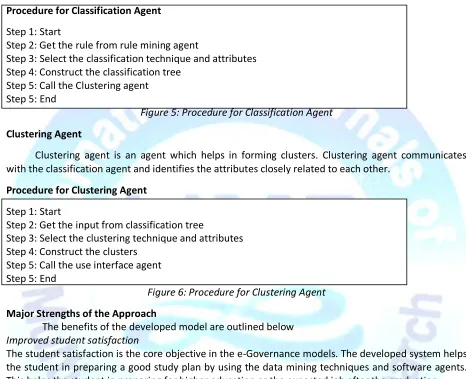
Classification agent is an agent which helps in tree construction. Classification agent communicates with the rule mining agent and identifies the attributes closely related to each other.
Procedure for Classification Agent
Step 1: Start
Step 2: Get the rule from rule mining agent
Step 3: Select the classification technique and attributes Step 4: Construct the classification tree
Step 5: Call the Clustering agent Step 5: End
Figure 5: Procedure for Classification Agent
Clustering Agent
Clustering agent is an agent which helps in forming clusters. Clustering agent communicates with the classification agent and identifies the attributes closely related to each other.
Procedure for Clustering Agent
Step 1: Start
Step 2: Get the input from classification tree
Step 3: Select the clustering technique and attributes Step 4: Construct the clusters
Step 5: Call the use interface agent Step 5: End
Figure 6: Procedure for Clustering Agent
9. Major Strengths of the Approach
The benefits of the developed model are outlined below a. Improved student satisfaction
The student satisfaction is the core objective in the e-Governance models. The developed system helps the student in preparing a good study plan by using the data mining techniques and software agents. This helps the student in preparing for higher education or the expected job after the graduation. b. Promotes student academic success
Any academic institution will always be interested in the success of the student academically. The developed model helps the student in succeeding their academic life by way of providing knowledge and thus help the student in being placed in a reputed job place / enrolled in higher education.
c. Enhance efficiency
All the organizations are working in improving efficiency in all the aspects in their activities. The academic institutions are more concentrating in this aspect to improve the efficiency in terms of producing quality and job ready graduates. The developed system increases the organizational efficiency, faculty efficiency and student efficiency.
d. Improve overall e-Governance quality
10. Conclusion
E-Governance in higher educational institution is very important in the academic system and it is the duty of the Universities/Colleges to use the appropriate technologies and providing the best available knowledge to the student community. This research work clearly shows that, the e-Governance model with the help of software agents will surely benefit the faculty/student. The developed model provides the administration with a set of possible courses that can be offered in a semester. With this input, the management can plan for expertise and other resources needed effectively.
References:
1.
JaphetOtike, E – Government: Its Role, Importance and Challenges, School of Information Sciences, Moi University, Eldoret, Kenya, 20122.
William Sheridan, Thomas B. Riley, Comparing e-Government Vs. e-Governance, Commonwealth Centre for e-Governance, Canada, 20103.
Dr. R. K. Shrivastava, Dr. A.K. Raizada, Mrs. Neeta Saxena, Role of e-Governance to strengthen higher education system in India, IOSR Journal of Research & Method in Education (IOSR-JRME) e-ISSN: 2320– 7388,p-ISSN: 2320–737X Volume 4, Issue 2 Ver. I (Mar-Apr. 2014), PP 57-62.4.
Leora Waldner, Dayna McDaniel, Murray Widener, E-Advising Excellence: The New Frontier in Faculty Advising, MERLOT Journal of Online Learning and Teaching, Vol. 7, No. 4, December 20115.
Mostafa and Nermin Khalifa, The Role of Semantic Expansion Network in E-advising, Business Information System Department (BIS), Arab Academy for Science and Technology and Maritime Transport (AAST), Alexandria, Egypt,2012 International Conference on Management and Education Innovation IPEDR vol.37 (2012) © (2012) IACSIT Press, Singapore.6.
Jiawei Han, Micheline Kamber, and Jian Pei, Data Mining: Concepts and Techniques, 3rd edition, Morgan Kaufmann, 2011.7.
Bruce C. Gabrielson, “Security Using Intelligent Agents and Data Mining”, CenterFor Information Security Technology Science Applications. International Corporation Columbia, MD, June 29, 1999.8.
Raymond S.T. Lee, James N.K. Liu, “IJADE Web-Miner: An intelligent frame work for Internet shopping” ,IEEE Transactions on Knowledge and Data Engineering, Vol 16, No 4, April 2004, Page No: 461-472.
9.
Jiming Liu, Shiwu Zhang and Jie Yang, “Characterising web usage regularities with information foragingagents” , IEEE Transactions on Knowledge and Data Engineering, Vol 16, No 5, May 2004, Page No: 566-582