Volume 2006, Article ID 85870, Pages1–8 DOI 10.1155/ASP/2006/85870
H.264 Layered Coded Video over Wireless Networks:
Channel Coding and Modulation Constraints
M. M. Ghandi, B. Barmada, E. V. Jones, and M. Ghanbari
Department of Electronic Systems Engineering, University of Essex, Wivenhoe Park, Colchester CO4 3SQ, UK
Received 13 July 2005; Revised 16 December 2005; Accepted 18 February 2006
This paper considers the prioritised transmission of H.264 layered coded video over wireless channels. For appropriate protection of video data, methods such as prioritised forward error correction coding (FEC) or hierarchical quadrature amplitude modulation (HQAM) can be employed, but each imposes system constraints. FEC provides good protection but at the price of a high overhead and complexity. HQAM is less complex and does not introduce any overhead, but permits only fixed data ratios between the priority layers. Such constraints are analysed and practical solutions are proposed for layered transmission of data-partitioned and SNR-scalable coded video where combinations of HQAM and FEC are used to exploit the advantages of both coding methods. Simulation results show that the flexibility of SNR scalability and absence of picture drift imply that SNR scalability as modelled is superior to data partitioning in such applications.
Copyright © 2006 Hindawi Publishing Corporation. All rights reserved.
1. INTRODUCTION
Within a given bandwidth, the capacity of a communication
channel is determined by its signal-to-noise ratio (SNR) [1]
which can vary widely. Ideally, a service such as video over wireless networks should adaptively change its information rate according to the available channel capacity. For exam-ple, low SNRs can only support a low source rate and re-quire a high protection of contents, and conversely for high SNRs, a high source rate can be transmitted with less
pro-tection [2]. However, this ideal adaptation is not feasible in
many applications where the transmitter has no knowledge of the channel conditions such as in video broadcasting. The solution might be a conservative design which only considers low SNRs and so would have a low throughput at high SNRs. Alternatively, unequal error protection (UEP) has been pro-posed in which only an essential portion of the source con-tents are protected for low SNRs and the rest would be
avail-able only at higher SNRs [3,4].
To achieve UEP for a video service, two distinct consid-erations are required. First, the contents of the coded video should be divided into layers that classify their importance. This can be achieved, for example, by the data partitioning
of the H.264 standard1 [5]. Secondly, the network should
offer a different protection against noise for each layer. Let
1H.264 is also called MPEG-4 part 10 advanced video coding (AVC), but
throughout this paper for convenience we call it H.264.
us assume there is a high-priority (HP) and a low-priority
(LP) layer with the corresponding source bit ratessHP and
sLP. One solution to achieve UEP is to incorporate
priori-tised forward error correction codes (FEC) with coding ra-tiosRHP < RLP which means greater coding protection for
the HP layer. Hence, the total required channel rate (the sum of HP and LP channel rates) becomes
ch=chHP+ chLP=RsHP
HP
+ sLP
RLP.
(1)
Assuming the unequal channel-coding ratios,RHP and
RLP, are constant, then in order to have a constant total
chan-nel rate (ch), not only the total source rate (sHP+sLP) should
be fixed, but also the allocation betweensHPandsLPneeds to
be constant. In other words, both source bit ratessHPandsLP
should be at constant rates—a condition which is not met in the case of data partitioning.
Another alternative for UEP is hierarchical quadrature
amplitude modulation (HQAM) [6] in which the two most
significant bits (MSBs) of each transmitted symbol with a gray mapping have a better immunity against the noise than the remaining least significant bits (LSBs). Although HQAM does not impose as much complexity on the system as FEC does, it is more limiting in that the fixed number of
MSBs and LSBs requires chHPand chLPto be constant.
0 2 4 6 8 10 12
Fr
am
e
le
n
gt
h
(k
b
it
s)
0 10 20 30
Frame number Prioritised FEC with
switchingRLP
Data after adding prioritised FEC
Total source contents
HP layer
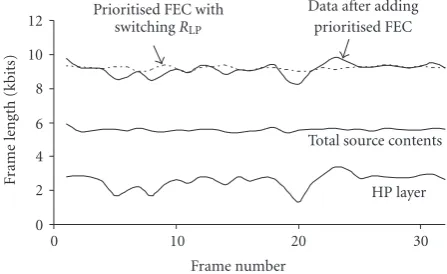
Figure 1: A constant rate data-partitioned video (48 kbps) after adding UEP (for Foreman QCIF test sequence at 10 Hz, withRHP=
1/2,RLP=3/4).
partitioning, since the proportion of the HP and LP source rates cannot be easily controlled, we consider switching the channel-coding ratios in a prioritised FEC scenario as
ex-plained inSection 2. We then employ our switched multilevel
HQAM [7] and show that a combination of switched HQAM
and fixed FEC results in a better performance. However, data
partitioning still suffers from picture drift where receiving
the HP layer alone can lead to the accumulation of errors in pictures. Hence, we consider a drift-free H.264 SNR-scalable
solution [8] and analyse its practical limitations inSection 3.
In the simulation results ofSection 4we show that the
flex-ibility of SNR scalability is better able to withstand the net-work constraints and is superior to data partitioning in UEP scenarios.
2. UNEQUAL ERROR PROTECTION WITH DATA PARTITIONING IN H.264
2.1. UEP-DP with switched prioritised FEC (switched turbo coding)
In the data-partitioning mode of H.264, each slice is divided into three network abstraction layer (NAL) units. NAL-A, the most important unit, carries addressing and motion data and NAL-B and NAL-C carry the intra- and interresidual data. In this work, we consider NAL-A as the HP layer and group both NAL-B and NAL-C into the LP layer. By adjust-ing the quantisation parameter, one can control the overall
source rate (sHP+sLP) for an acceptable low-delay
transmis-sion. However, in a constant bit rate stream, the bit rate of
the HP layer is still variable (Figure 1) under the influence of
picture contents and the motion of objects. Therefore, after adding the protection bits to this layer, the total channel data
rate (1) is still variable in spite of the efforts of the source rate
control.
To maintain a constant channel rate in UEP-DP, the
channel-coding ratios (RHP andRLP) should be frequently
adjusted with respect to the size of the HP and LP layers. We note that the main priority must be the HP layer. Thus, we do
not compromise its protection (we fixRHPwhatever the size
of the HP layer) and only varyRLPto maintain a fixed total
channel rate. In this paper, we allocate 60% of each
transmit-ted packet to the source data and 40% to the parity.Figure 2
depicts the different switching modes in our UEP-DP with
their corresponding capacities for the HP and LP source data.
When loading packets of each frame to a smoothing buffer,
the actual percentage between the HP and LP source units is
calculated and the appropriate mode fromFigure 2that
of-fers the closest HP and LP ratios is selected. Note that the selected mode is reported to the receiver in order to per-form the corresponding channel decoding procedure. This very low-rate control data can be transmitted reliably, and in this paper it is assumed to be error-free.
The above FEC approach has certain limitations. For ex-ample, its parity bit overhead is high such that with a limited channel rate, the source rate must be restricted to very low values. However, reducing the source rate in data-partitioned video will increase the proportion of the HP layer, as the mo-tion informamo-tion becomes the dominant part of the data. This further limits the system performance because the LP
layer will have less opportunity for protection, that is,RLP
will be more often switched to 1/1. To overcome this
prob-lem, we employ HQAM to offer prioritisation as discussed
below.
2.2. UEP-DP with combined FEC and switched HQAM
A conventional square M-HQAM constellation [6] offers two
levels of priority, where M (≥16) denotes the number of sig-nal points in the constellation. HP data bits occupy the two most significant bits of each point label while LP data occu-pies the remaining bits (i.e., 2 bits for 16- and 4 bits for
64-HQAM).Figure 3(a)shows such a constellation diagram for
2-level 64-HQAM, where the distances between quadrants (a
in Figure 3(a)) and between points inside each quadrantb
are adjusted such thata > b, giving a distance factorα=a/b.
For a given average signal power, increasing the value ofα
in-creases the HP protection, but dein-creases the LP protection, thus providing a simple UEP. However, the fixed number of
MSBs and LSBs requires the channel rates chHPand chLPto
be constant and as noted earlier, for data partitioning there is no such constant relationship. We therefore resort to a multi-level HQAM to switch the HP and LP bit lengths as explained below.
In a multilevel HQAM [9] the constellation points are
placed in such a way that groups of bits within the point label have similar degrees of protection as illustrated in the
con-stellation diagram ofFigure 3(b)for 3-level 64-HQAM. Two
distance factors are now introducedα =a/b, andβ= b/c.
The values of α andβ will determine the system “mode.”
Mode-1 withα = β = 1, is a nonhierarchical QAM where
all bits have the same immunity to noise and could be
as-signed to LP data. In mode-2, by settingα >1 (andβ=1)
the conventional HQAM is achieved, that is, there are 2 HP
bits and 4 LP bits. Finally, mode-3 withα = 1 andβ > 1,
Mode 1:
Mode 2:
Mode 3:
Mode 4:
RHP=1/2
RLP=1/1
RHP=1/2
RLP=3/4
RHP=1/2
RLP=2/3
RHP=1/2
RLP=3/5
HP source 40%
HP parity 40%
LP source 20%
HP source 30%
HP parity 30%
LP source 30%
LP parity
10%
HP source 20%
HP parity 20%
LP source 40%
LP parity 20%
LP source 60%
LP parity 40%
Figure2: Capacity of a transmitted packet in switched turbo-coded UEP-DP.
a c b
(a) Mode-2:α = a/b = 1.5, β=b/c=1
a c b
(b) Mode-3:α=a/b=1,β= b/c=2
Figure3: Hierarchical constellations for 64-QAM.
protection remains unchanged as shown inFigure 4withα
andβvalues as listed on the figure. What actually changes
with this switching arrangement is the protection of the
LP bits, similar to the switching of Section 2.1. For more
details of this switched HQAM the readers are referred to
[7].
The improved HP protection offered by HQAM is at the
price of a lower noise immunity for the LP layer. In order to improve the protection of the layers, we can incorporate channel coding before modulation to shift the BER curves ofFigure 4towards the desired SNR region. This
combina-tion of switched HQAM and fixed FEC offers a number of
advantages. Firstly, we can add protection with a constant channel-coding ratio for both HP and LP layers. Therefore, the LP data will never be transmitted unprotected, as op-posed to the switched FEC where we often need to switch
RLPto 1/1. Secondly, the protection of the HP layer becomes
better than expected, as the high reliability of the HP bits
soft information will improve the effectiveness of the turbo
coding employed in this work. In simulation results we will show that this combination performs better than switched FEC. However, in the following we introduce another UEP solution with a proposed SNR scalability source coding
ar-rangement which performs even better than the best effort
UEP-DP.
3. UNEQUAL ERROR PROTECTION FOR H.264 SNR SCALABILITY
In this work we employ our H.264 SNR-scalable codec
de-scribed in [8], which follows the general framework of SNR
scalability defined in the standard video codecs [10]. The HP
(base) layer of the scalable video is a fully standard compli-ant bitstream with a coarse qucompli-antisation step size while the LP (enhancement) layer contains additional data with a finer quantiser step size to enhance the video quality. Therefore, reception of the HP layer alone will give a drift-free service which is a desirable feature. Moreover, the existence of quan-tisation in both layers provides a flexibility to control the
rates of the individual layers independently.Figure 5shows
the average HP source rate percentage for a wide range of total source rates from 10 kbps to 200 kbps (66% confidence
limits, i.e.,±one standard deviation are also shown). As we
see in data partitioning, the portion of the bit rate assigned to the high-priority layer varies with the overall rate. That is
why we need the complex adaptation described inSection 2.
On the other hand with SNR scalability, asFigure 5shows,
1.E 05 1.E 04 1.E 03 1.E 02 1.E 01
BER
10 15 20 25 30
SNR (dB) HP
Mode-1: 0 bits Mode-2: 2 bits Mode-3: 4 bits
LP Mode-1: 6 bits Mode-2: 4 bits Mode-3: 2 bits
α β
Mode-1 1 1 Mode-2 1.5 1 Mode-3 1 2
Figure4: BER versus SNR for LP and HP bits for three HQAM modes.
10 20 30 40 50 60 70 80
HP
ra
te
(
sHP
)t
o
ta
l
(%
)
0 50 100 150 200
Total source rate (sLP+sHP) (kbps)
Standard deviation
Data partitioning Scalability, HP 50%
Scalability, HP 33% Scalability, HP 25%
Figure5: Mean HP source rate percentage (with±1 standard de-viation) versus total source rate, Foreman QCIF at 10 Hz.
However, the drawback of SNR scalability is its higher overhead compared with data partitioning, resulting in lower
picture quality for the same bit rate. This is shown inFigure 6
for a total source rate of 50 kbps. As can be seen, although
scalability can offer a flexible range of HP percentages while
data partitioning offers only one, the overhead has caused
a drop in the total peak signal-to-noise ratio (PSNR) of up to 1 dB. However, this penalty reduces with a lower HP per-centage because the entropy coding of the enhancement layer
improves as the data fraction reduces [8]. It should also be
noted that it is generally desirable to keep the HP bit rate as low as possible. This is because lower HP rates contribute to a significantly lower overall channel rate on account of the FEC process and also reduce the average transmitter power of the
HQAM. However, asFigure 6shows, lowering the HP rate
means a poorer HP quality and the rate and quality degrada-tion of the base layer below 20% of the total rate is steep. On the other hand, an HP proportion above 40% means little contribution of the LP layer to the overall picture quality. Thus, we should limit the HP percentage to around 20% to
40% to ensure a balance between efficiency and quality. In
20 22 24 26 28 30 32 34
Y
-PSNR
(dB)
10 20 30 40 50 60
HP rate of total (%) SNR-scalable HP + LP layers SNR-scalable HP layer only
Data-partitioned HP + LP layers
Data-partitioned HP layer only
Figure6: PSNR as a function of the proportion of HP source rate: 100×sHP/(sHP+sLP), Foreman QCIF at 10 Hz,sHP+sLP=50 kbps.
the following sections the incorporation of SNR scalability with UEP is discussed.
3.1. UEP-SCAL with prioritised FEC
Since the HP and LP source rates of the scalable video can be flexibly controlled, its unequal error protection does not require frequent switching as it does with data partitioning.
Hence, fixedRHPandRLP values can be selected for the
lay-ered protection of contents. However, to select proper rates,
different constraints do exist. As noted above, the
propor-tion of the HP source rate (sHP) should be within the region
of good efficiency. Secondly,RHPandRLP should be
deter-mined such that the total channel rate (1) does not exceed the
maximum available rate. These relationships are illustrated inFigure 7forRHP=1/3 andRLP =4/5. It can be seen that
only a limited region can be accepted as the practical
adjust-ment betweensHP andsLP. However, even in this area, the
rate of the HP layer is very low and will have a poor quality.
One solution is to increaseRHPwhich means compromising
HP protection. A better solution is to use HQAM which does not impose any overhead.
3.2. UEP-SCAL with combined FEC and HQAM
As mentioned inSection 2.2, the constraint on the HQAM is
that its HP and LP capacities are constant. For example, for
64-HQAM, chHPis 33% of the total channel rate. If there is
no FEC, this will be the required percentage of thesHPwhich
is easily obtainable by our SNR-scalable codec. Therefore, for
SNR scalability, we do not need to frequently changeαand
βas inSection 2.2, so the use of conventional HQAM is
suf-ficient. Thus, SNR-scalable video transmission with HQAM would be a simple and practical solution for many
applica-tions. The value ofαsimply determines how much
0 20 40 60 80 100
Sour
ce
/c
hannel
rat
e
o
f
total
(%)
0 20 40 60 80 100
chHPof total (%)
LP parity
DecreasingRLP
LP source rate (sLP)
HP source rate (sHP)
HP parity
20%< sHP<40%
IncreasingRHP
ch
HP
chLP
Figure7: Source and channel rates for an FEC UEP scalable video withRHP=1/3 andRLP=4/5.
In some applications, the quality of the channel is so poor that there is no option but to add FEC to the coded source data. For a UEP scalable video using HQAM, we can add FEC with a single channel-coding ratio for both HP and LP layers and leave the task of UEP distinction completely to HQAM
by adjustingα. In this caseRHP =RLPand hence the source
rate percentage remains unchanged.
Alternatively, we may wish to add different FEC to the
two layers. In this caseRHP=RLP, and the 64-HQAM
limita-tion that chHPshould be 33% limits the flexibility of choices,
that is, the source rates will be dictated to the codec by the
selectedRHPandRLP:
sHP=0.33×ch×RHP, sLP=0.66×ch×RLP, (2)
where ch is the total available channel rate. Therefore, we should be careful that the HP rate percentage does not move outside the practical range. For a combined HQAM and FEC, we leave the task of UEP entirely to HQAM, which only changes levels of protection, leaving source and chan-nel rates unchanged. As mentioned earlier, the combination of HQAM and turbo coding will add a protection to the HP layer that even the turbo coding alone with a lower channel-coding ratio cannot achieve. Therefore, for the same level of protection we can transmit more source information with this combination, than with turbo coding alone. This is evi-dent from our simulation results.
4. SIMULATION RESULTS
The unequal-error-protected transmission of data-partition-ed and SNR-scalable coddata-partition-ed video have been simulatdata-partition-ed in a Gaussian channel as well as in a fading environment (COST
207 model [11]) with a constant total channel rate of ch =
100 kbps. For forward error correction we employed turbo
codes with generators G1 =5 and G2=7 and a Log-MAP
algorithm with three iterations in the decoder. Other turbo
coding (TC) parameters are the same as detailed in [12]. The
received bits passed to the decoder include their reliabilities extracted from the soft demapping process for HQAM as in
[13].
For all the tests, the Foreman QCIF sequence at 10 Hz is used with a total length of 33 frames comprising NAL-units of no more than 150 bytes long. The first frame is an error-free intraframe and the rest are P-frames. The reason we did not consider more frames is that for data partition-ing, the drift and so the average quality (which is the princi-ple criterion in this paper) are directly related to the number of P-frames. We assumed that after 33 frames, an intraframe would stop the propagation of errors. For confidence, we ran each experiment 100 times and recorded the average results. We should mention that— although not demonstrated for brevity—these experiments have been repeated for the News video sequence and similar trends have been observed.
The PSNR of pictures versus channel symbol SNR is
de-picted inFigure 8for two UEP-DP scenarios in a Gaussian
and a fading channel. The source rate of the data-partitioned video for both cases is 60 kbps while the remaining 40 kbps of the channel rate is dedicated to the FEC codes. As a bench-mark, three nonlayered cases are also included in the
fig-ure (shown dotted) with different source rates and
channel-coding ratios as listed on the figure. It can be seen that our switched HQAM combined with fixed TC has outperformed the switched TC alone. For the HP part (low SNRs), it has
provided a better protection even with a higherRHP, and for
the LP part the advantage of the combined method is
evi-dent. Comparing Figures8(a)and8(b)it can be seen that
higher channel SNR is required for the fading channel than for the Gaussian for the same service but the advantage of the combined method is evident.
Comparing the UEP-DP graphs with the nonlayered ones is also interesting. When the entire channel rate is dedicated
to the source, that is,s=100 kbps andR=1/1, the service
20 25 30 35 40
A
ver
age
Y
-PSNR
(dB)
8 13 18 23 28
Channel SNR (dB)
Nonlayered 33 kbps (R=1/3) Nonlayered 60 kbps (R=3/5) Nonlayered 100 kbps (R=1/1) UEP-DP 60 kbps switched TC UEP-DP 60 kbps switched HQAM + TC
(a) In a Gaussian channel
20 22 24 26 28 30 32 34 36 38 40
A
ver
age
Y
-PSNR
(dB)
8 13 18 23 28 33 38 43 48
Channel SNR (dB) Nonlayered 33 kbps (R=1/3) Nonlayered 60 kbps (R=3/5) Nonlayered 100 kbps (R=1/1) UEP-DP 60 kbps switched TC UEP-DP 60 kbps switched HQAM + TC
(b) In a fading channel
Figure8: Foreman QCIF at 10 Hz, UEP-DPsHP+sLP =60 kbps, with switched TC:RHP =1/2,RLP = {3/5, 2/3, 3/4, and 1/1}, and with
switched HQAM combined with fixed TC:RHP=RLP=3/5.
15 20 25 30 35 40
Y
-PSNR
(dB)
0 10 20 30 40 50 60 70 80 90 100 Frame number
DP HP + LP SCAL HP + LP
SCAL HP layer only
DP HP layer only First 33 frames
Figure9: Error-free frame-by-frame PSNR, 10 seconds of Foreman QCIF@10 Hz, data-partitioned (DP):sHP+sLP =60 kbps, and SNR
scalable (SCAL):sHP=20 kbps,sLP=40 kbps.
is because turbo coding in the fading channel does not per-form as good as in the Gaussian channel. However, in a con-servative design, by dedicating 66 kbps of the channel rate
to the FEC (s =33 kbps, R =1/3) a video service is
avail-able over a wide SNR range with even a better quality than UEP-DP at the lower SNRs. This is the price to pay for un-equal error protection with data partitioning, where much of this degradation is the result of picture drift. In fact, if more than 33 consecutive P-frames had been selected, the average PSNRs of UEP-DP would have been even worse. This can be
observed fromFigure 9where it is clear that even the
error-free reception of the HP layer alone for data partitioning does not provide a stable picture quality.
However, the dotted plot in Figure 9 shows that SNR
scalability does not suffer from picture drift, so we can
ex-pect better results from UEP-SCAL especially because the
channel-coding ratios are fixed.Figure 10demonstrates the
average PSNRs for UEP-SCAL with turbo coding alone
(RHP = 1/3,RLP =4/5) and with a combined HQAM and
TC (RHP=RLP=3/5,α=1.5). The advantage of our
com-bined method is evident from the figure; it allows a higher
sHPfor yet a better HP protection. Comparing with the
con-servative nonlayered curve (R=1/3) at low SNRs, the
UEP-SCAL with the combined method has offered a video service
with somewhat less quality. However, at the other extreme for higher SNRs, it gives more than 2 dB improvement on the video quality. This is the desired graceful service charac-teristic of a layered codec.
Figure 11now compares the best effort data partitioned
20 25 30 35 40
A
ver
age
Y
-PSNR
(dB)
8 13 18 23 28
Channel SNR (dB) Nonlayered 33 kbps (R=1/3) Nonlayered 60 kbps (R=3/5) Nonlayered 100 kbps (R=1/1) UEP-SCAL HQAM + TC UEP-SCAL TC alone
(a) In a Gaussian channel
20 22 24 26 28 30 32 34 36 38
A
ver
age
Y
-PSNR
(dB)
13 16 19 22 25 28 31 34 37 40
Channel SNR (dB) Nonlayered 33 kbps (R=1/3) Nonlayered 60 kbps (R=3/5) UEP-SCAL HQAM + TC UEP-SCAL TC alone
(b) In a fading channel
Figure10: Foreman QCIF@10 Hz, UEP-SCAL with turbo coding alone:sHP=16.6 kbps,RHP=1/3,sLP=40 kbps,RLP=4/5, and combined
HQAM and turbo coding:sHP=20 kbps,sLP=40 kbps,RHP=RLP=3/5,α=1.5.
20 25 30 35 40
A
ver
age
Y
-PSNR
(dB)
8 13 18 23 28
Channel SNR (dB) UEP-DP switched HQAM + TC UEP-SCAL HQAM + TC
(a) In a Gaussian channel
20 22 24 26 28 30 32 34 36 38
A
ver
age
Y
-PSNR
(dB)
13 16 19 22 25 28 31 34 37 40
Channel SNR (dB) UEP-DP switched HQAM + TC UEP-SCAL HQAM + TC
(b) In a fading channel
Figure11: Best effort UEP-DP and UEP-SCAL, selected from Figures8and10.
(UEP-SCAL) of Figure 10. For both Gaussian and fading
channels, it can be seen that SNR scalability has clearly
outperformed the best effort UEP-DP at lower SNRs with a
relatively small penalty at high SNRs as a result of its over-head. As explained earlier this superiority has two
explana-tions: SNR scalability does not suffer from picture drift, and
secondly, it can flexibly cope with the constraints imposed by the hierarchical QAM.
5. CONCLUSION
We have shown that by combining HQAM and turbo coding,
a more effective unequal-error-protected video transmission
ACKNOWLEDGMENT
This work has been supported by the Engineering and Phys-ical Sciences Research Council (EPSRC) of the UK.
REFERENCES
[1] C. E. Shannon, “A mathematical theory of communication,” The Bell Systems Technical Journal, vol. 27, pp. 379–423, 623– 656, 1948.
[2] A. J. Goldsmith and S.-G. Chua, “Adaptive coded modulation for fading channels,”IEEE Transactions on Communications, vol. 46, no. 5, pp. 595–602, 1998.
[3] L. Cheng, W. Zhang, and L. Chen, “Rate-distortion opti-mized unequal loss protection for FGS compressed video,” IEEE Transactions on Broadcasting, vol. 50, no. 2, pp. 126–131, 2004.
[4] M. Gallant and F. Kossentini, “Rate-distortion optimized lay-ered coding with unequal error protection for robust inter-net video,”IEEE Transactions on Circuits and Systems for Video Technology, vol. 11, no. 3, pp. 357–372, 2001.
[5] ITU-T, “Advanced video coding for generic audiovisual ser-vices,” ITU-T Recommendation H.264, May 2003.
[6] ETSI, “Digital video broadcasting (DVB); framing structure, channel coding and modulation for digital terrestrial televi-sion,” EN 300 744, V1.4.1, 2001.
[7] B. Barmada, M. M. Ghandi, M. Ghanbari, and E. V. Jones, “Prioritized transmission of data partitioned H.264 video with hierarchical QAM,” IEEE Signal Processing Letters, vol. 12, no. 8, pp. 577–580, 2005.
[8] M. M. Ghandi and M. Ghanbari, “Layered H.264 video trans-mission with hierarchical QAM,”Journal on Visual Communi-cation and Image Representation, vol. 17, no. 2, pp. 451–466, 2006.
[9] A. R. Vitthaladevuni and M. S. Alouini, “A recursive algo-rithm for the exact BER computation of generalized hierar-chical QAM constellations,”IEEE Transactions on Information Theory, vol. 49, no. 1, pp. 297–307, 2003.
[10] M. Ghanbari, Standard Codecs: Image Compression to Ad-vanced Video Coding, IEE, London, UK, 2003.
[11] T. Keller, M. Munster, and L. Hanzo, “Turbo-coded burst-by-burst adaptive wide-band speech transceiver,”IEEE Journal on Selected Areas in Communications, vol. 18, no. 11, pp. 2362– 2372, 2000.
[12] C. Berrou and A. Glavieux, “Near optimum error correct-ing codcorrect-ing and decodcorrect-ing: turbo-codes,”IEEE Transactions on Communications, vol. 44, no. 10, pp. 1261–1271, 1996. [13] B. Barmada and E. V. Jones, “Adaptive modulation and coding
for multimedia services,” inProceedings of the 5th IEE Interna-tional Conference on 3G Mobile Communication Technologies (3G ’04), vol. 503, pp. 322–326, London, UK, October 2004.
M. M. Ghandireceived his B.S. (1998) and M.S. (2001) degrees in electronics engineer-ing from the University of Tehran. After two years of industrial experience in image and video coding, he joined the Video Network-ing Group at the University of Essex in 2003 as a Senior Research Officer where he pub-lished more than 20 papers in the field of video communications. He was granted a Ph.D. degree from this university in
Febru-ary 2006. Recently, he took up the post of Hardware Multimedia
Design Engineer at 4i2i Communications in Aberdeen, Scotland. His research interests include reliable image and video transmis-sion, advanced multimedia codecs, and video transcoding.
B. Barmadagraduated from the University of Aleppo, Syria, in 1995 with a B.Eng. de-gree in computer engineering and with dis-tinction. He received his M.S. and Ph.D. de-grees from University of Essex, UK, in com-puter and information networks (2000) and layered image and video wireless transmis-sion (2005), respectively. Currently he is a Lecturer at the University of Aleppo, De-partment of Communications. His research
interests include adaptive OFDM systems, layered wireless trans-mission, and MIMO.
E. V. Jonesstarted his research career with GEC Research Laboratories later transfer-ring to the Marconi Research Laboratories. After several years of industrial telecom-munications research, specialising in high-capacity transmission systems and net-works, he joined the Department of Elec-tronic Systems Engineering at the Univer-sity of Essex where he is now a Senior Lec-turer. His current research interests include
network topologies, cellular radio network design, and adaptive modulation and coding for efficient digital transmission.
M. Ghanbariis a Professor of Video Net-working in the Department of Electronic Systems Engineering, University of Essex, United Kingdom. He is best known for the pioneering work on two-layer video coding for ATM networks, now is known as SNR scalability in the standard video codecs, which earned him the Fellowship of IEEE in 2001. He has registered for eleven interna-tional patents and published more than 300