Post-polymerisation Modification of Bio-based Polymers: Maximising the High Functionality of Polymers Derived from Biomass
Thomas J Farmer, a* James W Comerford, a Alessandro Pellis a and Tobias Robert b
* Correspondence to: Dr Thomas J Farmer, Green Chemistry Centre of Excellence,
Department of Chemistry, University of York, Heslington, York, YO10 5DD, United Kingdom, E-mail: [email protected]
a Green Chemistry Centre of Excellence, Department of Chemistry, University of York, Heslington, York, YO10 5DD, United Kingdom
b Fraunhofer Institute for Wood Research – Wilhelm-Klauditz-Institut WKI, Bienroder Weg 54E, 38108 Braunschweig, Germany
James Comerford received his PhD from the University of York (2010) and part qualified as a patent attorney from the University of Bournemouth (2012). He is a post-doctoral researcher at the Green Chemistry Centre of Excellence at York, working on the synthesis of biodegradable polyesters from bio-based monomers. His research interests cover the synthesis and modification of bio-based polymers and the development of clean synthetic routes through the utilisation of renewable platform molecules, green solvents and heterogeneous catalysis, as well as through the use of continuous flow and microwave reactors.
Tobias Robert received his PhD degree in organic chemistry from the University of Cologne (Germany) in 2010 in the group of Hans-Günther Schmalz. Because of his interest in green chemistry, he then moved to Kingston (Canada) where he worked as a postdoctoral researcher at Queen’s University in the groups of Philip Jessop and Michael Cunningham. After another postdoctoral stay with Martin Oestreich at the TU Berlin funded by the DAAD (German Academic Exchange Service), he joined the Fraunhofer-Institute for Wood Research in 2013 as scientific project leader. His main research interests focus on the development of new bio-based polymeric materials for coating and UV-curing applications.
ABSTRACT
1. INTRODUCTION
Since the emergence of the first synthetic polymers in late 19th century, this class of materials has continued to have an enormous impact on society. Although early synthetic polymers, such as nitrocellulose and cellulose acetate, were chemically modified bio-based polymers they were gradually superseded by alternatives from petrochemicals, such as nylon 6,6, poly(ethylene) or synthetic rubber. Today, polymers represent the largest proportion of the chemical industry by volume, but there are well-founded concerns over the sustainability of an industry so reliant on a diminishing non-renewable feedstock. As such the last 20 years has seen a re-emergence of interest in bio-based polymers, with many excellent reviews now covering this rapidly growing area of research.1-4 In the short-term focus has been on preparing bio-based drop-in replacements for current polymers. Examples include the production of 100% bio-based poly(ethylene) from sugar cane, or the continued efforts towards wholly bio-based PET. However, the longer-term view is towards new polymers that on a molecular level may be different to the petrochemical polymers they intend to replace, but whose properties are equivalent or even superior to products current available. At the heart of this approach to new polymers is the synthesis and use of building-block chemicals from biomass, so called platform molecules.5,6 As a definition:
“A bio-based (or bio-derived) platform molecule is a chemical compound whose
constituent elements originate wholly from biomass (material of biological origin,
excluding fossil carbon sources), and that can be utilised as a building block for the
production of other chemicals.”
heteroatoms and so the first building-blocks produced, the base chemicals, are almost entirely comprised solely of hydrogen and carbon. The small amount of functionality present (i.e. C=C or arenes) are used as points to further functionalise via reactions such as oxidations, and in doing so add chemical functionality that can be exploited downstream. One such example is the multiple oxidation of para-xylene to terephthalic acid, this required for PET synthesis. However, the pathway from biomass to platform molecules is very different as biomass is inherently comprised of components rich in heteroatoms. The major constituents of biomass; polysaccharide (e.g. cellulose, hemicellulose, starch), lignin, triglycerides and protein are full heteroatoms such as O, N and S. When these constituents are broken down to smaller molecules much of the heteroatom content remains, leaving lots of functionality for further modification. As an example cellulose can be used as a feedstock to produce 5-(hydroxymethyl)furfurfural, and this easily oxidised to 2,5-furandicarboxylic acid (FDCA), a diacid used in the production of the promising PET replacement, PEF.
Figure 1. Diverse possibilities of post-polymerisation modification (PPM) as a result of using functional bio-based monomers.
2. CHEMO-CATALYTIC SYNTHESIS OF FUNCTIONAL BIO-BASED POLYMERS
functionality found with more complex tri- and tetra-substituted monomers, the range of effective activating agents/catalysts is somewhat restrictive. This is exemplified particularly well through the use of glycerol as a trifunctional monomer; glycerol has received much attention due to its plentiful supply (especially as a by-product from bio-diesel production) and sustainability.16,17
Scheme 1. Synthetic routes to highly branched poly(glycerol sebacate) and highly linear poly(sebacoyl diglyceride).
Scheme 2. Synthesis of linear poly(glycerol sebacate) showing different regioselective products, 1,3-diacylglycerol, 1,2-diacylglycerol and triacylglycerol.
Despite promising developments, direct synthesis of bio-based polymers from functional monomers is still largely problematic due to poor selectivity offered by traditional Lewis acid catalysts and the relatively harsh reaction conditions required. Ring opening polymerisation allows preservation of reactive groups to a certain extent, but this is still not absolute and often requires multiple steps to synthesise the necessary precursors employing relatively toxic reagents/solvents and costly reaction conditions. As such, there has been increased focus on the use of enzymes as highly selective polymerisation catalysts, allowing preservation of valuable reactive species.
3. ENZYMO-CATALYTIC SYNTHESIS OF FUNCTIONAL BIO-BASED POLYMERS
difficult to obtain using traditional chemo-catalysis. For example the polymerisation of itaconic acid and its derivatives is susceptible to the high operational temperatures commonly used for polyester synthesis (150-200 °C) that might cause isomerisation to less reactive mesaconic or citraconic acid or crosslinking of the polymeric chains.28 Enzymatic catalysis on the other hand, performed under mild conditions (50 °C, solventless) allows the synthesis of linear chains maintaining the vinyl moiety available for further functionalisations.29,30 A similar situation is subsisting for bio-based monomers having primary and secondary hydroxy groups such glycerol and sorbitol. Obtaining linear polyesters from these monomers is in fact possible only when a lipase-catalysed polycondensation approach is used. The used enzyme, typically lipase B from Candida antarctica (CaLB), when operating at mild conditions is extremely selective for the primary
such as nanoparticles and resins pre-polymers that will be crosslinked (cured) in a second reaction step, as described below.
4. POST-POLYMERISATION MODIFICATION (PPM) via C=C
Alkenes are a common reactive unit found in functional bio-based polymers, with monomers such as itaconic, fumaric and muconic acid (figure 1) often used to incorporate C=C into polyester backbones. Bio-based unsaturated polyesters (UPEs) containing these three diacids are often portrayed as potential replacements to petrochemical derived maleate polyesters, with the electron-deficient nature of the C=C imparting similar reactivity, as will be discussed in later sections.35
4.1. Curing of Unsaturated Polymers via C=C
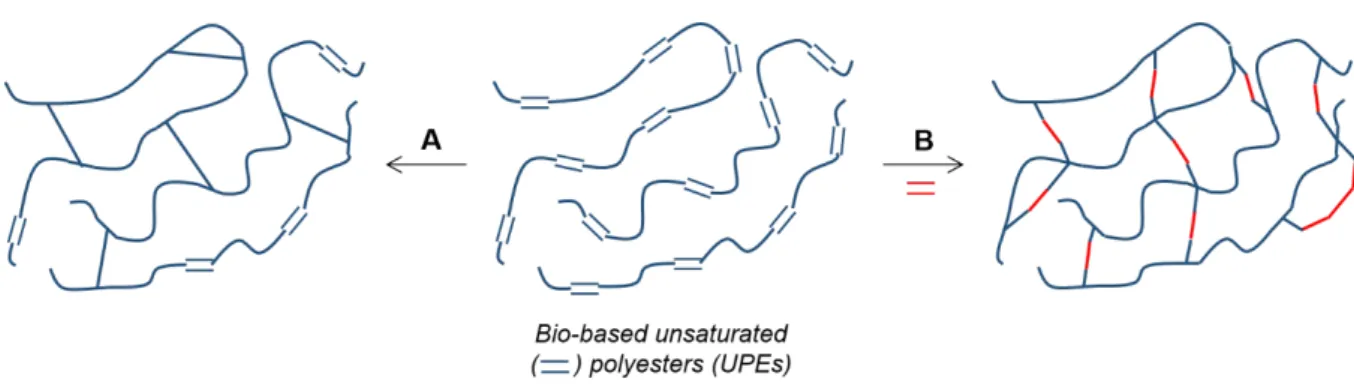
Following the typical uses of fossil-derived maleate UPEs, many of the previous studies into new bio-based UPEs first consider curing through the C=C as the major PPM pathway, producing three-dimensional cross-linked insoluble thermoset networks.36-38 The curing of bio-based UPEs can take two forms (figure 2), either with or without the addition of another curing agent / reactive diluent (acrylates, styrene, methacrylamide, divinylbenzene, N-vinyl-2-pyrrolidinone, alkylated epoxidised soybean oil etc.), many of which are not themselves bio-derived.
Scheme 3. Itaconate UPEs enhancing thermosets of acrylated epoxidised soybean oil (AESO).
Scheme 4. Itaconate UPEs cured via dialkyl itaconate reactive diluents (RDs).
A range of other diols and diacids (such as succinic, adipic and sebacic acid) have been investigated to both increase the bio-based content and to enhance further the properties of the resulting cured material.44,45 One promising example is glucose-derived bicyclic diol isosorbide, which was found to impart increased Tg and strength to the cured material as a results of increased rigidity in the UPE backbone.46-48 Similarly, 2,5-furandicarboxylic acid (FDCA) has also recently been investigated as a co-monomer in fumarate UPEs, and much like isosorbide is found in increase the Tg and thermal stability of resulting resin due to higher rigidity in the polyester backbone.49
cis-cis-Muconic is another promising renewable unsaturated dicarboxylic acid readily
and thermally initiating polymerisation (scheme 5). These partially bio-based thermoset composites possessed shear moduli in excess of 30 GPa, a value typical of current commercial petrochemical-derived composites.
Scheme 5. cis-cis-Muconic acid (MA) and succinic acid (SA) co-polyesters for the production of partially bio-based thermoset fibreglass composites.
transparency, good acetone resistance and high hardness, suggesting their potential application in coatings.
4.2. Addition of Pendants via C=C
Due to the periodically located exo-double bond in the polymer backbone, bio-based polyesters derived from itaconic are interesting structures for post-polymerisation reactions via Michael additions.53 As the first example of a reaction of this type Lv and co-workers reported aza- and thio-Michael additions of an amine and different thiols to an itaconic acid-based polyester obtained by means of acyclic diene metathesis (ADMET) polymerisation (scheme 6).54 These post-polymerisation modifications proceeded with high yields of more than 90% at ambient temperatures without the use of any catalyst, resulting in polyester-itaconates with molecular weights up 33 kg mol-1.
Scheme 6. Michael addition of different sulfur and nitrogen nucleophiles to an unsaturated polyester-itaconate.
providing a material with a temperature-controlled self-degradation with high potential for biomedical applications.
Scheme 7. Temperature dependent degradation of amine-modified polyester itaconates.
excess of nucleophiles was used in this case, while N-propylamine or LiClO4 were added in catalytic amounts. The molecular weights (Mn) obtained were very high ranging from 15 to 815 kg mol-1 with broad dispersities. This can be explained by undesired crosslinking reactions of the unsaturated double bonds.
Scheme 8. Addition of sulfur- and nitrogen nucleophiles to polyester itaconates.
Scheme 9. Synthesis of polysulfones derived from polyesters based on itaconic acid.
So far the only example of a Michael addition of C-nucleophiles was reported by Farmer et al.60,61 With their procedure, they were able to add acetylacetone and dimethyl malonate to
the -unsaturated double bond of polyester itaconates and fumarates (scheme 10). The
Scheme 10. Michael addition of acetylacetonate and dimethyl malonate to polyester itaconate.
4.3. Diels-Alder additions (1,3-cycloadditions)
Scheme 11. Fatty acid-derived poly (meth)acrylates with furan moieties than can be used as dienes.
A somewhat similar approach using furan moieties derived from furfuryl alcohol was already reported by Gandini and co-workers in 2002.65 However, in this case the furan building blocks were introduced into a polyacrylate backbone by co-polymerisation of hexylacrylate and 2-furfural acrylate, resulting in a polymer with a low percentage of renewable resources. Later, Yoshie and co-workers synthesized polyesters derived from 2,5-furandimethanol and succinic acid resulting in the incorporation of the diene into the backbone of the polymer.66,67 This kind of polyesters can also undergo reversible cross-linking with bismaleinimids by means of a Diels-Alder reaction.
4.4. Additions to isolated (non-conjugated) pendant C=C-double bonds
They modified poly(limone carbonate) PLC, which is accessible by a reaction of limonene oxide with CO2.69 They exploited the C=C double bond of the limonene moiety to add different thiols and polyethylene glycol in high conversions up to 99% (scheme 12). This lead to materials with a wide variety of applications, such as rubbers, hydrophilic and antibacterial polymers.
Scheme 12. Post-polymerisation modification of PLC.
A similar approach was undertaken by Sablong and co-workers.70 However, in this case two different marcaptoalcohols were added to the double bond to obtain a set of hydroxy-functionalized PLCs. These were then used as polyol components for polyurethane coatings and the curing kinetics was thoroughly examined.
Scheme 13. Synthesis of poly(limone dicarbonate) PLDC.
Polyesters of methylvinyl glycolate (MVG) represent another pathway to bio-based polymers containing a PPM suitable non-conjugated C=C. MVG is accessible through catalytic degradation of mono and disaccharides, and can be co-polymerised with other bio-based monomers such as lactic acid (via the lactide and the lactone of MVG).72-74 The incorporation of vinyl glycolic acid in polylactic acid-based polyesters and subsequent post-polymerisation modification via thiol-ene click chemistry allowed for tunable hydrophilicity (scheme 14), which is otherwise difficult to attain for pure poly(L-lactic acid).75
In a similar approach, Taarning et al. prepared trans-2,5-dihydroxy-3-pentenoic acid methyl ester (DPM) from pentoses using a Sn-Beta zeolite catalyst in methanol (33% yield).76 The purified DPM monomer was subsequently co-polymerised with ethyl 6-hydroxyhexanoate (E6-HH) using CaLB as catalyst, this giving polyesters with Mn over the range 5.2-1.8 kg mol -1 with higher chain lengths observed when the proportion of DPM in feed was reduced (22% relative to E6-HH). PPM was applied by reaction on either the hydroxyl (reaction with trifluoroacetic anhydride, 100% functionalisation possible, links to section 5) or the C=C (thiol-ene click, 30-100% functionalisation possible depending on sterics of thiol), this showing an improvement on the MVG study as two possible sites for PPM can be selectively exploited.
5. PPM via HYDROXY GROUPS
the polyester backbone to give lower molecular weight oligomers. Nevertheless, the resulting materials were found to have stronger physical bonding capability and enhanced elastic deformation as a result of the tyramine PPM. Taylor et al. demonstrated the ability to enhance the apparent number-average molecular weights of poly(glycerol sebacate) by crosslinking through urethane linkages via reaction with hexamethylene diisocyanate in varying concentrations (0.5 to 20 mol%) relative to polymer OH groups (scheme 15, d).23 Further to this, both You and Taylor synthesised glycerinate functionalised polymers by reaction with fluorenylmethyoxycarbonyl-(Fmoc)-protected glycine using N,N-diisopropylcarbodiimide (DIC), allowing >95% functionalisation of the OH groups, and N-tert-butoxylcarbonyl (Boc)-protected glycine using DCC to give 90% glycination and a Mn and Đ of 25.1 kg mol-1 and 1.4 respectively. De-protection to the free amine would allow the surface properties to be tailored or allow the possibility of bioconjugation through reaction with carboxylates present on amino acids, peptides, proteins, glycans or biotin, (scheme 15, e and f). Interestingly, Burdick et al. modified poly(glycerol sebacate) with 5-norbornene-2-carbonyl chloride (scheme 15, g) as way of preparing the polymer for thiol–ene click chemistry with pentaerythritol tetrakis (3-mercaptopropionate) and subsequently control amount of crosslinking. Three materials were synthesised containing 11, 15 and 19% norbornene determined by 1H NMR spectroscopy (scheme 15, h).78 Increased quantities of crosslinker resulted in materials with increased strength, whilst increased elongation was predominant in samples using lower concentrations of crosslinker.
Scheme 15. a) maleic anhydride, dimethylformamide (DMF), microwave; b) succinic anhydride, dioxane, pyridine, N2; c) tyramine, DCC / N-hydroxysuccinimide (NHS), 4-dimethylaminopyridine (DMAP), N2; d) hexamethylene diisocyanate, CHCl3; e) DIC, DMAP, CHCl3; f) DCC, DMAP, CH2Cl2; g) 5-norbornene-2-carbonyl chloride, triethylamine. h) pentaerythritol tetrakis (3-mercaptopropionate), 2,2-dimethoxy-2-phenylacetophenone UV (365 nm, 10 mW cm−2).
6. PPM via CHAIN EXTENSION
polyaddition pathway. In this field, a lot of research in the last years has been dedicated to increase the renewable content of this class of polymers. Most of the efforts have been placed on polyol components derived from bio-based building blocks. In this respect, vegetable oils,79-81 lignin,82 carbohydrates,83 and polyols from bio-based monomers have been used as polyol components.84,85 However, one of the major drawbacks in this field and the references cited above is the limited choice of diisocyanates that are to date almost exclusively derived from petrochemical resources. Therefore, the bigger challenge is to find bio-based alternatives to conventional isocyanates.
6.1. Extension Using Diisocyanates
The most straightforward approach to bio-based diisocyanates is the use of diamines derived from renewable resources. Maybe the most popular example in this field is pentamethylene diisocyanate and other polyisocyanates that are accessible from this component and are also commercially available.86 Pentamethylene diisocyanate is derived from the pentanediamine, which in turn can be obtained from glucose via a bio-technological pathway involving the decarboxylation of lysine (scheme 16).87
Scheme 16. Synthesis of pentamethylene diisocyanate from lysine.
1. By reacting the carboxylic acid with ethylchloroformat or thionylchloride, followed by an addition of sodium azide (scheme 17, a).89,90
2. By treatment with hydrazine, followed by a reaction with nitric acid (scheme 17, b).91
In both cases an acyl azide is formed, which rearranges to the corresponding isocyanate.
Scheme 17. Curtius-rearrangement of carboxylic acids to isocyanates.
However, this method is currently not applied on industrial scale and the reagents used, such as hydrazine, sodium azide, and ethylchloroformate also suffer from rather high toxicity. In addition, the latter is produced by a reaction of ethanol with phosgene, which only deflects the problem of using this critical reagent to a different stage of the process.
6.2. Non-Isocyanate Extension
Non-isocyanate polyurethanes (NIPU) have been introduced as a more sustainable alternative, as the urethane group is introduced by other more benign reaction pathways, avoiding critical reagents.
Scheme 18. Different routes to non-isocyanate polyurethanes.
The ring-opening reaction of these carbonates leads to polyurethanes with hydroxyl-groups
in -position to the urethanes. The influence of this structural difference on the properties of
the polymers compared to classical polyurethanes has been intensively studied with a significant difference in solubility and Tg to name but a few.93,97,98
A somewhat special case of this transformation is the reaction of a diamine with two equivalents of ethylene carbonate. This results in the formation of a diurethane diol, which can be further reacted with dicarboxylic acids to obtain different kinds of
polyester-polyurethanes.99 Using this method NIPUs without a hydroxyl-group in -position to the urethane can be obtained. However, it should be mentioned that this only allows for an ethylene group as linker between the ester and the urethane group (scheme 19).
Scheme 19. Synthesis of polyester-polyurethane starting from a polyurethane diol.
7. CHEMO-ENZYMATIC FUNCTIONALISATION OF SURFACES
materials.100,101 Kudanga and co-workers first functionalized beech wood pieces using a laccase-mediated approach in order to couple phenolic amines on the surface, their function to act as anchor point for subsequent coupling of a fungicide molecule.101 A similar approach was used for the coupling of different types of fluorophenols and dimer fatty amines onto flax and coconut fibres using laccase from Trametes hirsuta. The authors also noted that by using different mediators it was possible to enlarge the substrate scope and grafting efficiency of the method.102 Later in 2015 the hydrophobic surface functionalisation of jute fibers (having a middle lamella that is rich in lignin) was also achieved. A first laccase-activation step in order to create free radicals on the surface was followed by the grafting of octadecylamine leading to a hydrophobic material having a water contact angle (WCA) of 116.72° and a wetting time of 18.5 min.103 Further considering lignin, a very elegant approach of note is the enzymatic functionalisation of cork surfaces with antimicrobial hybrid biopolymer/silver nanoparticles. The group led by Prof. Tzanov used amino-functional biopolymers as doping agents to stabilize concentrated colloidal dispersions of silver nanoparticles carrying functionalities that were used in a second laccase-mediated reaction for the covalent immobilisation onto cork, this in order to obtain a durable antibacterial effect of the materials’ surface.104
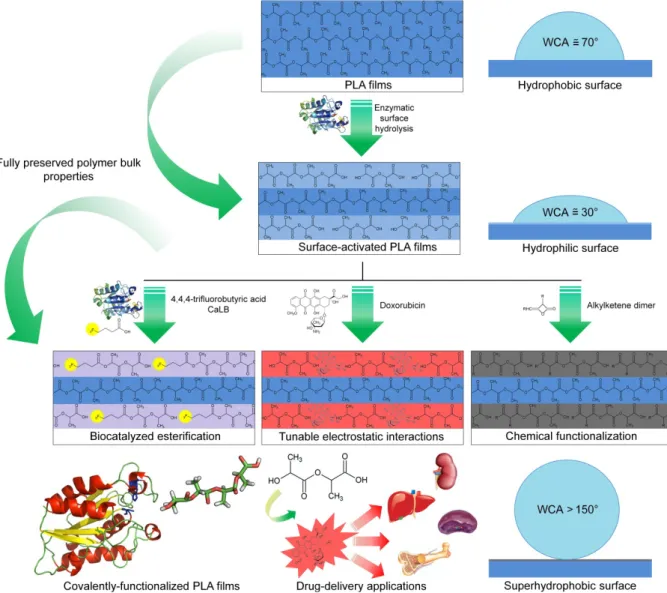
the materials’ bulk properties unaltered) followed by a functionalisation step that could be enzymatic (esterification reaction), electrostatic (polymer-drug interactions) or chemical (direct coupling on the newly created reactive surface groups).
Figure 3. Chemo-enzymatic surface functionalisations of poly(L-lactic acid surfaces) via use of the “limited surface hydrolysis” concept.
drug doxorubicin (and its subsequent controlled release in conditions mimicking the physiological environment)106 and the production of a superhydrophobic material via the chemical coupling of a stearic acid-based alkylketene dimer leading to a WCA>150° (figure 3).107
Beyond the enzymatic coupling described on polyesters above, a two enzymatic step approach was also used in order to functionalise polyamide fibres with ferulic acid. In a first step, a polyamidase from Nocardia farcinica was used to create some amino surface groups on the polymer that, in a second step, were coupled to ferulic acid using the previously reported laccase from Trametes hirsuta.108 A recent work from Song et al. focused instead on the potential of proteases for the hydrophilisation of nylon fabrics in order to create ionic groups that were stained with wool-reactive acid and basic dyes investigating the effect of several reaction parameters such as temperature, pH, enzyme concentration and reaction time.109 A recent publication also highlighted the different hydrolysis pattern between poly(ethylene terephthalate) (PET) and its bio-based counterpart poly(ethylene furanoate) (PEF). The authors, while performing the enzymatic hydrolysis of various surfaces (thin films and spin coated) noticed a remarkable 1.7 times faster hydrolysis of PEF and a strong negative effect of the polymer’s crystallinity on the hydrolysis rate.110 The enzymatic functionalization of surfaces is therefore an appealing strategy when the modification of the outer layers of polymer films and micro structures are desired but where maintaining its bulk properties is also necessary. This may not otherwise be achievable by traditional techniques like harsh chemical treatments, such as NaOH that would penetrate into the bulk of the material and deeply affecting the molecular mass and mechanical properties,106 or plasma which cannot reach the farthest corners and regions of complex structures (i.e. the functionalization of the inner part of a cylindric structure).
8. OUTLOOK
monomers and eventually to their polymers. These functional groups act as sites for post-polymerisation allowing for the properties of the final polymers to be fine-tuned to address the needs of the user. As such the increased functionality of bio-based monomers, relative to their petrochemical counterparts, should be embraced and not discarded (as they would be through the short-term view of targeting bio-based drop-in replacements to current fossil-derived monomers). This approach is succinctly captured by the concept of “bio-privileged molecules”, whereby we should be actively seeking to utilise the higher functionality of bio-based chemicals to yield new products with enhanced performance over petrochemical derived equivalents, those that bio-based polymers will eventually supplant.111
The field of PPM on bio-based polymers is rapidly growing and has significant scope for further development beyond the examples highlighted herein. New tools and techniques are continually being developed to assist those trying to exploit the functionality of bio-based polymers, but now greater details are needed on the effects these modifications have to final polymer properties, such as processability, biodegradability and cost.
DMDHHD has already been used to produce polyesters or polyamides containing C=C as sites from functionalisation, but as yet has not been exploited for PPM studies.118
This mini review also showed a mixture or both fully and partially bio-based polymers, it is indeed currently often found that either the functional group on the polymer, or the reagent it is being reacted with, is petro-chemically derived. Therefore, greater effort is required to ensure that the final polymers are wholly bio-derived, and that any procedure used to produce them is as environmentally benign. Despite this, it cannot be denied the exciting opportunity over the coming years to prepare a diverse range of tuneable polymers through the utilisation of highly functional bio-derived polymers coupled with the application of post-polymerisation modification.
ACKNOWLEDGEMENTS
TJF and JWC thanks the UK Engineering and Physical Sciences Research Council (grant EP/L017393/1) and the Biotechnology and Biological Sciences Research Council (grant BB/ N023595/1) for supporting their research into this topic. AP thanks the FWF Erwin Schrödinger fellowship (grant agreement J 4014-N34) for financial support.
REFERENCES
1. Isikgora FH and Becer CR, Polym Chem 6: 4497-4559 (2015).
2. Babu RP, O'Connor K and Seeram R, Prog Biomater 2: 8 (2013).
3. Celli A, Colonna M, Gandini A, Gioia C, Lacerda TM, and Vannini M, Polymers from monomers derived from biomass, in Chemicals and Fuels from Bio-Based Building Blocks, ed by Cavani F, Albonetti S, Basile F, and Gandini A. Wiley-VCH Verlag GmbH & Co. KGaA, Weinheim, pp 315-350 (2016).
5. Farmer TJ and Mascal M, Platform molecules, in Introduction to Chemicals from Biomass, 2nd Ed., ed by Clark JH and Deswarte FEI. John Wiley & Sons Ltd, Chichester, pp 89-155
(2015).
6. Brun N, Hesemann P and Esposito D, Chem Sci 8: 4724–4738 (2017).
7. M Dusselier M, Mascal M and Sels BF, Top chemical opportunities from carbohydrate biomass: a Chemist’s view of the biorefinery, in Selective catalysis for renewable feedstocks and chemicals, ed Nicholas KM, Springer-Verlag, Berlin Heidelberg, pp 1-40 (2014).
8. Theato P and Klok H-A (eds.), Functional polymers by post-polymerization modification: concepts, guidelines, and applications, Wiley-VCH Verlag GmbH & Co. KGaA, Weinheim
(2013).
9. Serniuk GE, Banes FW and Swaney MW, J Am Chem Soc 70:1804-1808 (1948).
10. Oliviero M, Verdolotti L, Stanzione M, Lavorgna M, Iannace S, Tarello M, and Sorrentino A, J Appl Polym Sci 134: 45113-45125 (2017).
11. Patila CK, Rajputa SD, Marathea RJ, Kulkarnib RD, Phadnisc H, Sohnd D, Mahulikara PP and Gite VV, Prog Org Coat 106: 87–95 (2017).
12. Gregory GL, Kociok-Köhnc G and Buchard A, Polym Chem 8: 2093–2104 (2017).
13. Papageorgiou GZ, Papageorgiou DG, Terzopoulou Z and Bikiaris DN, Eur Polym J 83: 202–229 (2016).
14. Arnaud SP, Wu L, Chang MAW, Comerford JW, Farmer TJ, Schmid M, Chang F, Lib Z and Mascal M, Faraday Discuss 202: 61-77 (2017).
15. Koreishi H, Tanaka Y and Miura K, Process for producing polyethylene terephthalate. PCT patent US5830981 A (1995).
16. He QS, McNutt J and Yang J, Renewable Sustainable Energy Rev 71: 63-76 (2017).
18. Zhang T, Howell BA, Dumitrascu A, Martin SJ and Smith PB, Polymer 55: 5065-5072 (2014).
19. Stumbé JF and Bruchmann B, Macromol Rapid Commun 25: 921–924 (2004).
20. Jia Y, Wang W, Zhou X, Nie W, Chen L and He C, Polym Chem 7: 2553-2564 (2016).
21. Yang B, Lv W and Deng Y, RSC Adv 7: 37426–37435 (2017).
22. You Z, Cao H, Gao J, Shin PH, Day BW and Wang Y, Biomaterials 31: 3129–3138 (2010).
23. Slavko E and Taylor MS, Chem Sci 8: 7106-7111 (2017).
24.Kobayashi S, Uyama H and Kimura S, Chem Rev 101(12): 3793-3818 (2001).
25. Gross RA, Kumar A and Kalra B, Chem Rev 101(7): 2097-2124 (2002).
26. Pellis A, Herrero Acero E, Ferrario V, Ribitsch D, Guebitz GM, Gardossi G, Trends Biotechnol 34(4): 316-328 (2016).
27. Gustini L, Lavilla C, Janssen WWTJ, Martinez de Ilarduya A, Munoz-Guerra S, Koning CE, ChemSusChem 9(16): 2250-2260 (2016).
28. Farmer TJ, Castle RL, Clark JH, Macquarrie DJ, Int J Mol Sci 16(7): 14912-14932 (2015).
29. Pellis A, Corici L, Sinigoi L, D’Amelio N, Fattor D, Ferrario V, Ebert C, Gardossi L, Green Chem 17(3): 1756-1766 (2015).
30. Corici L, Pellis A, Ferrario V, Ebert C, Cantone S, Gardossi L, Adv Synth Catal 357(8): 1763-1774 (2015).
31. Uyama H, Inada K, Kobayashi S, Macromol Rapid Commun 20: 171-174 (1999).
32. Uyama H, Inada K, Kobayashi S, Macromol Biosci 1: 40-44 (2001).
34. Vastano M, Pellis A, Immirzi B, Dal Poggetto G, Malinconico M, Sannia G, Guebitz GM, Pezzella C, Green Chem accepted, doi: 10.1039/C7GC01872J.
35. Reactive Polymers Fundamentals and Applications: A Concise Guide to Industrial Polymers, ed by Fink JK. William Andrew Publishing, Norwich NY, USA (2005).
36. Ma S, Li T, Liu X and Zhu J, Polym Int 65: 164-173 (2016).
37. Bobadea SK, Paluvaib NR, Mohantya S and Nayaka SK, Polym-Plast Technol Eng 55: 1863-1896 (2016).
38. Kumar S, Krishnan S, Samal SK, Mohanty S and Nayak SK, Polym Int 66: 1349–1363 (2017).
39. Goncalves FAMM, Fonseca AC, Domingos M, Gloria A, Serra AC and Coelho JFJ, Prog Polym Sci 68: 1–34 (2017).
40. Sakuma T, Kumagai A, Teramoto N and Shibata M, J Appl Polym Sci 107:2159–2164 (2008).
41. Dai J, Ma S, Wu Y, Han L, Zhang L, Zhu J and Liu X, Green Chem 17: 2383–2392 (2015).
42. Dai J, Ma S, Liu X, Han L, Wu Y, Dai X and Zhu J, Prog Org Coat 78: 49-54 (2015).
43. VV Panic, SI Seslija, IG Popovic, VD Spasojevic, AR Popovic, VB Nikolic and PM Spasojevic, Biomacromolecules 18: 3881-3891 (2017).
44. Fonseca AC, Lopes IM, Coelho JFJ and Serra AC, React Funct Polym 97: 1–11 (2015).
45. Brannstrom S, Malmstrom E and Johansson M, J Coat Technol Res 14: 851–861 (2017).
46. Goerz O and Ritter H, Polym Int, 62: 709–712 (2013).
48. Jasinska L and Koning CE, J Polym Sci, Part A: Polym Chem 48: 2885–2895 (2010).
49. Sousa AF, Fonseca AC, Serra AC, Freire CSR, Silvestre AJD and Coelho JFJ, Polym Chem 7: 1049-1058 (2016).
50. Rorrer NA, Dorgan JR, Vardon DR, Martinez CR, Yang Y and Beckham GT, ACS Sustainable Chem Eng 4: 6867−6876 (2016).
51. Thomsett MR, Storr TE, Monaghan OR, Stockman RA and Howdle SM, Green Mater 4: 115–134 (2016).
52. Li C, Johansson M, Sablong RJ and Koning CE, Eur Polym J 96: 337–349 (2017).
53. Robert T and Friebel S, Green Chem. 18, 2922-2934 (2016).
54. Lv A, Li Z-L, Du F-S and Li Z-C, Macromolecules 47: 7707-7716 (2014).
55. Felluga F, Pitacco G, Prodan M, Pricl S, Visintin M and Valentin E, Tetrahedron: Asymmetry 12: 3241-3249 (2001).
56. Wang Z, Wie T, Xue X, He M, Xue J, Song M, Wu S, Kang H, Zhang L and Jia Q, Polymer 55: 4846-4856 (2014).
57. Paytash PL, Sparrow E and Gathe JC, J Am Chem Soc 72: 1415-1416 (1950).
58. Chanda S and Ramakrishnan S, Polym Chem 6: 2108-2114 (2015).
59. Winkler M, Lacerda TM, Mack F and Meier MAR, Macromolecules 48: 1398-1403 (2015).
60. Farmer TJ, Clark JH, Macquarrie DJ, Ogunjobi JK, and Castle RL, Polym Chem 7: 1650-1658 (2016).
61. Clark JH, Farmer TJ and Macquarrie DJ, ChemSusChem 2: 1025–1027 (2009).
62. Goerz O and Ritter H, Beilstein J Org Chem 10: 902-909 (2014).
64. Yuan L, Wang Z, Ganewatta MS, Rahman MA, Lamm ME and Tang C, Soft Matter 13: 1306-1313 (2017).
65. Ghenheim R, Perez-Berumen C and Gandini A, Macromolecules 35: 7246-53 (2002).
66. Zeng C, Seino H, Ren J, Hatanaka K and Yoshie N, Macromolecules 46: 1794-1802 (2013)
67. Ikezaki T, Matsuoka R, Hatanaka K, Yoshie N, J Polym Sci A – Polym Chem 52: 216-222 (2014).
68. Hauenstein O, Agarwal S and Greiner A, Nature Commun 7: 11862 (2016).
69. Byrne CM, Allen SD, Lobkovsky, EB and Coates GW, J Am Chem Soc 126: 11404-11405 (2004).
70. Li C, van Berkel S, Sablong RJ and Koning CE, Eur Polym J 85: 466-477 (2016).
71. Kindermann K, Cristòfol A and Kleij AW, ACS Catal 7: 3860-3863 (2017).
72. Dusselier M, Van Wouwe P, de Clippel F, Dijkmans J, Gammon DW and Sels BF, ChemCatChem 5: 569 – 575 (2013).
73. De Clercq R, Dusselier M, Christiaens C, Dijkmans J, Iacobescu RI, Pontikes Y and Sels BF, ACS Catal 5: 5803−5811 (2015).
74. Sølvhøj A, Taarning E and Madsen R, Green Chem 18: 5448–5455 (2016).
75. Dusselier M, Van Wouwe P, De Smet S, De Clercq R, Verbelen L, Van Puyvelde P, Du Prez FE and Sels BF, ACS Catal 3: 1786−1800 (2013).
76. Elliot SG, Andersen C, Tolborg S, Meier S, Sadaba I, Daugaard AE and Taarning E, RSC Adv. 7: 985-996 (2017).
78. Yeh YC, Ouyang L, Highleya CB and Burdick JA, Polym. Chem 8: 5091- 5099 (2017).
79. Gandini A, Lacerda TM, Carvalho AJF, and Trovatti E, Chem. Rev. 116: 1637-1669 (2016).
80. Maisonneuve L, Chollet G, Grau E, and Cramail H, Oilseeds and Fats, Crops and Lipids 23: D508 (2016).
81. Noreen A, Zia KM, Zuber M, Tabasum S, and Zahoor AF, Prog Org Coat 91: 25-32 (2016).
82. Upton BM and Kasko AM, Chem Rev 116: 2275-2306 (2016).
83. Usman A, Zai K, Zuber KM, Tabasum S, Rehman S and Zia F, Int J Biol Macromol 86: 630-645 (2016).
84. Mou Z, Feng S and Chen EYX, Polym Chem 7: 1593-1602 (2016).
85. Oulame MZ, Pion F, Allauddin S, Raju KVSN, Ducrot PH and Allais F, Eur Polym J 63: 186-193 (2015).
86. Garrison TF and Kessler MR in Bio-Based Plant Oil Polymers and Composites, ed. Madbouly SA, Zhang C and Kessler MR, Elsevier, 37-54 (2016)
https://www.coatings.covestro.com/de/Products/Desmodur, accessed October 2017.
87. Ma W, Cao W, Zhang H, Chen K, Li Y and Ouyang P, Biotechnol Lett 37: 799-806 (2015).
88. Kreye O, Mutlu H and Meier MAR, Green Chem 15: 1431-1455 (2013).
89. Fu C, Zheng Z, Yang Z, Chen Y and Shen L, Prog Org Coat 77: 53-60 (2014).
90. Hojabri L, Kong X and Narine SS, J Poly Sci A: Polym Chem 48: 3302-3310 (2010).
92. Datta J and Włoch M, Polym Bull 73: 1459-1496 (2016).
93. Maisonneuve L, Lamarzelle O, Rix E, Grau E and Cramail H, Chem Rev 115: 12407– 12439 (2015).
94. Rokicki G, Parzuchowski PG and Mazurek M, Polym Adv Technol 26: 707–761 (2015).
95. Blattmann H, Fleischer M, Bähr M and Mülhaupt R, Macromol Rapid Commun 35: 1238-1254 (2014).
96. Nohra B, Candy L, Blanco JF, Guerin C, Raoul Y and Mouloungui Z, Macromolecules 46: 3771–3792 (2013).
97. Kihara N and Endo T, J Polym Sci Part A: Polym Chem 31: 2765 (1993).
98. Ochiai B, Satoh Y and T. Endo, Green Chem 7: 765, (2005).
99. Han L, Dai J, Zhang L, Ma S, Deng J, Zhang R and Zhu J, RSC Adv 4: 49471–49477 (2014).
100. Donelli I, Taddei P, Smet PF, Poelman D, Nierstrasz VA and Freddi G, Biotechnol Bioeng 103: 845-856 (2009).
101. Kudanga T, Pratseyo EN, Sipila J, Nousiainen P, Widsten P, Kandelbauer A, Nyanhongo GS and Guebitz GM, Eng Life Sci 8: 297-302 (2008).
102. Herrero Acero E, Kudanga T, Ortner A, Kaluzna I, de Wideman S, Nyanhongo GS and Guebitz GM, Polymers 6: 1676-1684 (2014).
103. Dong A, Fan X, Wang Q, Yu Y and Cavaco-Paulo A, Int J Biol Macromol 79: 353-362 (2015).
105. Pellis A, Herrero Acero E, Weber H, Obersriebnig M, Breinbauer R, Srebotnik E and Guebitz GM, Biotechnol J 10: 1739-1749 (2015).
106. Pellis A, Silvestrini L, Scaini D, Coburn JM, Gardossi L, Kaplan DL, Herrero Acero E and Guebitz GM, Process Biochem 59: 77-83 (2017).
107. Ortner A, Pellis A, Gamerith C, Orcal Yebra A, Scaini D, Kaluzna I, Mink D, de Wildeman S, Herrero Acero E and Guebitz GM, Green Chem 19: 816-822 (2017).
108. Herrero Acero E, Ribitsch D, Diaz Rodriguez R, Dellacher A, Zitzenbacher S, Marold A, Greimel KJ, Schroeder M, Kandelbauer A, Heumann S, Nyanhongo GS, Schwab H and Guebitz GM, J Mol Catal B: Enzym 79: 54-60 (2012).
109. Son JE, Kim HR, J Text I 108: 155-164 (2017).
110. Weinberger S, Haernvall K, Scaini D, Ghazaryan G, Zumstein M, Sander M, Pellis A and Guebitz GM, Green Chem accepted, doi: 10.1039/C7GC02905E (2017).
111. Shanks BH and Keeling PL, Green Chem 19: 3177–3185 (2017).
112. Väisänen T, Das O and Tomppo L, J Cleaner Prod 149: 582-596 (2017).
113. Bai Y, Clark JH, Farmer TJ, Ingram IDV and North M, Polym Chem 8: 3074-3081 (2017).
114. Bai Y, De bruyn M, Clark JH, Dodson JR, Farmer TJ, Honoré M, Ingram IDV, Naguib M, Whitwood AC and North M, Green Chem 18: 3945-3948 (2016).
115. Fernandes H, Souza Filho RM, Silva Sá JL and Lima-Neto BS, RSC Adv 6: 75104-75110 (2016).
116. van Hensbergen JA, Burford RP and Lowe AB, J. Polym. Sci., Part A: Polym. Chem. 51: 487–492 (2013).