O R I G I N A L R E S E A R C H
A Preliminary Study on the Establishment of the
PDTX Model
This article was published in the following Dove Press journal: Cancer Management and Research
Yong Liu1
Yan-Ping Zhu2
Ming-Zhi Cai1
Bin Ke1
Bin Li1
Ning Liu1
Qiang Xue1
Hong-Jie Zhan1
Jing-Yu Deng1
Li Zhang1
Yan-Peng Hao2
Zhi-Qiang Wang2
Li Wang2
Han Liang1
1Department of Gastroenterology,
Tianjin Medical University Cancer Institute and Hospital, National Clinical Research Centre for Cancer, Key Laboratory of Cancer Prevention and Therapy, Tianjin, Tianjin’s Clinical Research Center for Cancer, Tianjin 300060, People’s Republic of China;
2Nanjing Personal Oncology Biological
Technology Co. Ltd., Nanjing 211100, Jiangsu, People’s Republic of China
Objective:The current study aims to explore the establishment of the patient-derived tumor xenograft (PDTX) model.
Materials and Methods:Twenty patients with gastric cancer, 10 males and 10 females, were enrolled in the current study. Firstly, the volume, invasion and metastasis of the xenografts were observed. Subsequently, the correlation between tumor tissues of the PDTX mouse model and the patients’primary tumor tissues was evaluated by pathological H&E staining and immunohistochemistry.
Results:The results showed that the PDTX models corresponding to 15 of the 20 patients were successfully established, and the success rate of PDTX model establishment was 75%. Furthermore, the PDTX models maintained the differentiation degree, morphological char-acteristics and structural charchar-acteristics of tumor cells.
Conclusion: A PDTX model can be used as a substitute for cancer patients in clinical practice and may be suitable for clinical pharmacodynamic screening and new drug development.
Keywords:gastric tumor, PDTX, xenotransplantation model
Introduction
In recent years, more and more research results have suggested that the patient-derived tumor xenografts (PDTX) model can be successfully established using
immunity-deficient mice by inoculating the resected tumor tissue from the patient
during an operation. The tumor model established by this method can better
maintain the growth environment of tumor cells, the matrix andfibroblasts between
tumor cells, and can also maintain the basic morphology of tumors and the structure of their internal vascular network, making the three-dimensional structure of the
whole tumor model highly consistent with that of the tumors in clinical patients.1,2
(The application in gastric cancer and the success rate of establishing the model are
introduced to explain the significance of this experiment.) In the current study, NCG
mice were selected as the host of the xenotransplantation of human primary gastric cancer to establish an experimental animal model that can be passaged and resus-citated and retain the clinical tissue characteristics of primary tumors that is the PDTX model. Details are reported as follows:
Materials and Methods
This study was conducted in accordance with the declaration of Helsinki. This study was conducted with approval from the ethics committee of Tianjin Medical
Correspondence: Han Liang
Department of Gastroenterology, Tianjin Medical University Cancer Institute and Hospital, National Clinical Research Centre for Cancer, Key Laboratory of Cancer Prevention and Therapy, Tianjin, Tianjin’s Clinical Research Center for Cancer, Huan-Hu-Xi Road, Ti-Yuan-Bei, He Xi District, Tianjin 300060, People’s Republic of China
Tel +86 22 2334 0123-1061 Fax +86 22 2334 0123 Email [email protected]
Cancer Management and Research
Dove
press
open access to scientific and medical research
Open Access Full Text Article
Cancer Management and Research downloaded from https://www.dovepress.com/ by 118.70.13.36 on 24-Aug-2020
University Cancer Institute and Hospital. Written informed
consent was obtained from the participants. We confirmed
that ethical and legal approval was obtained prior to the commencement of the study, and all experiments were performed following relevant named institutional and national guidelines and regulations.
Experimental Animals
NCG mice were purchased from Nanjing
University-Nanjing Institute of Biomedicine, SPF grade, 6–8 weeks
old, weighing approximately 20 ± 2 g. All mice were fed in the barrier system, the temperature was 25 ± 2 °C and the
humidity was 40–70%. The mice were provided with food
and water ad libitum. Before the experiment, all the mice
were fed adaptively in the barrier system for 5–7 days.
Reagents and Consumables
The required reagents and consumables included 10%
formaldehyde, Leibovitz’s L15 tissue preservation
solu-tion, double antibodies, surgical equipment, gauze, etc.
Tumor Specimens
In the current study, all the tumor tissues originated from the resected tumor tissues of patients in Tianjin Cancer
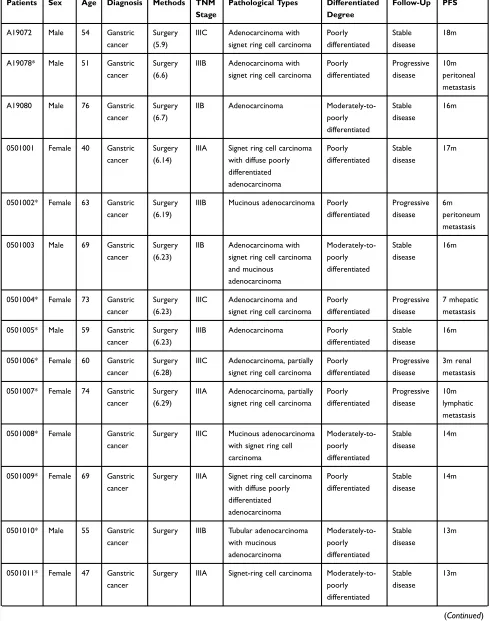
Hospital, there were a total of 20 patients (Table 1). Tumor
tissue was removed by a clinical surgeon and immediately placed in a tissue preservation solution and sent to the laboratory, then necrosis and residual blood on the surface of the tumor tissue were removed in the clean bench.
Tumor Transplantation Methods and
Passage
Fresh tumor tissue removed through clinical surgery was placed in a medium containing 1% double-antibody, then a tissue scissor was used to cut the tissue into several small pieces, approximately 2 mm × 2 mm × 2 mm in size. After disinfection and the preparation of skin on both of the sides
of the mice’s forelimbs, a trocar was used to inject the tumor
tissue rapidly into the subcutaneous tissue. The puncture needle was then rotated and removed and a cotton ball was
used to clean the oozing of blood on the surface of the mice’s
skin to prevent biting because of the residual blood. After tumor formation, the length and width of the tumors were measured regularly and the relative tumor volume (relative
tumor volume = 0.5× long diameter × short diameter2) was
calculated twice a week on average. In the current study, the criterion for successful transplantation of a tumor in mice is
that the volume of the tumors in a mouse should exceed
60 mm3. P2 passage was performed when P1 tumors grew to
500 mm3. There were six mice in each group.
Model Monitoring Indicators
(1) Changes in the mental state, activity, diet and hair color of the mice were observed daily. (2) The growth of the local subcutaneously transplanted tumor in the mice of each group was observed and recorded. (3) The tumorigenic rate and mortality rate of the mice in each group were counted. (4) Mice were euthanized, the transplanted tumor was removed, and the histomorphological characteristics of the tumor spe-cimens from the clinical patients and the transplanted tumors of each generation were observed using H&E staining. (5) The expressions of ck8/18, CK7, ki-67, matrix metallopro-teinase 9 (MMP-9), epidermal growth factor receptor (EGFR) and human epidermal growth factor receptor-2 (Her-2) in the tissues of P0 and P1 immune generation mice were detected by immunohistochemistry.
Pharmacodynamic Detection
When the average volume of the tumors in P2 mice
reached 100–150 mm3, the mice were randomly grouped:
one control group (no treatment), and 10 treatment groups (according to the situation of the subjects, and their recom-mended chemotherapeutic drugs and/or regimens for test-ing, synchronized therapy with the corresponding drugs and/or regimens for corresponding subjects was given, all tested drugs were provided by the patients).After adminis-tration, the general condition of the mice was observed and recorded daily, tumor volume was measured, and the weight of the tumor-bearing mice was also measured twice a week. After three weeks of continuous observa-tion, a tumor growth curve and an animal weight change curve were drawn, and a PDTX test report was written.
Statistical Analysis
We used the software program SPSS 20.0 (IBM, Chicago, USA) to conduct the statistical analysis. Continuous ables were expressed as mean± SD. Discontinuous vari-ables were expressed as percentage (%). A value of P<0.05
was considered statistically significant.
Results
Tumor Formation and Growth of Mice
The primary transplantation of tumor specimens to NCGmice was performed in 20 patients. At 4–6 weeks after
Cancer Management and Research downloaded from https://www.dovepress.com/ by 118.70.13.36 on 24-Aug-2020
Table 1Basic Data of Patients
Patients Sex Age Diagnosis Methods TNM Stage
Pathological Types Differentiated Degree
Follow-Up PFS
A19072 Male 54 Ganstric
cancer
Surgery (5.9)
IIIC Adenocarcinoma with signet ring cell carcinoma
Poorly differentiated
Stable disease
18m
A19078* Male 51 Ganstric
cancer
Surgery (6.6)
IIIB Adenocarcinoma with signet ring cell carcinoma
Poorly differentiated Progressive disease 10m peritoneal metastasis
A19080 Male 76 Ganstric
cancer
Surgery (6.7)
IIB Adenocarcinoma
Moderately-to-poorly differentiated
Stable disease
16m
0501001 Female 40 Ganstric cancer
Surgery (6.14)
IIIA Signet ring cell carcinoma with diffuse poorly differentiated adenocarcinoma Poorly differentiated Stable disease 17m
0501002* Female 63 Ganstric cancer
Surgery (6.19)
IIIB Mucinous adenocarcinoma Poorly differentiated Progressive disease 6m peritoneum metastasis
0501003 Male 69 Ganstric
cancer
Surgery (6.23)
IIB Adenocarcinoma with signet ring cell carcinoma and mucinous adenocarcinoma Moderately-to-poorly differentiated Stable disease 16m
0501004* Female 73 Ganstric cancer
Surgery (6.23)
IIIC Adenocarcinoma and signet ring cell carcinoma
Poorly differentiated Progressive disease 7 mhepatic metastasis
0501005* Male 59 Ganstric cancer
Surgery (6.23)
IIIB Adenocarcinoma Poorly
differentiated
Stable disease
16m
0501006* Female 60 Ganstric cancer
Surgery (6.28)
IIIC Adenocarcinoma, partially signet ring cell carcinoma
Poorly differentiated Progressive disease 3m renal metastasis
0501007* Female 74 Ganstric cancer
Surgery (6.29)
IIIA Adenocarcinoma, partially signet ring cell carcinoma
Poorly differentiated Progressive disease 10m lymphatic metastasis
0501008* Female Ganstric
cancer
Surgery IIIC Mucinous adenocarcinoma with signet ring cell carcinoma Moderately-to-poorly differentiated Stable disease 14m
0501009* Female 69 Ganstric cancer
Surgery IIIA Signet ring cell carcinoma with diffuse poorly differentiated adenocarcinoma Poorly differentiated Stable disease 14m
0501010* Male 55 Ganstric cancer
Surgery IIIB Tubular adenocarcinoma with mucinous adenocarcinoma Moderately-to-poorly differentiated Stable disease 13m
0501011* Female 47 Ganstric cancer
Surgery IIIA Signet-ring cell carcinoma Moderately-to-poorly differentiated
Stable disease
13m
(Continued)
Cancer Management and Research downloaded from https://www.dovepress.com/ by 118.70.13.36 on 24-Aug-2020
inoculation, a slightly rigid solid mass protruding from the skin could be seen at the site of the inoculation. As time progressed, the tumor nodules gradually enlarged. When
the tumor volume of the mice exceeded 60 mm3, it
indi-cated that the model was successfully established. The
results of the current study revealed that a total of 15 mice were successfully modeled. The success rate of the primary transplantation was 75%. The tumor formation
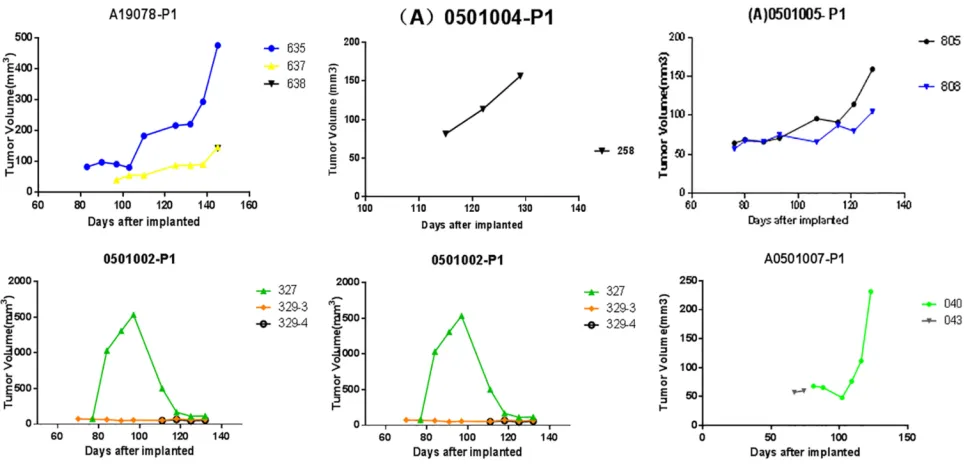
time was 40–115 days. The growth of P1 generation
tumors is shown inFigure 1.
Table 1(Continued).
Patients Sex Age Diagnosis Methods TNM Stage
Pathological Types Differentiated Degree
Follow-Up PFS
0501012* Female 62 Ganstric cancer
Surgery IIB Mucinous adenocarcinoma with moderately differentiated tubular adenocarcinoma
Moderately differentiated
Stable disease
13m
0501013* Male 55 Ganstric cancer
Surgery IB Mediumly-poorly differentiated tubular adenocarcinoma
Moderately-to-poorly differentiated
Stable disease
13m
0501014* Male 60 Ganstric cancer
Surgery IIIB Poorly differentiated adenocarcinoma
Poorly differentiated
Stable disease
13m
0501015* Female 63 Ganstric cancer
Surgery IV Adenocarcinoma and signet ring cell carcinoma
Poorly differentiated
Progressive disease
7m peritoneal metastasis
0501016 Male 64 Ganstric
cancer
Surgery IB Tubular adenocarcinoma Moderately differentiated
Stable disease
14m
0501017* Male 66 Ganstric cancer
Surgery IB Adenocarcinoma Moderately
differentiated
Stable disease
14m
Note:*P1 modeling successfully.
Figure 1The growth curve of P1 generation mice. A total of 15 mice are successfully modeled 4–6 weeks after injection. The success rate of primary transplantation is 75%.
The tumor formation time is 40–115 days.
Cancer Management and Research downloaded from https://www.dovepress.com/ by 118.70.13.36 on 24-Aug-2020
Histopathological Examination of
Specimens of Patients and Transplanted
Tumors
When the tumor volume in mice increased to 800 mm3, the
mice were euthanized and the transplanted tumors removed. The results of the current study reveal that the transplanted tumors in the mice were smooth on the sur-face, round or quasi-round in shape, solid, and slightly hard in texture. The tumors were cut according to the P1 generation inoculation method and re-injected into P2
generation mice. No obvious infiltrations were found in
the other organs of the mice. The results of the H&E staining of the specimens of clinical patients and the expressions of ck8/18, CK7, Ki-67 and MMP-9 in tumor
tissues are shown in Figures 2 and 3. Moreover, the
histopathological structure of PDTX mice tumors was basically consistent with that of the corresponding patient.
Pharmacodynamic Test Results
The pharmacodynamics test was carried out in 0501011
patients after successful modeling. As shown in Figure 4,
the results revealed that Scheme 6 (gemcitabine) > Scheme 11 (cisplatin + tegafur) > Scheme 8 (cisplatin) > Scheme 3 (irinotecan) > Scheme 2 (oxaliplatin + tegafur) > Scheme 9 (albumin paclitaxel + capecitabine) > Scheme 7 (albu-min paclitaxel). The tumor growth inhibition value (TGI)
and relative tumor volume (RTV) of these drugs were
listed in the Table 2. When the PDTX model was
estab-lished, the patient began to receive clinical concurrent adjuvant chemotherapy after the operation, and the treat-ment regimen was oxaliplatin + tegafur. Because the side effects of tegafur are substantial in clinical treatment, the drugs were adjusted to oxaliplatin + retitroxel (currently, a clinical follow-up is underway).
Clinical Follow-Up of Prognosis
The duration of the clinical follow-up was 17 months. Follow-up results revealed that, of the 15 patients whose models were successfully established, disease progression during the follow-up period occurred in six patients.
Disease in thefive patients whose models were
unsuccess-fully establishedisstable at present. The success rate of the
PDTX model correlates significantly with the prognosis of
the patient, which is worth further study (p=0.0086, <0.05). The prognoses of clinical patients during
follow-up are shown inFigure 5.
Discussion
At present, epidemiological data reveals that the morbidity
and mortality of gastric cancer ranksfirst among malignant
digestive system tumors in China. Although at present
surgery, radiotherapy and chemotherapy are still thefirst
choices for the treatment of gastric cancer, the results of
Figure 2The comparison of homogeneity of pathology between P1 generation tumors in PDTX model mice and tumors in the original patients. H&E staining results reveal that the histopathological structure of tumors in clinical patients is basically the same as that in PDTX model mice.
Cancer Management and Research downloaded from https://www.dovepress.com/ by 118.70.13.36 on 24-Aug-2020
a large number of studies have revealed that there were
significant individual differences in biological
characteris-tics and drug sensitivity of tumor tissues in clinical patients with tumors, even if the same type of cancer has huge individual differences among different patients. At present, the development of new anti-cancer drugs and the selection of clinical chemotherapy are often based on the drug sensitivity test of tumor cells cultured in vitro, genetic testing and in vivo models of the transplantation
of passaged tumor cells, but these do not really reflect the
individual’s sensitivity to chemotherapeutic drugs or
tar-geted drugs, therefore, the predictability was poor.1,2 In
recent years, some foreign scholars used a PDTX model for pharmacodynamics tests, which provided a new idea for individualized treatment of clinical cancer patients.
The results of previous studies have revealed that the success rate of PDTX modeling for surgical specimens
was 25–40%.3–5It was also reported that the success rate
CK8/18 CK7 Ki-67 MMP-9
Patient
P0
PDTX
(P1)
Her-2 EGFR
Patient
P0
PDTX
(P1)
Figure 3The expressions of ck8/18, CK7, ki-67 and MMP-9 in P0 and P1 tissues. The expressions of ck8/18, CK7, Ki-67 and MMP-9 are significant in tumor tissues in clinical patients.
Cancer Management and Research downloaded from https://www.dovepress.com/ by 118.70.13.36 on 24-Aug-2020
of needle aspiration puncture for small cell lung cancer
was 75%.6In the current study, among these 20 patients,
a PDTX model was successfully established for 15 patients, making the success rate of modeling 75%, with the PDTX model maintaining the biological characteristics of the primary tumors. The result is consistent with that of previous studies on, gastric cancer, liver cancer, lung can-cer, colorectal cancan-cer, melanoma, and esophageal cancer etc. Therefore, a PDTX model is a stable and reliable cancer research model andcan provide a good animal
model for cancer studies.7–9
In the current study, a mice model was unsuccessfully
established forfive patients. The main reasons are as follows:
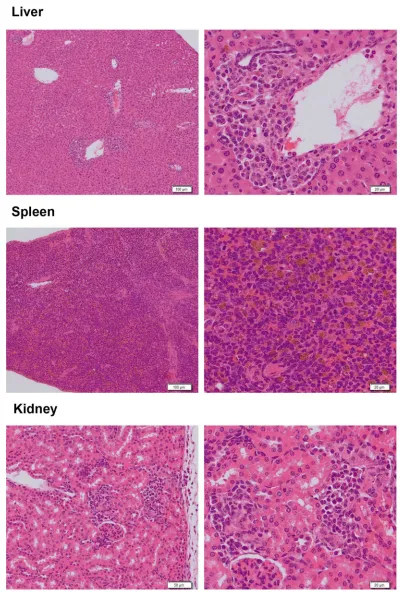
1. accidental death, 2. tumors did not grow, or they grew slowly and then did not meet the criteria, 3. infection. During the process of this experiment, one month after inoculation, for specimens A19078, A19080, 0501006 and 0501007, some mice started to successively develop hair loss and became weak. After examination, no microbial infection
was found, inflammatory cell infiltration was found in the
portal area of the liver, perivascular area and renal
interstitium, vigorous karyokinesis were found in some cells in the spleen, and no obvious pathological changes
were found in the ovaries and uterus (Figure 6). Because
the team of this study has carried out immune reconstitution experiments in NCG mice, similar phenomena occurred one month after tail vein injection of peripheral blood mono-nuclear cell (PBMC), therefore, it was considered that the reason may be related to immune rejection. It is suspected that it is caused by further inflammatory cell infiltration in the inoculated tumor tissue. Its mechanism needs further study.
The results of this study revealed that the characteris-tics of blood supply, matrix, growth and necrosis of the transplanted tumors in the mice were consistent with those of human tumors. Therefore, PDTX modeling is likely to be an important and highly homogenous in vivo model. At present, the tissue source for the PDTX model was mainly resected tumor tissue during enlarged surgery. However, many patients with advanced tumors are not suitable for surgical treatment and tumor tissues cannot be obtained from these patients, therefore, the clinical application of PDTX is limited.
In order to confirm that P1 generation tumors have the
same proliferation activity and malignant behavior as pri-mary tumors, its proliferation potential and transfer risk are consistent, and mutation sites and gene expressions can be an effective alternative, the expressions of ck8/18, CK7, ki-67, MMP-9, EGFR and Her-2 in P0 and P1 tissues were selected and analyzed. The results revealed that the two types of tissues were highly homogenous. Cytokeratin (CK) is an
intermediate fiber; its family consists of highly complex
polygenic proteins, and the molecular weight ranges between
40–68 kDa.Up until now, 20 CK proteins (CK1-CK20) have
been discovered. An in vitro experiment revealed that, com-pared with the control cells, various cell lines overexpressing CK8/18, including lung adenocarcinoma, melanocytes and
Figure 4The pharmacodynamic test results of patient 0501011 Clinical chemotherapy results reveals that Scheme 6 (gemcitabine) > Scheme 11 (cisplatin + tegafur) > Scheme 8 (cisplatin) > Scheme 3 (irinotecan) > Scheme 2 (oxaliplatin + tegafur) > Scheme 9 (albumin paclitaxel + capecitabine) > Scheme 7 (albumin paclitaxel).
Table 2Anti-Tumor Rate of Different Chemotherapy Regimens
No. Chemotherapy Regimens TGI RTV
0 Control / 1.37
1 Oxaliplatin + tegafur 19.0% 1.11
2 Irinotecan 30.6% 0.95
3 Epirubicin −14.0% 1.58
4 Olaparib −19.4% 1.63
5 Gemcitabine 47.6% 0.71
6 Albumin paclitaxel 2.5% 1.36
7 Cisplatin 38.7% 0.86
8 Albumin paclitaxel + capecitabine 17.4% 1.12
9 Oxaliplatin −1.3% 1.42
10 Cisplatin + tegafur 39.7% 0.84
Cancer Management and Research downloaded from https://www.dovepress.com/ by 118.70.13.36 on 24-Aug-2020
Figure 5The Histopathological examination of abnormal mice. Spleen: The red pulp structure of the spleen almost disappears. There is a large amount of pigmentation in tissues, and a small number of karyokinesis can be observed. Liver: The liver tissue has clear structures. There is a large amount of monocyte infiltration in most of the portal area of the hepatic lobules, sinus and central vein; there is a small amount of dispersive pigmentation in the tissue. Kidney: The kidney tissue has clear structures. There is monocyte infiltration in the interstitium around a few of the glomeruli, and no other pathological changes are found.
Cancer Management and Research downloaded from https://www.dovepress.com/ by 118.70.13.36 on 24-Aug-2020
mouse L cell lines, have a higher migration and stronger invasiveness. ki-67 is a relatively positive marker for nuclear proliferation in relation to cell cycle, which only exists in
the nucleus of proliferating cells.10 The coding gene is
located on chromosome 10 and its expression increases with the progress of cell cycle. In the cell division cycle, it is not expressed in G0 phase, begins to express in G1 phase, increases gradually in S and G2, reaches its peak in M phase, and degrades and disappears rapidly after the end of cell division, therefore it is an important indicator of cell prolif-erative activity, and widely used to evaluate the proliferation of cancer cells. There have been many studies on the relation-ship between gastric cancer and Ki-67, but there is still controversy at present. Studies have revealed that the expres-sion of Ki-67 in gastric cancer tissues was closely correlated to the clinicopathology and prognosis of the patients. Tsamandas et al revealed in their studies that ki-67 was correlated to the prognosis of patients with gastric cancer. Kikuyama et al considered that Ki-67 was an independent prognostic factor of patients with gastric cancer. Matrix metalloproteinases (MMPs) are proteolytic enzymes very closely related to invasion and metastasis of tumors. As
a matrix, metalloproteinase can degrade basement membrane and extracellular matrix components, and accordingly,
pro-mote the infiltration and metastasis of tumors and interstitial
angiogenesis. The detection of its expression level plays an important role in the prospective determination of the biolo-gical characteristics of tumors and it acts as a prognostic indicator. In the current study,CK8/18 and Ki-67 were highly expressed in all three patients whose models were success-fully established, whether in the original tumors or in the PDTX model. The results suggest that tumor tissue has strong invasiveness and metastasis ability. MMP-9 was
weakly positive in the model of one patient. Its significance
in predicting the prognosis of gastric cancer needs further verification.
In the PDTX study on colorectal cancer published by
Samsung Medical Center in South Korea,11 241 patients
with colorectal cancer were analyzed retrospectively. The model of nude mice was established by transplanting surgi-cal samples to investigate the relationship between the suc-cess rate of PDTX and clinical prognosis in patients with colorectal cancer. The results revealed that the prognosis of patients whose model was successfully established poorer
Figure 6The prognoses of clinical patients. Of the 15 patients whose models were successfully established, disease progression during the follow-up period occurred in six patients. Disease in thefive patients whose models were unsuccessfully established is stable at present.
Cancer Management and Research downloaded from https://www.dovepress.com/ by 118.70.13.36 on 24-Aug-2020
than that of patients whose model was not successfully established, especially obvious in patients at stage 3, long-term differences could also be seen in patients at stage 4 with metastasis. The prognosis of patients whose model was successfully established was poorer than that of patients whose model was not successfully established. This suggests
that PDTX can reflect the invasiveness of tumors and can be
used as one of the indicators to predict recurrence and metastasis in the future. In the current study, 1-year follow up results revealed that of the 15 patients whose models were successfully established, disease progression occurred in six patients, while disease in patients with a failed model establishment is currently stable. The success rate of PDTX
models was significantly correlated with the prognosis of
patients, which is worth further study.
In our study, the pharmacodynamics test revealed that Scheme 6 (gemcitabine) > Scheme 11 (cisplatin + tegafur) > Scheme 8 (cisplatin) > Scheme 3 (irinotecan) > Scheme 2 (oxaliplatin + tegafur) > Scheme 9 (albumin paclitaxel + capecitabine) > Scheme 7 (albumin paclitaxel). However,
the specific differences among these kinds of
chemother-apy regimens should be further research in the future. PDTX models can better preserve the biological char-acteristics of primary tumor tissues and their response to
drugs.12–16 PDTX models can be used as a substitute for
cancer patients in clinical practice and may be suitable for clinical pharmacodynamic screening and new drug
devel-opment. It has a wide application prospect.17
Funding
The study was funded by the National Key Research and
Development program“precision medicine research”
pro-gram (2017YFC0908300).
Disclosure
Dr Zhu and Dr Hao are the employees of the company Nanjing Personal Oncology Biological Technology Co. Ltd.
The authors report no other conflicts of interest in this work.
References
1. Sjöblom T, Jones S, Wood LD, et al. The Consensus Coding Sequences of Human Breast and Colorectal Cancers. Science. 2006;314:268–274. doi:10.1126/science.1133427
2. Kopetz S, Lemos R, Powis G. The promise of patient-derived xenografts: the best laid plans of mice and men.Clin Cancer Res. 2012;18:5160–5162. doi:10.1158/1078-0432.CCR-12-2408 3. Zhang XC, Zhang J, Li M, et al. Establishment of patient-derived
non-small cell lung cancer xenograft models with genetic aberrations within EGFR, KRAS and FGFR1: useful tools for preclinical studies of targeted therapies.J Transl Med.2013;11:168. doi:10.1186/1479-5876-11-168
4. Fichtner I, Rolff J, Soong R, et al. Establishment of patient-derived Non-small cell lung cancer xenografts as modeles for the identifi ca-tion of predictive biomarkers.Clin Cancer Res.2008;14:6456–6468. doi:10.1158/1078-0432.CCR-08-0138
5. John T, Kohler D, Pintilie M, et al. The ability to form primary tumor xenografts is predictive of increased risk of disease recurrence in early-stage Non-small cell lung cancer. Clin Cancer Res. 2011;17:134–141. doi:10.1158/1078-0432.CCR-10-2224
6. Anderson WC, Boyd MB, Aguilar J, et al. Initiation and Characterization of Small Cell Lung Cancer Patient-Derived Xenografts from Ultrasound-Guided Transbronchial Needle Aspirates. PLoS One. 2015;10:e0125255. doi:10.1371/journal.pone. 0125255
7. Hao C, Wang L, Peng S, et al. Gene mutations in primary tumors and corresponding patient-derived xenografts derived from non-small cell lung cancer. Cancer Lett. 2015;357(1):179–185. doi:10.1016/j. canlet.2014.11.024
8. Zhu Y, Tian T, Li Z, et al. Establishment and characterization of patient-derived tumor xenograft using gastroscopic biopsies in gastric cancer.Sci Rep.2015;5:8542. doi:10.1038/srep08542
9. Gu Q, Zhang B, Sun H, et al. Genomic characterization of a large panel of patient-derived hepatocellular carcinoma xenograft tumor models for preclinical development. Oncotarget. 2015;6:2016 0–20176. doi:10.18632/oncotarget.3969
10. Nowicki M, Ostalska-Nowicka D, Miśkowiak B. Prognostic signifi -cance of Ki-67 negative blaste cell clone in the high risk group of children treated for acute myeloid leukaemi. Folia Histochem Cytobiol.2006;44:49–52.
11. Malaney P, Nicosia SV, Davé V. One mouse, one patient paradigm: new avatars of personalized cancer therapy. Cancer Lett. 2014;344:1–12. doi:10.1016/j.canlet.2013.10.010
12. Tentler JJ, Tan AC, Weekes CD, et al. Patient-derived tumour xeno-grafts as models for oncology drug development.Nat Rev Clin Oncol. 2012;9:338–350. doi:10.1038/nrclinonc.2012.61
13. Julien S, Merino-Trigo A, Lacroix L, et al. Characterization of a large panel of patient-derived tumor xenografts representing the clinical heterogeneity of human colorectal cancer. Clin Cancer Res. 2012;18:5314–5328. doi:10.1158/1078-0432.CCR-1 2-0372
14. Scott CL, Becker MA, Haluska P, Samimi G. Patient-derived xeno-graft models to improve targeted therapy in epithelial ovarian can-cer treatment. Front Oncol.2013;3:295. doi:10.3389/fonc.2013.00 295
15. Siolas D, Hannon GJ. Patient-derived tumor xenografts: transforming clinical samples into mouse models. Cancer Res. 2013;73:53 15–5319. doi:10.1158/0008-5472.CAN-13-1069
16. Liu Q, Zheng L, Zhang H. The research progress of patient-derived tumor xenografts.Transl Med J.2014;3(02):65–68.
17. Rosfjord E, Lucas J, Li G, Gerber HP. Advances in patient-derived tumor xenografts: from target identification to predicting clinical response rates in oncology.Biochem Pharmacol.2014;91:135–143. doi:10.1016/j.bcp.2014.06.008
Cancer Management and Research downloaded from https://www.dovepress.com/ by 118.70.13.36 on 24-Aug-2020
Cancer Management and Research
Dove
press
Publish your work in this journal
Cancer Management and Research is an international, peer-reviewed open access journal focusing on cancer research and the optimal use of preventative and integrated treatment interventions to achieve improved outcomes, enhanced survival and quality of life for the cancer patient.
The manuscript management system is completely online and includes a very quick and fair peer-review system, which is all easy to use. Visit http://www.dovepress.com/testimonials.php to read real quotes from published authors.
Submit your manuscript here:https://www.dovepress.com/cancer-management-and-research-journal
Cancer Management and Research downloaded from https://www.dovepress.com/ by 118.70.13.36 on 24-Aug-2020