University of South Carolina
Scholar Commons
Theses and Dissertations
2018
Prevalence And Predictors Of Anxiety Disorders In
Adolescent And Adult Males With Autism
Spectrum Disorder And Fragile X Syndrome
Jordan Ezell
University of South Carolina
Follow this and additional works at:https://scholarcommons.sc.edu/etd Part of theSchool Psychology Commons
This Open Access Thesis is brought to you by Scholar Commons. It has been accepted for inclusion in Theses and Dissertations by an authorized administrator of Scholar Commons. For more information, please [email protected].
Recommended Citation
PREVALENCE AND PREDICTORS OF ANXIETY DISORDERS IN ADOLESCENT AND ADULT MALES WITH AUTISM SPECTRUM DISORDER AND FRAGILE X
SYNDROME
by
Jordan Ezell
Bachelor of Arts Samford University, 2013
Submitted in Partial Fulfillment of the Requirements
For the Degree of Master of Arts in
School Psychology
College of Arts and Sciences
University of South Carolina
2018
Accepted by:
Jane E. Roberts, Director of Thesis
Kimberly Hills, Reader
ABSTRACT
Anxiety disorders are the most prevalent disorders in children and adolescents,
affecting approximately 15-20% of individuals under the age of 18 (Salum et al, 2013).
Clinical subgroups, like autism spectrum disorder (ASD) and fragile X syndrome (FXS),
have an elevated risk of a co-occurring anxiety disorder. Despite the elevated risk of
anxiety in these groups, few research studies have investigated the rates and predictors of
anxiety disorders in adolescents with these ASD and FXS. In the current study,
participants included males with FXS (n=31) or ASD (n=20) aged 16 to 24. Measures
included the Children’s Interview for Psychiatric Symptoms-Parent Version (P-ChIPS),
the Autism Diagnostic Observation Schedule-2 (ADOS-2), and the Leiter International
Performance Scale-Revised (Leiter-R). Descriptive statistics indicated that 48% of the
FXS adolescents met criteria for an anxiety disorder compared with 50% in ASD.
Additionally, 13% of the FXS and 30% of the ASD sample met for multiple anxiety
disorders. Across the FXS and ASD groups 35% versus 15% met for Specific Phobia,
12% versus 30% met for Social Phobia and 33% versus 40% met for GAD, respectively.
T-tests showed no significant differences within and across groups for those meeting
criteria for an anxiety disorder verses those not meeting criteria for age, NVIQ growth
scores, and ASD severity. Results of the binary logistic regression did not show age,
NVIQ growth scores, or ASD severity as significant predictors of any anxiety disorder
across FXS and ASD. Lastly, approximately 40% of participants with FXS who met
to 20% of the participants with ASD who met criteria for an anxiety disorder. Logistic
regression results showed that taking anxiety medications were not significantly
predictive of meeting criteria for an anxiety diagnosis however anxiety medication use
was predictive of group diagnosis. Our primary finding is that approximately half of the
FXS and ASD sample met for an anxiety disorder based on DSM-V criteria. Further, This
study is the first that directly compares rates of anxiety disorders across adolescents and
adults with FXS and idiopathic ASD within a small range of ages, intellectual ability, and
autism severity. Reduced rates of anxiety disorders may be indicative of adolescent or
TABLE OF CONTENTS
ABSTRACT ... iii
LIST OF TABLES ... vii
CHAPTER 1INTRODUCTION ...1
1.1ANXIETYINAUTISMSPECTRUMDISORDER ...1
1.2ANXIETYINFRAGILEXSYNDROME ...4
1.3PRESENTSTUDY ...6
CHAPTER 2METHODS ...8
2.1PARTICIPANTS ...8
2.2PROCEDURES ...9
2.3MEASURES ...9
2.4STATISTICALANALYSIS ...11
CHAPTER 3RESULTS ...13
3.1PREVALENCE OF ANXIETY DISORDERS IN ASD AND FXS ...13
3.2 PREDICTORS OF ANXIETY IN ASD AND FXS ...13
3.3 MEDICATION USE IN ASD AND FXS ...14
4.1RATES OF ANXIETY DISORDERS IN ASD AND FXS ...18
4.2 RELATIONSHIP BETWEEN PREDICTORS AND ANXIETY DISORDERS IN ASD AND FXS ...20
4.3 MEDICATION USE IN RELATION TO ANXIETY DISORDERS IN ASD AND FXS ...21
4.4LIMITATIONSANDFUTUREDIRECTIONS ...22
4.5 CONCLUSIONS ...23
LIST OF TABLES
Table 2.1 Participant Demographics for Each Diagnostic Group ...12
Table 3.1 Number of Anxiety Disorders By Clinical Group ...15
Table 3.2 Rates of Specific Anxiety Disorders By Clinical Group ...15
Table 3.3 Descriptive Statistics Between Anxiety and
Non-Anxiety Within FXS and ASD ...16
Table 3.4 Descriptive Statistics Between Anxiety and
Non-Anxiety Across FXS and ASD ...17
Table 3.5 Logistic Regression for NVIQ Growth Scores, ASD Severity, and Age
CHAPTER1
INTRODUCTION
Anxiety disorders are among the most prevalent and debilitating disorders in
children and adolescents, affecting approximately 15-20% of individuals under the age of
18 (Beesdo, Knappe, & Pine, 2011; Salum, De Sousa, do Rosário, Pine, & Manfro,
2013). Clinical subgroups are often at a higher risk for developing a comorbid anxiety
disorder, which has been shown to reduce functioning across multiple domains (Simonoff
et al. 2008; Kim et al, 2000). Autism spectrum disorder (ASD) and fragile X syndrome
(FXS) are two clinical subgroups with an elevated risk of a co-occurring anxiety disorder.
Nearly 60% of males with FXS meet criteria for ASD, and there is considerable overlap
between ASD features and anxiety symptoms; thus, disentangling the presentation and
prevalence of anxiety in FXS and those with ASD is critical for the accurate diagnosis of
anxiety disorders and the subsequent development of targeted treatments. Despite the
elevated risk of anxiety in both ASD and FXS, few research studies have investigated the
prevalence of anxiety disorders in adolescents with these disorders and comorbid
intellectual disability (ID).
1.1 ANXIETY IN AUTISM SPECTRUM DISORDER
Autism spectrum disorder (ASD) is a highly prevalent neurodevelopmental
disorder that occurs in 1 in 68 children and is characterized by social-communication
2013; Christensen et al., 2016). Anxiety is one of the most prevalent comorbid disorders
in ASD youth (Magiati et al., 2015; van Steensel, Bögels, & Perrin, 2011; White,
Mazefsky, & Dichter, 2014; White, Oswald, Ollendick, & Scahill, 2009).
Population-based studies utilizing gold standard diagnostic measures report that 40-50% of
individuals with ASD meet diagnostic criteria for anxiety, but other studies report
prevalence rates ranging from 11-84% (White, Oswald, Ollendick, & Scahill, 2009; van
Steensel, Bögels, & Perrin, 2011; Simonoff et al., 2008). Previous studies also show a
range of rates for specific anxiety disorders. For instance, reported rates in ASD range
from 8–63% for Specific Phobia, 2-35% for Generalized Anxiety Disorder (GAD), and
6-37% for Social Anxiety Disorder (Muris, Steerneman, Merckelbach, Holdrinet, &
Meesters, 1998; Simonoff et al., 2008; Bellini, 2006; Green, Gilchrist, Burton, & Cox,
2000; Leyfer et al., 2006; de Bruin, Ferdinand, Meester, de Nijs, & Verheij, 2007; Kerns
et al., 2014). The wide variability in diagnostic rates highlights the challenges inherent in
diagnosing anxiety disorders in ASD and reflects a heterogeneous research population
with a range of ages and functioning levels, factors that likely impact anxiety presentation
in ASD. Further, adults with ASD and comorbid ID were less likely to receive a
community diagnosis of anxiety, despite parent-reported symptoms (Buck et al., 2014).
Several factors contribute to the challenges of accurately diagnosing anxiety
disorders in individuals with ASD. One barrier is the overlap in symptomatology between
ASD and anxiety. For instance, social avoidance, obsessions and preoccupations,
repetitive behaviors, fear of change, and atypical phobias are features of both ASD and
anxiety (Kerns, Kendall, Wood, & Storch, 2017; Van Steensel, Bögels, & Wood, 2013).
atypically relative to the DSM-5 diagnostic characterization of anxiety (Kerns et al.,
2014). Thus, the present DSM-5 based measures of anxiety may not accurately reflect the
atypical presentations of anxiety in ASD (Kerns et al., 2014). Furthermore, confounding
individual differences such as ID, and difficulties with insight and self-report also
contribute to the difficulty in accurately diagnosing anxiety disorders in individuals with
ASD (Kerns et al., 2014; van Steensel et al., 2011).
Examining potential risk factors for anxiety disorders can provide insight into the
development of these disorders and can improve diagnostic accuracy in ASD. Although a
number of studies have investigated risk factors for anxiety in ASD, the heterogeneity
across studies has reported that age, intellectual ability, and ASD symptom severity have
variable impacts on the presence of anxiety in ASD (Kerns et al., 2014; Sukhodolsky et
al., 2008; Renno & Wood, 2014). Some studies suggest that individuals with ID are at
higher risk of certain anxiety disorders (Sukhodolsky et al., 2008), while other studies
have found similar rates of anxiety across both ID and normal IQ in ASD (van Steensel et
al., 2011; Kuusikko et al, 2008). The impacts of ASD severity have also varied across
studies with some studies finding no associations between ASD severity and anxiety
(Sukhodolsky et al., 2008; Renno & Wood, 2014), while others report a relationship
between greater ASD severity and fewer anxiety symptoms (Gadow, Sprafkin, & Nolan,
2001; Wood & Gadow, 2010). Overall, these studies highlight that there are several
individual factors that may increase the risk for anxiety in children and adolescents with
ASD, but similar to the range of diagnostic rates, results vary across a diverse ASD
Most existing studies of anxiety in ASD have included heterogeneous samples in
regards to ASD severity, age, and anxiety measurement, leading to the wide range of
reported prevalence rates (11-84%). However, the majority of previous studies have not
included individuals with ASD with an IQ below 70, because, in part, measuring anxiety
accurately can be difficult in these individuals (van Steensel et al., 2011). An estimated
56% of individuals with ASD have an IQ below 85, with 31.6% having an ID, thus we
lack research on anxiety in around one-third of the ASD population ( Christensen et al.,
2016; Cordeiro, Ballinger, Hagerman, & Hessl, 2011). There is some evidence that
individuals with an ID are four times more likely to present with anxiety symptoms than
their neurotypical peers, yet anxiety disorders are not well understood in ASD subgroups
of ID (Green, Berkovits, & Baker, 2014; Matson & Matson, 2015). Although
characterizing anxiety in ASD is complex because of the heterogeneity within the
disorder and the phenotypic overlap, this is an important effort given that co-occurring
anxiety is clearly associated with poorer social functioning and increased difficulties in
individual and family functioning in individuals with ASD (Kim, Szatmari, Bryson,
Streiner, & Wilson, 2000; Simonoff et al., 2008; White et al., 2009). Thus, research on
the prevalence and predictors of anxiety in more homogeneous and lower functioning
ASD samples is essential for accurate identification and treatment of comorbid anxiety.
1.2 ANXIETY IN FRAGILE X SYNDROME
Fragile X syndrome (FXS) is a single-gene disorder caused by a CGG expansion
mutation on the Fragile X Mental Retardation-1 (FMR1) gene. Expansion of more than
200 CGG repeats in the FMR1 gene causes reduced production of the fragile X mental
(Hagerman, Lauterborn, Au, & Berry-Kravis, 2012; Schwarte, 2008). Reduced FMRP
results in the FXS behavioral phenotype, which is characterized by shyness, avoidant eye
contact, elevated states of physiological arousal, social-communication deficits, and ID
(Bailey, Hatton, Mesibov, Ament, & Skinner, 2000; Hessl et al., 2001; Klusek, Roberts,
& Losh, 2015; Rogers, Wehner, & Hagerman, 2001). Many of the core features of FXS
are qualitatively similar to those of ASD, and approximately 60% of males with FXS also
meet diagnostic criteria for ASD (Klusek et al., 2014; García-Nonell et al., 2008).
Few studies have examined prevalence and severity of anxiety disorders in FXS.
In fact, only one study to date has used a DSM-based diagnostic measure to assess rates
of anxiety disorders in FXS (Cordeiro et al., 2011). The study included 58 males and 39
females with FXS (5 – 27 years old) and used the Anxiety Disorders Interview Schedule
(ADIS-IV) (Grisham, Brown, & Campbell, 2004), a clinical parent interview based on
the DSM-IV. In this study, 86% of the sample met diagnostic criteria for any anxiety
disorder, 65% met criteria for Specific Phobia, and 35% met criteria for Social Phobia.
This study also examined the potential effects of age, ID, and ASD comorbidity on
anxiety disorder diagnosis. Results indicated that older age, the presence of an ID, and
the presence of ASD were associated with increased prevalence in certain anxiety
disorders. Though the use of a DSM-based measure is a strength of this study, the
heterogeneity of the sample (e.g., wide age range, inclusion of both males and females)
makes it difficult to draw firm conclusions about the prevalence of anxiety disorders in
FXS. Because FXS presents differently across sex, developmental level, and
chronological age, more focused samples are needed in order to clarify the prevalence of
1.3 THE PRESENT STUDY
Overall, research on anxiety disorders in both ASD and FXS is limited and
highlights the challenges associated with accurately measuring anxiety symptoms in
neurodevelopmental disorders characterized by ID and social-communicative deficits.
Though elevated rates of anxiety symptomatology have been reported in ASD and FXS,
no studies to date have directly compared anxiety prevalence in these clinical subgroups
from a cross-syndrome perspective using a DSM-based measure to determine anxiety
diagnoses, so the application of diagnostic criteria across studies is unclear. Finally, it
remains unclear how anxiety presents in individuals with ASD or FXS who have
comorbid ID (IQ < 70). Individuals with a comorbid ID are at elevated risk for
psychopathology like anxiety, but are understudied, as there are additional challenges to
accurately measuring anxiety in lower functioning populations (van Steensel et al., 2011;
White et al., 2009). Because comorbid anxiety is associated with increased risk for
problems such as inattention, hyperactivity, impulsivity, and self-injurious and aggressive
behaviors (Talisa, Boyle, Crafa, & Kaufmann, 2014), it is essential that we understand
how to diagnose these disorders in high-risk populations like ASD and FXS.
This study examined the prevalence and predictors of anxiety disorders to
determine the diagnostic rates of anxiety disorders in adolescents with non-syndromic
ASD compared to adolescents with FXS. It was hypothesized that the genetic
mechanisms of FXS confer elevated risk for anxiety resulting in higher rates of anxiety
disorders in the FXS group compared to the ASD group. The second objective was to
investigate ASD severity, nonverbal IQ (NVIQ), and age as predictors of anxiety
age, lower NVIQ, and elevated ASD severity will contribute to increased anxiety risk,
and that these factors would predict a diagnosis of anxiety in ASD and FXS. The third
objective was to evaluate the rate of prescribed anxiety medications in these groups and
to determine the relationship between anxiety medication use and anxiety disorders. It
was expected that anxiety medication rates would be higher in the FXS group than the
ASD group because FXS is often viewed as a medical diagnosis versus ASD which is
viewed as a behavioral diagnosis (Hernandez et al., 2009). Further, it is hypothesized that
individuals prescribed anxiety medications will be more likely to meet criteria for an
CHAPTER 2
METHODS
2.1 PARTICIPANTS
Participants included males with non-syndromic ASD (n = 20) or FXS (n = 31)
ranging from 16 to 24 years of age (M = 18.8, SD = 2.1). Females were excluded from
the study because of the cognitive and clinical heterogeneity across sexes for both ASD
and FXS (Rinehart, Cornish, & Tonge, 2011). Diagnosis of FXS was confirmed through
genetic testing (> 200 CGG repeats on the FMR1 gene). In participants with
non-syndromic ASD previous diagnosis was confirmed for the present study using gold
standard diagnostic measures. Additionally, all participants were required to be able to
communicate verbally (minimum combination of at least three words) and speak English
as their primary language. Participants were recruited through two complementary
studies. The entire FXS sample (n = 31) and a portion of the ASD sample (n = 8) were
recruited as a part of a longitudinal, multi-site study focused on the development of
language during adolescence in ID (i.e., Matherly et al., in press). The remaining 12
participants with non-syndromic ASD were recruited through a study of
social-communication profiles within families of children with FXS and non-syndromic ASD
(i.e., Klusek et al., 2017). Despite recruitment efforts to match the FXS and ASD groups
2.2 PROCEDURES
Participants were assessed at the Neurodevelopmental Disorders Lab at the
University of South Carolina over two days. Trained research staff members administered
all behavioral assessments and parent interviews. Participant families were compensated
for travel expenses and provided $50 for study participation. The Institutional Review
Board at the University of South Carolina approved all study protocols. Assent was
obtained from the participants and informed consent was obtained from the participant’s
parent prior to beginning the assessment.
2.3 MEASURES
Anxiety Diagnosis.The Children’s Interview for Psychiatric Symptoms-Parent
Version (P-ChIPS) is a DSM-IV based, structured psychiatric interview designed to
assess the presence of psychiatric disorders in children and adolescents (Weller, Weller,
Fristad, Rooney, & Schecter, 2000). The P-ChIPS was conducted with the parents of
participants to measure the presence of anxiety disorders, including Specific Phobia,
Social Anxiety Disorder, and Generalized Anxiety Disorder (GAD). The P-ChIPS
follows the DSM-IV structure of symptom count, duration, and impairment but was
adapted to reflect the DSM-5 criteria for the current study. The GAD DSM-5 criteria
specify that symptoms of excessive worrying need to occur the majority of days and on
multiple topics, and thus, frequency of worries had to be endorsed as often as “every day
or every other day” to meet criteria for the DSM-5. Further, if only one fear or worry is
present then GAD criteria are not met and the specific fear or worry is instead addressed
in Specific Phobia. The DSM-5 P-ChIPS adaptations also included the deletion of the
irrational or excessive for Specific Phobia and Social Phobia. Further, Specific or Social
Phobia symptoms must be present for at least a 6-month duration for the DSM-5.
Published kappa coefficients on the PChIPS ranged from good to excellent for
each anxiety disorder (GAD .86, Specific Phobia .76, and Social Phobia .72). Previous
studies found the intra-class correlations for all three subtype groups in the excellent
range (0.91-0.99), as well as overall agreement for each of the subtypes (GAD: 95.4%,
Specific Phobia: 90.7%, Social Phobia: 90.7%) (Witwer & Lecavalier, 2010; Witwer,
Lecavalier, & Norris, 2012). For the present study, a licensed clinical psychologist
assessed reliability on 20% of the ASD and FXS sample. Overall agreement across all
anxiety disorders was 100% for the ASD group and 92% for the FXS group.
Autism Spectrum Disorder (ASD) Symptom Severity. The Autism Diagnostic
Observation Schedule-Second Edition (ADOS-2) is a semi-structured, standardized
assessment of communication, social interaction, play, and restricted and repetitive
behaviors (Lord, Rutter, DiLavore, Risi, & Gotham, 2012). The ADOS-2 was
administered and scored live by graduate-level professionals who had completed research
reliability training. The ADOS-2 calibrated severity scores were used to reflect the
overall severity of ASD symptoms as well as severity of symptoms in the
social-communication domains and restricted/repetitive behavior domains. Table 1 presents
descriptive statistics for overall severity scores for overall behaviors across both ASD and
FXS groups.
Nonverbal Intellectual Ability (NVIQ). The Leiter-R is a test of nonverbal
four subtests consisting of Figure Ground, Form Completion, Sequential Order, and
Repeated Patterns. Due to low cognitive abilities in these populations floor effects can
significantly truncate standard scores, thus impacting analyses. Therefore, growth scale
value scores, which are a true interval scale unlike standard scores, were used in analysis
to limit floor effects.
2.4 STATISTICAL ANALYSIS
Analyses were conducted using RStudio Version 1.0.136(2015). Data were
analyzed for violations of assumptions including homogeneity of variance, normality of
residuals, and multicollinearity. The analytic strategy was completed in multiple steps.
First, descriptive statistics were run to calculate the rates of overall and specific anxiety
disorder diagnoses (i.e., GAD, Specific, Social) in the ASD and FXS groups. Next,
bi-serial correlations were performed to assess associations between anxiety and age, NVIQ
growth scores, and ASD severity. A logistic regression model was then conducted to
analyze age, ASD severity, and NVIQ growth scores as predictors of anxiety disorders in
ASD and FXS. Exploratory descriptive analyses were also conducted to investigate the
rates of prescribed anxiety medications across the ASD and FXS groups. Finally, a
logistic regression model was run to assess if anxiety medication was a predictor of
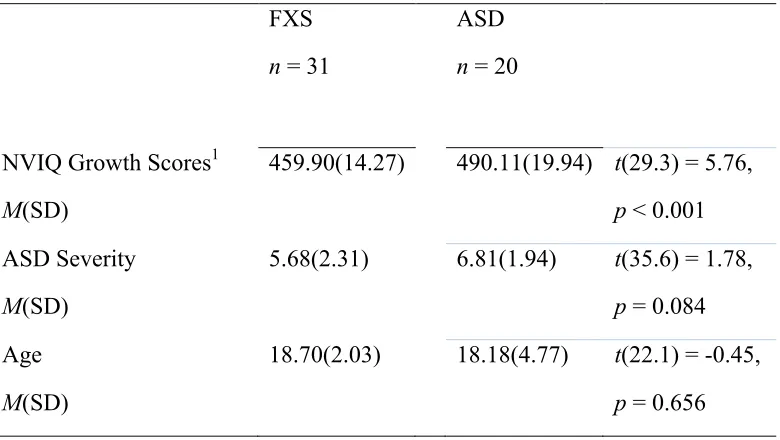
Table 2.1 Participant Demographics for Each Diagnostic Group
FXS
n = 31
ASD
n = 20
NVIQ Growth Scores1
M(SD)
459.90(14.27) 490.11(19.94) t(29.3) = 5.76,
p < 0.001
ASD Severity
M(SD)
5.68(2.31) 6.81(1.94) t(35.6) = 1.78,
p = 0.084
Age
M(SD)
18.70(2.03) 18.18(4.77) t(22.1) = -0.45,
p = 0.656
CHAPTER 3
RESULTS
3.1 PREVALENCE OF ANXIETY DISORDERS IN ASD AND FXS
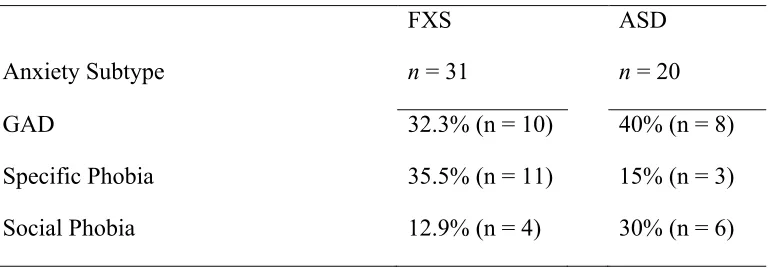
Descriptive statistics were used to compute the rates of anxiety disorders in FXS
and ASD. Findings indicate that 48% of the FXS adolescents met criteria for an anxiety
disorder, with 13% meeting for multiple anxiety disorders. Similarly, 50% of adolescents
with ASD met criteria for an anxiety disorder, and 30% met criteria for multiple anxiety
disorders. Rates of specific anxiety diagnoses for each group can be found in Table 2.
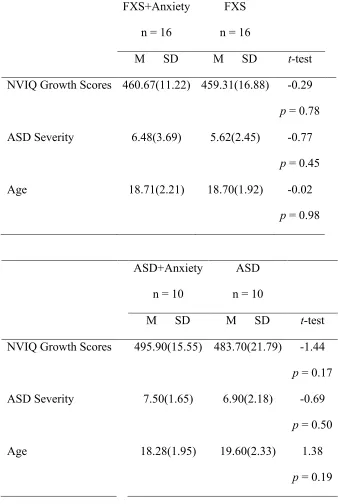
Further analysis showed no within- or between-group differences in age, NVIQ growth
scores, or ASD severity for those meeting criteria for an anxiety disorder versus those not
meeting criteria. (Tables 3.1 and 3.2).
3.2 PREDICTORS OF ANXIETY IN ASD AND FXS
Biserial correlations were run to examine the relationship between anxiety and
age, NVIQ growth scores, and ASD severity within FXS and ASD groups.
Multicollinearity was not violated for any predictors (r > .70, p > 0.05), although NVIQ
growth scores were moderately correlated with clinical diagnosis (FXS or ASD) (r =
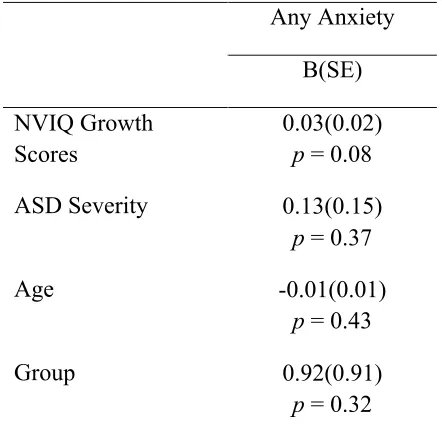
.664). A logistic regression model was then used to determine if age, NVIQ growth
scores, and ASD severity predicted anxiety by group. Results of the binary logistic
regression did not show that age, NVIQ growth scores, or ASD severity were significant
sample size, further inferential statistical tests were not conducted to examine predictors
for anxiety disorder subtypes across FXS and ASD.
3.3 MEDICATION USE IN ASD AND FXS
Descriptive statistics were run to assess the rate of prescription anxiety
medication use for both the FXS and ASD group. The analysis showed that
approximately 40% of participants with FXS and ASD who met criteria for an anxiety
disorder were currently taking prescribed medications for anxiety. Biserial correlations
did not show a relationship between anxiety medications and an anxiety diagnosis (r =
0.137) but did show a relationship between anxiety medications and group, FXS or ASD
(r = 0.394).Logistic regression was then used to assess the relation between anxiety
medication and anxiety diagnosis by group. Results showed that taking anxiety
medications was not significantly predictive of meeting criteria for an anxiety diagnosis
(b = -0.047, F(1, 50) = -0.074, p = .941), however anxiety medication use was more
likely in FXS (b = 2.133, F(1, 50) = 2.577, p = .0099 . Further, across groups, only 36%
of those meeting criteria for current anxiety were prescribed an anxiety medication and
46% of the sample were prescribed an anxiety medication but did not meet criteria for
Table 3.1 Number of Anxiety Disorders By Clinical Group
Overall Anxiety
FXS
n = 31
ASD
n = 20
No Anxiety Disorder 51.6% (n = 16) 50% (n = 10)
One Anxiety Disorder 48.4% (n = 11) 50% (n = 7)
Multiple Anxiety Disorders 12.9% (n = 4) 30% (n = 3)
Table 3.2 Rates of Specific Anxiety Disorders By Clinical Group
Anxiety Subtype
FXS
n = 31
ASD
n = 20
GAD 32.3% (n = 10) 40% (n = 8)
Specific Phobia 35.5% (n = 11) 15% (n = 3)
Table 3.3 Descriptive Statistics Between Anxiety and Non-Anxiety Within FXS and ASD
FXS+Anxiety
n = 16
FXS
n = 16
M SD M SD t-test
NVIQ Growth Scores 460.67(11.22) 459.31(16.88) -0.29
p = 0.78
ASD Severity 6.48(3.69) 5.62(2.45) -0.77
p = 0.45
Age 18.71(2.21) 18.70(1.92) -0.02
p = 0.98
ASD+Anxiety
n = 10
ASD
n = 10
M SD M SD t-test
NVIQ Growth Scores 495.90(15.55) 483.70(21.79) -1.44
p = 0.17
ASD Severity 7.50(1.65) 6.90(2.18) -0.69
p = 0.50
Age 18.28(1.95) 19.60(2.33) 1.38
p = 0.19
Table 3.4 Descriptive Statistics Between Anxiety and Non-Anxiety Across FXS and ASD
Anxiety
n = 25
Non-Anxiety
n = 26
M SD M SD t-test
NVIQ Growth Scores
474.38(22.16 )
467.92(22.35) -1.02
p = 0.32
ASD Severity 6.26(2.18) 5.70(2.20) -0.87
p = 0.39
Age 17.99(4.15) 19.02(2.13) 1.11
p = 0.27
Note. M = Mean. SD = Standard Deviation. No significant differences were detected at p<.05.
Table 3.5 Logistic Regression for NVIQ Growth Scores, ASD Severity, and Age Predicting Anxiety By ASD/FXS Group
Any Anxiety
B(SE)
NVIQ Growth Scores
0.03(0.02) p = 0.08
ASD Severity 0.13(0.15)
p = 0.37
Age -0.01(0.01)
p = 0.43
Group 0.92(0.91)
CHAPTER 4
DISCUSSION
Anxiety is highly prevalent in both ASD and FXS with estimated rates
significantly elevated above neurotypical populations. This is the first study to contrast
rates of anxiety using a DSM-V based measure across adolescent males with ASD or
FXS, most of whom have ID. We found that approximately half of the sample for both
ASD and FXS met DSM-V criteria for an anxiety disorder. The study did not find
significant differences across age, NVIQ, or ASD severity for those meeting criteria for
an anxiety disorder versus those who did not meet criteria for an anxiety disorder within
the sample. Additionally, results did not show age, NVIQ, or ASD severity as significant
predictors of an anxiety disorder across FXS or ASD. Thus, in a somewhat homogeneous
sample, age, NVIQ, and ASD severity are not associated with anxiety in low functioning
clinical subgroups.
4.1 RATES OF ANXIETY DISORDERS IN ASD AND FXS
Half of the ASD sample met criteria for at least one anxiety disorder,
which is generally consistent with previous population based studies (White et al., 2014).
The ASD group showed the highest rate of GAD at 40% of the sample, which is higher
than the previously reported range of 2-35% (Bellini, 2006; Green, Gilchrist, Burton, &
Cox, 2000; Leyfer et al., 2006) and might indicate that in general, adolescents with lower
functioning ASD maybe at a higher risk for GAD. Another potential hypothesis is that
(Kerns et al., 2017; Kerns et al., 2014). Social Anxiety Disorder (30%) and Specific
Phobia (15%) both fell within the previously reported ranges of 6-37% and 8–63%,
respectively (Muris et al., 1998; Simonoff et al., 2008; de Bruin, Ferdinand, Meester, de
Nijs, & Verheij, 2007; Kerns et al., 2014; Leyfer et al., 2006), suggesting that these
specific anxiety disorders are elevated in ASD regardless of intellectual level.
Overall, both similarities and differences were noted between the current study
and the Cordeiro et al. (2011) study of anxiety in FXS. Specific Phobia was the highest
reported anxiety disorder in both the current study (40%) and in the Cordeiro et al. (2011)
anxiety study (59.6%). Differences were seen in both rates of GAD, 24% compared to
33% in the current study, and Social Phobia, 37% compared to 13% in the current study.
It is possible that the differences in the rates of GAD and Social Phobia are related to the
heterogeneity between the two samples. The previous study included a wider range of
ages and both sexes, whereas our study was more homogeneous in both age and sex.
Overall the anxiety disorders in this study and in previous literature are elevated above
male neurotypical adolescents’ lifetime prevalence of anxiety disorders; approximately
30% for an anxiety disorder, 1.5% for GAD, 7% for Social Phobia, and 17% for Specific
Phobia (Merikangas, et al, 2010). While the specific anxiety disorder rates differed
between the ASD and FXS groups, approximately half of each group met DSM-5 criteria
for an anxiety disorder. The high rate of anxiety disorders in both samples might be
4.2 RELATIONSHIP BETWEEN PREDICTORS AND ANXIETY DISORDERS
IN ASD AND FXS
Previous research has shown that cognitive ability, ASD severity, and age can
predict anxiety disorders in ASD and FXS, yet the current study did not find a significant
relationship between these factors and meeting criteria for an anxiety disorder. One
explanation is that the current study sample was focused on a low-functioning sample
within a small age range, and further, significant differences were not seen across the
anxious and non-anxious groups for age, NVIQ, or ASD severity. Correlations also
showed a moderate relationship between FXS or ASD diagnosis and NVIQ, and the
regression model showed NVIQ trending towards significance in predicting anxiety. This
trend suggests that even in an overall low-functioning sample, NVIQ plays a significant
role in our ability to measure and detect anxiety. This finding is particularly important in
developing measures and understanding how to best capture features of anxiety in
low-functioning or nonverbal samples. Overall, a larger sample would allow for further
analysis into potential predictors of specific anxiety disorders, as the prevalence of each
specific anxiety disorder varied between the ASD and FXS groups.
This study also contributes to refining the ASD and FXS anxiety phenotypes.
Anxiety is clearly an important dimension to consider in understanding outcomes in these
clinical groups since approximately half of each group met DSM-5 criteria for an anxiety
disorder. Further, behavioral treatment studies for anxiety in individuals with low
functioning ASD or FXS have not been conducted. Although evidence-based treatments
for anxiety are effective in high functioning individuals with ASD, the majority of these
individuals with neurodevelopmental disorders (Sukhodolsky et al., 2013). Thus, further
research is necessary to understand effective treatments for anxiety in these lower
functioning clinical populations.
4.3 MEDICATION USE IN RELATION TO ANXIETY DISORDERS IN ASD
AND FXS
Medication is a primary form of treatment for anxiety with 40% of the FXS and
ASD participants who met criteria for a current anxiety disorder receiving medication for
anxiety in this study. These rates are similar to previous research in FXS that indicated
that approximately 50% of males with FXS are prescribed medication for anxiety
(Berry-Kravis & Potanos, 2004; Berry-(Berry-Kravis, Knox, & Hervey, 2011). Studies have shown
anxiety medications like SSRIs are effective in treating anxiety in around 50% of
individuals with FXS yet there are no behavioral interventions developed for anxiety in
FXS (Erickson et al., 2017; Hagerman et al., 2012). In ASD, however, previous studies
show that approximately 30% of individuals are prescribed psychotropic medications but
that rate climbs to 77-80% when diagnosed with comorbid anxiety (Coury et al., 2012;
Rosenberg et al., 2010). This might suggest that individuals with ASD and ID are less
likely to receive an anxiety diagnosis, and therefore, less likely to receive a
pharmacological intervention for treatment.
In the present study, of those taking an anxiety medication, approximately 53%
met for an anxiety disorder. Additionally, 64% of individuals meeting for an anxiety
disorder were not medicated for anxiety. One possible explanation is that the P-ChIPS
measures current anxiety (occurring for at least 6 months) and not past anxiety. Thus, the
P-ChIPS might indicate that the medications are effective in suppressing current anxiety
symptomology, and thus, causing them not to meet criteria for present anxiety. However
close to two-thirds of the sample that met criteria for an anxiety disorder were not
receiving any anxiety specific pharmacological treatment at the time of the study, which
indicates a potential gap between diagnosis and treatment in low functioning individuals
with anxiety. One reason for this gap maybe the perceived efficacy of anxiety
medications by parents of children or adolescents with FXS, with one study finding that
the majority of parents found anxiety medications “somewhat” effective to “not at all”
effective (Bailey et al., 2012). Additionally, anxiety is often considered a part of the
phenotype of FXS, and therefore, additional treatment may not be sought.
4.4 LIMITATIONS AND FUTURE DIRECTIONS
Despite being the first study to examine DSM-5 anxiety diagnoses in adolescent
males with non-syndromic ASD and FXS, our study had several limitations. First, our
analysis was restricted by the small sample size of the population of males with low
functioning ASD and males with FXS. Further, the mean NVIQ of the ASD group was
below 70, yet there was still a significant difference between the groups NVIQ. An
additional limitation to measuring anxiety in a low functioning population is that the
diagnoses were made on parent report and not self-reported by participants. Thus, there
were likely instances where parents were unsure if their son was experiencing anxiety
symptoms that were not verbalized or observed. Our future research will include
multi-dimensional measures of anxiety such as physiological (heart rate, cortisol) and
experimental observation (LAB-TAB, Anx-DOS) and use of measures developed
4.5 CONCLUSIONS
This study supports the growing literature that anxiety is highly prevalent
and pervasive in both ASD and FXS. The majority of the literature in ASD, however, has
spanned a wide range of ages and functioning levels, and does not typically include
individuals with ASD and ID. The research on anxiety in FXS is more limited and
primarily consists of broadband screening measures of anxiety across a wide age range.
Prior to this study, research had yet to compare anxiety presentation and moderating
factors in adolescents of these two neurodevelopmental disorder subgroups. Research
into anxiety disorders and predictors within these two groups is important because there
are clear negative impacts of anxiety, like increased aggression and self-injurious
behaviors and lower adaptive skills, when comorbid with neurodevelopmental disorders
such as ASD and FXS (Talisa et al., 2014; White et al., 2009). This study delves deeper
into the DSM-5 anxiety presentations in a homogeneous sample of male adolescents with
low functioning ASD and adolescent males with FXS. As a result, there are clear clinical
implications for diagnosing anxiety comorbid to neurodevelopmental disorders and ID
and treatment implications for the development of appropriate cognitive, behavioral
REFERENCES
American Psychiatric Association. (2013). DSM-V. American Journal of Psychiatry.
https://doi.org/10.1176/appi.books.9780890425596.744053
Bailey, D. B., Hatton, D. D., Mesibov, G., Ament, N., & Skinner, M. (2000). Early
development, temperament, and functional impairment in autism and fragile X
syndrome. Journal of Autism and Developmental Disorders, 30(1), 49–59.
https://doi.org/10.1023/A:1005412111706
Bailey, D. B., Raspa, M., Bishop, E., Olmsted, M., Mallya, U. G., & Berry-kravis, E.
(2012). Medication Utilization for Targeted Symptoms in Children and Adults With
Fragile X Syndrome : US Survey. J Dev Behav Pediatr., 33(1), 62–9.
Beesdo, K., Knappe, S., & Pine, D. S. (2011). Anxiety and anxiety disorders in children
and adolescents: Developmental issues and implications for DSM-V. Psychiatric
Clinics of North America, 32(3), 483–524.
https://doi.org/10.1016/j.psc.2009.06.002.Anxiety
Bellini, S. (2006). The Development of Social Anxiety in Adolescents With Autism
Spectrum Disorders. Focus on Autism and Other Developmental Disabilities, 21(3),
138–145. https://doi.org/10.1177/10883576060210030201
Berry-Kravis, E., Knox, A., & Hervey, C. (2011). Targeted treatments for fragile X
https://doi.org/10.1007/s11689-011-9074-7
Buck, T. R., Viskochil, J., Farley, M., Coon, H., Mcmahon, W. M., Morgan, J., & Bilder,
D. A. (2014). Psychiatric Comorbidity and Medication Use in Adults with Autism
Spectrum Disorder. JADD, 3063–3071. https://doi.org/10.1007/s10803-014-2170-2
Christensen, D. L., Baio, J., Braun, K. V. N., Bilder, D., Charles, J., Constantino, J. N.,
… Yeargin-Allsopp, M. (2016). Prevalence and Characteristics of Autism Spectrum
Disorder Among Children Aged 8 Years - Autism and Developmental Disabilities
Monitoring Network, 11 Sites, United States, 2012. Morbidity and Mortality Weekly
Report. Surveillance Summaries, 65(3), 1–23.
https://doi.org/10.15585/mmwr.ss6503a1
Cordeiro, L., Ballinger, E., Hagerman, R., & Hessl, D. (2011). Clinical assessment of
DSM-IV anxiety disorders in fragile X syndrome: prevalence and characterization.
Journal of Neurodevelopmental Disorders, 3(1), 57–67.
https://doi.org/10.1007/s11689-010-9067-y
Coury, D. L., Anagnostou, E., Manning-Courtney, P., Reynolds, A., Cole, L., McCoy, R.,
… Perrin, J. M. (2012). Use of Psychotropic Medication in Children and
Adolescents With Autism Spectrum Disorders. Pediatrics, 130(Supplement 2), S69–
S76. https://doi.org/10.1542/peds.2012-0900D
de Bruin, E. I., Ferdinand, R. F., Meester, S., de Nijs, P. F. A., & Verheij, F. (2007). High
Rates of Psychiatric Co-Morbidity in PDD-NOS. [Article]. Journal of Autism &
Erickson, C. A., Davenport, M. H., Schaefer, T. L., Wink, L. K., Pedapati, E. V,
Sweeney, J. A., … Berry-kravis, E. (2017). Fragile X targeted pharmacotherapy :
lessons learned and future directions, 1–14.
https://doi.org/10.1186/s11689-017-9186-9
Foundation, N. F. X. (n.d.). Autism Spectrum Disorder and Fragile X Syndrome, 1–3.
GADOW, K. D., SPRAFKIN, J., & NOLAN, E. E. (2001). DSM-IV Symptoms in
Community and Clinic Preschool Children. Journal of the American Academy of
Child & Adolescent Psychiatry, 40(12), 1383–1392.
https://doi.org/10.1097/00004583-200112000-00008
Green, J., Gilchrist, A., Burton, D., & Cox, A. (2000). Social and psychiatric functioning
in adolescents with Asperger syndrome compared with conduct disorder. Journal of
Autism and Developmental Disorders, 30(4), 279–293.
https://doi.org/10.1023/A:1005523232106
Green, S. a, Berkovits, L. D., & Baker, B. L. (2014). Symptoms and Development of
Anxiety in Children with or Without Intellectual Disability. Journal of Clinical
Child and Adolescent Psychology : The Official Journal for the Society of Clinical
Child and Adolescent Psychology, American Psychological Association, Division
53, 4416(December), 37–41. https://doi.org/10.1080/15374416.2013.873979
Grisham, J. R., Brown, T. A., & Campbell, L. A. (2004). The Anxiety Disorders
Interview Schedule for DSM-IV (ADIS-IV). Comprehensive Handbook of
Psychological Assessment, Vol 2: Personality Assessment, 163–177. Retrieved from
http://ovidsp.ovid.com/ovidweb.cgi?T=JS&NEWS=N&PAGE=fulltext&AN=2004-12821-014&D=psyc4
Hagerman, R., Lauterborn, J., Au, J., & Berry-Kravis, E. (2012). Fragile X syndrome and
targeted treatment trials. Results and Problems in Cell Differentiation, 54, 297–335.
https://doi.org/10.1007/978-3-642-21649-7_17
Hernandez, R. N., Feinberg, R. L., Vaurio, R., Passanante, N. M., Thompson, R. E., &
Kaufmann, W. E. (2009). Autism spectrum disorder in fragile X syndrome: A
longitudinal evaluation. American Journal of Medical Genetics, Part A, 149(6),
1125–1137. https://doi.org/10.1002/ajmg.a.32848
Hessl, D., Dyer-Friedman, J., Glaser, B., Wisbeck, J., Barajas, R. G., Taylor, A., & Reiss,
A. L. (2001). The Influence of Environmental and Genetic Factors on Behavior
Problems and Autistic Symptoms in Boys and Girls With Fragile X Syndrome.
Pediatrics, 108(5), e88–e88. https://doi.org/10.1542/peds.108.5.e88
Kerns, C. M., Kendall, P. C., Berry, L., Souders, M. C., Franklin, M. E., Schultz, R. T.,
… Herrington, J. (2014). Traditional and atypical presentations of anxiety in youth
with autism spectrum disorder. Journal of Autism and Developmental Disorders,
44(11), 2851–2861. https://doi.org/10.1007/s10803-014-2141-7
Kerns, C. M., Kendall, P. C., Wood, J. J., & Storch, E. a. (2017). Anxiety Disorders
Interview Schedule – Autism Addendum: Reliability and Validity in Children with
Autism Spectrum Disorder. Journal of Clinical Child & Adolescent Psychology,
46(1), 88–100. https://doi.org/10.1080/15374416.2016.1233501
Prevalence of Anxiety and Mood Problems among Children with Autism and
Asperger Syndrome. Autism, 4(2), 117–132.
https://doi.org/10.1177/1362361300004002002
Leyfer, O. T., Folstein, S. E., Bacalman, S., Davis, N. O., Dinh, E., Morgan, J., …
Lainhart, J. E. (2006). Comorbid psychiatric disorders in children with autism:
Interview development and rates of disorders. Journal of Autism and Developmental
Disorders, 36(7), 849–861. https://doi.org/10.1007/s10803-006-0123-0
Lord, C., Rutter, M., DiLavore, P., Risi, S., & Gotham, K. (2012). Autism diagnostic
observation schedule, (ADOS-2) modules 1-4. Los Angeles, California:
Magiati, I., Ong, C., Lim, X. Y., Tan, J. W.-L., Ong, A. Y. L., Patrycia, F., … Howlin, P.
(2015). Anxiety symptoms in young people with autism spectrum disorder attending
special schools: Associations with gender, adaptive functioning and autism
symptomatology. Autism, April 27(Online), 0–0.
https://doi.org/10.1177/1362361315577519
Matson, J. L. [Ed], & Matson, M. L. [Ed]. (2015). Comorbid conditions in individuals
with intellectual disabilities. Comorbid Conditions in Individuals with Intellectual
Disabilities. Retrieved from
http://ovidsp.ovid.com/ovidweb.cgi?T=JS&PAGE=reference&D=psyc12&NEWS=
N&AN=2015-31279-000
Muris, P., Steerneman, P., Merckelbach, H., Holdrinet, I., & Meesters, C. (1998).
Comorbid Anxiety Symptoms in Children with Pervasive Developmental Disorders.
https://doi.org/10.1016/s0887-6185(98)00022-x
Rinehart, N. J., Cornish, K. M., & Tonge, B. J. (2011). Gender differences in
neurodevelopmental disorders: Autism and Fragile X syndrome. Current Topics in
Behavioral Neurosciences. https://doi.org/10.1007/7854_2010_96
Rogers, S. J., Wehner, E. A., & Hagerman, R. (2001). The behavioral phenotype in
fragile X: Symptoms of autism in very young children with fragile X syndrome,
idiopathic autism, and other developmental disorders. Journal of Developmental and
Behavioral Pediatrics, 22(6), 409–417.
https://doi.org/10.1097/00004703-200112000-00008
Rosenberg, R. E., Mandell, D. S., Farmer, J. E., Law, J. K., Marvin, A. R., & Law, P. A.
(2010). Psychotropic medication use among children with autism spectrum disorders
enrolled in a national registry, 2007-2008. J Autism Dev Disord, 40(3), 342–351.
https://doi.org/10.1007/s10803-009-0878-1
Salum, G. A., De Sousa, D. A., do Rosário, M. C., Pine, D. S., & Manfro, G. G. (2013).
Pediatric anxiety disorders: From neuroscience to evidence-based clinical practice.
Revista Brasileira de Psiquiatria, 35(SUPPL. 1), 3–21.
https://doi.org/10.1590/1516-4446-2013-S108
Schwarte, A. R. (2008). Fragile X syndrome. School Psychology Quarterly, 23, 290–300.
https://doi.org/10.1038/ejhg.2008.61
Simonoff, E., Pickles, A., Charman, T., Chandler, S., Loucas, T., & Baird, G. (2008).
comorbidity, and associated factors in a population-derived sample. Journal of the
American Academy of Child and Adolescent Psychiatry, 47(8), 921–9.
https://doi.org/10.1097/CHI.0b013e318179964f
Smith, L. E., Barker, E. T., Seltzer, M. M., Abbeduto, L., & Greenberg, J. S. (2012).
Behavioral phenotype of fragile X syndrome in adolescence and adulthood. Am J
Intellect Dev Disabil, 117(1), 1–17. https://doi.org/10.1352/1944-7558-117.1.1
Sukhodolsky, D. G., Bloch, M. H., Panza, K. E., Reichow, B., Kanner, L., Bruin, E. de,
… Johnson, C. (2013). Cognitive-behavioral therapy for anxiety in children with
high-functioning autism: a meta-analysis. Pediatrics, 132(5), e1341-50.
https://doi.org/10.1542/peds.2013-1193
Sukhodolsky, D. G., Scahill, L., Gadow, K. D., Arnold, L. E., Aman, M. G., McDougle,
C. J., … Vitiello, B. (2008). Parent-rated anxiety symptoms in children with
pervasive developmental disorders: Frequency and association with core autism
symptoms and cognitive functioning. Journal of Abnormal Child Psychology, 36(1),
117–128. https://doi.org/10.1007/s10802-007-9165-9
Talisa, V. B., Boyle, L., Crafa, D., & Kaufmann, W. E. (2014). Autism and anxiety in
males with fragile X syndrome: An exploratory analysis of neurobehavioral profiles
from a parent survey. American Journal of Medical Genetics, Part A, 164(5), 1198–
1203. https://doi.org/10.1002/ajmg.a.36468
van Steensel, F. J. A., Bögels, S. M., & Perrin, S. (2011). Anxiety Disorders in Children
and Adolescents with Autistic Spectrum Disorders: A Meta-Analysis. Clinical Child
https://doi.org/10.1007/s10567-011-0097-0
Van Steensel, F. J. A., Bögels, S. M., & Wood, J. J. (2013). Autism spectrum traits in
children with anxiety disorders. Journal of Autism and Developmental Disorders,
43(2), 361–370. https://doi.org/10.1007/s10803-012-1575-z
Weller, E. B., Weller, R. a, Fristad, M. a, Rooney, M. T., & Schecter, J. (2000).
Children’s Interview for Psychiatric Syndromes (ChIPS). Journal of the American
Academy of Child and Adolescent Psychiatry, 39(1), 76–84.
https://doi.org/10.1097/00004583-200001000-00019
White, S. W., Mazefsky, C. A., & Dichter, G. S. (2014). Anxiety in Autism Spectrum
Disorder, (540), 22–36.
https://doi.org/10.1016/j.ijdevneu.2014.05.012.Social-cognitive
White, S. W., Oswald, D., Ollendick, T., & Scahill, L. (2009). Anxiety in children and
adolescents with autism spectrum disorders. Clinical Psychology Review, 29(3),
216–229. https://doi.org/10.1016/j.cpr.2009.01.003
Witwer, A. N., & Lecavalier, L. (2010). Validity of comorbid psychiatric disorders in
youngsters with autism spectrum disorders. Journal of Developmental and Physical
Disabilities, 22(4), 367–380. https://doi.org/10.1007/s10882-010-9194-0
Witwer, A. N., Lecavalier, L., & Norris, M. (2012). Reliability and validity of the
Children’s Interview for Psychiatric Syndromes-Parent Version in Autism Spectrum
Disorders. Journal of Autism and Developmental Disorders, 42(9), 1949–1958.
Wood, J. J. (2014). NIH Public Access, 43(9), 2135–2146.
https://doi.org/10.1007/s10803-013-1767-1.Discriminant
Wood, J. J., & Gadow, K. D. (2010). Exploring the Nature and Function of Anxiety in
Youth with Autism Spectrum Disorders. Clinical Psychology: Science and Practice,