Improved “Partial Sums”-based Square Attack on AES
Michael Tunstall
Department of Computer Science, University of Bristol, Merchant Venturers Building, Woodland Road,
Bristol BS8 1UB, United Kingdom
Abstract. The Square attack as a means of attacking reduced round variants of AES was described in the initial description of the Rijndael block cipher. This attack can be applied to AES, with a relatively small number of chosen plaintext-ciphertext pairs, reduced to less than six rounds in the case of AES-128 and seven rounds otherwise and several extensions to this attack have been described in the literature. In this paper we describe new variants of these attacks that have a smaller time complexity than those present in the literature. Specifically, we demonstrate that the quantity of chosen plaintext-ciphertext pairs can be halved producing the same reduction in the time complexity. We also demonstrate that the time complexity can be halved again for attacks applied to AES-128 and reduced by a smaller factor for attacks applied to AES-192. This is achieved by eliminating hypotheses on-the-fly when bytes in consecutive subkeys are related because of the key schedule.
Keywords: Cryptanalysis, Square Attack, Advanced Encryption Standard.
1
Introduction
The Advanced Encryption Standard (AES) [8] was standardized in 2001 from a proposal by Daemen and Rijmen [5]. It has since been analyzed with regard to numerous attacks ranging from purely the-oretical cryptanalysis to attacks that require some extra information, e.g from some side channel [11], to succeed.
In Daemen and Rijmen’s AES proposal an attack is described that is referred to as the Square attack [5]. This attack was so-called since it was first presented in the description of the block cipher Square [4]. The Square attack is based on a particular property arising from the structure of AES. That is, for a set of 256 plaintexts where each byte at an arbitrary index is a distinct value and all the other bytes are equal, the XOR sum of the 256 intermediate states after three rounds of AES will be zero.
Some optimizations to this attack have been proposed in the literature. Ferguson et al. proposed a way of conducting the Square attack referred to as the “partial sums” method [7]. This allowed the Square attack to be conducted with a relatively low time complexity for reduced round variants of AES. The time complexity of these attacks was further reduced following an observation made by Lucks. He noted that given a known last subkey in AES-192 then information on previous subkeys can be derived.
In this paper we describe how the attacks proposed by Ferguson et al. and Lucks can be improved. Specifically, we show that the number of chosen plaintext-ciphertext pairs required to conduct the Square attack can be halved and therefore halve the time complexity of the attack. Moreover, we demonstrate that the time complexity of the Square attack can be halved again when applied to AES-128, and reduced to a lesser extent for AES-192, by exploiting relationships between key bytes as they are derived. In this paper we restrict ourselves to attacks that require a relatively small number of chosen plaintext-ciphertext pairs. The attacks proposed by Ferguson et al., based on the Square attack, that require around 2128 chosen plaintext-ciphertext pairs are beyond the cope of this paper [7].
This paper is organized as follows. In Section 2 we define the notation we use to describe AES. In Section 3 we describe the property that the Square attack is based on. In Section 4 we describe how the Square attack can be applied to AES-128, and in Section 5 we describe how the Square can be applied to AES-192 and AES-256. We summarize our contribution and conclude in Section 6.
2
Preliminaries
In this paper, multiplications inF28 are considered to be polynomial multiplications modulo the irre-ducible polynomialx8+x4+x3+x+ 1. It should be clear from the context when a mathematical
expression contains integer multiplication.
2.1 The Advanced Encryption Standard
Algorithm 1:The AES encryption function.
Input: The 128-bit plaintext blockP and 128, 192 or 256-bit secret keyK, withN set to 10, 12, 14 respectively.
Output: The 128-bit ciphertext blockC.
X←AddRoundKey(P, K) ; fori←1toN do
X←SubBytes(X) ;
X←ShiftRows(X) ; if i6=N then
X←MixColumns(X) ; end
X←AddRoundKey(X, K) ; end
C←X ; returnC
The structure of the Advanced Encryption Standard (AES) , as used to perform encryption, is il-lustrated in Algorithm 1. In discussing the AES we consider that all intermediate variables of the encryption operation variables are arranged in a 4×4 array of bytes, referred to as the state matrix. For example, the 128-bit plaintext P = (p1, p2, . . . , p16), where each pi ∈ {1, . . . ,16} is one byte, is arranged in the following fashion
p1p5 p9 p13
p2p6p10p14
p3p7p11p15
p4p8p12p16
The encryption itself is conducted by the repeated use of a round function that comprises the following operations executed in sequence:
TheAddRoundKey operation XORs each byte of the array with a byte from a corresponding subkey. In each instance of theAddRoundKey a fresh 16-byte subkey is used from the subkey bytes generated by the key schedule. We describe how this is done in more detail for the different variants of AES in Section 2.2.
The SubBytes operation is the only nonlinear step of the block cipher, consisting of a substitution table applied to each byte of the state. This replaces each byte of the state matrix by its multiplicative inverse, followed by an affine mapping. In the remainder of this paper we will refer to the functionS as this substitution table andS−1 as its inverse.
TheShiftRowsoperation is a byte-wise permutation of the state that operates on each row.
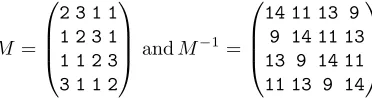
TheMixColumnsoperation operates on the state column by column. Each column of the state matrix is considered as a vector where each of its four elements belong toF28. A 4×4 matrixM whose elements are also in F28 is used to map this column into a new vector. This operation is applied to the four columns of the state matrix. HereM and its inverse M−1 are defined as
M =
2 3 1 1 1 2 3 1 1 1 2 3 3 1 1 2
andM−1=
14 11 13 9 9 14 11 13 13 9 14 11 11 13 9 14
All the elements inM andM−1 are elements of
F28 expressed in decimal.
In Algorithm 1 we can see that the last round does not include the execution of a MixColumns operation. In all the attacks considered in this paper we will assume that the last round does not include aMixColumnsoperation. This is important to note since it has been shown that the presence of aMixColumnsoperation in the last round would affect the security of AES [6].
2.2 The Key Schedule
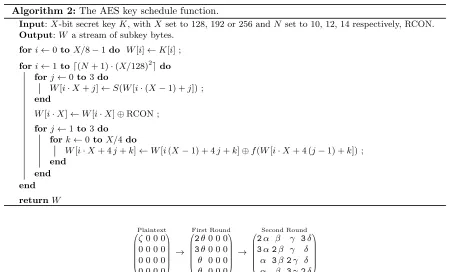
The key schedule generates a series of subkeys from the secret key. There are three variants of the AES corresponding to the three possible bit lengths of the secret key used, i.e. 128, 192 or 256 bits. In Algorithm 2 we show how the subkey bytes are generated from an initial secret keyK. The functionS is the substitution function used in theSubBytesoperation described above. The functionf is, for the most part, the identity function. However, whenKis a 256-bit key andj= 4 thenf is the substitution functionS. RCON is a round constant that changes for each loop. We refer the reader to the AES specification for a more detailed description of the key schedule [8].
For AES-128, knowing one subkey will allow the original key to be derived. For AES-192 and AES-256 there will still be some ambiguity and two subkeys are required to derive the original key.
3
The Square Attack
Algorithm 2:The AES key schedule function.
Input:X-bit secret keyK, withX set to 128, 192 or 256 andN set to 10, 12, 14 respectively, RCON. Output:W a stream of subkey bytes.
fori←0toX/8−1do W[i]←K[i] ;
fori←1tod(N+ 1)·(X/128)2edo forj←0to3do
W[i·X+j]←S(W[i·(X−1) +j]) ; end
W[i·X]←W[i·X]⊕RCON ; forj←1to3do
fork←0toX/4do
W[i·X+ 4j+k]←W[i(X−1) + 4j+k]⊕f(W[i·X+ 4 (j−1) +k]) ; end end end returnW Plaintext
ζ0 0 0 0 0 0 0 0 0 0 0 0 0 0 0 → First Round
2θ0 0 0
3θ0 0 0
θ 0 0 0
θ 0 0 0 → Second Round
2α β γ 3δ 3α2β γ δ
α 3β2γ δ α β 3γ2δ
Fig. 1.Propagation of a one-byte difference across two rounds of AES. A structure in this difference is imposed by theMixColumnsoperation (see Section 2.1).
It is therefore impossible that the XOR difference between two such plaintexts will be zero in any byte after two rounds. This property will persist until the nextMixColumnsoperation, and is used for impossible differential cryptanalysis since the XOR difference after two rounds cannot be zero [2].
This property is also used to construct an attack referred to as the Square attack (so-called since it was first presented in the description of the block cipher Square [4]) and was first presented in the original description of AES [5]. We consider 256 distinct plaintexts that are equal in fifteen bytes. After computing two rounds of AES the property described above will be valid between all possible pairs, i.e. across all 256 intermediate states the bytes at each index will contain one of each possible value. The XOR sum of the 256 bytes at each index will therefore be equal to zero. There will not be one instance of each possible value across the 256 bytes at each index after the nextMixColumnsoperation. However, the XOR sum of the bytes at each index will still be zero after theMixColumns operation, and this property will remain true until the nextSubBytesoperation. In the remainder of this paper we will refer to a set of 256 chosen plaintext-ciphertext pairs where the 256 distinct plaintexts that are equal in fifteen bytes as aδ-set.
4
Applying the Square Attack to AES-128
4.1 Analyzing Four-Round AES
An attack based on the property described in Section 3 was originally detailed by Daemen and Rijmen in their AES proposal [5]. If we consider oneδ-set, the XOR sum of the intermediate states at the end of the third round is equal to zero. For a four-round variant of AES an attacker can use this observation to validate hypotheses on the last subkey byte-by-byte, where an attacker checks that the XOR sum of the input to the final round is equal to zero. For each byte this will return the correct subkey byte and one additional incorrect hypothesis per byte with a probability of 255/256. That is, any random sequence of byte will have an XOR sum equal to zero with a probability of 1/256 and there are 255 such sequences. This will result in an expected total number of key hypotheses for the last subkey of 1 +25525616 ≈216, since the length of the lists of hypotheses are mutually independent. One can determine the key if one repeats the analysis, i.e. one takes 29 chosen plaintexts and conducts the above analysis twice. This would have a time complexity of 29one-round decryptions (27encryptions of a four-round AES).
Biham and Keller observed the sum of a sequence of random bytes can be computed by only considering one example of values that occur with an odd-numbered frequency. Since values that occur with an even-numbered frequency will have no effect on the XOR sum across all 256 intermediate values [2]. Given 256 bytes taken from the same index from aδ-set, one can remove all values that occur with an even-numbered frequency and keep one example of those that occur with an odd-numbered frequency.
We defineZ as the number of instances of a given value that occur in a sequence of 256 bytes. The probability of observing a given valuentimes is
Pr(Z=n) = 256
n
256−n
1− 1
256 256−n
(1)
for 1≤ n≤256. The probability of observing an odd number of a given value is therefore Pr(X = 1) + Pr(X = 3) +. . .+ Pr(X = 255) = 0.43, and therefore the number of values that need to be treated decreases to 256×0.43 = 110. The analysis given by Biham and Keller stops here and we provide a more precise analysis below.
We defineY as the number of distinct values that occur in a sequence of 256 bytes. The probability of observingmdistinct values is
Pr(Y =m) =256(m) 256
m
256256 , (2)
for 1≤m≤256. We definer(m) =r(r−1). . .(r−m+ 1) and
n
i as a function that returns the Stirling numbers of the second kind. That is, the number of ways of partitioning n elements into i non-empty sets. The expectation ofxis simplyP256
i=1iPr(Y =i) = 162.
For a sequence of 256 bytes that consist ofm distinct values, the probability distribution will be somewhat similar to that defined by Biham and Keller. Again we defineZ as the number of instances of a given value that occur in a sequence of 256 bytes. The probability of observing observing a given valuentimes given that there aremdistinct values is
Pr(Z =n|Y =m) = 256
n
m−n
1− 1
m 256−n
(3)
will be:
E(A) =
256
X
i=1
iPr(Y =i)
127
X
j=0
Pr(Z= (2j+ 1)|Y =i)≈78 (4)
That is, the sum of the number of distinct values occurring with an odd-numbered frequencyiP127
j=0Pr(X = (2j+ 1)|Y =i)
multiplied by the probability of it occurring. This would reduce the time complexity of an attack re-quiring twoδ-sets to 156 one-round decryptions (approximately 25encryptions of a four-round AES).
4.2 Analyzing Five-Round AES
An extension to the above attack was also first presented in the original description of AES [5]. This attack allowed an extra round to be analyzed with an increase in the time complexity. Rather than analyzing the final subkey byte-by-byte, one analyzes the penultimate subkey.
In order to do this one is obliged to guess 32 bits of the final subkey to determine one column of the state matrix before the XOR with the penultimate subkey. One can then compute theMixColumns operation on this column, and validate hypotheses on a byte of a subkey equivalent to the penulti-mate subkey (one could compute theMixColumns operation on the derived subkey to determine the penultimate subkey). A valid byte would allow the property described in Section 3 to be observed. Each evaluation reduces the potential key space of five bytes being analyzed by a factor of 256, and one would need to conduct this analysis five times to determine 32 bits of the final subkey [5].
If we define each of the 232partial decryptions as having a time complexity equivalent to a quarter
of a round, analyzing five sets of 256 ciphertexts to determine 32 bits of the last subkey and eight bits of the “penultimate” subkey, can be computed with an effort equivalent to 240/4 one-round AES
decryptions for oneδ-set. Given this is a quarter of the work required for one set of 256 acquisitions, the total complexity to determine a key using fiveδ-sets would be 5·240 one-round AES decryptions,
or equivalent to 240five-round AES encryption operations.
The cryptanalysis cannot be significantly improved by following the reasoning given in Section 4.1. That is, if one partially decrypts aδ-set using hypotheses on 32 bits of the last subkey, one can then form hypotheses on individual bytes of the penultimate subkey using one example of distinct values that occur with an odd-numbered frequency. One could follow this reasoning with the 32-bit values taken from the ciphertexts. However, over 256 acquisitions the probability of observing a value that occurs with an even-numbered frequency will be too low to have any significant impact on the time complexity of an attack.
Ferguson et al. present a way of conducting this attack that is referred to as the “partial sums” method [7]. They observe that conducting the attack involves computing
X
i
S−1(S0(ci,0⊕k0)⊕S1(ci,1⊕k1)⊕
S2(ci,2⊕k2)⊕S3(ci,3⊕k3)⊕k4),
(5)
whereSλ, forλ∈ {0, . . . ,3}, are bijective look-up tables that consist of the functionS and a multipli-cation by a field element fromF28. These are evaluated efficiently by associating a “partial sum” xk to each ciphertext wherexk is defined as
xk ← k X
j=0
Sj(cj⊕kj). (6)
This gives a map from (c0, c1, c2, c3) 7→ (xk, xk+1, . . . , c3). In order to conduct an attack one can
possible values of k0 and k1. This will take 224 executions of the function S resulting in 224 values
for (x1, c2, c3). This continues by computing (x2, c3) for all possible values ofk2 that also requires a
224 executions of the function S resulting in 232 values for (x
2, c3). Computing the 240 values forx3
for all values of k3 will require a further 240 executions of the function S. The last step will require
248 executions of the function S−1. Using the estimate provided by Ferguson et al., that the time
complexity of one AES encryption is equivalent to 28 executions of the functionS [7], implementing
the attack described above will have a time complexity equivalent to approximately 240five-round AES
encryption operations. This has the same time complexity as the straightforward approach described previously. The method reported by Ferguson et al. can only be applied when groups of δ-sets are treated together (see Section 4.3).
The above analyses assume that one only considers one byte of the subkey that is equivalent to the penultimate subkey. However, if we consider more bytes of the penultimate subkey then fewer δ-sets are required. An attacker guesses 32 bits of the last subkey which allows an attacker to validate hypotheses on four bytes of a subkey that is equivalent to the penultimate subkey. For one guess of 32 bits of the final subkey one would expect a hypothesis for any byte of the subkey that is equivalent to the penultimate subkey to produce an XOR sum equal to zero with a probability equal to 1/28. Given that there are four such bytes the probability that four bytes of this subkey will produce four sequences with XOR sums equal to zero is 1/232. Therefore, in order to determine 32 bits of the last subkey and 32 bits of a subkey equivalent to the penultimate subkey one would expect to need two δ-sets. This would reduce the time complexity of the attack detailed by Daemen and Rijmen [5] to approximately 239 five-round AES encryption operations.
The analysis of the hypotheses can be further optimized if the relationship between the last and penultimate subkey are verified as the attack progresses. If we consider one δ-set, one can analyze two columns of the penultimate subkey by guessing eight bytes of the last subkey (in two sets of four bytes). This will produce two sets of 232hypotheses with a time complexity equivalent to 236five-round
AES encryption operations (using the estimations given above). One can then eliminate hypotheses in each set that are inconsistent, given that we have hypotheses on eight bytes of the penultimate key and eight bytes of the last subkey. However, we note that extra computation is required to change the hypotheses on the derived values to hypotheses for the penultimate subkey. That is, the four bytes corresponding to the penultimate subkey are multiplied byM as described in Section 2.1. This can be efficiently computed by considering the input vector as a 32-bit word and the matrix multiplication conducted using 32-bit operations. We estimate the complexity of this to be approximately equivalent to (5), which is equivalent to 1/26five-round AES encryption operations. Operating on these 232values will require the equivalent of 226 five-round AES encryption operations, which is negligible compared to the generation of the hypotheses.
From the AES key schedule we can see that any subkey byte can be computed from two specific bytes in either the previous or following subkey. From the two sets of hypotheses generated, as described above, there will be three cases where known relationships between these sets of hypotheses can be verified. Given that the probability that all three bytes of a given hypotheses can be verified will be 1/224, one would expect that the two sets of 232hypotheses can be reduced to one set of 240hypotheses.
A third set of 232hypotheses can then be generated for one of the remaining columns of the penultimate
subkey and four bytes of the last subkey. There will be a further four bytes of the last subkey that are generated by bytes for which there are already hypotheses, and an element from the set of of 240
hypotheses will validate a hypothesis from the new set of 232 hypotheses with a probability of 1/232.
One would therefore expect to combine these two sets to produce a set of 240 hypotheses for 96 bits
of the penultimate and 96 bits of the last subkey. A set of 232 hypotheses can then be generated for
the final column of the penultimate subkey and four bytes of the final subkey. At this point on can verify whether an entire subkey can be generated from the penultimate subkey. For each of the 232
Plaintext
•0 0 0 0•0 0 0 0•0 0 0 0•
→ AddRoundKey
•0 0 0 0•0 0 0 0•0 0 0 0•
→ SubBytes
•0 0 0 0•0 0 0 0•0 0 0 0•
→ ShiftRow
•0 0 0
•0 0 0
•0 0 0
•0 0 0 → MixColumn
•0 0 0 0 0 0 0 0 0 0 0 0 0 0 0
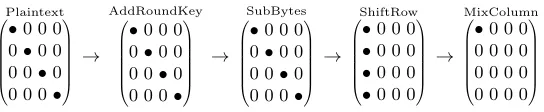
Fig. 2.Propagation of a four-byte difference across one round of AES, where•represents a non-zero difference.
bits of the last subkey will produce valid keys with a probability of 1/(28)9 = 1/272 (since there will
be nine bytes in the last subkey that will not have been verified previously). One would, therefore, expect to generate two hypotheses from the two sets of hypotheses. One that is correct and one that fulfills the criteria by chance. A detailed example of how an instance of this attack would be conducted is given in Appendix A.
The time complexity of the entire attack will be 238 five-round AES encryption operations and require 240 hypotheses to be stored in memory. If a second δ-set is included the time complexity will increase, but the memory requirements will become negligible. The time complexity does not double since an attacker only requires sufficient information to determine which of the two remaining hypotheses are false. This should be possible with work equivalent to 236five-round AES encryptions,
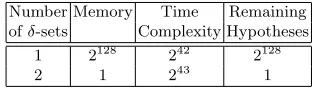
i.e. the generation of hypotheses of 32-bits of the final and 32 bits of the penultimate subkeys. These attack are summarized in Table 1.
Table 1.Summary of the Square Attack on Five-Round AES-128.
Number Memory Time Remaining ofδ-sets Complexity Hypotheses
1 240 238 2
2 1 238 1
4.3 Analyzing an Extra Round
The attack described above applied to a five-round AES can be extended to attack a six-round AES. In order to permit an extra round to be analyzed a set of 232 plaintexts are chosen that give all the
possible ciphertexts that differ at indexes 1,6,11, and 16. An attacker will then seek to choose the 256 plaintext-ciphertext pairs that produce intermediate states that differ in only one byte after one round, i.e. the input required to attack a five-round AES, as shown in Figure 2.
The simplest way of achieving this would be to choose 256 32-bit values for the first column of the intermediate state that differ in one byte. These 32-bit values can be deciphered for a given hypothesis for four bytes of the first subkey (specifically the bytes at indexes 1,6,11, and 16). This will produce 256 plaintexts that produce aδ-set after one round that can be analyzed using the attack described in Section 4.2, each of which will provide one hypothesis for the secret key given the hypotheses for 32 bits of the first subkey. This would increase the time complexity of an attack by a factor of 232, but
allow an extra round to be analyzed.
Ferguson et al. observed that all 232 can be used as a set of acquisitions to conduct the Square
attack [7]. That is, a set of 232 distinct plaintexts differing at, for example, indexes 1,6,11, and 16
described above can be viewed as 224 δ-sets. This remains true after the first round but an attacker
section work in the same manner but with a set of 232, rather than 28, acquisitions. We refer to a set
of 232 plaintext-ciphertext pairs that are equivalent to 224δ-sets as a∆-set.
An attack would proceed in the same manner as described in Section 4.2. Using the same notation the computation of the sets of (x1, c2, c3) will require 248executions of the functionS. This would result
in 232 triples (x1, c2, c3). However, a maximum of 224values distinct values are possible. As described
in Section 4.1, one only needs to keep one example of the triplets that occur with an odd-numbered frequency. Likewise, this will produce at most 216 values for (x
2, c3) per key hypothesis, and at most
28values forx
3per key hypothesis. The time complexity of the entire analysis requires 250 executions
of the functionS for all four 32-bit sets for the final subkey, which given our estimate given above corresponds to 242AES encryptions operations. This is increased to 244 where five∆-sets are required
to determine the key.
Given that only two∆-sets are required to determine the key, see Section 4.2, one the complexity using the “partial sums” method can be reduced to 243. This is not immediately apparent since
evaluating (5) will reduce the number of key hypotheses for {k0, k1, k2, k3, k4} by a factor of 256.
Intuitively, one would expect that the same effort would be required to analyze one∆-set four times, resulting in an attack with the same time complexity as that proposed by Ferguson et al. We note that evaluating (5) once for a given ∆-set will requires 248 executions of the function S. A second
evaluation of an instance of (5) withk4replaced with a different key byte from the penultimate subkey
will require 240 executions of the function S. This is because S
λ(ci,λ⊕kλ), for one λ ∈ {0, . . . ,3}, will already have been computed for alli(we note that this will involve carefully choosing the order in which the first instance of (5) is evaluated). This same reasoning applies for a third and fourth evaluation of (5) that will result in an 8-tuple consisting of four bytes of the last subkey and four bytes of the penultimate subkey. The overall complexity of evaluating (5) four times for one∆-set is, therefore, approximately 248 executions of the function S. The time complexity of the repeating this for all four 32-bit sets for the final subkey requires 250 executions of the function S, which given our estimate given above corresponds to 242 AES encryptions operations. This is increased to 243 where two∆-sets are required to determine the key.
We can reduce the time complexity further if we exploit the relationships between key bytes in adjacent subkeys. That is, one can generate 8-tuples of key byte values using the “partial sums” sums technique proposed by Ferguson et al. and use the attack described in in Section 4.2 to reduce the number of key hypotheses. Given one set of 232 plaintext-ciphertext pairs an attack with a time complexity equivalent to 242six-round AES encryption operations and require that 240key hypotheses are stored in memory. Again, more acquisitions can be used to reduce the memory requirements at the cost of an increased time complexity. This is summarized in Table 2.
Table 2.Summary of the Square Attack on Five-Round AES-128.
Number Memory Time Remaining ofδ-sets Complexity Hypotheses
1 240 242 2
2 1 242 1
5
Applying the Square Attack to AES-192 and AES-256
5.1 Analyzing Five-Round AES
Attacking a five-round AES-192 will function using a time complexity equivalent to 239AES encryption
operations using the attack described in Section 4.2 based on the attack proposed by Ferguson et al. [7]. That is, two δ-sets would be sufficient to determine the last two subkeys of a five-round instance of AES-192 or AES-256.
An attack on an instance of AES-256 cannot be made more efficient by analyzing two consecutive subkeys since there are no direct relationships. However, one can exploit the relationships between two consecutive subkeys when attacking an AES-192. This would follow a similar technique to that presented in Section 4.2. If one acquires aδ-set, one can analyze two columns of the penultimate subkey by guessing eight bytes of the last subkey (in two sets of four bytes). This will produce two sets of 232
hypotheses with a time complexity equivalent to 236 five-round AES encryption operations. One can
then eliminate hypotheses in each set that are inconsistent, since we would have hypotheses on eight bytes of the penultimate key and eight bytes of the last subkey. Given the key schedule, one would expect that the two sets of 232 hypotheses can be reduced to one set of 248 hypotheses. A third set of 232 hypotheses can then be generated for one of the remaining columns of the penultimate subkey and four bytes of the last subkey. One would expect that this would produce 264 hypotheses with the relevant subkeys. This is because, in each case, there are two key bytes in the penultimate key that can each be derived from bytes the last subkey. A detailed example of how this attack would be conducted is given in Appendix B.
As previously, the memory requirements of the above attack can be reduced by acquiring more δ-sets at the cost of an increase in the time complexity. However, one would only need to analyse half the information present in a secondδ-set to reduce the hypotheses to a trivial amount. The details of the square attack applied to five-round AES-192 and AES-256 are shown in Table 3 and 4 respectively.
Table 3.Summary of the Square Attack on Five-Round AES-192.
Number Memory Time Remaining ofδ-sets Complexity Hypotheses
1 264 238 264
2 1 238.5 216
Table 4.Summary of the Square Attack on Five-Round AES-256.
Number Memory Time Remaining ofδ-sets Complexity Hypotheses
1 2128 238 2128
2 1 239 1
5.2 Analyzing Six-Round AES
The attacks on five rounds of AES-192 and AES-256 can be extended by assuming that an attacker knows the last subkey. The time complexity of the five-round attack does increases by a factor of 2128
7-th Subkey • • • • • • • • • • • • • • • • → 6-th Subkey
◦ ◦0 0
◦ ◦0 0
◦ ◦0 0
◦ ◦0 0 → 5-th Subkey
0 0 0◦
0 0 0◦
0 0 0◦
0 0 0◦
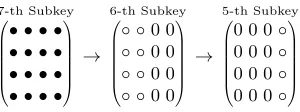
Fig. 3.The known information from the last subkey, where • represents a known value and ◦represents a derived value.
the last subkey would allow an attacker to directly derive bytes in previous subkeys when attacking AES-192 [10]. That is, 64 bits of the penultimate subkey and 32 bits of the antepenultimate subkey, as shown in Figure 3.
Following the reasoning in Section 4.2, a computational effort equivalent to 222 (i.e. a factor of
216 less than the standard attack) six-round AES-192 encryption operations to treat each δ-set. As
previously, twoδ-sets would be sufficient to determine the penultimate and antepenultimate subkeys. One can reduce this to one set if one uses the relationships between two consecutive subkey as described in Section 5.1. Since much of the subkeys are already known the memory requirements are much reduced. The details of the square attack applied to five-round AES-192 and AES-256 are shown in Table 5 and 6 respectively.
Table 5.Summary of the Square Attack on Six-Round AES-192 usingδ-sets..
Number Memory Time Remaining ofδ-sets Complexity Hypotheses
1 216 2150 28
2 1 2151 1
Table 6.Summary of the Square Attack on Six-Round AES-256 usingδ-sets..
Number Memory Time Remaining ofδ-sets Complexity Hypotheses
1 2128 2166 2128
2 1 2167 1
We can also note that introducing an extra round before, and acquiring∆-sets will lead to a more efficient attack. This involves conducting the five-round attack described in Section 5.1 on a six-round AES using ∆-sets rather than δ-sets. The details of the square attack applied to six-round AES-192 and AES-256 using∆-sets are shown in Table 7 and 8 respectively.
5.3 Analyzing an Extra Round
Table 7.Summary of the Square Attack on Six-Round AES-192 using∆-sets.
Number Memory Time Remaining ofδ-sets Complexity Hypotheses
1 264 242 264
2 1 242.5 216
Table 8.Summary of the Square Attack on Five-Round AES-256 using∆-sets.
Number Memory Time Remaining ofδ-sets Complexity Hypotheses
1 2128 242 2128
2 1 243 1
If, for example, an attacker wishes to evaluate (5) and knows (k0, k1) these values can be evaluated
before the unknown (k2, k3). Generating 224 values for (x1, c2, c3) will require 233 executions of the
functionS. Then 216 values for (x
2, c3) per hypotheses fork2 can be generated with 232 executions of
the functionS, and continue as per the attack described in Section 4.3. The time complexity of the entire analysis will be 234 evaluations of the functionS. That is, 236 executions of the functionS for
all four 32-bit sets for the final subkey, which corresponds to 228AES encryptions operations.
Table 9.Summary of the Square Attack on Seven-Round AES-192.
Number Memory Time Remaining ofδ-sets Complexity Hypotheses
1 216 2153 28
2 1 2154 1
6
Conclusion
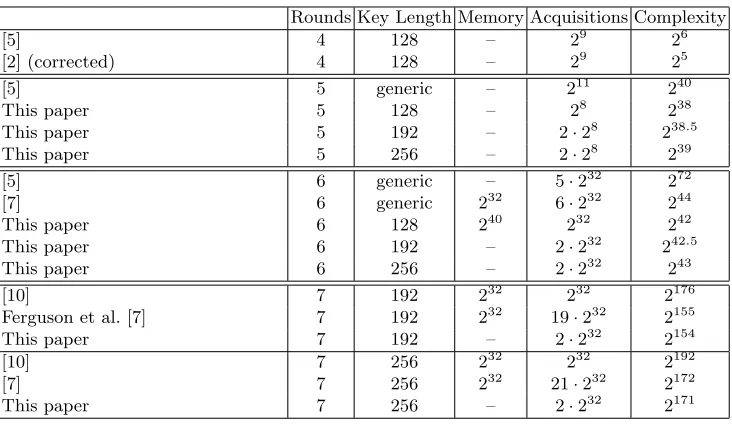
In this paper we have demonstrated that the “partial sums” method of conducting the Square attack can be improved by analyzing more information perδ-set (or∆-set). This allows the time complexity of attacks to be halved. For AES-128 the time complexity can be halved again, and reduced by a smaller amount for AES-192, by eliminating key hypotheses on-the-fly.
In Table 11 we present a summary of the attacks presented in this paper alongside similar attacks in the literature. The memory requirements are the number of state matrices, or equivalent, that need to be stored in memory. The number of acquisitions are the number of chosen plaintexts enciphered with an unknown key, where the number is given in multiples of 28 or 232so that it is clear how many δor∆-sets are required to conduct the attack. The time complexity is expressed as the computational effort required to compute that many AES encryption operations.
In this paper we have focused on attacks that require relatively few chosen plaintext-ciphertext pairs. Ferguson et al. also proposed a Square attack applicable to seven rounds of a AES-128 and eight rounds for AES-192 and AES-256. However, this attack requires approximately 2128 chosen
Table 10.Summary of the Square Attack on Seven-Round AES-256.
Number Memory Time Remaining ofδ-sets Complexity Hypotheses
1 2128 2170 2128
2 1 2171 1
Table 11.Summary of attacks presented in this paper.
Rounds Key Length Memory Acquisitions Complexity
[5] 4 128 – 29 26
[2] (corrected) 4 128 – 29 25
[5] 5 generic – 211 240
This paper 5 128 – 28 238
This paper 5 192 – 2·28 238.5
This paper 5 256 – 2·28 239
[5] 6 generic – 5·232 272
[7] 6 generic 232 6·232 244
This paper 6 128 240 232 242
This paper 6 192 – 2·232 242.5
This paper 6 256 – 2·232 243
[10] 7 192 232 232 2176
Ferguson et al. [7] 7 192 232 19·232 2155
This paper 7 192 – 2·232 2154
[10] 7 256 232 232 2192
[7] 7 256 232 21·232 2172
This paper 7 256 – 2·232 2171
References
1. B. Bahrak and M. R. Aref. Impossible differential attack on seven-round AES-128. IET Information
Security Journal, 2(2):28–32, 2008.
2. E. Biham and N. Keller. Cryptanalysis of reduced variants of Rijndael. unpublished, 1999. http://www. madchat.fr/crypto/codebreakers/35-ebiham.pdf.
3. A. Bogdanov, D. Khovratovich, and C. Rechberger. Biclique cryptanalysis of the full AES. In D. H. Lee and X. Wang, editors,ASIACRYPT 2011, volume 7073 of LNCS, pages 344–371. Springer, 2011.
4. J. Daemen, L. Knudsen, and V. Rijmen. The block cipher Square. In E. Biham, editor,FSE ’97, volume 1267 ofLNCS, pages 149–165. Springer, 1997.
5. J. Daemen and V. Rijmen. AES proposal: Rijndael. In AES Round 1 Technical Evaluation CD-1:
Docu-mentation. NIST, August 1998. http://www.nist.gov/aes.
6. O. Dunkelman and N. Keller. The effects of the omission of last round’s MixColumns on AES.Information
Processing Letters, 110(8–9):304–308, 2010.
7. N. Ferguson, J. Kelsey, S. Lucks, B. Schneier, M. Stay, D. Wagner, and D. Whiting. Improved cryptanalysis of Rijndael. In B. Schneier, editor,FSE 2000, volume 1978 ofLNCS, pages 213–230. Springer, 2001. 8. FIPS PUB 197. Advanced encryption standard (AES). Federal Information Processing Standards
Publi-cation 197, National Institute of Standards and Technology (NIST), Gaithersburg, MD, USA, November 2001.
9. J. Lu, O. Dunkelman, N. Keller, and J. Kim. New impossible differential attacks on AES. In D. R. Chowdhury, V. Rijmen, and A. Das, editors,INDOCRYPT 2008, volume 5365 ofLNCS, pages 279–293. Springer, 2008.
10. Stefan Lucks. Attacking seven rounds of Rijndael under 196-bit and 256-bit keys. In AES Candidate
11. S. Mangard, E. Oswald, and T. Popp. Power Analysis Attacks: Revealing the Secrets of Smart Cards. Springer-Verlag, 2007.
12. W. Zhang, W. Wu, and D. Feng. New results on impossible differential cryptanalysis of reduced AES. In K.-H. Nam and G. Rhee, editors,ICISC 2007, volume 4817 of LNCS, pages 239–250. Springer, 2007.
A
Using the Key Schedule to Complement the Square Attack on
Five-Round AES-128
In this section we describe an example of the attack presented in Section 4.2. We assume the worst case where an attacker only has oneδ-set. Other versions should be possible (i.e. where one chooses to examine the columns of the penultimate subkey in a different order).
We define the last two subkeys as
K4=
k4,1k4,5 k4,9 k4,13
k4,2k4,6k4,10k4,14
k4,3k4,7k4,11k4,15
k4,4k4,8k4,12k4,16
and
K5=
k5,1k5,5 k5,9 k5,13
k5,2k5,6k5,10k5,14
k5,3k5,7k5,11k5,15
k5,4k5,8k5,12k5,16
.
If an attacker has a δ-set, one can conduct an analysis as described in Section 4.2. That is, one can guess, for example, the key bytes{k5,1, k5,14, k5,11, k5,8} which will allow hypotheses to be formed on
each element of{k4,1, k4,2, k4,3, k4,4}independently. Note that while the attack derives information on
a transformed version of {k4,1, k4,2, k4,3, k4,4} this can be easily inverted for each hypotheses for the
whole set. With a time complexity equivalent to 218 five-round AES encryptions one would expect to
obtain 232hypotheses for
γ1={k5,1, k5,14, k5,11, k5,8, k4,1, k4,2, k4,3, k4,4} ,
which can be stored in a hash table.
One can then conduct the same analysis by making hypotheses on{k5,13, k5,10, k5,7, k5,4}which will
allow hypotheses to be derived on the elements of{k4,13, k4,14, k4,15, k4,16}. Likewise, this will provide
232 hypotheses for
γ2={k5,13, k5,10, k5,7, k5,4, k4,13, k4,14, k4,15, k4,16} .
However, as each element inγ2is generated the following relationships between the elements inγ2and
γ1 can be verified:
k5,1=S(k4,14)⊕k4,1⊕RCON, k5,4=S(k4,13)⊕k4,13
and k5,14=k5,11⊕k4,14
A given element ofγ2will therefore have 28elements inγ1that will satisfy these constraints, given that
a incorrect key value will fulfill these relationships with probability 1/224. The resulting 240hypotheses for{γ1, γ2} can also be stored in a hash table.
One can continue in a straightforward manner to derive 232hypotheses for
For each element inγ3 an attacker can verify the following relationships with{γ1, γ2}:
k5,2=S(k4,15)⊕k4,2, k5,5=k5,1⊕k4,5 k5,8=k5,4⊕k4,8
and k5,14=k5,10⊕k4,14
Again the resulting 240 hypotheses for{γ
1, γ2, γ3}can be stored in a hash table.
Lastly, one can perform the same analysis on
γ4={k5,9, k5,6, k5,3, k5,16, k4,9, k4,10, k4,11, k4,12} .
Each element from γ4 can be used to see if a valid pair {K4, K5} has been found by searching in {γ1, γ2, γ3}for values that satisfy the remaining relationships between the two subkeys:
k5,4 =S(k4,13)⊕k4,4, k5,6 =k5,2⊕k4,6,k5,7 =k5,3⊕k4,7,k5,9=k5,5⊕k4,9, k5,10=k5,6⊕k4,10,
k5,11=k5,7⊕k4,11,k5,12=k5,8⊕k4,12,k5,13=k5,9⊕k4,13, andk5,16=k5,12⊕k4,16
Given that an incorrect hypothesis for{K4, K5}will validate these equations with a probability of
1/289= 1/272, one would expect to have two hypotheses for {K4, K5} (i.e. the correct key and one
incorrect one that fulfills the criteria by chance) and therefore two hypotheses for the AES key.
B
Using the Key Schedule to Complement the Square Attack on
Five-Round AES-192
In this section we describe an example of the attack presented in Section 5.1. We assume the worst case where an attacker only has oneδ-set. Other versions should be possible (i.e. where one chooses to examine the columns of the penultimate subkey in a different order).
We define the last two subkeys as
K4=
k4,1k4,5 k4,9 k4,13
k4,2k4,6k4,10k4,14
k4,3k4,7k4,11k4,15
k4,4k4,8k4,12k4,16
and
K5=
k5,1k5,5 k5,9 k5,13
k5,2k5,6k5,10k5,14
k5,3k5,7k5,11k5,15
k5,4k5,8k5,12k5,16
If an attacker has aδ-set, one can conduct an analysis as described in Section 4.2. As previously, one can guess, for example, the key bytes{k5,1, k5,14, k5,11, k5,8}which will allow hypotheses to be formed
on each element of{k4,1, k4,2, k4,3, k4,4}independently. Note that while the attack derives information
on a transformed version of{k4,1, k4,2, k4,3, k4,4}this can be easily inverted for each hypotheses for the
whole set. With a time complexity equivalent to 218 five-round AES encryptions one would expect to
obtain 232hypotheses for
γ1={k5,1, k5,14, k5,11, k5,8, k4,1, k4,2, k4,3, k4,4} ,
which can be stored in a hash table.
One can then conduct the same analysis by making hypotheses on{k5,13, k5,10, k5,7, k5,4}which will
allow hypotheses to be derived on the elements of{k4,13, k4,14, k4,15, k4,16}. Likewise, this will provide
232 hypotheses for
However, as each element inγ2is generated the following relationships between the elements inγ2and
γ1 can be verified:
k5,15=k4,7⊕k5,11 and k5,12=k4,4⊕k5,8 .
A given element ofγ2 will therefore have 216 elements inγ1 that will satisfy these constraints, given
that a incorrect key value will fulfill these relationships with probability 1/216. This will result in 248
hypotheses for{γ1, γ2}. Continuing in a straightforward manner to derive 232 hypotheses for
γ3={k5,13, k5,10, k5,7, k5,4, k4,13, k4,14, k4,15, k4,16} .
For each element inγ3 an attacker can verify the following relationships with{γ1, γ2}:
k5,14=k4,6⊕k5,10 and k5,11=k4,3⊕k5,7
This will result in 264 hypotheses for{γ1, γ2, γ3} and the set
γ4={k5,9, k5,6, k5,3, k5,16, k4,9, k4,10, k4,11, k4,12},
can be used to check each element fromγ4can be used to see if a valid pair {K4, K5} has been found
by searching in{γ1, γ2, γ3}for values that satisfy the remaining relationships between the two subkeys
using
k5,13=k4,5⊕k5,9, k5,9=k4,1⊕k5,5, k5,10=k4,2⊕k5,6,
and k5,16=k4,8⊕k5,12 .
Given that an incorrect hypothesis for{K4, K5} will validate these equations with a probability of