A New Repeating Color Watermarking Scheme
Based on Human Visual Model
Chwei-Shyong Tsai
Department of Management Information System, National Chung Hsing University, Taichung 402, Taiwan Email:[email protected]
Chin-Chen Chang
Department of Computer Science and Information Engineering, National Chung Cheng University, Chiayi 621, Taiwan Email:[email protected]
Received 26 November 2001; Revised 6 March 2004; Recommended for Publication by Yung-Chang Chen
This paper proposes a human-visual-model-based scheme that effectively protects the intellectual copyright of digital images. In the proposed method, the theory of the visual secret sharing scheme is used to create a master watermark share and a secret wa-termark share. The wawa-termark share is kept secret by the owner. The master wawa-termark share is embedded into the host image to generate a watermarked image based on the human visual model. The proposed method conforms to all necessary conditions of an image watermarking technique. After the watermarked image is put under various attacks such as lossy compression, ro-tating, sharpening, blurring, and cropping, the experimental results show that the extracted digital watermark from the attacked watermarked images can still be robustly detected using the proposed method.
Keywords and phrases:secret sharing, digital watermark, human visual model.
1. INTRODUCTION
With the improvement of telecommunications, more and more people process, transmit, and store digital media via Internet. However, problems such as illegal use, tamper-ing, and forgery occur that not only violate copyright laws but also do harm to the monetary profits of the copyright owners. Therefore, the protection of the intellectual prop-erty for digital media has become an important issue. Re-cently, digital watermarking has successfully provided the methods to guard the intellectual property rights of digital media, and some excellent research results have been pub-lished [1,2,3,4,5,6,7,8,9,10,11,12,13,14,15,16,17, 18].
To effectively protect the copyright of the digital images, a successful digital watermarking technique must possess the following four characteristics [17,18].
(1) Watermarking must not reveal any hint of the digital watermark; that is, the watermarked image must not visually differ from the host image. This achieves the goal of invisible embedding.
(2) The host image is unnecessary when verifying the copyright process that detects the watermark from water-marked image. This eliminates the complexity of the process and saves extra space for host image storage.
(3) Even if the embedding and verifying processes are known, unauthorized users still cannot remove and detect the digital watermark from the watermarked image, and this achieves the goal of secure embedding.
(4) When purposely enhancing the quality of the marked image or when damage occurs so that the water-marked image may be processed by some kind of operation such as lossy JPEG compression, blurring, sharpening, rotat-ing, and cropprotat-ing, the copyright verification procedure can still distinguish the identifiable digital watermark from the modified watermarked image, and this achieves the goal of robust embedding.
to the digital host image; on the other hand, the shadow watermark share is created based on the master watermark share and its related digital watermark. The master mark share is open to the public, while the shadow water-mark share is kept secret by the copyright owner. Human visual model technology is used to determine the number of bits that can be modified without decreasing the qual-ity of the image. Thus the watermarked image created us-ing the watermark embeddus-ing process to embed the dig-ital watermark into the host image has such good qual-ity that human vision cannot determine that message is contained inside. When identifying ownership, the water-mark identification process can recover the embedded wa-termark by calculating the shadow wawa-termark share given by the owner and the master watermark share derived from the watermarked image to ensure the legality of owner-ship.
In this paper, the proposed technique can create the matching shadow watermark share of each watermark ac-cording to different digital watermarks. Therefore, it is a mul-tiple watermarking technique. The human visual model can be used to achieve the goal of invisible watermarking. Fur-thermore, the embedded watermark cannot be derived from the analysis using statistical methods and it is difficult to re-move because of the perfect securely feature of visual cryp-tography.
2. HUMAN VISUAL MODEL
In 1996, a human visual model for differential pulse code modulation (DPCM) was proposed by Kuo and Chen [19]. They took Weber’s law [20] into consideration in their model. Later, they applied another scheme based on the model of vector quantization (VQ) image compression [21]. The purpose of the human visual model is to evaluate the sensitivity of the human eyes to a luminance against a back-ground. To achieve this goal, a technique called contrast function in the gray-valued spatial domain (from 0 to 255) is used.
The two researchers constructed the contrast function C(x) from the combination of a bright background and a dark one. Thus, there are two definitions ofC(x) according to the backgroundB. HereBis the mean of the gray values in the background. For the bright background (B≥128),C(x) is defined as follows:
The other definition of C(x) for the dark background (B <128) is
where c1 is again a constant and is equal to 127.5/2,cL =
−128ek/(1−ek), andcH=(255−128ek)/(1−ek). Herekis
defined byk=2.5/(1 +eB/25).
In our proposed method, the contrast function is used to assess the sensitivity of an image block. The sensitivity of each pixelxin a block is measured via (1) or (2) based on the mean of the block (background). The evaluated sensitivity points out the number of bits of pixelxwould be changed. It will be difficult for the ordinary human eye to notice the change.
3. THE PROPOSED WATERMARKING SCHEME
For a specific digital image in need of protection, the co-operative manufacturer and individuals (called participants) owning the image copyright embed their digital color wa-termarks into it. When using the proposed method to em-bed these digital watermarks, a permutation with pseudoran-dom number generator (PRNG) and a master watermark is first created. Then each matching shadow watermark share is created based on the corresponding digital watermark. The shadow watermark share is derived by combining the mas-ter wamas-termark share and the information from its match-ing digital color watermark. Finally, the shadow watermark share is given to the related participant and kept privately for use in the future when declaring the legal copyright own-ership. When one of the participants needs to identify the copyright, an unbiased third party will stack the master wa-termark share derived from the digital image as well as the permuted shadow watermark share from the possible copy-right owner together and calculate both of them to recover the digital watermark possessing the copyright information. The proposed scheme can effectively identify the watermark to protect the intellectual property rights of the image.
3.1. Watermark embedding process
For the digital host imageHneeding protection and the dig-ital watermark representing its copyright informationW,H is a gray-value image andWis a color image. In the proposed method, the colors inWinclude white, red, green, and blue. We defineHandWseparately as follows:
H= HPij|0≤HPij≤255, 0≤i≤N1, 0≤j≤N2,
W= WPuv|WPuv∈ (255, 0, 0), (0, 255, 0),
(0, 0, 255), (255, 255, 255), 0≤u≤M1, 0≤v≤M2.
Table1: The generation rule of patternPij.
The interval of ¯xij Pij
[0, 63]
[64, 127]
[128, 191]
[192, 255]
Generally, the size of the watermark image is smaller than that of the host image. Thus letM1< N1andM2< N2.
The proposed watermark embedding process mainly in-cludes the master watermark share production procedure, the shadow watermark share production procedure, and the human-visual-based embedding procedure. The master termark share production procedure generates master wa-termark share MSaccording toH, and the shadow water-mark share production procedure combinesMSandW to generate shadow watermark share SS. Note that in order to increase the security, a secret key SK is used to be the seed of PRNG and PRNG(SK) is applied to permute all pixels of W. And the inverse permutation is applied dur-ing the watermark verification process to reveal the origi-nal secret. Fiorigi-nally, the human-visual-based embedding pro-cedure is used to generate watermarked imageH. We illus-trate these three procedures in detail in the following subsec-tions.
3.1.1. Master shadow share production
Because watermark imageWis smaller than host imageH, the proposed method divides H into many subimages of the same size Hi’s, and lets every subimage Hi correspond to W. Here, let every Hi contain n×n pixels and H = {H1,H2,. . .,HN1/n×N2/n}. When mapping each subimage
HitoW, firstHiis divided into blocksHBij’s such that each HBijcontainsq1×q2pixels, wherej=1, 2,. . .,n×n/q1×q2,
q1 = n/M1, andq2 = n/M2.Next, calculate the mean Xij
of each HBij, 0 ≤ Xij ≤ 255. Then use the Xij of each
HBij to create a pattern Pij according to a certain rule. Table 1 shows the rules of how to create Pij. Every Pij is 3×3 in size and contains 5 black pixels and 4 white pix-els. We divide the range [0, 255] in which all the possible values of Xij may appear in 4 intervals, and define a spe-cific Pij for each interval. For example, if Xij = 159, the pattern to whichHBijcorresponds is defined by the interval [128, 191].
After applying these rules to find the corresponding pat-terns for all blocksHBij’s in everyHi, the proposed method will combine all the patterns derived fromHi’s to make up the master watermark shareMSofH.
Table2: An example of CT.
Color No.
White 4
Red 3
Green 2
Blue 1
Pij= Sij=
Figure1: An example ofPijandSij.
3.1.2. Producing shadow watermark share procedure
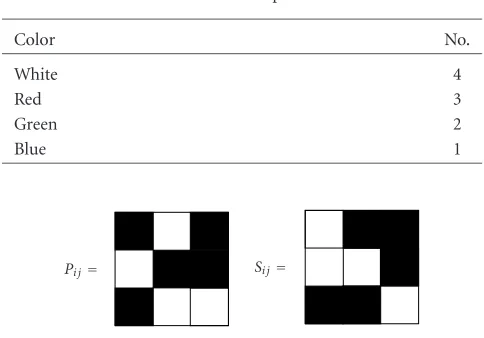
The size of shadow watermark shareSSis the same as that ofMS. EveryPij inMScorresponds to a 3×3 pattern inSS defined as Sij.Pij and the pixelWPij inW collectively de-termine the generation method of Sij. First, define a color referral table (CT) according to all of the color inW. In CT, every color inW is assigned a unique number. In the pro-posed method, the colors inWinclude white, red, green, and blue. Therefore, CT has 4 entries.Table 2shows an example of CT.
We define CT(WPij) as the color number of the pixel WPij in CT. On the other hand,Sij is a 3×3 black/white pattern built by making the number of black pixels appear-ing whenSijandPijare both in the same position equal to CT(WPij). For example, if WPij is a red pixel, and Pij is as shown inFigure 1then CT(WPij) = 3. Thus the num-ber of black pixels appearing when Sij and Pij are in the same position is 3. Therefore, Sij can be constructed as in Figure 1.
The following equation defines the creation ofSij:
p=3,q=3
p=1,q=1
Sij(p,q)Pij(p,q)=CTWPij, (4)
where
(1) Sij(p,q)=1 if the pixel thatSijlocates atpth row and qth column is black;
(2) Sij(p,q)=0 if the pixel thatSijlocates atpth row and qth column is white;
(3) Pij(p,q)=1 if the pixel thatPijlocates atpth row and qth column is black;
(4) Pij(p,q)=0 if the pixel thatPijlocates atpth row and qth column is white.
Table3: The thresholds of the 16 different contrast intervals.
3.1.3. Human visual model-based embedding
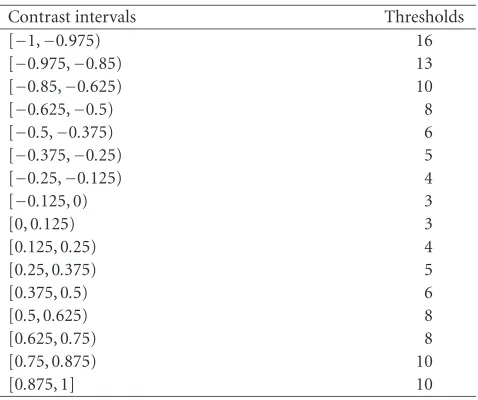
To enhance the robustness of this method, we adopt the the-ory of the human visual model to carry out the processing of watermark embedding. Due to the strong correlation be-tween the creation of the master watermark share and the black means in the host image, the value of each pixel inHBij is mainly adjusted during the embedding process. The value that is closer to the meanXijis more desirable assuming that the image quality will not be affected. To measure the maxi-mum change of each pixel without damaging the image qual-ity, the contrast functionC(x) inSection 2provides the best support. First, according to the viewpoint and experiment of the human visual model, we divide the range of C(x) into 16 intervals and assign a specific threshold to each interval. When the value of the pixel is V, the contrast value of the pixel isC(V), and the corresponding threshold ofC(V) isy, The adjusted pixel valuesVandV should conform to the following inequality equation:
|V−V| ≤y. (5)
Table 3shows the thresholds for the 16 different contract in-tervals. Next, for each pixelVstinHBij, calculate its contrast value C(Vst). Look up the value fromTable 3to obtain the corresponding thresholdTfor the contrast interval ofC(Vst). Complete the process of adjustingVsttoVst based on the fol-lowing equation:
Once each pixel within allHBij’s has been adjusted, the wa-termarked imageHis available.
For example, it is assumed thatHBij, a block in some subimage, is defined as
Therefore, from the formulas in human vision model, the backgroundB =Xij =161 from (1). Supposing the
origi-Next, the copyright owner must register the shadow wa-termark shareSSwith the certification authority in order to prevent copyright forgery. In our proposed scheme, the cer-tification authority uses a public-key cryptosystem such as RSA, signs the time-stamp registration in SSwith his own private key, and generates time-stamped shadow watermark share SST. After receivingSST, the owner will keep it a se-cret. Then, the watermarked image can be distributed to the public. As for the forged copyright, it can be easily identi-fied since the time stamp of the fake time-stamped shadow watermark share is dated after that ofSST belonging to the owner.
3.2. Watermark verification
After obtaining the secret key SK from the person declar-ing the copyright ownership and the time-stamped shadow watermark share SST, the arbitrator can carry on the pro-cess of watermark verification. First, useSKandHand exe-cute the procedure for watermark share production to obtain the master watermark shareMS. Then, stackMSandSS. For each 3×3 patternPijinMSand the corresponding 3×3 pat-ternSijinSS, recover the watermark pixelWPijaccording to (4) and the inverse permutation of the PRNG process. After allPij’s andSij’s are processed, the restored color watermark Wis available. The arbitrator comparesWand the digital watermarkW registered by the person declaring the copy-right ownership.
Figure2: Original image of Lena (512×512).
Figure3: Watermark of National Chung Cheng University (64×
64).
Figure4: Master watermark share (384×384, without PRNG pro-cess).
4. EXPERIMENTAL RESULTS
As shown in Figure 2in our experiments, the image size of a given gray-valued host image Lena was 512 ×512 pix-els. In Figure 3, a 64 ×64 color digital copyright image must be cast into the host image. First, in our method, Lena is permuted by the secret key and then partitioned into 2 ×2 blocks, where each block contains 256 ×256 pixels. We divide each 4×4 subblock into groups accord-ing to sequence after calculataccord-ing the mean value of each subblock. The next steps to generate a master watermark share are composed of patterns of 3×3 pixels. According to the mean value of each subblock and Table 1, each pat-tern of the master watermark share can then be constructed. A generated 384×384 master watermark share is shown in Figure 4.
Figure5: Shadow watermark share (384×384, without PRNG pro-cess).
Figure 6: Watermarked image of Lena (512×512); PSNR =
33.45 dB.
Figure7: Recovered repeating watermark (128×128).
Next, our shadow watermark share production proce-dure is utilized to combine the generated master watermark share and digital watermark image; then the shadow wa-termark share is generated (as shown in Figure 5). Finally, the watermarked image with PSNR = 33.45 dB, shown in Figure 6, can be generated by applying the human visual model.
Figure8: Reconstruction of JPEG compression of Lena.
Figure9: Recovered watermark fromFigure 8.
Figure10: Blurred image of Lena.
In our method, the master watermark share is not avail-able to illegal users without the secret key. Furthermore, be-cause the shadow watermark share must be generated by both the master watermark share and the digital watermark, an illegal user cannot obtain the ownership’s shadow water-mark share. The security of our proposed scheme relies on the secret key that is used in master watermark production share. Thus, different host images use different secret keys to create different master watermark shares of host images; and different images, if they have the same digital watermark, will still have different corresponding shadow watermark shares. Therefore, it is very difficult for an attacker to retrieve the copyright information using statistical methods and to fake ownership.
In order to prove the robustness of the copyright protec-tion technique proposed in our method, we simulate various kinds of attacks on watermarked image Lena in our experi-ments. Figures8,10,12,14, and16show the results of JPEG
Figure11: Recovered watermark fromFigure 10.
Figure12: Rotated image of Lena.
Figure13: Recovered watermark fromFigure 12.
lossy compression attacks with a compression factor of 80, blurring, rotating, cropping, and sharpening attacks, respec-tively. The digital watermarks under various kinds of attacks can still be clearly recovered. The results of the recovered re-peating watermarks are shown in Figures9,11,13,15, and 17, respectively.
InTable 4, the second row lists the retrieval rate of a mas-ter wamas-termark share, which stands for the ratio of the num-ber of accurate pixels to all of the pixels of the master wa-termark share in copyright retrieval. The experimental re-sults show that the retrieval rate of our method is above 80%, which means that the ownership can be retrieved ro-bustly.
Table4: The bit correct rates of extracted color watermarks of different images under various attacks.
Images
Attacks JPEG compression
(quality 90%)
Blurring (2-radius pixel)
Rotating (degree 1)
Cropping
(cut up left quarter) Sharpening
Lena 98.92% 92.86% 88.57% 80.17% 97.53%
F14 98.38% 93.25% 87.85% 84.55% 96.77%
Barbara 98.69% 92.10% 82.81% 81.92% 97.62%
Figure14: Cropped image of Lena.
Figure15: Recovered watermark fromFigure 14.
5. CONCLUSIONS
Combining the theory of the visual secret sharing scheme and the viewpoint of the human visual model, this paper pro-poses a new watermarking scheme to embedding the digital color watermark into a digital grey-level host image. The pro-posed method applies the theory of the visual secret sharing scheme along with its security feature to produce the master watermark share and the shadow watermark share for color watermarks. The shadow watermark share is kept secret by the copyright owner. On the other hand, the human visual model can be used to detect the sensitivity of each pixel in the host image so that the master watermark share is eff ec-tively embedded into the host image without reducing the image quality. Our method not only can effectively embed and detect the watermark but it also can prevent the forgery of ownership. Furthermore, the qualities of security, invisi-bility, robustness, and multiple embedding are provided in the embedded watermark.
ACKNOWLEDGMENTS
The authors wish to thank many anonymous referees for their suggestions to improve this paper. Part of this research was supported by National Science Council, Taiwan, under contract no. NSC92-2213-E-025-004.
Figure16: Sharpened image of Lena.
Figure17: Recovered watermark fromFigure 16.
REFERENCES
[1] W. Bender, D. Gruhl, N. Morimoto, and A. Lu, “Techniques for data hiding,” IBM Systems Journal, vol. 35, no. 3/4, pp. 313–336, 1996.
[2] A. G. Bors and I. Pitas, “Image watermarking using DCT domain constraints,” inProc. IEEE International Conference on Image Processing (ICIP ’96), vol. 3, pp. 231–234, Lausanne, Switzerland, September 1996.
[3] C.-C. Chang and C. S. Tsai, “A technique for computing wa-termarks from digital images,”Informatica, vol. 24, no. 3, pp. 391–396, 2000.
[4] C.-C. Chang and K.-F. Hwang, “A digital watermarking scheme using human visual effects,” Informatica, vol. 24, no. 4, pp. 505–511, 2000.
[5] C.-C. Chang and H. C. Wu, “A copyright protection scheme of images based on visual cryptography,” to appear inThe Imaging Science Journal.
[6] T. S. Chen, C.-C. Chang, and M. S. Hwang, “A virtual im-age cryptosystem based upon vector quantization,” IEEE Trans. Image Processing, vol. 7, no. 10, pp. 1485–1488, 1998. [7] I. J. Cox, J. Kilian, T. Leighton, and T. Shamoon, “Secure
spread spectrum watermarking for multimedia,”IEEE Trans. Image Processing, vol. 6, no. 12, pp. 1673–1687, 1997. [8] I. J. Cox and J. P. M. G. Linnartz, “Some general methods for
[9] S. Craver, N. Memon, B. L. Yeo, and M. M. Yeung, “Resolving rightful ownerships with invisible watermarking techniques: limitations, attacks, and implications,” IEEE Journal on Se-lected Areas in Communications, vol. 16, no. 4, pp. 573–586, 1998.
[10] M. S. Hwang, C.-C. Chang, and K.-F. Hwang, “A watermark-ing technique based on one-way hash functions,”IEEE Trans-actions on Consumer Electronics, vol. 45, no. 2, pp. 286–294, 1999.
[11] C. T. Hsu and J. L. Wu, “Hidden digital watermarks in im-ages,” IEEE Trans. Image Processing, vol. 8, no. 1, pp. 58–68, 1999.
[12] M. Kutter, F. Jordan, and F. Bossen, “Digital watermarking of color images using amplitude modulation,” Journal of Elec-tronic Imaging, vol. 7, no. 2, pp. 326–332, 1998.
[13] S. Low and N. Maxemchuk, “Performance comparison of two text marking methods,” IEEE Journal on Selected Areas in Communications, vol. 16, no. 4, pp. 561–572, 1998. [14] N. Naor and A. Shamir, “Visual cryptography,” inAdvances
in Cryptology (Eurocrypt ’94), A. De Santis, Ed., vol. 950 of
Lecture Notes in Computer Science, pp. 1–12, Springer-Verlag, Berlin, 1995.
[15] R. Ohbuchi, H. Masuda, and M. Aono, “Watermarking three-dimensional polygonal models through geometric and topo-logical modifications,”IEEE Journal on Selected Areas in Com-munications, vol. 16, no. 4, pp. 551–560, 1998.
[16] G. Voyatzis and I. Pitas, “Protecting digital image copyrights: a framework,”IEEE Computer Graphics and Applications, vol. 19, no. 1, pp. 18–24, 1999.
[17] M. D. Swanson, M. Kobayashi, and A. H. Tewfik, “Multimedia data-embedding and watermarking technologies,” Proceed-ings of the IEEE, vol. 86, no. 6, pp. 1064–1087, 1998.
[18] R. B. Wolfgang and E. J. Delp, “A watermark for digital im-age,” inProc. IEEE International Conference on Image Pro-cessing (ICIP ’96), vol. 3, pp. 219–222, Lausanne, Switzerland, September 1996.
[19] C. H. Kuo and C. F. Chen, “A prequantizer with the human visual effect for the DPCM,”Signal Processing: Image Commu-nication, vol. 8, no. 5, pp. 433–442, 1996.
[20] T. G. Stockham Jr., “Image processing in the context of a vi-sual model,” Proceedings of the IEEE, vol. 60, no. 7, pp. 828– 842, 1972.
[21] C. H. Kuo and C. F. Chen, “A vector quantization scheme us-ing prequantizers of human visual effects,” Signal Processing: Image Communication, vol. 12, no. 1, pp. 13–21, 1998.
Chwei-Shyong Tsaiwas born in Changhua, Taiwan, on September 3, 1962. He received the B.S. degree in applied mathematics in 1984 from National Chung Hsing Univer-sity, Taichung, Taiwan. He received the M.S. degree in computer science and electronic engineering in 1986 from National Cen-ter University, Chungli, Taiwan. He received the Ph.D. degree in computer science and information engineering in 2002 from
Na-tional Chung Cheng University, Chiayi, Taiwan. From August 2002, he was an Associate Professor in the Department of Informa-tion Management at NaInforma-tional Taichung Institute of Technology, Taichung, Taiwan. Since August 2004, he has been an Associate Pro-fessor in the Department of Management Information System at National Chung Hsing University, Taichung, Taiwan. His research interests include image authentication, information hiding, and cryptography.
Chin-Chen Chang was born in Taichung, Taiwan, on November 12, 1954. He received his B.S. degree in applied mathematics in 1977 and his M.S. degree in computer and decision sciences in 1979 from National Ts-ing Hua University, Hsinchu, Taiwan. He re-ceived his Ph.D. in computer engineering in 1982 from National Chiao Tung Univer-sity, Hsinchu, Taiwan. From 1983 to 1989, he was among the faculty of the Institute of