R E S E A R C H A R T I C L E
Open Access
Qualitative website analysis of information
on birth after caesarean section
Valerie L. Peddie
1*, Natalie Whitelaw
2, Grant P. Cumming
3, Siladitya Bhattacharya
4and Mairead Black
5Abstract
Background:The United Kingdom (UK) caesarean section (CS) rate is largely determined by reluctance to augment
trial of labour and vaginal birth. Choice between repeat CS and attempting vaginal birth after CS (VBAC) in the next pregnancy is challenging, with neither offering clear safety advantages. Women may access online information during the decision-making process. Such information is known to vary in its support for either mode of birth when assessed quantitatively. Therefore, we sought to explore qualitatively, the content and presentation of web-based health care information on birth after caesarean section (CS) in order to identify the dominant messages being conveyed.
Methods:The search engine Google™was used to conduct an internet search using terms relating to birth after CS. The ten most frequently returned websites meeting relevant purposive sampling criteria were analysed. Sampling criteria were based upon funding source, authorship and intended audience. Images and written textual content together with presence of links to additional media or external web content were analysed using
descriptive and thematic analyses respectively.
Results:Ten websites were analysed: five funded by Government bodies or professional membership; one via
charitable donations, and four funded commercially. All sites compared the advantages and disadvantages of both repeat CS and VBAC. Commercially funded websites favoured a question and answer format alongside images, ‘pop-ups’, social media forum links and hyperlinks to third-party sites. The relationship between the parent sites and those being linked to may not be readily apparent to users, risking perception of endorsement of either VBAC or repeat CS whether intended or otherwise. Websites affiliated with Government or health services presented referenced clinical information in a factual manner with podcasts of real life experiences. Many imply greater support for VBAC than repeat CS although this was predominantly conveyed through subtle use of words rather than overt messages, with the exception of the latter being apparent in one site.
Conclusions:Websites providing information on birth after CS appear to vary in nature of content according to their funding source. The most user-friendly, balanced and informative websites appear to be those funded by government agencies.
Background
Elective repeat caesarean sections (ERCS) account for a significant portion of the overall CS rate in the UK and US [1, 2]. However, geographical variation exists in this re-gard with one in six pre-labour CS in England determined by previous CS, while the same indication accounted for one third of pre-labour CS in Australia [3]. The ERCS rate
is affected by decisions made between couples and their health professionals in terms of whether or not to attempt a vaginal birth after CS (VBAC). As VBAC and ERCS carry differing risk profiles, and are each deemed accept-able options overall [4, 5], the availability of information on these risk profiles may play an important role in decision-making on preferred birth mode after CS. For some women, the decision to pursue VBAC may be asso-ciated with the desire to experience natural childbirth, suggesting that women may believe that successful VBAC will enhance their life experience [6, 7]. Reasons for opting for ERCS may also relate to beliefs about * Correspondence:[email protected]
1Division of Applied Health Sciences, School of Medicine and Dentistry,
University of Aberdeen, Aberdeen Maternity Hospital, Cornhill Road, Aberdeen AB25 2ZD, UK
Full list of author information is available at the end of the article
infant wellbeing or a desire to avoid repeating a previous birth experience [8].
The internet is known to play an important role in informing health-related decisions [9, 10]. Search en-gines, online symptom checkers and health checks [11] are being increasingly used by patients with the intent of contributing to positive health outcomes [12]. Women may therefore use information provided by the world-wide web (www) to help inform their decision on birth mode after CS [13]. The nature of information women receive in this manner may be influenced by characteris-tics of individual websites. Privately owned and commer-cially funded sites may have a vested interest in shaping their content as their websites may also be marketing tools. Similarly, websites may feature links to external media or webpages which imply that the index site is endorsing certain behaviours or products [12].
We observed in a previous study that the most fre-quently returned websites containing information on birth options after CS provide an incomplete picture of the risks involved for each approach to birthing mode when compared to the Royal College of Obstetricians and Gynaecologists (RCOG) patient information docu-ment [5];‘Birth after previous caesarean; Information for You’[14]. This previous work utilised a quantitative ap-proach to assess presence of facts which the RCOG sug-gest should be discussed with women planning birth after CS. However, the previous work did not allow for consideration of context in which facts were presented. The precise wording used by specific websites, the sur-rounding text and its allocated space, pictures, adverts or stories could each have an impact upon the readers’ perceptions - and future use - of the content. This study therefore aims to explore the content and presentation of internet-based health care information on birth after CS, focusing on the context in which information is pre-sented, the dominant message/s being conveyed and the overall tone of relevant websites.
Methods
Google™ (https://www.google.com), the most frequently utilised search engine worldwide, was used to perform the internet search of English language websites provid-ing information relatprovid-ing to birth after previous caesarean section. Exclusion Criteria included sites relating solely to advertising or products for sale; not relating to humans (i.e. veterinary or not related to the search terms entered), and those requiring membership or payment for full access. Search terms used included those pro-vided by a sample of women, pregnant after previous CS, attending the antenatal clinic in Aberdeen Maternity Hospital (between Dec 2013– Jan 2014). These women were invited to participate by means of a combined invi-tation letter, information sheet and form containing one
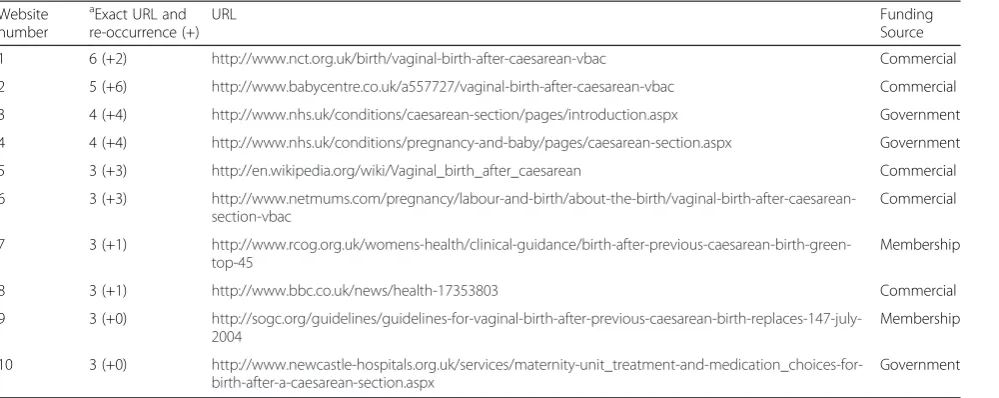
question regarding which search terms they would use if searching for information on birth options after CS on the internet. We received seven completed forms from 6 antenatal clinics. Ethical approval was sought, but the North of Scotland Research Ethics (NRES) Committee confirmed that this was not required. These, together with well-established keywords in this area (identified from a previous study, by Whitelaw et al., [14]) were selected, and a single reviewer (NW) per-formed the search. The search was conducted on a personal laptop and results verified on two NHS com-puters. The first 10 web pages returned for each of the 10 search terms were combined giving an initial sample of 100 Google search results. This provided 68 unique web pages from 44 individual websites (35 if all NHS websites are grouped together). The number of times websites recurred within this initial sample, including those returned under a slightly different uniform resource locator (URL) was recorded. Predetermined purposive sampling criteria was used to select the most frequently returned sites within this sample that met the criteria (minimum of one of the following: government-funded; commercially funded; charity-funded; aimed at the gen-eral public; UK-based, US-based and one from another country to give a final sample of 10 websites for analysis (Table 1).
research experience (VP), a second member of the team (MB), who also has qualitative research experience, checked a subset of codes/themes against relevant text, and ideas or concepts that underpinned the theme or category discussed. This process facilitated appreciation of contextual aspects of website content and the domin-ant message (s) being conveyed. This included detailed exploration of the tone in which risks and benefits asso-ciated with birthing mode options were discussed. On occasion, the way in which information was presented, had the potential for raising anxiety levels beyond that which is arguably justified by the actual risk involved, and as a result, the theoretical ability to affect birthing mode in-tentions. An example includes where the expressed risk of uterine rupture appeared distorted when compared with absolute risk, or mentioning only very briefly the risks of VBAC, might suggest a pro repeat CS and pro-VBAC stance respectively. The initial coding categories were dis-cussed among the authors, with modifications made to en-rich meaning. Where specific websites have been cited, they have been identified by ‘W’ (website) and number (refer to Table 1).
Results
The ten websites reviewed originated in three countries (UK, US and Canada) (Table 1). Five were funded by Gov-ernment (Health Services) or professional membership; one via charitable donations, and four by commercial means. Those funded by Government or professional membership specified multidisciplinary, professional authorship; NHS sites are certified by the Information Standard for Health and Social Care - which was estab-lished by the Department of Health (DoH) - and de-clared collaboration with The Royal Society for Public
Health Certification. The Charitable site and four of those commercially funded gave no clear implication regarding responsibility and accountability for pub-lished material, with one commercially funded site de-claring collaborative, anonymous contributions from other internet users. The others did not declare defined quality assurance. The qualitative analysis identified four major categories reflecting website content: (1)
‘presentation style/marketing’, including use of images, hyperlinks and advertisements; (2) ‘information bias’, where wording implied support for one particular birthing mode; (3) ‘prominence of information’, for ex-ample, one site displayed a prominent central text box il-lustrating its overall message: ‘Birthing tip’ ‘most women who choose a VBAC succeed in having a vaginal birth’and (4) ‘patient engagement’, where sites either promoted or played down collaborative decision-making and the role of women in planning the birth after CS.
Presentation style/marketing
Differences in presentation style were identified between websites commercially funded and those affiliated with Government and/or health services. The latter favoured a factual presentation style, whilst commercially funded sites tended to utilise question and answer format with advertisements/images, although some portrayed ele-ments of both.
One charitable site appeared to promote VBAC by providing hyperlinks to information predominately relat-ing to VBAC (W1). This site advocated trial of labour and VBAC in the context of promoting women’s birth choices; the overall message presented in a prominent textbox captured this; ‘Birthing tip’ ‘most women who choose a VBAC succeed in having a vaginal birth’(W1). Table 1 Study sample of websites
Website number
a
Exact URL and re-occurrence (+)
URL Funding
Source
1 6 (+2) http://www.nct.org.uk/birth/vaginal-birth-after-caesarean-vbac Commercial
2 5 (+6) http://www.babycentre.co.uk/a557727/vaginal-birth-after-caesarean-vbac Commercial
3 4 (+4) http://www.nhs.uk/conditions/caesarean-section/pages/introduction.aspx Government
4 4 (+4) http://www.nhs.uk/conditions/pregnancy-and-baby/pages/caesarean-section.aspx Government
5 3 (+3) http://en.wikipedia.org/wiki/Vaginal_birth_after_caesarean Commercial
6 3 (+3) http://www.netmums.com/pregnancy/labour-and-birth/about-the-birth/vaginal-birth-after-caesarean-section-vbac
Commercial
7 3 (+1) http://www.rcog.org.uk/womens-health/clinical-guidance/birth-after-previous-caesarean-birth-green-top-45
Membership
8 3 (+1) http://www.bbc.co.uk/news/health-17353803 Commercial
9 3 (+0) http://sogc.org/guidelines/guidelines-for-vaginal-birth-after-previous-caesarean-birth-replaces-147-july-2004
Membership
10 3 (+0) http://www.newcastle-hospitals.org.uk/services/maternity-unit_treatment-and-medication_choices-for-birth-after-a-caesarean-section.aspx
Government
a
Commercially funded sites featured images (for example, mothers with new born babies and those of
‘family units’), hyperlinks to colourful advertisements, special offers (often related to baby products and local events), links to social media sites (including reader for-ums), local events, as well as information on local birthing units. One commercially funded site invited readers to ‘share’ on social media sites and encouraged real time discussion with others, uploading of their latest‘prized’images with the chance to enter competi-tions (W6).
Irrespective of funding source, most websites em-braced social media, with links to email, Facebook and
Twitter accounts (W2,W3,W4,W6,W7,W9); one
dis-playing a ‘pop up’ box inviting readers to sign up to
‘free pregnancy and baby emails’ (W4). Similarly, most contained easy to navigate links to position statements and citations which supported the primary text, fre-quently asked questions and further information (W1,W3,W4,W5,W6,W9,W10). This included ethical considerations, consultation documents (W7,W9) and web-based applications (‘Apps’) (7).
In support of VBAC, Government funded sites used podcasts to support discussion with healthcare profes-sionals of clinically justified CS. Such sites also fea-tured patient testimonials using podcasts and written text in support of VBAC, and personal experience of CS (W3,W4). These sites linked to peer reviewed pub-lications, resources and guidelines. They supported VBAC with visual content (for example, images of family units and women breastfeeding), further sug-gesting quick recovery following vaginal birth. Overall, Government and professional membership sites pro-vided a balanced view in the presentation and style of their homepage.
Information bias (discourage (deter) vs encourage)
The way in which information was portrayed, and the language used in several websites appeared biased in support of or against VBAC/ERCS. Some sites adopted the ‘persuasive’ (positive) approach in advocating trial of labour, discussing VBAC as the default position (W7,W9,W10);‘Provided there are no contraindications, a woman with 1 previous transverse low-segment Caesarean section should be offered a trial of labour after Caesarean with appropriate discussion of maternal and perinatal risks and benefits’(9) and‘three out of four women will go on to have a vaginal delivery’(W10). Where content relat-ing to trial of labour with minimal intervention, minimal risk (W1,W3,W7,W9,W10), and successful outcome of VBAC (W1,W5,W6,W9,W10) was given greater prom-inence, this was perceived as ‘positive information provision’:‘if you have a baby by caesarean section, this does not necessarily mean that any baby you have in
the future will have to be delivered by caesarean section’ (W4), and ‘attempts at vaginal birth after caesarean (VBAC) have a high success rate and have many bene-fits’(W9).
On the other hand, some websites appeared to support repeat CS by emphasising the associated risks with trial of labour;‘during a VBAC you can have an epidural for pain relief. However, you may choose not to have an epi-dural so you can be aware of early symptoms of uterine rupture…..’(W2), which was subsequently perceived and termed‘negative information provision’. One website ap-peared to have difficulty in providing a balanced view when citing data from ‘studies’ through apparent mis-leading representation of the absolute risks; ‘The UK re-search is the first to compile national data about the risk of womb rupture - a serious complication of pregnancy, which can cause severe blood loss in the mother and put the baby at risk’ (W8). The frequent use of medical ter-minology with limited information to support the ‘ re-search’ findings quoted, further suggests that online information has the potential for misinterpretation; ‘in women who had a previous C-section, the risk of the womb rupturing during labour was seven times higher if they tried for a natural labour, compared with a planned C-section. The risk of the baby dying was three times higher’. However, as stated in a proceeding statement;
‘the overall risk was low - 2 in 10,000 of every UK preg-nancies’ (W8), thus, an astute reader could make an ob-jective assessment of the risk involved, but a casual reader may perceive risk of VBAC too great to contemplate. Similarly, a commercially funded site appeared to high-light and repeat the risks associated with VBAC; namely the 25 % risk of emergency CS and potential require-ment for blood transfusion and risk of uterine infection associated with VBAC. In an apparent attempt to redress the balance, it went on to say; ‘so if your VBAC is suc-cessful,you’ll have a lower risk of some minor and major complications’(W2).
(W7), thus ‘enhanced access to VBAC has been recom-mended based on the most recent scientific data on the safety of VBAC as compared to repeat caesarean sec-tion….’(W5).
Prominence of information
Some gave greater prominence–through physical space on their webpage - to negative outcomes (uterine rup-ture and infection; fetal death) in attempting VBAC; one commercially funded site in particular highlighted the potential for‘long term problems associated with uterine prolapse and stress incontinence and perceiving VBAC as high risk for subsequent emergency CS (25 %) with need for blood transfusion’ (W2). Another commercially funded site gave prominence to the potential risk of fetal death during VBAC; ‘the chance of your baby dying in labour is increased slightly with a VBAC compared to if you were to have a caesarean delivery’. However, the au-thors later engage an understanding of relative risk in this context; ‘the rate is actually the same as what it is with a first time mum (1:10000) so is only a very slight risk’ (W6). Government funded sites attempted to pro-vide a balanced argument, portraying risk as a cumula-tive incidence (a measure of risk occurring over period of time) in addition to simple language, which suggested these risks as non-emergency in nature; ‘if your midwife and doctor are concerned about the safety of you or your baby, they will suggest that you have a caesarean straight away, for instance if your cervix doesn’t dilate fully dur-ing labour and birth isn't progressdur-ing properly, or if you bleed during labour’ (W4). However, simple language was used by most to communicate the risks associated with birthing mode (W1,W3,W4,W5,W6,W9,W10). One commercially funded site gave prominence to results of several unreferenced research studies, moving seamlessly and selectively from one ‘study’ to another; ‘Australian researchers found the risk of stillbirth was lower in women who had a planned repeat C-section rather than trying for a natural labour’and ‘the team from the Na-tional Perinatal Epidemiology Unit at Oxford University identified 159 cases of womb rupture between April 2009 and April 2010, with the vast majority of cases - 139 - in women who had already had a Caesarean’ (W8). How-ever, contradiction was apparent in its overall less prom-inent message; ‘choosing a vaginal birth or a caesarean section carries different risks and benefits but overall ei-ther choice is safe with only very small risks’(W8), which had the potential for being overshadowed by the preced-ing text. Government sites gave greater prominence to the positive perception of VBAC; ‘According to the American Pregnancy Association, 90 % of women who have undergone caesarean deliveries are candidates for VBAC’(W7).
Patient engagement
Irrespective of funding source, most websites advocated patient autonomy, choice and involvement in decision-making (W1,W3,W4,W7,W9,W10). One charitable site promoted VBAC by tapping into women’s desire for
‘minimal intervention’ (W1), and another highlighted the psychological benefits of trial of labour and VBAC;
‘vaginal delivery is the most natural way to give birth and you should not underestimate the value of this ex-perience’ (W10). An NHS Trust-specific webpage sug-gested women ‘consider their thoughts about how they want to deliver their baby’ (W10), whilst at the same time, acknowledging the appropriate clinical justification for CS where a repeat CS might be recommended (W9), referring to first or subsequent pregnancies. One site provided links to news podcasts and review of the National Institute for Clinical Excellence (NICE) guide-lines, appearing to advocate a patient centred approach and maximising autonomy and choice in the context of mode of birth (W9). Government funded sites proposed that recommendation be based on the best available evi-dence (W3,W4,W7,W9,W10); ‘ask your health care pro-fessional if VBAC is right for you‘ and ’your doctor will review your surgery record and discuss whether a trial of VBAC is right for you' (9), thereby defining patient en-gagement as a collaborative effort and in-depth discus-sion with healthcare profesdiscus-sionals.
Discussion
This study established that most websites provided correct and balanced information based upon our clin-ical knowledge and the content of the RCOG docu-ment ‘Birth after previous caesarean; Information for You’[5]. In addition, all websites compared the advan-tages and disadvanadvan-tages of both repeat CS and VBAC. Government funded websites advocated a shared decision-making approach, providing balanced and ref-erenced information in the context of VBAC, and in-formation largely presented VBAC as the ‘default position’ in the absence of contraindications to CS. This was consistent with our previous work which demonstrated a trend towards government-funded sites displaying more information in support of VBAC than commercial sites [14]. Most sites, but in particu-lar, commercially funded sites, incorporated advertise-ments, pop-ups, and links to online forums and social media, which has the potential for bias in leading women to personal opinions of experiences.
convenient forum/venue for the publication of informa-tion relating to health. Innovative features (Web 2.0 technologies), such as online forums, afforded patient interaction and the opportunity to respond to com-ments or consultations in a way that may not be possible with their health care professionals [13]. Nevertheless, in relation to healthcare and in particular, pregnancy and birthing mode, it is important to assess the nature of information contained within the websites and its quality assurance. Our findings suggest that the presentation style of websites differ in relation to fund-ing source. Government-affiliated sites preferred a fac-tual style, whereas commercially funded sites tended to feature integration of health related information with links to additional web content (advertisements, offers and ‘social media’forums), which may be indicative of an attempt to influence consumer behaviour. In addition, navigational challenges–such as links to par-ent sites - might also distort the overall healthcare mes-sage contained within. All sites reported the risks and benefits associated with VBAC, however, presentation of information contributes to the overall message being conveyed, thus the way in which risk is portrayed or il-lustrated, may serve to negate the message intended. Overall, most sites attempted to present a balanced viewpoint, however presentation style, context and prominence given to specific information/graphical text implied greater support for one specific birthing mode. Whilst Weston and Anderson [13] explored generic internet use in pregnancy, to our knowledge, no other study has used qualitative methods to explore the con-tent and context of web-based information on birth after CS.
Pregnant women use the internet to pursue social sup-port, compare experiences and search for information [15, 16]. Forum engagement is recognised as increasing inter-connectivity amongst individuals [17], whilst re-inforcing the need for women to be in control of their birthing choices. Because the majority (75 %) of Internet users who look online for health advice do not consist-ently check the source and date of posting of informa-tion [18], a potential drawback includes the lack or subjective nature of evaluating the quality of web-based information. Yet, over half of online users discussed their findings with health care professionals [19]. Subse-quently, there exists the potential for concern, as women’s expectations of healthcare are likely to evolve in response to Internet-use [20], and the potential for disappointment if these are not met [21].
It is apparent that, the way in which information is presented - including the language used -may create formation bias. The multiple means by which online in-formation is presented may be an advantage to some women, in that information may need to be ‘seen’ in
visual form (images/podcasts) to be understood, which concurs with findings from previous studies [22, 23]. Whilst healthcare professionals exert influence on women’s decisions; life experience and attitudes under-pin our understanding of risk-based decision-making [8]. Some text was open to multiple interpretations. Thus, ambiguity was evident in the context of presentation of
‘statistics’; with popular media further complicating the decision-making process through sensationalist head-lining and biased reporting of health related studies. There is the potential therefore, for contradiction, which may result in the intended message being lost. Chou and colleagues [17] identified with this finding, in the‘indirect and unintended negative health impacts’of media reporting and online forum activity. As a result, women might use online information to assess the probability and subsequent cost or benefit associated with different birthing modes. Women’s views of the personal relevance and perceived accuracy of online in-formation create the potential for regret, for example women may select ERCS over trial of labour and later encounter a sense of failure and dissatisfaction as a re-sult [24].
The decision-making process in pregnancy, specific-ally information relating to birthing mode can be com-plicated and overwhelming, and this is further complicated by the vast number of websites in exist-ence. The literature also suggests that women are more likely than men to seek online diagnoses and advice [19], therefore need to manage the influence of these factors on decision-making in deciding the best course of action. Understanding the complexity of information provided requires key capabilities; cognitive, reflexive and social [24]. Therefore healthcare professionals need to consider both the clinical and social implications, which might further influence women’s decision-making in the context of birthing mode.
Strengths and limitations of the study
Adopting a qualitative approach to assessing the content of web-based information on birth after CS enables a greater understanding of both overt and subtle messages portrayed by websites likely to be accessed by women searching for information on this topic. Paying attention to both textual and graphical content ensures a broad appreciation of the impact a website may have on readers, enhancing previous analyses of quantitative na-ture. Due to restricting our analysis to the first webpage of a purposive sample, may mean that key content is not analysed or that other frequently accessed websites were not included in the study. These possibilities were each considered unlikely to undermine the study findings, as the purposive sampling strategy did not result in re-moval of any of the ten most frequently accessed sites from the final sample, while the content analysis of the first webpage was considered highly likely to encompass the content that women actually read. Finally, we cannot distinguish with confidence, the relevance of British, American and Canadian web-based information in other countries, where the information might be applicable, yet limited in access, due to tight control or censorship.
Future research
Knowledge of the impact that web-based information on birth after CS has on women’s decision-making is lited. It is also unclear how use of such information im-pacts upon the clinician-patient relationship. Therefore, further studies are required to evaluate the direct effect of web-based information in this context.
Conclusions
Our findings suggest disparity in the context of both quality and content of information on websites associ-ated with birth after CS. Content appears to vary in nature according to their funding source. The most user-friendly, balanced and informative websites appear to be those funded by government agencies. The find-ings of this study might better inform health care profes-sionals - in the context of web content and style - in an attempt to guide women to high quality resources and ensure informed use of these.
Competing interests
The authors declare that they have no competing interests.
Authors’contributions
VP performed duplication of website searches, contributed to purposive sampling, completed data extraction and analysis and wrote the first draft. NW designed and performed the website searches and contributed to purposive sampling. SB provided advice on overall study design and contributed to final draft of the manuscript. MB was responsible for overall study design and contributed to drafts of the paper. GC provided subject-specific advice on methodology and contributed to final drafts of the manuscript. All authors have read and approved the final manuscript.
Author details
1
Division of Applied Health Sciences, School of Medicine and Dentistry, University of Aberdeen, Aberdeen Maternity Hospital, Cornhill Road, Aberdeen AB25 2ZD, UK.2Aberdeen Maternity Hospital, Cornhill Road, Aberdeen, UK.3Department of Obstetrics & Gynaecology, NHS Grampian, Dr
Gray’s HospitalCornhill Road, Elgin, UK.4Division of Applied Health Sciences, University of Aberdeen, Cornhill Road, Aberdeen, UK.5Division of Applied
Health Sciences, School of Medicine and Dentistry, University of Aberdeen, Cornhill Road, Aberdeen, UK.
Received: 3 March 2015 Accepted: 10 August 2015
References
1. Thomas J, Callwood A, Brocklehurst P, Walker J. The national sentinel caesarean section audit. BJOG. 2000;107(5):579–80.
2. Timofeev J, Reddy U, Huang C, Driggers R, Landy H, Laughon S, et al. Obstetric complications, neonatal morbidity, and indications for caesarean delivery by maternal age. Obstet Gynaecol. 2013;122(6).
3. Prosser SJ, Miller YD, Thompson R, Redshaw M.“Why’down under’is a cut above: a comparison of rates of and reasons for caesarean section. In: England and Australia”. BMC Pregnancy Childbirth. 2014;14:149. 4. American College of Obstetricians & Gynecologists. ACOG Practice Bulletin
No. 115:Vaginal Birth after Previous Caesarean Delivery. Obstet Gynaecol. 2010;116:450–63.
5. Royal College of Gynaecologists (RCOG) (2008) Birth after Previous Cesarean Section: information for you. https://www.rcog.org.uk/globalassets/ documents/patients/patient-information-leaflets/pregnancy/birth-after-previous-caesarean.pdf (last accessed 20th Feb 2015)
6. Fenwick J, Gamble J, Hauck Y. Believing in birth - choosing VBAC: The childbirth expectations of a self-selected cohort of Australian women. J Clin Nurs. 2007;16(8):1561–70.
7. Liu S, Li H, Lee S. The experiences of multipara who chose to undergo vaginal birth after cesarean (In Chinese). J Evid Based Nursing. 2006;2(3):241–9.
8. Moffatt MA, Bell JS, Porter MA, Lawton S, Hundley V, Danielian P, et al. Decision making about mode of delivery among pregnant women who have previously had a caesarean section: a qualitative study. BJOG. 2007;114(12):86–93.
9. Mathieu, E (2010) The Internet and Medical Decision-Making: The Internet and Medical Decision Making: Can It Replace the Role of Health Care Providers? Medical Decision Making, Vol 30(5): 14S-16S. http://mdm. sagepub.com/content/30/5_suppl/14S.extract (last accessed 14th Feb 2015) 10. Rice RE, Katz JE, editors. The Internet & Health Communication. Thousand
Oaks, CA: Sage; 2001.
11. Fox S., Rainie L. (2000) The online health care revolution: How the Web helps Americans take better care of themselves [online]. Washington: Pew Internet & American Life Project http://www.pewinternet.org/2000/11/26/ the-online-health-care-revolution (last accessed 15th Feb 2015) 12. National Health Service (NHS) NHS Choices https://www.nhs.uk/
symptomcheckers/pages/symptoms.aspx (last accessed 15th Feb 2015) 13. Weston C, Anderson JL. Internet use in Pregnancy. Br J of Midwifery.
2014;22(7):488–93.
14. Whitelaw N, McLernon D, Bhattacharya SB, Black M. Internet information on birth options after caesarean compared to the RCOG patient information leaflet; a web survey. BMC Pregnancy Childbirth. 2014;14(1):361.
15. Eysenbach G, Till JE. Ethical issues in qualitative research on internet communities. BMJ Inf in Prac. 2001;323:1103–5.
16. Lagan BM, Sinclair M, Kernohan WG. Internet Use in Pregnancy Informs Women’s Decision-Making: A Web Based Survey. Birth.
2010;37(2):106–15.
17. Chou WS, Hunt Y, Burke-Beckjord E, Moser RP, Hesse PW. Social Media Use in the United States: Implications for Health Communication. J Med Internet Res. 2009;11(4):e48.
18. Fox S. Online Health Search. Washington, D.C: Pew Internet & American Life Project; 2006.
20. Luciano JS, Cumming GP, Wilkinson MD, Kahana E. The Emergent Discipline of Health Web Science. J Med Internet Res. 2013;15(8):e166.
21. Stavrou, EP., Ford, JB., Shand, AW., Morris, JM. & Roberts, CL. (2011) Epidemiology and trends for cesarean section births in New South Wales, Australia: a population-based study. BMC Pregnancy & Childbirth, 11:8. http://www.biomedcentral.com/1471-2393/11/8 (last accessed 14th Feb 2015) 22. Larsson M. A descriptive study of the use of the Internet by women seeking
pregnancy-related information. Midwifery. 2009;25(1):14–20. Epub 2007; Apr 3. 23. Torloni MR, Mansilla BC, Meraildi M, Betran AP. What do popular Spanish
women’s magazines say about caesarean section? A 21 year survey; BJOG, 121: 548-555related information. Midwifery. 2014;25:14–20.
24. Smith M, Higgs J, Ellis E. Factors influencing clinical decision-making. in: Clinical Reasoning in the Health Professions. Elsevier Health Sci. 2008;8:89–100. 25. Elwyn G, Laitner S, Coulter A, Walker E, Watson P, Thomson R.
Implementing shared decision-making in the NHS. BMJ. 2010;341:c5146. 26. National Health Service (NHS) (2010) Equity & Excellence; Liberating the
NHS https://www.gov.uk/government/uploads/system/uploads/ attachment_data/file/213823/dh_117794.pdf (last accessed 14th Feb 2015) 27. Handfield B, Turnbull S, Bell RJ. What do obstetricians think about media
influences on their patients? Aust N Z J Obstet Gynaecol. 2006;46(5):379–83.
Submit your next manuscript to BioMed Central and take full advantage of:
• Convenient online submission
• Thorough peer review
• No space constraints or color figure charges
• Immediate publication on acceptance
• Inclusion in PubMed, CAS, Scopus and Google Scholar
• Research which is freely available for redistribution