16a~].gG_&]~ ° £. Na;i;ttra.i La.,./gi~.;.~.ge A n a l y s i s c,
~ , y s t e m
TOK(]N.A GA '/)ake~obu, I W A Y A M A M~d~o~% T A N AK k i:fozu~tfi ])ep~trtment o1! C o m p u t e r ,£qelence
' ] b k y o h ~ s g i t ~ e <K ']2hc}mdogy
I(AMIWA KI 3%dashi
[iif,~whl ]h'sem:ch I,M>or~.tm:ytlit~mhi
I,M.
.Ab~;tza<:~t
'.Fhi.q p}~pm presmds ~s ]~a.tu~a.l laatg~atge ~ma]ysis system ~',~..:~gL.A?/~ based o~t _~:~0'~.-X(:.~ which parses with at I,r~i.t, om- ~p ~ d delr',h-.-fi~s~, strategy a:ttd hms atbili~,y t,o h~nd]e leg ext_~;].positio:,to We halve atl]xm+dy developed a gtammatr for-. mall|sin ')',X~};:;, which ix a. snpeJcset of I)CGo Wi~.h X.K.~{{, leg ex{]:atposii;io:~ phenome.,ta, is nattrt]:~/ly expressed i,~ g]:a.mmat~: F, les= We h.:tve atb;o optim.ized. ] : ~ t l ~ X < } cl.~,~,se,;. l,',:~pe> |merits aho'a.ed thatt h: i:ompatr]so~ to the el:it|rod }~U}*... XG} system~ the anMysis aped up 10 times in the interp~:eter ~node ~,td 4 times in the compiled mode° The '.PNX]!~ s~;r~c.. ttlred dictioaatry ixl. La,tgLAJC~ req~fires less rnentory, p]:o- rides Ikstm: dictim-~ary ):eD.renee {~nd also hat~td[es cma.p]i- c~ted idioms with versa~tJlity. Conseq~e]dly~ the itti]iz~4hm el ~,a_~.tg];.Ag for pra,:tical purposes ha.s become feasfble.
So t'a,r, seve~at! gratmmar forma./imn based <m logic progratm.-
mi]tg par;~d:,g]n
~iIlCh atSMet~nno~:phosis Gramm~,.r [~] aatd
])CC. [9] ha.~.e been p~:eseatedo In Meta.:,~:mrphosis Gr~llt~ta,r, each graanmax rule is tratnslatted i,.t~o at I[or~t Clatuse, and the Pro/og hd, erpreter pa~:ses the inp*tt sentmtee with these llo,:rt Clause uai~tl; at top-,dew, a,xtd dep~h.d'aa~~ strattegy. O]tlilm in the past where pa,sers had to be eo]]strlmted for synt~mt]e analysis, i~t ;;his method, we do not Mwe to i)ecrtuse the Pro- log iute~preter itself works a_.~ o,m. Metatmorplhosis Gratmma:c atlso provides ~ '~tatturatl btnguage processing method which intedeatves t;y~tta.etie ~aatlysls and sere.antic attalysis. 'i'his is at deal,able feattu~e from. the pot,4 of view of cognitive science°1.,"ollowing Met~u~torphusis Gra.mlaar~ Yereka e~ ~1o devel~ oped a gra,mmar formalism called lJe.ihfiie Cla.ase Gratm- ma.]:(D,,~.: 0 at,~d lgxt):atposii, imt (,ratmma~.r0=G) [ 8 ] . The gratmraat* r~!es writtmt i~t I)CG at~:e also tr~nslatted irate a~ Prolog progratm, a.nd the Prolog in.terpreter works as at top° (iowx~ a)~d dopth-4i~st pa~ser i~tterleatving syntax axtrdysis. ~nd sex**a~tie aaalysis. XG is the exte~tded ver.qioa of DCG ca,- pa.ble of haa,.dli,tg left ext~a~poaition,
){oweve.~:~ top--(low~ patrse~ have ;a. ta'oblem t M t the p:m- gra.m :5~lls i~to the infinite loop whe_*.t at leg ~ec,rsive rule a~pzpea]~rs i?t the gra.mma.~: rtfles. Thls problem (:a~.]t be solved by either t]:~mlatti~tg gra.mmar r~tles with left rem~rsive ruled i~4.o {met; wiZhollt le*t ~:eeursive r~ales or b y 'ashlg at botto~n.- ap p~.~:sing s t ~ t e g y . Si~tee the l b n n e r solallen ~aty give ~m~,~,g~tral ?2s.~:shtg ~:esults; the latter is prefe~:atb]e.
Ma.tsn~ao~o of l,~leetrotee/ndeal :!~,t~bora{;ory developed ~. sys*em in width the g~:atnlnla~ *~*les w*ittea i~t :I)CG atre t,a~tslated ittto ][o~:xt clauses c;dled BOP cb~uses ~atd Pro- log h~erpre~;e* wo:,:ks a~: a b o ~ o m - u p and depthdlrst p~.,sm:
" il,4,,,i,G ...
2
q
I7i£Z
Z Z Z Z , ZL~21:2_2.
Smllm~o~ I T f l l F . ~Iruetutod ] I • • t ~ dlotlonar I [ J U P - , ~ { 3 ( } l i t t l s O ~ ;Prolo~ S y s t e m
I ...
l
... ... VliOtAJli Figm:e 1: Stun:lute of L a n g L k l t
fin: these rules [1@ Ma,tsun~lotoh; system is called the BUP
system. 'i!?he BUP system ca,n ha,ndle Iv:It recn],sive redes ~n(i, t~:eat~ gl:ammatr rule~; a,nd ~he dictio~atry sepat:rattely,
Komto of '.lbkyo Institute of Technology extended the B 0 P system Lo BUP-X(4 system [5] wMch ca,n h~:ndle the left ex¢,]:atpositio~t phenonm]tat elegantly. BUP-X(:I system intn:oduced the g~atmmatr description form ea,lled XGS (F,x- tr:,,~posit.io~t Grammatr with Slash Category).
This paper presents a mttnral ]atnguage a.mdysis sysge:m La,ngf,AB based o~ KoItno's BUP--XG system. ],'igul:e 1 shows the structure of the LatngLAB system, Users should p~ep~re gr~mmar rules written in XGS and a dietionatry written in I)CG. Both gramma.r rules atnd ~t dictionatry a]:e t,atltalatted i~tto B U P - X G clauses and 3.'lf.IE stratetltred die- ti¢mary respectively by tra.nslatm's. 3)ranslated results are c0nsMted by the Prolog system and the Prolog interp~:eter works as ~ parset.
In chapter 2, we briet[y explatin the filndatmentals of the BUP system and the gra,mmar description tbrm XGS adopted itt LangLAB. We will a.lso describe BUP. X G treats- is.to.,: which translates the g~:atmma.r written i~l 7XGS into BUP.--XG cl~tllse altd its optimizatimts, l*t chatpter 3, we will to4ch on the '.FRIE st]mctn*ed dictionary adopted i~i LatngLAB. 'i?]{,IE struetrlred dietio]tary ~eqnires less mem- ory atnd provides' faster dicfio]n~ry reference a,n.d provides ~texible idiom lta~tdlil~g. In chapter: 4, we shall p]:esent re- suits of experiments re:drying the effect of the optimiza.*,io~ des,.:~:Jbed in the.pier 2. Experiments showed theft the a.md-- ysis sped ap 10 times in the interpretive mode uatd 4 times in the compiled mode. The authol:s believe l, ha.t L~]lg],A]l pe~fi>rms well cnoug]t to be of pratctiea,l use.
s --> rip, vp. (d-l)
np ~-.> pron. (d~2)
pron -o-> [you]. (d-3)
vp --> [walk]. (d~4)
Figure 2: Sample grammar written in DCG
np (G) --> {link (np,G) }, (b--l)
goal (vp) , s(G).
pron(G) --> np(G). (b--2)
d i e t (pron) ---> [you]. (b-3)
d i e t (vp) - - > [walk] . (b--4)
Figure 3: BUP clauses translated fzom figure 2
2 X G S a n d B U P - X G
hi this chapter, we shall explain the grammar description form XGS adopted in LangLAB and the BUP-XG trans- lator which translates grammar rules written in XGS into the BUP-XG clauses. Before explaining BUP--XG, we will briefly explain the mechanism of the BUP system, the pre- decessor of BUP-XG. Basic parsing mechanism of BUP is left-corner parsing with top-down prediction.
2.1 B U P s y s t e m
]in BUP system, grammar rifles written in DCG (Figure 2) are translated into the rules called BUP clauses which are also of DCG format and some Prolog program (link clauses and termination clauses : explained .later).
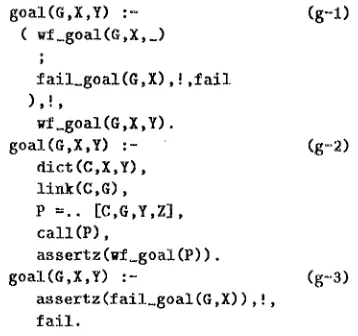
Figure 3 shows results of the translation. These BUP clauses are then translated into a Prolog program (Figure 4) by the DCG translator wl,ich is embedded in the Prolog system. Two more arguments are added to each predicate which denotes nontenninal symbol in figure 4. These argu- ments constitutes a difference list which represents the input string. With the special predicate g o a l which is necessary for bottom up parsing, this Prolog program can parse the input string with a bottom-up and depth-first strategy. Fig- ure 5 shows the definition of the predicate goal.
Now, we shall give a step by step explanation of the pars- ing algorithm of the BUP system. We will use the gram- mar shown in figure 4 and input sentence "you walk" as an example. Calling the predicate g o a l activates the parsing process:
? - g o a l ( s , [you,walk] , [ ] ) .
np(G,X,Z) :~' link(rip,G), (p--l)
g o a l (vp ,X ,Y),
s ( G , Y , Z ) .
pron(~,X,Y) :- np(G,X,Y). (p-2) diet (pron, [youlX] ,X) . (p-S) dict (vp, [wa].k IX] ,X) o (p-4)
Figure ~: Prolog progn~.ms translated from figure 3
goal(G,X,Y) :-~ ( g - l )
( w f _ g o a l ( G , X , _ )
f a i l _ g o a l ( G , X ) , ! , f a i l ) , ! ,
wf_goal(G,X,Y).
goal(G,X,Y) :- (g-2)
diet (C,X,Y), link(C,G) ,
P = . . [ c , G , Y , Z ] ,
c a l l (P),
a s s e r t z (wf_goal ( P ) ) .
goal(G,X,Y) : - (g-3)
assertz(fail_goal(G,X)) , !, fail.
Figure 5: Definition of the goal clause
This calling checks to see if :
A parse tree the root of which is the category % ' , can be constructed from the input string denoted by the difference between the list [you, walk] and the list [ ] ( [ y o u , walk] in this example).
The first call of g o a l invokes the clause ( g - l ) in the figure 5. The clause ( g - l ) checks to see if the same analysis have been made before, to avoid recomputation using the information previously asserted as wf_goal and fail_goal.
As the execution of the clause ( g - l ) fails in this case, the system chooses the next clause ( g - 2 ) . In the body of the clause (g-2), the system consults the dictionary by calling " d i e t (C, [you, w a l k ] , Y) ". This predicate call picks (p-3) in figure 4 and the system matches "pron" with variable C and "[walk]" with variable Y.
In the second line of ( g - 2 ) , the system calls the predicate l i n k to see if the category which is obtained by the previous dictionary consultation ("pron" in this example) can be left- corner of the current goal ('%" in this example). The l l n k clauses are calculated by the BUP translator. Suppose this test succeeds, the system calls the predicate "pron" :
P =.. [pron,s,[walk],[]], call(P).
Calling "pron(s, [walk] , [] )" invokes (p-2). Then, the
system executes its body that is, "up ( s , [walk] , [] )'~. Calling " n p ( s , [ w a l k ] , [] )" invokes the clause ( p - l ) . Af- ter calling the predicate l l n k to check a teachability from
"np"
to "s", the system invokes " g o a l (vp, [ w a l k ] , [] ) ". At this point, the system has analyzed the string "you" as "up" and is predicting that the trailing string "walk" should be bundled up to the category "vp".In the same manner, a bottomoup analysis with a top- down prediction proceeds until the execution of g o a l with the termination clauses succeeds. See [14] for the detail of the termination clauses.
[image:2.612.355.534.62.230.2]np =.-> pron° (x-2) ~tp --=> del;~ ~tomt, s _ x ' e l . ° / n p . (x-3)
vp .... > vt~ x~p. (x-4)
[image:3.612.321.526.65.193.2] [image:3.612.80.268.66.120.2]~.~:el °'o> :cel~p:coa, ~o (x-5)
Figure 6: Sample graramar written in XGS
2.2 ~ I O ' I ~ = X G s y s t e n l
The embedded sentence which appears in relative clauses in English can be viewed as a strncture ilt which a noun phrase is missing f[om declarative sentence. A gap is formed as a result of moving the antecedent from within the declarative sentence to the left of the relative clause. Linguists call such phenomena "Left extraposition'. By considering the gap left by the nloved constituents as a
"trace",
and incorporating a mechanism tha:t looks h)~ such a "trace" automatically, the number of gx ammar rules can be decreased and the grammar ~ules become easie~ to read. Moreover incorporating such mechanism contributes to making analysis speed faster.~*bp=down parsers hke ATNG [131, [12] and XG [8] incof porate such • mechanism° The top-down parser can predict what catego:ey the trailing input string may be bundled up ~o. Efficient trace searching is possible as the system as- sumes the e:dstence of traces only when a particular cate- go,y is predicted as a goal.
A pu~e boa;tom-up parser is not capable of such predictions and inefficiency results because of the necessity to assume the existence; of a trace between every two words. However, since the BI[P system incorporates top-down prediction in the bottom-up parsing strategy described in 2.1, it is pos- sible to implement the mechanism to look for the traces efficiently. Konno developed a BUP--XG system which in- corporated such a mechanism [5].
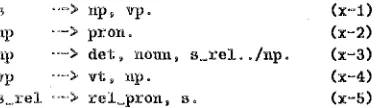
The XGS adopted in LangLAB p~ovides grammar writers the facility ~¢ith which left extraposition tan be naturMly expressed in grammar rules. Figure 6 shows a small English grammar w]dch is written in XGS.
The notation ". o/" (called "slash") in the rule (x=3) is in- troduced in XGS. This rule means that there exists the syn- tactic category "up" which dominates the "trace" under the syptactic ca~egory "s=xel" (%.xel" means relative sentence). This idea is influenced by the %lash category" in GPSG [3]. We call the category after " . . / " ~c slash category". Rule (x-3) also shows that the category '~np '~ consists of the cat- egories "det", ~'noun" and %.xel" and that the trace left behind by the left extraposition of the norm phrase consist- ing of "det" a~td "norm" is dominated by "s~rel". During an ~nalysi% when the system finds the trace under "s_~el", as sl~own tit figure 7, its associates the trace in the enlbedded sentence with the moved phrase ("the man").
XGS also provides a notation to represent "Ross's Como plex NP constraint" [10]. Following is an example of this notation. This notation is called "open (<)" and ~'close (:>)" following Pex'ei~a [8].
a ~-o> b9 c~ < d > .
'[.'his rule ~Yu!a.:as that category "a" consists of categories C~b', "C ~ and ~'d ~. Open-close notation defines the scope of extra-
np
np
s rel
det neun
the
man
rel_joren
s
np
vp
who
[trace]
loves
her
Figure 7: Matching between slash category and its trace position. This example says that the movement fi:om under "b" or "c" to the outside of "a" is permissible, but the move= ment from under "d" to the outside of "a" is not. Sentences violating "Ross~s Complex Np constraint" are rejected by modifying (x-3) to become ( x - 3 ' )
np --> d o t , noun, < s _ r e l . . / n p > . (x-.3')
With (x-3 ' ), the trace which is dominated by slash category "up" under "s_rel" can only correspond to the noun phrase which consists of "det" and "noun".
In addition, XGS also provides a double arrow notation (==>) and the notation to describe X lists (explained later) explicitly. With these notation, "coordinate structure" can be represented in a natural way (see [5]).
2.3 B U P - X G t r a n s l a t o r
Just like the BUP system, the grammar rules written in XGS are translated into BUP-XG clauses, link clauses atLd termination clauses by the BUP-XG translator. The BUP- XG translator in the LangLAB system has been improved so as to generate BUP--XG clauses more optimized than that in the original BUP-XG system. Furthermore, it is also equipped with a new function which inserts parse tree in.- formation automatically. The translator takes about three seconds to translate a grammar of about 200 rules. The following subsection explains these inlprovements.
2.3.1 R e p r e s e n t a t i o n o f l l n k clauses
As the number of grammar rules increases, more l i n k clauses are generated by the translator. For example, from about 200 grammar rules of English which we have developed, the BUP-XG translator generates about 700 l l n k clauses. Shortening the search time of l l n k clauses wonld contribute t o an efficient analysis.
L i n k clauses are called in the body of BUP-XG clauses and in the predicate goal. Since both the alguments of l i n k are atoms in the both cases, a l l n k
l i n k ( a , b ) .
which denotes th.e reachablity from the category %t" to "b" can be change to the form
a(b) : - !.
This form of representation reduces the search space of the reachablity test. The BUP-XG translator in LangLAB geuo erates link information of this form.
2.3.2 I n d e x e s for ditFerenee ]:~st
As described in subsection 2.1 input string are represented by ~, difference list and intermediate analysis results are as-- served with the predicate w f g o a l a:ud fidl.goal. Since dm h~st two arguments of" the wf_goal constitutes a diffbrence list of the input string, the longer the input string becomes, ~he more memory wKgoe! consumes. By indexing differ.. once lisfs, the amonnt of memory ~:eqnired is reduced, amt faster re[create to intermediate results is possible.
}'or example, when the system gets the input string '!you walk", the predicates t e x t arc a.sse~ted as follows :
tex~(sO, []). t e x t (r~:l:, [~alk]) . te:~:t(s2, [you, ~al.k])°
'l'he dictionary reference program gets a difference list by calling t e x t with indexes (s],s2,...) as the key, before con- suiting the dietiom~ry.
2.:L3 R e p r e s e n t a t i o n of i n t e r m e d i a t e r e s u l t s Generally, a long input string gives rise to more wftgoals and faiLgoals which results in longer search time for inter- mediate analysis results. Wf_goals and fail_goals have as their arguments, the index to the difference list denoting the partial input string, and its anMysis. As described in 2.1; goal first consults w f goads and fail_geMs with the indexes of input string as the key. In LangLAB system, the predi- (:ate names of intennedlate analysis result are the indexes to the ditference list insteaA of "wLgoa.]" or "fail_goal'. This modification reduces the search space oil the intermedi~ttc analysis results and speeds up the analysis processo 2.3°4 I n s e r t i o n of p a r s e t r e e i n f o r m a t i o n
Users sometimes reqaire the results of syntactic analysis to be expressed as pa.rse trees, and in both the BUP system and the originM B(Y])--XG system, users are required to insert an argument in each category to accommodate parse tree lure> marion. Itoweve~, it is not a difficult task to make the trans- lator insert this information automatically, ht the BUP-XG translator of LangLAB, this information is inserted auto- maritally unless instructed otherwise. This Nnction is simi- lar to ~he one in the McCord's MLG(Modular Logic Gram- mar) [7]. However, unlike MLG, all the nonterminal symbols can be a node of parse trees.
2.3.5 E x a m p l e of t r a n s l a t i o n
Figure 8 shows the BUP--XG clauses translated t~om the grammar in figure 6. The wriables beginning with "X" in the figme.8 axe introduced to handle left extraposmon. Tins variable is called X list (extraposition list) which were intro- duced in XG [8]. Information pertaining to slash categories is pushed into the X llst and is then transfe:rred from eate.~
gory to category during the analysis process. The predicate
goal_x is an extended version of the predicate gord in the BUP system, which pops up the slash category from the X ]is~ when the t,.'ace is [bun& Note that variables for parse tree in~brmation, the names of which begin with "T", are automatically inserted and that the representation of link information (in braces) is also modified.
np (Goal, [TJ], Xnfo,XO~Xl,XR) .... > geal_x (vp~ [T2] ,Xl ,X2),
s ((~oal, [ [s ,'fl ,'r2] ] , I n f o ,X0, X2 ,XR) o pron (Goal, [ T I ] , I n f o ,X0 ,Xl ,XR) ... >
{ up(Goal) },
np(Goal~ [ [ n p , ' f l ] ] ,Info~X0 ~)[I,XR). dot (Goal, [T1] ~ In're ,X0 ,Xi ~XI~) ... >
{
up(Goal) },
goa].~x (noml, [T2] , Xl ~ X2),
goal...x (~.rel, [Y3] ,x(np, [np (t)] ~X2) ,X3) ,~
np (Goal, [ tap, T1 ,T2 ,T3] ] , I n f o ~X0 ,X3 ,Xlt), • et (G o al, [TI ], -tat o, XO, X i, XR) ~-. >
{ vp(Goa].) },
goal_x (nil, [T2] ,X!,X2)
vp (Goal, [ [vp,T~.,T2]
],
lure, XO,X2, Xlt)~'el_p:~o:~,.(Goal, [T1] , I n f o ,X0 ,Xl ,XR.) "~'>
{ s_rel(Goal) ]',
goal..x (s ~ IT2] ,Xi ,X2)
s_rel (Goal, [ [s_rel, T:[, T2j ] ~ Inf o ~ XO ~ X2 ~ X~{) .
Figure 8: BUP-XG clo~nses t):~mslated from figm'e 6
v ( i n f o ( g e t ) ) ~-> [ g e t ] .
v ( r e f ( g e t , [ [vf I ed] ] )) .... > [got] ° v ( r e f ( g e t , [ [ v ~ l e n ] ] ) ) - - > [ g o t t e n ] . v ( i n : r o ( g e t _ u p ) ) -~-> [ g e t , Up]o v ( i n f o ( g c t _ o n ) ) ---> [ g e t , on].
Figure 9: Sample dictionary including idioms
3
T R , I E
st, r u c t u r e d d i c t i o n a r y
This chapter explMns the TRIE stnletnred dictionary, a > other extension to the BUP-XG system and the BUP sys-. tern. The TR]IE sh'nctured dictionary requires less memory, provides Nster dictionary ~eference aitd flexible idiom han- dling.
3°1 T i t l e s t r u c t u r e
The name "T/~ll?," is taken fl'om "reTlllllJval" [1] and it means a kind of tree structure. A dictionary written in I)CG is translated into a TRIE structured dictionary by the Tll.IE dictionary translator. The TPJE structure is u tupple which has three elements, that is "word", "information for word(s)" and '~its child TRIE strncture'.
}'or example, the dictionary written in DCG shown in fig-. are 9 would be translated to the TP~IE structured dictionary shown in figm:e ]0.
d:L r;~,a ( g e i ; ,
[ [ v , [i:i ~+:~ o (gei;),I i! J
[ t~(,.It,
i] D,, l{_t:u:t o (l:>ri;.mO ] 7! 7i ,
I11.1 t ,
[{ r+<~) - , i::[l[~ 0 ( ~j <! ~:. fl:~.~) ) 71 [l ."t ,
d i Ci:i~ ( r e ~; ~
i7 I v , E+:La:~I (g,;i;., [ [:v:~: ! ~.d] ~i )J ] ] , H )..
(12 t: i; ~+ ([-;o i;g eL*
! i"J, b_'e:,: (ge~, i~ [v:~ i e~d ] ) ] 11 !,
J] )o
]'~i[;,.-'i:e I0: 'J)]{l)'; s~;i:~c~,,+re t~:a~,',tsls.ted f r o m fig.x:e 9
ba,ckt:ca,cki.!~ a,+, (:lwl~.a~ level h~ dJ.c{imia~y reJhJ:eace, a,,d ~+,i, I,t it{are ), ~he ~r!~n:u)cn~ of i:he h e a d is the i n t b ) : m ~ i c . t of bk', <;~t t,~:y+ ' t'hc >,q~nmen ~, ":i,',+,~ o (+:+) ":' utean<~ t h e ht h)rma, iAo. el; {he elitr F %,'-'~', 'J'}lC ~ argllntevtt of tile e n t r y +eI~Otn a,!td
{([~,Ot{()]+ +) ] ; a! ,~{,rl.lCttLre {e]iJe;i}D WIIJcl! dem>{e,:.: a~, !>()Jilter to the e n t r y d e n o t e d by t h e iir<¢~ argmne-nt of %',+,i7" ( h t {hi~ case, a, ])oinl, e~ to tlm e n t r y ~<get~ ). ] ) i c t i o n a ) y et)trie,~ i;h(~ ilttb::'+aa:ho~l of whic}t o n l y differs Dora e a c h o t h e r l:)~+rt]aJly~ e+g+ t h e ]:oo{ :ibrnt ~utd t h e c o l @ g a t e d N r m of a+n i,:regld;<c "/e)b, ca, u 1+~: wri~,i;tm i,,. ~hJs ma.nne:,:+
+JP])e secoli_d gi:gtD.),en[ or t h e s[rlletltre c{:~:.~;;12~) is {]to dil:. J~erential it. ti>ima.tion bet,>e(;e~ {his e n t r y (:+f4ot ~ (Jr "!~(>~t()*i )>) and the e n h y p o h t t e d to b y the tit'.s+, arg/!ilteltt e-J' ";/el ". ]}(t i;hi<<i e/a'.,~qp]{e, . i } ! a t t l r e <<~,J7 ~ lrl.(;it.]lts :%erb !}iron" a.nd its v~Jae ~<od." a.nd %.m" men, Its "pa.s{" acttd <<].;itst puxticip],? ~ ,:e,~,pe,(> l,ive!y, "V\"i~h ..;tlch ~',+ (/emvxipgi()tl, users do ltot h a v e tO W]'ite ~Mdi~.iomd : d i e m m)LJ.es w h l e h i~mlude t h e e o , ~ s g a t e d lbYul
of i>:eguh~a
v e r b s . In t h e cas:; of reg~darvet:b%
since co,f, .]ug, a [ c d [ b r m s acre pr:)ee,<iqed b 2 t h e :utoqdiologieal aliMysis p:,:ograJ.m l)a_i[~ .;a i, he die{ionaa:y reihren(:e pc'oBram , idie,m c<nt~:ies wtii,:lt i:.qclade the c o n j u g a t e d J b r m au:e n o t ~tecessary+ {got exam.)~t% t~sers do :~)ot, hams to w~:ite g}te idionl mit*y <<kicked the bltdeet'~ i[ life (;ntry '<k[c]e {l~e b u c k e t " is w r i t : t e a .f i o ~ , a r y
'il,'])e ']/R[}'] strnctl~eed dic~io.a~ry ea.:u h t e h t d e P~:olog p r o . g~a.ms to check ,,;ome cons{,a,htts a,itd sy]~ta,etic ea:lego;ies i,t its ++wo:ed" po.,dtimt (tb:st e l e m e n t e l im.pl)ie). '.flit,<.; > a t iu'e m a k e s Jt p 3ssible ~;o }t~,:(td~e ~;l')e idio'_,rta i,iclm{ing ,ion-.fmze3,.
c]e,umt% a a e h as %!.(:,t t);aly .... b u t a,ls.) , ? ) J~+ ;,he B U i ' ~+ystem :mad !;l)e BU]?--XC:a. s y s t e m , t h e sys~<;m r e g a r d s so.ch i<]io~!<~ as ~:, two-:el,eme~, wo:rd, tlta~ is g prefix i, ermia~)l p a r t a n d a ~bll.owing
?,to;~te~:~F].na,l
]>ar~;. 3.'he Ib,:n~e,: p a r t iS ]It= ch, d e d h, i;he d i c f i m t a r y a n d t h e I.at{e.t pa:rg L<; i n c l u d e d in t h e gx:~mt], a,t ,~!es. l:a Lang],AilJ, t h e 'J.'l.{.i]g s{v~c*Yt~'..~d dic=i, io~u~,ry
is abk; to h~.ndle all s n c h idle:ms w.; t h e dicth)_aa,ry ceAries.' £ h e idi(}~t eni~:ies w h i c h i~tch;de ,),(nt.d'toze:t~ eleme).)g',.i such ~u; sh ow~+. ~ ao +, o n l y ,,, bu * ~+l'do ,,," cau b e w r i t {(hi as ilg,are 71 1,
+>_dj ( [ ] , [~1 ) ... > I}1.o~; ~ oltil~y] , a d j ( . . . ) , llt)~').~, a : t : m ] , a d j ( . . . ) .
:up(lSp, i ] ) "+ +;> Lx,-og ~m(l_y] ,,tp (i~p*, .) + 1)mi; ~ a l s o] ~ n p (i~lI)2 , ~+) , -[j o:ht ( l ~ p i , ~p:>, ~ l~p) } .
.i!'igt~.~o 1 ;i ; S a m p l e d i c t i o s ~ r y With ~o,i t e r m i n a l s y m b o l a ar, d ['~]x)/~):a,:,~ts i!l tlt+~ r!de b o d y
d:i,ct>aOurl;, [] + !;
i; t>0-:i ... ;I ,, i l ~ E
[bt~,t, [ ] , E
I;al::o, [;], f
[ [ v d j ... 1 ,
12 i. d j , [ I;;l + I;71 ;t ] ] , Ei] 71 ] ] 1 ] ] ,, L i.}?, tq>J. ~.:,] ~ 1£71, [
Ehrri; ~ l;] o i
faJ_.'.), [ ] , i
[ [:~tp, g p 2 , , . J , [ ] ,, [ il (j o:i.n 0~lp;t , g p 2 , ~'~p) ) ,
1: [ n p , [;l~p ~ H 71 ;1 ] , [] ] ] ] :l ;I ] ] ] ] ] ~1 ] ) ,,
]'~igare i2:'.L'IMI];3 ,<;tr~lc%~l,:e {~ansla+ted from fig.:ce !;1
A n d figm:e 12 is t h e r e s n l t of t h e t r a n s l a t i o n .
IN tim case of D C G , as t h e i d i o m ent~_:y s u c h as figure 1 ] is c s n a l i y h a n d l e d as a g ~ a m m a r rule, t h e n u m b e r of g r a m m a ~ rules blcrea~)os a,~.t inefl]cieney oll analysis p r o c e s s results. 1~ i,<.~ preDralAe to ha,,tdle g~aanmar cnles a n d d i c t i o n a r y entries sepa~:a.tely.
.A:; sttowll Jxt fignre 12, t h e txansla3,or c o n v e r t s the P r o l o g progra,ms i~t t h e dietiona.ry e n t r y e { j o i n ( g p l ,l~fp2,fgp)}" h, to {he :thrill (~(oo:hl(igpJ. +t~p2,}~p))'. T h e d i c t i o n a r y ~e:~ e,mtce l)mg*am calls tim prog~:ant enclosed by pa, r e n t h e s i s
w h e l t it e n c o / i n t e r s <(~nc.h i~ refilL. Ill t h e s a m e way, t h e syn- htciie ca¢,egory i~t Ore d i c t i o n a r y enLries such as "rip (~/pi, =)" au:e c(mverted i n t o t h e ]is{ t h e tits{ eleme:at of w h i c h is a, c a t e g o r y rot, m e a~,d ¢]te rest of w h i c h a, re a r g u m e n t s of £he categoi'y ( [ n p , ~ a p ; t , : ] ) . T h e d i c t i o n a r y reference l>rog~:am calls t h e predicatte g o a l ( g o a l ( n p + I)~p1 ,._] ,X ~Y)) tot snch.
a, ] b f I t t ,
'.rite T]tl;E s t , u c t u ~ e d d i c t i o n a r y e n a b l e s t h e ],angL AB
,(;ys~em to ttaild.le i d i o m s w i t h . v e r s a t i l i t y [4].
We c o n d r t c t e d e x p e r i m e n t s to verify t h e eflec~ of optimiza-- {ion of ]Y0P-,XC claaises. We mea,sa~ed t h e t i m e fo~ syntau: tic a:aa]ysis of ten s a m p l e s e n t e n c e s . T h e e x p e r i m e n ~ envJ-. ~:onraeitt Js a,s follows:
~, J~a,chine : S I D a / 2 6 0 Worksta+tion ~ P,:olog : @ f i n t ~ t s P m l o g Release 1.6 o (',.raommar : 1($3 l:nles in X G S
... T@P_-.L: A nAysi~
No. I' N u m b e r Numl}er of Words of Trees
11 14 9
21 4 ]2
31 3 7
41 1 10
5J 3 1 1
61 4 18
71 9 21 i
81 2 19
91 4 17
10 I 1 25
. . . I . . .
time using interpretive code
Analysis Time [msec] l%~tio I (1) D U B - X ( ] (2) L a n g L A B _(1)/(2_~) !
80,415 8,552
18,868 2,700
46,700 4,983
30,900 3,600
39,634 4,050
95,933 9,550
323,167 26,183
87,550 9,349
180,300 15,816
116,284 12,083
average
9.401 6.99 I 9.37 I 8.58 I 9.791 10.05 I 12.34 I 9.36 I 11.40 I 9.62 I 9.691
. . . . '_]?-~!,!e_.2:
AnaJ_ysis time using compiled c o d eNo. N u m b e r N u m b e r I of Words of Trees I
1 14 91
2 4 121
3 3 71
4 l 101
5 3 11 I
6 4 181
7 9 211
8 2 191
9 4 171
10 1 251
Analysis Time [m~ee] B.atio
(1) BUP--XG (2) LangLAB
20,485 4,134
2,467 1,299
4,783 2,284
2,884 1,566
4,383 1,917
18,768 4,500
127,400 14,000
13,450 4,450
59,468 8,216
23,650 5,801
average
(1)/(~)
4.96 1.90 2.09 1.84 2.29 4.17 9.10 3.02 7.24 4.08 4.07
sample sentence. '['his analysis does not include morphc~ logical a~tulysis. Table ] is the result of the experiment in the interpretive mode and table 2 is'the one in the compiled mode. The fourth and the fifth column of the table is the time to analyze the sentence in the original BUP-XG system and in the LangLAB system respectively. Time is shown in millisecond.
Results showed that in comparison to the original B U P - XG system, the analysis sped up 10 times in the interpretive mode and 4 times in the compiled mode. The optimization is less effective in the compiled mode than in the interpretive mode. I[owever, this optimization is practical because de- bugging is usually done in the interpretive mode. We believe that LangLAB has the capacity for practical use.
']'here is a related work SAX [6] by Matsumoto. SAX is also a parsing system based on logic programming, b u t its parsing strategy is bottom-up and breadth-first. Okunishi of ICOT reports that LangLAB is 6 ~ d0 times faster than SAX in the intm'pretive mode. However, in the compiled m o d e , SAX is 6 ~- 16 times faster than LangLAB [11]. SAX has still yet to be modified to handle idioms. If this modi- fication is introduced, debugging can be done on LangLAB in the interpretive mode and the debugged grammar can be executed on SAX in the compiled mode.
5 C o o n c h l m o n "
We have made the following modification to the original
BUI)-XG :
660
• Optimized and enhanced translated code
• Adopted TItIE structured dictionary
With these modifications, the analysis sped up in compari- son to the original B U P - X G system and fiexible idiom han- dling became possible. We believe that LangLAB has be- come a more powerful and practical tool for natural lan- guage processing. We plan to develop a natural language processing system which includes semantic analysis, based on LangLAB.
R e f e r e n c e s
[1] A. V. Aho, J. E. Hopcroft, and J. D. Ulhnan.
Data
Structures and Algorithms.
Addison-Wesley, i983.[2] A. Colmerauer Metamorphosis grammar, in
Natural
Language Communication with Computers,
pages 133- 190, Springer-Veflag, 1978.[3] G. Gazdar and A. F. Pullum.
Generalized Phrase
Structure Grammar:A Theoretical Synopsis.
Indiana University Linguistics Club, 1982.[4] M. Gross. Lexicon-grammar: the representation of
compound words. In
COLING '86,
pages 1-6, 1986.[5] S. Konno and H. Tanaka. Processing left-extraposition
in bottom up parsing system.
Computer Software,
3(2):115-125, 1986. (in Japanese).
[6] Y. Matsumoto and It. Sugimura. A parsing system
based on logic programming. In
IJCA[ '87,
pages 671-674, 1987.
[7] M. McCord. Natural language processing m prolog. I n
Adrian Walker, editor,
Knowledge Systems and Prolog,
chapter 5, pages 291-402, Addison-Wesley, 1987.
[8] F. Pereira. Extraposition grammar.
American Journal
o] Computational Linguistics,
7(4):243-256, 1981.[9] F. Pereira and D. Warren. Definite clause grammar for language analysis- a survey of the formalism and a com-
parison with augmented transition networks.
Artificial
Intelligence,
13(3):231-278, 1980.[10] J.it. Ross. Constraints on variables in syntax. In
On
Noam Chomsky: Critical Essays,
Anchor Books, 1974.[11] T. Oknuishi, et.al. Comparison of logic programming
based natural language parsing systems. In
~nd Inter.
national Workshop on Natural Language •nderstanding
and Logic Programming,
pages 90-102, 1987.[!2] T. Winograd.
Language as a Cognitive Process.
VoLume 1:Syntax, Addison-Wesley, 1983.
[13] W.A. Woods. Experimental parsing system for transl.
tion network grammar. In
Natural Language Process°
ing,
Algorithmic Press, 1971.[14] Y. Matsumoto, et.al. Bup:a b o t t o m - u p parser embed-
ded in I~olog.
New Generation Computing,
1(2):145-