1 Phishing Detection and SQL Injection Prevention System for E_Bank Security
Mr.DesaleAkash, miss KakadeRajashri, Miss Ghogare Monika, KolheSeema 1
Student,Computer,SPCOE, Pune,Maharashtra, India, 2
Student,Computer,SPCOE, Pune, Maharashtra, India, 3
Student,Computer,SPCOE, Pune,Maharashtra, India, 4
Student,Computer,SPCOE, Pune,Maharashtra, India,
Department1,2,3,4,Affiliation name1,2,3,4
Email: [email protected],[email protected], [email protected],[email protected]
Abstract-Nowdays, most user uses internet due to this chances of phishing is more.Phishing is an internet fraud that acquires users credentials by deceptions. It includes theft of password, credit card number, bank account details, and other confidential information. Aim to develop Best security system against Phishing and SQL Injection attacks. People purchase products online and make payment through e-banking. Develop system to detect the banking phishing website our system uses an effective classification data mining algorithm. The e-banking phishing website can be detected based on some important characteristics like URL and Domain Identity, and security and encryption criteria in the final phishing detection rate. The e-banking phishing website can be detected based on some important characteristics like URL and Domain Identity and security. This application can be used by many E-commerce enterprises in order to make the whole transaction process secure. Also SQL injection attack is the most common attack in websites in these days. Some malicious codes get injected to the database by unauthorized users and get the access of the database due to lack of input validation. Our Aim to presents the techniques for detection and prevention of SQL injection attack.
Index Terms- Phishing, network proxy, blacklists, input validation, SQL injection, anti-Phishing, e-commerce security, online banking security.
1.INTRODUCTION
Phishing attacks have become a serious problem for users of online banking and e-commerce websites. In this paper develop best security system against Phishing and SQL Injection attacks.
People purchase products online and make payment through e-banking. There are many E-banking phishing websites. Now, develop system to detect the e-banking phishing website our system uses an effective classification data mining algorithm. The e-banking phishing website can be detected based on some important characteristics like URL and Domain Identity, and security and encryption criteria in the final phishing detection rate. The e-banking phishing website can be detected based on some important characteristics like URL and DomainIdentity, and security. Once user makes transaction through online when he makes payment through e-banking website our system will use data mining algorithm to detect whether the e-banking website is phishing website or not. This application can be used by many E-commerce enterprises in order to make the whole transaction process secure.
Stilling sensitive user datain the form of online banking user_id and passwords or credit card information, which may
then be used by ‘phishers’ for their own personal gain is the primary objective of the phishing e-mails.
Also, add Best feature for website security name as SQL injection attack prevention. We going to use SQL injection blocker for enhance website security.
2. PHISHING ATTACK PROCEDURE AND
PREVENTION METHODS
A. THE PROCEDURE OF PHISHING
ATTACKS
1) Phishers set up a counterfeited Web site which looks exactly like the legitimate Web site, including setting up the web server, applying the DNS server name, and creating the web pages similar to the destination Website, etc.
2 convince the potential victims to visit their
Web sites.
3) Receivers receive the e-mail, open it, and click the spoofed hyperlink in the e-mail, and input the required information.
4) Phishers steal the personal information and perform their fraud such as transferring money from the victims account.
B. APPROACHES TO PREVENT
PHISHING ATTACKS
There are several (technical or non-technical) ways to prevent phishing attacks:
1) Educate users to understand how phishing attacks work and be alert when phishing-a like e-mails are received.
2) Use legal methods to punish phishing attackers.
3) Use technical methods to stop phishing attackers. In this research paper, only focus on the third one. Technically, if we can cut off one or several of the steps that needed by a phishing attack, then successfully prevent that attack. In what follows, briefly review these approaches.
3.LITERATURE SURVAY
1. Token Based Security for Prevention of Phishing Attack at Client Side
A database of tokens (hash codes) of legitimate web sites’ URLs is stored on the client machine. When a user enters a site address in the browser, the system computes its integrity code and matches it with the stored integrity code (token). For the validation of the proposed system, it has been compared with the existing ‘white list’ based anti phishing method in terms of false positive and false negative metrics.
2. Anti Phishing for Mid-Range Mobile Phones
E-commerce trade has experienced the largest number of cyber crimes that includes various types of security attacks. Phishing attack is the one most common among these all, as the mobile banking is getting popular, hence protecting the mobile users from phishing attacks is very important; particularly mid-range mobile users, because these users are easy
target of attackers as mid-range mobile phones do not support feature like anti-virus or anti-phishing tool.
3. Intelligent Phishing Website Detection and Prevention System by Using Link Guard Algorithm
Phishing is a new type of network attack where the attacker creates a replica of an existing Web page to fool users (e.g., by using specially designed e-mails or instant messages) into submitting personal, financial, or password data to what they think is their service provides’ Web site. In this research paper, we proposed a new end-host based anti-phishing algorithm, which we call Link Guard, by utilizing the generic characteristics of the hyperlinks in phishing attacks. These characteristics are derived by analyzing the phishing data archive provided by the Anti-Phishing Working Group (APWG). Because it is based on the generic characteristics of phishing attacks, Link Guard can detect not only known but also unknown phishing attacks. We have implemented Link Guard in Windows XP.
4. Protecting user against phishing using Anti-phishing:
AntiPhish , that aim to prevent users against spoofed web site-based phishing attack. To this end, Antiphishing tracks the sensitive information of a user and generates warnings whenever the user attempts to give away this information to a website that is considered unfaithed. The most effective solution to phishing is training users not to blindly follow links to web sites where they have to enter sensitive information such as passwords. However, expecting that all users will understand the phishing threat and surf accordingly is unrealistic. What Hacker do to you they make mirror pages of confidential websites like social login page,bank login pages and convert that pages into website link after that when user request for real website hacker launch pharming attack duo to that attack victim get Phishing link or fake link after that user enter his credential in fake pages Automatically or remotely send that sensitive data to hacker. In this paper, to create Anti-Phishing System which works for prevent and block phishing websites and redirect user to original website.
5. Adding Sql Injection Attack Preventer:
3 Website Hacking is big issue for organizations,
government, online banking confidential websites. One of best feature to protect SQL vulnerable website because of enhance website hacking ratio ,decide that our project totally work on security domain for website security or HTTPS Security. The project not only Intention of Engineering project we doing project for Future security .
4. LINK GUARD ALGORITHM:
Link Guard works by analyzing the differences between the visual link and the actual link. It also calculates the similarities of a URI with a known trusted site. The algorithm is illustrated in Figure. The following terminologies are used in the algorithm. Description of the Link Guard algorithm.. The Link Guard algorithm works as follows. In its main routine Link Guard, it first extracts the DNS names from the actual and the visual links. It then compares the actual and visual DNS names, if these names are not the same, then it is phishing of category 1. If dotted decimal IP address is directly used in actual DNS, it is then a possible phishing attack of category 2 . Delay the discussion of how to handle possible phishing attacks later. If the actual link or the visual link is encoded.
We first decode the links, then recursively call Link Guardto return a result. When there is no destination information (DNS name or dotted IP address) in the visual link (category 5), Link Guard calls Analyze DNSto analyze the actual DNS. Link Guard therefore handles all the 5 categories of phishing attacks. Analyzesand the related subroutines are depicted in Fig.2. In AnalyzeDNS, if the actual dns name is contained in the blacklist, then we are sure that it is a phishing attack Similarly, if the actual dns is contained in the whitelist, it is therefore not a phishing attack. If the actual dns is not contained in either whitelist or blacklist, Pattern Matchingis then invoked.
5. EXISTING OR PROPOSED SYSTEM
EXISTING SYSTEM
1) Users username & password Hacked Easily
2) Difficult to classify Real or Fake Login Page
3) IP and DNS Spoofing Vulnerable
4) SQL Injection Vulnerable system
PROPOSED SYSTEM
1) Trusted System For Communication
2)Classify and Notify website PhishingExistence.
3) Prevention IP &DNS spoofing Attack
4)Sql Injection Attack Preventer
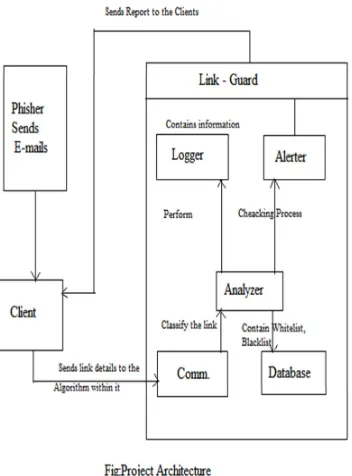
5. PROJECT ARCHITECTURE
It is dynamically loaded into the address spaces of the executing processes by the operating system. Whoop is responsible for collecting data, such as the called links and visual links, the user input URLs. More specifically, whook.dll is used to:
1) Install a BHO (browser helper object) for IE to monitor user input URLs.
2) Install an event hook with the SetWinEventHookprovided by the Windows operating system to collect relevant information.
3) Retrieve sender’s e-mail address from Outlook. 4) Analyze and filter the received windows and browser events passed by the BHO and the hook, and pass the analyzed data to the Link Guard executive. Link Guard is the key component of the implementation. It is a stand-alone windows program with GUI (graphic user interface). Analyzer, Alerted, Logger, Comma, and Database. The functionalities of these 5 parts are given below:
Comm: Communicate with the whook.dll of all of the monitored processes, collect data related to user input from other processes (e.g. IE, outlook, Firefox, etc.), and send these data to the Analyzer, it can also send commands (such as block the phishing sites) from the Link Guard executive to whook.dll. The communication between the Link Guard process and other processes is realized by the shared memory mechanism provided by the operating system.
Database: Store the whitelist, blacklist, and the user input URLs.
Analyzer: It is the key component of LinkGuard, which implements the LinkGuard algorithm; it uses data provided by Comm and Database, and sends the results to the Alert and Logger modules.
Alerter: When receiving warning messages from Analyzer, it shows the related information to alert the users and send back the reactions of the user back to the Analyzer.
Logger: Archive the history information, such as use revents, alert information, for future use. After implemented the LinkGuard system, we have designed experiments to verify the effectiveness of our algorithm. Since we are interested in testing Link
Guard’s ability to detect unknown phishing attacks, we set both whitelist and black list to empty in our experiment..
[image:4.612.118.294.130.368.2]6. SCREENSHOTS
fig 2:Admin login
Fig 4: SQL Injection Attack
7. CONCLUSION:
Phishing is a dangerous attack that results in a continual threat and the risk is high in social media. Phishing takes advantage of the trust that the user may not be able to tell that the site being visited, or program being used, is not real therefore, when this occurs, the hacker has the chance to gain the personal information of the targeted user, such as passwords, usernames, security codes, and credit card numbers, among other things. This paper discuss about the various types of phishing attacks and various anti phishing techniques used to prevent phishing attack. In this research paper, studied the characteristics of the hyperlinks that were embedded in phishing e-mails.then designed an anti-phishing algorithm, Link-Guard, based on the derived characteristics. Since Phishing-Guard is characteristic based, it can not only detect known attacks, but also is effective to the unknown ones. In this paper implemented .In this paper believe that LinkGuard is not only useful for detecting phishing attacks, but also can shield users from malicious or unsolicited links in Web pages and Instant messages. Also SQL injection attack is the most common and dangerous attack in websites in these days. Some malicious codes get injected to the database by unauthorized users and get the access of the database due to lack of input validation.
ACKNOLEDGEMENT
I would like to take this opportunity to express my sincere gratitude to my project guide prof. Kahate S.A. & head of department Prof. Deokate G. S. his encouragement, guidance, and insight throughout the research and in the preparation of this dissertation, he truly exemplifies the merit of technical excellence and academic wisdom. his extensive knowledge, serious research attitude and encouragement were extremely valuable to me.I also appreciate not only for his professional, timely and valuable advices, but also for his continuous scheduled follow up and valuable comments during my research work. I should also like
to acknowledge the contribution of my
principaleDrG.U.Kharat.
REFERENCES
[1] S. Philippsohn, “Trends In Cybercrime — An Overview Of Current Financial Crimes On The Internet”, in Computers & Security, 20 (1), 2001 pp. 53-69.
[2] Cyber Source, “9th Annual Online Fraud Report”, Edition: 2008 [online]. Available: http://www.cybersource.com, last access on 20/3/2007.
[3] J. S. Downs, M. B. Holbrook and L. F. Cranor, “Decision strategies and susceptibility to phishing”.Proc. the 2nd symposium on usable privacy and security. New York, USA: ACM Press, 2006, pp. 79 – 90.
[4] M. Chandrasekaran, R. Chinchani and S. Upadhyaya, “PHONEY: Mimicking User Response to Detect Phishing Attacks”. Proc. International Symposium on a World of Wireless, Mobile and Multimedia Networks. Washington DC: IEEE Computer Society, 2006, pp. 668-672.
[5] A. Litan, “The War on Phishing Is Far From Over”, Report: 2009 [online]. Gartner Group. Available:
http://www.gartner.com/DisplayDocument?ref=g_sear ch&id=927921, last access on 25 June 2009.
6 science education. New York: ACM Press, 2006, pp.
237 – 241.
[7] Symantec, “Mitigating Online Fraud: Customer Confidence, Brand Protection, and Loss Minimization”, 2004 report [online]. Available: http:// www.antiphishing.org/sponsors_technical_papers/ Symantec_online_fraud.pdf, last access on 21/3/2007.
[8] A. Alnajim and M. Munro, “Effects of Technical Abilities and Phishing Knowledge on Phishing Websites Detection”. Proc. the IASTED International Conference on Software Engineering (SE 2009), Innsbruck, Austria, ACTA Press, 2009, pp. 120-125.
[9] A. Alnajim and M. Munro, “An Anti-Phishing Approach that Uses Training Intervention for Phishing Websites Detection”.Proc. 6th IEEE International Conference on Information Technology - New Generations (ITNG). Las Vegas, IEEE Computer Society, 2009, pp. 405-410.
Appendix A:
Quality and Reliability testing of project design
1.Use of divide and conquer strategies to exploit parallel/concurrentprocessing of the above to identify object, morphisms, overloading in functions (if any), and functional relations and any other dependencies (as per requirements).It can include Venn diagram, state diagram, function relations, i/o relations; use this to derive objects, morphism, overloading
2.Use of above to draw functional dependency graphs and relevant Software modeling methods, techniques including UML diagrams or other necessities.
3.Testing of project problem statement using generated test data (using mathematical models, GUI, Function testing principles, if any) selection and appropriateuse of testing tools, testing of UML diagram’s reliability. Write also test cases [Black box testing] for each identified functions. You can use
Mathematica or equivalent open source tool for generating test data.
Appendix B:
To develop the problem under
consideration and justify feasibility using concept of knowledge canvas and IDEA matrix
Increase: In our project we are thus increase the use and operatingefficiency of current E-banking system and also, improved the secu-rityof database by preventing the SQL injection.
Improve: Improve traditional E-Banking Transction system.
Drive: Hereby we are driving the security of Online Transction atraditional E-Banking against a traditional Anti-Phishing system for E-Banking System.
Deliver: Deliver the exact result of Online Transction system withhelp of technical support.We are delivering a quick and easy solutionfor the maintenance of database secure.
Educate: Educate the users and the managing system with technical advancements.Also, we are making an attempt to make the serverauthority and end user of system aware of technical advancementsaround.
Evaluate: By considering problems
regarding Online Banking and Database security.