Paraphrase Acquisition for Information Extraction
Yusuke Shinyama
Department of Computer Science New York University
715, Broadway, 7th Floor, NY, 10003 [email protected]
Satoshi Sekine
Department of Computer Science New York University
715, Broadway, 7th Floor, NY, 10003 [email protected]
Abstract
We are trying to find paraphrases from Japanese news articles which can be used for Information Extraction. We focused on the fact that a single event can be re-ported in more than one article in differ-ent ways. However, certain kinds of noun phrases such as names, dates and numbers behave as “anchors” which are unlikely to change across articles. Our key idea is to identify these anchors among comparable articles and extract portions of expressions which share the anchors. This way we can extract expressions which convey the same information. Obtained paraphrases are generalized as templates and stored for future use.
In this paper, first we describe our ba-sic idea of paraphrase acquisition. Our method is divided into roughly four steps, each of which is explained in turn. Then we illustrate several issues which we en-counter in real texts. To solve these prob-lems, we introduce two techniques: coref-erence resolution and structural restriction of possible portions of expressions. Fi-nally we discuss the experimental results and conclusions.
1 Introduction
We are trying to obtain paraphrases which can be used for Information Extraction (IE) systems. IE
systems scan articles and retrieve specific informa-tion which is required for a certain domain defined in advance. Currently, many IE tasks are performed by pattern matching. For example, if the system re-ceives a sentence “Two more people have died in Hong Kong from SARS,” and the system has a pat-tern “NUMBER people die in LOCATION” in its in-ventory, then the system can apply the pattern to the sentence and fill the slots, and obtain informa-tion such as “NUMBER = two more, LOCATION = Hong Kong”. In most IE systems, the performance of the system is dependent on these well-designed patterns.
In natural language sentences, a single event can be expressed in many different ways. So we need to prepare patterns for various kinds of expressions used in articles. We are interested in clustering IE patterns which capture the same information. For example, a pattern such as “LOCATION reports
NUMBER deaths” can be used for the same purpose
summa-rization.
There have been several attempts to obtain para-phrases. (Barzilay and McKeown, 2001) applied text alignment to parallel translations of a single text and used a part-of-speech tagger to obtain para-phrases. (Lin and Pantel, 2001) used mutual infor-mation of word distribution to calculate the simi-larity of expressions. (Pang et al., 2003) also used text alignment and obtained a finite state automaton which generates paraphrases. (Ravichandran and Hovy, 2002) used pairs of questions and answers to obtain varied patterns which give the same an-swer. Our approach is different from these works in that we used comparable news articles as a source of paraphrases and used Named Entity tagging and de-pendency analysis to extract corresponding expres-sions.
2 Overall Procedure of Paraphrase Acquisition
Our main goal is to obtain pattern clusters for IE, which consist of sets of equivalent patterns captur-ing the same information. So we tried to discover paraphrases contained in Japanese news articles for a specific domain. Our basic idea is to search news articles from the same day. We focused on the fact that various newspapers describe a single event in different ways. So if we can discover an event which is reported in more then one newspaper, we can hope these articles can be used as the source of paraphrases. For example, the following articles ap-peared in “Health” sections in different newspapers on Apr. 11:
1. “The government has announced that two more people have died in Hong Kong after contract-ing the SARS virus and 61 new cases of the illness have been detected.” (Reuters, Apr. 11)
2. “Hong Kong reported two more deaths and 61 fresh cases of SARS Friday as governments across the world took tough steps to stop the killer virus at their borders.” (Channel News
Asia, Apr. 11)
In these articles, we can find several correspond-ing parts, such as “NUMBER people have died in
LOCATION” and “LOCATION reported NUMBER
deaths”. Although their syntactic structures are dif-ferent, they still convey the same single fact. Here it is worth noting that even if a different expression is used, some noun phrases such as “Hong Kong” or “two more” are preserved across the two arti-cles. We found that these words shared by the two sentences provide firm anchors for two different ex-pressions. In particular, Named Entities (NEs) such as names, locations, dates or numbers can be the firmest anchors since they are indispensable to re-port an event and difficult to paraphrase.
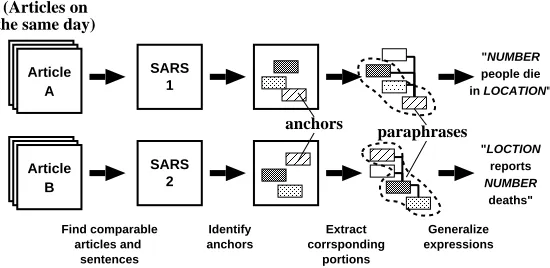
We tried to obtain paraphrases by using this prop-erty. First we collect a set of comparable articles which reports the same event, and pull appropriate portions out of the sentences which share the same anchors. If we carefully choose appropriate portions of the sentences, the extracted expressions will con-vey the same information; i.e. they are paraphrases. After corresponding portions are obtained, we gen-eralize the expressions to templates of paraphrases which can be used in future.
Our method is divided into four steps:
1. Find comparable sentences which report the same event from different newspapers.
2. Identify anchors in the comparable sentences.
3. Extract corresponding portions from the sen-tences.
4. Generalize the obtained expressions to para-phrase templates.
Figure 1 shows the overall procedure. In the re-mainder of this section, we describe each step in turn.
2.1 Find Comparable Sentences
Article A
Article B
SARS 1
SARS 2
Find comparable articles and
sentences
Identify anchors
Extract corrsponding
portions (Articles on
the same day)
anchors
paraphrases
"NUMBER people die in LOCATION"
"LOCTION reports
NUMBER
[image:3.595.169.444.75.209.2]deaths" Generalize expressions
Figure 1: The overall procedure
Before applying this technique, we first prepro-cessed the articles by stripping off the strings which are not considered as sentences. Then we used a part-of-speech tagger to obtain segmented words. In the actual matching process we used a method de-scribed in (Papka et al., 1999) to find a set of com-parable articles. Then we use a simple vector space model for sentence matching.
2.2 Identify Anchors
Before extracting paraphrases, we find anchors in comparable sentences. We used Extended Named Entity tagging to identify anchors. A Named Entity tagger identifies proper expressions such as names, locations and dates in sentences. In addition to these expressions, an Extended Named Entity tagger iden-tifies some common nouns such as disease names or numbers, that are also unlikely to change (Sekine et al., 2002). For each corresponding pair of sen-tences, we apply the tagger and identify the same noun phrases which appear in both sentences as an-chors.
2.3 Extract Corresponding Sentence Portions
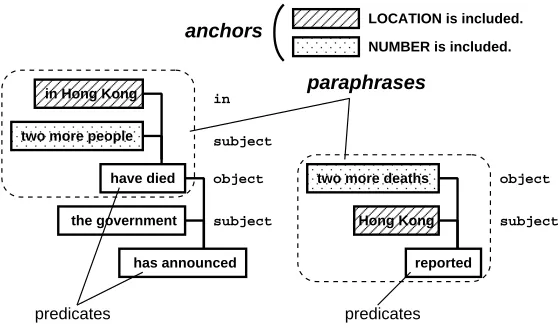
Now we identify appropriate boundaries of expres-sions which share the anchors identified in the pre-vious stage. To avoid extracting non-grammatical expressions, we operate on syntactically structured text rather than sequences of words. Dependency analysis is suitable for this purpose, since using de-pendency trees we can reconstruct grammatically correct expressions from a spanning subtree whose root is a predicate. Dependency analysis also allows us to extract expressions which are subtrees but do
not correspond to a single contiguous sequence of words.
We applied a dependency analyzer to a pair of corresponding sentences and obtained tree structures for each sentence. Each node of the tree is either a predicate such as a verb or an adjective, or an argu-ment such as a noun or a pronoun. Each predicate can take one or more arguments. We generated all possible combinations of subtrees from each depen-dency tree, and compared the anchors which are in-cluded in both subtrees. After a pair of correspond-ing subtrees which share the anchors is found, the subtree pair can be recognized as paraphrases. In ac-tual experiments, we put some restrictions on these subtrees, which will be discussed later. This way we can obtain grammatically well-formed portions of sentences (Figure 2).
2.4 Generalize Expressions
After corresponding portions are obtained, we gen-eralize the expressions to form usable templates of paraphrases. Actually this is already done by Ex-tended Named Entity tagging. An ExEx-tended Named Entity tagger classifies proper expressions into sev-eral categories. This is similar to a part-of-speech tagger as it classifies words into several part-of-speech categories. For example, “Hong Kong” is tagged as a location name, and “two more” as a number. So an expression such as “two more peo-ple die in Hong Kong” is finally converted into the form “NUMBER people die in LOCATION” where
NUMBER and LOCATION are slots to fill in. This
the government
has announced have died in Hong Kong
two more people
subject object in
subject
Hong Kong
reported two more deaths
subject object
predicates predicates
paraphrases
LOCATION is included. NUMBER is included.
[image:4.595.167.446.71.235.2]anchors
Figure 2: Extracting portions of sentences
3 Handling Problems in Real Texts
In the previous section we described our method for obtaining paraphrases in principle. However there are several issues in actual texts which pose difficul-ties for our method.
The first one is in finding anchors which refer to the same entity. In actual articles, names are some-time referred to in a slightly different form. For ex-ample, “President Bush” can also be referred to as “Mr. Bush”. Additionally, sometime it is referred to by a pronoun, such as “he”. Since our method relies on the fact that those anchors are preserved across articles, anchors which appear in these var-ied forms may reduce the actual number of obtained paraphrases.
To handle this problem, we extended the notion of anchors to include not just Extended Named En-tities, but also pronouns and common nouns such as “the president”. We used a simple corefer-ence resolver after Extended Named Entity tag-ging. Currently this is done by simply assigning the most recent antecedent to pronouns and finding a longest common subsequence (LCS) between two noun groups. Since it is possible to form a com-pound noun such as “President-Bush” in Japanese, we computed LCS for each character in the two noun groups. We used the following condition to decide whether two noun groupss1ands2are
coref-erential:
• if2 ≤ min(|s1|,|s2|) ≤ |LCS(s1, s2)|, then s1 ands2are considered coreferential.
Here |s| denotes the length of noun group s and
LCS(s1, s2)is the LCS of two noun groupss1and s2.
The second problem is to extract appropriate por-tions as paraphrase expressions. Since we use a tree structure to represent the expressions, finding com-mon subtrees may take an exponential number of steps. For example, if a dependency tree in one article has one single predicate which has n argu-ments, the number of possible subtrees which can be obtained from the tree is 2n. So the matching process between arbitrary combinations of subtrees may grow exponentially with the length of the sen-tences. Even worse, it can generate many combina-tions of sentence porcombina-tions which don’t make sense as paraphrases. For example, from the expression “two more people have died in Hong Kong” and “Hong Kong reported two more deaths”, we could extract expressions “in Hong Kong” and “Hong Kong re-ported”. Although both of them share one anchor, this is not a correct paraphrase. To avoid this sort of error, we need to put some additional restrictions on the expressions.
ob-tain a broader range of expressions not limited to IE patterns themselves, we tried to use other restric-tions which can be acquired independently of the IE system.
We partly solve this problem by calculating the plausibility of each tree structure. In Japanese sen-tences, the case of each argument which modifies a predicate is represented by a case marker (post-position or joshi) which follows a noun phrase, just like prepositions in English but in the opposite order. These arguments include subjects and objects that are elucidated syntactically in English sentences. We collected frequent cases occurring with a spe-cific predicate in advance. We applied this restric-tion when generating subtrees from a dependency tree by calculating a score for each predicate as fol-lows:
Let an instance of predicate p have cases C = {c1, c2, ..., cn}and a functionNp(I)be the number of instances ofpin the corpus whose cases areI = {c1, c2, ..., cm}. We compute the scoreSp(C)of the instance:
Sp(C) =
P
I⊂CNp(I)
the number of instances ofpin the corpus.
Using this metric, a predicate which doesn’t have cases that it should usually have is given a lower score. A subtree which includes a predicate whose score is less than a certain threshold is filtered out. This way we can filter out expressions such as “Hong Kong reported” in Japanese since it would lack an object case which normally the verb “re-port” should have. Moreover, this greatly reduces the number of possible combinations of subtrees.
4 Experiments
We used Japanese news articles for this experi-ment. First we collected articles for a specific do-main from two different newspapers (Mainichi and
Nikkei). Then we used a Japanese part-of-speech
tagger (Kurohashi and Nagao, 1998) and Extended Named Entity tagger to process documents, and put them into a Topic Detection and Tracking system. In this experiment, we used a modified version of a Japanese Extended Named Entity tagger (Uchimoto et al., 2000). This tagger tags person names, orga-nization names, locations, dates, times and numbers.
Article pairs:
Obtained Correct
System 195 156
(80%)
Sentence pairs:
(from top 20 article pairs)
Obtained Correct
Manual 93 93
W/o coref. 55 41 (75%)
W coref. 75 52 (69%)
Paraphrase pairs:
[image:5.595.314.545.93.320.2]Obtained Correct W/o coref. or restriction 106 25 (24%) W/o coref., w restriction 32 18 (56%) W coref. and restriction 37 23 (62%) Manual (in 5 hours) (100) (100)
Table 1: Results in the murder cases domain
Sample 1:
• PERSON1 killed PERSON2.
• PERSON1 let PERSON2 die from loss of blood.
Sample 2:
• PERSON1 shadowed PERSON2. • PERSON1 kept his eyes on PERSON2.
Figure 3: Sample correct paraphrases obtained (translated from Japanese)
Sample 3:
• PERSON1 fled to LOCATION.
• PERSON1 fled and lay in ambush to LOCATION.
Sample 4:
• PERSON1 cohabited with PERSON2.
• PERSON1 murdered in the room for cohabitation
with PERSON2.
Next we applied a simple vector space method to ob-tain pairs of sentences which report the same event. After that, we used a simple coreference resolver to identify anchors. Finally we used a dependency an-alyzer (Kurohashi, 1998) to extract portions of sen-tences which share at least one anchor.
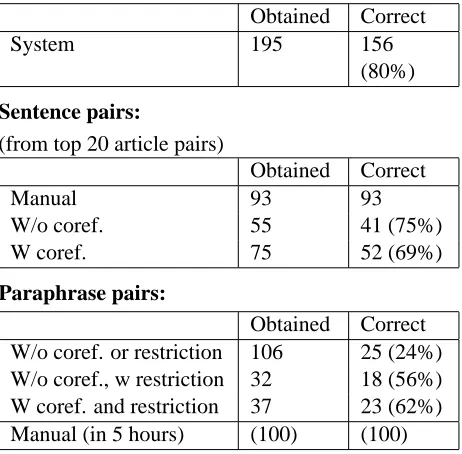
In this experiment, we used a set of articles which reports murder cases. The results are shown in Ta-ble 1. First, with Topic Detection and Tracking, there were 156 correct pairs of articles out of 193 pairs obtained. To simplify the evaluation process, we actually obtained paraphrases from the top 20 pairs of articles which had the highest similarities. Obtained paraphrases were reviewed manually. We used the following criteria for judging the correct-ness of paraphrases:
1. They has to be describing the same event.
2. They should capture the same information if we use them in an actual IE application.
We tried several conditions to extract paraphrases. First we tried to extract paraphrases using neither coreference resolution nor case restriction. Then we applied only the case restriction with the threshold 0.3 < Sp(C), and observed the precision went up from 24% to 56%. Furthermore, we added a sim-ple coreference resolution and the precision rose to 62%. We got 23 correct paraphrases. We found that several interesting paraphrases are obtained. Some examples are shown in Figure 3 (correct para-phrases) and Figure 4 (incorrect parapara-phrases).
It is hard to say how many paraphrases can be ul-timately obtained from these articles. However, it is worth noting that after spending about 5 hours for this corpus we obtained 100 paraphrases manually.
5 Discussion
Some paraphrases were incorrectly obtained. There were two major causes. The first one was depen-dency analysis errors. Since our method recognizes boundaries of expressions using dependency trees, if some predicates in a tree take extra arguments, this may result in including extraneous portions of the sentence in the paraphrase. For example, the predi-cate “lay in ambush” in Sample 3 should have taken a different noun as its subject. If so, the predicate
doesn’t share the anchors any more and could be eliminated.
The second cause was the lack of recognizing contexts. In Sample 4, we observed that even if two expressions share multiple anchors, an obtained pair can be still incorrect. We hope that this kind of error can be reduced by considering the contexts around expressions more extensively.
6 Future Work
We hope to apply our approach further to ob-tain more varied paraphrases. After a certain number of paraphrases are obtained, we can use the obtained paraphrases as anchors to obtain additional paraphrases. For example, if we know “A dismantle B” and “A destroy B” are para-phrases, we could apply them to “U.N. reported
Iraq dismantling more missiles” and “U.N. official
says Iraq destroyed more Al-Samoud 2 missiles”,
and obtain another pair of paraphrases “X reports Y” and “X says Y”.
This approach can be extended in the other direc-tion. Some entities can be referred to by completely different names in certain situations, such as “North Korea” and “Pyongyang”. We are also planning to identify these varied external forms of a single entity by applying previously obtained paraphrases. For example, if we know “A restarted B” and “A reac-tivated B” as paraphrases, we could apply them to “North Korea restarted its nuclear facility” and
“Py-ongyang has reactivated the atomic facility”. This
way we know “North Korea” and “Pyongyang” can refer to the same entity in a certain context.
In addition, we are planning to give some credi-bility score to anchors for improving accuracy. We found that some anchors are less reliable than oth-ers even if they are considered as proper expres-sions. For example, in most U.S. newspapers the word “U.S.” is used in much wider contexts than word such as “Thailand” although both of them are country names. So we want to give less credit to these widely used names.
require a narrower context than others and are not truly interchangeable. For example, “PERSON was sworn” can be replaced with “PERSON took office”, but not vice versa.
7 Conclusions
In this paper, we described a method to obtain para-phrases automatically from corpora. Our key notion is to use comparable articles which report the same event on the same day. Some noun phrases, espe-cially Extended Named Entities such as names, lo-cations and numbers, are preserved across articles even if the event is reported using different expres-sions. We used these noun phrases as anchors and extracted portions which share these anchors. Then we generalized the obtained expressions as usable paraphrases.
We adopted dependency trees as a format for ex-pressions which preserve syntactic constraints when extracting paraphrases. We generate possible sub-trees from dependency sub-trees and find pairs which share the anchors. However, simply generating all subtrees ends up obtaining many inappropriate por-tions of sentences. We tackled this problem by cal-culating a score which tells us how plausible ex-tracted candidates are. We confirmed that it con-tributed to the overall accuracy. This metric was also useful to trimming the search space for match-ing subtrees. We used a simple coreference resolver to handle some additional anchors such as pronouns.
Acknowledgments
This research is supported by the Defense Advanced Research Projects Agency as part of the Translin-gual Information Detection, Extraction and Sum-marization (TIDES) program, under Grant N66001-001-1-8917 from the Space and Naval Warfare Sys-tems Center San Diego, and by the National Science Foundation under Grant IIS-0081962. This paper does not necessarily reflect the position or the pol-icy of the U.S. Government.
References
Regina Barzilay and Kathleen R. McKeown. 2001. Ex-tracting Paraphrases from a Parallel Corpus. In
Pro-ceedings of the ACL/EACL.
Sadao Kurohashi and Makoto Nagao, 1998. Japanese
Morphological Analysis System JUMAN. Kyoto
Uni-versity, version 3.61 edition.
Sadao Kurohashi, 1998. Kurohashi-Nagao parser. Ky-oto University, version 2.0 b6 edition.
Dekang Lin and Patrick Pantel. 2001. Discovery of In-ference Rules for Question Answering. Natural
Lan-guage Engineering, 7(4):343–360.
Bo Pang, Kevin Knight, and Danial Marcu. 2003. Syntax-based Alignment of Multiple Translations: Ex-tracting Paraphrases and Generating New Sentences. In NAACL-HLT.
Ron Papka, James Allen, and Victor Lavrenko. 1999. UMASS Approaches to Detection and Tracking at TDT2. In DARPA: Broadcast News Workshop.
Deepak Ravichandran and Eduard Hovy. 2002. Learning surface text patterns for a question answering system. In Proceedings of the 40th Annual Meeting of the
As-sociation for Computational Linguistics (ACL).
Satoshi Sekine, Kiyoshi sudo, and Chikashi Nobata. 2002. Extended Named Entity Hierarchy. In
Proceed-ings of the LREC.
Yusuke Shinyama, Satoshi Sekine, Kiyoshi Sudo, and Ralph Grishman. 2002. Automatic Paraphrase Ac-quisition from News Articles. In Proceedings of the
Second International Conference on Human Language Technology Research.
Kiyoshi Sudo and Satoshi Sekine. 2001. Automatic Pat-tern Acquisition for Japanese Information Extraction. In Proceedings of the HLT.
Kiyotaka Uchimoto, Masaki Murata, Qing Ma, Hiromi Ozaku, and Hitoshi Isahara. 2000. Named Entity Ex-traction Based on A Maximum Entropy Model and Transformation Rules. In Proceedings of the 38th
Annual Meeting of the Association for Computational Linguistics (ACL), pages 326–335.