© 2015, IJCSMC All Rights Reserved 236
Available Online atwww.ijcsmc.com
International Journal of Computer Science and Mobile Computing
A Monthly Journal of Computer Science and Information Technology
ISSN 2320–088X
IJCSMC, Vol. 4, Issue. 8, August 2015, pg.236 – 245
RESEARCH ARTICLE
Different QOS Based Simulation Evaluation of
AODV, DSR, GRP and OLSR Using Frequency
Hopping for 2 Mbps via OPNET
Chetna
1, Ramveer Singh
*2, Jonish
3¹M-Tech Department of CSE, GNIOT, Greater Noida, Uttar Pradesh, India ²Assistant Professor, Department of IT, GNIOT, Greater Noida, Uttar Pradesh, India
³Department of CSE, Sonepat, Haryana, India
1
[email protected]; 2 [email protected]; 3 [email protected]
Abstract— Mobile Ad-Hoc network (MANET) is a network of mobile nodes that can communicate with each other without using any centralized control or fixed infrastructure. In this paper analysis and performance of AODV, DSR, GRP and OLSR is done for 2 Mbps data rate. We used OPNET Simulation tool to create a network containing 30 mobile nodes with data rate 2 Mbps with transmission power 0.005 watts and buffer size 1024000 bits each node moves randomly in the network and simulation time was 1500 sec. Routing protocols are compared in terms of WLAN Data Dropped (bits/sec), WLAN Load, WLAN Media Access Delay, WLAN Network Load (bits/sec) and WLAN Throughput (bits/sec). According to the analysis of resulted performance in 2 Mbps we can say that DSR>GRP>AODV>OLSR. The simulation result of the research has practical reference value for further study.
Keywords— AODV, DSR, GRP, OLSR, MANET, QOS, OPNET
I. INTRODUCTION
In a wireless network, simultaneous packet transmission by nearby nodes is often undesirable. This is because any resulting collision between these packets may cause a receiving node to fail to receive some or all of these packets. The vision of mobile ad hoc networking is to support robust and efficient operation in mobile wireless networks by incorporating routing functionality into mobile nodes. [5]
© 2015, IJCSMC All Rights Reserved 237
routing protocols are created to be implemented on MANET categorized in three different types according to the functionality.
A. Proactive Protocols
In networks utilizing a proactive routing protocol, every node maintains one or more tables representing the entire topology of the network. These tables are updated regularly in order to maintain a up-to-date routing information from each node to every other node. To maintain the up-to-date routing information, topology information needs to be exchanged between the nodes on a regular basis, leading to relatively high overhead on the network. One the other hand, routes will always be available on request.
B. Reactive Protocols
Reactive routing protocols do not make the nodes initiate a route discovery process until a route to a destination is required. This leads to higher latency but lower overhead. Reactive Protocols are bandwidth efficient. Route is determined when a path is required by a node to forward packets. Therefore, overhead routing is decreased because search for the route is not required on which packet is not sent.
C. Hybrid Protocols
It combine characteristics of both pro-active and re-active routing in order to find effective and reliable routes, without large control overhead, by locally using pro-active routing and inter-locally using re-active routing. One approach is to divide the network into zones, and use one protocol within the zone, and another between them. In this method communication in MANET is possible when nodes are near to each other and the supposition that changes in topology are only important if they happen in the vicinity of a node.
Routing protocol is the major issue in data communication’s performance of MANET. Hence, routing protocol required is to be effective and accurate so as to handle mobility of nodes and to give best utilization to technology. In this paper performance of AODV, DSR, GRP and OLSR protocols is evaluated for 2 Mbps data rate in Frequency Hopping WLAN Standard.
II. RELATED WORK
Narender[1] In this paper analysis of the performance of AODV routing protocol is done with the use of OPNET simulation tool, they created a 27 mobile nodes networks on data rate 1 and 11 Mbps and transmission power 0.005 watts with buffer size 256000 bits the time of simulation was 1200 sec. AODV routing protocol is compared in terms of AODV Route Discovery time, FTP Download Response Time(sec), HTTP Object Response Time (sec), WLAN Delay (sec) and AODV Total Cached Replies Sent in scenario for the simulation analysis and performances.
Parulpreet[2] This paper evaluates the performance of reactive (DSR) routing protocols in MANETs based on Average end-to-end delay, Throughput using OPNET 14.5. The performance DSR routing protocols is evaluated with respect to throughput and end-to-end delay under different traffic load using OPNET simulator.
© 2015, IJCSMC All Rights Reserved 238
was 1500 sec. Infra Red WLAN and Extended Rate PHY (802.11g) WLAN is compared in terms of 1 Mbps for different QOS’s using GRP protocol.
Narender[4] In this paper analysis and performance of OLSR is done for 1 and 11 mbps data rate. We used OPNET Simulation tool we created a network containing 27 mobile nodes with data rate 1 Mbps and 11 Mbps with transmission power 0.005 watts and buffer size 256000 bits each node moves randomly in the network and simulation time was 2000 sec. OLSR routing protocol is compared in terms of OLSR Performance Topology changes, FTP Download Response Time(sec), HTTP Object Response Time (sec), WLAN Retransmission Attempts (packets) and OLSR MPR count .
III. SIMLATION SETUP
We used software known as OPNET Modeler to conduct this work, which is a tool provided by the OPNET Technologies in order to undertake the experimental evaluation; the version named OPNET Modeler 14.5 has been adopted for study [7]. OPNET is one of the most extensively used commercial simulators based on Microsoft Windows platform, which incorporates most of the MANET routing parameters compared to other commercial simulators. It simulates the network graphically and gives the graphical structure of actual networks and network components.
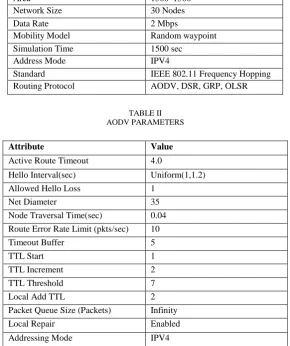
TABLE I
SIMULATION PARAMETERS
Simulation Parameter Value
Simulator OPNET Modular 14.5
Area 1500*1500
Network Size 30 Nodes
Data Rate 2 Mbps
Mobility Model Random waypoint
Simulation Time 1500 sec
Address Mode IPV4
Standard IEEE 802.11 Frequency Hopping
Routing Protocol AODV, DSR, GRP, OLSR
TABLE II AODV PARAMETERS
Attribute Value
ActiveRoute Timeout 4.0
Hello Interval(sec) Uniform(1,1.2)
Allowed Hello Loss 1
Net Diameter 35
Node Traversal Time(sec) 0.04
Route Error Rate Limit (pkts/sec) 10
Timeout Buffer 5
TTL Start 1
TTL Increment 2
TTL Threshold 7
Local Add TTL 2
Packet Queue Size (Packets) Infinity
Local Repair Enabled
© 2015, IJCSMC All Rights Reserved 239
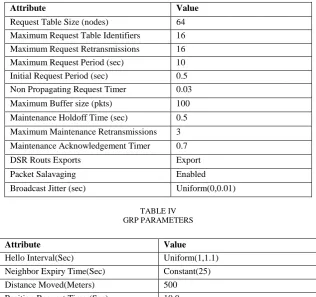
TABLE III DSR PARAMETERS
Attribute Value
Request Table Size (nodes) 64
Maximum Request Table Identifiers 16
Maximum Request Retransmissions 16
Maximum Request Period (sec) 10
Initial Request Period (sec) 0.5
Non Propagating Request Timer 0.03
Maximum Buffer size (pkts) 100
Maintenance Holdoff Time (sec) 0.5
Maximum Maintenance Retransmissions 3
Maintenance Acknowledgement Timer 0.7
DSR Routs Exports Export
Packet Salavaging Enabled
Broadcast Jitter (sec) Uniform(0,0.01)
TABLE IV GRP PARAMETERS
Attribute Value
Hello Interval(Sec) Uniform(1,1.1)
Neighbor Expiry Time(Sec) Constant(25)
Distance Moved(Meters) 500
Position Request Timer(Sec) 10.0
Backtrack Option Enabled
Routes Export Enabled
Number Of Initial Floods 3
TABLE V OLSR PARAMETERS
Attribute Value
Willingness Willingness High
Hello Interval(sec) 3.0
TC Interval(sec) 10.0
Neighbor Hold Time(Sec) 8.0
Topology Hold Time(Sec) 20.0
Duplicate Message Hold Time(Sec) 20.0
Addressing Mode IPV4
TABLE VI
WIRELESS LAN PARAMETERS
Attribute Value
Physical Characteristics Frequency Hopping
Data Rate 2 Mbps
Short Retry Limit 9
© 2015, IJCSMC All Rights Reserved 240
Max Receive Lifetime (sec) 0.5
Buffer Size(bits) 1024000
Roaming Capability Enabled
Large Packet Processing Fragment
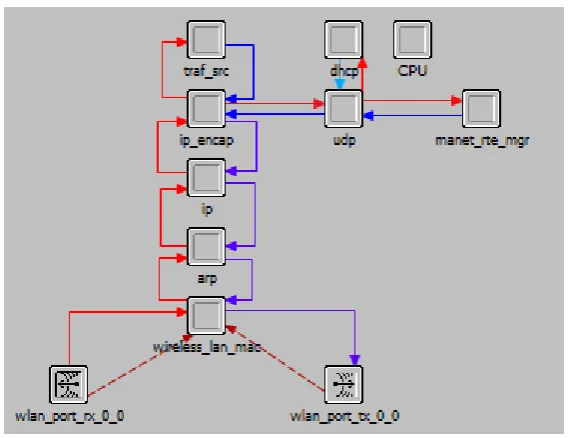
Fig. 1, 2 shows the simulation environment of scenario Node Models containing 30 WLAN mobile nodes, one fixed WLAN Server, Application definition, Profile definition and Mobility config. We configure the nodes in the scenario to work with 2 Mbps data rate in Frequency Hopping.
Fig. 1 Node Model for 30 Nodes scenario in AODV, GRP and OLSR
© 2015, IJCSMC All Rights Reserved 241
IV. PERFORMANCE MERICS A. WLAN Data Dropped (bits/sec)
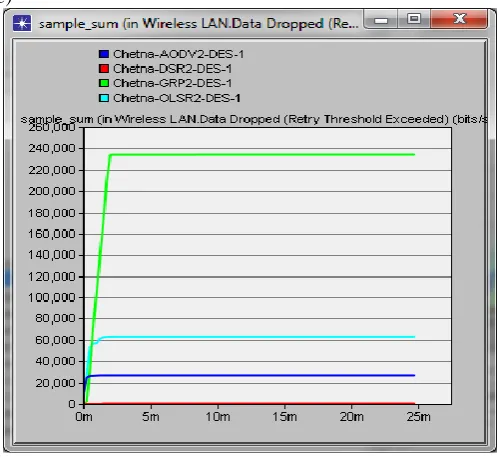
Wireless Local Area Network Data Dropped is the data dropped due to the Retry Threshold Exceeded in bits per second.
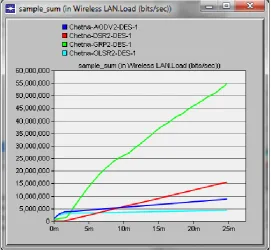
B. WLAN Load
Represents the total load (in bits/sec) submitted to wireless LAN layers by all higher layers in all WLAN nodes of the network.
C. WLAN Media Access Delay
It represents the global statistic for the total of queuing and contention delays of the data, management, delayed Block-ACK and Block-ACK Request frames transmitted by all WLAN MACs in the network.
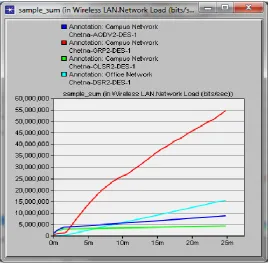
D. WLAN Network Load (bits/sec)
Wireless Local Area Network’s Network Load is the Load in bits/sec for both campus network and office network.
E. WLAN Throughput (bits/sec)
It represents the total number of bits (in bits/sec) forwarded from wireless LAN layers to higher layers in all WLAN nodes of the network.
V. SIMULATION RESULTS AND ANALYSIS
Figure (3 - 7) below shows WLAN Data Dropped (bits/sec), WLAN Load, WLAN Media Access Delay, WLAN Network Load (bits/sec) and WLAN Throughput (bits/sec) in 30 mobile nodes scenario for IEEE 802.11 standard at 2 Mbps data rate with AODV, DSR, GRP and OLSR. The color scheme is showing the protocols behavior in different graphs which gives the average values. From these average values we will conclude the behavior of all these routing protocols.
A. WLAN Data Dropped (bits/sec)
Fig. 3 Sample Sum for WLAN Data Dropped (bits/sec) in 2 Mbps for AODV, DSR, GRP and OLSR
© 2015, IJCSMC All Rights Reserved 242
B. WLAN Load
Fig. 4 Sample Sum for WLAN Load in 2 Mbps for AODV, DSR, GRP and OLSR
According to simulation, as we can see in Fig. 4, Resulted Performance is GRP > DSR > AODV > OLSR
C. WLAN Media Access Delay
Fig. 5 Sample Sum for WLAN Media Access Delay in 2 Mbps for AODV, DSR, GRP and OLSR
© 2015, IJCSMC All Rights Reserved 243
D. WLAN Network Load (bits/sec)
Fig. 6 Sample Sum for WLAN Network Load (bits/sec) in 2 Mbps for AODV, DSR, GRP and OLSR
According to simulation, as we can see in Fig. 6, Resulted Performance is GRP > DSR > AODV > OLSR
E. WLAN Throughput (bits/sec)
Fig. 7 Sample Sum for WLAN Throughput (bits/sec) in 2 Mbps for AODV, DSR, GRP and OLSR
© 2015, IJCSMC All Rights Reserved 244
VI. CONCLUSION
In this paper performance of AODV, DSR, GRP and OLSR by using 30 nodes scenario with IEEE 802.11 Frequency Hopping WLAN Standard in 2 Mbps is compared in terms of WLAN Data Dropped, WLAN Load, WLAN Media Access Delay, WLAN Network Load and WLAN Throughput. According to resulted performance we can say that DSR performed best for WLAN Media Access Delay and WLAN Data Dropped while GRP performed best for WLAN Load and WLAN Network Load and WLAN Throughput is found to be best in terms of AODV.
TABLE VII RESULTING VALUES
S.NO. PERFORMANCE METRICS AODV DSR GRP OLSR
1 WLAN DATA DROPPED 2 1 4 3
2 WLAN LOAD 3 2 1 4
3 WLAN MEDIA ACCESS DELAY 2 1 4 3
4 WLAN NETWORK LOAD 3 2 1 4
5 WLAN THROUGHPUT 1 4 2 3
AVERAGE PERFORMANCE IS –DSR>GRP>AODV>OLSR.
The simulation result of the research has practical reference value for further study.
REFERENCES
[1] Narender, Ravi Antil, Jonish “Different QOS Based Simulation Evaluation of AODV Protocol Using Direct Sequence for 1 Mbps and 11 Mbps Using OPNET”, IJCSMC, Vol. 4, Issue. 1, January 2015, pp. 36–44.
[2] Parulpreet, Ekta, Gurleen “Evaluation of various Traffic loads in MANET with DSR routing protocol through use of OPNET Simulator”, International Journal of Distributed and Parallel Systems (IJDPS) Vol.3, No.3, May 2012, pp. 75-83.
[3] Vineet Bansal, Ravi Antil, Jonish “Different QoS Based Comparative Simulation Evaluation of Infra Red and Extended Rate PHY (802.11g) Based on GRP Routing Protocol”, IJCSMC, Vol. 4, Issue. 1, January 2015, pp. 149–158..
[4] Narender, Ravi Antil, Jonish “Direct Sequence Based Performance Evaluation of OLSR for 1 Mbps and 11 Mbps Using OPNET”, IJCSMC, Vol. 4, Issue. 1, January 2015, pp. 26–35.
© 2015, IJCSMC All Rights Reserved 245
[6] Humaira Nishat, Vamsi Krishna, Dr. D.Srinivasa Rao, Shakeel Ahmed,” Performance Evaluation of On Demand Routing Protocols AODV and Modified AODV (R-AODV)in MANETS”, International Journal of Distributed and Parallel Systems (IJDPS) Vol.2, No.1, January 2011.
[7] Opnet Technologies, Inc. “Opnet Simulator,” Internet: www.opnet.com.
[8] Syed Basha Shaik, Prof. S. P. Setty,” Performance Comparison of AODV, DSR and ANODR for Grid Placement Model”,International Journal of Computer Applications (0975 –8887)Volume 11– No.12, December 2010.