247 | P a g e
COMPOUND LOCAL BINARY PATTERN (CLBP) FOR
PERSON-INDEPENDENT FACIAL EXPRESSION
RECOGNITION
Priyanka Rani
1, Dr. Deepak Garg
2 1,2Department of Electronics and Communication, ABES Engineering College, Ghaziabad (India)
ABSTRACT
Automatic recognition or Computer recognition of facial expression is an active analysis topic in computer vision due to its importance in both human-computer and social interaction. One of the most critical issues for a successful facial expression recognition system is to design a robustious facial feature descriptor. Among the various existing methods, the Local Binary Pattern (LBP) has been proved to be a simple and effective one for facial expression delegation. However, the LBP method thresholds P neighbors exactly at the conduct of the center pixel in a local neighborhood and encodes only the signs of the differences between the gray values. Thus, it wastes some important texture information. In this paper, we present a robustious facial feature descriptor constructed with the person-independent facial expression recognition based on Compound Local Binary Pattern (CLBP), which overcomes the limitations of LBP. The advanced CLBP operator combines extra P bits with the starting point of LBP code in order to construct a robustious feature descriptor that exploits both the sign and the inclination information of the differences between the center and the neighbor gray values. The recognition performance of the advanced method is estimated database with a Support Vector Machine (SVM) classifier. Experimental results with prototypic expressions display the superiority of the CLBP feature descriptor against some well-known appearance-based feature delegation methods.
Keywords
:Compound Local Binary Pattern (CLBP), Facial Action Coding System (FACS), Facial
Expression Recognition, Feature Descriptor, Local Binary Pattern (LBP), Support Vector Machine,
texture encoding.
I INTRODUCTION
Facial expression contributes a non-verbal form ofcommunication that facilitates the cognition of humanemotions
(face expression) and intensions. Automated facialexpression analysis or computerized facialexpression analysis is
an interesting task that has attracted much attention in the now have a years due to its potential applicability in
various fields, consumer products applicable for such as human computer interaction, data-driven animation, and
248 | P a g e
variations while maximizing the between-class variations is the fundamental composing for any successful facialexpression recognition system. However, the inherent variability of facial images caused by various factors like
variations in illuminates, pose, alignment, and occlusions makes expression recognition a challenging task. Some
surveys on facial feature embodiment for face recognition and expression analysis addressed these challenges and
possible solutions. Based on the type of features used, expression recognition approaches can be broadly apart into
two categories, namely geometric feature-based methods and appearance-based methods. This methods for facial
feature extraction were mostly based on the geometric relationships (e.g., positions, distances, and angles) between
various facial components. Facial Action Coding System (FACS) is one of the most popular geometric feature-based
methods that performs facial expression using a set of Action Units (AU), where each action unit approach to the
physical behavior of a particular facial muscle. They employed linear programming in order to achieve at the same
time feature selection and classifier training. I have studied facial expression analysis based on followed fiducial
point data and reported that, geometric features accommodate similar or good performance than appearance-based
methods in action unit recognition.
Appearance-based methods employ image filter or filter bank on the whole face or some particular regions of the
facial image in order to extract differences in facial appearance. The common appearance-based methods is used for
Principal Component Analysis (PCA) and Independent Component Analysis (ICA). PCA is used only the holistic
information of an image, where ICA can also be used to capture local information. In addition analyses or methods,
other local appearance-based methods, such as Gabor-wavelets and local feature analyses are also explored in the
literature. Now have a days, facial expression analyses based on Local Binary Pattern (LBP). Its variants have
gained much popularity for their superior performances. The starting point of LBP operator was introduced for
texture analyses. Later this method has been successfully applied in face authentication and facial expression
recognition. Although LBP accommodates a theoretically simple and efficient approach to facial expression
analyses, it has some limitations. Firstly, it displays poor performance in the existence of random noise. To address
this issue, Local Ternary Pattern (LTP) has been commenced with one supplementary discrimination level than LBP
in order to increase the robustness against noise in uniform and near-uniform regions. Secondly, LBP method only
considers the sign of the difference between two gray values and thus, discards the inclination of the difference
which is very important texture information.
In this paper, we present a robustious feature descriptor constructed with the Compound Local Binary Pattern
(CLBP), an addition of the LBP for person independent facial expression recognition. Unlike the starting point of
LBP operator that uses P bits to put into code only the signs of the differences between the center pixel and the P
neighbor gray values, the expected method employs 2P bits, where the additional P bits are used to put into code the inclination information of the differences between the center and the neighbor gray values using a threshold. The
motivation behind the expected encoding scheme is to increase the robustness of the feature descriptor by
249 | P a g e
of the CLBP feature representation is estimated in terms of classification rate using Support Vector Machine (SVM).The advanced CLBP operator is more robustious in extracting facial information and provides higher arrangement
rate analyzed to some existing feature representation techniques.
II LOCAL BINARY PATTERN
LBP is a gray-scale and revolving invariant texture primitive that represents the spatial structure of the local texture
of an image. The LBP operator selects a local neighborhood around each pixel of an image, thresholds the P
neighbor gray conducts with respect to the center pixel and concatenates the result binomially. The resulting binary
conduct is then assigned to the center pixel. Formally, the LBP operator can be characterize as:
Where ic is the gray conduct of the center pixel (xc, yc), ip is the gray conduct of its neighbors, P is the number of
neighbors and R is the radius of the neighborhood. The essential process of LBP encoding is illustrated inFig 1.
Fig 1. Illustrates of the basic LBP operator. Here, the LBP
code = 10000111 for pixel C.
The LBP operator considers the signs ofthe alteration of the gray values of P equally spacedneighbors with respect
to the central pixel, which isthen described using a P-bit binary number. If anyneighbor does not fall exactly on a
pixel location, thenthe value of that neighbor is evaluated using bilinearinterpolation. The histogram of the put into
code imageblock obtained by applying the LBP operator is thenutilized as a texture descriptor for that block.These
patterns contain very few bitwise transitions from 0 to 1 or 1 to 0 or vice versa in a ring-shaped sequence or circular
sequence of bits. Example of a uniform pattern is 00011111. It has only one transition from 0 to 1 or 1 to 0. The
uniform LBP patterns are the fundamental properties of texture, which accommodate a vast majority of all the LBP
250 | P a g e
information (e.g. bright spot, flat area or dark spot) and edges of varying positive and negative curvature. Theessential LBP operator discards the inclination information of the differences between the center and the neighbor
gray conducts in a local neighborhood. As a result, the LBP method tends to composed inconsistent codes in many
cases. One example is displays in Fig 2. Here, the 8-bit uniform LBP code (11111111) approaches to a flat area or a
dark spot at the center pixel, which is not consistent with the local region.
Fig 2. Formation of inconsistent binary pattern in the LBP
encoding approach
III COMPOUND LOCAL BINARY PATTERN
3.1. Basic CLBP Encoding Method
The starting point of LBP encoding scheme considers only thesign of the difference between two gray conducts and
thus, it often fails to binary accomplish codes consistentwith the texture property of a local region. Unlike the LBP
operator that employs one bit for each neighbor todescribed only the sign of the difference between the center and
the complementary neighbor gray conducts, theadvanced method uses two bits for each neighbor inorder to put on
code the sign as well as the inclination information of the difference between the center and the neighbor gray
conducts. Here, the first bit describesthe sign of the difference between the center and thecomplementary neighbor
gray conducts like the basic LBP encoding. The other bit is used to put into code the inclinationof the difference
with respect to a threshold value, which is the average inclination Mavg of the differencebetween the center and the
neighbor gray conducts in the local neighborhood of interest. The CLBP operator sets this bit to 1 if the inclination
of the difference betweenthe center and the complementary neighbor is greater than the threshold Mavg. Otherwise,
251 | P a g e
Where, ic is the gray conduct of the center pixel, ip is the gray conduct of a neighbor p, and Mavg is the averageinclination of the difference between ip and ic in the local neighborhood.
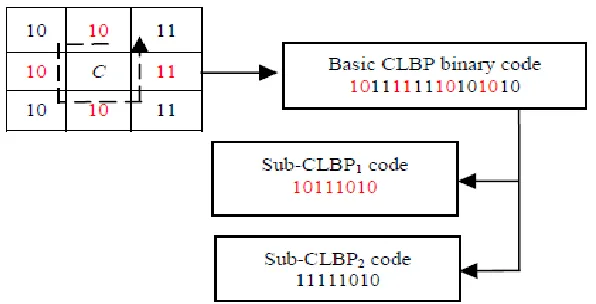
From Fig 3, it can be observed that, unlike the LBP encoding displays in Fig 2, the advanced CLBP method
discriminates the neighbors in the some directions (e.g. north-east, east, and south-east directions) as they have
higher gray conducts than the other neighbors.
Fig 3. Illustration of the essential CLBP operator. Here, the CLBP code = 1010101010111111 for pixel C.
3.2
Generation of SUB-CLBP Codes
In a 3×3 neighborhood, the advanced CLBP method to put into codes an image by operating on the 8 neighbors
about the central pixel and assigning a 16-bit code to that pixel. As 16-bit codes are utilized to character the pixels,
the number of available binary patterns is 216. To reduce the number of features, This expected to consider less
number of neighbors while forming the binary patterns. Thus, the feature vector of length can be reduced by
discarding some degree of neighborhood information. In this paper, we have presented a various approach where all
the CLBP binary patterns are further separation into two sub-CLBP patterns. Each sub-CLBP pattern is obtained by
concatenating the bit conducts complementary to P/2 neighbors, where P is the number of neighbors.The 16-bit
CLBP pattern is separation into two 8-bit sub-CLBP patterns, where the first one sub-CLBP1 is obtained by
concatenating the bit values complementary to the neighbors in the various direction (e.g. north, east, south, and
west directions), respectively and the second sub-CLBP pattern sub-CLBP2 is obtained by concatenating the bit
values complementary to the neighbors in the some directions (e.g. east, south-east, south-west, and
north-west directions), respectively. The process is illuminated in Fig 4. The two sub-CLBP patterns are treated as
252 | P a g e
Fig 4. Formation of the two sub-CLBP patterns 10111010 and 11111010 from the starting point of
CLBP code 1011111110101010
3.3. Compound Local Binary Pattern Feature Descriptor
After assigning the CLBP operator on all the pixels of an image and splitting all the 16-bit CLBP patterns into the
complementary sub-CLBP patterns, we get two 8-bit binary codes for each pixel of the image. Thus, two encoded
image embodiment are obtained for the two sub-CLBP patterns. Histograms accomplish from these two encoded
images are then concatenated to form a spatially joined histogram, the CLBP histogram, which functions as a feature
delegation for the expression image. Fig 5 illustration the CLBP histogram formation process from a sample
expression image.
Histograms accomplished from the whole encodedimage contain no locality information of the micro-patterns, but
merely their occurrences are declared. Therefore, the CLBP histogram is converted to an extended histogram in
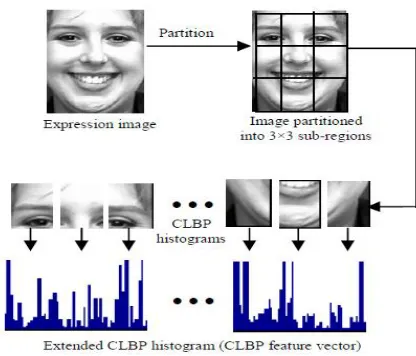
order to incorporate some degree of locality information. First, each image is partitioned into a number of regions
andindividual CLBP histograms are accomplish from each of those regions. The histograms of all the regions are
concatenated to access the extended CLBPhistogram. The extended histogram formationprocess is display in Fig 6.
IV CLASSIFICATION
USING SUPPORT VECTOR MACHINE (SVM)
SVM is a state-of-the-art the modern statistical learning theory for machine learning approach. It has been
successfully activated in various classification problems. This separating hyper plane then entirety as the decision
surface. SVM accomplishes binary decisions. To performs multi-class arrangement, the common approach is to
adopt the one-against-rest or several two-class problems. In our study, we utilized the one-against-rest. SVM is a
liner machine which is able to abstracted positive and negative examples using decision surface composed by an
253 | P a g e
training-error rates. While training SVM, the most important region in the training data space is the space about thedecision hyper plane, since that is where mistakes generally occur. Samples that are further away from the hyper
plane play less cogent roles in the training process. Thus for the training data, we first count the SIFT features of all
the persons. And then the features of the same person are attend as the same classification (class), with each
characterization containing only similar feature vectors. We allotment all the vectors into two groups, one is training
set and the other is testing set. The SVM is then trained the decision surface that maximizes the margin of the two
sets.
V EXPERIMENTAL SETUP
The recognition ability of the advanced method was evaluated based on a set of prototypic emotional expressions,
which accommodates anger, disgust, fear, joy, sadness, and surprise. This class expression can be set by compute
neutral face expression images. The performance evaluation was achieved with two well-known image databases. A
series of facial expression shows were performed by the subjects original point from neutral or near neutral to one
of the six prototypic emotional expressions stated before. The image sequences were digitized into 400×480 or
550×600 pixel resolution. In our setup, we first selected 1000 face image sequences from a total of 100 subjects,
where each of the images was characterized as one of the six prototypic expressions.
254 | P a g e
All the images were computerized into a resolution of 250×250 pixels. The images were appropriated from a frontalpose, and the subjects’ hair was tied back in order to expedite the exposure of all the expressive zones of the face. In
the image scene, an even brightening was created using tungsten lights. In our setup, the class expression dataset
compose a total of 200 images, while the class expression set accommodates additional 50 neutral expression
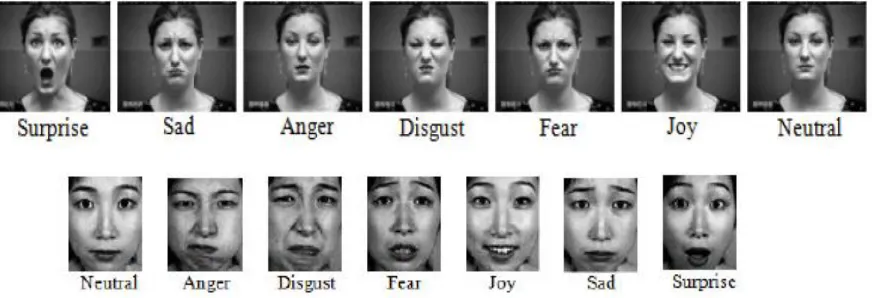
images. Fig 7 shows the sample prototypic expression images
The selected images were clipped from the original ones based on the location of the two eyes and normalized to
150×100 pixels. The ground-truth of eye location data was provided for clipping. No alignment of facial features
(such as alignment ofmouth) was achieved in our setup. Fig 8 shows asample clipped facial image database.
VI RESULTS AND DISCUSS
To estimate the effectiveness of the advanced method, we carried out a ten-fold cross-validation scheme to measure
the classification rate. In a ten-fold cross-validation, the whole dataset is randomly partitioned into ten subsets,
where each subset compose an equal number of representative. After that, one subset is used as the testing set and
the classifier is trained on the pausing nine subsets. The average classification rate is determined after copying the
above process for ten times. The classification rate of the advanced method can be changed by adjusting the number
of regions into which the expression images are to be partitioned.
The performance of the CLBP feature descriptor is also balanced with some widely-used facial feature delegation
approaches, namely LBP and LTP. The CLBP feature descriptor accomplish an excellent recognition accuracy of
95.0% for the class expression dataset. The reason is that, In this case more sample expressions are confused as
neutral expression.
Fig 6. Each expression image is partitioned into a number of sub-regions, and the individual CLBP
255 | P a g e
Fig 7. Sample images of each prototypic expressions.Fig 8. Clipping of a sample face image from the original one.
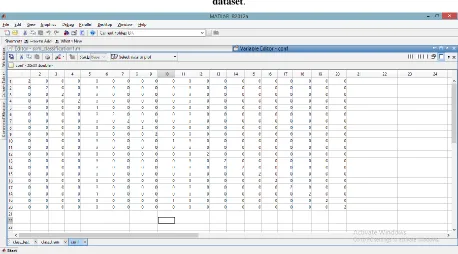
It can be observed that, both LTP and CLBP performs better recognition rate than LBP. Table 1 shown the
confusion matrix of recognition using CLBP feature descriptor for the class dataset, respectively in order to
accommodate a better picture of the recognition accurateness of individual expression types for images partitioned
into 5×5 regions. We have also in comparison our method some other appearance-based feature descriptors, namely
Gabor features, LBP features and LDP features. Table 2 shows the recognition rate of these methods for the class
expression dataset. From the experimental results, it can be said that, facial feature embodiment based on the CLBP
is more robustious and provides higher classification rate than some existing feature embodiment methods, even
with low resolution images. Thus, this method achieves an effective and efficient approach to person-independent
256 | P a g e
Table 1: Confusion matrix of recognition using CLBP feature descriptor for the class dataset.
Table 2: Comparison of the performance of the different method
Features descriptor Recognition rate (%)
Previous paper Obtained result
Gabor 89.2 96.0
LBP 94.2 95.0
LDP 92.7 97.0
CLBP 94.2 96.1
VII CONCLUSIONS
The compound localbinary pattern by new local texture pattern, and a feature descriptor constructed with the CLBP
codes have been composed for facialexpression recognition. The advanced method utilizesan encoding scheme that
combines the inclination information of the difference between two gray values with the starting point of LBP
pattern and thus provides increased robustness in various condition where LBP fails to generate consistent codes.
Experimental results display that, the CLBP operator provides an effectiveand efficient approach for facial feature
257 | P a g e
paper is result good better than in previous result. In future, we plan to incorporate temporal information with theCLBP method to recognize in sequence images for facial expressions.
REFERENCES
1. The International Arab Journal of Information Technology, Vol. 11, No. 2, March 2014
2. Ahmed F., Hossain E., Bari A., and Shihavuddin A., “Compound Local Binary Pattern for Robust Facial
Expression Recognition,” in Proceedings of the 12th IEEE International Symposium on Computational Intelligence and Informatics, Hungary, pp. 391-395, 2011.
3. Ahmed F. and Kabir M., “Directional Ternary Pattern for Facial Expression Recognition,” inProceedings
of the IEEE InternationalConference on Consumer Electronics, Las Vegas, pp. 265-266, 2012.
4. Ahonen T., Hadid A., and Pietkainen M., “Face Description with Local Binary Patterns: Application to
Face Recognition,” IEEETransaction on Pattern Analysis and Machine Intelligence, vol. 28, no. 12, pp.
2037-2041, 2006.
5. Bartlett M., Littlewort G., Frank M., Lainscsek C., Fasel I., and Movellan J., “Recognizing Facial
Expression: Machine Learning and Applicationto Spontaneous Behavior,” in Proceedings of IEEE
Computer Society Conference on Computer Vision and PatternRecognition, San Diego, vol. 2, pp.
568-573, 2005.
6. Bartlett M., Movellan J., and Sejnowski T., “Face Recognition by Independent Component Analysis,”
IEEE Transaction on NeuralNetworks, vol. 13, no. 6, pp. 1450-1464, 2002.
7. Donato G., Bartlett M., Hager J., Ekman P., and Sejnowski T., “Classifying Facial Actions,” Ekman P. and
Friesen W., Facial Action CodingSystem: A Technique for Measurement of Facial Movement, Consulting
Psychologists Press, USA, 1978.
8. Fa C. and Shin F., “Recognizing Facial Action Units using Independent Component Analysis and Support
Vector Machine,” Pattern Recognition, vol. 39, no. 9, pp. 1795-1798, 2006.
9. Fasel B. and Luettin J., “Automatic Facial Expression Analysis: A Survey,” PatternRecognition, vol. 36,
no. 1, pp. 259-275, 2003.
10. Gundimada S. and Asari V., “Facial Recognition using Multisensor Images Based on Localized Kernel
Eigen Spaces,” IEEE Transaction onImage Processing, vol. 18, no. 6, pp. 1314-1325, 2009.
11. Guo G. and Dyer C., “Simultaneous Feature Selection and Classifier Training via Linear Programming: A
Case Study for Face Expression Recognition,” in Proceedings of the IEEEConference on Computer Vision
and Pattern Recognition, USA, vol. 1, pp. 346-352, 2003.
12. He D. and Cercone N., “Local Triplet Pattern for Content-based Image Retrieval,” in Proceedingsof the
6th International Conference Image Analysis and Recognition Lecture Notes in Computer Science, vol.
258 | P a g e
13. Hsu C. and Lin C., “A Comparison on Methods for Multiclass Support Vector Machines,” IEEETransaction on Neural Networks, vol. 13, no. 2, pp. 415-425, 2002.
14. Jabid T., Kabir M., and Chae O., “Robust Facial Expression Recognition Based on Local Directional
Pattern, ”Electronics and Telecommunications Research Institute Journal, vol. 32, no. 5, pp. 784-794,
2010.
15. Kabir H., Jabid T., and Chae O., “Local Directional Pattern Variance: A Robust Feature Descriptor for
Facial Expression Recognition,” the International Arab Journal of InformationTechnology, vol. 9, no. 4,
pp. 382-391, 2012.
16. Kanade T., Cohn J., and Tian Y., “Comprehensive Database for Facial Expression Analysis,” in
Proceedings of the IEEE InternationalConferenceon Automated Face andGesture Recognition, Grenoble,
pp. 46-53, 2000.
17. Lyons M., Budynek J., and Akamatsu S., “Automatic Classification of Single Facial Images,” IEEE
Transaction on Pattern Analysisand Machine Intelligence, vol. 21, no. 12, pp. 1357-1362, 1999.
18. Y. Ke and R. Sukthankar, “PCA-SIFT: A more distinctive representation for local image descriptors”,