1204 | P a g e
Increasing Security and Performance of Cloud Storage
Using Data Division and Replication Strategies
Suyog Ghodey
1, Niranjan Dandekar
2, Sagar Kate
3, Vikrant Bhalerao
4,
Shubham Bhange
5, Alka Londhe
61,2,3,4,5,6
Department of Computer Engineering,
Pimpri Chinchwad College of Engineering, Pune, (India)
ABSTRACT
The security of large scale systems, such as the Cloud depends upon the security of the whole system and
security of individual nodes. A successful intrusion into a single node may have severe consequences, not only
for data of host node but also for other nodes. As storage is the most precious factor in the Clouds, data
fragments having same values can be considered as redundant. In this paper we will propose a system which
will implement a new storage strategy that uses the Division and Replication methodology for storing the data.
In this system, the file will be divided into fragments and then those fragments will be replicated several times
according to the replication factor before storing on the cloud. The fragments are then distributed such that no
node in a cloud holds more than a single fragment, so that even a successful attack on the node leaks no
significant information.
Furthermore, this methodology does not rely on the traditional Cryptographic techniques for the data security;
thereby relieving the system efficiency in clouds. The system will analyze the performance parameters by
simulating it in a controlled environment of computationally expensive methodologies.
This system will enhance cloud security using Division and Replication of data in Cloud for Optimal
Performance and Security (DROPS) methodology. The system will increase space.
Index Terms
—
Cloud, Data Fragments, Redundancy, Security, Space Efficiency, T-coloring.
I.INTRODUCTION
Cloud computing is an information technology (IT) paradigm that enables ubiquitous access to shared pools of
configurable system resources and higher-level services that can be rapidly provisioned with minimal
management effort, often over the Internet. Cloud computing relies on sharing of resources to achieve coherence
and economy of scale, similar to a utility.
Cloud computing poses privacy concerns because the service provider can access the data that is in the cloud at
any time. It could accidentally or deliberately alter or even delete information. Many cloud providers can share
information with third parties if necessary for purposes of law and order even without a warrant. That is
1205 | P a g e
privacy include policy and legislation as well as end users' choices for how data is stored. Users can encrypt datathat is processed or stored within the cloud to prevent unauthorized access. [1]
Cloud computing and storage provides users with capabilities to store and process their data in third-party data
centres. Organizations use the cloud in a variety of different service models (with acronyms such as SaaS, PaaS,
and IaaS) and deployment models (private, public, hybrid, and community). Security concerns associated with
cloud computing fall into two broad categories: security issues faced by cloud providers (organizations
providing software-, platform-, or infrastructure-as-a-service via the cloud) and security issues faced by their
customers (companies or organizations who host applications or store data on the cloud). The responsibility is
shared, however. The provider must ensure that their infrastructure is secure and that their clients’ data and
applications are protected, while the user must take measures to fortify their application and use strong
passwords and authentication measures. [2]
Cloud storage is based on highly virtualized infrastructure and is like broader cloud computing in terms of
accessible interfaces, near-instant elasticity and scalability, multi-tenancy, and metered resources. Cloud storage
services can be utilized from an off-premises service (Amazon S3) or deployed on-premises (ViON Capacity
Services).Cloud storage typically refers to a hosted object storage service, but the term has broadened to include
other types of data storage that are now available as a service, like block storage.
Cloud storage is made up of many distributed resources, but still acts as one, either in a federated or a
cooperative storage cloud architecture. It is highly fault tolerant through redundancy and distribution of data. It
is highly durable through the creation of versioned copies. It typically eventually consistent with regard to data
replicas.
This paper will aim to improve upon these current storage and security policies. Therefore, in this paper, we
collectively approach the issue of security and performance as a secure data replication problem. We present
Division and Replication of Data in the Cloud for Optimal Performance and Security (DROPS) that judicially
fragments user files into pieces and replicates them at strategic locations within the cloud. The division of a file
into fragments is performed based on a given user criteria such that the individual fragments do not contain any
meaningful information. Each of the cloud nodes (we use the term node to represent computing, storage,
physical, and virtual machines) contains a distinct fragment to increase the data security. A successful attack on
a single node must not reveal the locations of other fragments within the cloud. To keep an attacker uncertain
about the locations of the file fragments and to further improve the security, we select the nodes in a manner that
they are not adjacent and are at certain distance from each other. The node separation is ensured by the means of
the T-coloring. [3]
To improve data retrieval time, the nodes are selected based on the centrality measures that ensure an improved
access time. To further improve the retrieval time, we judicially replicate fragments over the nodes that generate
the highest read/write requests. We develop a scheme for outsourced data that takes into account both the
security and performance. The proposed scheme fragments and replicates the data file over cloud nodes. The
1206 | P a g e
revealed to the attacker. We do not rely on traditional cryptographic techniques for data security. Thenon-cryptographic nature of the proposed scheme makes it faster to perform the required operations (placement and
retrieval) on the data. We ensure a controlled replication of the file fragments, where each of the fragments is
replicated only once for the purpose of improved security. [4].
II.ALGORITHMS USED
1)
Fragment Replication
Replication technique called sole replication used, that every fragment is replicated only once. Sole replication
increase the security without having multiple copies of fragments thereby reducing the unnecessary storage
space. Node selection and fragment placement for replicated fragments is same as the original file fragments.
Data owner will select the number of nodes greater than the number replicated fragments as done while
fragmenting. By repeating the same process will avoid the storage of any replicated fragments in any node
holding the original fragment. Algorithm represents the process of sole replication.
Algorithm for fragment′s replication
for each Ok in O do
select Si that has max(Rik+Wik)
ifcolSi = open_color and si>=ok then
Si←Ok
si←si−ok
colSi←close_color
Si’←distance(Si,T)
colSi′←close_color
end if
end for
2)
File Fragmentation
Being specified the fragmentation threshold value by the user or considered default percentage through SLA the
fragmentation process will be preceded. With those value CMS will spilt the file into Number of fragments.
Once the file is fragmented, this methodology selects the cloud nodes for fragment placement. The selection is
1207 | P a g e
fragmentation technique and choosing distinct node for every single fragment enhance the security withoutusing any cryptographic techniques. Data owner will provide details to the user about the file size, number pages
and number of fragments. This information is provided in order to user choose to provide data owner access or
to decline. [5]
3)
Graph coloring concept
Node selection places an important part inplacing the fragments. Placements of fragments aresignificant because
for improving data retrieval timethese fragments should be highly reliable. Hereproposed the concept of hotbed
measure. In this acentral node is selected primarily which called ashotbed node of the network. To find central
node thenode should be less eccentric. Eccentricity measure ofthe node is the maximum distance of other node
fromthe selected node n. [6]T-coloring concept is used, which helpsin improving data retrieval time and
security. Fragmentplacement is done securely by selecting nodes whichare separated by a distance to avoid
interference. In thisconcept being selected the hotbed node, selection ofnext node for the placement of next
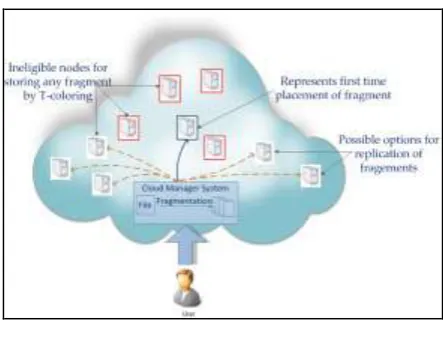
fragment is done insuch way that all adjacent node to the hotbed node willbecome ineligible. In figure 1, nodes
boxed in red colourare adjacent to the hotbed node, which becomeineligible to place next fragment. Nodes
boxed in greencolour are eligible for next fragment placement becauseit is not adjacent to the hotbed node. This
process iscarried out for upcoming fragments of that file. Byplacing fragments using these techniques
avoidsleakage of information to attackers. Even in case ofsuccessful intrusion of single node does not
provideany clue to next fragment location. [6]
Algorithm for fragment placement
O = {O1;O2; :::;ON}
o = {sizeof(O1); sizeof(O2); ::::; sizeof(ON)}
col = {open color; close color}
cen = {cen1; cen2; :::; cenM}
col _ open color¦ i
cen _ ceni¦ i
Compute:
for each Ok > O do
select Si S Si _ indexof(max(ceni))
1208 | P a g e
Si _ Oksi _ si − ok
colSi _ close color
Si’_ distance(Si; T) P /*returns all nodes at
distance T from Si and stores in temporary set Si’*/
colSi. _ closecolor
end if
end for
III.RELATED WORK
Juels presented a technique to ensure the integrity, freshness, and availability of data in a cloud. The data
migration to the cloud is performed by the Iris file system. A gateway application is designed and employed in
the organization that ensures the integrity and freshness of the data using a Merkle tree. The file blocks, MAC
codes, and version numbers are stored at various levels of the tree. The proposed technique in [10] heavily
depends on the users employed scheme for data confidentiality. Moreover, the probable amount of loss in case
of data tempering as a result of intrusion or access by other VMs cannot be decreased. Our proposed strategy
does not depend on the traditional cryptographic techniques for data security. Moreover, the DROPS
methodology does not store the whole file on a single node to avoid compromise of all of the data in case of
successful attack on the node. [7] The authors in [11] approached the virtualized and multi-tenancy related
issues in the cloud storage by utilizing the consolidated storage and native access control. The Dike
authorization architecture is proposed that combines the native access control and the tenant name space
isolation. The proposed system is designed and works for object based file systems. However, the leakage of
critical information in case of improper sanitization and malicious VM is not handled. The DROPS
methodology handles the leakage of critical information by fragmenting data file and using multiple nodes to
store a single file. The use of a trusted third party for providing security services in the cloud is advocated. The
authors used the public key infrastructure (PKI) to enhance the level of trust in the authentication, integrity, and
confidentiality of data and the communication between the involved parties. The keys are generated and
managed by the certification authorities. At the user level, the use of temper proof devices, such as smart cards
was proposed for the storage of the keys. Similarly, Tang et. al. have utilized the public key cryptography and
trusted third party for providing data security in cloud environments. However, the authors have not used the
PKI infrastructure to reduce the overheads. The trusted third party is responsible for the generation and
management of public/private keys. The trusted third party may be a single server or multiple servers. The
symmetric keys are protected by combining the public key cryptography and the (k, n) threshold secret sharing
1209 | P a g e
arising from virtualization and multi-tenancy. [8] A secure and optimal placement of data objects in a distributedsystem is presented here. An encryption key is divided into n shares and distributed on different sites within the
network. The division of a key into n shares is carried out through the (k, n) threshold secret sharing scheme.
The network is divided into clusters. The number of replicas and their placement is determined through
heuristics. A primary site is selected in each of the clusters that allocates the replicas within the cluster. The
scheme presented combines the replication problem with security and access time improvement. Nevertheless,
the scheme focuses only on the security of the encryption key. The data files are not fragmented and are handled
as a single file. The DROPS methodology, on the other hand, fragments the file and store the fragments on
multiple nodes. Moreover, the DROPS methodology focuses on the security of the data within the cloud
computing domain that is not considered in [9]
IV.SYSTEM MODEL
Fig 1: Cloud management system
Once all the fragments are placed on its appropriate locations, the cloud manager should maintain all the nodes
in the cloud. Cloud storage has a different unique storage in different region. This all node should be followed
by a single primary node that represent first placement of fragment. Then, T-coloring algorithm is used to plan
the remaining nodes and also it uses centrality measures. T-coloring prohibits storing the fragment in
neighbourhood of a node storing a fragment, resulting in the elimination of a number of nodes to be used for
storage. In such a case, only for the remaining fragments, the nodes that are not holding any fragment are
selected for storage randomly. Based on replication algorithm, a controlled replication is performed to increase
the data availability, reliability and improve data retrieval time. Cloud node store a fragment file in single time
1210 | P a g e
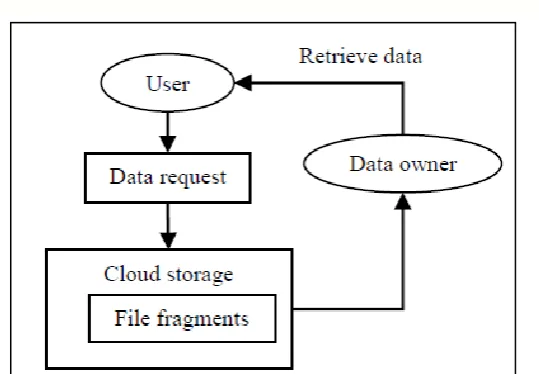
Fig 2: System Flow
V.CONCLUSION
We proposed the DROPS methodology, a cloud storage security scheme that collectively deals with the security
and performance in terms of retrieval time. The data file was fragmented and the fragments are dispersed over
multiple nodes. The nodes were separated by means of T-coloring. The fragmentation and dispersal ensured that
no significant information was obtainable by an adversary in case of a successful attack. No node in the cloud,
stored more than a single fragment of the same file. The performance of the DROPS methodology was
compared with full-scale replication techniques. The results of the simulations revealed that the simultaneous
focus on the security and performance, resulted in increased security level of data accompanied by a slight
performance drop.
REFERENCES
[1] Ali, Mazhar, Kashif Bilal, Samee Khan, BharadwajVeeravalli, Keqin Li, and Albert Zomaya. "DROPS:
Division and Replication of Data in the Cloud for Optimal Performance and Security." IEEE Transactions on
Cloud computing (2015).
[2] Wang, Shulan, Kaitai Liang, Joseph K. Liu, Jianyong Chen, Jianping Yu, and WeixinXie. "Attribute-based
data sharing scheme revisited in cloud computing." IEEE Transactions on Information Forensics and
Security 11, no. 8 (2016): 1661-1673.
[3]Salunkhe, Sujata D., and Dhanshri Patil. "Division and replication for data with public auditing scheme for
cloud storage." In Computing Communication Control and automation (ICCUBEA), 2016 International
Conference on, pp. 1-5. IEEE, 2016.
[4]Singla, Sanjoli, and Jasmeet Singh. "Cloud data security using authentication and encryption technique."
1211 | P a g e
[5] Moral, W. Delishiya, and B. Muthu Kumar. "Improve the data retrieval time and security through
fragmentation and replication in the cloud." In Advanced Communication Control and Computing
Technologies (ICACCCT), 2016 International Conference on, pp. 539-545. IEEE, 2016.
[6] Kang, Seungmin, BharadwajVeeravalli, and KhinMiMiAung. "A Security-aware Data Placement
Mechanism for Big Data Cloud Storage Systems." In Big Data Security on Cloud (BigDataSecurity), IEEE
International Conference on High Performance and Smart Computing (HPSC), and IEEE International
Conference on Intelligent Data and Security (IDS), 2016 IEEE 2nd International Conference on, pp. 327-332.
IEEE, 2016.
[7]Boru, Dejene, DzmitryKliazovich, FabrizioGranelli, Pascal Bouvry, and Albert Y. Zomaya. "Models for
efficient data replication in cloud computing datacenters." In Communications (ICC), 2015 IEEE
International Conference on, pp. 6056-6061. IEEE, 2015.
[8]Singla, Sanjoli, and Jasmeet Singh. "Cloud data security using authentication and encryption technique."
Global Journal of Computer Science and Technology 13.3 (2013).