AnInteractive Method for Content-Based Image Retrieval based on
Relevance Feedback and Multiple GLCM features
M. NagaSireesha & G.Srujana
(M.Tech,DECS), Department of ECE, Godavari Institute of Engineering and Technology, Rajahmundry.
M.Tech, Assistant Professor, Department of ECE, GIER(Autonomous), Rajahmundry.
Abstract – The manifold increase in theuse of digital media on the Internet has resulted in the increasing emphasis on the field of image search or retrieval.By ignoring visual content as a basis for image retrieval and adapting methods with text search techniques the search engines suffer inconsistency between the text words and visual content. Content-based image retrieval makes use of the representation of the visual content to identify relevant images and has attracted well-deserved attention in the last few years. CBIR combines the contents or features of images like color, texture, and edges instead of keywords, labels or metadata related to an image. The earlier CBIR methods were not able to bridge the gap between high-level concepts and low-level features. This work reviews the previous works carried out in this area. An approach ispresented for retrieval of images based on acombination of multiple GLCM features and relevance feedback based interactive approach. Performance evaluation of this method is done based on retrieval score and accuracy.
Keywords: CBIR, GLCM, Feature Extraction, Relevance Feedback.
I.
Introduction
The internet has changed the way we share and gather information. One of the most remarkable effects of this is the use of images to share information, which has lead to the success of IT companies like Flickr, Imgur, Instagram, Facebook etc.As online image sharing and public journalism is growing day by day, it has become mandatory to develop better search engines so that users can retrieve large number of images on the Internet. Big search engines such as Google do the image search asa purely text-based search problem and hence the search results are unsatisfactory. CBIR also was known as Query by image content (QBIC) use image content deterministic properties of color, texture, shapes and their objects in search [1]. Implementation of CBIR using only one feature will obviously not guarantee satisfactory results [2]. To overcome this problem, multiple features are combined to implement effective search and retrieval of images.An interactive user interface will allow the user to submit an initial query and refine his search results using relevance feedback. The relevance feedback being used will combine
the textual features with visual features to generate a better retrieval score. This paper is organized as follows: In section 2, the basic methods used in CBIR are presented along with the basic concepts involved in it. Section 3 reviews the main issues, research gaps and literature review of few image retrieval techniques. In section 4, the proposed methodology is presented. Section 5 shows the experimental results and comparison with other techniques.Section 6 presents theconclusion of the work and future scope of the work proposed here.
II.
Background Work
Image retrieval is the method for browsing, searching and retrieving images from a large database of digital images. There have been a lot of works in image retrieval systems in the recent time [3]. These works can be categorized into two categories – text-based image retrieval (TBIR) and content-basedimage retrieval (CBIR).
A.
Text-Based Image Retrieval
In conventional systems, text-based image retrieval systems are most commonly used. This search is based on annotation of images or metadata associated with images. The most commonly used TBIR system is Google Images. In advanced systems, the annotation is a translation from a set of image segments to a set of words in the same way as done in linguistic translation [4].Even though a text-based search-engine can retrieve images properly without understanding the content, it is not convenient for a user to give a low-level description of what image he is looking for.And for this reason, the results of TBIR systems are sometimes very irrelevant.
A. Content-Based Image Retrieval
To overcome the above problems, CBIR was implemented where content-based features properties were used for image retrieval. The term was coined by Kato in his 1992 research article [5].
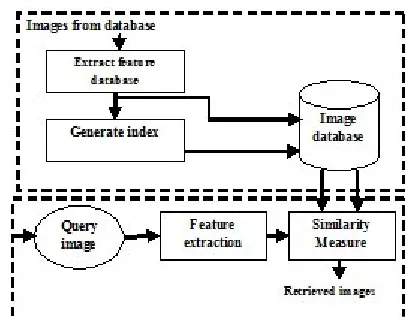
Figure 1: CBIR architecture
It can be deduced that CBIR mainly comprises of three steps which are feature extraction, feature matching,and retrieval system design. The CBIR has the following steps
1. Creating a databaseStore images into a database to prepare own database for testing purpose or use inbuilt databases.
2. Input Query ImageSelect an image for which similar images for thedatabaseare needed to be retrieved.
3. Feature ExtractionImportant features of database images and query images are extracted using relevant techniques.
4. Feature Matching Measure similarity between query and stored database images based on similarity measures such as Manhattan distance, Euclidean distance, and the images which have features with minimum distances are finally retrieved,
5. Result evaluationThe retrieved images are then evaluated based on performance metrics such as sensitivity, specificity etc.
6. Relevance feedback The initial query is filtered by the user to optimize the selected visual features.
Features of Images used for retrieval: A feature is information about the image, whichcan be used for solving the calculation tasks related to specific applications. Generally, the features are of much less in size and dimension than the original image. This reduces the computational complexity required for matching images. The features extracted are alow-level representation of the images.
Retrieval of images based on color features:Color is naturally the most used property of image in CBIR. There are different representations of color as in normalized RGB, hue, saturation, c1c2c3,andl1l2l3 [6]. The c1c2c3model has been found to be most suitable for application in CBIR. The
c1c2c3 features are invariant to background complication and different photometric conditions. These features are defined as follows
𝑐1 𝑥, 𝑦 = 𝑎𝑟𝑐𝑡𝑎𝑛 𝑅(𝑥, 𝑦) max(𝐺 𝑥, 𝑦 , 𝐵(𝑥, 𝑦))
𝑐2 𝑥, 𝑦 = 𝑎𝑟𝑐𝑡𝑎𝑛 𝐺(𝑥, 𝑦) max(𝑅 𝑥, 𝑦 , 𝐵(𝑥, 𝑦))
𝑐3 𝑥, 𝑦 = 𝑎𝑟𝑐𝑡𝑎𝑛 𝐵(𝑥, 𝑦) max(𝑅 𝑥, 𝑦 , 𝐺 𝑥, 𝑦 )
Here R(x,y), G(x,y) and B(x,y) is the red, green and blue component of the color image. Various features that can be used are Color histogram, Color Coherence Vector, Color Correlogram and Color Moments.
Retrieval of images based on texture features:Texture features are calculated from the local power spectrum of the images. The real and imaginary parts of the complex local power spectrum are relevant features that give information about the presence of significant texture orientations. The other information which is desired from texture featuresis adegree of contrast, coarseness and regularity [7, 8]. 2D Gabor filters are very widely used in extracting the texture features. Even fractals have been used for texture analysis [9]. The main goal of texture based retrieval is to find images with asimilar texture to the images with homogeneity are searched for. Hencethe homogeneity of the texture should be represented by these features.This is effectively represented by the mean and standard deviation of the magnitude of the Gabor filter outputs.
Retrieval of images based on shape features:Local shapes are often the most discriminate feature inside an image. Global shape descriptors such as Fourier transforms or skeletal shape are too general to be used in CBIR. Shape information is calculated from edge extraction. While extracting edges, over-segmentation or under-segmentation will create problems in shape analysis. These features can be used for retrieval systems [10, 11].Sometimes fuzzy features are also used to represent shape information [12].
GLCM. While extracting GLCM, there are three basic parameters that have to be defined: the quantization levels of the image and the displacement and orientation values of the measurements [14].
Need for multiple Features:The combination of multiple features is necessary because usually a single feature based representation is not sufficient to capture the variations in an image (view-point, illumination etc.). The combination of multiple features help in achieving improved performance and allows retrieval of meaningful images.Multiple features of different types will properly represent the image content. For effective and accurate retrieval, it is also necessary to use a way which will encode these features properly into a low dimensional vector.Some features even have complementary properties and combining such features should be done with utmost care.
Need for Feature Extraction:Feature extraction is the most significant step of CBIR as the specific features used for retrieval directly affects the efficiency of the retrieval process. Feature extraction derives the visual content of the image and represents it in the form of a low-dimensional vector. The feature extraction is applied to each image of the database as a result of which the large and complex database gets converted into an array of low-dimensional vectors. Each vector representing an image of the database. The database is indexed using these vectors and later these indices are used for retrieval process.
III.
Review Method
The problems which we have delved into this section are as follows
What are the existing tools, techniques,and methods for CBIR
What are the existing gaps in the existing works
Which are the key areas of interest in the field of CBIR
The results of this study have been presented in this section.
One of the most difficult problem in CBIR is to assign the low-level visual features such as color, texture, shape etc to high-level semantic values such as animals, buildings, flowers etc [15]. In the last few years, many methodologieshave been proposed to reduce the semantic gap between visual content and human semantics [16, 17]. The CBIR methods can be again classified into three approaches
1. Supervised Learning
2. Unsupervised Learning
A. Supervised Learning Techniques
Supervised learning is a significant step in speeding up the speed of image retrieval, increasing the efficiency of the retrieval process, and performannotation [17]. Datta et al. [17] categorized the classification of images into discriminative and generative frameworks. In thediscriminative framework, boundaries of classification are directly determined as in Support Vector Machines (SVM) and Decision Trees (DT).While generative approach tries to calculate data intensity within each class and based on that tries to optimize the boundaries between each class by using Bayesian formula. The generative frameworks are preferable when there a lot number of classes.
Vailaya et al. [18] proposed a hierarchical algorithm based on binary Bayesian classification. Natural scene images were categorized into indoors and outdoorusing a hierarchical structure. Outdoor images were further divided into city and landscape. At the lowest level, subsets of landscape images were again dividedinto sunset, forest, and mountain. They achieved high accuracy in classification on a specific database comprising of 6931 images. They also concluded that the accuracy of the method is based on selected features, the number of training sets, and the learning ability of classifier in true decision boundary. The drawback of this method is that categorization is under constraint. That is, test image has tobe taken from one of the classes.
Feng et al. proposed a method to solve some neural network problems [19]. The Bootstrap tries to learn samples from a small set of training labels. In this approach, to classify a new image, two independent classifiers are used to co-train and co-annotate for cumulative annotating. The results on 6000 mid-size images from CorelCD1,PhotoCD2, and Web demonstrated 10% improvement in retrieval accuracy as comparedto previous algorithms.
800 training and testing image sets have shown strong results to classify image regions.
Recent research work [21] conclude that decision tree learning (DT) methods can produce the more efficient interpretation of high-level semantic concepts in semantic-based image retrieval (SBIR) among the machine learning techniques for feature vector coding. Decision tree learning algorithms including ID3, ASSISTANT, C4.5 (enhanced version of ID3), and CART are extensively used for data classifying. This method divides feature space repeatedly into a group of non-overlapping spaces.
Shinde et al. [27] used color features of an image to form a feature vector. These features were then used for classification using machine learning classifiers. These techniques were shown to perform well for some classes but not so efficient for other classes.
AmmarHuneiti et al. [28] used color and texture feature vectors using the Discrete Wavelet Transform and the Self Organizing Map artificial neural networks. They used Euclidean distance as the similarity measure. But they did not consider the shape features.
B. Unsupervised Learning Techniques
Unsupervised clustering is one moresignificant method used in content-based image retrieval. The goal of this method is to classify a set of image data in a manner to enhance the similarity within clusters (high intra-cluster similarity) and reduce the similarity between the clusters (low inter-cluster similarity) [22].
Zheng et al. [23] proposed a powerful locality preserving clustering (LPC) algorithm for image databases, which is modified version of locality preserving projections (LPP) [24]. At the fundamental level, spectral clustering comprises of two steps: dimension reduction and using clustering method. Zheng’s comparative study [23] found that the cluster representation and computational efficiency of LPC method are very useful in their method. Other than that, this method can offer an explicit mapping function compared to theNormalized cut method (spectral clustering) [25].
Chen et al. [26] proposed a new algorithm termed as cluster-based retrieval of images by unsupervised learning (CLUE), in which the system aims to retrieve images by using the similarity knowledge between target images through user interaction. They claim that the degree of user involvement with CBIR system can help to reduce the semantic gap.
Deepak John et al. [29] divided the images into sub-blocks of equal size as their first step. They extracted the color and texture of each sub block by quantifying the HSV color space. Euclidean distance was used in retrieving in similar images. The computational complexity and retrieval time increased because of the extra step of block matching and extraction.
IV.
Proposed Method
A. Image Representation
The images have rich metadata associated with them such as title, category, and comments. All this metadata is used to represent the image in the form of textual features. We use Search Result Clustering for construction of the textual space. The vector-space model with TF-IDF weighting scheme is used to represent the textual feature
𝐹𝑇
= 𝑤1, … 𝑤𝐿
𝑤𝑖 = 𝑡𝑓𝑖. ln(𝑁 𝑛 )𝑖
𝐹 𝑇 is the textual feature of the image
𝑤𝑖 is the weight of the ith term in I’s textual space
𝐿 is the number of all distinct terms
𝑡𝑓𝑖is the frequency of ith term in I’s textual space
𝑁 is the total number of images
𝑛𝑖 is the no of images whose metadata consists the
ith term
The image is visually represented by a 64 dimensional feature vector in addition to the GLCM features. The feature vectors are combination of the following features:
Color Moments:Color moments are values that can be used differentiate images based on their features of color.The most importantmoments are Mean, Standard deviation and Skewness. Thefirst order (mean), the second (standard deviation) and the third order (Skewness) color moments have been proved to beefficient and effective in representing color distributions ofimages. In total we took six dimensional color moments for each image.
Auto-Correlogram:An auto-Correlogram is used to derive the spatial correlation between pixels. Here we use banded auto Correlogramof 44 dimensions.
Color texture moments:We calculated first and second order textural moments to represent certain aspect of image. 14 textural moments calculated for each image .
We calculate the GLCM matrix for only one direction and one distance. For the proposed approach the features extracted from the GLCM are as follows:
Mean
𝜇𝑖 = 𝑖𝑃(𝑖, 𝑗)
𝐺−1
𝑖,𝑗 =0
𝜇𝑗 = 𝑗𝑃(𝑖, 𝑗) 𝐺−1
𝑖,𝑗 =0
Variance
𝜎𝑖= 𝑖 − 𝜇𝑖 𝑃(𝑖, 𝑗) 𝐺−1
𝑖,𝑗 =0
𝜎𝑗 = 𝑗 − 𝜇𝑗 𝑃(𝑖, 𝑗)
𝐺−1
𝑖,𝑗 =0
Entropy
𝐸𝑛𝑡𝑟𝑜𝑝𝑦 = − 𝐺−1𝑃 𝑖, 𝑗 log(𝑃 𝑖, 𝑗 )
𝑖,𝑗 =0
Higher entropy values are found in homogeneous scenes while lower values are found in inhomogeneous scenes.
Dissimilarity
𝐷𝑖𝑠𝑠𝑖𝑚𝑖𝑙𝑎𝑟𝑖𝑡𝑦 = 𝐺−1 𝑖 − 𝑗 𝑃 𝑖, 𝑗
𝑖,𝑗 =0 Contrast
𝑐𝑜𝑛𝑡𝑟𝑎𝑠𝑡 = 𝑖 − 𝑗 2 𝐺−1
𝑖,𝑗 =0
𝑃(𝑖, 𝑗)
Homogeneity (Inverse Difference Moment)
𝐼𝐷𝑀 = 𝑃(𝑖, 𝑗) 1 + (𝑖 − 𝑗)2 𝐺−1
𝑖,𝑗 =0
Correlation
𝑐𝑜𝑟𝑟𝑒𝑙𝑎𝑡𝑖𝑜𝑛 = 𝑖 − 𝜇𝑖 𝑗 − 𝜇𝑗 𝑃(𝑖, 𝑗) 𝜎𝑖𝜎𝑗
𝐺−1
𝑖,𝑗 =0 Energy
𝐸𝑁𝑅𝐺𝑌 = 𝐺−1(𝑃(𝑖, 𝑗))2 𝑖,𝑗 =0
In total we calculated 8 features for each image from the gray level co-occurrence matrix.
C. Similarity Measure
Similarity measurement is an important part of CBIR algorithms. We haveused Euclidean distance measure which is the most common metric formeasuring the distance between two vectors.
Euclidean distance
𝐸 𝑢, 𝑣 = 𝑥1 − 𝑦1 2 2+ 𝑥2 − 𝑦2 2+ ⋯ 𝑥𝑛 − 𝑦𝑛 2
D. RF in Textual Space
Rocchio’s algorithm is used to perform RF in textual space. By using the RF, an optimal query so that the difference between the averages scores of a relevant image and the average score of a non-relevant image is maximized. Cosine similarity is used to calculate the similarity between an image andthe optimal query.
𝐹𝑜𝑝𝑡
= 𝐹 +𝑖𝑛𝑖 𝛼 𝑁𝑅𝑒𝑙𝐹 𝐼
where:
𝐹 𝑖𝑛𝑖 is the vector of the intial query
𝐹 𝐼is the vector of a relevant image 𝐹 𝐽 is the vector of a non relevant image 𝑁𝑅𝑒𝑙 is the number of relevant images
𝛼 is the parameter which controls the relative contribution of relevant images and the initial query
E. RF in Textual Space
Rocchio’s algorithm is usedto perform RF in textual space. By using the RF, an optimal query so that the difference between the averages scores of a relevant image and the average score of a non-relevant image is maximized.Cosine similarity is used to calculate the similarity between an image andthe optimal query.
𝐹𝑜𝑝𝑡
= 𝐹 +𝑖𝑛𝑖 𝛼 𝑁𝑅𝑒𝑙𝐹 𝐼
Where:
𝐹 𝑖𝑛𝑖 is the vector of the intial query
𝐹 𝐼is the vector of a relevant image
𝐹 𝐽 is the vector of a non relevant image 𝑁𝑅𝑒𝑙 is the number of relevant images
𝛼 is the parameter which controls the relative contribution of relevant images and the initial query
F. RF in Visual Space
G. Fusion of TRF and VRF
The flow chart of the fusion process is shownin the given figure
Figure 2: flow chart of TRF and VRF
RF in textual space is done to rank the images using the optimal query equation. Then, RF is done in visual space using Riu’salgorithm. This re-rankingis only done on the top K images. The re-ranking process is based on the following equations
𝑆 = 𝛽 ∙ 𝑆𝑉 + 1 − 𝛽 𝑆𝑇
𝛽 = 𝛼 ∙ 𝑒𝑥𝑝 −𝜆 ∙ 𝐷𝑎𝑣𝑒
𝐷𝑎𝑣𝑒 = 𝐹 − 𝐹𝑖𝑉 𝑂𝑃𝑇𝑉
/𝑛
𝑛
𝑖=1
𝐹𝑂𝑃𝑇𝑉
= 𝐹 𝑖𝑉
𝑛
𝑛
𝑖=1
𝑆𝑉 = 1 − 𝐷𝑉
Where:
𝑆 is the similarity metric in both visual and textual spaces
𝑆𝑉 is the similarity between the top image 𝐼’s
visual feature and𝐹 𝑂𝑃𝑇𝑉
𝑆𝑇 is the cosine similarity between I’s textual
feature and 𝐹 𝑂𝑃𝑇𝑇
𝛽 is the combination parameter for visual and textual spaces
𝛼 and 𝜆control RF feedback in visual space
𝐷𝑎𝑣𝑒is the deviation of the clicked image in visual space.
𝐹 𝑖𝑉is the visual feature of top image Ii. 𝐹 𝑂𝑃𝑇𝑉 is the visual feature of optimal query
𝐷𝑉is the similarity metric between I’s visual
feature and feature of optimal query.
V.
Experiment results
The algorithm was implemented in Matlab and the results are presented in this section.
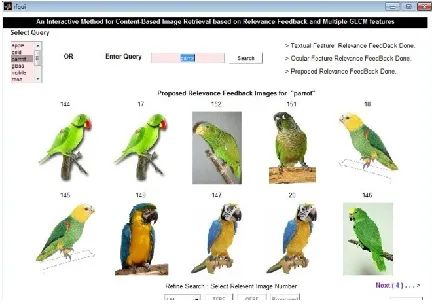
Figure 3: given query and images retrieved using TFRF
Figure 4: Images retrieved by VFRF with GLCM features
manner as dicussed earlier to get the optimal values for both. The performance is shown in below figure.
After selecting these values the performance of five strategies is evaluated.
(i) Retrieval using RF in Textual space (ii) Retrieval using RF in Visual space
(iii) Retrieval using RF in Visual space with extended feature-set (using GLCM)
(iv) Retrieval combining RF in Visual and Textual space
(v) Retrieval combining RF in Visual with extended feature set and Textual space
Figure 5: Performance of different strategies
VI.
Conclusion
In this work, relevance feedback methods are employed for both textual and visual features based image retrieval isdiscussed exposing their achievements and gaps. The GLCM features extracted for each image improved the search results. Performance assessment of little state–of- the –art imageretrieval methodsand the proposedmethodare done using Accuracy. Experimental results on 5 different data groups have been carried out and the results show improved accuracy over the previous methods. The future work incorporates database population and the investigation of the other features of the images in order to enhance the retrieval process.
References
[1] Flickner, M., Sawhney, H., Niblack, W., Ashley, J., Huang, Q., Dom, B., Gorkani, M., Hafner, J., Lee, D., Petkovic, D.,and Steele, D., 1995. Query by image and video content: The QBIC system. computer, 28(9), pp.23-32.
[2]Dandge, S.S. and Bodkhe, A.P., 2012. Content-Base Image Retrieval Using Feature Extraction. International Journal of Advanced Research in Computer Science, 3(3).
[3] Shinde, S.R., Sabale, S., Kulkarni, S. and Bhatia, D., 2015, January. Experiments on content-based image classification using Color feature extraction. In Communication, Information & Computing Technology (ICCICT), 2015 International Conference on (pp. 1-6).IEEE.
[4] P. Duygulu, K. Barnard, N. de Freitas, and D. Forsyth. Object recognition as machine translation: Learning a lexicon for a fixed image vocabulary. In Seventh European Conference on Computer Vision, pages 97–112, 2002.
[5]Kato, T., 1992.Database architecture for content-based image retrieval. Image Storage and Retrieval Systems, 1662, pp.112-123.
[6] E. Salvador, A. Cavallaro, T. Ebrahimi, Shadow identification and classification using invariant color models, in Proc. IEEE Int. Conf. on Acoustics, Speech, and Signal Processing (ICASSP), 2001, pp. 1545–1548.
[7] H. Tamura, S. Mori, T. Yamawaki. “Texture features corresponding to visual perception”. IEEE Trans. on Systems, Man,and Cybernetics. 6(4):460-473, 1976.
[8] W. Niblacket. al. “The QBIC Project: Querying Images by Content Using Color, Texture,and Shape”. Proc. of the Conference Storage and Retrieval for Image and Video Databases, SPIE vol.1908, pp.173-187, 1993
0 0.2 0.4 0.6 0.8 1 1.2
TRF VRF EVRF TVRF ETVRF
Performance Evaluation
DATAset1 Dataset2 Dataset3
[9] Kaplan, L M et al. “Fast texture database retrieval using extended fractal features” in Storage and Retrieval for Image and Video Databases VI (Sethi, I K and Jain, R C, eds), Proc SPIE 3312, 162-173, 1998.
[10] T. Gevers and A.W.M. Smeuiders., “Combining color and shape invariant features for image retrieval”, Image and Vision Computing, vol.17(7),pp. 475-488, 1999.
[11] A.K.Jain and Vailalya, “Image retrieval using color and shape”, pattern recognition, vol. 29, pp. 1233-1244, 1996.
[12] M.Banerjee, M,K,Kundu and P.K.Das, “Image Retrieval with Visually Prominent Features using Fuzzy set-theoretic Evaluation”, ICVGIP 2004, India, Dec 2004.
[13] R. M. Haralick, K. Shanmugam, and I. Dinstein, “Textural Features for Image Classification”, IEEE Trans. on Systems, Man, and Cybernetics, Vol. SMC-3, No.6, November 1973, pp.610-621.
[14] Soh, L.K. and Tsatsoulis, C., 1999. Texture analysis of SAR sea ice imagery using gray level co-occurrence matrices. IEEE Transactions on Geoscience and remote sensing, 37(2), pp.780-795.
[15]A. Smeulders, W. Worring, S. Santini, A. Gupta, and R. Jain, "Content-Based Image Retrieval at the End of the Early Years," Pattern Analysis and Machine Intelligence, IEEE Transactions on, vol. 22, pp. 1349-1380, 2000
[16] J. Z. Wang, J. Li, and G. Wiederhold, "SIMPLIcity: semantics-sensitive integrated matching for picture libraries," Pattern Analysis and Machine Intelligence, IEEE Transactions on, vol. 23, pp. 947-963, 2001.
[17] R. Datta, D. Joshi, J. Li, and J. Z. Wang, "Image Retrieval: Ideas, Influences, and Trends of the New Age," ACM Computing Survey, vol. 40, pp. 5:1-60, 2008.
[18] A. Vailaya, M. A. T. Figueiredo, A. K. Jain, and Z. HongJiang, "Image classification for content-based indexing," Image Processing, IEEE Transactions on, vol. 10, pp. 117- 130, 2001.
[19] H. Feng and T.-S.Chua, "A bootstrapping approach to annotating large image collection," Multimedia Information Retrieval in ACM Multimedia, Workshop on, pp. 55-62, 2003.
[20] Y. Liu, D. Zhang, and G. G. Lu, "Region-based image retrieval with high-level semantics using decision tree learning," The Journal of the Pattern Recognition Society, vol. 41, pp. 2554-2570, 2008.
[21]T. M. MITCHELL, Machine Learning: McGraw-Hill, 1997
[22] Y. Liu, D. Zhang, G. Lu, and W. Ma, "A survey of content-based image retrieval with high-level semantics," TheJournal of the Pattern Recognition Society, vol. 40, pp. 262- 282, 2007.
[23] X. Zheng, D. CAI, X. He, W.-Y.Ma, and X. Lin, "Locality preserving clustering foranimage database," Proceedings of the ACM International Conference on Multimedia, pp. 885 – 891, 2004.
[24] X. He and P. Niyogi, Locality preserving projections, Advances in Neural Information Processing Systems vol. 16: Cambridge, MA, MIT Press, pp. 153-60, 2004.
[25] S. Jianbo and J. Malik, "Normalized cuts and image segmentation," Pattern Analysis and Machine Intelligence, IEEE Transactions on, vol. 22, pp. 888-905, 2000.
[26]Y. Chen, J. Z. Wang, and R. Krovetz, "CLUE: cluster-based retrieval of images by unsupervised learning," Image Processing, IEEE Transactions on, vol. 14, pp. 1187-1201, 2005.
[27] Shinde, S.R., Sabale, S., Kulkarni, S. and Bhatia, D., 2015, January. Experiments on content-based image classification using Color feature extraction. In Communication, Information & Computing Technology (ICCICT), 2015 International Conference on (pp. 1-6).IEEE.