ISSN: 2231-2803
www.internationaljournalssrg.org
Page 313Content Based Image Retrieval Using Spatial Features
Akshay Alex
1, Pranay Goyal
2, Tejaswinee Thorat
3, Mayur Sonawane
4,
Mr. Subhash Rathod
51
(Department Of Information Technology, Marathwada Mitra Mandal’s Institute of Technology, India) 2
(Department, Of Information Technology, Marathwada Mitra Mandal’s Institute of Technology, India) 3
(Department Of Information Technology, Marathwada Mitra Mandal’s Institute of Technology, India) 4
(Department, Of Information Technology, Marathwada Mitra Mandal’s Institute of Technology, India) 5
(Department, Of Computer Engineering, Marathwada Mitra Mandal’s Institute of Technology, India)
ABSTRACT :
The field of image retrieval technologies have enabled the creation of large image datasets. It is necessary to develop appropriate information systems to efficiently manage these collections. An image retrieval system is a computer system for searching, browsing and retrieving images from a large database of images.An approach known as Content-Based Image Retrieval (CBIR) systems used to retrieve images similar to a user-defined specification or pattern (image, sketch etc). Their goal is to support image retrieval based on content properties (colour, texture and shape), usually encoded into feature vectors. CBIR approach is an automatic retrieval process, instead of the traditional keyword-based approach, which usually is very time-consuming. The CBIR technology has been used in several applications such as, digital libraries, crime prevention, medicine, historical research, fingerprint identification, biodiversity information systems.Keywords - CBIR, digital libraries, feature vectors, keyword-based, image acquisition.
1. Introduction
1.1 Need
Digital images have increased enormously over the past few years, fuelled at least in part by the rapid growth of imaging on the World-Wide Web. Different professional fields are using the opportunities offered by the ability to access and use remotely stored images in all kinds of innovative and new ways. The process of locating a desired image or a query image in a large collection is a difficult task to be achieved. The problems with image retrieval are widely getting notified, and the search for solutions an increasingly active area for research and development.
1.2 Basic Concept
The problems with traditional methods of image indexing had led to the rise in the interest of image retrieving techniques on the basis of spatial features such as color, texture and shape – a technology known as Content-Based Image Retrieval (CBIR)[1][3][5]. Researches have been made on this technology. CBIR technology is now beginning to move out of the laboratory and into the real world applications, in the form of commercial products like QBIC and Virage [2][3]. The technology still lacks perfectness, and is not yet ready to be used on a large scale. In the absence of hard evidence on the perfectness and effectiveness of CBIR techniques in practice, opinions are been made about their usefulness in handling real-life queries in large and diverse image collections. However, is it yet obvious how and where CBIR techniques can most profitably be used.
ISSN: 2231-2803
www.internationaljournalssrg.org
Page 314 demands for automatic and effective techniques forcontent-based image retrieval (CBIR) systems. Many CBIR systems use low-level image features such as color, texture, shape, edge, etc., for image searching and retrieval. Because the low-level these features can be computed automatically [2][4].
1.3 Related Work Done
Different reviews of the literature on image retrieval have been published from different viewpoints. Enser [1995] provides a method for providing subject access to pictorial information, developing a four-category framework to classify different approaches. He discussed about the pros and cons both of conventional methods based on linguistic cues for both categorizing and searching, and experimental systems using visual cues for one or both of these. His conclusions shows that there are serious limitations in current text-based techniques for subject access to image data from large image database and also significant research advances will be needed before visually-based methods are adequate for this task. He also notes, as does Cawkell [1993] in an earlier study, that additional dialogue between researchers into image analysis and information retrieval is needed [1][5].
Aigrain et al [1996] discussed the main principles of automatic image similarity matching for database retrieval, enlarging the difficulty of expressing this in terms of automatically generated features. Reviewing a selection of current techniques for both still image retrieval and video data management, including shot detection, key frame extraction, video parsing and video skimming. Conclusion has been created that the sector is increasing speedily, however that several major analysis challenges stay, together with the problem of expressing semantic information in terms of primitive image features, and also the want for improved user interfaces. CBIR techniques are probably to be used largely in restricted subject domains, and wherever synergies with alternative forms of information (i.e. text and speech) are often exploited [1] [6].
Eakins [1996] provides a platform for image retrieval classifying image queries into a series of levels, and discussed the extent to which advances in technology
are probably to fulfill user’s desires at every level.[1] Conclusion created is that automatic CBIR techniques can address several of user’s needs at level one, and can be capable of constructing a major contribution at level a pair of if current analysis ideas may be successfully exploited. they are very unlikely to create any impact at level three in future[1][3].
Idris and Panchanathan [1997] proposes an in-depth review of CBIR technology, depicting the principles behind techniques used for color, texture, shape and spatial indexing and retrieval in some. Discussions were made on the issues involved in motion detection, video segmentation and retrieval techniques for compressed images. Identification of a number of unanswered research questions, including the development of more compact and robust image content features, more accurate modeling of human perceptions of image similarity, the identification of more efficient image storage and indexing techniques, and the development of methods of identifying objects within images[1][3].
ISSN: 2231-2803
www.internationaljournalssrg.org
Page 315 2. System ArchitectureFig.1 proposed architecture
2.1 What is to be developed?
The aim is to develop software that provides summarized information about a image based on contents using Android Phone. The aim of this project is to review the current state of the art in content-based image retrieval (CBIR), a technique for retrieving images on the basis of automatically-derived features like color, texture and shape. Our findings are primarily based both on a review of the relevant literature and on discussions with researchers in the field (Fig 1).
A need to search out a query image from a collection of giant image database is shared by many professional groups. While the requirements of image users can vary considerably, it is often helpful to characterize image queries into three levels of abstraction: primitive features such as color or shape, logical features like the identity of objects shown and abstract attributes like the significance of the scenes portrayed.
2.2 Technology Used
CBIR (Content Based Image Retrieval)
Content-based image retrieval (CBIR) jointly referred as query by image content (QBIC) and content-based visual information retrieval (CBVIR) is an application of computer vision techniques to the image retrieval drawback i.e. the matter of finding out digital pictures in massive databases [1][3][5].
CBIR is different from traditional information retrieval in which image databases are essentially unstructured, since digitized pictures consist strictly of arrays of pixel intensities[1] [7], with no inherent meaning. A major issue with any kind of image processing is the need to extract useful information from the raw data (such as the presence of particular color, shape and texture) before any kind of reasoning about the image’s contents is shown.
CBIR presents several of its implementation strategies from the sector of image process and computer vision, and is regarded by some as a subset of that field. It differs from these fields chiefly, although its focuses on the retrieval of images with desired characteristics from a collection of great size. Image processing covers a far wider field which includes image compression, enhancement, transmission and interpretation. While there are grey areas (i.e. areas which are recognized by feature analysis), the distinguishing between mainstream image analysis and CBIR is fairly clear-cut. An example may make this clear. Police forces currently use automatic face recognition system. Such systems may be used in one of two ways. Firstly, the image ahead of the camera may be compared with a single individual’s database record to verify his or her identity. Only two images are matched in such a scenario, a process few observers would decision CBIR. Secondly, the complete image database is searched to seek out the foremost closely matching images. This is a real example of CBIR.
ISSN: 2231-2803
www.internationaljournalssrg.org
Page 316 image processing and information retrieval. Someof the most important are:
Understanding image users’ wants and information-seeking behavior.
Identification of acceptable ways that describe image content
Extracting such features from raw images.
Providing compact storage for giant image databases
Matching query and stored images in a manner that reflects human similarity judgments
Efficiently accessing stored images by content
Providing usable human interfaces to CBIR systems
3. Proposed Work 3.1 Algorithms Used
3.1.1 Color Feature Extraction using Average RGB
We use Average RGB to compute color similarity. It calculates the average value in Red, Green, and Blue channel of each pixel in an image, and uses this as a descriptor of an image for matching purpose.
Averaging color values is similar to averaging numbers, except with the extra initial step of finding the red, green and blue elements of the color. To do this we are able to use bitwise operators [2] [8] [9] [10].
R: Number = pixel >> 16 & 0xFF;
G: Number = pixel >> 8 & 0xFF;
B: Number = pixel & 0xFF;
3.1.2 Texture Color Co-occurrence
Image textures means images of natural textured surfaces and visual patterns created by artificial means, which approach within sure limits of natural objects. Image sensors yield further
geometric and optical transformations of the perceived surfaces, and these transformations must not affect on a selected category of textures in which the surface belongs.
Many applied statistical texture features are based on co-occurrence matrices representing second-order statistics of grey levels in pairs of pixels in an image. The matrices are of adequate statistics of Markov/Gibbs random field with multiple pairwise pixel interactions [10].
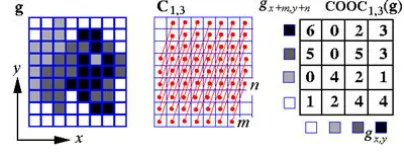
A co-occurrence matrix shows how frequent is every particular pair of grey levels in the pixel pairs, separated by a certain distance d along a certain direction a.
Let g=(gxy:x=1,…,M;y=1,…..,N) be a digital image.
Let Q={0…..qmax} be set of grey levels.
The co-occurrence matrix (Fig 2) for a given inter-pixel distance‘d’ and directional angle ‘α’ is defined as
COOCm=dcosα,n=dsinα (g)=[coocm,n(q,s|g):q,s=0,……….,qmax]
Where COOCm,n (q,s|g) is the cardinality of the set Cm,n of pixel pairs [(x,y),(x+m,y+n)] such that gx,y=q and gx+my+n=s
Fig 2. Co-occurrence matrix representation.
3.1.3 Shape Feature using Geometric Moment
ISSN: 2231-2803
www.internationaljournalssrg.org
Page 317 requirement that two similar shapes will also haveclose-to-identical shape descriptors. Fourier descriptors (GD) convince to be a lot advantageous than other techniques in terms of computation complexity, robustness, easy normalization and retrieval performance. The two-dimensional moment (for short 2-D moment)[8][10] of a 2-D object R is defined as:
Where f(x,y) is the characteristic function describing the intensity of R, and p+q is the order of the moment. In the discrete case, the double integral is often replaced by a double sum giving as a result:
3.1.4 Combining All three Algorithms
The Combinational algorithm is used to achieve a greater accuracy.In earlier CBIR applications the accuracy was not good.But by combining all the three algorithms(i.e Color Feature Extraction using Average RGB, Texture Color Co-occurrence, Shape Feature using Geometric Moment) will achieve a greater accuracy for the query image.
3.1.5 Euclidean Distance Algorithm
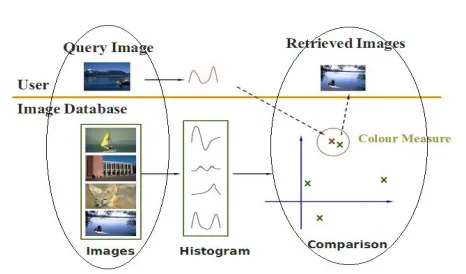
Fig 3. Histogram representing different images.
Euclidean distance algorithm is used after the combination of all the three algorithms (i.e. Color
Feature Extraction using Average RGB, Texture Color Co-occurrence, Shape Feature using Geometric Moment).A histogram is made between the query image and the images from the database. The histogram matching (Fig 3) the query image and similar histograms from image database are retrieved. The similar histograms are plotted on a graph. The images having similar features plotted on the graph are matched using Euclidean Distance Algorithm for distance measurement. The image plotted with the distance closer to the query image is calculated by:
Where:
(x1,y1): coordinate point of query image.
(x2,y2):coordinate point of the similar image matching from database.
4. Conclusion
In our proposed system we have implemented retrieval system by integrating various features of query Images. Experimental results show that integration of extracted features improves image indexing and retrieval. This is demonstrated by the finding that multiple features produce effective and efficient system as precision and recall values are improved.
4.1 Advantages
CBIR often performs better than keyword indexing, because many of the images cannot adequately be described by linguistic cues.
CBIR is fascinating because most web based image search engines believe purely on metadata and this produces lots of garbage in within the results.
ISSN: 2231-2803
www.internationaljournalssrg.org
Page 318 4.2 Disadvantages The system accuracy and performance depends upon the quality of Image.
If poor quality is given as a input then there is a possibility of getting wrong results.
Image size is large that may slow down the computer network.
5. Acknowledgement
We are very thankful to our professor Mr.Subhash Rathod of Department of Computer Engineering, MMIT Lohgaon, Pune, Maharashtra, India, for providing their support for this project. We would also like to thank our HOD Mr.K.S.Wagh for his un-ending faith and blessings.
References
[1] Ricardo da Silva Torres ,Alexandre Xavier Falcão , Content Based Image Retrieval: Theory and Applications, Institute of Computing, State University of Campinas, Campinas, SP,Brazil, RITA • Volume XIII • Número 2 • 2006
[2] Prabhjot Kaur, Dr. Satish Devane, Content Based Image Retrieval Algorithm Using Color Models,International Journal of Advanced Research in Computer and Communication Engineering,Vol. 2, Issue 3, March 2013
[3] Gaurav Jaswal (student), Amit Kaul,Content Based Image Retrieval – A Literature Review, National Conference on Computing, Communication and Control (CCC‐09)
[4] Srinivasa Kumar Devireddy, Content Based Image Retrieval,,Georgian Electronic Scientific Journal: Computer Science and Telecommunications 2009|No.5(22)
[5] Monika Rathore, Mr. Ravindra Gupta, Mr.Gaurav Shrivastav, A EFFECTIVE CONTENT BASED IMAGE
RETRIEVAL SYSTEM BASED ON FEATURES AND
TECHNIQUES ,International Journal of Advanced Research in Computer Engineering & Technology (IJARCET) Volume 2, Issue 12, December 2013 3195
[6] Sitesh Kumar Sinha, Krishna kumar Pandey, Dhiraj
Kushwah, A Quick Survey on latest Content Based Image
Retrieval Systems(CBIRS),International Journal of Advanced Research in Computer Science and Electronics Engineering (IJARCSEE) Volume 2, Issue 9, September 2013
[7] Y. Poornima ,P.S. Hiremath, Survey on Content Based Image Retreival System and Gap Analysis for Visual Art Image Retreival System, IJCSI International Journal of Computer Science Issues, Vol. 10, Issue 3, No 1, May 2013
[8] M. H. Saad, H. I. Saleh, H. Konbor, M. Ashour, Image Retrieval based on Integration between Color and Geometric Moment Features, Arab Journal of Nuclear Sciences and Applications 45(2)447-454(2012)
[9] Ms. K. Arthi , Mr. J. Vijayaraghavan,Content Based Image Retrieval Algorithm Using Colour Models,International Journal of Advanced Research in Computer and Communication Engineering Vol. 2, Issue 3, March 2013
[10] Aman Chadha ,Sushmit Mallik,Ravdeep Joha, Comparative Study and Optimization of Feature-Extraction Techniques for Content based Image Retrieval, International Journal of Computer Applications (0975 – 8887) Volume 52– No.20, August 2012