Available online: https://edupediapublications.org/journals/index.php/IJR/ P a g e | 2546
Resource allocation in MIMO-OFDM Systems
Kulwinder Kaur & Jatinder Singh Saini
1
Student, Baba Banda Singh Bahadur Engineering College Fatehgarh Sahib (PUNJAB)
E-mail:- [email protected]
2
Assistant Professor of CSE/IT Deptt., Baba Banda Singh Bahadur Engineering College
Fatehgarh Sahib (PUNJAB)
E-mail:- [email protected]
Abstract— MIMO and OFDM communication systems are one of the prominent technology that is preferred for performing wireless communication now a days. It facilitates the users to communicate at a high capacity which relies upon propagating surroundings. In recent wireless communication trends the resource allocation is one of the major issues. The efficient resource allocation can enhance the system’s performance. In recent years various researchers represented the resource allocation in MIMO system and some of them are defined in this work. The objective of this study is to provide an overview to the concept of resource allocation in MIMO networks. The scheduling of various assignments is represented in this study by considering an example of MIMO network. This work also represents the routing and resource allocation in MIMO.
Keywords—MIMO (Multiple Input Multiple Output), Resource Allocation, Scheduling, Routing.
1.
INTRODUCTION
Wireless mode of communication and mobile communication systems are significant communication technology of the current era and affect the all parts of the world with socially and economically. The recent status of wireless communication facilitates an expansion of application in comparison to what it was initially. The merging of internet and mobile communication has become a drastic change in communication field as it gives birth to new radio access technology by enhanced coverage area, capacity and latency. Wireless communication is measured to be one of the rapidly growing parts of the communication technology. Mobile communication faces [1,2].
In last few years, the Cellular communication systems have significant growth. With the help of ordinary techniques and invention of new methods that can attain high bit rates, the increasing demands of end users can be easily attained. Upcoming generation of wireless communication network needs to support the application that require high bit rate like video transmission, voice transmission etc. Mainly there are two types of technologies that have obtained the wide interest
to obtain the high bit rates in upcoming generation of wireless network are as follow: first one is Input Multiple-Output (MIMO) systems that use more than one antenna at transmitter unit and also at the receiver unit and second one is Orthogonal Frequency-Division Multiplexing (OFDM). Due to frequency selective fading and multipath propagation the bit rates are affected and also various problems are arises like noise and ISI. With the help of Multiple Input Multiple output system in wireless communication system has resulted in improved capacity of transmission [3,4,5]. MIMO uses multipath transmission system and that’s why it is beneficial in cellular communication networks. Large numbers of end users can be accommodated simultaneously in one BTS with the help of spatial multiplexing technique.
OFDM is a technology which is meant for 4G implementations. It is a wireless broadband technology with high bandwidth normally up to 20MHz. Thus it supports greater than 1Gbps data transfer rate.
In modulation, Information is mapped onto the variation in frequency, Phase and amplitude of a signal. Multiplexing is used for allocating the users in given bandwidth. OFDM is an approach which is the mixture of modulation and multiplexing.. In this the resources are shareable i.e. shared by the data sources. It uses modulation techniques.
OFDM is a digital multicarrier modulation scheme which enhances the single sub carrier modulation by using the concept of multiple subcarriers within the same individual channel. It follows the concept of FDM. In this various stream of information are added to the various channels which have parallel frequency [6, 7].
Features of OFDM:
Less sensitive to time synchronization errors.
Provides the SFN i.e. Single Frequency Network.
Robust against fading and ISI i.e. Inter Symbol Interference.
Available online: https://edupediapublications.org/journals/index.php/IJR/ P a g e | 2547 MIMO has two features:
Spatial Diversity: In this, same information is transferred over the independent fading channels to oppose fading.
Spatial multiplexing- In this, each spatial channel carries independent information thereby, increasing data rate of system.
Development at physical layer can help in improving the capacity of data transmission in wireless transmission system. Orthogonal Frequency Division Multiplexing (OFDM) is widely used technique in static digital subscriber links. This technique is integrated with Multiple Input Multiple output technique, so multiple antennas are used at both transmitter end and receiver end. The limitation on the data transmission capacity in wireless networks has been removed by using the MIMO system and also it overcome the problems of fading that encountered by the information signal over the channel [8,9,10]. The big challenge is that the practical implementation of MIMO based wireless communication system in those channels where fast fading is present. The major thing need to be considered is that to design a system that is observable as well as controllable. It is necessary to develop a observable design for communication system so that the proper radio network measurements can be obtained along with the appropriate signaling. Now, it is also important to develop a controllable system so that interference can be eliminated from the required information signal. The Multiple Input Multiple Output system has been actually presented as single-user point-to-point method to increase the efficiency of spectrum by accommodating large number of users simultaneously with the help of multipath scattering technique. [11, 12, 13] Moreover, one this kind of related technique is also called as SDMA (Spatial Division Multiple Access). This method has already described about the probability of utilizing the space system to accommodate various users simultaneously in limited spectrum.
2.
OFDM SYSTEM MODEL
In this section a model we have given the model for multiuser MIMO OFDM transmission, with its block scheme a brief summary provided about the OFDM and MIMO scheme.
Orthogonal frequency division multiplexing is a popular wireless multicarrier transmission technique. It is a promising candidate for next generation wired and mobile wireless system. The basic principle of OFDM is to split a high data rate stream into a number of low data rate stream so that the lower data rate can be transmitted simultaneously over a number of subcarriers. In OFDM, the amount of dispersion in time caused by multipath delay spread is decreased due to increased symbol duration for lower rate parallel subcarriers. The spectrum of OFDM is more efficient because of the use of closer channel space. Interference is prevented by making all subcarrier orthogonal to one another.
MIMO system utilizes space multiplex by using antenna array to enhance the efficiency in the used bandwidth. These systems are defined spatial diversity and spatial multiplexing. Spatial diversity is known as Tx -and Rx- diversity. Signal copies are transferred from another antenna, or received at more than one antenna. With spatial multiplexing, the system carriers’ more than one spatial data stream over one frequency, simultaneously.
In subcarriers MIMO-OFDM system, the individual data stream is first passed through an OFDM modulator. Then the resulting OFDM symbols are launched simultaneously through the transmit antenna. In a receiver side ,the individual received signal are passed through OFDM demodulator .The output of OFDM demodulator are decoded and rearranged to get desired output.
1.1 Scheduling
Let’s define an assignment for a MIMO network which poses the above properties of network. The vector v is defined as
𝑣= 𝑣1… … …. .𝑣𝑙 (1)
Where 𝑣𝑥∈ 0,1 𝑤𝑖𝑡ℎ𝑣𝑥= 1
The vector depicts that the link x is active during allocation of v. Whereas the set of assignments is depicted by 𝑣 . The size of 𝑣 is the main issue which exist while performing optimal scheduling in MIMO systems. [14] The rate of data transmission through link x in MIMO at the time of assignment v is denoted as
𝑅 𝑣,𝑥 = 𝑅𝑥𝑖𝑓𝑉𝑦= 0 𝑓𝑜𝑟𝑎𝑙𝑙𝑦 ∈ ℵ 𝑥
0 𝑜𝑡ℎ𝑒𝑟𝑤𝑖𝑠𝑒 (2)
R (v,x) is a complex function which is modeled with binary relationship as defined in above equation. In equation (2) ℵ 𝑥 stands for a set of links. 𝑅𝑥 is used for nominal data rate
over maximum data rate x which can be achieved by applying various techniques such as water filling method. [15, 16] The set of conflicts links can be represented by using the following formulation:
𝑦 ∈ ℵ 𝑥 (3)
if the data rates of at least one link is lesser than the threshold value 𝜂. Let us consider that the data rate of link x be 𝑅𝑥𝑦 when the both links are active then in such case the conflict set corresponding to link x is developed by using the given equation
𝑦𝜖ℵ 𝑥 𝑖𝑓𝑅𝑥𝑦 <𝜂𝑅𝑥𝑦𝑜𝑟𝑅𝑦𝑥<𝑅
𝑦 (4)
Here 𝑅𝑥𝑦 and 𝑅𝑦𝑥is evaluated by using methods such as GP
and QN etc. the value of threshold is pre-defined by the user in order to ignore the interference. A schedule is defined as a convex combination of assignments. A scheduler is a vector 𝑎𝑣,𝑣 ∈ 𝑉 (5)
Available online: https://edupediapublications.org/journals/index.php/IJR/ P a g e | 2548 𝑎𝑣is used to define that the assignment v is used. [17,18] The
average data rate generated by the scheduler for link x is 𝑎𝑣 𝑖𝑠 𝑣𝑎𝑣𝑅 𝑣,𝑥
1.2 Routing
Routing in MIMO based network is defined as which channel is used to transmit the data packets from sender to receiver. Let Φ as a set of simultaneous sessions and in which this notation is used to show the pair of source and destination node in the network. The traffic demand is denoted by 𝑑Φ is transferred from source node which is denoted by Φ𝑠 to
destination node which is represented as Φ𝑑 through collection of routes [19,20].
𝑟𝑥Φ is a notation which is used for representing the data rate linked with x and also define 𝑂 𝑛 and 𝐼(𝑛) to represent the set of links that are connected to nodes in the network. If the node n is elected as relay node for Φ𝑡ℎ flow, then the
following equation is used:
𝑟𝑥Φ− 𝑟𝑥Φ= 0
𝑥∈𝐼(𝑛)
𝑥∈𝑂(𝑛)
(6)
If the node is elected as destination node for Φ𝑡ℎ flow, then
the following formulation is used [25]:
− 𝑟𝑥Φ=−𝑑Φ
𝑥∈𝐼(𝑛)
(7)
1.3 Resource Allocation
In this work the issue of resource allocation in MIMO system is addressed to determine the scheduling, routing and power control etc. Generally, the motive of resource allocation is to enhance the throughput of the system in order to accomplish peer to peer traffic demand [21, 22, 23].
In order to clarify the concept of resource allocation, let us consider an example where there is a MIMO network which is comprised of n number of MIMO nodes and l MIMO links. The MIMO nodes are transceivers and all the nodes in the network perform communication via similar channel [24,25]. The issue of resource allocation is defined by using the following formulation:
𝑚𝑎𝑥𝛽
𝑟𝑥Φ=𝛽𝑑Φ,𝑛𝑑𝑒𝑓𝑖𝑛𝑒𝑠𝑡ℎ𝑒𝑠𝑜𝑢𝑟𝑐𝑒𝑜𝑓Φ
𝑥∈𝑂(𝑛)
(8)
𝑟𝑥Φ
𝑥∈𝑂(𝑛)
− 𝑟𝑥Φ= 0 ,ℎ𝑒𝑟𝑒𝑛𝑑𝑒𝑝𝑖𝑐𝑡𝑠𝑡ℎ𝑒𝑟𝑒𝑙𝑎𝑦𝑜𝑓Φ
𝑥∈𝐼(𝑛)
(9)
− 𝑟𝑥Φ
𝑥∈𝐼(𝑛)
=− 𝛽𝑑Φℎ𝑒𝑟𝑒𝑛𝑑𝑒𝑝𝑖𝑐𝑡𝑠𝑡ℎ𝑒𝑑𝑒𝑠𝑡𝑖𝑛𝑎𝑡𝑖𝑜𝑛𝑜𝑓Φ (10)
𝑟𝑥Φ ≤ 𝛼𝑣𝑅 𝑣,𝑥 𝑓𝑜𝑟𝑙𝑖𝑛𝑘𝑥 𝑣∈𝑉
𝜙∈Φ
(11)
𝛼𝑣≤1, 0≤ 𝑓𝑜𝑟𝑒𝑣𝑒𝑟𝑦𝑣 ∈ 𝑉
𝑣∈𝑉
(12)
3.
WATER FILLING ALGORITHM
The process of water filling algorithm is similar to pouring the water in the vessel. The un-shaded portion of the graph represents the inverse of the power gain of a specific channel. The Shadow portion represents the power allocated or the water. The total amount on water filled (power allocated) is proportional to the Signal to Noise Ratio of channel. VEC is the absolute or relative level of noise in LINEAR units at different frequencies, space or whatever bins. PCON is a total power constrain given in the same units as the VEC. TOL is an acceptable tolerance in the units of VEC. WLINE indicates the WATERLINE level in units of VEC so that:
(i) Find the length (N) of VEC. N = length (vec)
(ii) Determine the initial waterline level, WLINE. wline = min(vec) + pcon/N (iii) Measure the total power of current
waterline. ptot = sum(max(wline - vec,0))
(iv) Repeat step (a) & (b) until
abs (pcon - ptot) > tol a) wline = wline + (pcon - ptot)/N b) ptot = sum(max(wline - vec,0)).
The water filling algorithm is shown in figure 1.
Figure 1: Comparison of Water- filling and water filling ANN.
4.
MODELLING AND SIMULATION
Available online: https://edupediapublications.org/journals/index.php/IJR/ P a g e | 2549 The OFDM system is modeled using MATLAB and is
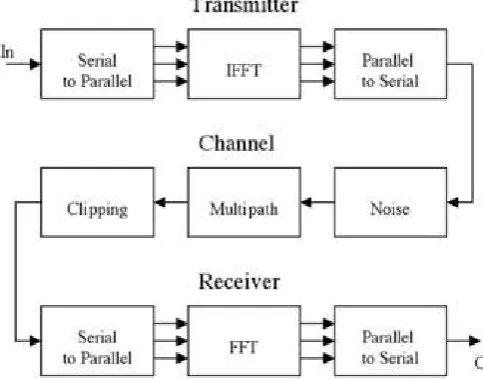
shown in Fig. 2.The data to be transmitted on each carrier is differentially encoded with previous symbols, then mapped into a Phase Shift Keying (PSK) format. The data on each symbol is then mapped to a phase angle based on the modulation method such as QPSK. The serial data stream is formatted into the word size required for transmission, e.g. 2 bits/word for QPSK, and shifted into a parallel format. Zero padding has used in our system to increase sampling rates for better resolution of signals. After the required spectrum is worked out, an inverse Fourier transform is performed to find the corresponding time waveform. The guard period is then added to the start of each symbol. After the guard has been added, the symbols are then converted back to a serial time waveform. This is then the base band signal for the OFDM transmission.
Figure 2: OFDM model used for simulations: OFDM transmitter and OFDM receiver
A channel model is then applied to the transmitted signal. The model allows for the signal to noise ratio (SNR), multipath, and peak power clipping to be controlled. The SNR is set by adding a known amount of white noise to the transmitted signal. Multipath delay spread is then added by simulating the delay spread using an FIR filter. The length of the FIR filter represents the maximum delay spread, while the coefficient amplitude represents the reflected signal magnitude. The receiver basically does the reverse operation to the transmitter. In the receiving side, the model recovers the input data, and performs an analysis to determine the transmission error rate.
B. MIMO- OFDM Simulation Modeling and results
In this simulation, a highly scattered environment is considered. The capacity of a MIMO channel is analyzed with the antenna configuration as. Each channel is considered as a parallel flat fading channel. The power in a parallel channel (after decomposition) is distributed as water
filling algorithm. The simulation model accepts inputs as text or audio files, binary, sinusoidal, or random data. The channel simulation allows examination of common wireless multipath channel characteristics such Resource allocation MIMO-OFDM SYSTEMS. Figure 3 represents delay graph in OFDM signal. Figure 4 shows comparison of water-filling and water-filling ANN. Figure 5 shows comparison of various techniques for resource allocation in MIMO-OFDM systems. We fix every sub channel with 32 subcarriers, so that the total subcarriers range from 32 to 1280. The performance of the proposed algorithm is evaluated. In Figure 6, the computation time for the various kinds of algorithms is plotted. To show the specific increment of the computation time, it is shown that the computation time of proposed algorithm is faster than that of the existing algorithm.
Figure 3: DELAY energy of water-filling ANN
Available online: https://edupediapublications.org/journals/index.php/IJR/ P a g e | 2550
Figure 5: Comparison of techniques in different MIMO system.
Figure 6: Computation time versus no. of subcarriers.
5.
CONCLUSION
The present scenario demands the high data rate to support the newly introduced applications. This can be achieved with the help of multiple input multiple output technique (MIMO). MIMO is widely used form of communication which facilitates the users to perform data transmission with higher capacity. Multiple-Input Multiple-Output technique in wireless transmission system can help in achieving the high level improvements in offering optimum spectral utilization in wireless system but it also suffers from the problem of resource allocation. The issue of resource allocation with scheduling, routing is concluded in this study with an objective to enhance the performance of the system by increasing the throughput of the system. The effective resource allocation can be achieved by using various
techniques such as water filling algorithm for power allocation.
REFERENCES
[1] P. Wang and B. Henz, “Efficient Approaches to Resource Allocation in MIMO-based Wireless Mesh Networks”, IEEE, pp. 1-7, 2015.
[2] X. Lu, Q. Ni, W. Li and H. Zhang , “Dynamic User Grouping and Joint Resource Allocation With Multi-Cell Cooperation for Uplink Virtual MIMO Systems”, IEEE Transactions on Wireless Communications, Vol 16, Issue 6, 2017.
[3] X. Xiao, X. Tao and J. Lu, “Energy-Efficient Resource Allocation in LTE-Based MIMO-OFDMA Systems With User Rate Constraints”, IEEE Transactions on Vehicular Technology, Vol 65, Issue 1, 2015.
[4] E. Castañeda, A. Silva, A. Gameiro and M. Kountouris, “An Overview on Resource Allocation Techniques for Multi-User MIMO Systems”, IEEE Communications Surveys & Tutorials, Vol 19, Issue 1, 2017.
[5] A. Soysal, “Joint Channel Estimation and Resource Allocation for MIMO Systems–Part I: Single-User and Numerical Analysis”, IEEE-TRANSACTIONS ON WIRELESS COMMUNICATIONS, Vol 9, Issue 2, 2010. [6] S. L. Prasanthi, P. R. Devi and S. Rajenda, “Resource
Allocation for Wireless Multicast MIMO – OFDM Systems Using Water Filling Algorithm”, IJESC, pp. 1019-1023, 2014.
[7] S. N. A, “Adaptive Resource Allocation in MIMO-OFDM Communication System”, SCRIBD, International Journal for Scientific Research & Development, Vol 1, Issue 7, pp. 1456-1460, 2013.
[8] M. O. Memis, O. Ercetin, O. Gurbuz and S. V. Azhari, “Resource allocation for statistical QoS guarantees in MIMO cellular networks”, SPRINGER, Journal on Wireless Communications and Networking, 2015. [9] Y. Hu, B. Ji, Y. Huang, F. Yu, and L. Yang,
“Energy-Efficient Resource Allocation in Uplink Multiuser Massive MIMO Systems”, HINDAWI, International Journal of Antennas and Propagation, Vol 2015, pp. 1-9, 2015.
[10] M. Ghorbanzadeh, “Utility Functions and Radio Resource Allocation”, SPRINGER, pp. 21-35, 2017.
[11] G. Liu-Yang, Z. Na-E , Xi-yu Song and S. Yang, “Review on resource allocation in MIMO radar”, IEEE, Computer and Communications (ICCC), 2017.
[12] K. Sun ,W. Huang , Y. Tie and Y. Zhang, “Resource allocation and scheduling in MIMO-OFDMA with time-varying channel and bursty arrivals”, IEEE, Communications and Networking in China, 2011.
Available online: https://edupediapublications.org/journals/index.php/IJR/ P a g e | 2551 Journal of Advanced Scientific Technologies,
Engineering and Management Sciences, Vol 33, Issue 1, pp. 278-282, 2017.
[14] B. Archana and T. P. Surekha, “Resource Allocation in LTE: An Extensive Review on Methods , Challenges and Future Scope”, Communications on Applied Electronics (CAE) Foundation of Computer Science FCS, Vol 3, Issue 2, pp. 12-22, 2015.
[15] S. Rawat and P. Sharma, “Review Paper on MIMO – OFDM System for WIMAX (IEEE 802.16) based on Cognitive Radio Networks”, International Journal of Innovative Research in Computer and Communication Engineering, Vol 4, Issue 10, pp. 18837-18842, 2016. [16] B.S. Awoyemi, B.T.J. Maharaj and A.S. Alfa, “Solving
resource allocation problems in cognitive radio networks: a survey”, SPRINGER, Journal on Wireless Communication and networking, Vol 2016, Issue 176, pp. 1-14, 2016.
[17] A. Satyasekhar, “Performance Evaluation of MIMO for Resource Allocation of OFDM-Based Cognitive Radio Networks”, International Journal of Engineering Research & Technology (IJERT), Vol 4, issue 7, Pp. 481-483, 2015 [18] H. Zhao, E.G. Palacios, J. Wei and Y. Xi, “Capacity and
resource allocation of cooperative MIMO in ad hoc networks”, ELSEVIER, Vol 4, Issue 2, pp. 98-110, 2011. [19] M.A. Abuibaid and S. Aldırmaz, “Energy-efficient
massive MIMO system: Exploiting user location distribution variation”, ELSEVIER, Vol 72, pp. 17-25, 2017.
[20] W. Hamidouche, C. Olivier, Y. Pousset and C. Perrine, “Optimal resource allocation for Medium Grain Scalable video transmission over MIMO channels”, ELSEVIER, Vol 24, Issue 3, pp. 373-387, 2013.
[21] Z. Chengwen, Z. Zhongzhao and M. Yongkui, “Resource allocation with CCI suppression for multiuser MIMO-OFDM downlink in correlated channels”, ELSEVIER, Vol 19, Issue 2, pp. 213-216, 2008.
[22] J. Nocedal and S. Wright, Numerical Optimization. Springer, 2000.
[23] F. Shams, G. Bacci and M. Luise, “A survey on resource allocation techniques in OFDM(A) networks”, ELSEVIER, Vol 65, Issue 2, pp. 129-150, 2014.