© 2015, IJCSMC All Rights Reserved 307 Available Online atwww.ijcsmc.com
International Journal of Computer Science and Mobile Computing
A Monthly Journal of Computer Science and Information Technology
ISSN 2320–088X
IJCSMC, Vol. 4, Issue. 1, January 2015, pg.307 – 313
RESEARCH ARTICLE
OCR-ANN Back-Propagation Based Classifier
Asmaa Qasim Shareef
1Sukaina M. Altayar
2¹
,2College of Science, University of Baghdad, Iraq1
[email protected] 2 [email protected]
Abstract— Optical Character Recognition by using Neural Network is a prototype system that is useful to
recognize the character. pre-processing for document is the preliminary step for the recognition to be accurate, which transforms the data into a format that will be processed easily and effectively. The main task of pre-processing is to decrease the variation that causes a reduction in the recognition rate and increases the complexities. In this paper, many pre-processing techniques has been used to improved OCR accuracy by pre-processing the original image and its character spiritedly, which includes noise
filtering, smoothing, thresholding, and skewing. The experimental results show that the improvement of
recognition side has achieved a good result for many types of noisy and non-uniform characters document. The efficiency and recognition testes for training method has been performed and reported in
this paper. This paper shows how the use of artificial neural network for an optical character
recognition application, while achieving highest quality of recognition and good performance by applying multiple image processing technique.
Keywords— Optical Characters Recognition; Back-Propagation; Neural Network; Image Analyses
I. INTRODUCTION
The Optical Character Recognition (OCR) is the process of automatic recognition for different characters from an image documented, and also provides a full alphanumeric recognition of printed or handwritten characters, text, numerals, letters and symbols into a computer process able to be formatted. OCR has gained largely impetus due to its application in the fields of Computer Vision, Intelligent Text Recognition applications and Text based decision-making systems [1,2]. The approach is taken as an attempted to solve the OCR problem, is based on psychology of the characters as perceived by the humans. Thus, the geometrical features of a character and its variants will be considered for recognition.
© 2015, IJCSMC All Rights Reserved 308 image data is needed, in addition to smooth image for better recognition, and extract features efficiently, train the system and classify patterns [3,4].
II. RELATED WORK
[6] proved that the Succession in OCR depends on two factors, which are feature extraction and classification algorithms.[7] applied neural network approach to perform high accuracy recognition on music score with backward propagation. [8] presented scheme to develop a complete OCR system for different five fonts and sizes of characters, and implemented the steps of the OCR system: pre-processing, feature extraction, segmentation, and classification. The artificial neural network (ANN) has been used for classification purpose. [9] explained the classification methods based on learning from examples and its application to character recognition.
III.PROPOSED SYSTEM ARCHITECTURE
This paper presents a procedure for designing OCR-ANN system, which recognized text from a scanned image. The model built using C# language with Open CV library. The system consists of two parts shown in Fig.1: Training ANN Part and Pattern Recognition part.
Fig.1 OCR-ANN system scheme
In 1st part, the database of characters has been created based on training ANN on images of characters with Backpropagation (BP) to generate data matrix that was used for classification operation. In 2nd part multiple processing have been used to recognize charterers from scanned image includes; pre-processing and classification.
ANN Training Part
© 2015, IJCSMC All Rights Reserved 309 the input data and desired output determines the number of nodes in the hidden layer. Also, the amount of training data sets set an upper bound for the number of nodes in the hidden layer. This upper bound is calculated by dividing the number of input output pairs examples in the training set by the total number of input and output nodes in the network. Then divide the result by scaling factor between five and ten [10].
Pattern Recognition Part
This part of scheme will imported the scanned image through pre-processing operations to recognition operation to be compared with the trained images in order to classify each character. pre-processed operation is to enhance and segment the characters to prepare them for recognition process. Image binarization (thresholding) is used for edge/boundary detection [11].
Fig.2 Input/output Data matrix Generation scheme
IV.EXPERIMENTAL RESULTS
© 2015, IJCSMC All Rights Reserved 310 Fig.3 BP-ANN Training Dialog.
After completing the training part, recognition part then started. First document image either was loaded from image files or through an optical device, and load training weights to be used in recognition. Fig.4 shows two samples of images has been taken to compare results: white background and graduate lighting images.
(a) (b)
(b) (d)
Fig.4 Binarazation of document images for
© 2015, IJCSMC All Rights Reserved 311 From Fig.5 it shows the Comparison between two different background documents the first image that is character image with white background and second are character image with graduate lights background. As appeared there are no noisy background from first image Fig.6-b because of no graduate lighting which makes recognized process with good accuracy, the problem appears with colour and graduate lights background images it makes classification process difficult due to noisy background as in Fig.6-d. The recognition result for both is shown in Fig.7
(a) (b)
Fig.5 Recognition of characters for
(a) Character image with white background and (b) Character image with graduate lights background
Fig.6 Applying pre-processing algorithms on graduate lights background
A sample of character images with white background has been used in test. As shown in Fig.7 the background is graduate in lighting duo to scanning process, also it has mirrored characters, this makes more noise and unwanted features that makes recognition process has many errors.
(a) (b) Fig.7 Scanned Character image
© 2015, IJCSMC All Rights Reserved 312 When used ANN to recognized the image, it obviously that recognition will field to identify the actual characters and it will have many errors as shown in Fig.8. After used pre-processing enhancement (smoothing, adaptive threshold and noise filter), the recognition process has been removed noisy background and recognized just characters with good accuracy.
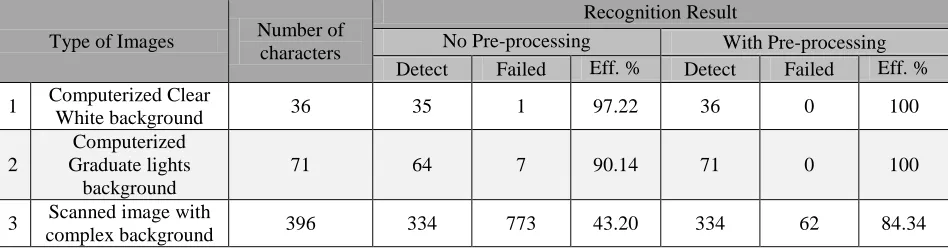
Table-1 shows the results of recognition for all the previous tested images that either use pre-processing or without using it.
(a) (b) Fig.8 Recognition results
(a) Recognition by ANN without used pre-processing (b) Recognition by ANN with used pre-processing
Table 1:Recognition Results for trained document images
Type of Images Number of characters
Recognition Result
No Pre-processing With Pre-processing Detect Failed Eff. % Detect Failed Eff. %
1 Computerized Clear
White background 36 35 1 97.22 36 0 100
2
Computerized Graduate lights background
71 64 7 90.14 71 0 100
3 Scanned image with
complex background 396 334 773 43.20 334 62 84.34
v. Conclusion
Using BP-ANN in OCR gives good results. However, the OCR affects by many factors like noise, brightness, coloured background. So pre-processing is necessary to be used in documented images as an initial step for character recognition systems to remove the effects of these factors. Each image requires different pre-processing techniques depending on the effect of the factor that may affect the quality of it.
ACKNOWLEDGEMENTS
© 2015, IJCSMC All Rights Reserved 313
References
[1] Sandeep S., Nabarag P., Sayam K. D. and Sandip K., “Optical Character Recognition using 40-point Feature Extraction and Artificial Neural Network”, International Journal of Advanced Research in Computer Science and Software Engineering, Volume 3, Issue 4, ISSN: 2277 128X, pp. 495-502, October 2012.
[2] Vivek S. and Navdeep S., “Optical Character Recognition using Artificial Neural Networks”, Signal & Image Processing: An International Journal (SIPIJ) Vol.3, No.5, October 2012.
[3] Rakesh B., “Artificial Neural Network Based Optical Character Recognition”, BLB-International Journal of Science & Technology, Vol.1 No. 2, pp. 143-152, ISSN 0976-3074, 2010.
[4] Sameeksha B., “Optical Character Recognition Using Artificial Neural Network”, International Journal of Advanced Research in Computer Engineering & Technology Vol.1, Issue 4, June 2012.
[5] Marinai S., Gori M. and Soda G., “Artificial neural networks for document analysis and recognition”, IEEE Transactions on Pattern Analysis and Machine Intelligence, Vol.27, no.1, pp. 23 - 35, ISSN: 0162-8828, Jan. 2005. [6] Ivan D., “Machine Learning Methods for Optical Character Recognition”, Chair of Computer Science, Department of
Mathematics and Informatics, Novi Sad, Serbia, December 2005.
[7] Akinwonmi A. E., Adewale O.S., Alese B.K., and Adetunmbi O.S., “Design of a Neural Network Based Optical CharacterRecognition System for Musical Notes”, the Pacific Journal of Science and Technology, Vol.9. no.1, 2008. [8] Raghuraj S., Yadav C. S., Prabhat V., and Vibhash Y., “Optical Character Recognition for Printed Devnagari Script
Using Artificial Neural Network”, International Journal of Computer Science & Communication Vol.1, no.1, pp. 91-95, 2010.
[9] Vijay L. S. and Babita K., “Offline Handwritten Character Recognition Techniques using Neural Network”, AReview International Journal of Science and Research (IJSR), India Online ISSN: 2319-7064 Vol.2 Issue1, January 2013.
[10]Jon M [12] Dike U. I and Adoghe U. A., “Back-Propagation Artificial Neural Network Techniques for Optical Character Recognition –A Survey”, International Journal of Computers and Distributed Systems, Vol. No.3, Issue 2, ISSN: 2278-5183, Jun-July 2013.