181 | P a g e
OCR-OPTICAL CHARACTER RECOGNITION
Abhishek Verma
1, Suket Arora
2, Preeti Verma
31
B.Tech (CSE), ACET, Amritsar,
2
Research Scholar, IKJPTU, Kapurthala,
3
Research Scholar, IKJPTU, Kapurthala,
ABSTRACT
Optical Character Recognition or OCR is the electronic translation of handwritten, typewritten or printed text
into machine translated images. It is widely used to recognize and search text from electronic documents or to
publish the text on a website. OCR is the machine replication of human reading and has been the subject of
intensive research for more than three decades. OCR can be described as mechanical or electronic conversion
of scanned images where images can be handwritten, typewritten or printed text. It is a method of digitizing
printed texts so that they can be electronically searched and used in machine processes. It converts the images
into machine-encoded text that can be used in machine translation, text-to-speech and text mining. This paper
presents a simple, efficient, and less costly approach to construct OCR for reading any document that has fix
font size and style or handwritten style. To achieve efficiency and less computational cost, OCR in this paper
uses database to recognize English characters which makes this OCR very simple to manage. So this research
paper is based on the construction, working and applications of OCR. Paper will also discuss different stages of
OCR like optical scanning , location segmentation ,preprocessing ,feature extraction and recognition post
processing.
Key Words:
Feature Extraction, Location Segmentation, Machine-Encoded Text, Optical
Character Reader, Optical Scanning, Preprocessing, Recognition Post Processing.
I. INTRODUCTION
Until a few decades ago, research in the field of Optical Character Recognition (OCR) was limited to document images acquired with flatbed desktop scanners. The usability of such systems is limited as they are not portable because of large size of the scanners and the need of a computing system. Moreover, the shot speed of a scanner is slower than that of a digital camera. But now, with the advancement of processing speed and high internal memory of hand -held mobile devices such as high- end cell -phones, Personal Digital assistants (PDA), smart phones, iPhones, iPods, etc. has given a new direction to OCRs.An app called „Google Translate‟ has been launched for android phones which is one of the best app based on OCR.
182 | P a g e
system in some former devices yield poor quality images. The processing speed and memory size of former handheld devices was not yet sufficient enough so as to run desktop based OCR algorithms that are computationally expensive and require high amount of memory. The processing speeds of mobile devices with built-in camera start with as low as few MHz to as high as 624 MHz but now , the new generation handheld devices have been launched with high performance cameras with auto-focusing system.II. CONSTRUCTION AND THE DIFFERTENT COMPONENTS OF OCR
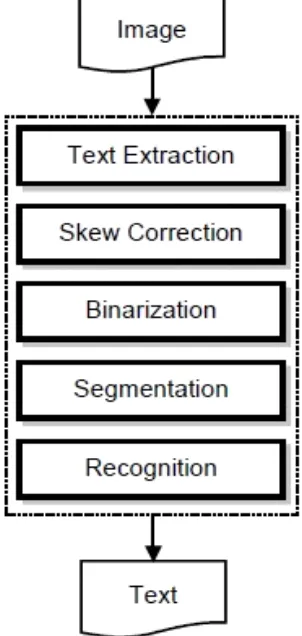
OCR is a simple machine with different parts that works according to the programming. At first, a typical OCR consists of an optical scanner that scans the analog document .Then each symbol and character is extracted through a location segmentation process. The next stage is of preprocessing of scanned image. After that in the next stage i.e feature extraction, the characters are further extracted according to the required dimensions. At the end in the last stage of recognition post processing, the characters are reconstructed with reduced noise according to the original text. Fig.1 represents the stages of an OCR.
Fig.1: Stages Of An OCR
III. WORKING OF OCR
The working of OCR is done step by step according to different stages as mentioned above in the construction of OCR.
3.1 Optical Scanning
183 | P a g e
recognition are totally dependent of the quality of the bilevel image. Still, the thresholding performed on the scanner is usually very simple. A fixed threshold is used, where gray-levels below this threshold is said to be black and levels above are said to be white. For a high-contrast document with uniform background, a fixed threshold can be sufficient. However, a lot of documents encountered in practice have a rather large range in contrast. In these cases more sophisticated methods for thresholding are required to obtain a good result. The best methods for thresholding are usually those which are able to vary the threshold over the document adapting to the local properties as contrast and brightness. However, such methods usually depend upon a multilevel scanning of the document which require more memory and computational capacity. Therefore such techniques are seldom used in connection with OCR systems, although they result in better images.3.2 Location Segmentation
Segmentation is a process that determines the constituents of an image. It is necessary to locate the regions of the document where data have been printed and distinguish them from figures and graphics. For instance, when performing automatic mail-sorting, the address must be located and separated from other print on the envelope like stamps and company logos, prior to recognition. Applied to text, segmentation is the isolation of characters or words. The majority of optical character recognition algorithms segment the words into isolated characters which are recognized individually. Usually this segmentation is performed by isolating each connected component, that is each connected black area. This technique is easy to implement, but problems occur if characters touch or if characters are fragmented and consist of several parts. The main problems in segmentation may be divided into four groups:
3.2.1 Extraction of touching and fragmented characters
Such distortions may lead to several joint characters being interpreted as one single character, or that a piece of a character is believed to be an entire symbol. Joints will occur if the document is a dark photocopy or if it is scanned at a low threshold. Also joints are common if the fonts are serifed. The characters may be split if the document stems from a light photocopy or is scanned at a high threshold.
3.2.2 Distinguishing noise from text
Dots and accents may be mistaken for noise, and vice versa. 3.2.3 Mistaking graphics or geometry for text
This leads to non text being sent to recognition. 3.2.4 Mistaking text for graphics or geometry
This often happens if characters are connected to graphics.
3.3 Preprocessing
184 | P a g e
obtain characters of uniform size, slant and rotation. To be able to correct for rotation, the angle of rotation must be found. For rotated pages and lines of text, variants of Hough transform are commonly used for detecting skew. However, to find the rotation angle of a single symbol is not possible until after the symbol has been recognized. Therefore , preprocessing leads to the symmetry and alignment of characters in a scanned image.3.4 Feature Extraction
The objective of feature extraction is to capture the essential characteristics of the symbols, and it is generally accepted that this is one of the most difficult problems of pattern recognition. The most straight forward way of describing a character is by the actual raster image. Another approach is to extract certain features that still characterize the symbols, but leaves out the unimportant attributes. The techniques for extraction of such features are often divided into three main groups, where the features are found from:
1. The distribution of points.
2. Transformations and series expansions. 3. Structural analysis
.
The following Fig.2 represents the technique of feature extraction.
Fig.2: Feature Extraction Technique
The different groups of features may be evaluated according to their sensitivity to noise and deformation and the ease of implementation and use. The criteria used in this evaluation of these groups are as following:
3.4.1 Robustness
Noise: Sensitivity to disconnected line segments, bumps, gaps, filled loops etc.
Distortions: Sensitivity to local variations like rounded corners, dilations and shrinkage.
185 | P a g e
Translation: Sensitivity to movement of the whole character or its components. Rotation: Sensitivity to change in orientation of the characters.
3.4.2 Practical use
Speed of recognition. Complexity of implementation. Independence.
3.5 Recognition Post Processing
These techniques are different from the others , in that no features are actually extracted. Instead the matrix containing the image of the input character is directly matched with a set of prototype characters representing each possible class. The distance between the pattern and each prototype character is computed, and the class of the prototype giving the best match is assigned to the pattern. The technique is simple and easy to implement in hardware and has been used in many commercial OCR machines. However, this technique is sensitive to noise and style variations and has no way of handling rotated characters.
At the end of the above processes the image is converted to the text with all corrections ,therefore a clear and original image of text is produced. The present system of Optical Character Recognition is presented in the Fig.3. .
186 | P a g e
IV. APPLICATIONS OF OCR
OCR itself is an application of computers and it further has many applications. OCR engines have been developed into many kinds of object-oriented OCR applications, such as receipt OCR, invoice OCR, check OCR, legal billing document OCR. Now a days, hand held OCRs are used for converting a language say English to other language say Punjabi with the help of scanning the image captured by camera. This is possible with the help of some OCR programmed apps like Google Translate. OCRs can be used for the following main purposes:
4.1 Banking
Another important application of OCR is in banking , where it is used to process cheques without human involvement. A cheque can be inserted into a machine where the system scans the amount to be issued and the correct amount of money is transferred. This technology has nearly been perfected for printed checks, and is fairly accurate for handwritten checks as well reducing the waiting time in banks. Fig.4 cheques by OCR
187 | P a g e
4.2 Invoice Imaging
Invoice imaging is widely used in many businesses applications to keep track of financial records and prevent a backlog of payments from piling up. In government agencies and independent organizations, OCR simplifies data collectioSSSSn and analysis, among other processes. As the technology continues to develop, more and more applications are found for OCR technology, including increased use of handwriting recognition. Furthermore, other technologies related to OCR, such as barcode recognition, are used daily in retail and other industries.
4.3 Legal Industry
Legal industry is also one of the beneficiaries of the OCR technology.OCR is used to digitize documents, and directly entered to computer database. Legal professionals can further search documents required from huge databases by simply typing a few keywords.
4.4 Captcha
A CAPTCHA is a program that can generate and grade tests that human can pass but current computers programmers‟ cannot. Hacking is a serious threat to internet usage. Now a day‟s most of the human activities like economic transactions, admission for education, registrations, travel bookings etc are carried out through internet and all this requires a password which is misused by hackers. They create programs to like dictionary attacks and automatic false enrolments which lead to waste of memory and resources of website. Dictionary attack is attack against password authenticated systems where a hacker writes a program to repeatedly try different passwords like from a dictionary of most common passwords. In CAPTCHA, an image consisting of series of letters of number is generated which is obscured by image distortion techniques, size and font variation, distracting backgrounds, random segments, highlights and noise in the image. This system can be used to remove this noise and segment the image to make the image tractable for the OCR (Optical Character Recognition) systems. Fig.5 represents the segmentation result of captcha.
Fig.5: Segmentation result for captcha
4.5 Institutional Repositories and Digital Libraries
188 | P a g e
preserved and aired. It helps to open up the outputs of an institution and give it visibility and more impact on worldwide level. Enables and encourages interdisciplinary approaches to research and facilitates the development and sharing of digital teaching materials and aids. It is basically a collection of peer reviewed journal articles, conference proceedings, research data, monographs, books, theses and dissertations and presentations. Their first role is to provide the Open Access literature. Practical implementation of this includes setting up a system which consists of scanner which scans the documents. This scanned document is then fed as an input to an Optical Character Recognition system where information is acquired and retained in digitizedform. Fig.6 represents the segmentation result for an institutional repository.
Fig.6: Segmentation result for institutional repository
.4.6 Healthcare
189 | P a g e
4.7 Handwriting Recognition
Handwriting recognition is the ability of a computer to receive and interpret intelligible handwritten input from sources such as paper documents, photographs, touch-screens and other devices. The image of the written text may be sensed "off line" from a piece of paper by optical scanning (optical character recognition) or intelligent word recognition. Alternatively, the movements of the pen tip may be sensed "online", for example by a pen-based
computer screen surface. Various OCR based android and iso apps has been also designed for recognition of hand written documents and papers. The books in various languages are also published with the help of handwriting recognition by an OCR. Fig.7 represents the handwriting recognition by an OCR.
Fig.7: Handwriting recognition by an OCR
4.8 Optical Music Recognition
190 | P a g e
musical data and also it can be used for diversity in musical notation. Image enhancement and segmentation is the basic step and hence the paper focuses on it.Fig.8 represents the segmentation result of OMR.
Fig.8: Segmentation result for OMR
4.9 Automatic Number Recognition
Automatic number plate recognition is used as a mass surveillance technique making use of optical character recognition on images to identify vehicle registration plates. ANPR has also been made to store the images captured by the cameras including the numbers captured from license plate. ANPR technology own to plate variation from place to place as it is a region specific technology. They are used by various police forces and as a method of electronic toll collection on pay-per-use roads and cataloging the movements of traffic or individuals. Automatic number plate recognition by an OCR also helps the police to control rash driving in accidents prone roads and areas. Therefore, this application of OCR is very useful worldwide. Fig,9 represents the segmentation result of automatic number plate recognition.
191 | P a g e
V. CONCLUSION
This is detailed discussion about optical character recognition techniques and includes its use in different area of character recognition by using OCR. From study of various papers I have seen that selection of relevant technique plays an important role in performance of character recognition rate. This material serves as a helpful guide and update for readers working in the Optical Character Recognition area. In the nutshell , researches in the field of OCRs is never ending because still OCR is a developing branch of computers , and a vast number of things about OCRs are still there to find out.
REFERENCES
[1] https://en.wikipedia.org/wiki/Optical_character_recognition
[2] Amarjot Singh, Ketan Bacchuwar, and Akshay Bhasin “A survey of OCR Applications” innternational
Journal of Machine Learning and Computing Vol.2,No.3,June 2012.
[3] Sarika Pansare,Dhanshree Joshi”A Survey on optical character recognition techniques”in International
Journal of Science and Research (IJSR)
[4] Shalin A.Chopra,Amit A. Ghadge, Onkar A. Padwal Karan S. Punjabi, Prof. Gandhali S.Gurjar,” Optical
Character Recognition ”International Journal ofAdvanced Research in Computer and Communication
Engineering Vol.3, Issue 1, January 2014.
[5] Ayatullah Faruk Mollah , Nabamita Majumder, Subhadip Basu and Mita Nasipuri “Design of an
Journal of Computer Science Issues, Vol. 8, Issue 4, No 1, July 2011