© 2014, IJCSMC All Rights Reserved 261 Available Online at www.ijcsmc.com
International Journal of Computer Science and Mobile Computing
A Monthly Journal of Computer Science and Information Technology
ISSN 2320–088X
IJCSMC, Vol. 3, Issue. 12, December 2014, pg.261 – 265
RESEARCH ARTICLE
Analyze the Performance of Divide and
Conquer Scheme for Wireless Sensor Network
Gagandeep Kaur Kaleka
1, Harmanjot Singh
2Student
1, Assistant Professor
2, Department of ECE
UCOE, Punjabi University, Patiala
,
Punjab, India
[email protected]
1,
[email protected]
2Abstract: Wireless sensor network (WSN) is a network of small light weight wireless nodes which are highly distributed and deployed in large numbers. There are some issues in wsn like scalability, deployment, energy consumption and many more. There are also many energy efficient techniques in wireless sensor network like LEACH, HEAP etc. Divide and conquer is also one of the efficient technique which is based upon manually deployment. In this paper, divide and conquer scheme is explained in detail.
Keywords: LEACH, HEAP, Sensor nodes, Relay Nodes
1. INTRODUCTION
© 2014, IJCSMC All Rights Reserved 262
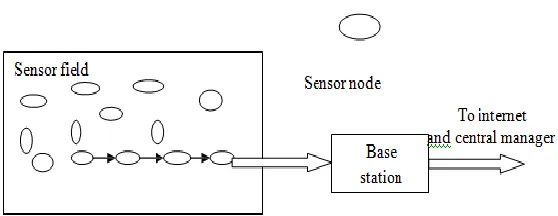
Fig. 1.1: Wireless sensor networks
Nodes are dependent on battery for their power. Hence power conservation and power management is an important issue in wireless sensor network [9]. Due to this reason researchers are focusing on the design of power aware protocols and algorithm for sensors network. In this paper main focus is about analysis battery consumption. A Wireless Sensor Network may consist of multiple sinks which may be mobile or static. If any system has more than one sink, then it can generate the same query into the WSN. For such a system each sink will have its own path developed to the source node which is somehow not required or there can be a way which avoids this. There are some issues in wireless sensor network like network deployment, energy consumption, dynamic changes and unattended operation. Battery consumption is a major issue which degrades the performance of the system. Sensor nodes can use up their limited supply of energy performing computations and transmitting information in a wireless environment but their lifetime is strongly battery dependent and hence energy-conserving forms of communication and computation are essential.
2. Review of Literature
In[1] Kiran Maraiya et.al presented an overview of wireless sensor network, how wireless sensor networks works
© 2014, IJCSMC All Rights Reserved 263
techniques in WSNs based upon metrics such as power management, energy management, network lifetime, optimal cluster head selection, multihop data transmission etc. LEACH forms clusters based on the received signal strength and use the Cluster Head nodes as routers to the base-station. All the data processing such as data fusion and aggregation are local to the cluster. LEACH forms clusters by using a distributed algorithm, where nodes make autonomous decisions without any centralized control. Initially a node decides to be a Cluster Head with a probability p and broadcasts its decision. A node becomes a Cluster Head for the current rotation round if the number is less than the pre-defined threshold. The limitation of this approach is that since the decision to change the Cluster Head is probabilistic, there is a chance that a node with very low energy gets selected as a Cluster Head. When this node dies, the whole cell becomes dysfunctional. Also, the Cluster Head is assumed to have a long communication range so that the data can reach the base-station from the Cluster Head directly. This is not always a realistic assumption since the Cluster Heads are regular sensors and the base-station is often not directly reachable to all nodes due to signal propagation problems, e.g., due to the presence of obstacles. Consequently, it is not applicable to networks deployed in large regions. K. Latif et. al [5],have presented routing technique called Divide-and-Rule which is based on static clustering and minimum distance based Cluster Head selection. Network area is logically divided into small regions (clusters). Old fashioned routing techniques such as LEACH, LEACH-C are not as energy efficient as present day clustering techniques such as Rule scheme. The benefit of Divide-and-Rule scheme is that when it is compared with LEACH and LEACH-C this scheme provides better results in terms of stability period, network life time, area coverage and throughput. But the limitation of this scheme is that during routing each node in Os region sends its data to Primary level Cluster Heads which then forwards the aggregated data to the secondary level Cluster Head present in the Ms. Secondary level Cluster Heads then, aggregate all collected data and forward it to Base Station which will lead to more energy consumption of CH nodes present in the Middle Square and Inner Square regions which may lead to energy hole and may cause data routing problems.
3. Divide and Conquer Scheme
Network area is logically divided into small regions (clusters). The beauty of this technique is the formation of square and rectangular regions, which divides the network field into small regions, as a result the communication distance for intra cluster and inter cluster reduces. It has following Steps:
1. Formation of Regions:
In first step, network is divided into n equal distant concentric squares. Network is divided into three equal distance concentric squares: Internal square (Is), Middle square(Ms) and Outer square(Os).BS is located in the centre of network field therefore; its coordinates are taken as reference point for formation of concentric squares. Division of network field into concentric squares can be obtained from some equations.
2. Cluster Head Selection:
Divide-and-Rule protocol considers multi-hop communication for inter-cluster communication. It has two types of approach that will be followed in it. These are:
1. Primary Cluster Head Selection
2. Secondary Cluster Head Selection
© 2014, IJCSMC All Rights Reserved 264 3. Secondary Level Cluster Head
Steps followed in selection of secondary level CHs are:
(i) CHs in Osregions send data to CHs of exactly one level above adjacent region’s CH. These CHs are also known as secondary level CHs (ii) secondary level CHs aggregate their own cluster nodes data and, data of the primary level CH then, transmit data to BS.
4. Protocol Operation
In setup phase BS divides the network field into small regions, on the bases of their co-ordinates nodes send data directly to BS. In each region one CH is selected per round. CHs of Osregions, select frontneighboring CHs of Ms regions as their next hop CH. Nodes of CR selects, BS or neighboring CHs as theirCH, based on minimum distance [10].
4. Problem Formulation
The communication between sensor node to sink is based upon multi-hop message relay. The batteries of the sensor nodes placed near the sink will exhaust faster as compared to those that are placed far away. This is because nearby sensors are shared by more sensor-to-sink paths, heavier message relay load and therefore consume more energy. Energy depletion causes energy holes which degrade the network performance. Researchers have develop many energy models to give proper explanation but these models still need to be improved. Clustering technique in routing protocols plays a key role to prolong the stability period and lifetime of the network. One of the energy efficient routing protocols for wireless sensor network is Divide and Rule scheme.
© 2014, IJCSMC All Rights Reserved 265
5. Conclusion
Wireless Sensor networks have various types of energy issues. In this paper ,we focused on the divide and conquer scheme to degrade energy consumption problem. It is concluded that energy consumption problem can be reduced using relay nodes in future.
References
[1] K.Maraiya, K. Kant, N. Gupta, “Application based Study on Wireless Sensor Network” International Journal of
Computer Applications (0975 – 8887), Volume 21– No.8, May 2011, 2006.
[2] H. Duboris-Ferries and D. Estrin, “Efficient and Practical Query Scoping in Sensor networks,” Tech
Rep.2004-39, CENS/UCLA Tech Report, 2004.GA 30332, USA Received 12 December 2001; accepted 20 December 2001.
Conference on Ambient Systems, Networks and Technologies (ANT), 2013
[3] K. Maraiya, K. Kant, N. Gupta “Efficient Cluster Head Selection Scheme for Data Aggregation in Wireless Sensor Network” International Journal of Computer Applications, Volume 23-No. 9, June 2011.
[4] S. Tyagi, N. Kumar, “A systematic review on clustering and routing techniques based upon LEACH protocol for wireless sensor networks” Journal of Network and Computer Applications, Volume 36, Issue 2, March 2013. [5] K. Latif, A.Ahmad, N.Javaid, Z.A. Khan, N. Alrajeh, “Divide-and-Rule Scheme for Energy Efficient Routing in Wireless Sensor Networks” 4th International Conference on Ambient Systems, Networks and Technologies (ANT),
2013
[6] I.F. Akyildiz, W. Su, Y. Sankarasubramaniam, E. Cayirci. “Wireless Sensor Networks: A survey” Broadband and Wireless Networking Laboratory, School of Electrical and Computer Engineering, Georgia institute of Technology, Atlanta, 2008
[7] Arun K. Somani, Shubha Kher, Paul Speck, and Jinran Chen “Distributed Dynamic Clustering Algorithm in Uneven Distributed Wireless Sensor Network”, 2004.
[8] Ebin Deni Raj “An Efficient Cluster Head Selection Algorithm for Wireless Sensor Networks – Edrleach”IOSR Journal of Computer Engineering (IOSRJCE), volume 2, Issue 2, pp. 39-44 Aug. 2012.
[9] Vinay Kumar, Sanjeev Jain and Sudarshan Tiwari, “Energy Efficient Clustering Algorithms in Wireless Sensor Networks: A Survey”, IJCSI International Journal of Computer Science Issues, volume 8, Issue 5, No 2, pp. 1694-0814, Sep. 2011.