Performance Analysis Of Optimum Routing Protocols In
Wireless Sensor Networks
Vishnupriya E1, Prof.T.Jayasankar2
1
M.E., Communication Systems
2
Assistant Professor(ECE Department)
1,2
Anna University,Trichy
Abstract
Sensor nodes are in the role of gathering the sensed information in an energy efficient manner is critical to operate the sensor network for a long period of time. However, the characteristics of wireless sensor network require more effective methods for data forwarding and processing. Routing protocols for wireless sensor networks are responsible for maintaining the routes in the network and have to ensure reliable multi-hop communication. The aim of the proposed work to compare the performance of optimum routing protocols in WSNs in terms of packet delivery ratio, throughput, end to end delay, average delay. The optimum routing protocols are such as LEACH,PEGASIS,APTEEN and AOMDV routing protocols. In QoS based routing protocols data delivery ratio, latency and energy consumption are mainly considered. To get a good QoS (Quality of Service), the routing protocols must maintain more data delivery ratio, less latency and less energy consumption. Here, achieved the better performance routing protocol.
Keywords:
LEACH,PEGASIS,APTEEN,AOMDV, Packet delivery ratio, Throughput, End to end delay andAverage delay.
1. Introduction
A sensor network is a network of many tiny disposable low power devices, called nodes, which are spatially distributed in order to perform an application-oriented global task. These nodes form a network by communicating with each other either directly or through other nodes. One or more nodes among them will serve as sink(s) that are capable of communicating with the user either directly or through the existing wired networks. The primary component of the network is the sensor, essential for monitoring real world physical conditions such as sound, temperature, humidity, intensity, vibration, pressure, motion, pollutants etc. at different locations. The tiny sensor nodes, which consist of sensing, on board processor for data processing, and communicating components, leverage the idea of sensor networks based on collaborative effort of a large number of nodes[3]. The basic goals of a WSN are to: determine the value of physical variables at a given location, detect the occurrence of events of interest, and estimate parameters of the detected event or events, classify a detected object and track an object. Thus, the important requirements of a WSN are: use of a large number of sensors, attachment of stationary sensors, low energy consumption, self organization capability, collaborative signal processing and querying ability[3].
In the recent past, wireless sensor networks have found their way into a wide variety of applications and systems with vastly varying requirements and characteristics. The sensor networks can be used in Disaster Relief, Emergency Rescue operation, Military, Habitat Monitoring, Health Care, Environmental monitoring, Home networks, detecting chemical, biological, radiological, nuclear, and explosive material etc.
Here, we are going to discuss about the architecture of WSN, classifications of routing protocols, related work on the routing protocols and optimum routing protocols.
2. Architecture Of Wireless Sensor Network
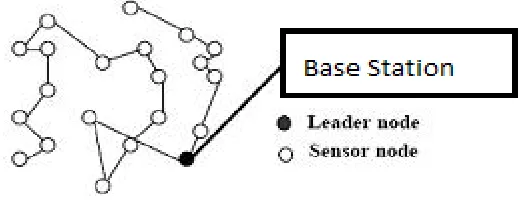
The architecture of a generic Wireless Sensor Network, and examine how the clustering phenomenon is an essential part of the organizational structure.
Figure 1. Architecture of Wireless Sensor Network
Sensor Node: A sensor node is the core component of a WSN. Sensor nodes can take on multiple roles in a network, such as simple sensing, data storage, routing and data processing.
Clusters: Clusters are the organizational unit for WSNs. The dense nature of these networks requires the need for them to be broken down into clusters to simplify tasks such a communication.
Cluster heads: Cluster heads are the organization leader of a cluster. They often are required to organize activities in the cluster. These tasks include but are not limited to data-aggregation and organizing the communication schedule of a cluster.
Base Station: The base station is at the upper level of the hierarchical WSN. It provides the communication link between the sensor network and the end-user. It act as a gateway between sensor nodes and the end user as they typically forward data from the WSN on to a server.
3. Related Work
Hierarchical routing protocols greatly increase the scalability of a sensor network. The overall energy consumption of the nodes is reduced, leading to prolonged network lifetime. Cluster -based routing holds great promise for many-to-one and one-to-many communication paradigms that are prevalent in sensor networks. Data routing in sensor networks and classified the approaches into three main categories, namely data-centric, hierarchical and location-based. Few other protocols followed the traditional network flow and QoS modeling methodology. Sensor network nodes are limited with respect to energy supply, restricted computational capacity and communication bandwidth. To prolong the lifetime of the sensor nodes, designing efficient routing protocols is critical. Even though sensor networks are primarily designed for monitoring and reporting events, since they are application dependent, a single routing protocol cannot be efficient for sensor networks across all applications.
4. Classification Of Routing Protocols In WSN
Routing in wireless sensor networks differs from conventional routing in fixed networks in various ways. There is no infrastructure, wireless links are unreliable, sensor nodes may fail, and routing protocols have to meet strict energy saving requirements. Many routing algorithms were developed for wireless networks in general[5]. Routing protocols are classified as Node Centric, data- centric or location- aware ( Geo- centric) and Qos based routing protocols. Most Ad-hoc network routing protocols are node-centric protocols where destinations are specified based on the numerical addresses (or identifiers) of nodes. Node-centric communication is not most expected communication type in WSNs. Therefore, routing protocols designed for WSNs are more data-centric or Geo-centric.
In data-centric routing, the sink sends queries to certain regions and waits for data from the sensors located in the selected regions. Here data is usually transmitted from every sensor node within the deployment region with significant redundancy. In location aware routing nodes know where they are in a geographical region. Location information can be used to improve the performance of routing and to provide new types of services. In QoS based routing protocols data delivery ratio, latency and energy consumption are mainly considered. To get a good QoS (Quality of Service),the routing protocols must maintain more data delivery ratio, less latency and less energy consumption. In Flat routing protocols all nodes in the network are treated equally. When node needs to send data, it may find a route consisting of several hops to the sink.
5. Performance Analysis In Optimum Routing Protocols
destination. This illustrates the level of delivered data to the destination.
6. Optimum Routing Protocols
6.1. LEACH (Low Energy Adaptive Clustering Hierarchy)
All the networks have a certain lifetime during which nodes have limited energy by using that, the nodes gather, process, and transmit information. This means that all aspects of the node, from the sensor module to the hardware and protocols, must be designed to be extremely energy-efficient. Decreasing energy usage by a factor of two can double system lifetime, resulting in a large increase in the overall usefulness of the system. In addition, to reduce energy dissipation, protocols should be robust to node failures, fault-tolerant and scalable in order to maximize system lifetime[4].
LEACH is the first network protocol that uses hierarchical routing for wireless sensor networks to increase the life time of network. All the nodes in a network organize themselves into local clusters, with one node acting as the cluster-head. All non-cluster-head nodes transmit their data to the cluster-head, while the cluster-head node receive data from all the cluster members, perform signal processing functions on the data (e.g., data aggregation), and transmit data to the remote base station. Therefore, being a cluster-head node is much more energy-intensive than being a non-cluster-head node. Thus, when a cluster-head node dies all the nodes that belong to the cluster lose communication ability.
CH Node
Sensor Node
Figure 2. LEACH protocol
LEACH incorporates randomized rotation of the high-energy cluster-head position such that it rotates among the sensors in order to avoid draining the battery of any one sensor in the network. In this way, the energy load associated with being a cluster-head is evenly distributed among the nodes. Since the cluster-head node knows all the cluster members, it can create a TDMA schedule that tells each node exactly when to transmit its data. In addition, using a TDMA schedule for data transfer prevents intra-cluster collisions. The operation of LEACH is divided into rounds. Each round begins with a set-up phase when the clusters are organized, followed by a steady-state phase where several frames of data are transferred from the nodes to the cluster-head and onto the base station.
Figure 3. LEACH protocol process
Here no long-distance communication with the base station is required and distributed cluster formation can be done without knowing the exact location of any of the nodes in the network. In addition, no global communication is needed to set up the clusters[8]. Finally, the cluster-head nodes should be spread throughout the network, as this will minimize the distance the non-cluster-head nodes need to send their data.
The steady-state operation is broken into frames where nodes send their data to the cluster-head at most once per frame during their allocated transmission slot. The set-up phase does not guarantee that nodes are evenly distributed among the cluster head nodes. Therefore, the number of nodes per cluster is highly variable in
LEACH, and the amount of data each node can send to the cluster-head varies depending on the number of nodes in the cluster. To reduce energy dissipation, each non-cluster-head node uses power control to set the amount of transmits power based on the received strength of the cluster-head advertisement. The cluster-head must keep its receiver on to receive all the data from the nodes in the cluster. Once the cluster-head receives all the data, it can operate on the data and then the resultant data are sent from the cluster-head to the base station.
6.2. PEGASIS (Power Efficient Gathering Sensor Information System)
The main idea in PEGASIS is for each node to receive from and transmit to close neighbors and take turns being the leader for transmission to the BS. In constructing the chain, it is possible that some nodes may have relatively distant neighbors along the chain. Such nodes will dissipate more energy in each round compared to other sensors. Whenever a node dies, the chain will be reconstructed and the threshold can be changed to determine which nodes can be leaders.
Figure 4. PEGASIS
PEGASIS improves on LEACH by saving energy in several stages. First, in the local gathering, the distances that most of the nodes transmit are much less compared to transmitting to a cluster-head in LEACH. Second, the amount of data for the leader to receive is at most two messages instead of 20 (20 nodes per cluster in LEACH for a 100-node network). Finally, only one node transmits to the BS in each round of communication. Data aggregation occurs at all node in the sensor network to pervade all important information across the network. In PEGASIS in spite of multiple nodes only one node in a chain transmit data to the BS. It increases the network life time, when all nodes take turns in communicating with the BS and node communicate only with their nearby neighbors. It reduces the power required to send data per round as the energy draining is spread equally among all nodes. In, PEGASIS energy conservation is achieved in two ways:
1. The head node receives at most two data messages.
2. The distance over which the data are transmitted to closest neighbor is much smaller.
Distributing the energy load among the nodes increases the lifetime and quality of the network[1]. PEGASIS performs better than LEACH by about 100 to 300% when 1%, 20%, 50%, and 100% of nodes die for different network sizes and topologies.
6.3. APTEEN (Adaptive Threshold Sensitive Energy Efficient Sensor Network Protocol)
The Adaptive Threshold Sensitive Energy Efficient Sensor Network Protocol (APTEEN) is an extension of TEEN and objective to both capturing periodic data collections and reacting to time crucial events. The architecture of APTEEN is same as in TEEN. In APTEEN once the cluster heads are decided, in each cluster duration, the cluster head broadcasts the parameter such as attributes, threshold, schedule and count time to all nodes. The performance of APTEEN lies between TEEN and LEACH in terms of energy consumption and durability of the network. While sensing the environment, TEEN only transmits time crucial data. APTEEN makes an improvement over TEEN by supporting periodic report for time crucial events.
(i) Historical query: To analyze past data values,
(ii) One-time query: To take a snapshot view of the network; (iii) Persistent queries: To monitor an event for a period of time.
Figure 5. Hierarchical clustering of TEEN and APTEEN
In APTEEN once the CHs are decided, in each cluster period, the cluster head first broadcasts the following parameters[2]:
Attributes(A): This is a set of physical parameters which the user is interested in obtaining data about.
Thresholds: This parameter consists of a hard threshold (HT) and a soft threshold (ST). HT is a particular value of an attribute beyond which a node can be triggered to transmit data. ST is a small change in the value of an attribute which can trigger a node to transmit data again.
Schedule: This is a TDMA schedule similar to the one used, assigning a slot to each node.
Count Time(TC): It is the maximum time period between two successive reports sent by a node. It can be a multiple of the TDMA schedule length and it accounts for the proactive component. In a sensor network, close-by nodes fall in the same cluster, sense similar data and try to send their data simultaneously, causing possible collisions. The main features of our scheme are :
1. By sending periodic data, it gives the user a complete picture of the network. It also responds immediately to drastic changes, thus making it responsive to time critical situations. Thus, It combines both proactive and reactive policies.
2. It offers a flexibility of allowing the user to set the time interval (TC) and the threshold values for the attributes.
3. Energy consumption can be controlled by the count time and the threshold values.
4. The hybrid network can emulate a proactive network or a reactive network, by suitably setting the count time and the threshold values. The main drawback of this scheme is the additional complexity required to implement the threshold functions and the count time. However, this is a reasonable trade-off and provides additional flexibility and versatility.
6.4. AOMDV (Ad-Hoc On-Demand Multipath Distance Vector Routing Protocol)
control packets (i.e. RREQs, RREPs and RERRs) constitute the only additional overhead in AOMDV relative to AODV.
First, it does not have high inter-nodal coordination overheads. Second, it ensures disjointness of alternate routes via distributed computation without the use of source routing. Third, AOMDV computes alternate paths with minimal additional overhead over AODV, it does this by exploiting already available alternate path routing information as much a possible. AOMDV shares several characteristics with AODV. It is based on the distance vector concept and uses hop-by-hop routing approach. In AOMDV, RREQ propagation from the source towards the destination establishes multiple reverse paths both at intermediate nodes as well as the destination. Multiple RREPs traverse these reverse paths back to form multiple forward paths to the destination at the source and intermediate nodes. AOMDV also provides intermediate nodes with alternate paths as they are found to be useful in reducing route discovery frequency. The core of the AOMDV protocol lies in ensuring that multiple paths discovered are loop-free and disjoint, and in efficiently finding such paths using a flood-based route discovery. AOMDV route update rules, applied locally at each node, play a key role in maintaining loop-freedom and disjointness properties.
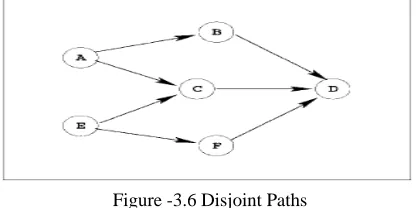
AOMDV can be used to find node-disjoint or link-disjoint routes. To find node-disjoint routes, each node does not immediately reject duplicate RREQs[8]. Each RREQs arrive in via a different neighbor of the source defines a node disjoint path. This is because nodes cannot be broadcast duplicate RREQs, so any two RREQs arriving at an intermediate node vie a different neighbor of source could not have traversed the same node.
Figure -3.6 Disjoint Paths
Paths maintained at different nodes to a destination may not be mutually disjoint[9]. Here D is the destination. Node A has two disjoint paths to D: A – B – D and A – C – D. Similarly, node E has two disjoint paths to D: E – C – D and E – F – D. But the paths A – C – D and E – C – D are not disjoint; they share a common link C – D. AOMDV protocol describe in four components: routing table, route discovery, route maintenance and data packet forwarding.
6.4.1. Routing table
AOMDV route table entry has a new field for the advertised hop count. Besides a route list is used in AOMDV to store additional on formation for each alternate path including: next hop, last hop, hop count and expiration timeout. Last hop information is useful in checking the disjointness of alternate paths.
6.4.2. AOMDV route discovery
A reverse path is always formed when the first hop is unique. However, as in regular AODV, only the first copy of the RREQ is forwarded. Thus there is no additional routing overhead. All these reverse paths can be used to propagate multiple RREPs towards the source so that multiple forward paths can be formed.
It replies up to copies of RREQ arriving via unique neighbors, disregarding the first hops of these RREQs. Unique neighbors guarantee link disjointness in the first hop of the RREP. Beyond the first hop, the RREP follows the reverse route that have been set up already which are node disjoint (and hence link disjoint). Each RREP arriving at an intermediate node takes a different reverse route when multiple routes are already available. Suppose, the second copy of RREQ is transmitted over the dotted link. AODV ignores it. But AOMDV forms a reverse path through the previous hop. Either protocol does not forward the second copy.
Route maintenance in AOMDV uses RERR (Route Error) packets. When link breaks it then creates a RERR message, in which it lists each of these lost destination. The node sends the RERR upstream towards the source node. If there are multiple previous hops that were utilizing this link, the node broadcasts the RERR; otherwise, it is unicast. When a node receives a RERR, it first checks whether the node that sent the RERR is its next hop to any of the destination listed in the RERR. If the sending node is the next hop to any of these destination, the node invalidates these route table and then propagates the RERR back towards the source. The RERR continues to be forwarded in this manner until it is received by the source. Once the source receives the RERR, it can re-initiate route discovery if it still requires the route.
6.4.4. Data Packet Forwarding
For data packet forwarding at a node having multiple paths to a destination. In other alternative , alternate paths are used simultaneously for load balancing where data packets are distributed over the available paths, thereby improving the network utilization and end-to-end delay.
7. Optimum Routing Protocols Simulation Results
8. Conclusion And Future Work
To maximize the network life time optimal cluster head selection is important. CHs require more energy than all other nodes because they perform processing, sensing, communication and aggregation. To obtain optimal cluster head, CH should be elected based on the residual energy of each and every node. PEGASIS gives a better improvement in throughput and network lifetime compared to LEACH. From the results, the PEGASIS routing protocols has the high throughput and packet delivery ratio than the other protocols. Therefore energy efficiency is maximized & network lifetime is also prolonged. The future work of this project is secured data transmission in optimum routing protocols. without affecting the throughput and packet delivery ratio, the secure data transmission is the future work.
REFERENCES
[1] Jalil Jabari lotf and Mehran Hosseinzadch . (2010), 'Hierarchical routing in wireless sensor networks: A survey 'IEEE, v3-650.
[2] Kemal Akkaya and Mohamed Younis . (2003),'A survey of routing protocols for wireless sensor
networks '.
[3] Rajashree.V.Biradar , V.C .Patil ,'Classification and comparison of routing protocols In wireless sensor networks ',Ubicc Journal, volume 4.
[4] Jenn-Long Liu and Chinya V. Ravishankar . (2011),'LEACH-GA: Genetic Algorithm-Based Energy-Efficient Adaptive Clustering Protocol for Wireless Sensor Networks 'IEEE,vol 1.
[5] Shio Kumar Singh , M P Singh, and D K Singh .(2010),'Routing Protocols in Wireless Sensor Networks ' A IJCSES, vol.1, No-2.
[6] Stephanie Lindsey and Cauligi S. Raghavendra ,'PEGASIS: Power-Efficient GAthering in Sensor Information Systems'.
[7] Dheeraj Ritu Mishra .(2014),'Review Paper on Hierarchal Energy- Efficient Protocols in Wireless Sensor Networks', IJARCSSE,Vol.4, Issue-6.
[8] Amareswara Kumar Pullama, Shiva Vishnu B,Mohan Reddy.(2013),' Energy Efficient Routing in Wireless sensor Network, IJETAE,Vol.3, Issue-9.
[9] Mrs. Poonam Meghare, Prof. Preeti Deskhmukh . (2014),'Packet Forwarding using AOMDV Algorithm in WSN, IJAIEM,Vol.3,Issue-5.
[10] Lourthu Hepziba Mercy.M, Balamurugan.K, Vijayaraj.M .(2013),'Maximization of Lifetime and Reducing Power Consumption in Wireless Sensor Network Using Protocol', IJSCE, Vol.2,Issue-6.
[11] Vipin Pal, Girdhari Singh, Rajender Prasad Yadav .(2012),'SCHS: Smart Cluster Head Selection Scheme for Clustering Algorithms in Wireless Sensor Networks ', SciRes.
[13] Tintu Devasia, Gopika S .(2013),'Statistical Analysis of Energy Efficient Hierarchical Routing Protocols in WSN',IJARCCE, Vol.2,Issue-5.
[14] Meena Malik, Dr. Yudhvir Singh , Anshu Arora .(2013),'Analysis of LEACH Protocol in Wireless Sensor Networks',IJARCE,Vol.3,Issue-2.
[15] Chunyao FU, Zhifang JIANG, Wei WEI2and Ang WEI .(2013),'An Energy Balanced Algorithm of LEACH Protocol in WSN', IJCSI,Vol.10,Issue-1.