R Color Based Fire Detection in Video’s using
ANN
V.S.Kulkarni
1, S.E.Memane
2Assistant professor, Dept. of ETC, SKN College of Engineering, Pune, India1
PG Student [VLSI & Embedded System], Dept. of ETC, SKN College of Engineering, Pune, India2
ABSTRACT:Now-a-days Fire detection technology is becoming important point of research with its fire recognition rate and increase in accuracy, speed, required computational rate and storage memory. The fire detection system proposed use of optical flow based fire detection algorithm for fire features extraction and detecting motion area using supervised machine-learning-based neural network training. The system gives good results of fire detection when tested on a large video database to know their practical usefulness and detection rate. Little false detections are observed in presence of smoke, significant noise, motion of non-fire objects and small-steady fire. Then further system performance with the accuracy in detection can be improved with the development of optical flow estimators with the improvement in algorithm and increase the robustness to noise and rejects those fire pixels looks like fire but actually not a fire.
KEYWORDS: Optical flow, Feature extraction, artificial neural network classification
I.INTRODUCTION
Detecting of fire at the initial stage is important for the prevention of material and environmental damage as well as human loss. Previously microelectronics, sensor based technologies were used for the understanding characteristics of fire. In sensor-based system, it is not possible to cover large area in outdoor applications such as forest. They cannot be used in open spaces and large coverage areas. Therefore, video fire detection systems are useful, where point sensors may leads to failure in detection. Fire behaviour is observed by various spatio-temporal features such as flickering, salt and paper noise, spatial and spatiotemporal energy. Recently many new fire technologies and concepts have been developed such as spatio-temporal flame modelling and dynamic texture analysis and the optical flow estimation algorithm for fire recognition and detection. Early smoke and fire detection in images and video’s is particularly applicable in industrial monitoring and surveillance. Optical flow algorithms (OMT and NSD) are very complex and computational rate, memory resources required are high. Therefore, the proposed system is a new video based fire detection system that uses optical flow features calculated from optical flow motion vectors. The optical flow or optic flow is the pattern of apparent motion of objects, surfaces, and edges in a testing video frame caused by the relative motion between the user who observes (an eye or a camera) and the scene. Optical flow and motion estimation try to calculate the motion between two image frames. Optical flow color based fire detection algorithm is used for feature vector creation and feature extraction. The classification involves training of input frames which makes use of supervised-machine-learning algorithm of back propagation of neural network. The creation of optical flow motion vectors is important part of system that is used to estimate the amount of motion undergone by an object while moving from one frame to another of the same video.
II.
LITERATURE SURVEYGeorge Hadjisophocleous, Jun Ouyang and Zhigang Liu proposed smoke/flame detection system [1] called as The AlarmEye VID system. Video processing and alarm algorithm executions are performed at the detector working independently. Eight video cameras are connected together to form a centralized detection system. It can be processed in a single computer unit. Then AlarmEye detector can be used in a test series which consists of one infrared camera, one color camera, one infrared light source, image capture and pre-processing unit and digital image processor (DSP). Additionally, optical flame sensor can be combined with the detector.
foreground object contains fire or not. The output of the both stages is analyzed in consecutive frames which is the verification process of fire that uses the fact that fire never stays stable in visual appearance.
Many systems such as Multi-sensor Network System, Sequential pattern technology for visual fire detection, Satellite-Based Systems, Signal Processing and Monitoring Technology, Integrated Fire Detection System were exist and used previously for fire and smoke detection giving good results. But many cases it was observed that these systems fail or not able to work due to different reasons. Due to the regular distribution requirements of sensors in close proximity in a sensor-based fire detection system, it is not possible to cover large areas in outdoor applications [3]. Traditional point based sensors for heat or smoke detection will detect the presence of fire only if the particles produced as a result of combustion reach the sensors.
III.
THE PROPOSED SYSTEMA. Block diagram
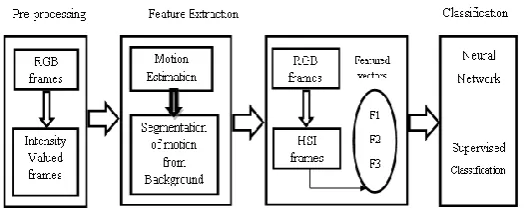
Figure 1 shows the block diagram of overall proposed work. The proposed system is a new video based fire detection system that makes use of optical flow. The proposed system includes following three steps:
1. Preprocessing
Pre-processing steps includes removing low-frequency background noise, salt and paper noise, reflections, flickering and masking portions of images. Also it involves normalizing the intensity of the individual particles images. Image pre-processing is the technique that enhances the data images prior to computational pre-processing. Also color transformation is involved in the pre-processing. First, it reads the Input Video and then randomly selects any one of the frame in that video. Then it converts that selected frame into gray-scale images in the process of the module and then feature processing with segmentation and classification is continued to the next modules.
Fig. 1: Block Diagram of the Proposed System
2. Feature Extraction using color feature based algorithm
A feature is defined as an "interesting" point of an image, and features are used as start to implement many concepts computer vision algorithms. Though features are used as the starting point and main primitives for computer vision algorithms, the overall algorithm will often only be as good as its feature detector in system. In image processing, feature extraction starts from an initial set of measured data in a database and builds derived values (features). It gives subsequent learning and generalized steps which are informative and non-redundant. Feature extraction is related to dimensionality reduction in an image. For feature extraction simple color based feature extraction algorithm is used. When large no. of input frames are given to the algorithm and processed time is large or pixels in the images are repeated, then it is converted into a reduced set of features called as feature vector and process is called feature extraction. The extracted features include the useful information from the input images. Therefore, desired task can be done by using reduced set of image characteristics instead of the complete initial input. Feature Extraction block involves motion estimation, creation of objects for optical flow, thresholding and median filtering, morphological operations. To reduce complexity, candidate fire regions are determined through color classification. Here, RGB and HSV two color space are used to detect the fire color pixels are present or not in an image.
3. Neural network Classification.
computationally and mathematically convenient to process. However, real-world data is usually redundant, highly variable and complex. Therefore for real videos, images and sensor measurement, it is on priority to discover useful features or representations from raw data.
Classification algorithms use the computed features as input and make decision outputs regarding the target’s presence. Supervised machine-learning-based classification algorithms such as Neural Network (NN) are systematically trained on data set of features and system feature. Training using the back-propagation [5] neural network involves a non-linear regression in the feature space. It is good to separate the labeled training data into classes, such as fire or non-fire. Also, by improving algorithm one can do separation into smoke and non-smoke classes. In the testing phase, a feature vector is supplied and the output is a probability that the feature vector is associated with a particular class. The simplest way of classifying a candidate region based on its feature vector F = (f1, f2, f3)T is to threshold each of the features fi based on heuristically determined cut-off values and make a decision by majority voting.
IV.RESULTS AND DISCUSSION
The characteristic fire features are related to the flow magnitudes and directions are computed from the flow fields to discriminate between fire and non-fire motion. The proposed system gives better results of fire detection when tested on a large video database to demonstrate their practical usefulness. It is observed that, fire is not detected for any for a single frame as fire is too small and also due to slight impact of sunlight. Therefore system gets failed and will not be useful for small detection area and fire. Also system gets failed due to large smoke which is whitish black as system algorithm is based on color features. Use of Neural network models gives better computational performance and stability, energetic efficiency.
1. Neural Network Results and Graphs:
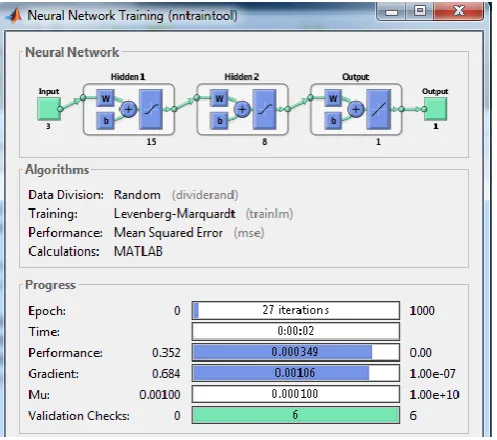
To define neural network, neural object is used to store all the information in neural network toolbox software. Levenberg-Marquardt algorithm is used for training purpose. “trainlm” is a network training function that gives weight and bias values according to optimization. It is the fastest back-propagation algorithm in the neural network toolbox. It requires more memory than other algorithms still it is first choice for supervised-machine-learning algorithm.
Following window shown in fig. 2 describes that “dividerand” function is used to divide the data and the Levenberg-Marquardt training method is used with the mean square error performance function.
Fig. 2 Neural Network Training Window
magnitude, the number of validation checks, etc. The error histogram plot shows the distribution of the network errors. The regression plot shows a regression between network outputs and network targets.
(A) (B)
Fig. 3 Graphs of Neural Network (A) Neural Network Performance Plot (B) Neural Network Training State Plot
1. Fire Detection Output:
a. Case1 for Video1.avi:
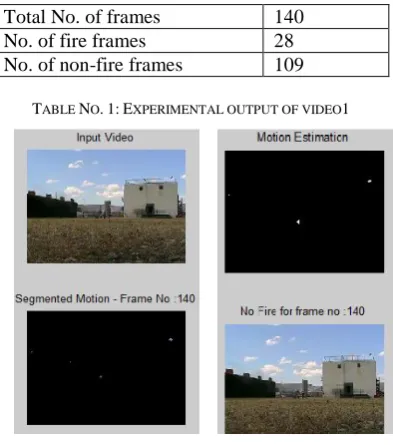
Fig. 3 shows Experimental output of video1-case1. Minimum four frames are required for fire feature extraction and detection. In this case fire is not detected for any for a single frame as fire is too small and also due to slight impact of sunlight. Therefore system gets failed and will not be useful for small detection area and fire.
No. of frames fire and non-fire frames for this video is shown in table1 as below:
Total No. of frames 140 No. of fire frames 28 No. of non-fire frames 109
TABLE NO.1:EXPERIMENTAL OUTPUT OF VIDEO1
Fig. 4 Experimental output of video1 (a) Original Video files (b) Motion Estimation in video (c) Segmented motion (d) Output detection at the original video
Fire present in video1 is small with smoke. System is unable to detect small fire in most of the frames.
b. Case1 for Video2.avi:
Fig. 5 Experimental output of video2-case1 (a) Original Video files (b) Motion Estimation in video (c) Segmented motion (d) Output detection at the original video
Fire gets detected for frame no. 125 due to motion of fire estimated using optical flow i.e. shown above in Fig 5(d).
c. Case2 for Video2.avi:
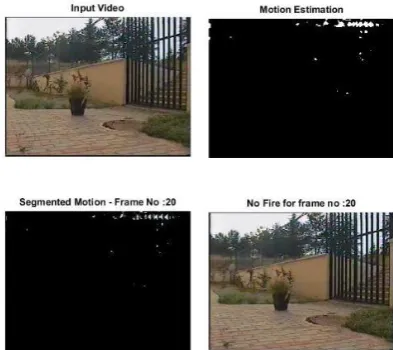
Fig. 6 Experimental output of video2-case2 (a) Original Video files (b) Motion Estimation in video (c) Segmented motion (d) Output detection at the original video
In experimental results shown above in Fig. 6(d), system failed due to small and steady fire for frame no. 20 for the same video2.
No. of frames fire and non-fire frames for this video is shown in table below:
Total No. of frames 708 No. of fire frames 663 No. of non-fire frames 45
TABLE NO.2:EXPERIMENTAL OUTPUT OF VIDEO2
d. Case1 for Video3.avi:
Total No. of frames 208 No. of fire frames 207 No. of non-fire frames 1
TABLE NO.2:EXPERIMENTAL OUTPUT OF VIDEO3
Fire gets detected for frame no. 20 due to motion of fire and optical flow algorithm works as shown in fig. 7(d).
Fig. 7: Experimental output of video2 (a) Original Video files (b) Motion Estimation in video (c) Segmented motion (d) Output detection at the original video
V.CONCLUSION
The proposed system uses optical flow algorithm for motion estimation and fire feature based fire detection using supervised machine-learning-based algorithm. The characteristic fire features are related to the flow magnitudes and directions are computed from the flow fields to discriminate between fire and non-fire motion. The proposed system gives better results of fire detection when tested on alarge video database to demonstrate their practical usefulness. Little false detections are observed in presence of significant noise, motion of non-fire objects and rapid angle change. Further system performance can be improved with development of optical flow estimators with improved robustness to noise and rejects those fire pixels looks like fire but actually not a fire. The enhanced system is performing well than the existing system in terms of detection rate.
VI.ACKNOWLEDGMENT
The author would like to express his sincere thanks to his Head of Department Dr. S.K. Shah for her valuable references and support throughout the seminar work. The author would also like to thank Prof. V.S. Kulkarni for their support, co-operation and valuable suggestions.
The author would be grateful to his Principal, Dr. A.V. Deshpande and Vice Principal, Dr. K.R. Borole for their encouragement and guidance throughout the course.
Also author would express his sincere thanks to all teaching and non-teaching staff of Electronics and Telecommunication department in Smt. Kashibai Navale College of Engineering- Pune, for their help.
REFERENCES
[1] K George Hadjisophocleous, Jun Ouyang and Zhigang Liu, “ Study of Video Image Fire Detection Systems for Protection of Large Industrial Applications and Atria”, 2012 Carleton University, Ottawa, ON, Canada.
[2] T. Celik, H. Demirel, H. Ozkaramanli, M. Uyguroglu, “Fire Detection In Video Sequences Using Statistical Color Model” 2006 IEEE Department of Electrical and Electronic Engineering, Eastern Mediterranean University, ICASSP 2006.
[3] I. Bosch, A. Serrano, and L. Vergara, “Multisensor Network System for Wildfire Detection Using Infrared Image Processing”, Hindawi Publishing Corporation, the Scientific World Journal, Volume 2013.
[4] Jayant Kumar Basu, DDebnath Bhattacharya, Tai-hoon Kim, Use of artificial neural network in pattern recognition, International Journal of Software Engineering and Its Applications, Vol. 4, No. 2, April 2010.