i
EFFECTS OF SOCIO-ECONOMIC FACTORS ON PUPILS
PERFORMANCE IN KENYA CERTIFICATE OF PRIMARY
EDUCATION IN CHUKA DIVISION, THARAKA-NITHI
COUNTY, KENYA
JACKSON MUCHUNKU
E55/CE/11131/2008
A RESEARCH PROJECT SUBMITTED TO THE DEPARTMENT OF EDUCATIONAL MANAGEMENT, POLICY AND CURRICULUM STUDIES IN PARTIAL FULFILMENT OF THE REQUIREMENTS FOR THE AWARD
OF MASTER OF EDUCATION ADMINISTRATION DEGREE OF KENYATTA UNIVERSITY
ii
DECLARATION
This research project is my original work and has not been presented for a degree in any other University.
JACKSON MUCHUNKU DATE
E55/CE/11131/2008
This project has been submitted for examination with our approval as University supervisors.
DR. FLORENCE M. ITEGI DATE
Lecturer,
Department of Educational Management, Policy and Curriculum Studies,
Kenyatta University
DR. FELICITA W. NJUGUNA DATE
Lecturer,
Department of Educational Management, Policy and Curriculum Studies,
iii
DEDICATION
iv
ACKNOWLEDGEMENTS
I sincerely thank the almighty God who has given me good mental health to undertake and accomplish this task.
My gratitude goes to Dr. F. Itegi and Dr. F. W. Njuguna my supervisors for their encouragement, guidance and inspiration at all levels in the preparation of this project. Their professional suggestions and comments assisted me to complete this work. I must extend special thanks to all the lecturers who taught me during the coursework. Collectively, your efforts and expertise have given me a rudimentary look into their world.
I sincerely thank and appreciate my respondents for providing me with the required information without which this work would not have been completed. They included head teachers, teachers and pupils in Chuka division, the locality in which I carried out my research.
I am greatly indebted to my loving wife, Beatrice for her moral support in the course of my studies. Her love and support mean everything to me. I thank her always for believing in me and encouraging me to do my best. This proves that together we can do anything.
v
TABLE OF CONTENTS
Page
DECLARATION ... ii
DEDICATION ... iii
ACKNOWLEDGEMENTS ... iv
TABLE OF CONTENTS ... v
LIST OF TABLES ... viii
LIST OF FIGURES ... ix
ABBREVIATIONS AND ACRONYMS ... x
ABSTRACT ... xi
CHAPTER ONE:INTRODUCTION ... 1
1.1 Background to the Study ... 1
1.2 Statement of the Problem ... 5
1.3 Purpose of the Study ... 6
1.4 Objectives of the Study ... 6
1.5 Research Questions ... 7
1.6 Significance of the Study ... 7
1.7 Assumptions of the Study ... 8
1.8 Scope of the Study ... 8
1.9 Limitations of the Study... 8
1.10 Theoretical framework of the Study ... 9
1.11 Conceptual framework of the study ... 11
1.12 Operational Definition of Terms ... 13
CHAPTER TWO:LITERATURE REVIEW ... 14
2.1 Introduction ... 14
2.2 Social and Cultural Factors Affecting Performance ... 14
2.3 Effect of School Type on Academic Achievement... 15
2.4 Effect of Parents Income and Occupation on Pupil’s Academic Achievement ... 16
2.5 Effect of Family Background on Pupil’s Academic Achievement ... 20
vi
CHAPTER THREE:METHODOLOGY ... 28
3.1 Introduction ... 28
3.2 Research Design... 28
3.3 Study Area ... 28
3.4 Target Population ... 29
3.5 Sampling Procedure and Sample Size ... 29
3.6 Research Instruments ... 30
3.6.1 Questionnaire ... 30
3.6.2 Document Review ... 31
3.7 Piloting ... 31
3. 7.1 Validity of the Research Instrument ... 32
3. 7.2 Reliability of the Research Instrument ... 32
3.8 Data Collection Procedures ... 33
3.9 Data Analysis ... 33
3.10 Ethical Considerations ... 34
CHAPTER FOUR:RESULTS AND DISCUSSION ... 35
4.1 Introduction ... 35
4.2 Response Rate ... 36
4.3 Socio-Demographic Characteristics of the Respondents ... 36
4.3.1 Gender Distribution of the Respondents ... 36
4.3.2 Age Distribution of the Respondents ... 39
4.3.3 Teachers Years of Service ... 40
4.3.4 Academic Qualifications ... 41
4.4 Social Factors Affecting Pupil’s Performance in KCPE ... 43
4.5 Economic Factors Affecting Pupil’s Performance in KCPE ... 45
4.6 Cultural Factors Affecting Pupil’s Performance in KCPE ... 62
vii
CHAPTER FIVE: SUMMARY, CONCLUSION AND
RECOMMENDATIONS ... 67
5.1 Introduction ... 67
5.2 Summary of the Study ... 67
5.2.1 Social Factors Affecting Pupils Performance in KCPE in Chuka Division ... 67
5.2.2 Economic Factors Affecting Pupils Performance in KCPE In Chuka Division ... 67
5.2.3 Cultural factors affecting pupils performance in KCPE in Chuka division ... 68
5.2.4 Measures to Improve Pupil’s Performance in KCPE ... 69
5.3 Conclusion ... 69
5.4 Recommendations ... 70
5.5 Suggestions for Further Research ... 71
REFERENCES ... 72
APPENDICE ... 79
APPENDIX I: LETTER TO THE SCHOOL HEAD TEACHER ... 79
APPENDIX II: QUESTIONNAIRE FOR TEACHERS ... 80
APPENDIX III: QUESTIONNAIRE FOR PUPILS ... 87
APPENDIX IV: DOCUMENT ANALYSIS ... 94
APPENDIX V: LETTER OF APPROVAL FOR RESEARCH ... 95
APPENDIX VI: RESEARCH AUTHORIZATION ... 96
viii
LIST OF TABLES
Table 3.1: Sampling Matrix ... 30
Table 4.1: Gender Distribution of Respondents ... 37
Table 4.2: Age Distribution of Pupils ... 39
Table 4.3: Teachers Years of Service ... 40
Table 4.4: Teachers’ Academic Qualification ... 42
Table 4.5: Responses on Social Factors Affecting Pupils Academic Performance . 43 Table 4.6: Pupils Distribution of Marks in Five Joint Evaluation Tests year 2013 . 45 Table 4.7: Breakdown of Social Classes According to Scores on Measures of Social Economic Status ... 46
Table 4.8: Correlation between Parental SES and Pupil Performance ... 47
Table 4.9: Family Member’s Education Background ... 48
Table 4.10: Details of Parents Occupation ... 52
Table 4.11: Parents Income and Related Aspects According to Their Children ... 55
Table 4.12: School Characteristics ... 59
Table 4.13: Multiple Regression Coefficients (β-coefficients) by School Characteristic Variables against Pupils Academic Performance ... 60
Table 4.14: Cultural Factors Affecting Pupil’s Performance in KCPE ... 62
ix
LIST OF FIGURES
x
ABBREVIATIONS AND ACRONYMS
ASAL Arid and Semi-Arid Lands
GOK Government of Kenya
KCPE Kenya Certificate of Primary Education
KCSE Kenya Certificate of Secondary Education
SES Socio-economic Status
xi
ABSTRACT
1
CHAPTER ONE
INTRODUCTION
1.1 Background to the Study
The relationship between family socio-economic status (SES) and the academic achievement of children is well established in sociological research. While there is disagreement over the best way to measure socio-economic status, a study by (Graetz, 1995) found that children from low socio-economic backgrounds do not perform as well as they potentially could at school compared to children from high economic backgrounds. Most studies, however, compare pupils from across all socio-economic backgrounds to reach the conclusion that low socio-socio-economic status adversely affects a range of educational outcomes. Another important dimension, however, is the factors that may influence educational outcomes withinparticular SES bands. One of the most debated issues among educational professionals is the correlation between the academic achievement and socio-economic status of pupils. A prevalent argument is that the socioeconomic status of a student has a major effect on his/her academic achievement. Academic achievement in many secondary schools in districts which have a high number of low socio-economic pupils has been generally low in national examinations (Ellis, 2008).
2
and result in a lowering of self-esteem. This lack of confidence infringes on the success a student may have in the academic environment (Ellis, 2008). Others challenge this theory and imply that other variables outside the socio-economic status of a student are the determining factor in academic performance (Marzano, 2003). This research hopes to generate data on the educational achievement of pupils from different socio-economic backgrounds and examine its variation as affected by traditional measures of SES as well as by a range of other family, individual and contextual factors.
3
The challenges facing education in Kenya are well documented in some Government of Kenya documents (GoK, 1999). However, it is pertinent to highlight some policy issues.
The GoK and other partners in the development of education including households have been investing heavily in education since 1963. The GoK expenditure in education stands at over 35 per cent of discretionary expenditures. Primary education receives about 55% of the sectoral recurrent budget. Existing surveys also indicate that under the cost-sharing policy, households have continued to meet increasing costs of education of their children. An average family in Kenya living in an urban setting spends about 30-40 per cent of their income on education, while an average family in a rural setting spends up to 60 per cent. In the face of the cost-sharing policy, households are supposed to meet about 95% of school recurrent expenditure in the form of textbooks, stationery, furniture, school uniform, activity fees and examination, among others. With the high level of incidence of poverty most parents have failed to meet this obligation thereby affecting the educational outcomes. Their contribution has not effectively filled the resource gap created by the implementation of the cost-sharing policy (Abagi, 1998; GoK, 1999).
4
South District to drop out of school to engage in subsistence farming, Khart farming and become housemaids or engage in other menial jobs to support their academic pursuit. Hence, many pupils have since taken schooling as a secondary assignment and school attendance on rotational basis. The resultant problem posed by this, is poor academic performance in examinations. This trend is posing huge problems to parents, governments and stakeholders in education. A study by Ngatiari (2011) in Meru South District found that the academic achievement of secondary school pupils was affected by student’s engagement in petty trading, street hawking, farming and babysitting during school hours to mitigate the levels of poverty. This study will seek to determine whether these factors affect pupil’s performance.
5
street labouring to make ends meet. Based on various factors that may influence examination performance and the varied background of pupils who take examinations in any given year, predictions of the quality of education and/or academic achievement in national examinations would be realistic to explore.
1.2 Statement of the Problem
Across the world, educational researchers and practitioners as well as parents and other education stakeholders have expressed increasing concern about the academic achievement of pupils in high schools. Studies of the correlates of academic achievement have been a major concern in most developed countries in the last four decades. Low academic standards constitute a problem that demands attention. In Kenya, the quality of education at public primary level is still a major problem in some districts especially those in pockets of poverty. Public concern is high over the dismal performance of pupils especially in rural areas.
6
education performance of pupils in Chuka division and by large Meru South District. KCPE examination for the public primary schools in Chuka division for the last five years shows that the mean score has oscillated between 200 and 220. This rather poor state of academic achievement in comparison with the performance in many other public primary schools in other parts of Kenya which post higher mean scores than in Chuka division gives the impetus for this study. The major problem that this study attempted to explore was the effect of socio-economic factors on student’s performance in KCPE in Chuka division, Tharaka-Nithi County.
1.3 Purpose of the Study
The purpose of this study was to investigate effects of socio-economic factors on pupils’ performance in KCPE in Chuka Division in Tharaka-Nithi County, Kenya.
1.4 Objectives of the Study
The following objectives guided this study:
i) To determine social factors that affect pupil’s performance in KCPE in public primary schools in Chuka division in Tharaka-Nithi County.
ii) To investigate economic factors that affect pupil’s performance in KCPE in public primary schools in Chuka division in Tharaka-Nithi County.
iii) Assess the cultural factors that affect pupil’s performance in KCPE in public primary schools in Chuka division in Tharaka-Nithi County.
7
1.5 Research Questions
This study sought to answer the following questions:
i) What social factors affect pupil’s performance in KCPE in public primary schools in Chuka division in Tharaka-Nithi County?
ii) What economic factors affect pupil’s performance in KCPE in public primary schools in Chuka division in Tharaka-Nithi County?
iii) What cultural factors affect pupil’s performance in KCPE in public primary schools in Chuka division in Tharaka-Nithi County?
iv) What measures can be put in place to improve pupils’ performance in KCPE in public primary schools in Chuka division in Tharaka-Nithi County?
1.6 Significance of the Study
8
1.7 Assumptions of the Study
This study made the assumption that pupil’s academic performance was influenced by socio-economic factors. Further, the study made the assumption that respondents gave accurate information that enabled the researcher to draw valid conclusions.
1.8 Scope of the Study
The participants in this study were class eight pupils, teachers, deputy head teachers and the head teachers in Chuka division in Meru South Sub-County in Tharaka-Nithi County.
Findings may not be generalized to other regions. Specifically, the study sought to find out the effect of social, economic and cultural factors that affected pupil’s performance in KCPE. The study took a period of one month.
1.9 Limitations of the Study
9
1.10 Theoretical framework of the Study
This research was based on Walberg’s (1998) theory of Educational Productivity that postulates that schools are the focal point for the positive influence on a student’s academic success. There are many more factors in achieving success outside the realm of curriculum, and instructional strategies and practices. Community support, parental involvement, and the psychological characteristics of pupils also play a critical role in the academic achievement of all pupils. Walberg’s theory is useful in determining the different factors that affect academic achievement. Walberg stated that the most important factor of academic success for pupils from low socio-economic status is the home environment. It is more crucial than other factors affecting academic achievement, such as parental income and education. Schools cannot change the factors of parental education and income but can have a positive effect on the home environment by educating and working with parents. Walberg opines that the family’s socio-economic status plays a significant role in the involvement of the student’s educational process.
Research shows that families from a high socio-economic background are more involved in the educational process than those from a low socio-economic background.
socio-10
economic background are the ones not receiving the crucial involvement from home. They are the pupils in whose academic achievement is failing the most. The author stated that parental involvement created higher grades and test scores, long-term academic achievement, positive attitudes and behavior, more successful programs, and more effective schools.
11
1.11 Conceptual framework of the study
A conceptual framework according to Orodho (2009:120) is a type of model that employs the use of drawing/diagrams to explain the interrelationship between variables, especially the independent and dependent variables. The conceptual framework that presents the interrelationship of the study variables is shown in Figure 1.1.
Figure 1.1: Socio-Economic Factors influencing Pupils Performance in KCPE
Source: Author, 2014
Socio-economic Factors
Cultural Factors
Cultural Factors
Independent Variables Dependent Variables
Economic Factors
- Education level of a person - Occupation of a person - Income level of a person
School Factors - Student character
- Teacher character/motivation
Family background Factors - Parental attitude
- Family size/status
- Female genital m utilation - Early marriages
- Gender discrimination - Broken families
12
13
1.12 Operational Definition of Terms
High SES: Parents completed a university degree and their level of income is above 25, 000 per month Parents work in high paying jobs.
Lower SES: Parents did not attend school, attended only primary school, or attended some secondary school. Parents’ income levels are below 10,000 and their main pre-occupation classified as peasant farming or unemployed.
Middle SES: Parents completed secondary school and/or vocational/tertiary
qualification.
Parents’ income levels are between 10,000 and 25,000 their main occupation being civil servant, teacher, self-employed or in family business.
Socio-economic status: Defined as a person’s overall social position to which attainments in both the social and economic domain contribute. In this study it is used to refer to the SES of the parents or family determined by achievements in income, education, and occupational.
14
CHAPTER TWO
LITERATURE REVIEW
2.1 Introduction
This chapter covers the previous studies that have been undertaken pertaining to effects of socio-economic background on pupils’ performance. The chapter presents the literature review under the following subheadings: social cultural factors affecting performance, effect of school type, parental income and occupation and family background on pupils’ performance. The chapter ends with summary and gap identification.
2.2 Social and Cultural Factors Affecting Performance
According to Chambers andSchreiber (2004), factors such as, sex, race/ethnicity, of the learner has got effects on academic achievement. For example, girls have been found to exert more effort at school, leading to better school performance. Additionally, studies show that girls perform better in reading than males (Eitle, 2005), but males are found to outperform females in mathematics and science (Eitle, 2005).
15
2.3 Effect of School Type on Academic Achievement
A student’s educational outcome and academic success is greatly influenced by the type of school that they attend. School factors include school structure, school composition, and school climate. The school one attends is the institutional environment that sets the parameters of a pupils’ learning experience. Depending on the environment a school can either open or close the doors that lead to academic achievement (Crosnoe, Johnson, & Elder, 2004b).
Crosnoe, Johnson, and Elder (2004b) suggested that school sector (public or private) and class size are two important structural components of schools. Private schools tend to have both better funding and smaller class sizes than public schools (Crosnoe et al, 2004b). The additional funding of private schools leads to better academic performance and more access to resources such as computers, which have been shown to enhance academic achievement (Crosnoe et al, 2004b; Eamon, 2005). Smaller class sizes create more intimate settings and therefore can increase teacher-student bonding which has also been shown to have a positive effect on student success (Crosnoe et al, 2004b). The relative social class of a student body also affects academic achievement (Eamon, 2005). Pupils from low socio-economic backgrounds who attend poorly funded schools do not perform as well as pupils from higher social classes (Eamon, 2005).
16
school attachment increase when a pupils’ own race matches the most common race of their schools’ student body (Crosnoe et al, 2004, Bali & Alvarez, 2004). Crosnoe et al defines school climate as “the general atmosphere of a school” (2004). School climate is closely related to the interpersonal relations between pupils and teachers. Trust between pupils and teachers increases if a school encourages teamwork. Research shows that pupils who trust their teachers are more motivated and as a result perform better in school (Crosnoe et al, 2004; Eamon 2005).
School policies and programs often dictate school climate. Therefore, pupils benefit more from school policies if the administrators and teachers, who help create the policies, are representative of minorities (Bali & Alvarez 2004). Pupils can focus more clearly when a school is able to create an environment where pupils feel safe. If a school is able to accomplish a feeling of safety pupils can have success despite their family or neighborhood backgrounds (Crosnoe et al, 2004).
2.4 Effect of Parents Income and Occupation on Pupil’s Academic Achievement
17
various levels of schooling with exceptions to the high school level pupils. The relationship between grade levels showed significant correlations between income status and academic achievement. It started in the elementary levels and continued through the middle school years. The study showed that there was a statistical gap between pupils from low and high socio-economic pupils throughout the grade level and tended to widen as the grade levels increased. Sirin also stated that academic achievement is a process, and when valuable skills are not obtained in early grade levels, the gap of academic achievement increases throughout the educational process. The reason for the high school level showing a low statistical gap was due to the fact that many of those pupils performing at a low level were more likely to drop out of school in later years, thus not allowing for inclusion in the research samples.
Weinreb (2001) found that children from low income families are more likely to be preoccupied with environmental stressors within their neighborhood such as feelings on insecurity about their safety, housing status, and violence within their community to the detriment of their academic achievement.
Majoribanks (1996) asserts that pupils from low income families have been found to score about ten percent lower on the National Assessment of Educational Programs than higher SES pupils. Majoribanks has also shown that children from single-parent households do not perform as well in school as children from two-parent households. There are several different explanations for this achievement gap. Single-parent households have less income and there is a lack of support for the single-parent which increases stress and conflicts.
18
Secker (2004) stated that, when groups of pupils with similar backgrounds are compared, the pupils from a high socio-economic status outperform those from a low socioeconomic status (SES) on academic achievement. High SES is related to better social support, fewer discipline problems in the district, and higher social expectations.
Brownell and Roos (2005) indicated that educators have known for years that pupils from high income families academically perform better than those from low income families. Although many pupils from high socio-economic backgrounds do not perform well, and many from low socio-economic background perform very well, the overall trend is evident. It is not the case that pupils from low socio-economic status do poorly, but the higher the economic status of the student, the more likely the educational success. The results of the authors’ study reveal that the socio-economic status as compared to the academic achievement is far more evident than previous documentation has shown. Pupils from low income families are much more likely to drop out of school or are retained in a particular grade. The answers to the problem of educating such pupils are challenging and demanding.
19
Kahlenberg (2001) study found that pupils from a high poverty backgrounds tend to skip classes, have more behavioral problems, have less motivation for academic success, and even possibly feel that performing successfully on their academics is embarrassing. Kahlenberg believed that having the majority of the school population comprised of middle class pupils would improve the quality of teachers and expectations of pupils, and would ensure educational quality in public schools. Kahlenberg indicated that all pupils are entitled to a quality education. He concludes that the success of such a goal is dependent on schools consisting of a population in which the majority is comprised of middle class pupils. The author stated there should be much importance placed on the economic diversity of children in public schools.
Haveman (2007) said that Parents occupation is an important variable which determines the economic status of the family. Higher occupational levels of the parents indicate better economic condition and this result in material support for the education of their children. Georgewill (1987) conducted a study to find out the effect of parental occupation on their children's academic achievement. The sample consisted of 500 parents in Port Hartcourt city. The results revealed that civil servants children perform better followed by children of business parents. But the poorest performance came from farmer's children.
20
verbal intelligence scores and non-verbal intelligence scores were taken. The results showed that highest marks were obtained in the service group, followed by agriculturists and then labourers. Verbal intelligence scores were highest in agriculturists followed by servicemen and labour class. Hence, the results showed that occupation of parents influenced the school performance of children.
Budhdev (1999) conducted a study on "Academic achievement among children of working and non-working mother. The study was designed to compare academic achievement among children of working and non-working mothers, studying in secondary schools of Saurashtra region sample included 307 boys and 343 girls of working mothers and same number of boys and girls of non-working mothers. Academic achievement score was collected from the annual worksheet of schools. It is described that academic achievement of the children of working mother is greater than the children of non-working mothers.
2.5 Effect of Family Background on Pupil’s Academic Achievement
21
resources, for instance) can often be mediated by what family members do(for example parental support, family cohesion).
The social and the economic components of socio-economic status, in other words, may have distinct and separate influences on educational outcomes. While both components are important, social factors (for instance, parents’ educational attainments) have been found to be more significant than economic factors, such as a family’s capacity to purchase goods and services, in explaining different educational outcomes. It is argued that families where the parents are advantaged socially, educationally and economically, foster a higher level of achievement in their children. They also may provide higher levels of psychological support for their children through environments that encourage the development of skills necessary for academic achievement at school.
Fantuzzo (2000) concluded that parents who are educated have a more positive relationship with the school than those less educated. Those parents that come from an educational background feel comfortable being involved in the school setting. They do not feel intimidated by communicating with the teachers of their children. They also tend to put more emphasis on the educational achievement of their children, and spend more time helping with homework and educational skills at home. This way, their children register better academic achievement than those from uneducated parents.
22
powerful factor influencing children's academic success. Sarigiani continues to point that it has been established that generally, the educational level of parents is greatly connected to the educational Attainment of their children.
Okantey (2008) concluded that parents play an immense and significant role in the academic performance of their children. Educated parents would have increased emphasis on educational excellence. Educated parents are equipped by virtue of their education to take cognizance of the fact that parent- student- school- community relationship is important in order to promote educational attainment and academic achievement of their children and so they make the partnership a priority. Okantey continues to assert that the educational levels as well as income of parents are interconnected; this is because educated parents by virtue of their educational background possess the potential for increased income. Thus, educated parents have the capacity to build bridges out of poverty and benefit from better quality of life. Parental education which leads to good income empowers parents to give their children a solid foundation for school and life success and enables them to build up strong partnerships between parents and schools in order to sustain achievement standards. It also heightens parents' feelings of competence and confidence in guiding their children's education (Okantey, 2008).
23
could confidently visit their children's schools without feeling intimidated or timid. It is worthy of note, however, that there is an exception to everything, so to all the point raised previously, there is bound to be an exception in terms of individual learner.
Matanmi (1989) research has shown that academic aspiration of schoolchildren is positively related to the standing of their parents. This is so because children tend to imitate their parents and so aspire to be as highly educated as their parents. There is an indication that children of parents with high level of education are likely to follow the modern ideas while the children from parents with low level of education are likely to follow old tradition i.e. not to appreciate the value of education.
24
Krishnan (1977) conducted a study on 180 pupils from class 6th to 9th studying in central school, Tirupati. The sample was divided into 3 groups depending upon their parent’s education as high, middle and low groups. The results showed that parent’s educational status had significant influence on the academic achievement of the children.
In the same year Saini (1977) conducted a study on academic achievement as a function of economic status and educational standard of parents. The sample consisted of 196 pupils from 4 colleges of Chandigarh. The findings revealed that the economic status as well as educational standard of parents had significant effect on the academic achievement of arts and science pupils at the college level. Similar results were reported by Singhal (1983) he conducted a study to find the relationship between educational level of parents and academic achievement of their children. The sample consisted of 276 primary school children from Delhi and Culcutta. The children were classified in to 3 groups (high, medium and low) on the basis of parent’s education. The educational status of both the parents was taken depending on whether they finished elementary school, high school or college education. The results revealed that differences in educational background of parents contributed to difference in the performance of their children.
25
carried out a research to investigate the relationship between education of parents and academic achievement of pupils in a semirural setting. A total of 85 pupils of Rajasthan city were related. The results revealed that, the children whose parents attended school performed higher academic performance than the children whose parents not attended the school indicates parental education was significantly related to the academic achievement of pupils.
26
Other factors according to Danesy (2004), complimenting environmental and socioeconomic factors to produce high academic achievements and performance include good teaching, counseling, good administration, good seating arrangement and good building. Dilapidating buildings, lacking mental stimulating facilities that are characterized with low or no seating arrangement will also be destructive. Danesy, however, lamented that the innovative environment do stimulate head start learning and mental perception, not only that, it is has also been proved that pupils that come from simulative environment with laboratory equipments or those that are taught with rich instructional aids, pictures and allowed to demonstrate using their functional peripheral nerves like, eyes, hands and sense of taste performed better than those trained under theoretical and canopy of abstraction. Thus, teaching and learning should be done under organized, planned, and fortified environment with learning instructional aids to stimulate pupils' sense of conception, perception and concentration to facilitate systematic understanding and acquisition of knowledge in them. In sum, a combination of a healthy family background living in good environment plus the child being educated in a conducive environment with a fortified learning or instructional aids or motivational incentives will prompt academic performance and lack of it will retard academic performance.
2.6 Summary on Literature Review
27
focused on pupils' performance in the United States and Europe. However, since cultural differences may play a role in shaping the factors that affect pupils' performance, it is very important to examine those relevant factors to the Kenyan society. There are limited studies focusing on Socio-economic factors affecting pupil’s performance in KCPE in public primary schools in Chuka Division, Tharaka-Nithi County. This study therefore
28
CHAPTER THREE
METHODOLOGY
3.1 Introduction
This chapter presents the methodology that was used in the study. The chapter covers the research design, the target population, sampling procedures and sample size, research instruments, validity and reliability of the instruments, pilot study, data collection procedures, and data analysis.
3.2 Research Design
The study utilized the descriptive research survey design. According to Creswell (1994) it intends to present facts about the nature and status of a situation as it exists at the time of the study. In addition, it also concerns with the relationships and practices that exist, beliefs and processes that are on-going, effects that are being felt or trends that are developing (Kombo& Tromp, 2006). Therefore, it can be helpful in order to describe the current conditions and situations based on the impressions and perceptions of the respondents of the study (Creswell, 1994). The design was therefore appropriate for this study since the researcher gathered information without manipulation of variables.
3.3 Study Area
29
of 240 (KNEC, 2010). Therefore, it was imperative to conduct a study to find out if a correlation between the two variables exists. Research has been done on academic achievement but not specifically in this study area.
3.4 Target Population
The target population for this study was a cohort of 2622 class eight pupils, 400 teachers, 50 deputy head teachers, 50 head teachers and totaling to 3122 (Meru South Sub-County Education Office, 2013).
3.5 Sampling Procedure and Sample Size
Sampling design is the method a researcher applies to determine the members or items of the target population to be included in the study. Mugenda and Mugenda (1999) recommend a representative sample of 10-30% for descriptive survey research. Therefore a representative sample of 15 public primary schools was selected using simple random sampling from the 50 public primary schools in the division accounting for 30% representation. Head teachers were 15 and 15 deputy head teachers in the sampled schools were purposively sampled to participate in the study.
30
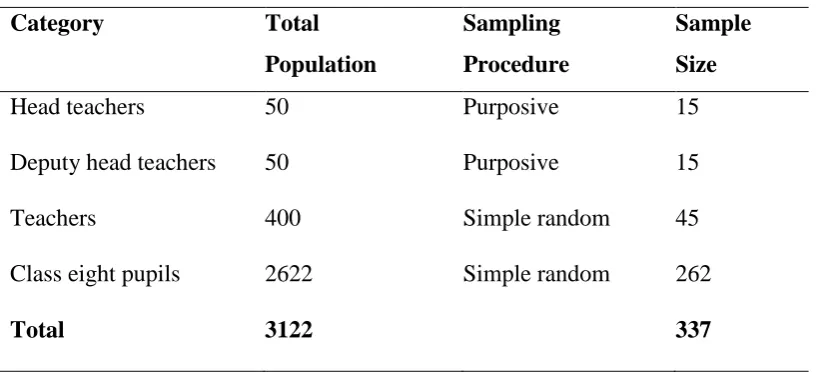
participate in the study. Class eight pupils were considered key respondents because they have been in school long enough to experience the factors that influences academic performance. The sample size for the study therefore was 337. Table 3.1 provides a summary of the sample matrix.
Table 3.1: Sampling Matrix Category Total
Population
Sampling Procedure
Sample Size
Head teachers 50 Purposive 15
Deputy head teachers 50 Purposive 15
Teachers 400 Simple random 45
Class eight pupils 2622 Simple random 262
Total 3122 337
3.6 Research Instruments
The study utilized questionnaires and document review to collect data.
3.6.1 Questionnaire
31
contained sections that gathered information on social, economic and cultural factors affecting pupil’s performance in KCPE. Parent’s income, education and occupation were used to measure the economic status of the family. The questionnaires contained both open and closed ended questions.
3.6.2 Document Review
The researcher collected data pertaining to the examination results by looking at the records of the student’s academic achievement in the joint evaluation test and record it in a document analysis proforma. This was necessary as it enabled the researcher to collate the information given by the student and that captured by the researcher. The document analysis proforma was structured to record pupils name, gender and mean score attained.
3.7 Piloting
32
3. 7.1 Validity of the Research Instrument
According to Borg and Gall, (1986) validity is the degree to which a test measures what it purport to measure. In other words, validity is the degree to which results obtained from the analysis of the data actually represent the phenomena under study. The construct and content validity was ascertained by piloting the instruments.To ensure validity of the instrument the research objectives were crosschecked with the corresponding items in the research instrument. The researcher presented the research instruments to experts in the department of education management, policy and curriculum studies at Kenyatta University to evaluate content and construct validity and suitability.
3. 7. 2 Reliability of the Research Instrument
Reliability is a measure of the degree to which a research instrument yields consistent results after repeated trials using the same subjects under the same conditions (Mugenda & Mugenda, 1999). Pre-testing of the research instrument was carried out before the actual data collection. The reliability of the data was tested using the test re-test technique that involved the following procedures.
• Selecting an appropriate group of subjects. • Administering the questionnaire to the subjects.
• Keeping all initial conditions constant, administer the sample questionnaire to the same subjects after two weeks.
33
A reliability of 0.69 and 0.68 was obtained with the teachers and pupil’s questionnaires. Fraenkel and Wallen (2000) recommend a reliability of at least 0.70. Based on this, the instruments were considered acceptable.
3.8 Data Collection Procedures
The researcher booked appointments with the respondents to visit and administer the questionnaires. The researcher personally administered the instruments to all the respondents who were given 3 days to complete all the items adequately, after which the researcher collected the filled-in questionnaires. The data for this study was collected within a period of one month.
3.9 Data Analysis
34
3.10 Ethical Considerations
35
CHAPTER FOUR
RESULTS AND DISCUSSION
4.1 Introduction
This chapter covers the analysis of data and presentation of results for the study and discussions. The data presented covers respondent’s demographic data that includes genders, and age, academic qualification and the number of years teachers have served. The study respondents included head teachers, deputy head teachers, teachers and class eight pupils. Overall 262 respondents took part in the study with 78.0% return rate of the questionnaires. The chapter presents the results and discussion of the study objectives. The study sought to answer the following research questions based on the objectives of the study.
i) What social factors affect pupil’s performance in KCPE in public primary schools in Chuka division in Tharaka-Nithi County?
ii) What economic factors affect pupil’s performance in KCPE in public primary schools in Chuka division in Tharaka-Nithi County?
iii) What cultural factors affect pupil’s performance in KCPE in public primary schools in Chuka division in Tharaka-Nithi County ?
iv) What measures can be put in place to improve pupils’ performance in KCPE in public primary schools in Chuka division in Tharaka-Nithi County?
36
4.2 Response Rate
The study administered the research instruments to head teachers, deputy head teachers, teachers and class eight pupils. Overall 262 respondents took part in the study with 78.0% return rate of the questionnaires.
4.3 Socio-Demographic Characteristics of the Respondents
The demographic profile provides information about the population structure, and helps create a mental picture of the subgroups that exist in the overall population. Researchers obtain demographic information from the study subjects to understand sample characteristics and to determine if samples are representative of the populations of interest (Kirton, 2000). Although demographic variables cannot be manipulated, researchers can explain relationships between them and dependent variables. In this study, the researcher investigated the respondent’s characteristics by establishing their gender, age, academic qualification and experience, parent’s income and occupation and education status.
4.3.1 Gender Distribution of the Respondents
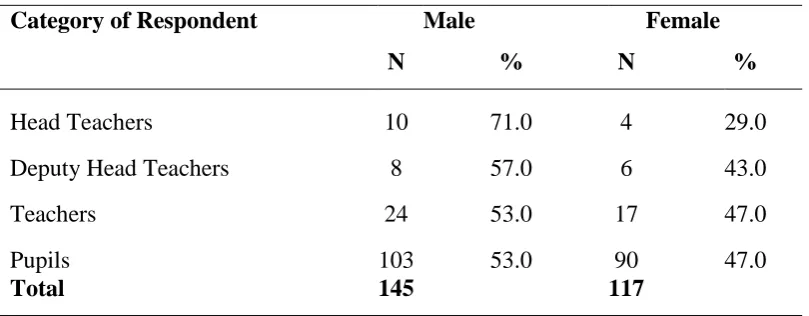
37
Table 4.1: Gender Distribution of Respondents
Category of Respondent Male Female N % N %
Head Teachers 10 71.0 4 29.0
Deputy Head Teachers 8 57.0 6 43.0
Teachers 24 53.0 17 47.0
Pupils 103 53.0 90 47.0
Total 145 117
38
Smith (2004) observed that the smaller number of female teachers was a global issue and that the proportion of men within teaching ranks was increasing significantly. It has also been speculated in some quarters that teacher’s gender affected the performance of the child. Dee (2006) described two theories which suggested that the performance of the child depended on the gender of the teacher. According to him (Dee, 2006), one theory asserts that the teacher’s gender shapes communications between teacher and pupil, while another says the teacher acts as a gender-specific role-model, regardless of what he or she says or does. Dee further explained that the second theory stipulated that students were more engaged, behaved more appropriately, and performed at a higher level when taught by one who shared their gender.
39
(2006) again reported that his results confirmed that a teacher’s gender does have large effects on student’s test performance. Based on his convictions concerning the authenticity of his results, he went further to claim that girls have better educational outcomes when taught by women and boys are better off when taught by men. On the other hand, Holmlund and Sund’s (2005) results did not support the idea that a same-sex teacher had a positive causal impact on student outcomes, measured in terms of course grades in upper-secondary school. In other words, they found no strong support for their initial hypothesis that a same-sex teacher improves student outcomes. Krieg (2005) also found no evidence to support the hypothesis that the interaction of student and teacher gender impacted upon test scores.
4.3.2 Age Distribution of the Respondents
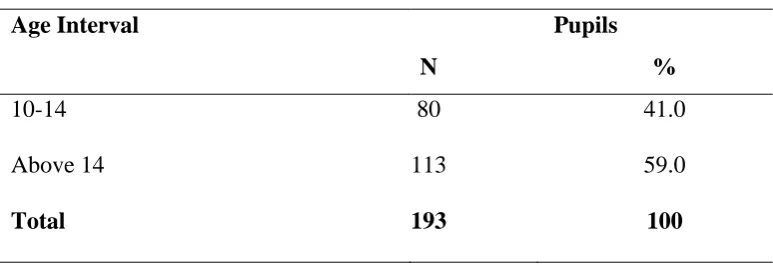
The study sought to establish how the pupils were distributed in terms of age. The data obtained is captured in Table 4.2.
Table 4.2: Age Distribution of Pupils
Age Interval Pupils
N %
10-14 80 41.0
Above 14 113 59.0
Total 193 100
40
join standard one at age six and by class 8 children are above 14 years old. Many young children in Kenya start their education at the age of three or four years in a nursery school or pre-school unit. However formal schooling begins at six or seven years when pupils enter class 1 of the eight-year primary cycle. Those who pass this cycle without interruption should enter the final grade and sit the KCPE examination when they are 13 or 14 years of age. If the pupils are interrupted with the cycle of education they stay a little longer in school. This information also shows that majority of pupils were old enough and knowledgeable and could give valid and reliable information on socioeconomic factors on pupils performance in KCPE.
4.3.3 Teachers Years of Service
The study sought to establish the length of service of teacher’s respondents and the results are shown on Table 4.3.
Table 4.3: Teachers Years of Service
Year Interval Head Teachers Deputy Head Teachers
Teachers
N % N % N %
Less than 1 year 1 7.1 1 7.1 5 12.0
1-5 years 6 42.9 3 21.4 14 34.0
6-10 years 3 21.4 5 35.7 12 29.0
11-15 years 1 7.1 1 7.1 3 7.0
Above 15 years 3 21.4 4 28.6 7 17.0
41
The findings on Table 4.3 show that majority (42.9%) head teachers, have had 1-5 years of service while 35.7% deputy head teachers had 6-10 years of service. Majority (34.0%) of the teachers were found to have had between 1-5 years of service. These findings therefore, reflect that teachers’ were reasonably experienced and therefore capable of handling curriculum and guiding students towards good performance but also may reflect the effect of teacher efficiency on academic achievement. Pupil’s performance is to some extent influenced by teachers experience with the subject matter.
Teacher experience has a significant effect on pupil performance in primary schools according to Stringfield and Teddlie, (1991). According to their findings teachers have a richer background of experience to draw from and can contribute insight and ideas to the course of teaching and learning, are open to correction and are less dictatorial in classroom. Furthermore, more experienced teachers are considered to be more able to concentrate on the most appropriate way to teach particular topics to learners who differ in their abilities, prior knowledge and backgrounds (Stringfield&Teddlie, 1991). Ferguson (1991) reveals that at the high school level, students taught by teachers with more than nine years of experience had significantly higher test scores than students whose teachers had five to nine years of experience.
4.3.4 Academic Qualifications
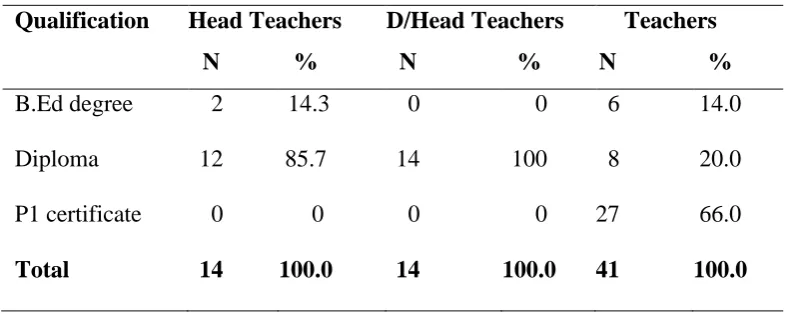
42
Table 4.4: Teachers’ Academic Qualification
Qualification Head Teachers D/Head Teachers Teachers
N % N % N %
B.Ed degree 2 14.3 0 0 6 14.0
Diploma 12 85.7 14 100 8 20.0
P1 certificate 0 0 0 0 27 66.0
Total 14 100.0 14 100.0 41 100.0
The results shown on Table 4.4 indicate that majority (100%) of the head teachers, had a certificate and above. All the deputy head teachers who participated in the study were found to be holders of diploma certificate. The study also found that majority (66.0%) of other teachers was P1 certificate holders while others (20.0%) and 14.0%) had diploma and bachelor of education holders. The findings imply that the teachers had the requisite qualification to teach the pupils in primary schools.
43
Morumbwa (2006) carried out a study on the factors affecting performance in KCPE in Nyamaiya Division of NyamiraDistrict in Kisii County, Kenya and found that the teachers’ academic qualifications professional qualifications and administrative experience does not affect school performance in KCPE. Further studies exploring the effect of teachers’ academic qualification on pupils’ performance in KCPE would shed more light as a result of emerging mixed findings.
4.4 Social Factors Affecting Pupil’s Performance in KCPE
Objective one was to determine social factors that affect pupil’s performance in KCPE in public primary schools in Chuka Division of Meru South District in Tharaka Nithi County. The responses obtained are shown in table 4.5.
Table 4.5: Responses on Social Factors Affecting Pupils Academic Performance
Factor Number Percentage
Indiscipline 84 32.0
Substance abuse 50 19.0
Pregnancy 53 20.0
Perceived gender roles 2 1.0
Unexplained reasons 42 16.0
Sickness 16 6.0
Failure to adjust to school environment 4 2.0
Family breakups 3 1.0
Lack of interest in school 8 3.0
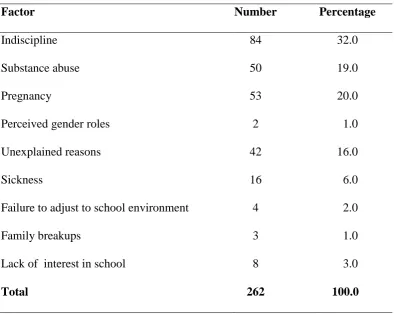
44
The results shows that the social factors affecting pupils academic performance were:indiscipline (32.0%), substance abuse (19.0%), pregnancy (20.0%), perceived gender roles (1.0%), unexplained reasons (16.0%), sickness (6.0%), failure to adjust to school environment (2.0%), family breakups (1.0%) and lack of interest in school (3.0%). Therefore, according to the head teachers, deputies and teachers and the pupils the above factors were the main cause of poor performance in primary school in Chuka Division of Meru South Sub-County in Tharaka-Nithi County.
Kiveu and Mayio (2009), Mbani (2008), Eshiwani (1983) and Njau (1997) identified sickness, absenteeism, pregnancy and indiscipline as the leading causes of pupil’s poor performance in primary schools. For example, a study carried out by Mbani (2008) in Mombasa revealed that once girls get pregnant they drop out of school and some end up in early marriage. Njau (1997) revealed that the relationship between school enrolment and girls‟ experience in reproductive events is more complex today than in the past due to the rising adolescent time being spent in school and inadequate guidance and counseling. When girls reach puberty, they face the risk of sexual coercion, unwanted pregnancy and early marriages that may interfere with their academic performance and force them to drop out of school. Eshiwani (1983) pointed out that sick learners may spend most of their time away from school or seeking medication which may lead to low performance.
45
This finding concurs with those of (Alderman et al, 2001), who studied children in rural Pakistan. They stated that child health/nutrition had a greater impact on children’s academic performance. Research by Pridmore, (2007) indicates that school-aged children who suffer from protein-energy malnutrition, hunger, or who lack certain micronutrients in their diet do not have the same potential for learning as healthy and well-nourished children. Studies suggest that these children attend school less frequently, are more likely to repeat grades, drop out early and fail to learn adequately due to poor levels of attention, low motivation and poor cognitive function (Pridmore, 2007).
4.5 Economic Factors Affecting Pupil’s Performance in KCPE
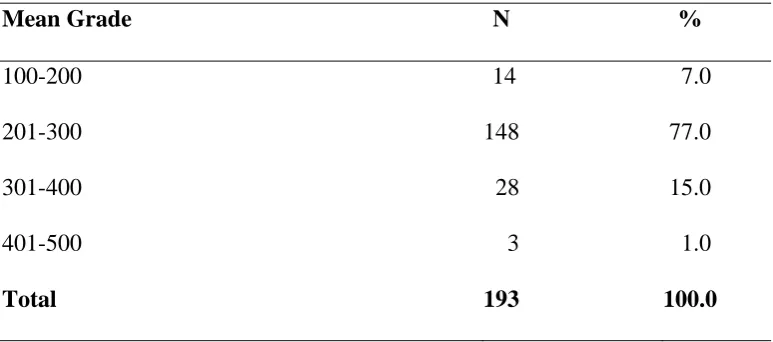
Task two was to find out economic factors that affects pupil’s performance in KCPE in public primary schools in Chuka Division of Meru South District in Tharaka-Nithi County. The findings are shown on Table 4.6.
Table 4.6: Pupils Distribution of Marks in Five Joint Evaluation Tests year 2013
Mean Grade N %
100-200 14 7.0
201-300 148 77.0
301-400 28 15.0
401-500 3 1.0
Total 193 100.0
46
The findings in Table 4.6 show that majority (77 %) of the pupils scored between 201 and 300 marks in joint evaluation test commonly known as mocks. From the study findings it was established that the percentage of pupils that scored proficient (quality) marks that is between 401 and 500 that would enable them get admitted to national schools were only 1.0%. Pupils who scored marks that would see them get admitted to provincial school cadre were 15.0%.This is poor performance. It was therefore imperative to determine if there was a correlation between the scores attained and socio economic status.
In this study, socio-economic status of parent (that is father, mother and guardian) were first established and the results cross tabulated with pupils scores in joint evaluation test to establish the influence of socio-economic status on academic achievement. The data was analyzed in two stages. The first stage involved formation of socio-economic classes and distribution of achievement scores done. The second stage involved determining correlation coefficients to find if a relationship of marks and socio-economic status existed. The detail of the distribution of parents social classes according to obtained scores determined from the evaluation of parents income, education and occupation, is shown in Table 4.7.
Table 4.7: Breakdown of Social Classes According to Scores on Measures of Social Economic Status
Socio-economic classes Frequency Percentage
High SES Middle SES Lower SES
42 58 93
22.0 30.0 48.0
47
Table 4.7 indicates that in the selected sample 22.0 % of pupils were from the upper class (high socio-economic status), 30.0 % of the pupils were from Middle SES and 48.0 % were from lower SES. So the majority of the pupils belonged to lower socio economic class. This also indicates that a majority of pupils of lower SES are studying in public primary schools in Chuka division.
The academic achievement of the pupils’ was measured by the marks obtained in class eight joint evaluation test held in 2012. The sampled pupils’ achievement scores were categorized as shown on Table 4.10. When the pupil’s scores were cross tabulated with the parents SES, the results reflected a relationship. Majority of the pupils from the lower SES were found to have scored below 300 marks. Pearson correlation was used to test whether there was a significant association between parental SES and pupils’ performance and the results have been presented in Table 4.8.
Table 4.8: Correlation between Parental SES and Pupil Performance
SES Pupils performance
Parents SES Pearson Correlation .060
Sig. (2-tailed) .633
N 193
48
SES. This finding also indicates that pupils from across the social classes can have varied academic performance and that there could be other underlying reasons for this other than parent’s socio economic status. The results of this study are consistent with Hardy (2006) findings shows that, it is not the socio-economic status of one particular individual that determines his/her academic success. Hardy (2006) further showed that test scores of pupils from disadvantaged social class performed remarkably similar when they study from similar schools.
This study obtained details of education background of family members and the information captured is provided in Table 4.9.
Table 4.9: Family Member’s Education Background
Levels and variables
Responses
Low SES
F (%) n=93
Middle SES
F (%) n=58
High SES
F (%) n=42
P G S P G S P G S
School attendance status At school Left School Never went to school 0(0) 14(15) 7(8) 0(0) 10(11) 2(2) 17(18) 6(6) 3(3) 0(0) 6(10) 0(0) 0(0) 9(16) 0(0) 16(28) 8(14) 0(0) 0(0) 2(5) 0(0) 0(0) 6(14) 0(0) 4(10) 1(2) 0(0) Highest formal level of schooling completed Primary Secondary College University 9(10) 6(6) 0(0) 0(0) 4(4) 1(1) 1(1) 0(0) 7(8) 3(3) 2(2) 1(1) 0(0) 10(17) 4(7) 1(2) 0(0) 1(2) 2(3) 1(2) 0(0) 2(3) 2(3) 2(3) 1(2) 3(7) 0(0) 5(12) 0(0) 2(5) 1(2) 2(5) 0(0) 5(12) 3(7) 7(17)
49
The data on Table 4.9 indicate that majority (15%) parents and 11% guardians in the lower socio-economic status had left school while 18% siblings were still in school. Eight percent parents, 2% guardians and 3% siblings in the low SES had never gone to school. The study further established that the highest formal level of schooling reached by majority of the parents (10%) was primary school while 4% of the guardians and 8% of the siblings had reached a similar level of formal schooling. Six percent, 1% and 3% of the pupils from the lower socio-economic status that participated in the study reported that the highest level of formal schooling reached and completed by their parents, guardians and other siblings was secondary school while 1% and 2% most of the members in the family had reached college level in formal schooling. Only 1% of the pupils reported having members whose highest formal level of schooling was university.
School attendance status of family members in the middle SES revealed that majority (28%) sibling were still in school, while 10% parents, 16% guardians and 14% siblings had left school. The study established that parents, guardians and siblings who were able to reach college level schooling were 7%, 3% and 3% respectively compared to a smaller number of those in the lower socio-economic status. The study also found that family members in the middle socio-economic status had gone to university and completed university education.
50
backgrounds were cross tabulated with pupils’ scores in joint evaluation test to establish the general trend in achievement. Results from cross tabulation revealed that there was relatively weak linkage between pupils’ academic achievement and their parents’ education level. The results showed that parent’s educational status had little influence on the academic achievement of the pupils. The result revealed that the differences in educational background of parents did not contribute to a significant difference in the academic achievement of their children. Pupils were classified into three groups, low, medium and high social economic status on the basis of parents education.
The educational status of both parents and guardians was taken depending on whether they attended formal schooling, or completed primary, high school or college education.
51
findings are in tandem with argument by Ngatiari (2011) who posited that level of parents education enhance children’s learning and overall achievement thus educated parents encourage and support their children to obtain good education. Ayoo (2002) found that unlike uneducated parents who do not attach much value in education, educated parents enhance the children’s academic achievement.
The study further probed the social component by establishing the level of parental involvement in academic activities of pupils and whether this influenced learning outcomes. When asked whether parents participated in schools academic activities all 100% head teachers responded affirmatively. When asked whether the education level of parents and their participation in school academic activities helped pupils achieve academically, 71.4% said yes, and 28.6% said no. Musgrave (2009) established that parents who visit the pupils in school and participated in school activities encouraged their children to do better.
52
Table 4.10: Details of Parents Occupation
Variabl e Responses Low SES
F (%) n=93
Middle SES
F (%) n=58
High SES
F (%) n=42
F M G F M G F M G
n= 40 n= 40 n= 13 n= 25 n= 25 n= 8 n= 19 n= 20 n= 3
Occupation Peasant
farmer Small scale business Manager Civil servant 19(20) 13(14) 0(0) 8(9) 30(32) 6(6) 0(0) 4(4) 9(10) 3(3) 0(0) 1(1) 7(12) 4(7) 0(0) 14(24) 5(9) 3(16) 1(2) 16(28) 0(0) 4(7) 0(0) 4(7) 1(2) 1(2) 5(10) 12(29) 0(0) 10(24) 3(7) 7(17) 0(0) 0(0) 0(0) 3(7) Terms of service Permanent Temporary Casual Self 8(9) 0(0) 0(0) 32(34) 4(4) 0(0) 0(0) 36(39) 1(1) 0(0) 0(0) 12(13) 4(7) 0(0) 0(0) 11(20) 17(9) 0(0) 0(0) 8(14) 4(7) 0(0) 0(0) 4(7) 17(40) 0(0) 0(0) 2(5) 10(24) 0(0) 0(0) 10(24) 3(7) 0(0) 0(0) 0(0)
Employer GOK/PSC
Private sector NGO/FBO/ CBO Self 3(3) 4(4) 1(1) 32(34) 2(2) 1(1) 1(1) 36(39 1(1) 0(0) 0(0) 12(13) 14(24) 0(0) 0(0) 11(20) 16(28) 1(2) 0(0) 8(14) 4(7) 0(0) 0(0) 4(7) 12(29) 5(10) 0(0) 2(5) 7(17) 3(7) 0(0) 10(24) 3(7) 0(0) 0(0) 0(0)
Key: F = Father; M = Mother; G = Guardian: Figures in brackets are percentages while the rest are frequency counts.
53
were better-off as most of them were civil servants and managers. These occupations are commensurate with high pay. The study established that most employed parents worked on permanent terms of service while the rest were self-employed. It emerged that majority of the parents worked for the public service (government) while others worked for the private sector. Head teachers responses reflected that most parents were peasant farmers. Head teachers further reported that among the categories of parents, those in the civil service engaged their children in academic activities. Kombo (1988) in his study found out that parental occupation are among the factors that had important effects on pupils’ academic performance.The responses obtained from the pupils also indicated that when they were asked whether the parent's occupation affects pupils’ performance in KCPE, most of them responded in the affirmative. In addition, the pupils noted that their parents engaged in lowly paying jobs that made them incapable of supporting the education of their children in terms of payment of other school levies which leads to absenteeism of pupils from school and this may ultimately lead to poor performance. The view that the parent's occupation affected pupils KCPE performance was shared by the teachers. Like the pupils, the teachers noted that some occupations cannot support education in terms of financing while others deprive the parents’ time to follow up the progress of their children in school.
54
found out that poor parental care with gross deprivation of social economic needs can contribute towards poor performance. Ndiritu (1999), found that the socio-economic background influenced academic performance and that children from poor families are more involved in labour.