Architecture of Hybrid Intrusion Detection
System using TAN & GA Algorithm
Namita Parati
1, Sumalatha Potteti
2Assistant Professor, Department of CSE, BRECW, Hyderabad, India1 Assistant Professor, Department of CSE, BRECW, Hyderabad, India2
ABSTRACT: The dramatically development of internet, security of network traffic is becoming a major issue of computer network system. Attacks on the network are increasing day-by-day. Many intelligent learning techniques of machine learning are applied to the large volumes of data for the construction of an efficient intrusion detection system (IDS). Several machine-learning paradigms including neural networks, linear genetic programming (LGP), support vector machines (SVM), Bayesian networks, multivariate adaptive regression splines (MARS) fuzzy inference systems (FISs), etc. have been investigated for the design of IDS. This paper presents an overview of intrusion detection system and a hybrid technique for intrusion detection based on . Tree Augmented Naïve Bayes (TAN) algorithm and Genetic algorithm. TAN algorithm classifies the dataset into various categories to identify the normal/ attacked packets where as genetic algorithm is used to generate a new data by applying mutation operation on the existing dataset to produce a new dataset. Thus this algorithm classifies KDD99 benchmark intrusion detection dataset to identify different types of attacks with high detection accuracy. The experimental result also shows that the accuracy of detecting attacks is fairly good.
KEYWORDS: Intrusion Detection System (IDS), Data Mining, Classification, Genetic algorithm, Tree augmented Naive Bayes Classifier.
I.INTRODUCTION
Information Security, intrusion detection is the act of detecting actions that attempt to compromise the confidentiality, integrity or availability of a resource. When Intrusion detection takes a preventive measure without direct human intervention, then it becomes an Intrusion-prevention system. Intrusion detection can be performed manually or automatically. Manual intrusion detection might take place by examining log files or other evidence for signs of intrusions, including network traffic. A system that performs automated intrusion detection is called an Intrusion Detection System (IDS). An IDS can be either host-based, if it monitors system calls or logs, or network-based if it monitors the flow of network packets. Modern IDSs are usually a combination of these two approaches [9]. Another important distinction is between systems that identify patterns of traffic or application data presumed to be malicious (misuse detection systems) and systems that compare activities against a ‟normal‟ baseline (anomaly detection systems.
II. LITERATURE SURVEY 2.1 Intrusion Detection System
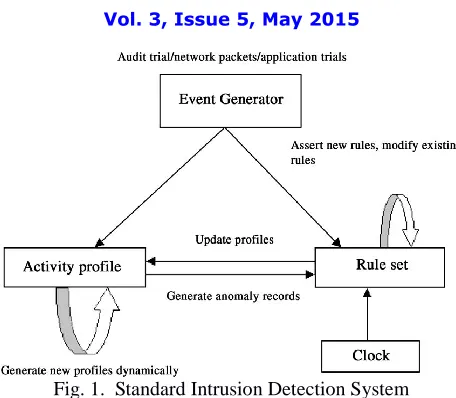
Fig. 1. Standard Intrusion Detection System
An intrusion detection system (IDS) inspects all inbound and outbound network activity and identifies suspicious patterns that may indicate a network or system attack from someone attempting to break into or compromise a system It gathers and analyzes the network traffic & detect the malicious patterns and finally alert to the proper authority. The main function of IDS includes:[14]
2.1.1 Classification of IDS:
According to techniques used for intrusion detection based on whether attack‟s patterns are known or unknown, IDS classified into two category [6][15]:
(1) Misuse detection (2)Anomaly detection
1) Misuse Detection:
Misuse detection compares the user activities to the known intruder activities on web. The idea of misuse detection is to represent attacks in the form of a pattern or a signature so that the same attack can be detected and prevented in future [3]. The IDS searches for defined signatures and if a match is found, the system generates an alarm indicting the presence of intrusion. Since it works on the basis of predefined signatures, it is unable to detect new or previously unknown intrusions.
2)Anomaly Detection:
Table 1. Attack Classification
Denial of Service Remote-to-Local User to root Probe
Smurf Guess-Password Imap Ipsweep
Snmp Warezmaster Load module Nmap
Back ftp-write Butter overflow Portsweep
Land Multihop Rootkit Saint
Neptune Phf *** satan
III. DATA MINING BASED INTRUSION DETECTION SYSTEM
Data mining is the activity of extracting relevant information from a large amount of data[17]. Network traffic is massive and information comes from different sources, so the dataset for IDS becomes large. Hence the analysis of data is very shard in case of large dataset.
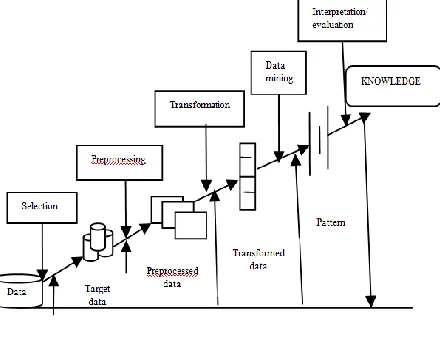
Fig 2: Data Mining
Fig 2 shows the working of data mining. Data mining techniques are applied on IDS because it can extract the hidden information and deals with large dataset. Presently Data mining techniques plays a vital role in IDS. By using Data mining techniques, IDS helps to detect abnormal and normal patterns. This section describes different Data mining techniques such as clustering and classification, which are used in IDS to obtain information about vulnerability by monitoring network data[2].
3.1.1. Naive Bayes classifier [13]: Naive Bayes classifier is probabilistic classifier. It predicts the class according to membership probability. To derive conditional probability, it analyzes the relation between independent and dependent variable.
3.1.2. Support Vector Machine [12]: An SVM maps input (real-valued) feature vectors into a higher-dimensional feature space through some nonlinear mapping. SVMs are developed on the principle of structural risk minimization. Structural risk minimization seeks to find a hypothesis for which one can find lowest probability of error whereas the traditional learning techniques for pattern recognition are based on the minimization of the empirical risk, which attempt to optimize the performance of the learning set. Computing the hyper plane to separate the data points i.e. training an SVM leads to a quadratic optimization problem. SVM uses a linear separating hyper plane to create a classifier but all the problems cannot be separated linearly in the original input space.
SVM uses a feature called kernel to solve this problem. The Kernel transforms linear algorithms into nonlinear ones via a map into feature spaces.
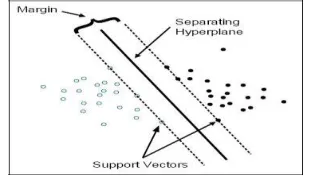
Fig. 3. Separating Hyperplabe with SVM
There are many kernel functions; including polynomial, radial basis functions, two layer sigmoid neural nets etc. Fig 3 shows Hyperplabe separation in SVM.
Support Vector Machine is supervised learning method used for prediction and classification. It separate data decision tree has high detection rate in case of large points into two classes +1 and -1 using hyperplane because it is binary classification classifier. +1 represents normal data and -1 for suspicious data. Hyperplane can be expressed as: W. X +b=0 Where W={w 1 ,w 2 ,...,w n } are weight vector for 'n' attributes A={A 1 ,A 2 ,...,A n }, X={x 1 ,x 2 ,...,x n } are attribute values and b is a scalar. The main goal of SVM is to find a linear optimal hyper plane so that the margin of separation between the two classes is maximized. The SVM uses a portion of the data to train the system.
3.1.3. K-Nearest Neighbor [11]: It is one of the simplest classification technique. It calculates the distance between different data points on the input vectors and assigns the unlabeled data point to its nearest neighbor class. K is an important parameter. If k=1, then the object is assigned to the class of its nearest neighbor. When value of K is large, then it takes large time for prediction and influence the accuracy by reduces the effect of noise.
3.2.1. K-Means Clustering algorithm [18][13]: K-Means clustering algorithm is simplest and widely used clustering technique proposed by James Macqueen. In this algorithm, number of clusters K is specified by user means classifies instances into predefined number of cluster. The first step of K-Means clustering is to choose k instances as a center of clusters. Next assign each instances of dataset to nearest cluster. For instance assignment, measure the distance between centroid and each instances using Euclidean distance and according to minimum distance assign each and every data points into cluster. K –Means algorithm takes less execution time, when it applied on small dataset. When the data point increases to maximum then it takes maximum execution time. It is fast iterative algorithm but it is sensitive to outlier.
3.2.2. K-Medoids clustering algorithm [13]:
K-Medoids is clustering by partitioning algorithm as like as K-means algorithm. The most centrally situated instance in a cluster is considered as centroid in place of taking mean value of the objects in K-Means clustering. This centrally located object is called reference point and medoid. It minimizes the distance between centroid and data points means minimize the squared error. K-Medoids algorithm performs better than K-Means algorithm when the number of data points increases to maximum. It is robust in presence of noise and outlier. Generally IDSs are deployed to monitor a system or a network in search of any abnormal condition. In this surveillance if any kind of intrusive attempt is detected, the monitoring system i.e. IDS sets up an alarm which is an indication of the presence of intrusion. In order to detect intrusions in an efficient manner, various appreciable models have registered their presence in the literature. The presently available models involve usage of various novel algorithms which are likely to detect these intrusions distinguishably. Among these, algorithms based on data mining have been a point of attraction for researchers because of their extensive feasibility in detecting intrusions. These algorithms aid in improving accuracy of the system along with effective detection rate and less false alarm rate. The algorithms loyal for classification are the most desirable algorithms for detection. In the data mining classification techniques, Tree Augmented Naïve Bayes (TAN) and Reduced Error Pruning (REP) algorithms have come out as the most significant detection algorithms in IDS. Hence this paper presents an intelligent effort for intrusion detection which proposes a framework named Hybrid Intrusion Detection Model. This model is a combinational scheme which aims at surmounting the shortcomings faced by two algorithms individually with interestingly increased accuracy of the detection.
IV. PROPOSED METHODOLOGY
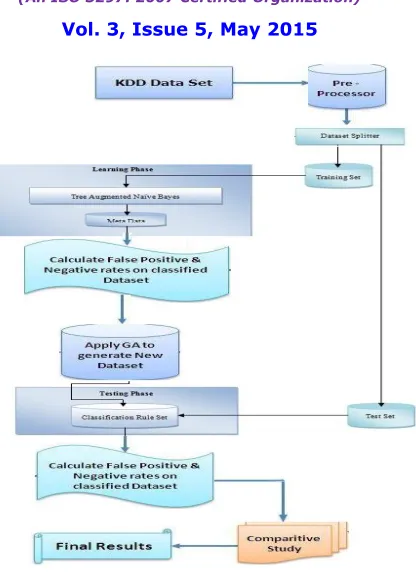
The proposed system (shown in figure 4) is a hybrid intrusion detection framework based on the combination of two classifiers i.e. Tree Augmented Naïve Bayes (TAN), Genetic algorithm(GA) . The TAN classifier is used as a base classifier while the GA This takes the classified dataset as input and builds a new dataset using the Genetic Algorithm by observing the different variations in the dataset.
Initialization. Initially many individual solutions [3] are randomly generated to form an initial population. The population
size depends on the nature of the problem, but typically contains several hundreds or thousands of possible solutions.
Selection. During each successive generation, a proportion of the existing population is selected to breed a new
generation. Individual solutions are selected through a fitness-based process, where fitter solutions (as measured by a fitness function) are typically more likely to be selected. Certain selection methods rate the fitness of each solution and
Fig 4: Hybrid Architecture for IDS
individuals with higher scaled values. [12] Initially many individual solutions are randomly generated to form an initial population. The population size depends on the nature of the problem, but typically contains several hundreds or thousands of possible solutions.
The two algorithm indulged in the proposed system can be understood as:
4.1.Tree Augmented Naïve Bayes Algorithm:
The Tree Augmented Naïve Bayes (TAN) [20, 21] is a Bayesian Network learning technique and it is the extension to simple Naïve Bayes classifier. Naive Bayes is probabilistic classifier structure based on Bayes theorem having naive (strong) independence assumptions. This structure encodes the strong conditional independence assumption among attributes i.e. the class node is the parent
node for each and every attribute node with no parent node defined for it.
4.2. Genetic Algorithm
The GA then evaluates each candidate according to the fitness function. In a pool of randomly generated candidates, we choose promising candidates toward solving the problem. These promising candidates are kept and allowed to reproduce. Multiple copies are made of them, but the copies may not perfect; random changes are introduced during the copying process. These digital offspring then go on to the next generation, forming a new pool of candidate solutions, and are subjected to a second round of fitness evaluation. Those candidate solutions which were worsened, or made no better, by the changes to their code are again deleted; but again, purely by chance, the random variations introduced into the population may have improved some individuals, making them into better, more complete or more efficient solutions to the problem at hand. Again these winning individuals are selected and copied over into the next generation with random changes, and the process repeats. The expectation is that the average fitness of the population will increase each round, and so by repeating this process for hundreds or thousands of rounds, very good solutions to the problem can be discovered.[3][5]. Fig 5 Explains basic Generic Algorithm.
Methods of Change. Once selection has chosen fit individuals, they must be randomly altered in hopes of improving their fitness for the next generation. There are two basic strategies to accomplish this, they are.,
Mutation: By applying random changes to a single individual in the current generation to create a child.
Crossover: By selecting vector entries, or genes, from a pair of individuals in the current generation and combines them to form a child.
Fig. 5. Basic Genetic Algorithm Flow
V. DETAILED DESCRIPTION OF THE HYBRID IDS FRAMEWORK
This section describes about all the modules incorporated in the Hybrid IDS framework shown in fig.4. Following is the brief discussion about each module:
5.1. KddCup’99 Dataset:
5.2. Preprocessing:
In the preprocessing module the class label presents in the 42nd feature of KddCup‟99 dataset is recast into five major categories for the sake of decreasing complexity of performance evaluation of the proposed model. As the original KddCup‟99 dataset having 22 types of attack labels, it was very inconvenient to assess the performance of the classification model. Hence the attack labels are modified to their respective categories for the ease of analysis. Finally five major classes are formed as the class label i.e. DoS, Probe, R2L, U2R and Normal.
The four different categories of attack patterns are as follows.
-Probing Attack: It is a method of gathering information about a network of computers with an intention of circumventing
its security controls.
-Denial of Service Attack (DoS): It is a type of attack in which an attacker denies legitimate users access to machines or
makes computing resources too busy to handle requests.
-User to Root (U2R): In U2R the attacker first accesses the system with a normal user account by sniffing passwords or
social engineering and then gains root access to the system by exploiting some vulnerability.
-Remote to Local (R2L): R2L occurs when a user without an account has the ability to send packets to a machine gains
local access as a user of that machine.
5.3. Dataset Splitter:
The Dataset Splitter module partitions the dataset into two parts received from the preprocessing module. To partition the dataset into two parts a method named holdout is used. In this method, the given data are randomly partitioned into two independent sets, a training set and a test set [17]. The 66% of the data is allocated to the training set and the remaining 44% of the dataset is allocated to the testing set. The training set is used to derive the proposed framework while the test set is used to assess the accuracy of the derived model. When the KddCup‟99 dataset passed through the data splitting module then it gets divided into the training set which consists of 326054 instances and the testing set which consists of 167967 instances.
5.4. Learning Phase:
The learning phase involves two steps for generating the classification rules. In the first step, the learning of base classifier i.e. TAN using the training dataset is achieved. The outcome of this base classifier is assumed as the input data (known as Meta data) for the second step. This meta-level training set is composed by using the base classifiers predictions on the validation set as attribute values, and the true class as the target [18]. From these predictions, the meta-learner adapts the characteristics and performance of the base classifier and computes a meta-classifier which is a model of the original training data set. This meta-classifier in second step fetches the predictions from the base classifier for classifying an unlabeled instance, and then makes the final classification decision.
5.5. Testing Phase:
The classification rules that are generated in Learning Phase are stored for the performance evaluation of hybrid intrusion detection framework. In this phase, the Testing Set generated in Data Splitting module is used as input to assess the performance. The outcomes of this module is further forwarded to next module i.e. Classifier Performance Evaluator module.
5.6. Classifier Performance Evaluator:
The Classifier Performance Evaluator module calculates the various classification performance
• True Positive Rate (TPR):
• True Negative (TN): These are the negative tuples that were correctly labeled by the classifier. • True Positive (TP): These refer the positive tuples that were correctly labeled by the classifier. • False Positive (FP): These are the negative tuples that were incorrectly labeled as positive. • False Negative (FN): These are the positive tuples that were mislabeled as negative.
VI.STIMULATION & RESULT SECTION
The result generated in the Performance Evaluation phase can be visualized in the visualization module. These results can be in the form of text or graph etc.
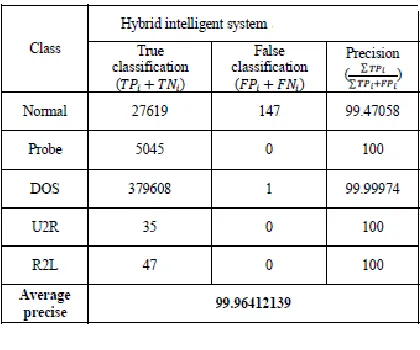
This section evaluates the performance of the individual SVM and proposed hybrid TAN-GA for detection. In the individual SVM and proposed hybrid TAN-GA algorithms, the k-fold method is used to evaluate the accuracy of classification, and output the best test accuracy and decision rules. This study set k as 10; that is, the data was divided into 10 portions. Nine portions of data are retrieved as training data and the other one is used for testing data. In experiments, the parameter C and of TAN varies from 0.01 to 50,000. Table 3 shows classification precision for Hybrid IDS.
A set of data is selected to train the process and the algorithm. Then we have another set called the test set with which the TAN Algorithm is implemented. Thus after classifying the dataset into attack and normal packets using TAN Algorithm, we calculate the false positive, false negative rates and the detection accuracy. We then apply Genetic algorithm to obtain a new generation of dataset by selecting the required attributes from the already existing dataset. Here, we use mutation as the reproduction operator.
Now we use this dataset to again implement the TAN Algorithm and classify the dataset into attack and normal packets. Also we calculate the false positive, false negative rates and the detection accuracy.
Finally we show a comparative analysis of the false positive, false negative rates and the detection accuracy.
Table 4. The Classification Precision for Hybrid IDS
VII. CONCLUSION AND FUTURE ASPECT
performed on the developed IDS framework and is compared with other techniques present in the scenario. The resultants obtained convey that the developed hybrid framework is highly effective to overcome the deficiencies found in previous work. Here we designed a hybrid TAN-GP model Empirical results reveal that GP gives better or equal accuracy for Normal, Probe, U2R and R2L classes. Also shows that the developed framework has reduced the false alarm rate and increased the accuracy up to noteworthy extend which is a major concern in case of intrusion detection mechanism. In addition to this, the framework is able to detect U2R and R2L attacks more efficiently than previous findings, boosting up the detection process. In future, some more work can be made in order to detect U2R and R2L attacks more accurately which may tend to further enhance the system efficiency.
VIII.ACKNOWLEDGMENT
It is not only customary but necessary for a researcher to mention her indebtedness to those who had helped in carrying out and enhance the research work. I pay my deep regards to God, my Parents , my caring Husband Mr. Pratyush Anand, and my loving Friends for their support and wishes which made this tedious work easy and successful. Finally, I would like to extend my thanks to all those who have contributed, directly or indirectly to make this project successful.
REFERENCES
[1] KDDCUP-99 task description. https://kdd.ics.uci.edu/databases/kddcup99/task.html.
[2] Deepthy K Denatious & Anita John, “Survey on Data Mining Techniques to Enhance Intrusion Detection”, International Conference on Computer Communication and Informatics (ICCCI -2012), Jan. 10 – 12, 2012, Coimbatore, INDIA
[3] Srinivas Mukkamala, Andrew H. Sung, Ajith Abraham, Intrusion detection using an ensemble of intelligent paradigms, Elsevier, Journal of Network and Computer Applications 28 (2005) pp.-167–182.
[4] Sandhya Peddabachigari, Ajith Abraham,Crina Grosan, Johnson Thomas, Modeling intrusion detection system using hybrid intelligent systems, Elsevier, Journal of Network and Computer Applications 30 (2007), pp.114-132.
[5] Rung-Ching Chen, Kai-Fan Cheng and Chia-Fen Hsieh, “Using Rough Set And Support Vector Machine For Network Intrusion Detection”, International Journal of Network Security & Its Applications (IJNSA), Vol 1, No 1, April 2009
[6] Wei-Hao Lin and Alexander Hauptmann, Meta-classification: Combining Multimodal Classifiers, Springer, Mining Multimedia and Complex Data, LNAI 2797 (2003) pp. 217–231.
[7] Peddabachigiri S., A. Abraham., C. Grosan and J. Thomas, “Modeling of Intrusion Detection System Using Hybrid intelligent systems” , Journals of network computer application, 2007
[8] Mrutyunjaya Panda and Manas Ranjan Patra, “A Comparative Study Of Data Mining Algorithms For Network Intrusion Detection”, First International Conference on Emerging Trends in Engineering and Technology, pp 504-507, IEEE, 2008
[9] M.Govindarajan and Rlvl.Chandrasekaran, “Intrusion Detection Using k-Nearest Neighbor” pp 13-20, ICAC, IEEE, 2009
[10] Mohammadreza Ektefa, Sara Memar, Fatimah Sidi and Lilly Suriani Affendey, “Intrusion Detection Using Data Mining Techniques”, pp 200-203, IEEE, 2010FRNN(U, C, y)
[11] Roshan Chitrakar and Huang Chuanhe, “Anomaly based Intrusion Detection using Hybrid Learning Approach of combining k-Medoids Clustering and Naïve Bayes Classification”, IEEE,2012
[12] David Ndumiyana, Richard Gotora and Hilton Chikwiriro, “Data Mining Techniques in Intrusion Detection: Tightening Network Security”, International Journal of Engineering Research & Technology (IJERT), Vol. 2 Issue 5, May – 2013
[13] Muhammad K. Asif, Talha A. Khan,Talha A. Taj, Umar Naeem and Sufyan Yakoob, “ Network Intrusion Detection and its Strategic Importance”, Business Engineering and Industrial Applications Colloquium(BEIAC), IEEE, 2013
[14] Kapil Wankhade, Sadia Patka and Ravindra Thools, “An Efficient Approach for Intrusion Detection Using Data Mining Methods”, IEEE 2013 [15] Vaishali B Kosamkar and Sangita S Chaudhari, “Data Mining Algorithms for Intrusion Detection System: An Overview”, International
Conference in Recent Trends in Information Technology and Computer Science (ICRTITCS), 2012
[16] Iwan Syarif, Adam Pruge Bennett and Gary Wills, “Unsupervised clustering approach for network anomaly detection”, IEEE.
[17] Wei-Hao Lin and Alexander Hauptmann, Meta-classification: Combining Multimodal Classifiers, Springer, Mining Multimedia and Complex Data, LNAI 2797 (2003) pp. 217–231.
BIOGRAPHY
Namita Parati is working as Assistant Professor at Bhoj Reddy Engineering College for Women, Hyderabad, INDIA. She has received B.E, M.Tech Degree in Computer Science and Engineering. Her main research interest includes intrusion detection using hybrid network.