Copyright to IJIRSET www.ijirset.com 3175
Comparison of Performance Analysis between
Single Basin Solar Still made up of
Copper and GI
M. Koilraj Gnanadason
1, P. Senthil Kumar
2, Vincent H. Wilson
3, A. Kumaravel
4, B. Jebadason
5Research Scholar, Department of Mechanical Engineering, PRIST University, Thanjavur, Tamilnadu, India1. Professor and Head, Dept. of Mechanical Engineering, KSR College of Engineering, Tiruchengode, Tamilnadu,
India2.
Director, Engineering & Technology, PRIST University, Thanjavur, Tamilnadu, India3.
Professor and Head, Dept. of the Mechanical Engineering, KS Rangasamy College of Tech., Tiruchengode, Tamilnadu, India4.
Student, Department of Mechanical Engineering, SCAD Engineering College, Tirunelveli, Tamilnadu, India5.
Abstract: Water is essential to life. The origin and continuation of mankind is based on water. The supply of drinking water is an important problem for the developing countries. The increasing world population growth together with increasing industrial and agricultural activities all over the world contributes to the depletion and pollution of fresh water resources. The rapid increasing need for energy and environmental concerns has focused much attention on renewable energy resources. Among the non-conventional methods to desalinate brackish water or seawater, the cheapest method is solar distillation. The yield of the single basin solar still is very less and it increases considerably when the solar still was built with copper sheet. They greatly improve the rate of evaporation and the rate of condensation on the cooler surface. The efficiency is higher for solar still made up of copper sheet and it can be increased further by providing a heat absorbing materials inside the still. This cost-effective design is expected to provide the rural communities an efficient way to convert the brackish water in to potable water. The theoretical results agree well with the experimental ones.
Keywords: Solar Still, Distillate, Solar Radiation, Still Efficiency
.
I. INTRODUCTION
Copyright to IJIRSET www.ijirset.com 3176 Remote and arid regions depend on underground water for drinking. On the other hand, the surface water (rivers and lakes) pollution caused by industrial and agricultural wastes and the large amount of sewage, limits the suitability of many available fresh water and resources. Unfortunately underground water is not always considered to be fresh drinking water; instead it is called brackish water. The salinity of brackish water varies with locations. In such cases, fresh water has to be either transported for long distances or connected with an expensive distribution water network at extremely high cost for a small population [5]. Excess brackishness causes the problem of taste, stomach problems and laxative effects. According to World Health Organization (WHO), the permissible limit of salinity in water is 500 ppm but most of the water available on earth has the salinity up to 10,000 ppm. This is accomplished by several desalination methods like reverse osmosis, electro dialysis, vapour compression, multistage flash distillation, multiple-effect distillation and solar distillation, which are used for purification of water [6].
The use of solar energy is more economical than the use of fossil fuel in remote areas having low population densities, low rain fall and abundant available solar energy. Solar stills are highly reliable and they can easily provide us with the necessary daily amount of drinking water for the water scare and drought areas like Africa, Asian countries etc. Also it is simple and has no moving parts and maintenance free. The problem of solar stills is the low productivity. Different techniques were used to enhance the output of the stills. In this context, distilled water evaporation rate is improved by making solar still basin on Copper sheet instead of Galvanized Iron sheet. The rate of heat transfer to water in the still made up of Copper is more and hence the increase in efficiency. The attempts are also made to increase the productivity of water by painting black coating inside the still basin made up of Copper sheet.
II. LITERATURE REVIEW
Water has been recognized as a basic human right. Large quantities of fresh water are required in many parts of the world for agricultural, industrial and domestic uses. The utilization of renewable energy offers a wide range of exceptional benefits and expected to have a flourishing future and an important role in the domain of brackish and seawater desalination in developing countries [7]. Fortunately, the regions in most need of additional fresh water are those with the most intense solar radiation. For this reason thermal solar energy in desalination processes should be the most promising application of renewable energies to seawater desalination [8]. Many solar distillation systems were developed over the years using the above principle for water purification in many parts of the world. For smaller communities with less consumption rates and greater distances from the water supply network, savings can be more evident. As of today, nearly one fourth of mankind is suffering from inadequate fresh water supply [9].
A. Conventional Solar Still
The conventional solar still is an airtight basin of rectangular shape made from galvanized iron or cast iron and covered by glass to trap the solar energy inside the still. The condensed vapour at the interior surface of the glass is collected at the glass bottom. Solar stills can solve part of the problem in those areas where solar energy is available [10]. A solar still is a low-tech way of distilling water, powered by the heat from the sun. A solar still operates similar to the natural hydrologic cycle of evaporation and condensation. In the conventional solar still, saline water is stored in the basin of still, and the sun rays are passed through the glass cover to heat the water in the basin and the water gets evaporated and it leaves all contaminates and microbes in the basin. The purified water vapour condenses on the inner side of the glass, runs through the lower side of the still and then gets collected in a closed container. By considering the various factors affecting the productivity of the solar still, various modifications are being made to enhance the productivity of the solar still.
III. EXPERIMENTAL SETUP
Copyright to IJIRSET www.ijirset.com 3177 Iron – Constantant J type Thermocouples were installed to measure the glass cover temperature, the vapour temperature, the water temperature and the ambient temperature. Solarimeter is used to measure the solar intensity. The wind speed is measured by an Anemometer.
A. Design Specification
The materials selection and design specification of the solar still is shown in Table I. The cover is sealed tightly using silicon sealant to reduce the vapor leakage. Sealant should remain resilient at very low temperatures, low cost, durable and easily applicable.
TABLE I SPECIFICATION
Parts Size Material Purpose
Still outer box 1050 X 350 X 430mm Plywood (Water Proof) Low cost and availability
Still Basin 900 X 300 X 50 mm Thickness 1.5mm
Galvanized Iron Sheet Low cost and stability
Copper Sheet High Thermal conductivity
Top Cover 1175 X 320 X 5 mm Glass High transmitivity
Insulation 25mm thick Thermo cool Insulation, economical
B. Solar still made up of GI sheet
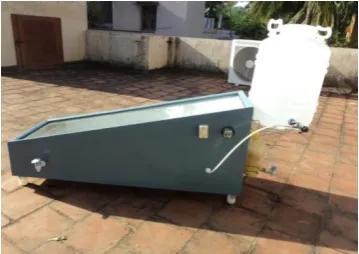
Fig. 1 shows an experimental setup of a solar still, made up of Galvanized Iron sheet. After releasing the
latent heat, the condensed water vapor trickles down the inclined glass cover to an interior collection trough from there it is collected into the storage container through distilled output collection port. Purified drinking water is collected from the distilled output collector.
Fig. 1 Solar Still made up of GI Sheet
C. Solar Still made up of Copper Sheet
Another still basin made up of Copper, painted black at the inside bottom is fabricated for the same specifications as shown in the Fig. 2. The Copper has higher thermal conductivity of 401 W/mK which is comparatively higher than G.I Sheet. Therefore the rate of heat transfer to water in the still is more. Thus the water temperature will be increased. Due to this evaporation rate of water will also be increased.
Copyright to IJIRSET www.ijirset.com 3178
IV. EXPERIMENTAL ANALYSIS FOR SOLAR STILL MADE UP OF GI SHEET
A. Measurements
The solar still made up of Galvanized Iron sheet, inside bottom black paint coated is operated at ambient conditions from 7:00 am to 7:00 pm during the months of April and May 2012. The measurements of the temperatures, solar radiation intensity, and the production of distilled water are taken hourly to study the effect of each parameter on the still productivity. In this study various operating conditions have been examined such as; different water depth, insulation thickness, ambient temperature and salt concentrations. The variables such as Tgin, Tgout, Ta, Tw, Tp and
productivity are measured hourly. The total productivity and solar Intensity for each day are also measured. Also, different experimental tests are carried out at different ambient conditions. The wind speed is found to be around 2-4 m/s.
B. Experimental Readings
The water level in the solar basin is maintained to a level of 1 cm and the salt concentration 0%. The hour by hour reading is tabulated in the Table II. The productivity rate varies as time passes from the early morning until late afternoon. In the morning, the temperature of water is low; therefore it needs high energy to change its phase from saturated liquid to saturated vapour phase. The results show that temperature and required heat are inversely proportional. The same measurement process is repeated for various parameters to find out the performance of the solar still by varying the salt concentrations of the water inside the solar still. Readings are tabulated for the different salt concentrations for the same water level inside the solar still and graphs are drawn. The readings are very low in values when compared to the water having 0% salt concentration for the same water level. It also shows that the higher the salt concentrations the lower will be the productivity.
The same measurement process is repeated to find out the performance of the solar still by varying the water level inside the solar still. The water level inside the still is increased from 1 cm, 3 cm and 5 cm. Readings are tabulated for the different water level for the same salt concentrations inside the solar still. If the water level inside the still is increased, the heat received from the solar radiation is spent for heating large quantity of water. So that water temperature inside the basin is decreased and in turn the amount of water evaporated is lowered. Therefore higher the water level, lower will be the distillate collected. Hence, there is a decrease in efficiency of the still for the incident solar radiation. This shows that the lower the distillate collected for the increase in water level.
C. Discussion on Results
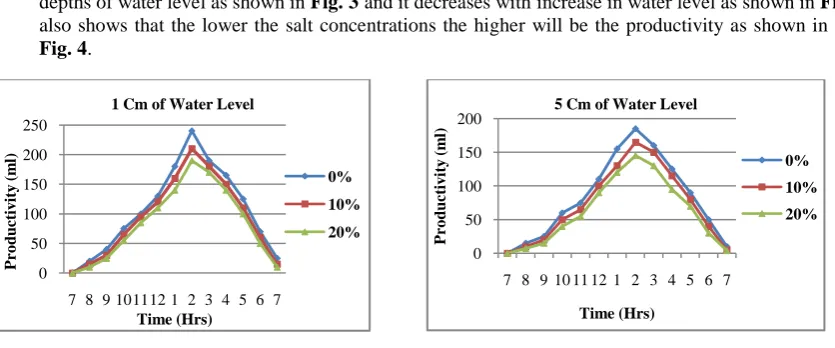
1) Productivity Vs Time with various concentrations: For a solar still made up of galvanized iron sheet, graphs are drawn for Productivity and Time for various concentrations of 0 %, 10 % and 20% and where different depths of water level of 1cm and 5 cm. It reveals an increase in the productivity for minimum depths of water level as shown in Fig. 3 and it decreases with increase in water level as shown in Fig. 4. It also shows that the lower the salt concentrations the higher will be the productivity as shown in Fig. 3, Fig. 4.
Fig. 3 Productivity Vs Time Fig. 4 Productivity Vs Time
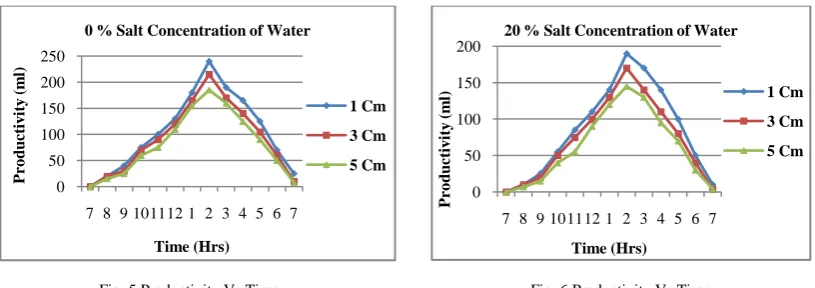
2) Productivity Vs Time with different levels of water: For a solar still made up of galvanized iron sheet graphs are drawn for Productivity and Time for different depths of water level of 1cm, 3cm and 5cm for various concentrations of 0 % and 20%. It reveals an increase in the productivity for the minimum depths of water level as shown in Fig. 5 and Fig. 6. It also shows that the lower the salt concentrations the
0 50 100 150 200 250
7 8 9 101112 1 2 3 4 5 6 7
Pr
o
d
u
ct
iv
it
y
(
m
l)
Time (Hrs) 1 Cm of Water Level
0%
10% 20%
0 50 100 150 200
7 8 9 10 11 12 1 2 3 4 5 6 7
Pr
o
d
u
ct
iv
it
y
(
m
l)
Time (Hrs) 5 Cm of Water Level
Copyright to IJIRSET www.ijirset.com 3179 higher will be the productivity as shown in Fig. 5 and it decreases with increase in the salt concentrations as shown in Fig. 6.
Fig. 5 Productivity Vs Time Fig. 6 Productivity Vs Time
V. EXPERIMENTAL ANALYSIS FOR SOLAR STILL MADE UP OF COPPER SHEET
A. Measurements
A single basin solar still made up of copper sheet inside bottom black colour coated is fabricated and tested in the same way from 7:00 am to 7:00 pm during the months of April and May 2012. The same measurement processes is repeated to study the effect of each parameter on the still productivity for various operating conditions. The wind speed is found to be around 2-4 m/s. The average daily output was found to be 3 liters/day for basin area of 0.27 m2 based on data. The optimized glass cover angle was 90. The water level in the solar basin is maintained to a level of 1cm and 0% salt concentration. The hour by hour reading is tabulated in the below tabular column Table II. From this table, we infer that the output readings are very high in values when compared to the solar still made up of galvanized iron sheet for 0% salt concentration and 1 cm water level. The productivity rate varies as time passes from the early morning until late afternoon and the output of the solar still varies directly with the ambient temperature. The hourly output is maximum in the afternoon hours when the ambient the ambient temperature is at its daily peak.
B. Experimental Readings
In this still, the productivity increases due to the increase in heat gain for water vaporization inside the still because copper conducts more heat compared to the still made up of Galvanized Iron. If the level of salt concentration is higher, the portion of incident solar radiation is wasted for heating the salt rather to heat the water inside the still. So that water temperature inside the basin is decreased and in turn the amount of water evaporated is lowered. Therefore, more the salt concentrations lower the distillate collected. Hence, there is a decrease in efficiency of the still for the incident solar radiation. The water temperature has a direct effect on the productivity whereas the depth of water increases from 1 cm to 3 cm and 5 cm, the daily still output decreases i.e. inversely proportional. The efficiency was calculated as 80 % higher when compared with the stills being used worldwide.
C. Discussion on Results
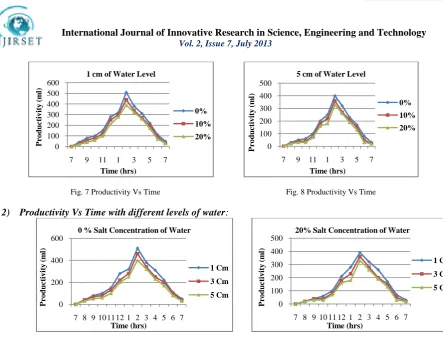
1) Productivity Vs Time with various Concentrations: For a solar still made up of copper sheet, Graphs are drawn for Productivity and Time for various concentrations of 0 %, 10 % and 20% for different depths of water level of 1cm and 5 cm. It reveals an increase in the productivity for minimum depths of water level as shown in Fig. 7 and it decreases with increase in water level as shown in Fig. 8. It also shows that the lower the salt concentrations the higher will be the productivity as shown in Fig.7 and Fig. 8.
0 50 100 150 200 250
7 8 9 101112 1 2 3 4 5 6 7
Pr
o
d
u
ct
iv
it
y
(
m
l)
Time (Hrs)
0 % Salt Concentration of Water
1 Cm
3 Cm
5 Cm
0 50 100 150 200
7 8 9 101112 1 2 3 4 5 6 7
Pr
o
d
u
ct
iv
it
y
(
m
l)
Time (Hrs)
20 % Salt Concentration of Water
1 Cm
3 Cm
Copyright to IJIRSET www.ijirset.com 3180
Fig. 7 Productivity Vs Time Fig. 8 Productivity Vs Time
2) Productivity Vs Time with different levels of water:
Fig. 9 Productivity Vs Time Fig. 10 Productivity Vs Time
For a solar still made up of copper sheet, Graphs are drawn for Productivity and Time for various concentrations of 0 % and 20% and where different depths of water level of 1cm ,3cm and 5cm. as shown in Fig. 9 and Fig. 10. It reveals an increase in the productivity for minimum depths of water level as shown in Fig. 9. It also shows that the higher the salt concentrations the will be lower the productivity as shown in Fig. 10.
VI. COMPARISON BETWEEN SOLAR STILLS MADE UP OF GI SHEET VS COPPER
In this work, the performance of a solar still made up of copper sheet is compared to the still made up of galvanized iron sheet as shown in the Table II. Both the stills are coated with black painting inside the bottom of the basin to increase the temperature of the water in the basin by absorbing all the incident solar radiation. A single basin solar still made up Galvanized Iron sheet has low yield of 1360 ml/day and 30 % efficiency. But, for the still made up of copper sheet, the productivity is increased further due to the increase in heat gain for vaporization of water inside the still. Copper has higher thermal conductivity and it conducts more heat. Due to this, the amount of distillate collected in this still is higher (2490 ml/day) and hence the increase in efficiency by 80 % when compared to the still made up of Galvanized Iron sheet for the same basin area, coated with black painting inside the still. The annual yield is at its maximum when the condensing glass cover inclination is equal to the latitude of the place.
0 100 200 300 400 500 600
7 9 11 1 3 5 7
Pr o d u ct iv it y ( m l) Time (hrs) 1 cm of Water Level
0% 10% 20% 0 100 200 300 400 500
7 9 11 1 3 5 7
Pr o d u ct iv it y ( m l) Time (hrs) 5 cm of Water Level
0% 10% 20% 0 200 400 600
7 8 9 10 11 12 1 2 3 4 5 6 7
Pr o d u ct iv it y ( m l) Time (hrs)
0 % Salt Concentration of Water
1 Cm 3 Cm 5 Cm 0 100 200 300 400 500
7 8 9 10 11 12 1 2 3 4 5 6 7
Pr o d u ct iv it y ( m l) Time (hrs)
20% Salt Concentration of Water
1 Cm 3 Cm
Copyright to IJIRSET www.ijirset.com 3181
TABLE II
GI SHEET Vs COPPER SOLAR STILLS (1Cm WATER LEVEL 0% SALT CONCENTRATION)
Time Duration DBT WBT Wind Velocity Solar Intensity Water Collection in ml
Hour 0C 0C m/s W/m2 GI still Copper Still
07a.m-08a.m 28 25 0.9 850 20 50
08a.m-09a.m 30 26 1 1000 40 80
09a.m-10a.m 32 27 1 1250 75 120
10a.m-11a.m 34 27 0.7 1275 100 200
11a.m-12a.m 35 28 4.5 340 130 260
12p.m-13p.m 36 27 0.5 1143 180 300
13p.m-14p.m 37 27 2.1 1060 240 330
14p.m-15p.m 36.5 28 1.8 338 190 380
15p.m-16p.m 36 27 2.5 750 165 320
16p.m-17p.m 33 25 2.3 1100 125 240
17p.m-18p.m 31 24 2.5 904 70 130
18p.m-19p.m 28 23 2.0 700 25 80
A. Productivity Vs Time for Copper Still Vs GI Still
For a solar still made up of copper solar stills made up of GI sheet and Copper sheet, Graph is drawn for Productivity and Time for the water level of 3cm for salt concentration of 10 %. The productivity is higher for the copper still when compared with the still made up of GI sheet as shown in Fig. 11.
Fig. 11 Productivity Vs Time for Copper Still Vs GI Still
VII. COST ESTIMATION
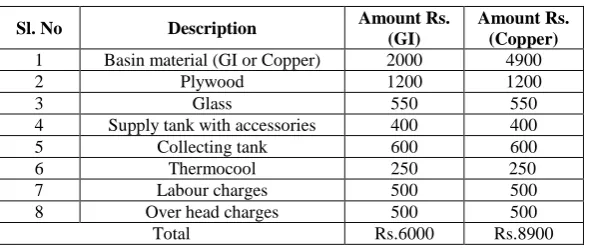
The overall cost of the experimental setup is given in Table III.
TABLE III COST ESTIMATION
Sl. No Description Amount Rs.
(GI)
Amount Rs. (Copper)
1 Basin material (GI or Copper) 2000 4900
2 Plywood 1200 1200
3 Glass 550 550
4 Supply tank with accessories 400 400
5 Collecting tank 600 600
6 Thermocool 250 250
7 Labour charges 500 500
8 Over head charges 500 500
Total Rs.6000 Rs.8900
0 100 200 300 400 500 600
7 8 9 10 11 12 1 2 3 4 5 6 7
Pro
d
u
ct
iv
ity
(
m
l)
Time (hrs)
GI vs Copper Still
GI Still
Copyright to IJIRSET www.ijirset.com 3182 A. Economic Analysis
The payback period of the solar still setup depends on overall cost of fabrication, maintenance cost, operating cost and cost of feed water. The payback period for both the stills is less than 1 Year.
VII. THEORETICAL ANALYSIS
The energy received by the saline water in the still I (t) solar radiation and Q cb-w convective heat transfer
between basin and water are equal to the summation of energy lost by Q cw-g convective heat transfer between water
and glass, Q rw-g radiative heat transfer between water and glass, Q ew-g evaporative heat transfer between water and
glass and energy gained by the saline water:
Q
b
w
A
a
t
I
(
)
w w cQ
cw
g
Q
rw
g
Q
ew
g
m
wc
pwdT
w/
dt
Following Dunkle (1961),the rate energy lost from water surface by evaporation per m2 is given by
)
(
0163
.
0
c w w ge w
h
P
P
q
n cw
Gr
C
k
d
h
Nu
.(
.
Pr)
The hourly distillate output per m2 from distiller unit is given by
3600
X
L
q
m
w
ewn g
w
C
Gr
L
d
k
P
P
)(
)(
3600
)
(
Pr)
(
0163
.
0
wC
Gr
nR
m
Pr)
(
where)
3600
)(
)(
(
0163
.
0
L
d
k
P
P
R
w
gPw =Partial pressure of saturated water
Pg= Partial pressure of glass saturated
hcw=heat loss coefficient by convection from water surface to glass (W/m2 K)
The still efficiency is defined as the ratio of heat energy used for vaporizing the water in the basin to the total Solar Intensity of radiation absorbed by the still. The daily efficiency ( ηd) is obtained by summing up the hourly condensate
production (mw), multiplied by the latent heat of vaporization (hfg), and divided by the daily average solar radiation (I)
over the still area (As).
The overall Thermal Efficiency of still (
) is given byI
A
h
m
s g f w.
.
---(16) where,mw=mass of distillate collected in kg/s A = Area of the basin in m2
I(t) = Solar radiation with respect to time W/m2 and L = Latent heat of vaporization in KJ/kg.
VIII. CONCLUSION
Copyright to IJIRSET www.ijirset.com 3183 salt concentrations lower the distillate collected. Hence, there is a decrease in efficiency of the still for the incident solar radiation. Thus the efficiency is higher for a solar still made up of copper sheet and it can be used at each house for producing the drinking water.
REFERENCES
[1] Bhanu Pratap Singh, “Performance Evaluation of a Integrated Single Slope Solar Still With Solar Water Heater,” MIT International Journal of Mechanical Engineering, Vol. 1,No. 1, pp 68-71, Jan 2011.
[2] Tiwari G.N, H.N. Singh, Rajesh Tripathy, “Present status of solar distillation,” solar energy, No. 75, pp.367-373, 2003.
[3] Omar O. Badran, Mazen M. Abu-khader, “Evaluating thermal performance of a single slope solar still,” Heat And Mass Transfer, No.43, pp. 985-995, 2007.
[4] Al Hayek I and Bardan O O, “The effect of using different designs of solar stills on water distillation,” Desalination, No.150, pp.230-250, 2004. [5] Salah Abdallah, Omar Badran, Mazen M,Abu-Khader, “Performance evaluation of a modified design of a single-basin solar still, Desalination,
No.219, pp.222-230, 2008.
[6] Kalidasa Murugavel K, Chockelingam Kn KSK, Srither K, “Progresses in improve the effectiveness of the single basin passive solar still,” Desalination, No. 220, pp., 677-686, 2008.
[7] Srithar, K. “Performance Analysis of Vapour Adsorption Solar Still Integrated with Mini-solar Pond for Effluent Treatment,” International Journal of Chemical Engineering and Applications, Vol. 1, No. 4, December 2010.
[8] Hussain A.K.M. Solar energy utilization in Libya for seawater desalination, Proceedings at the ISES Solar World Congress, Gothenburg, (2003). [9] Kalogirou, S.A., “Economic analysis of a solar assisted desalination system, International journal of Renewable Energy, 12 (4), 351-367, 1997. [10]Velmurugan.V, Senthilkumaran.S,Niranjanprabhu.V, Srither.K. “Productivity enhancement of stepped solar still-performance analysis,”Thermal
science, Vol.12, No.3, pp.153-163, 2008.
[11] Garzia-Rodriguez L. “Seawater desalination driven by renewable energies: a review, In: Desalination, 143, 103- 113, 2002.
[12]Anil Kr. Tiwari, and Tiwari, G.N. “Effect of water depths on heat and mass transfer in a passive solar still: in summer climatic condition”, Desalination, Vol.195, pp. 78-94, 2006.
[13]Arjunan, T.V., Aybar, H.S. and Nedunchezhien, N. “Status of solar desalination in India”, Renewable and Sustainable Energy Reviews, Vol.13, No.9, pp. 2408-2418, 2009.
[14]Badran, O.O. and Al-Tahaineh, H.A. “The effect of coupling a flat plate collector on the solar still productivity”, Desalination, Vol.183, pp.137-142, 2005.
[15]Dunkle, R.V. “Solar water distillation; the roof type solar still and a multi effect diffusion still”, International Developments in Heat Transfer, Part V, ASME, University of Colorado, pp.895, 1961.
[16]Dwivedi, V.K. and Tiwari, G.N. “Comparison of internal heat transfer coefficients in passive solar stills by different thermal models: An experimental validation”, Desalination, Vol.246, pp.304-318, 2009.
[17]World Health Organization. “Guidelines for drinking water quality, Vol. I. Recommendations, Geneva, 1984.
[18]Amos Mahhlopa, “Development of an advanced passive solar still with separate condenser”, Ph.D. Thesis, University of Strathclyde, UK, 2009. [19]Garcia-Rodriguez, L., “Renewable energy applications in desalination: state of the art, Solar Energy 75, 381-393, 2003.
[20]Fiorenza, G., Sharma, V.K. and Braccio, G., “Process control in water desalination industry: an overview. Desalination 126, 15-32, 1999. [21]Dore, M.H.I., “Forecasting the economic costs of desalination technology. Desalination 172, 207-214, 2005.
[22]Ebensperger,U., and Isley, P. “Review of the current state of desalination. Water Policy Working Paper 2005-008. Georgia State University. Environmental Policy Program; Water Policy Centre, 2005.
[23]Schiffler, M., “Perspectives and challenges for desalination in the 21st century. Desalination 165, 1-9, 2004.
BIOGRAPHY