RESEARCH ARTICLE
ENHANCING STUDENTS’ SPEAKING COMPETENCE THROUGH COMMUNICATIVE LANGUAGE
TEACHING METHOD
Lourdes A. Batuto, MA. and *Maria Morena E. de la Pena
Biliran Province State Univesity, Philippines
ARTICLE INFO ABSTRACT
This study primarily aimed to enhance the students’ speaking competence in Naval Night High School through communicative language teaching (CLT) method. This study utilized the descriptive-correlational research design, with the aid of observation checklist and rubric to measure the speaking competence of the Junior High School students, school year 2018-2019. The Junior High School English teachers in Naval Night High School have knowledge, attitudes, and practices about CLT, such as: focuses on meaning rather than grammar, suffers from low proficiency in the spoken target language, gathers students in group or/and pair-work, uses language activities for carrying out the meaningful tasks to promote learning, and raises questions related to students’ personal experiences. The speaking competence of the JHS students from all levels was enhanced through role playing, dramatic presentation, and panel discussion. Some of the problems encountered by the teachers in the implementation of CLT related activities includes relaying of ideas, insufficient time in practicing, not being prepared resulting to not being able to present on scheduled time, unwillingness to help, and difficulties during the rehearsals. There is a significant relationship between the communicative language teaching (CLT) related activities used by the teachers and students’ competence was rejected. In conclusion, the CLT activities such as role playing, drama presentations, and panel discussion improved the speaking competence of the students. Hence, the use of CLT inspired learning material shall be used by the English teachers not only in Naval Night High School, but in other schools across Biliran Division is strongly recommended.
INTRODUCTION
Background of the Study: Communicative language teaching (CLT) was widely seen as the definitive response to the shortcomings of previous approaches and the communication needs of a globalized world. Since its inception in the 1970s, CLT has served as a major source of influence on language teaching practice around the world. Many of the issues raised by a communicative teaching methodology are still relevant today, though teachers who are relatively new to the profession may not be familiar with them. For some 40 years now, discussions of foreign language teaching have been dominated by the concept of ‘communication’ and its various derivatives such as ‘communicative language teaching’ and ‘communicative competence’. Hunter and Smith (2012) analyzed the keywords in articles published in one leading UK-based journal (ELT Journal) and showed how communicative ideas and terminology gradually climbed to a dominant status in ELT professional discourse in the years up to 1986. Wenli (2005) posited that some teachers have problems with students who do not participate in classroom and are always silent. In countries like China and Japan, teachers encourage students to participate in, for example role plays, etc. The ever-growing need for good communication skills in English has created a huge demand for English’ teaching around the world. Millions of people today want to improve their command of English or want their children achieve a good command of English. Abbaspour (2016) noted that most English learners nowadays need to be able to
communicate with other people in the language. Speaking is not always their top priority, and, for many learners, reading and writing may be of more importance. However, even academics and businessmen whose main interest in English is for reading and writing reports, may need, on occasion, to explain their ideas and thoughts, or simply to make polite conversation, in English. Approaches to language teaching today seek to capture the rich view of language and language learning assumed by a communicative view of language. Jacobs and Farrell (2003) see the shift toward CLT as marking a paradigm shift in our thinking about teachers, learning, and teaching. Harmer (2003) suggests that ‘the problem with communicative language teaching (CLT) is that the term has always meant a multitude of different things to different people.’ Spada (2007) expresses a similar view in her review of CLT: ‘What is communicative language teaching, where he posited that the answer to this question seems to depend on whom you ask. In the Philippines, not many studies have been done in this context. However, practical wisdom suggests that speaking competence is therefore an important, but elusive, objective for many foreign language learners. It has been the focus of foreign language teaching methods so far. The debate on the importance of accuracy in communicative language teaching era has been reflected in many studies in speaking and has been a key element in the definition of communicative competence. In Naval School of Fisheries, the students have a lot of problems at their secondary level. They want to speak, but when they go to class, they do not feel to learn a thing. They are not able to convert their thoughts through speaking, Article History:
Received 30th may, 2019 Received in revised form 20th June, 2019 Accepted 10th July, 2019 Published online 31st August, 2019
International Journal of Recent Advances in Multidisciplinary Research
Vol. 06, Issue 08, pp.5107-5117, August, 2019
Keywords:
Hypothesis,
Framework of the Study, Theoretical Framework, Conceptual Framework.
and they could not understand non-native speaker at all. Some teachers encourage students to interact with others and to communicate in real situation. Likewise, students should know the purpose of speaking, what is speaking, where to speak, and how to speak. The worldwide call for English has created an enormous demand for quality language teaching with appropriate materials and resources. Learners set themselves demanding goals. They want to be able to master English to a high level of accuracy and fluency. It is for this reason that the researcher opted to conduct this study to find out how communicative language teaching (CLT) method enhances the speaking competence of the students.
Objectives of the Study: This study primarily aimed to enhance students’ speaking competence in Naval School of Fisheries through communicative language teaching (CLT).
Specifically, it aimed to achieve the following objectives
Determine the communicative language teaching (CLT) related activities used by the teachers in terms of knowledge and application.
Evaluate the students’ speaking competence;
Identify the problems encountered by the teachers in the implementation of CLT related activities;
Ascertain the significant relationship between the communicative language teaching (CLT) related activities used by the teachers and the students’ speaking competence; and
Design a CLT inspired learning material.
Hypothesis
Ho1: There is no significant relationship between the
communicative language teaching (CLT) related activities used by the teachers and the students’ speaking competence.
Framework of the Study: This study takes hold of the following theoretical and conceptual framework as its main and strong foundation in the due course of its proceedings.
Theoretical framework: This study is anchored on Hymes’ (1972) Communicative Competence Theory. Hymes (1972) used this theory to reflect the following key positions on knowledge and use of language: (1) the ability to use a language well involves knowing how to use language appropriately in any given context; (2) the ability to speak and understand language is not based solely on grammatical knowledge; (3) what counts as appropriate language varies according to context and may involve a range of modes – for example, speaking, writing, singing, whistling, and drumming; and (4) learning what counts as appropriate language occurs through a process of socialization into particular ways of using language through participation in particular communities. In this regard, Hymes (1972) offers communicative competence as a more general and super-ordinate term to encompass the language capabilities of the individual that include both knowledge and use: “competence is dependent upon both (tacit) knowledge and (ability for) use. This theory is appropriate since the present study is focused on enhancing the students’ speaking competence through CLT method.
Conceptual framework: The present study is focused in enhancing the students’ speaking competence in Naval School of Fisheries through communicative language teaching (CLT)
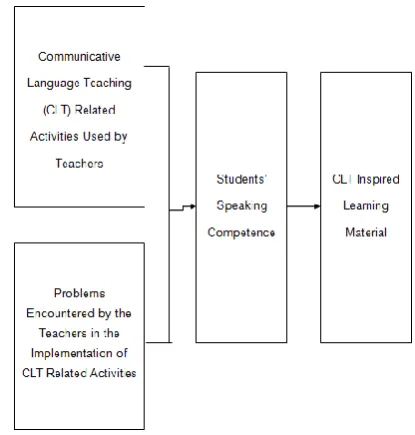
method. Specifically, the communicative language teaching (CLT) related activities used by the teachers in terms of knowledge and application is the independent variable, while students’ competence is the dependent variable of the study, and is the basis in designing a CLT inspired learning material. The problems encountered by the teachers in the implementation of CLT related activities were also elicited. The schematic diagram in Figure 1. Shows the notion of the present study.
Figure 1. Conceptual Framework of the Study
Importance of the Study: The findings drawn from this study will help school authorities and other stakeholders gain insights of the benefits of the communicative language teaching.
The results will give intuitions to the following personalities
School heads: The results will guide them in designing trainings related to the communicative language teaching. They will be empowered to formulate new policies that could improve the communicative competence of the learners.
Teachers: The results could potentially be used to guide them in the utilization of teaching strategies that could somehow boost the instructional design and delivery, knowing that their students have become participative in the class.
Students: They will be given equal chances to participate in class, resulting to fluency of the English language through speaking. Their speaking skills will be developed, and they will be more likely to succeed.
Future researchers: This study could be replicated in other settings to determine if there is enhancement of speaking competence through the use of other strategies. The writer also hopes that the results can stimulate other researchers to conduct research related to this field.
researcher had only eight weeks to conduct the study, where communication language teaching (CLT) is used only once every week.
Definition of Terms: To avoid confusions and misinterpretation of the terminologies used in this study, the following terms are operationally and conceptually defined.
Communicative Language Teaching (CLT): The term refers to the method that emphasizes on breaking down the global concept of language, and aims to develop the communicative competence through personally meaningful learning experiences. Richards and Rodgers (1986) described CLT as an approach rather than a method, since it represents a philosophy of teaching that is based on communicative in use.
CLT related activities: This term refers to the activities employed by the teachers in developing the speaking competence of the learners; such as, but not limited to role playing, dramatic presentation, and panel discussion.
Speaking competence: The term is used to refer to the competence of the learners in pronunciation, grammar, and vocabulary. It can be measured through their fluency and accuracy.
Review of Literature: In this section, different insights and ideas authored by educators viewed the nature of the departmentalized instruction. One of the most important goals of teachers is to enable learners to use English for communication. There are ways of communicating language, and one is speaking. However, speaking is not the most determining way whether a communication goes as it is expected or not. People can also write to communicate the language, but most people speak, and they speak everyday. Richards (2006) noted that the ever-growing need for good communication skills in English has created a huge demand for English teaching around the world. Millions of people today want to improve their command of English to ensure that their children achieve a good command of English. The demand for an appropriate teaching methodology is therefore as strong as ever. Since the 1990s, the communicative approach has been widely implemented and has continued to evolve as our understanding of the processes of second language learning has developed. Current communicative language teaching theory and practice thus draws on a number of different educational paradigms and traditions.
And since it draws on a number of diverse sources, there is no single or agreed upon set of practices that characterize current communicative language teaching. Rather, communicative language teaching today refers to a set of generally agreed upon principles that can be applied in different ways, depending on the teaching context, the age of the learners, their level, their learning goals, and so on (Richards, 2006).
The following core assumptions or variants underlie current practices in communicative language teaching as Richards points out
Second language learning is facilitated when learners are engaged in interaction and meaningful communication;
Effective classroom learning tasks and exercises provide opportunities for students to negotiate meaning, expand their language resources, notice how language is
used, and take part in meaningful interpersonal exchange;
Meaningful communication results from students processing content that is relevant, purposeful, interesting, and engaging;
Communication is a holistic process that often calls upon the use of several language skills or modalities;
Language learning is facilitated both by activities that involve inductive or discovery learning of underlying rules of language use and organization, as well as by those involving language analysis and reflection;
Language learning is a gradual process that involves creative use of language, and trial and error. Although errors are a normal product of learning, the ultimate goal of learning is to be able to use the new language both accurately and fluently;
Learners develop their own routes to language learning, progress at different rates, and have different needs and motivations for language learning;
Successful language learning involves the use of effective learning and communication strategies;
The role of the teacher in the language classroom is that of a facilitator, who creates a classroom climate conducive to language learning and provides opportunities for students to use and practice the language and to reflect on language use and language learning; and
The classroom is a community where learners learn through collaboration and sharing.
In conclusion, Richards (2006) wrote that since its inception in the 1970s, communicative language teaching has passed through a number of different phases. In its first phase, a primary concern was the need to develop a syllabus and teaching approach that was compatible with early conceptions of communicative competence. This led to proposals for the organization of syllabuses in terms of functions and notions rather than grammatical structures. Later, the focus shifted to procedures for identifying learners’ communicative needs and this resulted in proposals to make needs analysis an essential component of communicative methodology. At the same time, methodologists focused on the kinds of classroom activities that could be used to implement a communicative approach, such as group work, task work, and information-gap activities. Today, CLT can be seen as describing a set of core principles about language learning and teaching, assumptions which can be applied in different ways, and which address different aspects of the processes of teaching and learning. Today, CLT continues in its classic form as seen in the huge range of course books and other teaching resources that cite CLT as the source of their methodology. In addition, it has influenced many other language teaching approaches that subscribe to a similar philosophy of language teaching (Richards, 2006).
teacher-centred pedagogy to a student-centred CLT pedagogy as a ‘quantum leap’ in the transmission-oriented context of Hong Kong schools. In China, Wang (2007) summarizes some of the practical challenges faced by teachers in China when they are asked to make this ‘leap’ from a traditional approach to a communication-oriented approach: they are expected to develop new practical skills for classroom teaching; change how they evaluate students; develop the ability to adapt textbooks; use modern technology; improve their own language proficiency; change their conception of their own role from being a transmitter of knowledge to being a multi-role educator; and change their conception of language learning from one based on knowledge-acquisition to one based on the holistic development of competence.
In Korea, Jeon (2009) describes a similar situation, where ‘emphasizing the communicative language approach was a drastic change compared to the previous, traditional approach to language instruction in Korea.’ The factors in this ‘drastic change,’ which Jeon highlights include setting the unit of analysis at the discourse level rather than the sentence level; emphasizing communicative competence rather than only linguistic competence; moving from teacher-fronted to learner-centred classes; changing the teacher’s role from lecturer to facilitator; and working with textbooks which focus on communicative situations rather than language based on sentence examples. After a survey of 305 teachers in Korea, Jeon (2009) notes that ‘while it can be seen that many EFL teachers support the introduction of the communicative approach in Korea, it is also evident that too many discouraging factors will inhibit their enthusiasm for actually implementing the communicative approach in reality.’ Following her survey of teachers in the Asia-Pacific region, Butler (2011) classifies the challenges as involving: ‘(a) conceptual constraints (conflicts with local values and misconceptions regarding CLT/TBLT); (b) classroom-level constraints (various student and teacher-related factors, classroom management practices, and resource availability); and (c) societal-institutional level constraints (curricula and examination systems)’. With specific reference to the Korean experience with CLT, Li (1998) groups teachers’ difficulties with CLT under four factors similar to those of Butler (2011): the teacher factor, the student factor, the education system factor, and the method factor. The factors which emerge from Kim’s (2008) analysis of one teacher’s behaviour could be grouped under similar categories: the teacher’s own experience as an English learner, students’ low proficiency level in English, the effectiveness of traditional methods of instruction for preparing students for high-stake school exams, top-down teacher training, class size, teachers’ and students’ socialization in the educational context, and teachers’ and students’ beliefs about language teaching and learning.
In its early days, CLT was perceived by many as a new and unquestionable orthodox. As Morrow and Johnson (1983) put it with reference to a seminal conference that they organized in 1978, in those days ‘functional syllabuses seemed to offer an automatic solution to all the problems of language teaching’. As a package of ideas and techniques, CLT was exported around the world with the support of the full paraphernalia of the ELT industry (textbooks, advisors, training courses, native-speaker teachers, and so on). According to Sewell (2013), the National language education policies have shown a strong tendency to follow this trend. This is not surprising, since almost every nation has faced an increasing need for people
who can communicate with speakers of other languages, particularly through ‘English as a lingua franca.’ This trend to advocate CLT is documented in international surveys such as those of Butler (2011), Ho and Wong (2004) and Nunan (2003). Brown (2001) posited that worrying about being "wrong, stupid, or incomprehensible" completely influences learners' speaking performance. Most of English learners are nervous in class, especially when they are asked to speak in class without any readiness. This was supported by Shumin (2002), who said that too much nervousness makes learners tongue-tied or lost for words, which completely affects their achievement in foreign language classroom. Since risk taking is viewed as an essence for successful learning of a second language, (Brown, 2007), encourages EFL learners to speak bravely in order to promote their speaking competence gradually.
In line with this, Bax (2003) writes of what he sees as the ‘CLT attitude’ that accompanied this endeavour: ‘assume and insist that CLT is the whole and complete solution to language learning; assume that no other method could be any good; ignore people’s own views of who they are and what they want; neglect and ignore all aspects of the local context as being irrelevant’. After their experiences, Ho and Wong (2004), shared that ‘there has been much criticism of an unquestioning acceptance of CLT techniques in ELT in this [East Asian] region and of the varying practices of CLT’. Hiep (2007) too states, from the perspective of Vietnam, that ‘teachers in many parts of the world may reject the CLT techniques transferred from the West’. However, he goes on to say that ‘it is doubtful that they reject the spirit of CLT.’ In his words, this spirit is that ‘learning is likely to happen when classroom practices are made real and meaningful to learners,’ and that the goal is to teach learners ‘to be able to use the language effectively for their communicative needs.’ If this is so, CLT may continue to provide a conceptual framework centred on the needs: (a) to orient teaching towards learners’ communicative goals, and (b) to design meaningful experiences which lead towards these goals. It is in this spirit that many teachers and teacher-educators now put the emphasis not on adopting CLT but on adapting it to suit the context where English is taught (Hiep, 2007). In contrast, Jeon (2009) concludes in her survey of 305 teachers, saying that ‘different contexts require different methods.
priority over the creative language use and student centring which have been associated with more fluency-oriented or “progressivist” interpretations of the communicative approach.’ Meanwhile, Zheng and Adamson (2003) analyze how a secondary school teacher of English ‘reconciles his pedagogy with the innovative methodology in a context constrained by examination requirements and the pressure of time, ’by ‘expanding his repertoire rather than rejecting previous approaches.’ The teacher maintains many traditional elements, such as his own role as a knowledge transmitter, the provision of grammatical explanations, and the use of memorization techniques and pattern drills. However, he integrates new ideas into his pedagogy by including more interaction and more creative responses from the students in his classes, ‘usually in the context provided by the textbook, but sometimes in contexts derived from the students’ personal experience.’ The discussion so far has been framed around the notion that the core notions of a ‘traditional approach’ and a ‘CLT approach’ are valid reflections of reality. However, this is not a necessary assumption. Teachers may break free altogether from concepts such as ‘traditional’ and ‘CLT’. They may simply choose ideas and techniques from the universal, transnational pool that has been built up over the years and evaluate them according to how well, in their own specific context, they contribute to creating meaningful experiences, which lead towards communicative competence.
From this perspective, the notion that CLT is a distinct methodology disappears. Ideas and techniques from whatever source – so-called traditional, so-called CLT, or indeed any other source – constitute a common pool on which teachers can draw in order to design classroom practices which are real and meaningful to their learners and help learners towards fulfilling their communicative needs. This aligns with the suggestion of Beaumont and Chang (2011) that the CLT / traditional dichotomy may ‘inhibit methodological development’ and it is better to define learning activities in terms of their learning outcomes and their ‘potential to make a contribution to the general goal of learning a language, i.e. successful communication.’ It is also consistent with the views reported above that CLT now functions mainly as an ‘umbrella term’ for learning sequences that lead towards communication (Harmer, 2007), and that what is now essential is not any specific set of ideas and techniques, but ‘the spirit of CLT’ (Hiep, 2007). Richards (2006) reported that advocates of CLT also recognized that many learners needed English in order to use it in specific occupational or educational settings. For them, it would be more efficient to teach them the specific kinds of language and communicative skills needed for particular roles, (e.g., that of nurse, engineer, flight attendant, pilot, biologist, etc.) rather than just to concentrate on more general English. This led to the discipline of needs analysis, which is used to determine the specific characteristics of a language when it is used for specific rather than general purposes. Such differences might include: differences in vocabulary choice, differences in grammar, differences in the kinds of texts commonly occurring, differences in functions, and differences in the need for particular skills. One of the goals of CLT is to develop fluency in language use. Fluency is natural language use occurring when a speaker engages in meaningful interaction and maintains comprehensible and ongoing communication despite limitations in his or her communicative competence. Accuracy is developed by creating classroom activities in which students must negotiate meaning, use communication strategies, correct
misunderstandings, and work to avoid communication breakdowns. Fluency practice can be contrasted with accuracy practice, which focuses on creating correct examples of language use (Richards, 2006). The concepts of the aforementioned literature and findings of some research on CLT to students’ speaking competence have direct and indirect bearing on the problem of this study and will be used as benchmark information for the development of the investigation. Those studies were to some extent relevant to the present study because it focuses on the use of communicative language teaching in enhancing the speaking competence of the students.
MATERIALS AND METHODS
This chapter presents the methods used in the study. It discusses the research design, research locale, research respondents, research instrument, data gathering procedure, data scoring, and statistical treatment in the analysis of the data.
Research Design: This study utilized the descriptive-correlational research design, which involved observing and describing the behavior of a subject without influencing it in any way.It is deemed appropriate because it gives a better and deeper understanding of a phenomenon on the basis of an in-depth study, which provides the basis for decision-making.
Research Locale: This study was conducted at the Junior High School (JHS) Department of the Naval Night High School (NNiHS), situated along the road of Caray-Caray, Naval, Biliran. Naval Night High School is offering both Junior High School and Senior High School, where Caregiving is the only program offered by its Senior High School under the TVL track/strand.
Research Respondents: The respondents of this study were the 190 Junior High School students and four English teachers of the Naval Night Junior High School, during the school year 2018-2019.
Research Instrument: This study utilized a standardized survey questionnaire, observation checklist, and a rubric to elicit the data needed. The survey questionnaire and observation checklist elicited information on the communicative language teaching (CLT) related activities used by the teachers. The indicators were adopted from the study of: Niez, Cerera, Tan, Superable, and Castro (2018). The rubric solicited data on students’ speaking competence through the conduct of role plays, drama presentation, and panel discussion. To solicit the problems encountered by the teachers in the implementation of CLT related activities, and to triangulate the results gathered through the questionnaire, this research conducted a Focus Group Discussion.
Data Scoring: Data were collated, tallied, analyzed, correlated, interpreted, and presented in tables based on the variables of the study. A survey questionnaire and observation checklist were used in eliciting the communicative language teaching (CLT) related activities used by the teachers.
The responses to the survey questionnaire were categorized into
Range Qualitative Description
4.21 – 5.00 Strongly Agree 3.41 – 4.20 Agree
2.61 – 3.40 Uncertain 1.81 – 2.60 Disagree
1.00 – 1.80 Strongly Disagree
The responses to the observation checklist were categorized into
Range Qualitative Description
3.3 – 4.0 Observed 2.1 – 3.3 Not Observed 1.0 – 2.0 Not at All
The students’ speaking competence were measured through role playing, dramatic performance, and panel discussion; and were evaluated using a rubric. On dramatic performance, the following categorization was used.
Rating Qualitative Description
100 pts. Master 85 pts. Apprentice 75 pts. Stage Hand
On panel discussion, the following categorization was used
Rating Qualitative Description
4.21 – 5.00 Excellent 3.41 – 4.20 Very Impressive 2.61 – 3.40 Impressive 1.81 – 2.60 Convincing 1.00 – 1.80 Beginning
Statistical Treatment of the Data
Data in this study were analyzed using the following:
Descriptive statistics such as frequency counts, simple percentage, and weighted mean were used to describe the modifying variables of the study. The data were also subjected to the coefficient of correlation analysis to find out any significant relationship among the variables.
RESULTS AND DISCUSSION
This chapter presents the results, analysis, and interpretation of data from the survey conducted. The results are presented according to the sequence of the objectives, with corresponding analysis and textual presentations of the interpretations contained therein.
Communicative Language Teaching (CLT) Related Activities: Table 1-4 show the communicative language teaching related activities used by the teachers are categorized into knowledge of teachers, students, and classroom practices, as well as the application of CLT in the classroom.
Knowledge of teachers: Table 1 shows the communicative language teaching related activities used by the teachers on knowledge of teachers. The weighted means ranged from 2.0 to 4.0, and an average weighted mean of 3.6 interpreted as strongly agree. The highest weighted mean of 4.0 denotes that the respondent strongly agree that: in communicative Language teaching (CLT), the teacher should emphasize communicative competence; the role of teacher in CLT classes is viewed as a facilitator and guide to students; the teachers' task is to motivate students; the teacher plans a set of activities and techniques; and in CLT classes, teacher should be aware of the individual differences among students. In contrast, the lowest weighted mean of 3.0 means that the respondents agree that: in CLT classes, the teacher discuses students’ homework and assignments; the teacher is responsible for organizing the resources for the students; vocabulary is presented to students in the form of isolated word lists; and in CLT classes, the teacher is a researcher and a learner at the same time.
Knowledge of students: Table 2 illustrates the communicative language teaching related activities used by the teachers on knowledge of students. The weighted means ranged from 2.0 to 4.0, and an average weighed mean of 3.03, interpreted as agree. The highest weighted mean of 4.0 means that the respondents strongly agree that, in CLT, students should interact with other people through pair and group- work. On the other hand, the lowest weighted mean of 2.0 denotes that the respondents disagree that, in CLT, students prefer teacher- centered lessons to student- centered ones; and in CLT classes, students must get information from teachers only rather than other sources.
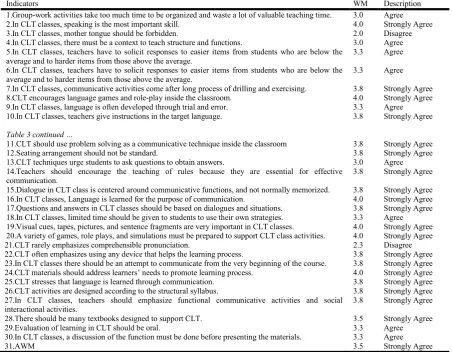
Knowledge of class procedures: Table 3 displays the communicative language teaching related activities used by the teachers on knowledge of class procedures. The weighted means obtained ranged from 2.0 to 4.0, and an average weighted mean of 3.5 interpreted as strongly agree. The highest weighted mean of 4.0 connotes that the respondents strongly agree that: in CLT classes, speaking is the most important skill; CLT encourages language games and role-play inside the classroom; in CLT classes, Language is learned for the purpose of communication; visual cues, tapes, pictures, and sentence fragments are very important in CLT classes; a variety of games, role plays, and simulations must be prepared to support CLT class activities; and CLT materials should address learners’ needs to promote learning process. On the other hand, the lowest weighted mean of 2.0 signifies that the respondents disagree that in CLT classes, mother tongue should be forbidden.
Table 1. Communicative Language Teaching Related Activities Used by the Teachers (Knowledge of Teachers)
Indicators WM Description
1.In Communicative Language Teaching Approach (CLTA), the teacher should emphasize communicative competence. 4.0 Strongly Agree
2.In the CLT classes, the teacher starts with grammar then meaning. 3.3 Agree
3.The role of teacher in CLT classes is viewed as a facilitator and guide to students 4.0 Strongly Agree
4.The teachers' task is to motivate students. 4.0 Strongly Agree
5.The teacher plans a set of activities and techniques. 4.0 Strongly Agree
6.In CLT classes, teacher has to focus on developing students’ abilities to use language for different purposes. 3.8 Strongly Agree
7.In CLT classes, the teacher discuses students homework and assignments. 3.0 Agree
8.The teacher gives students chance to do some listening exercises. 3.8 Strongly Agree
9.The teacher is responsible for organizing the resources for the students. 3.0 Agree
10.Vocabulary is presented to students in the form of isolated word lists. 3.0 Agree
11.In CLT, the teacher provides students with feedback. 3.8 Strongly Agree
12.The teacher emphasizes fluency more than accuracy. 3.5 Strongly Agree
13.CLT teachers correct all grammatical errors made by students. 3.2 Agree
14.In CLT classes, the teacher is a researcher and a learner at the same time 3.0 Agree
15.The teachers' task is to respond to learner needs 3.5 Strongly Agree
16.In CLT classes, teacher should be aware of the individual differences among students. 4.0 Strongly Agree
AWM 3.6 Strongly Agree
Table 2. Communicative Language Teaching Related Activities Used by the Teachers (Knowledge of Students)
Indicators WM Description
1.In CLT classes, students can learn best by using plenty of rules than analysis 2.8 Agree 2.In CLT classes, students should be trained to think directly in second language. 3.2 Agree
3.CLT learners need long term rewards. 3.5 Strongly Agree
4.In CLT, students should interact with other people through pair and group- work. 4.0 Strongly Agree 5.In CLT, students prefer teacher- centered lessons to student- centered ones. 2.0 Disagree 6.In CLT, students should act with each other rather than with the teacher. 2.8 Agree 7.CLT emphasizes that students should have an opportunity to practice language outside of the classroom. 3.5 Strongly Agree
8.In CLT classes, student should act as a negotiator 3.0 Agree
9.In CLT classes, students must get information from teachers only rather than other sources. 2.0 Disagree 10.CLT emphasizes that students should contribute as much as they gains. 3.3 Agree 11.In CLT classes, students determine how teaching and learning are alike 3.0 Agree
12.In CLT students motivate themselves. 3.0 Agree
13.In CLT classes, students should work cooperatively rather than individually. 3.3 Agree
AWM 3.03 Agree
Table 3. Communicative Language Teaching Related Activities Used by the Teachers (Knowledge on Class Procedures)
Indicators WM Description
1.Group-work activities take too much time to be organized and waste a lot of valuable teaching time. 3.0 Agree
2.In CLT classes, speaking is the most important skill. 4.0 Strongly Agree
3.In CLT classes, mother tongue should be forbidden. 2.0 Disagree
4.In CLT classes, there must be a context to teach structure and functions. 3.0 Agree 5.In CLT classes, teachers have to solicit responses to easier items from students who are below the
average and to harder items from those above the average.
3.3 Agree
6.In CLT classes, teachers have to solicit responses to easier items from students who are below the average and to harder items from those above the average.
3.3 Agree
7.In CLT classes, communicative activities come after long process of drilling and exercising. 3.8 Strongly Agree 8.CLT encourages language games and role-play inside the classroom. 4.0 Strongly Agree 9.In CLT classes, language is often developed through trial and error. 3.3 Agree 10.In CLT classes, teachers give instructions in the target language. 3.8 Strongly Agree
Table 3 continued …
11.CLT should use problem solving as a communicative technique inside the classroom 3.8 Strongly Agree
12.Seating arrangement should not be standard. 3.8 Strongly Agree
13.CLT techniques urge students to ask questions to obtain answers. 3.0 Agree 14.Teachers should encourage the teaching of rules because they are essential for effective
communication.
3.8 Strongly Agree
15.Dialogue in CLT class is centered around communicative functions, and not normally memorized. 3.8 Strongly Agree 16.In CLT classes, Language is learned for the purpose of communication. 4.0 Strongly Agree 17.Questions and answers in CLT classes should be based on dialogues and situations. 3.8 Strongly Agree 18.In CLT classes, limited time should be given to students to use their own strategies. 3.3 Agree 19.Visual cues, tapes, pictures, and sentence fragments are very important in CLT classes. 4.0 Strongly Agree 20.A variety of games, role plays, and simulations must be prepared to support CLT class activities. 4.0 Strongly Agree
21.CLT rarely emphasizes comprehensible pronunciation. 2.3 Disagree
22.CLT often emphasizes using any device that helps the learning process. 3.8 Strongly Agree 23.In CLT classes there should be an attempt to communicate from the very beginning of the course. 3.8 Strongly Agree 24.CLT materials should address learners’ needs to promote learning process. 4.0 Strongly Agree 25.CLT stresses that language is learned through communication. 3.8 Strongly Agree 26.CLT activities are designed according to the structural syllabus. 3.8 Strongly Agree 27.In CLT classes, teachers should emphasize functional communicative activities and social
interactional activities.
3.8 Strongly Agree
28.There should be many textbooks designed to support CLT. 3.5 Strongly Agree
29.Evaluation of learning in CLT should be oral. 3.3 Agree
30.In CLT classes, a discussion of the function must be done before presenting the materials. 3.3 Agree
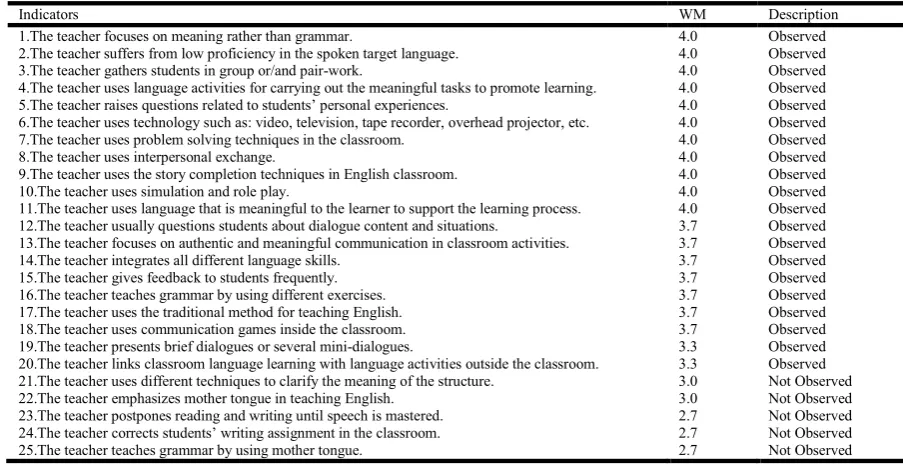
This was supported by the teachers’ practices, such as: focuses on meaning rather than grammar; suffers from low proficiency in the spoken target language; gathers students in group or/and pair-work; uses language activities for carrying out the meaningful tasks to promote learning; raises questions related to students’ personal experiences; uses technology such as: video, television, tape recorder, overhead projector, etc.; uses problem solving techniques in the classroom; uses interpersonal exchange; uses the story completion techniques in English classroom;and usessimulation androle play. As many writers have noted, (Nunan, 2004; Richards, 2005), the communicative tasks in the development of CLT, serve not only as major components of the methodology, but also as units around, which a course may be organized (Little wood, 2004). Hall (2011) agrees and goes on to note that everyday classroom practices can appear to be quite different when CLT principles are applied in differing social and educational contexts.
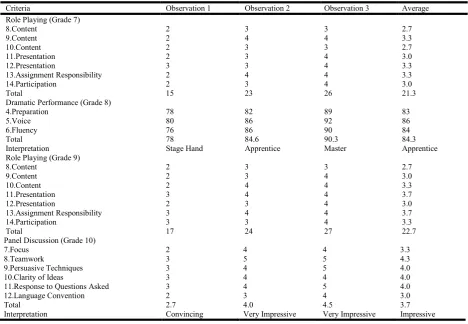
Students’ Speaking Competence: Table 5 presents the speaking competence of the students. These were observed through role playing, dramatic performance, and panel discussion. For the Grade 7 class, the CLT activity used by the teacher was role playing. It was found out that after three observations, the performance rating of the students has improved from15, to 24, to26, withan averageof 21.3.For the Grade 8 class, the teacher used dramatic performance as CLT activity. As reflected, the performance of the students has improved from being on “stage hand” to being an “apprentice,” and finally, to becoming a “master” with a total rating of 78, 85.3, and 90.3 respectively, with an average of 84.3, described as “apprentice.” For the Grade 9 class, the CLT activity used by the teacher was also role playing. After three observations, the performance rating of the students has improved from 17, to 24, to 27, with an average of 22.7. For the Grade 10 class, the CLT activity used by the teacher was panel discussion.The results reveal that the performance of the students has increased from being “convincing” to becoming “very impressive,” with a total rating of 2.7, to 4.0, to 4.5, with an average of 3.7, described as “impressive.” This only proves that CLT activities like role playing, drama presentations, and panel discussion improved the performance of the students, particularly their speaking competence.
According to many theories, speaking skill can be improved by games, role play, etc., which shows that speaking happens in activities and in a group. Saunders and O'Brien (2006) noted that the correct use of language form is important for learner's oral proficiency. However, linguistic factors include several features like pronunciation, grammar, and vocabulary.
Problems Encountered by the Teachers: It was learned from the interview that most teachers encountered some problems in using CLT in the classroom. Teacher 1 said that most learners have difficulty in relaying their ideas orally using the English language, though they are working collaboratively. But during the CLT activity, they don’t spend much time on practicing group activities that require much of their time. It seems that they are more responsive on short and quick activities done by the group. Moreover, teacher 2 stated that the students were not able to present on the scheduled time because they were not prepared; and some were shy, which resulted to failure of activity. On the other hand, teacher 3 reported that before, other groups have difficulty in writing their dialogues, while other group members showed unwillingness to help. But during the use of CLT, the students came prepared, with some who are not prepared. Teacher 4 described other groups to be reluctant at first towards the chosen group activity, such as talk show, interview, and role play. He stated further that other groups have difficulties in the practice because most of their group members are working students. During the activity; however, they were so excited to showcase their assigned task, even others were obviously nervous. Nevertheless, it is surprising to see those silent-type students, who engaged themselves into the assigned task. During the CLT activities, the students participated in group language activities that carry out meaningful tasks to promote learning. Although some errors were found in their lines, they tried to answer the questions asked from them. This finding supports the features of CLT that the teacher focuses on meaning rather than grammar, and the teacher suffers from low proficiency in the spoken target language. This was further corroborated by Schemitt (2010), who notifies that in countries where English is not widely spoken outside the classroom, learners often build a substantial knowledge about the language through study of its grammar and vocabulary, but have difficulty in developing oral proficiency because they lack exposure and experience using the language.
Table 4. Communicative Language Teaching Related Activities Used by the Teachers
Indicators WM Description
1.The teacher focuses on meaning rather than grammar. 4.0 Observed
2.The teacher suffers from low proficiency in the spoken target language. 4.0 Observed
3.The teacher gathers students in group or/and pair-work. 4.0 Observed
4.The teacher uses language activities for carrying out the meaningful tasks to promote learning. 4.0 Observed 5.The teacher raises questions related to students’ personal experiences. 4.0 Observed 6.The teacher uses technology such as: video, television, tape recorder, overhead projector, etc. 4.0 Observed 7.The teacher uses problem solving techniques in the classroom. 4.0 Observed
8.The teacher uses interpersonal exchange. 4.0 Observed
9.The teacher uses the story completion techniques in English classroom. 4.0 Observed
10.The teacher uses simulation and role play. 4.0 Observed
11.The teacher uses language that is meaningful to the learner to support the learning process. 4.0 Observed 12.The teacher usually questions students about dialogue content and situations. 3.7 Observed 13.The teacher focuses on authentic and meaningful communication in classroom activities. 3.7 Observed
14.The teacher integrates all different language skills. 3.7 Observed
15.The teacher gives feedback to students frequently. 3.7 Observed
16.The teacher teaches grammar by using different exercises. 3.7 Observed
17.The teacher uses the traditional method for teaching English. 3.7 Observed
18.The teacher uses communication games inside the classroom. 3.7 Observed
19.The teacher presents brief dialogues or several mini-dialogues. 3.3 Observed 20.The teacher links classroom language learning with language activities outside the classroom. 3.3 Observed 21.The teacher uses different techniques to clarify the meaning of the structure. 3.0 Not Observed
22.The teacher emphasizes mother tongue in teaching English. 3.0 Not Observed
23.The teacher postpones reading and writing until speech is mastered. 2.7 Not Observed 24.The teacher corrects students’ writing assignment in the classroom. 2.7 Not Observed
For such learners, fluency is perhaps the major speaking problem they face. Their speech tends to be slow, hesitant, full of repetitions, and self-corrections. Such phenomenon places more strain on the speakers themselves than that of effortless, automatically processed, and fluent speech. These problems coincide with Harmer’s (2003) finding, who confirms that the problem with communicative language teaching (CLT) is that it has always meant a multitude of different things to different people.
Relationship of Variables: The significant relationship between the communicative language teaching (CLT) related activities used by the teachers and the students’ competence is reflected in Table 6. The table indicates a p-value of 0.002, which is lower than the r-value of 0.672, at .05 level of significance. The decision was to reject the hypothesis, which means that there is a significant relationship between the communicative language teaching (CLT) activities used by the teachers and students’ competence.
LT Inspired Learning Material: As the output of the study, the researcher designed a CLT inspired learning material to improve the speaking competence of the Junior High School students. This is illustrated in Appendix A.
Summary, Conclusion, and Recommendation: This chapter presents the summary of findings, conclusion, and recommendations based on the results of the study.
Summary of Findings
This study generally sought to enhance students’ speaking competence in the Naval Night High School through
communicative language teaching (CLT). Communicative
language teaching (CLT) related activities used by the teachers. The Junior High School English teachers in Naval Night High School have knowledge, attitudes, and practices about CLT, such as: focuses on meaning rather than grammar, suffers from low proficiency in the spoken target language, gathers students in group or/and pair-work, uses language activities for carrying out the meaningful tasks to promote learning, and raises questions related to students’ personal experiences.
Students’ speaking competence
The speaking competence of the Junior High School students from all levels was enhanced through role playing, dramatic presentation, and panel discussion.
Problems encountered by the teachers in the implementation of CLT related activities
Some of the problems encountered by the teachers in the implementation of CLT related activities includes relaying of ideas, insufficient time in practicing, not being prepared
Table 5. Students’ Speaking Competence
Criteria Observation 1 Observation 2 Observation 3 Average
Role Playing (Grade 7)
8.Content 2 3 3 2.7
9.Content 2 4 4 3.3
10.Content 2 3 3 2.7
11.Presentation 2 3 4 3.0
12.Presentation 3 3 4 3.3
13.Assignment Responsibility 2 4 4 3.3
14.Participation 2 3 4 3.0
Total 15 23 26 21.3
Dramatic Performance (Grade 8)
4.Preparation 78 82 89 83
5.Voice 80 86 92 86
6.Fluency 76 86 90 84
Total 78 84.6 90.3 84.3
Interpretation Stage Hand Apprentice Master Apprentice
Role Playing (Grade 9)
8.Content 2 3 3 2.7
9.Content 2 3 4 3.0
10.Content 2 4 4 3.3
11.Presentation 3 4 4 3.7
12.Presentation 2 3 4 3.0
13.Assignment Responsibility 3 4 4 3.7
14.Participation 3 3 4 3.3
Total 17 24 27 22.7
Panel Discussion (Grade 10)
7.Focus 2 4 4 3.3
8.Teamwork 3 5 5 4.3
9.Persuasive Techniques 3 4 5 4.0
10.Clarity of Ideas 3 4 4 4.0
11.Response to Questions Asked 3 4 5 4.0
12.Language Convention 2 3 4 3.0
Total 2.7 4.0 4.5 3.7
Interpretation Convincing Very Impressive Very Impressive Impressive
Table 6. Significant Relationship between the Communicative Language Teaching (CLT) Activities Used by the Teachers and Students’ Competence
Variables M SD r-value p-value Decision
CLT Activities 4.00 .405 0.672 0.002 Rejected
resulting to not being able to present on scheduled time, unwillingness to help, and difficulties during the rehearsals.
Relationship of variables
There is a significant relationship between the
communicative language teaching (CLT) related activities used by the teachers and the students’ competence.
Conclusion
After a thorough analysis of the results gathered from the study, it was proven that CLT activities such as role playing, drama presentations, and panel discussion improved the speaking competence of the students.
Recommendations
After the careful analysis of the findings and conclusion from the results, the following recommendations are offered for consideration:
Teachers are encourage to employ CLT activities
such as: role playing, drama presentations, and panel discussions to promote participation and create active learners.
Teachers should put emphasis on the areas that can
be problematic for the students, and work on these to achieve advanced results.
It is recommended that the CLT inspired learning
material shall be used by the English teachers not only in Naval Night High School, but in other schools across Biliran Division as well.
A replication of this study is hereby recommended to
validate the findings in a wider scope and coverage.
REFERENCES
Abbaspour and Faezeh, 2016. Speaking Competence and Its Components: A Review of Literature. Department of English Language, Ayatollah Amoli Branch, Islamic Azad University, Amol, Iran. International Journal of Research in Linguistics, Language Teaching and Testing, Vol. 1, Issue 4, pp. 144-152. ISSN: 2367-9336. Breiner-Sanders, K. E., Lowe, P., Miles, J. and Swender, E.
2000. ACTFL Proficiency Guidelines-Speaking Revised 1999. Foreign Language Annals, Vol.33, No.1, 13-8. Brown, H. D. 2001. Teaching by principles: An interactive
approach to language pedagogy. White Plains, NY: Longman.
Brown, H. D. 2007. Principle of language learning and teaching. White Plains, NY: Pearson Longman.
Canale, M. and Swain, M. 1980. Theoretical bases of communicative approaches to second language teaching and testing. Applied Linguistics, 1, 1-47.
Celce-Murica, M. 2001. Teaching English as a second language or foreign language. NY: Routledge.
Ellis and Rod, 2009. The Differential Effects of Three Types of Task Planning on the Fluency, Complexity, and Accuracy in L2 Oral Production. Applied
Linguistics, 30/4: 474–509. doi:10.1093/
applin/amp042.
Goh, C. C. M. 200. Teaching speaking in the language classroom. Singapore: SEAMEO Regional Language Centre.
Hastoyo and Sovenda, S. 2010. Improving Students’ Speaking Competence through Small Group Discussion. A Classroom Action Research. English Department, MI Al Islam Grobagan Surakarta.
Hughes, R. 2002. Teaching and researching speaking. Edinburgh: Pearson Education.
Hymes, D. 1971. On communicative competence. Philadelphia University of Pennsylvania Press.
Johnson and Paul, F. 2011. Communicative Language Teaching.
Lan and Lim Soh, 1994. Fluency and Accuracy in Spoken English---Implications for Classroom Practice in a Bilingual Context. The English Teacher, Vol. XXIII.
Retrieved August 28, 2012, from http://
www.melta.org.my/ ET/ 1994/main4.html. [8]
Larsen-Freeman, D. 2001. Grammar teaching. In R. Carter and D. Nunan (Eds.), The Cambridge guide to teaching English to speakers of other languages (pp.34-41). Cambridge: Cambridge University.
Littlewood and William, 2013. Developing a
Context-Sensitive Pedagogy for Communication-Oriented
Language Teaching. Hong Kong Baptist University. Liu Runqing, 1988. On English Language Teaching.
Beijing: Beijing Foreign Language Teaching and Research Press.
McLaughlin, B. and Heredia, R. 1996. Information-processing approaches to research on second language acquisition and use. In W. C. Ritchie and T. K. Bhatia (Eds.), Handbook of second language acquisition (pp.213-228). San Diego: Academic Press.
Nakano, M. et al. 2001. A Quantitative Analysis of Annotated Learners’ Spoken Corpus.
Nation, L. S. P. 2001. Learning vocabulary in another language. Cambridge: Cambridge University.
Patanasorn and Chomraj, 2012. Effects of Procedural, Content, and Task Repetition on Accuracy and Fluency in an EFL Context. Unpublished doctoral dissertation, Northern Arizona University, Arizona. Presentation at JACET 40 Annual Convention. Sapporo: Fuji Women’s University.
Richards and Jack C. 2006. Communicative Language
Teaching Today. Cambridge University Press,
Cambridge, New York, Melbourne, Madrid, Cape Town, Singapore, Sao Paulo. 32 Avenue of the Americas, New York, NY 10013-2473, USA. www.cambridge.org.
Richards, J. C. and Renandya, W. A. 2002. Methodology in language teaching. New York: Cambridge University Press.
Roberts and John, T. 2004. Communicative Approach to Language Teaching: The King is dead! Long live the King!' University of Murcia. International Journal of English Studies, Vol. 4 (1), pp. 1-37.
Schemitt, R. 2012. Applied linguistic. In A. burns and B. Seidhofer (Eds.), Speaking and pronunciation (pp.197- 199). London: Great Britain press.
Shumin, K. 2002. Factors to consider: Developing adult EFL student speaking abilities. In J. C. Richards and W. A. Renandya (Eds.), Methodology in language teaching: An anthology of current practice (pp. 204-211). Cambridge: Cambridge University Press.