Cover Page
The handle
http://hdl.handle.net/1887/26165
holds various files of this Leiden University
dissertation.
Author: Edisherashvili, Natalia
i
Communicative Language
Teaching in Georgia
ii
Published by
LOT phone: +31 30 253 6111
Trans 10
3512 JK Utrecht e-mail: [email protected]
The Netherlands http://www.lotschool.nl
Cover illustration: created specially for this dissertation by a Georgian painter and animator Dato Sikharulidze. The image captures the atmosphere of a communicative language lesson.
ISBN: 978-94-6093-145-1 NUR 616
Communicative Language Teaching in Georgia
From Theory to Practice
Proefschrift
ter verkrijging van
de graad van Doctor aan de Universiteit Leiden, op gezag van Rector Magnificus prof. mr. C.J.J.M. Stolker,
volgens besluit van het College voor Promoties te verdedigen op dinsdag 3 juni 2014
klokke 11.15 uur
door
Natalia Edisherashvili
iv
Promotiecommissie
promotor: Prof. dr. I.M. Tieken-Boon van Ostade co-promotor: Dr. D. Smakman
overige leden: Prof. dr. J. Schaeken
vii
Acknowledgements
There is a whole range of people who helped me in the process of writing this dissertation in different ways, and here I would like to take this opportunity and extend my deepest gratitude and appreciation to all of them.
I would certainly like to start by thanking my supervisor Ingrid Tieken and my co-supervisor Dick Smakman to whom I am greatly indebted for being able to complete my work. Ingrid was the very first person (and by now this list thanks to her is much more extensive) at Leiden University whom I met shortly after my arrival in the Netherlands. Her very positive and helpful manner was a strong incentive for me to believe that accomplishing my aspiration of writing a PhD thesis at Leiden University was realistic. So I got started, and Ingrid has always been there to provide the right direction and supervision as needed. It was her who introduced me to the importance of quality and rigor while doing research, to concepts such as Academic Integrity and Research Ethics; she has always tried to convey the message that it is the quality that matters while doing research. I am not sure how far I have met her expectations, but I did my best, and I believe that her advice will have a long-lasting impact and trace on my future academic activities.
Dick Smakman, my co-supervisor, is a person whose efforts and input in the present project were invaluable. He always found time to provide me with very close and systematic supervision. His advice ranged from such meticulous feedback as where to use and where not the articles in English (I really appreciate his real patience here), to such global decisions as whether to include in the study schools all over Georgia or in its capital only. I also very much appreciate how Dick Smakman tried to involve me in certain academic and research activities as well. Helping me publish an article, which he co-authored, was a big honor for me; also letting me be a guest lecturer on the topic of Communicative Language Teaching in his course on Second Language Acquisition has become a yearly tradition for me already.
viii
As English is not my native language, and structurally very different from Georgian, I wanted to make sure that the quality of the text was free from inaccuracies, the task which is very difficult to accomplish. This is where Alex Thomson, a well-educated British gentleman, with a linguistic academic background and first-hand knowledge of the Georgian context, turned out to be very helpful. I am extremely grateful to him for relieving me from the stress of worrying much about the quality of the language used. Another person to whom I would like to express my gratitude is Vincent van Heuven. He was the one who helped me with the statistics, the area which was a totally ‘uncharted territory’ for me until I found myself in need of conducting statistical manipulations for analyzing the data for the present study. He was always ready to provide advice and consultation with regard to which statistical analysis methods to use as well as how to technically run them in SPSS. A word of thanks has also to be directed to Klaas van Veen for the time and advice that he provided for coming up with the methodology of data analysis for Chapter 7 of this dissertation.
There are also other groups of people who have been instrumental in making this study possible. Special thanks should go to my dear colleagues and friends, Dodo Gvineria, Nino Berishvili, Nino Qantaria, Keti Vatiashvili and Ken Goff for co-evaluating the numerous learners’ speech recordings. Further, I would like to thank in particular Dodo Gvineria and Nino Berishvili. Dodo is actually my husband’s aunt, and by a very lucky coincidence, of the same profession, and a person who shares many of my professional interests and aspirations; she has taken much time to discuss things with me and provide advice and encouragement. Nino Berishvili is another person to whom I would also like to extend special thanks. As mentioned above, Nino helped with evaluating learners’ speech, as well as with co-observing the lessons, recording the teachers’ interviews and learners’ speech; so, her role has been crucial and without her, the fieldwork conducted within this study would have been much more difficult to accomplish.
I would also like to thank all the participating school administrations, as well as the 96 teacher and 698 learner participants, who were willing to help and take their time completing the questionnaires, for letting me observe their classes and for being very friendly and open in the whole process of the interviews.
ix
The picture on the cover has been created specially for this dissertation by my favorite uncle Dato Sikharulidze (even though I have no other uncles except him, I am sure even if I did, he still would be my favorite). So, I would like to extend my warmest thanks to him, as well as to my cousin Mariam Sikharulidze, who has also been very involved in coordinating the whole communication and detail negotiation process between Dato and myself. My heartfelt thanks to them.
And finally, on a more personal basis, I would like to thank my parents, one of the staunchest supporters of my work, who did their best to encourage and motivate me from Georgia. My parents-in-law, who supported, encouraged and cheered me throughout the whole process; to Nunuka, who helped me with taking care of my children, so that I had to worry less about them and could take more time and better concentrate on my work. However, while completely immersed in PhD work, making myself available for the children still turned out to be more challenging than I had imagined. “Mummy, how many more days do you have to go,” Anastasia and Aka started asking me impatiently soon after my work took an intensive turn. After realizing that the completion of my work was a longer term perspective, they started asking “Mummy, how many more months exactly do we still have to wait till the things are the way they used to be”, and then they gave up. Seeing their messages, written with humor on scraps of paper, and discreetly left on my table in my study, saying “we love you Dr. Edisherashvili”, amused me a lot and made me realize they were not that angry and unhappy about what I had been doing after all.
x
The Grammar Lesson
By Scott Thornbury (2013)
The teacher enters briskly, taps the board: ‘Now pay attention, class, and not a word.' Her steely gaze subdues the general clamour. ‘I’m going to teach the rules of English grammar.’
‘I’ll start by explicating all the tenses, Their forms, a few examples, and their senses. We’ll finish, as is usual with a test. A prize for which of you can answer best.'
He always takes the bus (she writes). ‘The present (Though present, as we speak, it clearly isn’t). We call this timeless present “present simple” .My tailor’s very rich is an example.’
‘Now look at me,’ she orders, as she paces Between the rows of startled little faces. ‘I’m walking to the door. Now I am turning. I’m teaching you the grammar. You are learning.’
Intending that her actions be the stimulus, She demonstrates the present tense (continuous). ‘For acts that are in progress, it’s expressive, and so it’s sometimes classified “progressive”.’
‘Now, who is this?’ She shows a pic of Caesar. ‘An ancient Roman?’ someone says, to please her. She draws a Roman galley, oars and mast. ‘He came, he saw, he conquered: simple past’.
‘And when he came, the weather – it was pouring’. She adds this detail to her simple drawing. And with a gesture eloquently sinuous, she illustrates what means the past continuous.
‘I’ve been to China. In my life. Just once. Time not important. Use the perfect tense. He lost the race since he had started last: Had started represents the perfect past.’
‘Although it seems a little bit excessive, We also use the perfect with progressive. Have you been playing badminton? is how We ask if something’s happening to now.’
‘The future forms we’ll save until … the future. I think by now you have the general picture. So pen and paper out – yes, you have guessed it: I’ve taught you stuff and now it’s time to test it.’
xi
Abbreviations and symbols
ANOVA Analysis of Variance
CEFR Common European Framework of Reference
CELTA Certificate of English Language Teaching to Adults
CLT Communicative Language Teaching
EFL English as a Foreign Language
ELT English Language Teaching
ETAG English Teachers’ Association in Georgia
GT Grammar Translation
ICC Inter-class correlation
K Symbol standing for Cohen’s Kappa coefficient
F Symbol used to refer to the effect size of an independent
factor on the study outcomes
M Symbol standing for group mean
MES Ministry of Education and Science
MI Multiple Intelligences
xii
NA Natural Approach
NAEC National Assessment and Exam Centre
NCFL National Curriculum for Foreign Languages
NCTD National Centre for Teacher Development
p.
Symbol standing for the statistical significance of the
difference between groups
Pub. C. Public Central (school)
Pub. P. Public Peripheral (school)
Pri. C. Private Central (school)
Pri. P. Private Peripheral (school)
r
Symbol standing for the Pearson’s correlation coefficient
SD Standard Deviation
SPSS Statistical Package of Social Sciences
T Symbol standing for the teacher
TBLT Task-Based Language Teaching
TELL Technology-Enhanced Language Learning
xiii
Statistics Reference Page
This page provides definitions of the statistical terms used in this dissertation
Analysis of Variance (ANOVA) – is a statistical test concerned with comparing the means of two or more population samples (Butler, 1985:129).
Bonferroni – is a multiple-comparison post-hoc test that assumes equal variances in the data, and is commonly used with ANOVA (Butler, 1985:127-136).
Brown-Forsythe test – is a test for the homogeneity of variance within the groups under investigation. It is a more robust test that is very similar to Levene’s test (Fields, 2012a:8).
Cohen’s Kappa – is a statistical coefficient of the degree of inter-rater agreement on qualitative items. It is commonly measured when the raters’ level of agreement on certain qualitative data has to be estimated (Haley & Osberg, 1989:90).
Intra-class correlation (ICC) – is a descriptive statistic used for measuring data in a quantitative manner. It detects the similarity level between units in the same group. The ICC is considered to be high when there is a low degree of difference between the ratings assigned to each item by the raters – if the raters give a similar assessment to the items (Fields, 2005:948-954).
Cronbach’s Alpha – is a coefficient of internal consistency; it is commonly used as an estimate of inter-item reliability. A value of 7.0 or higher is normally considered to be acceptable (Tavakol & Dennick, 2011:53).
Factor Analysis – is a statistical tool used for data reduction and/or grouping purposes. This method investigates whether a number of variables of interest are linearly related to a smaller number of unobservable factors (Osborne & Costello, 2005:1).
Test of homogeneity of variance – is a test which checks how similar the level of variance within the dependent variables is (Butler, 1985:127-128).
xiv
Levene's test – is an inferential statistics test used to assess the equality of variances in different samples. It tests the condition that the variances of the samples are equal, indicated by the Levene Statistic. (Fields, 2012b:13)
Paired-Samples T-Test – is a statistical procedure that compares the means of two variables of a single group (Butler, 1984:178- 97).
Pearson product-moment correlation coefficient (referred to as Pearson's r) – is a measure of the linear correlation (dependence) between two variables X and Y, giving a value between +1 and −1 inclusive (Butler, 1985:137-153).
Repeated Measures ANOVA – is a statistical test which compares how a within-subjects experimental group performs in three or more experimental conditions, or how the group is influenced by various independent factors. As the sample is exposed to each condition in turn, the measurement of the dependent variable is repeated (Fields, 2008:1).
Shapiro–Wilks test – is a statistical test of the hypothesis that sample data have been drawn from a normally distributed population (Fields, 2012b:8-9).
Tamhane's T2 – is a multiple comparison, post-hoc, test which is normally used after ANOVA application to see where exactly the difference between groups lies. Tamhanes’ T2 thus does not assume equal variances in the groups (Tamhane, 1979: 471-480).
xv
TABLE OF CONTENTS
3.9.2 Focus on oral aspect of the language ...46
3.3.3 The concept of Communicative Competence ...37
3.4 Course design and syllabus ...40
3.5 Teacher roles...41
3.6 Learner roles ...43
3.7 Communicative activities and classroom interaction ...43
3.8 Teaching material ...44
3.9 A critical look at CLT ...45
3.9.1 Aimed at developing language fluency, not accuracy ...45
ACKNOWLEDGEMENTS...vii
GRAMMAR LESSON...x
LIST OF ABBREVIATIONS...xi
STATISTICS REFERENCE PAGE...xiii
1. INTRODUCTION 1.1 Changing foreign language teaching in Georgia ...1
1.2 Aims of the present study and the research questions...4
1.3 Research questions ...6
1.4 General approach to the presents study ...7
1.5 Previous research and the sigfnificance of the present study...9
1.6 Dissertation overview...11
2. HISTORY OF LANGUAGE TEACHING METHODS 2.1 Introduction...13
2.2 Major methods in foreign language teaching ...17
2.3 Alternative methods in foreign language teaching...18
2.4 The Communicative Approaches in language teaching...22
2.4.1 Communicative Language Teaching...23
2.4.2 Content-Based Instruction...24
2.4.3 Task-Based Language Teaching...25
2.5 Summary and post method perspectives ...27
2.5.1 Summary of the teaching methods ...27
2.5.2 The post-method perspectives ...28
3.3.1 Language theories ...33
3.3.2 Learning theories ...36
3. COMMUNICATIVE LANGUAGE TEACHING 3.1 Introduction... ...31
3.2 General background to CLT ...32
4. TECHNOLOGY-ENHANCED COMMUNICATIVE LANGUAGE TEACHING
3.10 Potential challenges related to CLT...50
3.10.1 Lack of teaching skills and knowledge of CLT theory...50
3.10.2 Language proficiency factor...50
3.10.3 Classroom management-related problems...51
3.10.4 Communicative Competence assessment-related difficulties...
..
...523.10.5 Pre-determined curriculum ...52
3.10.6 Negative effect of the previous exposure to grammar-driven teaching...52
3.10.7 Teaching material ...53
3.10.8 Lack of time and expertise to prepare for CLT lessons ...54
3.11 Conclusion...54
4.1Introduction…...55
5.1 Introduction...85
5.2 The Soviet era and language teaching ...86
3.9.3 Unnecessary focus on some meta-linguistic skills ...46
3.9.4 CLT and local contexts ...47
3.9.5 Too demanding towards teachers as well as learners ...49
3.9.6 CLT-related ambiguity ...49
4.2 Importance of technology integration in CLT...56
4.3 Various forms of technology resources and CLT...57
4.3.1 Online communication opportunities and CLT...58
4.3.2 Other web-based resources and CLT ...65
4.3.3 Other digital tools and CLT–Interactive white board ...70
4.4 Summary of pros and cons of technology integration in CLT ...73
4.4.1 Advantages of technology use in CLT...73
4.4.2 Challenges of technology use in CLT ...76
4.5 Recommendations...79
4.6 Conclusion ...82
5. FOREIGN LANGUAGE TEACHING IN GEORGIA: FROM SOVIET TIMES TO THE PRESENT DAY 5.3 The post-Sovier period and the move towards CLT in Georgia...92
5.4 Governmental and non-governmental institution efforts...95
5.4.1 The National Curriculum for Foreign Languages...95
5.4.2 New teaching material...96
5.4.3 Priorities in teaching foreign languages...97
5.4.4 Project: Teach & Learn with Georgia... 97
5.4.5 Professional development of language teachers...100
5.4.6 Efforts of the non-governmental organizations in Georgia...101
5.2.1 Socio-historic background ...86
5.2.2 Language teaching methods and aims in Soviet times ...87
5.2.3 Language teaching material in Soviet times ...91
xvii
6. FOREIGN LANGUAGE TEACHING POLICY IN GEORGIA
8. LEARNERS’ ATTITUDES TOWARDS COMMUNICATIVE LANGUAGE TEACHING
8.1 Introduction...153
5.5 Technology-enhanced language teaching in Georgia...102
5.5.1 Developments in Technology-Enhanced Language Teaching...102
5.5.2 Proliferation of computer literacy in Georgia ...105
5.6 Conclusion...106
6.1 Introduction ...107
6.2 A way towards current communicative curriculum for foreign languages ...107
6.3 The Current National Curriculum for Foreign Languages ...109
6.3.1 The National Curriculum for Foreign Languages in Georgia ...110
6.3.2 Standards for foreign languages...113
6.3.3 Recommended contents of the syllabus for foreign languages...115
6.4 Conclusions and discussion………...115
6.4.1 Communicative basis of the NCFL of Georgia ...115
6.4.2 Recommended assessment format for foreign languages in Georgia...116
6.4.3 Some inconsistencies and issues observed in the NCFL...116
6.4.4 Final remarks ...118
7. ENGLISH LANGUAGE TEACHERS PERCEPTIONS OF CLT 7.1 Introduction...119
7.1.1 The aim of the study...120
7.1.2 The theoretical background and the research questions...121
7.2 Methodology...121
7.2.1 Study design ...121
7.2.2 Study participants ... ...124
7.2.3 Data collection tools ...126
7.2.4 Data collection procedure and obtained material ...129
7.2.5 Data analysis ...130
7.3 Study results ...134
7.3.1 Interview results ...134
7.3.2 Questionnaire results ...144
7.4 Summary and conclusions ...148
8.1.1 The aim of the study...153
8.1.2 The theoretical background and the research questions...154
8.2 Methodology...156
8.2.1 Research design...156
8.2.2 Study participants...157
8.2.3 Data collection tools ...158
8.2.4 Data collection procedure and obtained material ...159
xviii
8.3 Study results ...161
8.4 Conclusions ...170
10. LEARNERS’ COMMUNICATIVE PROFICIENCY IN ENGLISH 11. CONCLUSIONS 11.1 Introduction...227
9. LESSON OBSERVATION 9.1 Introduction ...175
9.1.1 The aim of the study...175
11.2 Summary of findings...228
11.3 Identified challenges and practical recommendations...241
11.4 Research strength and limitations...250
11.5 Suggestions for future research...251
11.6 Final conclusions...252
10.1 Introduction...197
10.1.1 Discussion of the linguistic terminology used in the present study...197
10.1.2 Research question...199
10.2 Methodology...199
10.2.1 Research design...199
10.2.2 Study participants...201
10.2.3 Data collection tools...202
10.2.4 Data collection procedure and obtained material ...207
10.2.5 Data analysis...207
10.3 Study results...209
10.3.1 The results of learners’ communicative proficiency analysis...209
10.3.2 The comparison of the main results of the four studies...221
10.4 Conclusions...223
9.1.2 The research questions...176
9.2 Methodology ...177
9.2.1 Research design ...177
9.2.2 Study participants ...177
9.2.3 Data collection tools ...179
9.2.4 Data collection procedure and obtained material...179
9.2.5 Data analysis ...180
9.3 Study results ...182
xix
Chapter 8
Appendix 8.1a: Learners questionnaire (Georgian)...305
Appendix 8.1b: Learner questionnaire (English)...307
Appendix 8.2: Frequency analysis of the learner questionnaire data ...309
Appendix 8.3: The effect of ‘school type’ on learners’ attitudes towards CLT ...314
REFERENCES...253
APPENDICES ...281
Chapter 6 Appendix 6.1: The samples of the assessment task provided in the NCFL... 281
Appendix 6.2: Recommended syllabus contentsvocabulary...282
Chapter 7 Appendix 7.1a: Teacher interview (Georgian)...283
Appendix 7.1b: Teacher interview (Translation) ...284
Appendix 7.2: Teacher interview data analysis form ...285
Appendix 7.3a: Teacher questionnaire (Georgian) ...286
Appendix 7.3b: Teacher questionnaire (Translation) ...289
Appendix 7.4: Interview results: CLT-related difficulties ...292
Appendix 7.5: Teachers’ attitudes towards CLT...294
Appendix 7.6: Teachers’ evaluations of language activities ...300
Appendix 7.7: Teachers’ evaluations of CLT-related difficulties ...302
Chapter 9 Appendix 9.1: Observation form used in the study ...316
Appendix 9.2: CLT principles observed in the English lessons in Tbilisi ...319
Appendix 9.3: Inter-item correlation analysis: observation groups 1–7 ...324
Appendix 9.4: The effect of the independent variables on teachers’ performance...325
Appendix 9.5: ‘School type’ effect on the level of difficulty faced by the teachers ...329
Chapter 10 Appendix 10.1: CEFR descriptors: qualitative aspects of spoken language use ...330
Appendix 10.2: Language evaluation form ...333
Appendix 10.3: Learners’ communicative proficiency assessment scores...334
Appendix 10.4: Correlation of the learners’ prerformance scores...335
Appendix 10.5: Learner speech samples – Levels A0-B2...336
SUMMARY IN DUTCH ………...……...341
1
CHAPTER 1: INTRODUCTION
1.1 CHANGING FOREIGN LANGUAGE TEACHING IN GEORGIA
“Tell me and I forget, teach me and I may remember, involve me and I learn” – this aphorism by Benjamin Franklin captures well the essence and importance of choosing the right approach in the teaching/learning process in order to achieve lasting and meaningful results. The language teaching that I was exposed to myself in my secondary school and university years, in the 1990s, was the type which focused on “teaching” rather than “learning”: teaching grammar rules, grammar forms, vocabulary lists and uninspiring texts about
imaginary people, in imaginary contexts. It was coursebooks inherited by us,
newly-independent Georgians, from Soviet authors that constituted the teaching material in those days. We had to memorize and recite word for word whole passages such as “The Working Day of an Engineer” by Bonk (1986), which was about a typical day of a model Soviet citizen, one ‘Comrade Petrov’. Later on, some coursebooks and texts, written by foreign authors, were also adopted for English language teaching purposes. Intermediate English Course by Gimson (1976), for instance. The very first text from this book, “Quiet Life”, which every first-year university student of my generation knew by heart, was somewhat more ‘progressive’ in a sense, in that it described the typical day not of a Soviet proletarian but of a middle-class Englishman, Felix Catt, living on Syberia Avenue, in a suburb of London.
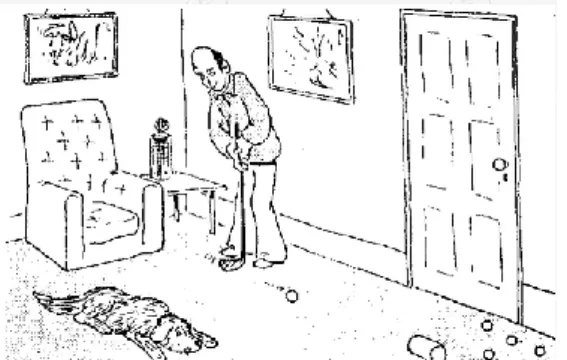
Figure 1.1: Illustration of the text “A Quiet Life”from Intermediate English
Course by Gimson (1976) 1.
Furthermore, the achievement level recorded for students of foreign languages
was assessed based on how well one could remember and recite these texts, as well as on the ability to complete grammar and vocabulary fill-in-the-gaps exercises or to translate texts from English into Georgian and vice versa.
2 CHAPTER 1
Consequently, grammar and vocabulary instruction constituted an end in itself rather than a means for communication, which is what it would have been in the case of Communicative Language Teaching, the method under research in the present study.
Such form-focused and grammar-driven approach to language teaching, as well as to its assessment, often resulted in the development of learners’ memory capacity and recitation skills only. This did not worry most of language teachers in Georgia at that time, who would say: “The main thing is that learners learn grammar rules and vocabulary; they can always learn to speak later”, or, “By memorizing things, learners remember language structures very well, which then they will be able to apply in speaking”. So, mastering speaking and authentic communication skills were put off for later, and was left to learners to come to grips with on their own. Consequently, the vast majority of learners who were exposed to such ‘language- rather than learning-centered’ methods of language instruction (Kumaravadivelu, 2007: 83) “remembered” certain texts, grammar rules and vocabulary definitions; however, as far as communication skills were concerned, unfortunately, the ‘later’ never came for majority of language learners who enjoyed no language learning opportunities outside school. Only those learners who had a chance to be “involved” in extracurricular language learning, through study abroad or travel opportunities,
or who managed to have intensive exposure and access to authentic foreign
language through the then scarce foreign broadcast media and information technology were able to actually ‘learn’ the target foreign language.
Here it should also be mentioned that, with the passage of time, understanding of what constitutes competence in a foreign language and the goal of language teaching/learning has also changed. In Soviet times, ‘learning’ a foreign language meant acquiring linguistic knowledge; language learners were mostly women aspiring to a career in language teaching or to translator positions, very popular professions for females at that time. Their eventual goal, then, was to pass on this body of knowledge to the next generation in the same way their own teachers had done. Indeed, the Soviet academic model placed more emphasis on linguistics and even philology as a subject for mass study than almost any other academic model in the world did. From this perspective, bearing in mind the foreign language teaching/learning aims of that context and the respect afforded to academic linguistic knowledge, we might tone down our critical attitude toward the types of approaches used in language teaching in those days.
INTRODUCTION 3
and which make language use a means as well as an end of the study process may be claimed to be adequate and relevant to the contemporary individual. Communicative Language Teaching (CLT) is one of the most popular among such recent approaches, one which emerged as a result of the new economic and sociopolitical circumstances arising in the 1970s in the West, and has maintained its actuality and validity up to the present (Davies & Pearse, 2000: 193), being particularly prized in latter years by emerging economies which have been moving towards the Western model.
The Georgian government, a few years after its independence from the Soviet Union in 1991, started making efforts in the direction of transforming language teaching from an old-fashioned model, which no longer met the foreign language needs of Georgian citizens, into a more Westernized practice, focusing on real life language skills. The first official communicative National Curriculum for Foreign Languages (NCFL) was adopted in Georgia in 1997, a year when the still desperately impoverished and divided country had barely got over its existential threats. Attempts to bring language teaching in Georgia up to European standards can be perceived in that context as a demonstration of will on the part of the Georgian government to become a more integral part of Europe and the Western world as a more robustly independent state, by means of widely being seen to share those countries’ norms and values. Thus, foreign language teaching gained far wider importance than merely linguistic, which also explains the high political and even ideological priority that has been explicitly accorded by politicians to language teaching and learning in schools in Georgia. Nevertheless, in 1997, little else was done beyond the official introduction of a language curriculum, the declared goal of which was transforming a grammar-based foreign language teaching into a communicative one.
4 CHAPTER 1
innovation is the direction of the reform. As Karakhanyan (2011: 21) remarks, when a top-down approach is applied in the process of reformation, it should be expected that the changes will be “superficial” and many gaps will be left behind.
In the case of Georgia, the reform in language teaching was introduced from the top down, imposing the norms and practices of Communicative Language Teaching employed in the Western world upon language teachers and learners in Georgia, who had been used to totally different types of language teaching and learning paradigms. In the first iteration of Georgia’s reform of language teaching (in 1997), there was not much done in terms of helping implementers of the reform to come to grips with the necessary skills and knowledge to successfully implement the new methodology requirements in actual practice; not much account was taken of the practicalities of the local context either, and the situation in the ELT field remained Soviet methodology-driven, with no signs of communicative aspects of teaching being visible in actual practice at all (Tkemaladze et al., 2001: 112).
The top-down nature of the second wave of the language teaching change in Georgia was such that the then president, Mikheil Saakashvili, made the reforms in the country’s teaching of English a major theme of his speeches. This reformation has been ongoing since 2009, and has encompassed much more ambitious attempts than the first phase did. It has included attempts at further refining the National Curriculum for Foreign Languages, employing thousands of native-speaker teachers of English at secondary public schools all over the country, and making efforts to provide new teacher standards, teacher training courses and better school infrastructure (see 5.4). However, in order to prevent reform from failing or from having only a “superficial” effect on the situation, it is essential that the context of change, and factors inhibiting and facilitating the modernization of education, be carefully explored before reforms are undertaken (Karakhanyan, 2011: 21).
Chapter overview
In the remainder of this introductory chapter, the following areas will be dealt with: Section 1.2 discusses the main aims of the present study, and in Section 1.3 the concrete research questions for which this study seeks answers are presented. Study design and the methodology adopted are described in Section 1.4. Section 1.5 discusses the significance of the present study and finally Section 1.6 provides an overview of the structure of the whole dissertation.
1.2 AIMS OF THE PRESENT STUDY
INTRODUCTION 5
meets practice, and to what outcomes the combination of the two leads, is the main goal of the present study. In general, education policy goes through several stages before reaching its ultimate target. Firstly, it needs to penetrate, and be accepted by, the actual implementers of the policy – teachers – and to be approved of and welcomed by the other category of immediate agents of the educational process – learners. Secondly, the policy needs to be actually applied in practice, and should thus have characteristics compatible with classroom realities. Thirdly, the success of a given education policy should ultimately be measured through assessing its effects on learners’ knowledge. This is an approach which is adopted in the present work in order to evaluate Communicative Language Teaching situation in Georgia.
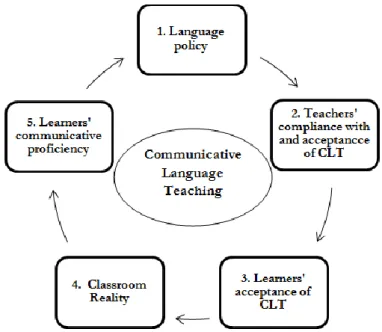
Thus, this dissertation comprises the four studies which look into different areas of Communicative Language Teaching in Georgia: they explore how language teachers and learners understand and how receptive they are to CLT, what the actual language classroom reality is, and how far the sum of all of these factors is reflected in the level of learners’ communicative proficiency in English. The sequence of the areas that were explored one at a time in order to arrive at an understanding of the state of affairs of CLT in Georgia is graphically represented in Figure 1.2 below.
Figure 1.2: Areas involved in change implementation in foreign language teaching
6 CHAPTER 1
Curriculum for Foreign Languages of Georgia is described in Chapter 6 in order to provide an official framework for foreign language teaching and learning in Georgia. The goals, nature and levels of achievement of the observed language teaching and learning process in Georgia and its outcomes are then discussed within and with reference to this framework. As for the research areas 2, 3 and 4 shown in Figure 1.2, they have been explored in much detail in the four studies presented in Chapters 7–10. They represent a separate pieces of research in their own right, consisting of their own introduction, methodology, results and conclusions sections (for more detailed information about the structure of the dissertation, see Section 1.5 below).
1.3 RESEARCH QUESTIONS
Below are presented the summaries of the main research questions for each of the study. More detailed research questions can be found in the relevant chapters (Chapters 7–10).
Study 1 (Chapter 7)
How aware are English language teachers of the official recommendations with regard to foreign language teaching in Georgia, and what is the reported level of compliance with these recommendations on their part? What are their attitudes towards CLT?
What effect do school context and certain teacher characteristics have on the study results?
Study 2 (Chapter 8)
What are English language learners’ attitudes towards CLT at secondary schools in Tbilisi?
What effect do school type and certain learner characteristics have on their attitudes?
What is the level of discrepancy between learners’ and teachers’ attitudes towards this method?
Study 3 (Chapter 9)
How communicative are English language classes at secondary schools in Tbilisi?
What are the observed practical challenges that inhibit language teaching from having a communicative character?
What effect do school type and certain teacher characteristics have on the communicative nature of English language classes?
INTRODUCTION 7
Study 4 (Chapter 10)
How close does English language learners’ actual communicative proficiency in Tbilisi come to the communicative language requirements outlined in the National Curriculum for Foreign Languages?
What effect do school type and learner characteristics have on learners’ actual communicative proficiency in English?
1.4 GENERAL APPROACH TO THE PRESENT STUDY
To answer the research questions, and given that certain research questions necessitated both qualitative and quantitative data analyses, a mixed-method design was adopted in the present study. As claimed by Haladyna et al. (1991), “[To] judge the value of an outcome or end, one should understand the nature of the process or means that led to that end” (1991: 6). Hence, secondary school learners’ communicative proficiency level in Tbilisi was not explored in isolation in the present study; rather, the whole chain of components leading to the end goal of Communicative Language Teaching has been thoroughly investigated. Since teaching and learning are constructs which occur interactively in the classroom, both teacher-related and learner-related investigations were undertaken in the present study.
A number of choices were made with regard to the study context as well, which I decided to restrict to the capital of Georgia, Tbilisi only. There were several reasons for this; first, innovation and policy change diffusion largely starts out from the capital city, and the outcome in terms of achieved success was accordingly expected to be best visible in Tbilisi; second, it was expected that enough variation could be detected within the capital only, and that proceeding with language teaching and learning situation investigation in the regions, outside the capital, would affect the depth and feasibility of the present study. Also, to keep the research focused, it was decided to look into the situation at the secondary schools only, and restrict the study to a particular age range within secondary schools (for more discussion see Section 7.2.1).
8 CHAPTER 1
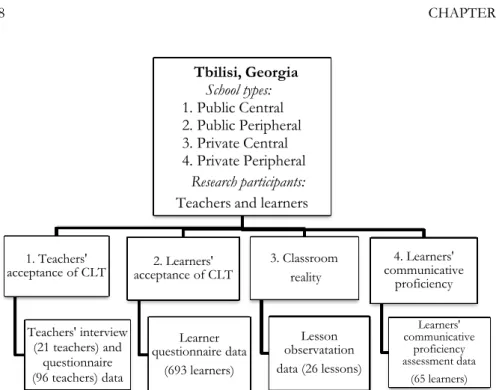
Figure 1.3: Research context, areas studied and the obtained data
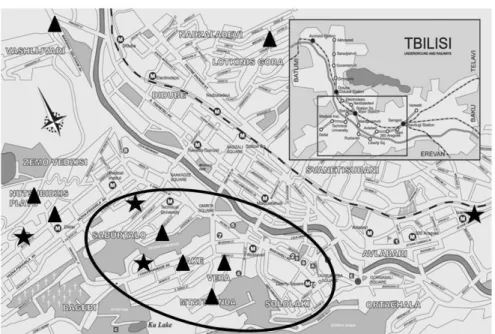
More information about the research methodology employed for each study area presented in Figure 1.3 above can be found in the corresponding dissertation chapter. Also, to better illustrate the study context, which applies to all the empirical research presented in chapters 7–10 of this dissertation, a map of Tbilisi, with the participating schools marked on it, is presented in Figure 1.4 below:
Tbilisi, Georgia
School types:
1. Public Central
2. Public Peripheral 3. Private Central 4. Private Peripheral
Research participants:
Teachers and learners
1. Teachers' acceptance of CLT
Teachers' interview (21 teachers) and questionnaire (96 teachers) data
2. Learners' acceptance of CLT
Learner questionnaire data
(693 learners)
3. Classroom reality
Lesson observatation data (26 lessons)
4. Learners' communicative
proficiency
Learners' communicative
proficiency assessment data
INTRODUCTION 9
Figure 1.4: Map of Tbilisi and locations of the schools of the present study2
Consequently, the results of all four studies were analyzed against varying context-related, as well as teacher- and learner-related, external factors. Thus, in each analysis chapter, the general tendencies are explored first, which are then further broken down into the different school types (the four school types) as well as being considered in terms of teacher and learner characteristics. This approach proved to be useful, as a number of differences were revealed as a result of including the external factor as a differentiating variable, leading to a more accurate and informative output.
1.5 PREVIOUS RESEACH AND THE SIGNIFICANCE OF THE PRESENT STUDY
Since the area which the present dissertation explores, Communicative Language Teaching in Georgia, and the related theory and practice officially starts in 1997 (Tkemaladze et al., 2001:18), not much previous research is available in this regard, whether focusing on theoretical or on practical aspects. In the process of a review of literature for this study, whereas a plethora of resources was available that discussed CLT in other countries, little was available discussing CLT in a Georgian context. The only research dealing with
2 Map has been retrieved from: http://www. besttbilisihotels. com/images/ Tbilisi%20map % 2
02.jpg. The central part of Tbilisi is marked with a circle on the map. Triangles stand for public
10 CHAPTER 1
CLT and language teaching in Georgia was an empirical study undertaken by a group of five Georgian researchers in 2001 with the support of the Georgia branch of the British Council and the Ministry of Education of Georgia, entitled Teaching and Learning English in Georgia 2001: A Baseline Study (Tkemeladze et al., 2001). This study was of the utmost importance, as it was the first of its kind, exploring the state of affairs in foreign language teaching and learning in the post-Soviet period, coming four years after the first Communicative Curriculum for Foreign Languages was introduced in Georgia in 1997.
Nevertheless, with regard to the above mentioned study, it can be argued that the history of the reform at that time, stretching merely from 1997 to 2001, had been too short for CLT measures to have had a real impact on the situation of language teaching and learning in Georgia. Also, many more efforts aimed at transforming the post-Soviet language teaching model in Georgia into a more modern, communication-oriented experience were undertaken in the first decade of the 2000s, and this effort still continues today. No other investigation of developments in the English Language Teaching (ELT) field in Georgia has been conducted since then, and many policy decisions and novelties with regard to foreign language teaching in Georgia in the years since the publication of Tkemaladze et al. have been either copied wholesale from other Western contexts or were made on intuitive grounds. Thus, in acknowledgement of the urgency of further research being undertaken in order to investigate how things have further developed since the second, stronger wave of language teaching reform that took place in Georgia in 2009, the present study was conducted. It is hoped that the findings of this investigation of Communicative Language Teaching in Georgia will provide a certain degree of continuity with the previous research and that these findings may serve as a basis for future research to be conducted in the area of language teaching and learning in Georgia.
INTRODUCTION 11
Also, since the research tools per se did not specifically focus on English language teaching, but rather bear a general character, they could be applicable to similar future studies conducted with regard to the situation for other foreign languages as well as in the contexts of other countries, particularly those with a post-Soviet or at least post-communist background.
1.6 DISSERTATION OVERVIEW
The present dissertation consists of two parts: the introductory chapters (Chapters 2-6) provide theoretical and contextual background to the second, analysis-based part of the dissertation (Chapters 7–10). Below follows an outline of how the remainder of this dissertation is organized.
Chapter 2 is about the general history of language teaching – about various language instruction methods, their underlying theories, procedures and goals. In this chapter, CLT is presented as one of the approaches to language teaching that have arisen historically. Chapter 3 focuses on CLT only, describing in detail its history and theoretical basis. The information presented in this chapter was essential for developing suitable research tools, which, as they were aimed at investigating the application as well as the effects of CLT, had to be based on clearly-identified CLT principles. Hence the research instruments used in this study – interviews, questionnaires and observation forms – closely follow the sections presented in Chapter 3. Chapter 4 is about modernizing CLT and the role that information technology can play in this regard. Chapter 5 places foreign language teaching into a Georgian context and deals with developments in the field since Soviet times up to the present day. Developments in the area of technology-enhanced teaching in Georgia are also touched upon in this chapter. In Chapter 6, the National Curriculum for Foreign Languages, adopted in 2009 and subsequently revised in 2011, is discussed in detail. This is important in order to have a point of reference and framework against which requirements for language teachers as well as learners in Georgia can be measured, and the levels of achievement defined.
12 CHAPTER 1
efficiency and degree of success of CLT adopted as an official language teaching method in secondary schools in Georgia. Chapter 9 investigates the actual classroom reality at twelve secondary schools in Tbilisi. Thus, Study 3 (Chapter 9) sheds light on what works and what does not work in actual practice at secondary schools in Georgia. Being a follow-up to teacher and learner interviews and questionnaire surveys, it also allows for the possibility of comparison between what teachers and learners say with what they actually do in the classroom and reveals the possible discrepancy between the two. Finally, Chapter 10, the last of the four analysis chapters measures the end-product of all the efforts made at the theoretical as well as practical level: it reports the results of Georgian learners’ communicative proficiency, which is measured against the requirements and standards presented in the National Curriculum for Foreign Languages of Georgia.
HISTORY OF LANGUAGE TEACHING 13
CHAPTER 2: HISTORY OF LANGUAGE TEACHING
METHODS
2.1 INTRODUCTION
Placing CLT, the language teaching method which is the focus of the present dissertation, in its historical context enables the reader to compare and contrast it with other teaching methods described in the mainstream literature that deals with the second-language learning/teaching field, and to accentuate the distinctive features characteristic of CLT in better ways (for a detailed discussion on Communicative Language Teaching, see Chapter 3). For this reason, a brief disucssion of the foreign language teaching methodology history is provided in the present chapter. A more detailed overview of the chapter is provided below.
Chapter overview
The present Section of this chapter (Section 2.1) discusses the general dynamics observed throughout the history of language teaching methods and the method categorization principles adopted in this chapter. The older mainstream methods of foreign language teaching, such as the Classical Method/ Grammar Translation, The Direct Method and the Audio-Lingual Method, are described in Section 2.2. The shift towards more communicative approaches to language teaching and the emergence of so called “alternative methods” are looked at in Section 2.3, while Section 2.4 discusses the Communicative Approaches. Finally, Section 2.5 provides a summary of the chapter as well as a discussion of the “post-method condition” (Kumaravadivelu, 2006: 161) witnessed today.
Foreign language teaching became a profession in the early twentieth century, when the concept of a “method” emerged in language teaching, a concept referring to “a set of teaching practices based on a particular theory of language and language learning” (Richards & Rodgers, 2001: 1). The theoretical grounds and principles underlying a certain method were subsequently used to form the basis for foreign language teaching curriculum, syllabus, classroom procedure, and for defining teachers’ and learners’ roles as well as material design. There were, in addition, some cases where methods were not supported by any profound theoretical basis, but rather emerged as a result of certain strong culturally-grounded beliefs with regard to what the value and general goal of language learning was, the Classical Method and the Grammar Translation Method being two such instances (Richards & Rodgers, 2001: 1; for more discussion, see Section 2.2).
14 CHAPTER 2
one. The failure of a given existing language teaching method to accomplish its goal and the emergence of new language teaching theories and ideologies in linguistics and adjacent fields of study resulted in frequent changes and innovations in the field throughout the twentieth century (Richards & Rodgers, 2001: 1). According to Brown (2007), “a glance through the previous decades of language teaching shows that as disciplinary schools of thought – namely, psychology, linguistics and education – waxed and waned, along went language-teaching trends” (2007: 1). Thus, it can be said that the tendency in foreign language teaching was that of seesawing: that one method would usually be replaced by a radically different alternative, which can be explained by the fact that the lack of success of a given method occasioned a desperate search for another approach representing the other extreme of teaching ideology. As Mackey (2006: 138) rightly remarks, “while sciences have advanced by approximations in which each new stage results from an improvement, not rejection, of what has gone before, language-teaching methods have followed the pendulum of fashion from one extreme to the other”.
HISTORY OF LANGUAGE TEACHING METHODS 15
included under Method, which includes the components of theory as well as practice (Richards & Rodgers, 2001: 16).
The first level, approach, defines those assumptions, beliefs, and theories about the nature of language and the nature of language learning which operate as axiomatic constructs or reference points and provide a theoretical foundation for what language teachers ultimately do with learners in classrooms. The second level in the system, design, specifies the relationship of theories of language and learning to both the form and function of instructional materials and activities in instructional settings. The third level, procedure, comprises the classroom techniques and practices which are consequences of particular approaches and designs. (Richards & Rodgers 1982: 154)
Richards and Rodgers’ definition of the term Approach coincides with that offered by Antony; however, Design and Procedure (replacing Antony’s Method
and Technique) provide more detailed definitions: under Design, the further
concepts of language teaching syllabus, learner and teacher roles, and instructional materials and their types and functions are also specified (Kumaravadivelu, 2006: 86). Procedure, like Technique in the Antony framework, refers to actual classroom activities; however, Richards and Rodgers describe this component in more elaborate terms: “the types of teaching and learning techniques, the types of exercises and practice activities, and the resources – time, space, equipment – required to implement recommended activities” (Kuramavadivelu, 2008: 86).
Charging Richards and Rodgers’ model with being somewhat ambiguous, and criticizing the three-component model of describing classroom teaching activities as “redundant and overlapping”, Kumaravadivelu suggests the two-component model of definition of the language teaching related terms: namely, of Principles and Procedures (2008: 86, 87). He merges the levels of Approach and Design proposed by Richards and Rodgers and elaborates that the activities described under method/design, such as “syllabus construction, material production, and the determination of learner/teacher roles” go beyond the responsibilities of a practicing teacher, who should be in charge of the undertakings that fall under technique/procedure aspect of language instruction (2008: 87).
Acknowledging the validity of the reasoning offered by Kumarava-divelu with regard to the interpretation of language teaching-related terminology, the model offered by Richards and Rodgers is the one adopted in the present dissertation, as their use of ‘method’ as a general term for referring to the unity of language teaching principles, as well as their Approach versus Method distinction, provides the more elaborate definitions needed (with
Approach referring to the broader term under which Method falls as a
16 CHAPTER 2
According to Kumaravadivelu (2008), “another source of tiresome ambiguity that afflicts language teaching is the absence of a principled way to categorize language teaching methods in a conceptually coherent fashion” (2008: 90), which is due to the emergence of a plethora of major and minor methods, some mainstream, some alternative, during the twentieth century. The “Method Boom” (Stern, 1985: 249) that was witnessed in the 1970s made this need even more obvious. Currently, Kumaravadivelu (2008: 90-92) claims, there are at least “a dozen” of various language teaching methods methods, and the categorization scheme he offers is as follows.
a. Language-centerd methods –deal with language structures mainly and aim to help learners practice “pre-selected” and “presequenced linguistic structures” through pre-determined form-oriented activities (such as, the Grammar Translation and the Audio-Lingual Method).
b. Learner-centerd methods – deal with learner needs and relevant contexts and aim to provide opportunities for learners to practice “preselected and presequenced linguistic structures” as well as provide communicative/ functional abilities through meaning-oriented exercises (such as the appro-ach at the focus of this thesis and currently officially favored in Georgia, Communicative Language Teaching).
c. Learning-centered methods – deal with the “cognitive processes of language
learning” and considered them as “nonlinear” and thus unsuited for pre-determined activities and approaches to teaching. Hence, these methods (such as, the Natural Approach) aim at providing learners with opportunities for spontaneous, meaningful communication through which language knowledge is hoped to be constructed.
Yet another form of grouping foreign language teaching methods is adopted by Richards and Rodgers in their book Approaches and Methods in Language Teaching (2001), according to which the trends in language teaching over the last fifty years are presented in the following three categories:
a. Major trends in twentieth-century language teaching b. Alternative approaches and methods
c. Current communicative approaches.
HISTORY OF LANGUAGE TEACHING METHODS 17
2.2 MAJOR METHODS IN FOREIGN LANGUAGE TEACHING
The first method as such that emerged historically in Europe in the teaching of non-native languages was the Classical Method, which was mainly used for teaching Latin and Greek. According to this method, it was believed that a profound knowledge of the grammar of the target language would contribute to better familiarization with and mastery of the grammatical system of one’s native language and that the language learning process would also be a beneficial “mental exercise even though learners would probably never use the target language” (Dincay, 2010: 43).
Later, in the spread of extensive schooling to the middle and lower social classes in the latter part of the 19th century, the Classical Method was modified
for the teaching of modern foreign languages and came to be known as the Grammar Translation Method (GT). The Grammar Translation Method has no real theoretical bases – whether “linguistics, psychological or educational” –to corroborate its practices (Richards & Rodgers, 1986: 5). It was a language teaching method devised on pragmatic grounds of economy and suited the existing institutional resources. GT offered very little beyond insight into grammatical rules and some measure of involvement by learners in the process of translating texts from a second language into a native tongue. No focus on communication or real-life language was provided under this method (Richards & Rodgers, 1986: 4).
The process of globalization and the increase in foreign travel for both business and pleasure in late 19th-century Europe and latterly other continents
brought about the need for something approaching mass oral proficiency in foreign languages. As a result, the Direct Method emerged, which was the opposite extreme to the Grammar-Translation Method. The idea emphasized in the Direct Method is that learning a language is an innate ability and that foreign languages ought to be learned in the same way children pick up their first language – by being directly exposed to the language, with no translation employed at all (Richards & Rodgers, 1996: 9). A generation after the appearance of the Direct Method in Europe (1920s-1930s), this method evolved into the Oral Approach (1950s-1960s), or as it is more frequently referred to, Situational Language Teaching (Richards & Rodgers, 1986: 31). One of the distinctive features of Situational Language Teaching is the emphasis it places on linking knowledge of structures to situations of their practical application: meaning is explained through situational dialogues, visual aids, realia, pantomime, gestures, demonstration, mime and drawing, with no recourse to the students’ mother tongue (Richards & Rodgers, 2001: 41-46).
18 CHAPTER 2
and translators. As a reult, an intensive Audio-Lingual Method, also called as “the Army Method” (1940-1960s), emerged. Under this method, it was recommended that learners be taught a foreign language for six days a week, ten hours a day (Richards & Rodgers, 2001: 50-51; Kumaravadivelu, 2006: 98). Being based on the behavioural theory, this method largely focuses on speaking and listening skills and effective habit formation through adequate reinforcement. The Audio-Lingual Method largely employs rote memorization, repetition, drills and dialogues in the study process (Kumaravadivelu, 2006: 100; Richards & Rodgers, 2001: 56, 58).
2.3 ALTERNATIVE METHODS IN FOREIGN LANGUAGE TEACHING
According to Kumaravadivelu (2006) “language-centered methods proved to be immensely helpful to the classroom teacher. The entire pedagogic agenda was considered teacher-friendly, as it provided a neat rules-of-thumb framework with which to work”. In language centered methods, the aims of language teaching, teaching materials, lesson structure as well as assessment approaches are clearly determined. Thus, the teacher is in complete control of classroom processes and at ease (Kumaravadivelu, 2006: 109). However, convenience and ease with which a cetrain teaching method can be employed does not necessarily mean their being successful. The strongly-felt inadequacy of the “language-centered” teaching methods, together with new insights emerging in the field of psychology and linguistics, triggered a quest for a substitute for the existing language teaching methods which would be better adapted to the newly emerged language learning needs. This led to the latter 20th-century paradigm
shift in the language teaching field (Kumaravadivelu, 2006: 109, 113).
In the early 1950s, Noam Chomsky and his followers challenged previous assumptions about language teaching. He drew the attention of the applied linguists and language teachers to the ‘deep structure’ of language and professed that language learning is about creativity more than about habit formation, and that humans are capable of coming up with linguistic structures that they have never heard before, not merely copying the model provided but creating them on their own (Richards & Rodgers, 2001: 153).
HISTORY OF LANGUAGE TEACHING METHODS 19
psychological theories gave way to the “communicative movement” in mainstream language teaching (Richards & Rodgers, 2001: 71), leading to the emergence of Communicative Approaches (which will be discussed in Section 2.4 below). However, around the same time, in the 1970s-1980s, the period which is referred to as the “Method Boom” (Stern, 1985: 249), other experimental methods, which also came to be known as “Designer Methods” (Nunan, 1989: 97), or “Alternative Methods” (Richards & Rodgers, 2001: 71), emerged in parallel with the communicative approaches.
Alternative Methods, it is claimed, focus on certain aspects neglected by the traditional approaches, such as feelings, emotions and interpersonal relationships, and hence, are sometimes also called “Humanistic Methods” (Richards & Rodgers, 2001: 71). According to Richards and Rodgers, “these methods are developed around particular theories of learners and learning, sometimes the theories of a single theorizer or educator” (2001: 71). Summaries of these methods, which in Kuramavadivelu’s (2008) terms fall under the “Learning-Centered Methods” category, are presented in the paragraphs that follow below in this section.
The “alternative methods” mentioned in the preceding paragraph can be further classified into certain groups: three methods, Total Physical Response (Asher, 1970s), Natural Approach (Krashen & Terrel, 1983) and Lexical Approach (Lewis, 1993), can be housed under a more general umbrella category, the Comprehension Approach. As Richards and Rodgers (2001) summarize,what all these three methods have in common are the following:
a) It is believed that the receptive skills are mastered before productive skills are
b) It is believed that speaking should be taught only after the comprehension skills are acquired
c) It is believed that acquisition of a listening skill is beneficial to other skills development as well
d) It is believed that in the teaching/learning process more attention should be given to the meaning of the language rather than its form
e) It is believed that teaching/learning process should be stress free (2001: 78-79).
In Kumaravadivelu’s (2008: 93-94) analysis, the theoretical premises of the Comprehension Approaches rest upon the following principles:
In Comprehensive Approaches:
a. Language development is incidental, not intentional
b. Language development is meaning-focused, not form-focused
20 CHAPTER 2
The Total Physical Response (TPR) developed in the 1970s is influenced by developmental psychology, learning theory and humanistic pedagogy (Richards & Rodgers, 2001:73). In the TPR, physical movement activities are employed to achieve teaching/learning goals. TPR advocates that both language and body movement are synchronized through action responses and the use of the imperative. According to TPR, learning should resemble the natural process of language acquisition by children, who develop their listening competence first by responding physically to their caregivers’ commands and only at a later stage becoming capable of spontaneously imitating and producing the language to which they are exposed (Rodgers, 2001: 74-89).
The Natural Approach (NA) was initially proposed by Terrell (1977; 1982). Terrell sought to incorporate into language teaching the “naturalistic” principles identified in studies dealing with second-language acquisition (Richards & Rodgers, 2001). The Natural Approach (NA), like the Direct Method, is based on the assumption that a spontaneous, unorganized language teaching process, ostensibly resembling first-language acquisition, is “the only learning process which we know for certain will produce mastery of the language at a native level” (Newmark & Reibel, 1968: 153). Drawing on the theoretical basis discussed above, in the Natural Approach no explicit correction or grammar instruction is provided, the main emphasis being the teaching of lexis and of fluency, and the main target of the language learning being defined as communicating the right messages and meanings (Richards & Rodgers, 2001:178-191).
The Lexical Approach, alsoknown as the “Slot and Filler Approach”, is a method of teaching foreign languages described by Lewis in the 1990s. This method assumes that the basic building blocks of language learning is not grammar, functions or notions, but rather words and word combinations (collocations) in a language: in a word, lexis. It further assumes that learning a language involves the ability to comprehend, memorize and produce lexical phrases as chunks. The language is perceived as “grammaticalized lexis not lexicalized grammar” (Lewis, 1993), which means that vocabulary is prized over grammar per se in this approach. In the Lexical Approach, for the first time in the history of the profession, the language syllabus was based on a lexical rather than grammatical scheme (Richards & Rodgers, 2001:138). Having discussed three of the methods that fall under the “Comprehension Methods” category, in the remainder of this section [2.3], more “Alternative Methods”, which are also believed to be more “humanistic”, are further summarized.