Packet Routing using Optimal Flooding Protocol
in Cluster based MANET
S.Bavani A.Aarthi
Department of Computer Engineering Department of Computer Engineering KPR Institute of Engineering and Technology, Coimbatore,
Tamil Nadu
KPR Institute of Engineering and Technology, Coimbatore, Tamil Nadu
V.Aiswariya C. S. Madhumathi
Department of Computer Engineering Assistant Professor
KPR Institute of Engineering and Technology, Coimbatore, Department of Computer Engineering
Tamil Nadu KPR Institute of Engineering and Technology, Coimbatore, Tamil Nadu
Abstract
In Mobile ad-hoc network, the topology of the network changes rapidly, as the mobile nodes are self-configuring. In non-uniform load distribution, the bandwidth utilization is efficiently managed by dynamic channel allocation and co-operative load balancing algorithm. Also, the investigation of routing layers has not been discussed, so this paper is mainly focused on packet routing using optimal flooding protocol. Some form of flooding is used by most of the ad-hoc routing protocols for location discovery and route of a mobile node. There will be propagation of unnecessary messages even after optimization, therefore in optimal flooding protocol, unnecessary transmissions are minimized by selective transmission there by reducing the overhead. The efficiency of OFP remains very high in large networks.
Keywords: OFP, Mobile ad-hoc network, Load Balance, CBR
________________________________________________________________________________________________________
I. INTRODUCTION
Mobile ad-hoc network is rapidly deployable and self-configuring network. Nodes are free to move and organize themselves. So, the network topology changes frequently. In an ad-hoc network, devices are called nodes which have limited transmission range. Therefore, communication takes place within the transmission range of nodes via intermediate nodes.
The fundamental operation in the mobile ad-hoc network is broadcasting, where a node disseminates the message to all other nodes within the network. Flooding is an indispensable message dissemination technique for the wide network within the Manet. In flooding, all incoming packets are broad casted through all outgoing link except the one it arrive on. But it will have more unwanted retransmission and more control message overhead for route discovery.
This paper present optimal flooding protocol which will minimize the control overhead for route discovery by selective forwarding where broadcasting is done only by few selective nodes. It is assumed that a mobile node knows its location.
The key advantages of OFP are:
OFP minimizes the number of unnecessary transmissions to maximum possible extent. OFP is scalable.
In OFP, bandwidth overhead can be minimized because a node does not need to know neighbourhood information.
The rest of the paper is organized as follows. In section 2, we discuss about review of literature. Section 3 presents existing system section 3.1 and in section 3.2 we present the dynamic channel allocation and cooperative load balancing algorithm. Section 4 discusses the proposed system. In section 5, we conclude the paper.
II. REVIEW OF LITERATURE
The requirements of a routing protocol for ad hoc networks are to withstand different traffic patterns and to control overhead. Flooding protocol is used to discover the location and route of mobile nodes, which is a problem in ad hoc networks. In optimal flooding protocol, to avoid the unnecessary transmissions, covering problem is used. The optimal flooding protocol sends the packets only to the selected nodes. On-demand protocols such as DSDV [3], ZRP [5] and GOSSIP [6] also make use of the flooding algorithms.
DSDV routing has been proposed as an approach for routing between ad hoc mobile nodes. The approach involves all nodes, to maintain a complete list of routes to all other nodes in the network. Keeping a routing table does not reduce the route latency before transmission of the first packet to the destination.
bimodal behaviour, which used in larger networks. Gossiping can be combined with optimizations of flooding for improved performance. It reduces 35% of control message overhead. Even though it reduces the overhead because of the probabilistic model, the gossip dies out in premature. The proactive and reactive approaches in the route discovery and route maintenance were proposed by Hass and Pearlman in Zone Routing Protocol (ZRP) [5]. The topology update propagation is limited to the initiator's neighbourhood in the route discovery, which is performed on-demand.
DREAM [7] is also a protocol that is used for the location discovery in terms of the GPS system. It needs the information of the physical location of the node and using the GPS gives the location information. In ad hoc networks along with this feature of radio communications, a node can calculate its location with respect to the other nodes in the locality using GPS. A demand driven route-establishment procedure with an expanding-ring search has been proposed by Perkins and Royer in the AODV (Ad hoc on demand distance vector Routing) [4]. If the destination is not found in a zone of small radius, it resorts to pure flooding.
III. EXISTING SYSTEM
In MANET, it is important to maintain bandwidth efficiency while maintaining requirements on energy consumption, delay. For uniform load distribution, co-ordinated channel access protocol is well suited for highly loaded MANET and it is not suited for non-uniform load distribution due to lack of on-demand dynamic channel allocation. So in order to improve the performance, dynamic channel allocation and co-operative load balancing algorithm are used. This can be implemented by using MH-TRACE.
Dynamic Channel Allocation
The algorithm deals the problem of non-uniform load distributions from the perspective of channel coordinators. The available channels are continuously monitored for its power level by channel controllers with the help of threshold, the measured power levels are compared and the availability of channels are assessed. If the capacity of the channel coordinator is less than the load, then the channel coordinator will use an additional channel with lowest power level. Also, it reacts to the increasing load by the share of bandwidth. The power level of that channel is increased so that channel cannot be accessed by nearby controllers.
Cooperative Load Balancing
This algorithm deals with the problem of non-uniform load distribution from the perspective of nodes in the network. The channel coordinators loads are continuously monitored by active nodes. If the channel coordinator is heavily loaded, active nodes can switch to available resources. These nodes detect the depletion of the channel coordinators and shift their load to other coordinators with non-available resources.
IV. PROPOSED SYSTEM
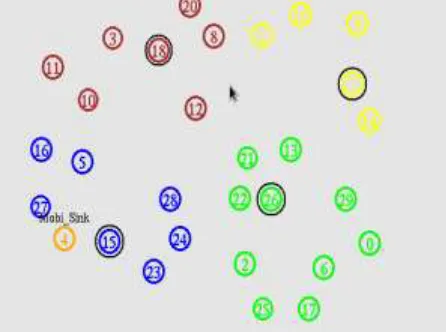
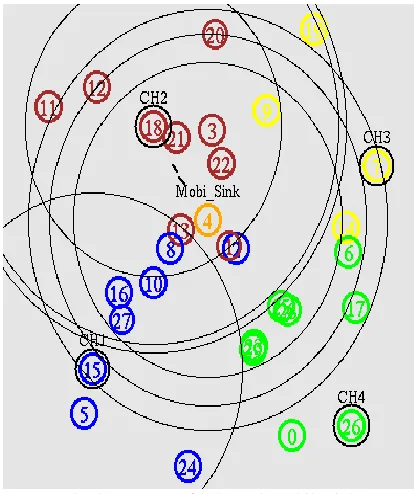
We created 30 nodes as four clusters having one mobile sink node. Nodes 15, 26, 7, 18 are cluster heads. Different colours are used to represent nodes which are in their range. Mobile sink acts as the base station which will receive the packets from nodes and transmit the packets to receiver nodes.
Fig. 2: Data transfer
The data need to be sent to the other cluster is first send to the cluster head and it is forwarded to the mobile sink node when mobile sink is available within its range. The mobile sink will send the packet to the respective cluster head. In the fig-2 28th node sends its data to its cluster head 15.
Fig. 3: Data transfer through mobile sink
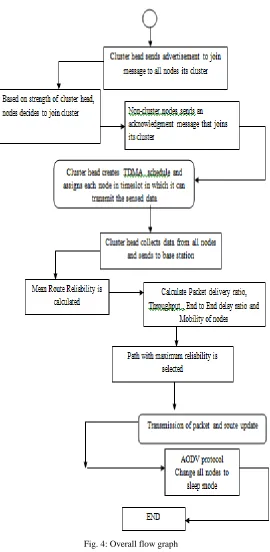
Fig. 4: Overall flow graph
V. CONCLUSION
Due to dynamic nature of the nodes in the mobile ad-hoc network, it is difficult to design efficient broadcast protocol. In this paper, we proposed optimal flooding protocol for efficient broadcasting. Variation of the covering problem is the base of optimal flooding protocol (OFP). By using this protocol, the objective of flooding is achieved with little/reduced transmissions.
REFERENCES
[1] Ora Karaoglu and Wendi Heinzelman “Cooperative Load Balancing and Dynamic Channel Allocation for Cluster-Based Mobile Ad Hoc Networks” IEEE transactions on mobile computing, vol. 14, no. 5, may 2015
[2] Vamsi K Paruchuri, Arjan Durresi, Durga S Dash and Raj Jain“optimal flooding for routing in ad-hoc networks”
[3] C.perkins and P.Bhagat. Highly dynamic Destination-sequenced Distance Vector Distance-Vector routing for mobile computers. In ACMSIGCOMM Symposium on Communication Architectures and Protocols, 1994.
[4] C.Perkins and E.Royer “Ad- hoc on demand distance vector routing”. Internet Draft, August 1998. [5] Z.Haas and M.pearlman” The Zone Routing protocol for ad-hoc networks”. Internet-draft, August 1998. [6] Hass, Halpern, Li. “Gossip based Ad Hoc Routing”. In IEEE INFOCOM, June 2002.