Parts Shape Recognition Based on Improved
Harris Corner Detection Algorithm
Huicheng Yang
School of electrical engineering,Anhui Polytechnic University,Wuhu Anhui province,China Email:[email protected]
Ying Ma
School of electrical engineering,Anhui Polytechnic University,Wuhu Anhui province,China E-mail:[email protected]
Hui Yang
School of electrical engineering, Anhui Polytechnic University,Wuhu Anhui province,China E-mail:[email protected]
Mingshu Li
Electronic science and technology, Southeast University,Nanjing Jiangsu province,China E-mail:[email protected]
Abstract—Harris corner detection algorithm called Harris corner detector is a very effective corner algorithm for gray-scale images. The corners extracted by Harris corner detector are stable, reliable, homogeneous and reasonable. However, it has own inevitable limitations. For the shape recognition of parts, an improved Harris corner detector is proposed in this paper. Based on the analysis of Harris corner detector, B-spline function is chosen as smooth filter instead of Gaussian function. And then the convolution template of B-spline function is provided. Some experiment results indicate that the improved Harris corner detector is effective and superior.
Index Terms—hape recognition, Harris corner detector, smooth filter, Gaussion function, B-spline function, convolution template.
I. INTRODUCTION
With the rapid advance of industrial production automation, it is a trend for manufacture to improve the efficiency, intelligence and precision. In the process of production, machine vision has important applications such as the detection and recognition of machine parts, production monitoring[1]. What is more important, the human eye cannot meet the detection requirements in some industrial situation. Compared with the human eye, machine vision can improve significantly the production efficiency and automation level. In the meantime, machine vision can also save the labor cost. In recent years, with the development of image recognition, object detection has acquired a series of success in the video sequences and 2D images[1-5].
As an important branch of the machine vision, shape recognition is widely applied to in the fields of parts localization in industrial production, product quality testing and so on [4]. At present, the shape recognition methods of parts are based on the profile, the ratio of
length to width and the degree of rectangle. Paijit K. suggest that humans can identify structured shapes by some interest points in local image[5]. Because interest points could represent visually information and are robust to partial occlusion, some researchers have applied interest points to recognize objects in various successful cases.
Corners are the local features of an image that can decide the shape of an object. So, it can be used widely in machine vision and pattern recognition. Harris corner detector is a method of corner extraction based on a gray-scale image[6]. It adopts a local autocorrelation analysis method that is robust to noise, rotation and lighting. However, it adopts Gaussian low-pass filter to smooth the gray-scale image. So it has some problems, such as the position offsets and the information lose of the corners. In addition, it's very poor real-time performance because of the large amount of calculation.
This paper proposes an improved Harris corner detector to recognize corner points in some part images. A B-spline function can converge to a Gaussian function. In additional, it has the characteristics of data fitting, low-pass flitting, good approximation and compactness. So the Gaussian low-pass filter of Harris corner detector can be replaced with a B-spline function. In this paper, the improved Harris corner detector has two improvements: 1) using a B-spline filter to smooth noise before corner extraction; 2) establishing a window inhibition function to erase the pseudo corners after corner extraction.
II. HARRIS CORNER DETECTOR
Harris corner detector is a classic corner detection algorithm proposed by Harris C and Davis L S.A in 1988 [6]. Based on a local auto-correlation function, the basic
idea of Harris corner detector is to recognition a point by a small sliding window and to use a gradient formulation to detect response at any shift. If the point is a corner point, shifting the window in any direction can yield a large change in the intensity of the detect response. With characteristics of rotationinvariance,scale invariance and high reliability, Harris operator is used to corner detection in a gray-scale image. The corner is proportional to the principal curvatures of the autocorrelation function that can represent the intensity change rate of the local image. So, Harris corner detector can be applied to detect the shape of parts in a gray-scale image by the differential operation and autocorrelation matrix. While shifting the small sliding window at any shift
( , )
u v
in any direction,the intensity change
E u v
( , )
can be quantified bysum-of-squared- difference(SSD) .
,
2
( , )
[
,
,
]
,
2
[
]
,
,
,
,
2
[
]
,
,
=
∑
+
+
−
≈
∑
+
+
−
=
∑
+
x y
E u v
w
I
I
x u y v
x y
x y
w
I
uI
vI
I
x y x y
x
y
x y
x y
w
uI
vI
x y
x
y
x y
. (1)
Where
w
x y
,
is a Gussian window function,I
x y, is thepixel intensity at the position
( , )
x y
in a gray-scale image,,
/
x x y
I
= ∂
I
∂
x
andI
y= ∂
I
x y,/
∂
y
which can be gotby convoluting difference operator [7].
,
,
( 1,0,1)
( 1,0,1)
x x yT y x y
I
I
I
I
=
⊗ −
=
⊗ −
(2)
Where
⊗
is the convolution operator, the first order gradient operator reflects the intensity change of the pixels in any direction, which can effectively distinguish between corner pixels and edge pixels, so Harris corner detector has rotation invariance. At the same time, Harris corner detector selects a Gaussian function as a detection window function, which can smoothly filter the image to well inhibit the noise.Supposed gradient matrix
M
is the 2 by 2 symmetricmatrix .
⎥ ⎦ ⎤ ⎢ ⎣ ⎡
=
⎥ ⎥ ⎦ ⎤ ⎢
⎢ ⎣ ⎡
=
B C
C A
y I y I x I
y I x I x I M
2 2
(3)
Where
A
,B
, andC
can be calculated as followingequations:
A=Ix2⊗w (4) B=Iy2⊗w (5)
C=(IxIy)⊗w (6)
2 2 2
,
exp (
) / 2
x y
w
=
−
x
+
y
σ
(7)Where
w
x y, is a smooth window function producedby the Gaussian function, and equations (1) can be expressed as:
( , )
22
2[
] [
]
TE u v
Au
Cuv
Bv
u v M u v
=
+
+
=
(8)Because the sliding window auto-correlation function of a corner point has a minimum value when centered on the corner, gradient matrix
M
is used to detect cornerpoints [4]. Supposing
λ
1andλ
2are two eigenvalues ofM
,if
λ
1andλ
2 both are high then the intensity change ofE u v
( , )
is also tremendous, so the point is a corner. Ifone of
λ
1andλ
2 has big eigenvalue then the point situates the edge point. Ifλ
1andλ
2 both are very small then the intensity changeE u v
( , )
is very small in anydirection. In order to avoid calculating the eigenvalues (
λ
1andλ
2) of matrixM
, Harris corner detector definesa corner response function
G
to detect corner points. Supposed thatD
et( )
M
is the determinant of the matrixM
andTr M
( )
is matrix trace of the matrixM
[8], thenB A M
Tr( )=λ1+λ2= + (9) 2 2
1 )
(M AB C
Det =λ λ = − (10) 2
) ( )
(M k Tr M Det
G= − • (11) Where
k
is an empirically determined constant and04
.
0
=
k
is proposed[6]. Then corner points can beselected by a given threshold to determine the minimum of
G
. In other words, one point is considered as cornerpoint only when its response value
G
is greater than thegiven threshold.
III. GAUSSIAN FUNCTION AND B-SPLINE FUNCTION A. The Drawback of Gaussian Function
Using a Gaussian function to smooth a gray-scale image, there are two problems:
(1)For a Gaussian function
G
(
x
)
∈
L
∞(
R
)
,function
f
(
x
)
would be excessively smoothed. Owing to)
(
)
(
)
(
x
f
x
G
x
g
=
⊗
, the better smoothness, theimage smoothed is the worse compared with the original image. According to the differential property of the convolution operator:
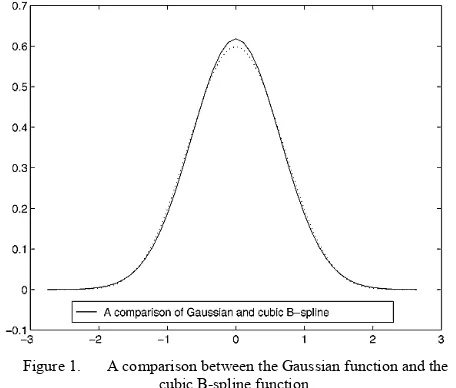
Figure 1. A comparison between the Gaussian function and the cubic B-spline function.
) ( )
(
)] ( ) ( [ ) (
x G n x
n x f
x G x f n x
n x g n x
n
∂ ∂ =
∂ ∂ = ∂
∂
(12)
And
)
(
)
(
x
L
R
G
∈
∞Thus
)
(
)
(
x
L
R
g
∈
∞ .(2)Image smoothing mainly aims to improve the signal-to-noise ratio and eliminate noise. However, during procedure of smoothing image using a Gaussian function, edge as high frequency components will be smoothed out. In addition, some edge will be transform into graded and compressed on the image histogram. As a consequence, corner may be lost easily on the maximum inhibition. Harris corner detector has high stability, especially in L-shaped corner detection, but smoothing filter designed by the gaussian function may cause image information loss for excessive smoothness. Above all, the gaussian window’s size is not easy to control in the practical application. According to the central B-spline function theory, B-spline function has smoothing performance. In view of the above two problems, the paper puts forward an improved algorithm. Firstly, a central B-spline function is applied to smooth the gray-scale image, which replaces the Gaussian function. Next, this paper analyzes the advantages and disadvantages of both the central B-spline function and the Gaussian function.
B. The Definition and Properties of B Spline Function B-spline function is widely used in the fields of image processing and pattern recognition, such as image de-noising and edge detection.
Supposed that
β
n(
x
)
denotes a central continuousB-spline function with n order, which can be generated by a B-spline function with zero order.
R x
n
x x n x
n
∈ +
=
− =
, 1
) ( 0 * ... * 0 * 0
) ( 1 * 0 ) (
β β
β β β β
(13)
Where
⎪ ⎪ ⎪
⎩ ⎪ ⎪ ⎪
⎨ ⎧
= < < −
=
otherwise x
x
x
,
0 2
1 ,
2
1 2
1 2 1 , 1
) (
0
β (14)
According to the consequence of the central limit theorem, a B-spline function can well approximate
Gaussian function. So it is commonly used in computer vision [9]. Some researchers have presented a more general proof that B-spline function can converge to the Gaussian function inLp(R),
∀ ∈ +∞
p
[2,
)
as the ordern
of the B-spline tends to infinity. Since the variance2
σ
of the B-spline function withn
order is12
1
+
n
, the approximation relation is as follows.
⎟⎟
⎠
⎞
⎜⎜
⎝
⎛
+
−
+
=
+
=
−
≈
1
6
exp
)
1
(
6
12
1
),
2
exp(
2
1
)
(
2 2 2
2
n
x
n
n
x
x
nπ
σ
σ
πσ
β
(15)
In Fig.1, the Gaussian function is drawn in a solid line and the cubic B-spline is drawn in a dotted line. Form Fig.1, there is a graphical comparison between the Gaussian function and the cubic B-spline function. Besides, both the physiological and biological experiments [10] have shown that the human vision can be modeled with the Gaussian function. Thus, B-spline function is suitable for modeling biological vision because of their close approximation to the Gaussian function.
IV. IMPROVED HARRIS CORNER DETECTOR A. B-spline Filter Operator
Compared with the Gaussian function, the order number nof the B-spline function is adjustable. So this
paper adopts the B-spline function to improve Harris corner detector. With the increase of n, the smooth performance is better. However, reducing the ordern can enhance approximation performance [11].
The B-spline function with norder can be rewritten as follows.
) 2 1 ( ) 2 1 ( 1 1 0 ! ) 1 ( )
( Cnj x n ju x n j
n
j n j x
n
B ∑+ + + + − + + −
= −
= (16)
) ( , 0 ,1 0 , 0 )
( x R
x x x u ∈ ⎩ ⎨ ⎧ > <
= (17)
Wheren usually could be set as 3. If
n
=
3
,B
3(
x
)
can be got as
⎪ ⎪ ⎩ ⎪⎪ ⎨ ⎧ ≤ < + − − + − ≤ < + − > = 1 0 3 ) 1 ( 4 3 ) 2 ( 2 1 3 ) 2 ( 2 0 6 1 ) ( 3 x x x x x x x
B (18)
Whennincreases, the smoothing effect become better and filter ability gets stronger, but the processing time may be delayed and easy to lose the information of boundary. When n decreases, the approximation performance of function become well to protect the details, but ability of removing noise becomes weak.
The local discrete function of a two-dimensional B-spline function could be written as follows.
) , ( 21 ) 2 1 ( 21 ) 2 1 ( ) , ( ) , ( j y i x l m B m x m x i l x l x j j i f y x − − × ∑ + + − − = ∑ + + − − = = Ψ (19)
Where
f i j
( , )
is gray-scale value of the pixel at theposition
( , )
i j
,B
m l×(
x i y
−
,
−
j
)
is B-spline filtertemplates. It is known that B-spline can be separable, so
( ,
)
( ) (
)
m l m l
B
×x i y j
− − =
B x i B y j
−
−
.Usually, the size of the filter templates
B
m l× is(2
m
+ ×
1)
(2
m
+
1)
, thusm
= =
l
n
If
n
=
3
then⎥ ⎥ ⎥ ⎦ ⎤ ⎢ ⎢ ⎢ ⎣ ⎡ = × 1 4 1 4 16 4 1 4 1 2 6 1 3 3
B (20)
B. Differential Form of B-spline Function
The space of a square integral function contains the nth spline function which is the nth piecewise polynomial and has(n−1)th derivative. According to the definition of Schoenberg [12], the two-dimensional of the nth spline function can be expressed by
) 2 , ( } ) ( ) ( ) (
{ x RC L
z k k x n B k C x n n
V ∑ ∈ ∈
∈ −
=
= ϕ (21)
where
B
n(
x
)
can be written byn x n B x n x n B x n x n B / )) 2 1 ( 1 ) 2 1 ( ) 2 1 ( 1 ) 2 1 (( ) ( − − − + + + − + + = (22)
The two-dimensional form of above equation can expressed by
gn(x,y)=∑C(k,l)Bn(x−k,y−k) (23) And B-spline function is separable, so
) ( ) ( ) ,
(x k y l Bn x k Bn y l n
B − − = − − (24)
The derivative of equation (21) and (22) can expressed by ) ( ) ( , ( , ) ) , ( l y n B x k x n B z l k l k C x y x n g − ∂ − ∂ ∑ ∈ = ∂
∂ (25)
y l y n B k x n B z l k l k C y y x n g ∂ − ∂ − ∑ ∈ = ∂ ∂ ( ) ( ) , ( , ) ) ,
( (26)
Moreover, using equation (22), equation (27) can be derived . ) 2 1 ( 1 ) 2 1 ( 1 ) ( − − − + − = ∂ ∂ x n B x n B x x n B (27)
Combined equation(27) and equation(26), the first rank differential templates of B-spine function can be figured out, namely, the first-order differential filter template in
x
direction (smoothing filtering iny
direction) canexpressed by ⎥ ⎥ ⎥ ⎦ ⎤ ⎢ ⎢ ⎢ ⎣ ⎡ − − − = 1 4 1 0 0 0 1 4 1 12 1 x
m (28)
The first-order differential filter template in
y
direction(smoothing filtering in
x
direction) can be expressed by⎥ ⎥ ⎥ ⎦ ⎤ ⎢ ⎢ ⎢ ⎣ ⎡ − − − = 1 0 1 4 0 4 1 0 1 12 1 y
m (29)
The second-order differential filter template can be expressed by ⎥ ⎥ ⎥ ⎦ ⎤ ⎢ ⎢ ⎢ ⎣ ⎡ − = 1 1 1 0 8 0 1 1 1 12 1 2 xy
m (30)
C. Improved Corner Detection Algorithm
The procedures of improved Harris corner detector are as follows [13]:
l) Using B-spline filter dispose image, namely using B-spline filter template (equation(20)) to instead Gaussian function.
Figure 3. Image recognition system.
Figure 2. Flow diagram of the part shape recognition.
2)Using the differential operator of B-spline to calculate
I
xandI
yinx
andy
direction of image,y I x I y I x I
y I y I y I
x I x I x I
× =
× =
× =
2 2
(31)
3)Responsibly convolute
I
x2,2
y
I
,I I
x ywith B-splinefilter, the value name still be named as
I
x2,2
y
I
,I I
x y, thenget the matrix M with four elements.
⎥ ⎥ ⎦ ⎤ ⎢
⎢ ⎣ ⎡
= 2 2
y I y I x I
y I x I x I
M (32)
4) Calculating the intensity of each corner pixel, namely,
2
1 2
et( )
D
M
=
AB C
−
= ×
λ λ
(33)1 2
( )
Tr m
= + = +
A
B
λ λ
(34)2
et( )
( ),
0.04
G
=
D
M
− •
k Tr M k
=
(35)4)Finally, if
G
is the local maximum within aneighborhood and is larger than the given threshold then the current point can be considered as a corner point.
In general, increasing the given threshold, the number of the corner points becomes less; Reducing the threshold, then the number of corner can be increased. In addition, the size of local maximum neighborhood may influence the quantity and tolerance of the improved Harris corner detector.
V. PART SHAPE RECOGNITION PROCESS A. The Composition of the Image RECOGNITI- on System
An image recognition system can be divided into four main units, and it’s block diagram is shown as Fig.2.
The first unit is the image information acquisition, which includes survey and comprehends of the object to acquire the most basic information. Image recognition system digitalizes the analog images acquired by camera equipment, and then input them into computer for subsequent processing.
The second unit is image preprocessing. The purpose of the preprocessing is to remove background noise, enhance image, meanwhile convert the original image into a form which is suitable for computer to feature extraction. It includes image transform, enhancement and so on.
The third unit is the image feature extraction. Based on the image processing, based on the analysis and summary, here can highlight the characteristics of the object. What feature parameters selected is of relating to identify the object.
The fourth unit is the image matching. Namely according to the feature parameters extracted, the paper uses some classification discriminators and rules to classify image characteristics, so as to get recognition result.
Parts shape recognition is a real-time image processing system based on computer [14]. Its working procedures are as follow:
1) Collecting the part shape image
2) Preprocessing the part shape image acquired and extract image features such as corners
3) Analyzing the similarity between the part shape image acquired and its template image
4) Matching shape.
Figure 5. Physical images and the Digital image (a)Square part (b)Circular part (c) Hammer
Figure 4. Part’S images
Figure 6. Comparison between improved algorithm with original algorithm
Fig.3 shows the flow of parts shape recognition algorithm. Firstly, collecting parts image by camera. Secondly, using computer software to process the image including gray level transformation, filtering, de-noising and so on. Thirdly, extracting corners and removing pseudo corners for obtaining shape features. Finally, matching image.
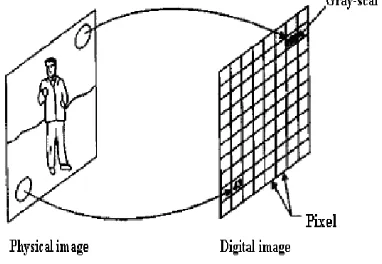
Collecting image data: Fig.4 shows that how to use a digital array to represent a physical image in the process of collecting imagery by cameral. Physical image is divided into small blocks called image elements (picture elements) or pixels [15].
Gray-scale conversion: System reads image data and manages pixel by its own function. Generally the color image acquired in RGB color space could convert to gray-scale image as follows.
(
)
3
R G
B
I
=
+ +
(36) B-spline filtering: because the order of the B-spline function is adjustable, the B-spline filter deposes image without appearing the negative effect brought from the little wave truncation. Meanwhile, the B-spline filter has very high filtering efficiency utilizing fast Fourier transformation. So this paper chooses the discrete B-spline convolution template
B
3 3× to smooth the partsshape image.
Corner extraction: Similar to Harris algorithm, if both
λ
1andλ
2are large enough, the corresponding pixelis recognized and extracted as a corner. Assumed that threshold is
R
, a point is the corner if G is larger thanR
.Removing pseudo corner: it can be removed by the strategy of joining adjacent point, choosing a
3
3
×
template sliding on the whole image. If there is more than one corner, the corner with the biggestG is retained by removing adjacent points out. This method could restrain the phenomenon of corner cluster.Shape matching: Extracting the parts shape characteristic to establish library from the template images and matching corners extracted by inquiring characteristic library [16]. Here, the features extraction includes two aspects.
1) Giving priority to the number of corner points, for some simple shapes of parts such as the quadrilateral and triangular parts, using corner point number for identification.
2) Considering the relative position of corners, the number of part shape corner points extracted is consistent
with its template.
After imagery sampling, there is only one part’s surface absorbed, where two-dimensional intensity image is only considered. Establishing library of common shape parts is good to comprise with angular point extracting.
Part shape recognition methods are shown in Table I.
VI. EXPERIMENT AND RESULT ANALYSIS
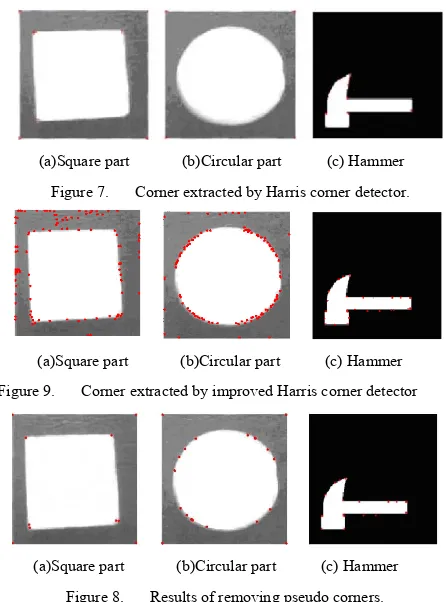
In this paper, parts shape recognition algorithm is realized by Matlab programming. The improved Harris corner detection algorithm is verified by square part, circular part and common tool such as hammer as examples shown as Fig.5.
Fig.6 shows the disposal results by improved Harris corner detection algorithm, Fig.7 shows the disposal results by Harris corner detection algorithm and Fig.8 is the disposal results after removing pseudo corner based on Fig.6.
TABLE 1
PART SHAPE RECOGNITION METHODS
part shape Polygon(cross-shaped,T-shaped) curved part Quadrilateral(square,rectangle,trapezoid) The number
of corners 12,T-shaped has 8 cross-shaped has 0 4 Matching
method corner point number matching
corner point number matching
corner point number matching,then matching
rectangularity
(a)Square part (b)Circular part (c) Hammer Figure 7. Corner extracted by Harris corner detector.
(a)Square part (b)Circular part (c) Hammer Figure 9. Corner extracted by improved Harris corner detector
(a)Square part (b)Circular part (c) Hammer Figure 8. Results of removing pseudo corners.
Compared Fig.6 with Fig.8, the improved Harris corner detector can obtain more corners and more accurate than the original Harris corner detector. The experimental results show that the improved Harris corner detector is superior to the original Harris corner detector in performance.
From Fig.6, 7, 8, the images of square part and circular part are irregular compared with hammer. Both square part and circular part are gray-scale images while hammer is a binary image. It is known that pseudo corners easily appear in irregular parts and gray-scale images. Increasing threshold
R
of corner respondingfunction or image binarization can remove these pseudo corners. So, the reasonable selection of threshold has a major impact on the results of parts shape recognition.
Here, supposed threshold
R
∈
[0,8000]
, increasing step is 500. For each threshold selected, five simulation experiments are carried out and each experiment result is recorded, which is applied to calculate average accuracy of part recognition. Fig.9 shows square part’s recognition accuracy of both the improved Harris corner detector and the original Harris corner detector. From Fig.9, the improved Harris corner detector has superiority for the biggish thresholdR
. with the threshold become larger,the number of corner gets smaller corner points’ number increasing, the matching reliability ascent. In the other words, reducing threshold, the number of corner increasing, reliability declined. In general, the improved Harris corner detector can be applied to parts shape recognition.
Parts images of different shape are applied to simulation tests. For each test case, shape recognition’s accuracy is recorded in the Table II. According to Table II,
the improved Harris corner detector has a significant advantage on accuracy compared with the original Harris corner detector.
VII. THE INNOVATION POINTS AND CONCLUDING
REMARKS
This paper puts forward an improved Harris corner detector for the recognition of parts images. Based of the analysis of Harris corner detector, the improved Harris corner detector adopts a B-spline function to replace Gaussian function of Harris corner detector. In addition, this paper provides the convolution template of B-spline function. Some experiment results show that the improved Harris corner detector is effective and superior, which has better performance and efficiency than Harris corner detector.
ACKNOWLEDGMENTS
This paper is supported by the major projects of Natural Science Funds in universities of Anhui province P. R. China under grant No. KJ2014ZD04.
REFERENCES
[1] Qingyong Li, Shengwei Ren. A real-time visual inspection system for discrete surface defects of rail heads, instrumentation and measurement, IEEE Transactions on Pattern Analysis and Machine Intelligence, Vol. 61, pp.
2189-2199, 2012.
[2] Wenhui Li,Yifeng Lin,Bo Fu, Mingyu Sun, Wenting Wu.Cascade Classifier Using Combination of Histograms of Oriented Gradients for Rapid Pedestrian Detection.
Journal of software, Vol. 8, pp. 71-77, 2013.
[3] Junhua Tong, Huanyu Jiang. Wei Zhou. Development of automatic system for the seedling transplanted based on machine vision technology, Computer Science and Automation Engineering (CSAE), IEEE International Conference on Computer Science and Automation Engineering, Vol. 2, pp. 742-746,2012.
[4] Alain Crouzil, Xavier Descombes, Jean-Denis Durou. A multi resolution approach for shape from shading coupling deterministic and stochastic optimization, IEEE Transactions on Pattern Analysis and Machine Intelligence,
Vol. 25, pp. 1416-1421,2003.
[5] Kochakornjarupong, Paijit. Trademark Image Retrieval by Local Features[D]. Scottish: University of Glasgow, 2011.
TABLE II
PARTS SHAPE RECGONITION ACCURACY Method
Part shape
Improved algorithm
Original algorithm accuracy
round 85% 72%
trapezoidal 87% 82%
rectangular 88% 84% T-shaped 83% 70% cross-shaped 80% 69%
[6] HuihuaYang, Lei Zhai, Lingqiao Li, Zhenbing Liu, et al. An Efficient Vehicle Model Recognition Method. Journal of software, Vol. 8, pp. 397-403,2003.
[7] Jian Gao, Xinhan Huang, Gang Peng, Min Wang, Zuyu Wu. A feature detection method based on Harris Corner and difference of Gaussian, PR & Al, Vol. 21, pp. 171-176,
2008.
[8] Junfeng Jing, Guangyan Li, Pengfei Li. The Research of Automatic Registering Detection of Rotary Screen Printing Machine Based on MeanShift and Fast Block-Matching Algorithm. Journal of Computers, Vol. 7, pp. 1369-1376,
2012.
[9] Yuping Wang,S.L.Lee.Scale-Space Derived From B-Splines.Pattern Analysis and Machine Intelligence, IEEE Transactions on, Vol. 20, pp. 1040-1055, 1998.
[10]R.A. Young, “The Gaussian Derivative Model for Machine Vision:Visual Cortex Simulation”. J. Optical Soc. Am., July 1987.
[11]Junfeng Zhang, Xing Xing. Harris corner. Based on the static image registration, Science & technology information,
Vol. 20, pp. 9-10, 2008.
[12]Schoenberg I J. Cardinal interpolation and spline functions,
Approximation Theory, Vol. 2, pp. 167-206, 1969.
[13]Peter I Rocket. A Methodology and Case Study on Corner Detectors, IEEE Transactions Image Processing, Vol. 12,
pp. 1668-1671, 2003.
[14]Chao Fang, Xiaopeng Wang, Yunpeng Niu,Wang chao. Corner detection Based on An Improved Harris Algorithm,
Computer & Digital Engineering, Vol. 39, pp. 142-144,
2011.
[15]Shizhe Shen, Xiaolong Zhang, Wei Heng. Improved Harris Corner Detection Algorithm Based on Auto-adaptive Threshold and Pre-selection, Journal of Data Acquisition
&Processing, Vol. 26, pp. 208-213, 2011.
[16]Ping Gong, Xiangbin Liu, Peng Zhou. Improved Harris Corner Detection Algorithm,Computer. Project & Application, Vol. 46, pp. 173-175, 2010.
Huicheng Yang was born in Chuzhou, Anhui China, on 1970. He received the B.Sc. Degree in Engineering from Nanjing University of Science & Technology. Currently, he is a professor and master tutor at Anhui Polytechnic University. His research interests include signal and information processing, intelligent control, system modeling and simulation and electric drive.
Ying Ma was born in Anqing, Anhui China, on February 8, 1990. She is Communication Engineering B.E, graduated from College of Electrical Engineering, Anhui Polytechnic University.She is currently pursuing her M.E at Electrical Engineering, Anhui Polytechnic University.
Hui Yang was born in Suzhou, Anhui China, on February 28, 1989. She is Communication Engineering B.E, graduated from College of Electrical Engineering, Anhui Polytechnic University.She is currently pursuing her M.E at Electrical Engineering, Anhui Polytechnic University. Her research interest includes image processing and pattern recognition. Mingshu Li was was born in Wuhu, Anhui China, on October, 1993. She is currently pursuing her M.E at Electronic science and technology, Southeast University.