© 2015 IJSRSET | Volume 1 | Issue 6 | Print ISSN : 2395-1990 | Online ISSN : 2394-4099 Themed Section: Engineering and Technology
Impact of Different Mobility Models in MANETs Based on MAC 802.11
Elmustafa S. Ali Ahmed
1,Bakhita El.Sheikh Ali
2,Eman Omer Osman
3,Tagwa Amin M. Ahmed
4Electrical and Electronic Engineering Department, Red Sea University, Sudan
ABSTRACT
Mobility plays an important role in performance of MANET. Therefore, mobility models are used in almost ad hoc networks, and it should represent realistic scenarios with MANETs, since MANETs are affected by every node movements and by network topologies. IEEE 802.11 is a set of standards for implementing wireless local area network (WLAN), these standards provide the basis for wireless network products using the Wi-Fi band which may be used in MANETs. This paper aims to study the impact of most famous mobility models such as Reference Point Group Mobility, Random Waypoint Mobility, Freeway Mobility and City Section Mobility on the performance of IEEE 802.11 through simulation, and measurements used are throughput, overhead, end-to-end delay, packet dropped and packet delivery ratio parameters, using NS2.34.
Keywords: MANETs, Mobility Models, MAC 802.11, Freeway, RPGM, RWP, City Section.
I.
INTRODUCTION
Mobile Ad-Hoc Network is a type of wireless network, which does not require any predefined infrastructure to be established and is a collection of mobile nodes forming a network by their own. Each mobile terminal is an autonomous node, which may function as both a host and a router also the control and management of the network the distributed among the terminals [1]. Wi-Fi technology is one of the commonly used techniques in MANET, developed on IEEE 802.11 standards, and uses the IEEE 802.11 specification to create a wireless local-area network [2]. Routing protocols are having the responsibility to find and maintain routes between nodes in a dynamic topology. In this paper, we utilized Ad-hoc On-Demand Distance vector (AODV), which initiate a route request only when a source node needs a route to a certain destination, it broadcasts a route request packet (RREQ) to its neighbors. Each receiving neighbor checks its routing table to see if it has a route to the destination. . If the receiving node is the destination or has route to destination, a route reply (RREP) packet will be sent back to the source node [3]. Mobility model of nodes that distributed in an area can effect in the performance of the network may be gives poor networks
utilization and may lead to high packet drops, therefore, analysis is required to optimize and evaluate the performance of these networks due to operating in different models of mobility.
II.
METHODS AND MATERIAL
Mobility Models
Mobility models represent the movement of mobile devices and describe how the location, velocity and connectivity within the nodes are changing over the time. These mobility models are used for simulation intent whenever new changing techniques and environment are applied on mobile nodes to get commendable performance and obtrusive connectivity within the mobile ad hoc network [4].
A. Random Waypoint Mobility Model (RWP)
elapsed, the mobile node randomly selects the next destination in the simulation area, chooses a speed uniformly distributed between the minimum speed and maximum speed, and travels with a speed (v) whose value is uniformly chosen in the interval (0, Vmax) [5]. When the node reaches the intended destination, it pauses for a time Pause seconds before continuing on its trajectory [6].
B. Reference Point Group Mobility
Reference Point Group Mobility (RPGM) model represents the random motion of a group of mobile nodes and their random individual motion within the group [7]. Each group is composed of one leader and a number of members. The movement of the group leader determines the mobility behavior of the entire group. For each mobility group, the model defines a logical reference center whose movement followed by all mobile nodes within the group [8].
C. Freeway Mobility Model
This model emulates the motion behavior of mobile nodes on a freeway. Maps are used in this model. There are several freeways on the map and each freeway has lanes in both directions [9].
D. City Section Mobility Model
The City Section model provides realistic movements for nodes located within specific city sections, by restricting to polar coordinates the traveling behavior of mobile nodes. [10].The map consists of horizontal and vertical streets. The mobile node is free to move along the horizontal and vertical lines in the grid. At the intersection of horizontal and Vertical Street, the mobile node can turn left or right or can go street [11].
Simulation Models
The simulation environment consists of 50 wireless mobile nodes, which are place uniformly, and forming a Mobile Ad-hoc Network. We have used AODV routing protocol. By using CBR traffic, we calculate performance of different mobility model in IEEE802.11 MAC protocols. The most mobility models used were evaluated such as; Random Waypoint, Reference point group, Freeway and City Section mobility model as described in the figure 1.
(a) Random Waypoint
(b) Reference point group
(d) City Section
Figure 1 : Mobility Models in NS2.34 window
In our proposed simulation, we used NS2.34 to simulate our proposed study, then extracted data from NS2.34 linked to mat lab to draw the performance figures. The simulated performance results obtained using different performance metrics such as throughput, packet delivery ratio (PDR), routing overhead, end-to-end delay, and loss. The following table shows the values of the various parameters used during simulation to evaluate the performance of mobility models in mobile ad hoc network using IEEE802.11 MAC protocol.
Table 1: MAC 802.11 Simulation Parameters
Parameters Values
Routing protocol AODV
Simulation time (sec) 100
Simulation area 1000 x 1000
MAC protocol IEEE802.11
Application Traffic CBR
Distribution model RWP, RPGM, City Section and Freeway No. of mobile nodes 50
Pause time(sec) 20, 40, 60, 80
The proposed payment system combines the Iris recognition with the visual cryptography by which customer data privacy can be obtained and prevents theft through phishing attack [8]. This method provides best for legitimate user identification. This method can also be implemented in computers using external iris recognition devices.
III.
RESULTS AND DISCUSSION
For the simulation results, we have evaluated the performance of IEEE 802.11 for different mobility models, the results we obtained are shown in the following figures.
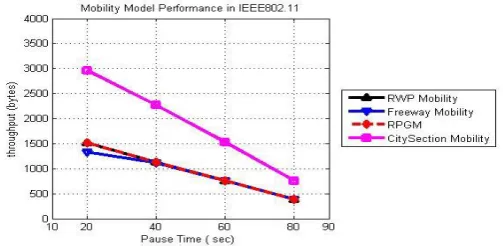
Figure 2: Throughput of different mobility models
Figure 3: End delay of different mobility models
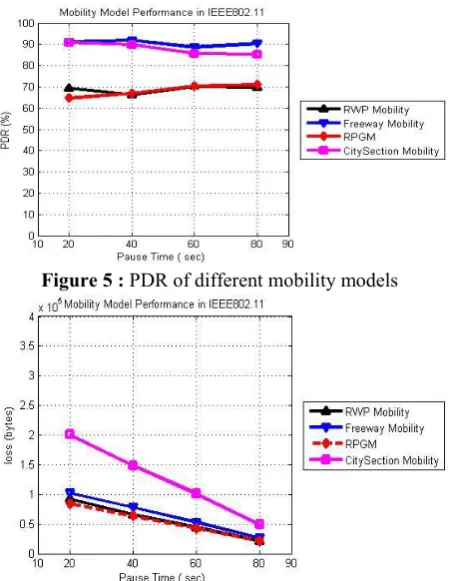
Figure 5 : PDR of different mobility models
Figure 6 : Data loss of different mobility models
In figure 2 we obtain that the throughput performance of mobility models in MANET using pause time 20,40,60,80, increased when the pause time decreased and vice versa. We obtains that City Section has better throughput compared to RWP, RPGM and freeway mobility models, that because in city section when the node density is increased and the network loading is increased. In RWP model and RPGM model, the throughput is lower because in this model each node’s movement is independent of the others and is more random. The probability that a node moves out of its neighbour’s communication area is high.
For end-to-end delay performance as in figure 3 RWP mobility experiences a higher end to end delay when compared with; freeway mobility, RPGM and city section mobility. With RWP when the pause time is 20sec the end-to-end delay is high because the time taken by the packet to arrive to the destination is very large, so when the pause time is increase the end-to-end delay is decrease. In city section mobility model the end-to-end delay is lower because the packets going in the paths in opposite directions take short time to get to its destination.
For network overhead as shown in figure 4 the performance is generally decreased when pause time
increased. City Section motility exhibited the highest overhead compared to other mobility models. In city section when the pause time is 20 sec it has higher overhead, because in this pause time AODV routing protocol flooding high bytes in the network at the beginning of simulation time. The increasing in overhead result a reduction in the performance of the network.
The packet delivered ratio (PDR) performance result given in figure 5 represent the performance of the MANETs mobility models at different pause time, under AODV routing protocol. The results we obtained show that the PDR of all the mobility models decreases when pause time is decreased. Figure 5 shows that freeway mobility model has better performance when compared to other mobility models. In case of CBR traffic both model delivers almost all originated data packets around 60-100% when mobility is low.
The data losses performance of mobility models was obtained in figure 6. As we observed that City Section motility exhibited the highest data loss compared to other mobility models. In city section mobility model, nodes moved based on constrained time and geographical conditions. It was observed that MAC802.11protocol had a lesser data loss rate for RWP and RPGM when compared to all other two models. This is because in the RPGM, spatial dependence of nodes is high and the relative position in the process of nodes movements change is less when the nodes move in RPGM. The duration of the effective link in this model is longer than other models. The case that link interruption leads to less packet loss, so the RPGM has minimum loss rate.
IV.
CONCLUSION
higher end-to-end delay. High packet delivery ratio obtained in freeway, city section and lowest performance in RWP, RPGM. The RWP and RPGM Almost gave the same result in overhead is lowest and highest overhead performance in city section. For throughput, City Section mobility model has a better performance than all other models.
In future, the same work may extended by introducing the performance of mobility models on MAC 802.15.4 ZigBee for personal area networks (PAN). Secondly, the performance of MAC 802.11 and MAC 802.15.4 ZigBee may evaluated by the change in many factors such as traffic patterns, node density, and other routing protocols to study its impact on the performance of the network.
V.
REFERENCES
[1] Jun-Zhao Sun; “Mobile Ad Hoc Networking: An
Essential Technology for Pervasive Computing”; Finland 2002.
[2]
http://www.slideshare.net/rymachohan1/wireles-network?qid=fad3b85e-da7b-4422975e11d042e3c 393&v=qf1&b=&from_search=1. Accessed in May 2015
[3] R. Mohan, C. Rajan, Dr. N. Shanthi ; ”A Stable
Mobility Model Evaluation Strategy for MANET Routing Protocols”; International Journal of Advanced
Research in Computer Science and Software
Engineering; Volume 2, Issue 12, December 2012.
[4] Kuldeep Singh, karandeep Singh; “A survey and
analysis of mobility models in mobile ad hoc network”; IRF International Conference; November 2014.
[5] S gowrishankar , t g basavaraju, subir kumar sarkar;
“effect of random mobility models pattern in mobile ad hoc networks”; ijcsns international journal of computer science and network security; vol.7 no.6, june 2007.
[6] mbuyu sumbwanyambe; “ indoor mobility modeling
for MANETS: An activity approach”; university of Johannesburg; may 2008.
[7] Tracy Camp, Jeff Boleng, Vanessa Davies; “A Survey
of Mobility Models for Ad Hoc Network Research”; Computer Sciences Colorado School of Mines, Golden, CO; 10 September 2002.
[8] Fan Bai, Ahmed Helmy; “A SURVEY OF MOBILITY
MODELS in Wireless Ad hoc Networks”; University of Southern California,U.S.A; 2004.
[9] Fan Bai, Narayanan Sadagopan, Ahmed Helmy; “The
IMPORTANT framework for analyzing the Impact of Mobility on Performance of Routing protocols for Ad
hoc Networks”; F. Bai et al. / Ad Hoc Networks 1 (2003) 383–403.
[10] Ramanna Havinal, Girish V Attimaradb, M N
Giriprasad; “A Review of Mobility Models for Energy Conservation in Mobile Ad hoc Network”; International Journal of Innovative and Emerging Research in Engineering; Volume 2, Issue 2, 2015.
[11] Deepak Kumar and Suresh C. Gupta; “Routing
Protocols under different Mobility Models, Node Density and Speed”; Transactions on Networks and Communications; Volume 3 No 1, Feb (2015).
Authors Biography
Bakhita El.Sheikh Ali, She is presently doing B.Sc.
degree with honors in red sea university faculty of Engineering, complete her graduate research in September 2015. Her research interest on field MANETs and Wireless Networks.
Eman Omer Osman, She is presently doing B.Sc.
degree with honors in red sea university faculty of Engineering, complete her graduate research in September 2015. Her research interest on field MANETs and Wireless Networks.
Tagwa Amin M. Ahmed, She is presently doing B.Sc.
degree with honors in red sea university faculty of Engineering, complete her graduate research in September 2015. Her research interest on field MANETs and Wireless Networks.
Elmustafa Sayed Ali Ahmed, received his M.Sc.