by
Patrick Chapman
A thesis
submitted in partial fulfillment of the requirements for the degree of Master of Science in Computer Science
Boise State University
DEFENSE COMMITTEE AND FINAL READING APPROVALS
of the thesis submitted by
Patrick Chapman
Thesis Title: Deviant: A Mutation Testing Tool for Solidity Smart Contracts Date of Final Oral Examination: 1 July 2019
The following individuals read and discussed the thesis submitted by student Patrick Chapman, and they evaluated his presentation and response to questions during the final oral examination. They found that the student passed the final oral examination.
Dianxiang Xu, Ph.D. Chair, Supervisory Committee Gaby Dagher, Ph.D. Member, Supervisory Committee Jyh-haw Yeh, Ph.D. Member, Supervisory Committee
iv
I would first like to thank my advisor, Dr. Dianxiang Xu, for guiding me during this research. Without their guidance, I would have struggled greatly with understanding the concepts that went into my research. I would also like to thank Dr. Lin Deng and his student Yin Xiong from Towson University. Dr. Deng had provided his expertise in mutation testing, while him and Yin have provided useful testing resources for these Solidity projects, making this research possible.
v
Blockchain in recent years has exploded in popularity with Ethereum being one of the leading blockchain platforms. Solidity is a widely used scripting language for creating smart contracts in Ethereum applications. Quality assurance in Solidity contracts is of critical importance because bugs or vulnerabilities can lead to a considerable loss of financial assets. However, it is unclear what level of quality assurance is provided in many of these applications.
Mutation testing is the process of intentionally injecting faults into a target program and then running the provided test suite against the various injected faults. Mutation testing is used to evaluate the effectiveness of a test suite, measuring the test suite’s capability of covering certain types of faults. This thesis presents Deviant, the first implementation of a mutation testing tool for Solidity smart contracts. Deviant
implements mutation operators that cover the unique features of Solidity according to our constructed fault model, in addition to traditional mutation operators that exist for other programming languages.
vi
ACKNOWLEDGEMENTS ... iv
ABSTRACT ...v
LIST OF TABLES ... ix
LIST OF FIGURES ...x
LIST OF ABBREVIATIONS ... xi
CHAPTER ONE: INTRODUCTION ...1
CHAPTER TWO: BACKGROUND AND RELATED WORK ...4
2.1 Blockchain ...4
2.2 Ethereum and Solidity...6
2.3 Quality Assurance for Smart Contracts ...10
2.4 Mutation Testing ...19
2.4.1 muJava ...22
2.4.2 Stryker ...23
CHAPTER THREE: THE DESIGN OF DEVIANT ...25
3.1 Overview ...25
3.2 Design Challenges ...27
3.2.1 Program Validity ...27
3.2.2 Language Evolution ...28
vii
3.2.5 Performance ...30
3.3 Fault Model of Solidity Smart Contracts ...32
3.4 Mutation Operators ...35
3.4.1 Intra-Statement Level...35
3.4.2 Intra-Function Level ...39
3.4.3 Intra-Module Level ...42
3.4.4 Inter-Module Level ...46
3.4.5 Mutation Operator Relationship to Fault Types ...47
CHAPTER FOUR: IMPLEMENTATION ...51
4.1 Implementation of Deviant ...51
4.2 Implementation Issues ...57
CHAPTER FIVE: EMPIRICAL EVALUATION ...60
5.1 Experiment ...60
5.2 Analysis...66
5.2.1 Gas Mutants ...67
5.2.2 Address Mutants ...67
5.2.3 Address Function Mutants ...68
5.2.4 Data Location Mutants ...69
5.2.5 Event Mutants ...69
5.2.6 Selfdestruct Mutants ...70
5.2.7 Exception-Handling Mutants ...71
viii
5.2.10 Function Visibility Mutants ...73
5.2.11 Library Function Visibility Mutants ...74
5.2.12 State Variable Visibility Mutants...74
5.3 Threats to Validity ...75
CHAPTER SIX: CONCLUSION ...77
REFERENCES ...78
APPENDIX A ...82
ix
Table 3.1 Address Mutation Operators ... 36
Table 3.2 Address Function Mutation Operators ... 38
Table 3.3 Selfdestruct Mutation Operators ... 40
Table 3.4 Exception-Handling Mutation Operators ... 41
Table 3.5 State Variable Mutation Operators ... 42
Table 3.6 Function Type Mutation Operators ... 43
Table 3.7 Function Visibility Mutation Operators ... 44
Table 3.8 Library Function Visibility Operators ... 46
Table 3.9 Fault Types with Associated Mutation Operators ... 47
Table 5.1 Subject Program Metrics... 62
Table 5.2 Subject Programs and Their Contracts Used for Mutation ... 63
Table 5.3 Subject Program Experimental Results Including Potential Equivalent Mutants ... 65
Table 5.4 Number of Live Mutants for each Mutant Type of Solidity-Specific Features ... 66
Table A.1 Binary Mutation Operators ... 84
Table A.2 Unary Mutation Operators ... 85
Table A.3 Assignment Mutation Operators ... 86
Table A.4 Literal Mutation Operators ... 87
x
Figure 2.1 Blocks in the Bitcoin blockchain model [12] ... 5
Figure 2.2 State transition model in the Ethereum blockchain model [12] ... 8
Figure 3.1 Architecture of Deviant... 26
Figure 4.1 Home Page for Deviant GUI... 52
Figure 4.2 Mutation Operators Page for Deviant GUI ... 53
xi
EVM Ethereum Virtual Machine
dApp Decentralized Application
AST Abstract Syntax Tree
UTXO Unspent Transaction Output
GUI Graphical User Interface
JSON JavaScript Object Notation
CHAPTER ONE: INTRODUCTION
Blockchain is an increasingly popular technology that led to one of the biggest economic anomalies in recent years. As a popular platform for blockchain applications, Ethereum provides a Turing-complete instruction set [12], allowing for the development of more computationally expressive smart contracts in blockchain applications. Among the several high-level programming languages that can compile into Ethereum Virtual Machine (EVM) bytecode, this thesis focuses on Solidity. Different from traditional programs, a Solidity smart contract cannot be simply patched after it has been compiled and added to the blockchain because of the nature of Ethereum and blockchain. Quality assurance of smart contracts is therefore extremely important in the development process. For example, a vulnerability in the DAO (decentralized autonomous organization)
resulted in the loss of approximately $50 million worth of ether (Ethereum’s cryptocurrency) [36].
processes. To address this issue, a widely-applied approach is mutation testing, which aims to simulate programming faults by creating mutants of a given program [40]. Each mutant has one fault injected by a mutation operator. A mutant is said to be killed if it fails one or more test. A live mutant not killed by any test can be either faulty or
equivalent to the original program. Mutation score, i.e., the mutant-killing ratio between the number of mutants killed and the total number of non-equivalent mutants, is often used to indicate the fault detection capability of given tests. Mutation testing has been applied to various programming languages, such as Java, C, and JavaScript. Experiments have shown that mutants are indeed similar to real faults for the purpose of evaluating testing techniques [41].
In this paper, we present Deviant, a mutation testing tool for Solidity smart contracts. It aims to automatically generate mutants of a given Solidity project that simulate various faults that may occur during the programming process, and
automatically run the test cases of the given Solidity project against each mutant so as to evaluate the effectiveness of the given tests. Thus, Deviant can help Solidity developers deliver higher quality code, reduce the risk of financial loss, and increase user
satisfaction.
This research is the first attempt to apply mutation testing to Solidity smart contracts. The contributions are twofold:
• Deviant has been applied to five Solidity programs to evaluate the effectiveness of their tests. The results indicate that these tests have not achieved high mutation scores and thus cannot provide a high-level assurance of code quality.
CHAPTER TWO: BACKGROUND AND RELATED WORK Chapter Two presents the background information and related work for
blockchain, Ethereum/Solidity, quality assurance of smart contracts, and mutation testing. Section 2.1 gives the background of blockchain and explains why it is a growing trend among software developers. Section 2.2 explains Ethereum and Solidity, highlighting uniqueness and differences that exist between Ethereum and the earliest form of
blockchain. Section 2.3 reviews related work in quality assurance for smart contracts and how it relates to our work. Finally, subsection 2.4 concludes with an overview of
mutation testing and its purpose.
2.1 Blockchain
data, while it is also considered a ledger because information is always being appended to the blockchain. This means that information is constantly being added to the blockchain, never removed or altered. This feature of the blockchain is called immutability and is crucial for confirming the history of transactions that actually take place on the
blockchain. The earliest form of blockchain, Bitcoin, was invented by an anonymous user going by the alias Satoshi Nakamoto [2].
Figure 2.1 shows blocks in the Bitcoin blockchain model, where the block contains the information such as: the time the block was created, the unique nonce number, the hash of the previous block, and the list of the transactions that have taken place since the previous block was added.
Figure 2.1 Blocks in the Bitcoin blockchain model [12]
Bitcoin blockchain supported loops or recursion, then it is highly-likely an attack would take place in the form of a Denial of Service (DoS) attack or a programmer error would lead to infinite execution. With the removal of loops and recursion, Bitcoin can ensure that the script execution will eventually stop.
Blockchain also uses a specific record keeping model called Unspent Transaction Output (UTXO). The UTXO model is named as such because output from previous transactions are used as input for new transactions. What this means is that when a transaction takes place, the entirety value of the user’s UTXO is used as input for the transaction. The designated amount of Bitcoin is sent to the given address, where the remaining value from the Bitcoin UTXO is actually sent back to the sender’s address in the form of a new UTXO.
Bitcoin is however not the only blockchain platform that exists. There have been many blockchain platforms that have been introduced since Bitcoin’s inception, most of which have made an effort to improve on some of the concepts behind Bitcoin. In some cases, these new blockchain platforms introduce new ideas entirely or are made
specifically for certain purposes.
2.2 Ethereum and Solidity
The philosophy behind Ethereum is to provide a blockchain with an instruction set that is simple, universal, modular, agile, and non-discriminatory [12]. Ethereum needs to be simple so that an average programmer can implement a specification without trouble. In a similar vein, Ethereum must be universal such that if the program can be mathematically defined, it should be able to be implemented within Solidity. Ethereum must be also modular so that the separate components of Ethereum are self-contained, while also being agile so that if any of these modules need to be updated, it can be. Finally, Ethereum needs to be non-discriminatory such that Ethereum should not actively try to restrict specific categories of usage. There are the primary concepts that were considered in the design of the Ethereum blockchain.
The Ethereum model, unlike Bitcoin, is based on the account model. Ethereum accounts contains key data values that make the Ethereum protocol work. Like Bitcoin, Ethereum accounts contain a nonce, which is a counter to make sure that transactions can only happen once, meaning that the nonce should be unique. Ethereum accounts also contain the balance for that specific account, where the currency that Ethereum uses is known as Ether. This is different from the Bitcoin model, which does not necessarily have a UTXO matching directly to an account. Another important aspect of Ethereum is that an account may optionally contain contract code. This means that there are two types of accounts for Ethereum, externally owned and contract codes. The externally owned accounts are controlled by private keys, whereas the contract codes are controlled by the contract code that is stored on the account.
transactions contain: the recipient of the message, a signature of the sender, the amount of ether to transfer from sender to recipient, an optional data field, a STARTGAS value that is representative of the maximum number of computational steps the transaction
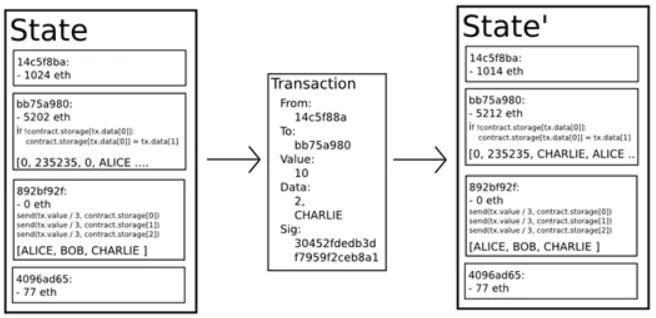
execution is allowed to take, and a GASPRICE value that represents the fee the sender pays per computational step. The STARTGAS and GASPRICE values are incredibly crucial to prevent DoS attacks. As mentioned previously with Bitcoin, a blockchain is susceptible to DoS attacks if code running on the blockchain causes infinite execution. Bitcoin prevented this by not implementing a Turing-complete language. However, since Ethereum is considered Turing-complete, Ethereum uses gas to prevent this problem. Gas is a resource that is used by contracts that are executing code and when the gas runs out, then the code will stop executing. An example of an Ethereum state transition is given in Figure 2.2.
Figure 2.2 State transition model in the Ethereum blockchain model [12]
language into valid EVM bytecode. The most popular of these scripting languages is Solidity. Solidity is a scripting language that is designed to be simple and rather intuitive for most programmers. To achieve these features, Solidity is designed to closely resemble JavaScript, sharing many of the same basic programming constructs and syntax. Solidity is commonly used to create decentralized applications (dApps), which are applications that take advantage of the inherent features that come with the blockchain model. While it may commonly be assumed that blockchain can only be used for cryptocurrency, it has also been demonstrated to be useful in several areas. In fact, there have been several real-world and several proof-of-concept projects that have demonstrated the usefulness of blockchain in fields such as online voting, healthcare, and governance systems. In many cases, Solidity is often used as the language for implementing these projects because of its simplicity and similarity to traditional programming languages.
Ethereum, while being innovative in the field of blockchain, is still susceptible to faults and vulnerabilities. This can be especially troublesome considering that the
many in the Ethereum community. In fact, throughout Ethereum and Solidity’s lifespan, there have been several instances where a fault or vulnerability has had a tremendous effect for users of the Ethereum blockchain. For example, a company known as The DAO (decentralized autonomous organization) contained a vulnerability (known as reentrancy) that led to an attacker stealing approximately $50 million [36] worth of ether (Ethereum’s cryptocurrency). When these situations happen, it typically requires a hard fork of the Ethereum blockchain. A hard fork occurs when a non-backwards compatible protocol change occurs in the blockchain. This means that nodes (users) that wish to use the latest version of the Ethereum blockchain must update their Ethereum version to be current or else their future transactions will not be valid on the latest version of the blockchain. Because of the consensus requirements of blockchain, these hard forks require a majority vote in favor of the hard fork. This means that performing a hard fork can be quite a nuisance for the Ethereum community if they constantly have to do so. In a similar manner, Solidity can be quite troublesome if there exists faults or vulnerabilities in contract code. When the Solidity code is stored on the blockchain, it is immutable,
meaning that they cannot patch a bug if they find it. Because of this, quality assurance for smart contracts is especially important.
2.3 Quality Assurance for Smart Contracts
Ethereum and Solidity. Atzei provides a fault taxonomy that describes the vulnerabilities and faults, breaking them down into three levels: Solidity, EVM, and Blockchain.
Solidity vulnerabilities are the vulnerabilities that exist because of the improper use of the Solidity language by the programmer or by the language itself. EVM vulnerabilities are the vulnerabilities that exist in the instruction set or limitations that exist in the actual implementation of Ethereum. Finally, blockchain vulnerabilities are those that exist because of the limitations of the blockchain model. Atzei also surveyed several attacks that exist on Ethereum particularly the famous DAO attack and others such as other various vulnerabilities that exist in other applications. This survey concludes that there are some key areas that will be researched in the foreseeable future such as verification of smart contracts and low-level attacks. In our research, we primarily attempt to replicate the faults from the taxonomy that we can directly observe in Solidity. These faults are as follows:
sent to the receiving address is received, the receiving contract will not know how to interpret the data, causing the fallback function to execute. 2. Exception disorder: In Solidity and Ethereum, not all exceptions are
handled the same. Like all programs, when contract code is being executed, there is a chance for an exception to occur. In the case of Solidity, typically an exception will be thrown. However, it is quite common for developers to incorrectly handle exceptions. For instance, take the send function call in Solidity, which returns false when it fails whereas the function transfer throws an exception on failure. When a developer calls a contract with the send function call, there is a likely chance that they mishandle the exception-case if they do not realize that send is being used. Because send only returns false, a developer might not be able to determine where the failure is happening.
When executing these instructions, if there are too many, then the out-of-gas exception will occur.
4. Type casts: While Solidity does perform type checking, it cannot directly handle checking things such as addresses directly. What this means if that if an address is cast to a contract, the only thing that Solidity does it check the signatures of the functions of the contract that the address is being cast to. The problem is that Solidity does not actually check to see if that contract resides at that address. For instance, an address may cast to the wrong contract, meaning that when the casted contract is called, it will be highly likely that its fallback function is invoked, creating
non-deterministic behavior for the developer.
5. Reentrancy: The most devastating vulnerability to date, the reentrancy vulnerability has led to major financial devastation, such as “The DAO” attack that caused losses of approximately $50 million [36][4] at the time of the attack. The reentrancy attack is based on the fact that it is possible to re-enter a non-recursive function before it is terminated. Take the example:
contract vulnerable {
function badfunct(address addr) { //vulnerable code addr.call.value(200)();
} }
contract attacker {
function() { //fallback function
vulnerable(msg.sender).badfunc(this); }
In the above example, the vulnerable contract’s function badfunc, sends the given address ether. Now, the attacker contract has its fallback function invoked, which simply calls the same badfunc that was
previously called. This process repeats itself several times before it eventually is stopped, but at this point too much of the ether has been taken away. The reason that this happens is that the fallback function is able to call the badfunc again before the execution is able to stop. However, the much bigger problem resides in the call function. The call function will fail during this process; however, it will not propagate the error and as a result will not reverse the transactions that have taken place, except for the very last transaction. Because of this vulnerability, most developers now only use the send and transfer function calls, which are protected against this type of attack. However, there are still instances where a developer has no other choice than to use the call function.
The previous faults can be mostly targeted in Solidity, however, there are faults that are primarily concerned with just Ethereum and blockchain. These faults cannot be directly targeted in Solidity, but rather are faults that exist because of the design of Ethereum and blockchain in general. However, these faults are important to consider when designing a smart contract, as the smart contract will naturally have these fault properties associated with them. These faults are as follows:
7. Keeping Secrets: In contracts, fields can be public or private. However, even though a field may be private, when a value is set for that field, the transaction must be sent to miners who publish it to the public blockchain. This allows any observers to obtain information that might lead them to being able to figure out the value. Also, while the actual variable information is kept private during execution, the actual contract code is not private, as it resides on the blockchain. This allows attackers to infer information about what may be happening in a contract and allows a white hat approach when trying to attack an application.
blockchain because of the severity of the reentrancy vulnerability, leading to there being two versions of Ethereum now, Ethereum and Ethereum Classic.
9. Unpredictable State: It is impossible to determine the order that the transactions will run for a contract. That means that if the callee invokes a function from a contract, they cannot determine if the contract will be in the same state that it originally was.
10.Generate Randomness: The execution of EVM bytecode is deterministic. As with any deterministic approach to solving a problem, some
information can be inferred. This is especially relevant considering that the blockchain is public. Any outsider can attempt to infer something based on what is observed in the blockchain.
11.Time Constraints: Miners can choose the timestamp on a block with a certain degree of arbitrariness. This means that the miner can determine a timestamp that is advantageous to them. This is because many applications use time constraints in order to determine which actions are suitable. 12.Stack Size Limit: If an attacker were to generate a nearly full-stack and
then call a victim function, then if the function does not handle exceptions properly, can have adverse effects when the stack has ultimately reached its limit.
were by far the most prevalent bugs that were found in blockchain, for instance, Ethereum had approximately 70% of its bugs related to semantic errors. This can be attributed to the fact that programmers were not able to understand the semantics of blockchain. However, the bugs that took the longest to fix were related to security vulnerabilities. Typically, security vulnerabilities are attributed to problems with the blockchain itself. While security vulnerabilities may on average have taken longer, they were also not as abundant as bugs such as semantic or environment related. This means that the sample sizes were largely different, meaning that more data might reveal a better trend for this data. If anything, this study has led the blockchain community to believe that programmers might tend to struggle with understanding the semantics of blockchain, causing them to introduce errors because of their lack of understanding.
complete small-step semantics of EVM byte-code. In this research, they used the proof assistant F* [40] to formalize their small-step semantics. Their research and formalization led to the characterization of several security characteristics. They define these
characteristics as call integrity, atomicity, and independence from miner-controlled parameters. The call integrity property is related to bugs such as the reentrancy or call to the unknown, while atomicity is related to mishandled exceptions. Independence from miner controller parameters can be split into two separate categories: independence of mutable account state and independence of transaction environment. Independence of mutable account state deals with bugs such as transaction order dependency and unpredictable state, whereas independence of transaction environment deals with timestamp dependency, time constraints, and generating randomness. These
classifications are heavily based on the fault taxonomy that was discussed previously and provided by Atzei. The key contribution in this research paper was the actual
formalization of these semantics, which as can be seen from the previous research, is an important area of research as the semantics of Ethereum are often not well understood.
As discussed previously, Solidity often deals with financial assets, meaning that it is critical that security vulnerabilities are identified and fixed early. Liu et al. [18]
fuzzing engine, and the core detector. Essentially, this tool will run using these components potentially revealing if there are any reentrancy bugs, which in their preliminary evaluation, they were able to identify seven new bugs in existing projects.
2.4 Mutation Testing
Typically, mutants are similar to real programming mistakes and should highlight areas where a test suite is weak. However, there is also the potential for a valid mutant to be created, while still being functionally equivalent to the original code. These mutants are called equivalent and do not offer any insight into the adequacy of a test suite. These are an expensive problem in mutation testing because they will still be tested while not offering anything of value. There is also the problem of generating mutants based off of the operators which are syntactically incorrect, leading the program to not compile. This is an overhead because the incorrect mutants will still have to compile and fail the process, however, these mutants should not count when determining the mutation score. To address some of these issues, a research paper by Schuler et al. [27], the
JAVALANCHE framework was introduced, which uses the invariant detection engine DAIKON [28] to help in identifying equivalent mutants. JAVALANCHE first learns the invariants from the original program and then checks for any existing violations of those invariants that exist in the mutants. When it comes to classification of mutants,
JAVALANCHE treats the classification slightly different. When a mutant fails a test, then it is considered “killed”, which is typical in most mutation testing tools. However, when a mutant is considered “live”, it is either in one of two categories: non-violating mutants or violating mutants. Violating mutants are mutants that have passed all of the tests, however, they violate the program invariants that were learned from DAIKON.
public foo(int A, int B) { if (A > B) { // original return A;
}
return B; }
public foo(int A, int B) {
if (A < B) { // mutant
return A; }
These violating mutants are more likely to be considered non-equivalent mutants, since they violate the invariant. Whereas, non-violating mutants do not violate any variant, meaning that they do not appear to impact the program with respect to the invariants. In their evaluation of the framework, they discuss three hypotheses. The first hypothesis is that mutants that violate invariants are less likely to be equivalent than mutants that do not violate invariants. In their research, they conclude that there is enough statistical significance to support this hypothesis, however, they only worked with a small sample size. The second hypothesis is that mutants that violate invariants are more likely to be detected by test suites. In their evaluation, they concluded that this hypothesis was true. For instance, in JAXEN, they detected that 98% of invariant-violating mutants are detected versus 44% of non-violating mutants. The third hypothesis is that the more invariants that a mutant violates, the more likely it is to be detected by tests. Again, their evaluation supports the hypothesis, with all seven projects that were evaluated showing that mutants with a higher number of violations resulted in better detection.
Another common problem that exists in mutation testing is the high
mutation testing was approximated to be roughly quadratic, whereas Marthur's approach was estimated to be approximately linear. The concept is quite similar, where we simple remove mutation operators based on their generated number of mutants. For instance, removing two different operators would be called 2-selective mutation. The result was quite positive in this research, where removing the most plentiful mutation operators did not drastically affect the mutation score, but instead improved the performance.
In the paper by DeMillo et al. [11], mutation testing was first implemented and used to evaluate the testing methodology when considering complex errors. In this research, the evaluation took place on providing simple-error data to the tested program. By doing this, it was observed that simple-error data was able to kill multiple-error mutants, essentially killing off mutants that were considered to be more complex. According to their research, they believed that these simple techniques were effective because of the coupling effect. Since then, mutation testing has been applied to evaluate even more testing methodologies. Another application of mutation testing, called weak mutation testing was described be Howden [26]. In weak mutation testing, a simple component mutation takes place and subsequently a mutant version of that program is created containing just the one mutated component. For example, a simple component may include such things as arithmetic or boolean expressions. The advantage of weak mutation testing over strong mutation testing is its ability to generalize errors, which is due to the fact that weak mutation makes no coupling assumptions.
2.4.1 muJava
mutants based on selected mutant operators and selected Java class files. Once the mutants are generated, they are displayed to the user in such a way that the mutants can be compared directly to the original code. While a simple feature, it is important to notify the user the differences that exist between a mutant and the original code. Whenever a mutant passes the test suite and is considered live, the user must be able to determine if they need to design a new test based on the mutant or if the mutant is considered equivalent. In muJava, it is reported that around 5-20% of the generated mutants are considered equivalent. As mentioned previously, one of the major difficulties in mutation testing is determining if the generated mutants are functionally equivalent to the original program. Since the possibility of a generated mutant being equivalent is relatively high, it is important to let the user easily be able to determine if the mutant is actually live.
While many of the programming constructs that can be mutated in Java are relatively simple, the primary unique contribution of muJava is that it also contains mutation operators based on class [9] and inter-class [10] programming constructs. For instance, these mutation operators can mutate things such as the inheritance structure of Java classes. This means that things such as overridden methods can be modified or deleted, potentially leading to serious consequences or undefined behavior. While Java and Solidity are quite different, muJava is an important tool in our research, as many of the OOP mutation operators can be implemented in Solidity (given that Solidity allows for some features of OOP).
2.4.2 Stryker
CHAPTER THREE: THE DESIGN OF DEVIANT
Chapter three discusses the design of Deviant by giving an overview, explanation of our fault model, and a discussion of the Solidity-specific mutation operators that we have created. Section 3.1 provides an overview as to how our application will work, illustrating the flow of the program. Section 3.2 presents the fault model and explains the fault types in relation to the programming constructs in Solidity. Sections 3.3 details the mutation operators, which are the Solidity-specific mutations that are designed to replicate the Solidity faults that were discussed in the fault model.
3.1 Overview
Deviant aims to automatically generate mutants of a given Solidity project and run the given tests against each mutant to evaluate the testing effectiveness. Figure 3.1 illustrates the architecture of Deviant. Given a Solidity project together with test code, Deviant selects one program file (contract, library, and/or interface) at a time, parses it into an abstract syntax tree (AST), and applies (user-selected) mutation operators to respective nodes of the AST to generate mutants. Mutation operators are defined according to a comprehensive fault model of the Solidity language. In addition to the normal fault types in traditional languages (e.g., expression in JavaScript and inheritance in Java), our fault model considers Solidity-specific features as well as the existing Solidity fault taxonomy mentioned in the related works. Each mutation operator
Figure 3.1 Architecture of Deviant
After all the mutants have been generated, a single mutant will be copied into the Solidity project directory and compiled into EVM bytecode as if it were part of the original project. The tests of the given Solidity project will then be run against the mutated EVM bytecode. Tests will either pass or fail depending on how the mutant has affected the functionality of the program. This process is repeated for every single mutant that was generated by Deviant. Deviant keeps track of the test execution result of each mutant (e.g., pass or fail) and produces a summary report on the mutation testing (e.g., mutation score, killed mutant count, and live mutant count). This mutation report gives insight to the Solidity developer on the quality of their test suite. Primarily, the report can highlight weaknesses in the developer’s suite, such as a tendency to miss covering certain Solidity programming constructs.
Test Report Exec Tests
Solidity Program
Tests Mutation
Operators
Parse Mutate
Compile EVM
Bytecode
AST
3.2 Design Challenges
3.2.1 Program Validity
contracts in terms of mutation. Abstract contracts in Solidity are never deployed to the blockchain, rather the child contracts that inherit them do. The other problem is that abstract contracts are never directly tagged as abstract with keyword in Solidity. To perform mutation on abstract contracts, we have to determine that at least one function in the contract does not contain an implementation. In Deviant, we can overcome this problem by searching the AST for a function where the body attribute is null, meaning that there is no implementation in the function itself. Once we have done this, we can continue to modify other function bodies through mutation operators.
3.2.2 Language Evolution
Another challenge in designing Deviant is the fact that Solidity is a constantly evolving language. With Solidity being a relatively new language, there are going to be many instances where Solidity features are added, removed, or changed. These changes to the language often times affect the semantics or syntax of the language and can
functions that were considered “stateless”, they were not actually enforcing this idea completely. Pureness was eventually enforced in Solidity 0.4.17, but still created
semantic ambiguity during this time period. There are several other examples of updates in Solidity that have changed what the code actually means.
3.2.3 Ethereum Evolution
A challenge similar to the previous is that the Ethereum blockchain always has potential to change. As developers and researchers continue to use the Ethereum blockchain, it becomes more likely that they will discover new faults with the current design of the Ethereum blockchain. For example, the reentrancy attack was such a crucial vulnerability that a hard fork of the blockchain had to occur. The hard fork in a
blockchain platform has serious effects, as it ends up changing the protocol of the
to the node user, which means that they must update their own node if they wish to take advantage of these features.
3.2.4 Reasonable Operators
Another more conceptual challenge is designing mutation operators that are considered useful and reasonably targetable by test suites. There are an incredible amount of mutation operators that could be created for any given programming language.
However, the challenge is designing mutation operators that are considered useful and reasonable for the developers that use that language. In the case of Solidity, there are several mutants that could easily be generated by Deviant if we chose to do so. However, some of these mutants would be quite meaningless and would practically never be tested in a real test suite as it serves no real purpose. For example, mutating the Solidity version that is defined in the contract will almost never be useful for a developer. In most cases, these contracts won’t even be able to compile if the versions are too different,
considering that there may be compatibility issues between the contract versions and the Solidity compiler. This mutation is also likely to never be tested by any smart contract developer, as these types of errors will almost always lead to a compile time error and will actually not ever reach the point of test execution. To overcome this challenge, we only consider the mutation operators that we believe are useful to Solidity developers. The mutation operators that we consider useful are those that can replicate common faults in Solidity and can create behavior in programs that can be caught by test cases.
3.2.5 Performance
becomes exponentially more expensive as the project’s complexity increases. For instance, if a test suite takes approximately one minute to run all tests, then that means that each mutant will take one minute to run the entirety of the test suite. Some mutation operators can generate hundreds of mutants for a single program file, meaning that a test suite must be run hundreds of times for all the mutants to be considered. One way that we can alleviate some of this performance problem is to allow the developers to choose the mutation operators that they wish to use during the mutation testing process. While we consider all of the mutation operators to be useful, a developer may only really care about certain types of mutation operators in relation to their test suite. This can be especially useful when removing mutation operators that typically generate the most mutants. For example, one instance of a relational operator can have several mutants involved with the single operator. By ignoring this one mutation operator, we can potentially remove hundreds to thousands of potential mutants across a program. Now, just simply removing mutation operators from the list of applied operators isn’t always the best solution. We can also reduce the number of generated mutants by limiting the number of functionally equivalent mutants that are generated. Functionally equivalent mutants are mutants that are syntactically valid mutants, but are functionally equivalent to the original program, meaning that the mutant will always be considered live because it works the exact same as the original program. As discussed in the mutation testing subsection in the
considered for identifying equivalent mutants cannot be applied to our case yet. The best solution that we have for now is to ensure that we closely follow the semantics that are outlined in the Solidity documentation when creating our mutation operators. By doing this, we can at least ensure that we are at least understanding the semantics of Solidity and can avoid any potential equivalent mutants that may be generated.
3.3 Fault Model of Solidity Smart Contracts
In Deviant, each mutation operator is designed to create mutants that simulate a certain type of faults in Solidity smart contracts. The collection of fault types implied by all mutation operators is referred to as the fault model. The goal of Deviant is to make the fault model as comprehensive as possible so that the generated mutants will simulate as many types of faults as possible. It is worth pointing out that the current mutation operators in Deviant create mutants by making only one change to the original program (called first-order mutation operators). While such small changes may only represent minor faults directly, the mutation testing research has shown that real bugs are often composed of such minor faults [41].
snippet, stateAddress is an internal state variable whose type is address. foo is a payable external function with a modifier called funcModifier. A function or function modifier is composed of a sequence of statements which may use various expressions as in OOP methods.
Solidity’s programming constructs in a program file are designed into four levels: • Inter-module: this level involves signatures of modules and relationships
among them. For example, inheritance is an inter-module level construct. • Intra-module: this level involves the immediate constructs within a
module. For example, intra-contract level includes state variable
declarations, signatures of functions, and signatures of function modifiers. • Intra-function and function modifier: this level involves individual
statements within a function (excluding functions in interfaces)
For each level, we identify feasible faults with respect to the programming constructs. For example, an incorrect use of inheritance is an inter-module fault (e.g., “is IA” is removed from “contract A is IA”). Missing the reference and definition of a function modifier in a contract is an intra-contract fault (e.g., funcModifier is removed from the signature of foo and the definition of funcModifier is removed). Missing a statement within a function of a contract is an intra-function-level fault (e.g.,
msg.sender.send(10) is removed from the function foo), whereas an incorrect expression within a statement is an intra-statement level fault (e.g., 10 is changed to 1 in
msg.sender.send(10). The above classification ensures that the fault model covers the fault types of every programming construct in Solidity.
pragma solidity 0.4.24 //version of Solidity to use contract A is IA{
address internal stateAddress; //internal state variable of the address type function foo() funcModifier payable external {
int memory memInt; //int variable with data location of memory stateAddress = 0x12345; //address being assigned
msg.sender.send(10); //sends ether to the contract
msg.sender.call(0x123); //sends the bytes 0x123 to the contract selfdestruct(stateAddress); //self-destruct and send remaining ether ...
}
modifier funcModifier() {
if (msg.sender == stateAddress) { _; //execute the function normally if true }
} }
3.4 Mutation Operators
This section details and highlights the mutation operators that target Solidity-specific features. The mutation operators are categorized by the operator’s associated programming construct level as was defined in our fault model. Deviant also includes general mutation operators, meaning that these mutation operators exist in other mutation testing tools and the programming constructs are common in other programming
languages. These general mutation operators are listed and explained in Appendix A. 3.4.1 Intra-Statement Level
Intra-statement level mutation operators are those that modify the components within a statement. Typically, intra-statement level operators modify different types of expressions. In regards to Solidity-specific features, these mutation operators modify Solidity constructs such as: gas, address, address function, and data location constructs.
Gas Operators: The only mutation operators that take place on gas involve the
Address Operators: Address operators mutate attributes of an address variable.
Addresses in Solidity can be represented as any numerical value. However, they are typically represented in a hexadecimal format. The modify address operators work similarly to other numerical literal operators. They modify the actual value that the address is being assigned to. These mutation operators can replicate faults such as type cast error, call to the unknown, and ether lost in transfer. The type cast error and call to the unknown can occur because the address can potentially become associated wrong contract. This will mostly only occur however if the address still points to a valid address that contains contract code. The ether lost in transfer is much simpler fault that can occur from this mutation operator, considering that either a random or zero address will most likely point to an orphaned address. The Switch Call Expression Casting (SCEC)
mutation operator is only ever applied if there are two or more instances where addresses are being cast to different contracts. This mutation operator is more likely to cause type cast and call to the unknown faults because the addresses in the mutant contract should still be valid. These faults can be replicated because the SCEC operator takes two instances of addresses being casted to different contracts and then switches the contracts that they are being cast to, most likely causing them to point to incorrect addresses. Table 3.1 lists the address operators.
Table 3.1 Address Mutation Operators
Mutation Operators Abbreviations Fault Types Switch Call Expression Casting SCEC Call to the Unknown
Type Casts
Ether Lost in Transfer Modify Address Literal to
Non-Zero
MALNZ Call to the Unknown
Ether Lost in Transfer Modify Address Literal to Zero MALZ Call to the Unknown
Address Function Operators: There are several functions that are associated with
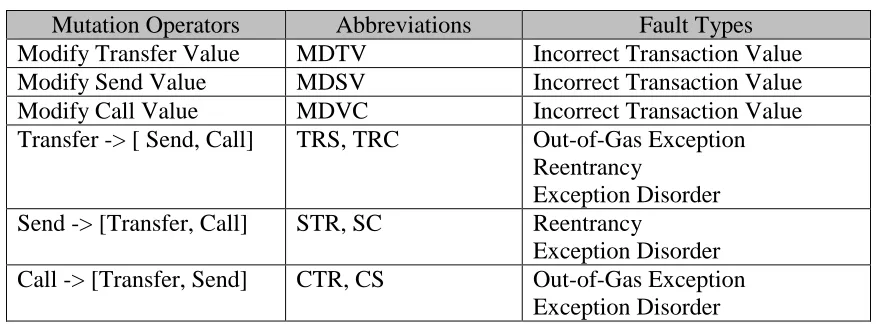
addresses, including: transfer, send, and call. In any of these cases, there is likely to be a literal associated with the function call. It is relatively simple to modify these literal values to any other value to create a valid mutant. These mutation operators modify the literal argument values that are in the function call, which typically represent the amount of ether that is sent. A potentially more dangerous fault that could exist in a smart
version will return false instead of throwing an exception like it normally would have in the code. Table 3.2 lists the mutation operators that target address functions.
Table 3.2 Address Function Mutation Operators
Mutation Operators Abbreviations Fault Types
Modify Transfer Value MDTV Incorrect Transaction Value
Modify Send Value MDSV Incorrect Transaction Value
Modify Call Value MDVC Incorrect Transaction Value
Transfer -> [ Send, Call] TRS, TRC Out-of-Gas Exception Reentrancy
Exception Disorder Send -> [Transfer, Call] STR, SC Reentrancy
Exception Disorder Call -> [Transfer, Send] CTR, CS Out-of-Gas Exception
Exception Disorder
Data Location Operators: The data location mutation operators swap the memory location keyword in the source code. The purpose of these mutation operators is to affect the behavior of the variables. For instance, storage variables persist beyond the lifespan of a function call, whereas the life span of a variable with the memory keyword is temporary, only existing in the function that it is declared in. Also, by design storage is quite a bit more expensive to use than memory, but this allows for storage variables to be more dynamic. This means that data types such as arrays are automatically assigned to the storage location to allow for dynamic usage. It is also important to note that memory variables cannot exist outside of the lifespan of a function, meaning that global variables cannot be declared as memory variables. Now, while these mutation operators cannot necessarily be directly associated with the faults that were listed in the fault taxonomy, it is quite clear that these mutation operators can severely affect the behavior of the
3.4.2 Intra-Function Level
Function level mutation deals with the mutation of the contents within a function. These contents include function calls, statements, or blocks, which may be comprised of multiple function calls or statements.
Event Operators: Events can fire from the smart contracts and anything connected
to the Ethereum JSON-RPC API can listen to the events and then act. In the context of Solidity, events are primarily used for the EVM logging facilities. When an event is called, the arguments are stored in the transaction log, which resides in the blockchain. In dApps, when events are fired, the JavaScript can be notified and can then act accordingly. Of course, by applying these mutation operators, the dApp will potentially act improperly because an event was fired when it should not have or may not fire at all. These mutation operators will typically introduce an exception disorder fault because of the change of behavior that the mutation operators will introduce. If the developer does not properly test their event invocations, then it is likely that these mutants may be live when the mutation testing takes place. The event operators are Remove Event Invocation (REI) and Swap Event Invocations (SEI).
Selfdestruct Operators: Selfdestruct operators are essential for creating gas
efficient contracts and for when a contract is at the end of its life. Calls such as
contract, then the developer can destroy that contract and redeploy a different one. It is also important in terms of gas because it technically costs negative gas to execute this function because it ultimately ends up freeing gas on the blockchain. Of course, calling these functions unexpectedly can have major consequences, considering that it deletes the contract code that resides at a specific address. For instance, take the example of someone trying to send ether to this address. If the selfdestruct call has been executed
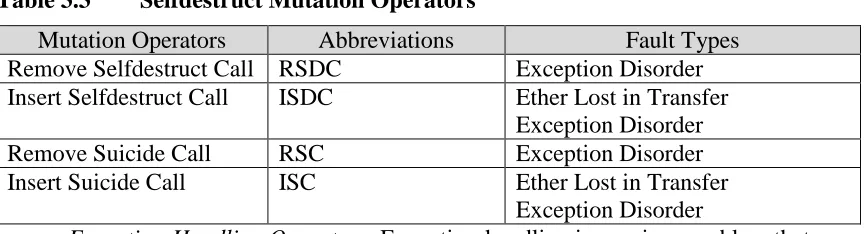
unexpectedly at this address, then the ether will be sent to an orphaned address, causing the ether lost in transfer fault. Table 3.3 lists the selfdestruct operators.
Table 3.3 Selfdestruct Mutation Operators
Mutation Operators Abbreviations Fault Types
Remove Selfdestruct Call RSDC Exception Disorder Insert Selfdestruct Call ISDC Ether Lost in Transfer
Exception Disorder
Remove Suicide Call RSC Exception Disorder
Insert Suicide Call ISC Ether Lost in Transfer
Exception Disorder
Exception-Handling Operators: Exception-handling is a serious problem that
properly, then the code may still execute because it does not catch the exception that has occurred. Also, the revert statement can cause major problems for developers if it used improperly. The importance of revert cannot be understated in contract development. When something goes wrong in the execution of the contract code, it may be important to revert all state changes that happened during the execution, which is where the revert call comes in. The revert call reverses all the state changes, refunding all the remaining gas to the caller. Now, if the revert statement is in the wrong place or does not even exist, then these changes will probably not be reversed, causing some of the changes to be
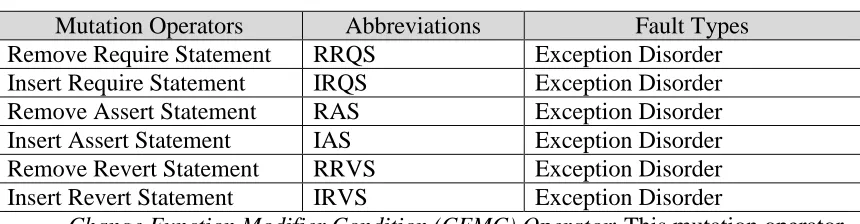
permanent. The exception-handling operators target these problems by intentionally removing or inserting these statements into areas of the code where they did not previously reside. Table 3.4 lists the exception-handling operators.
Table 3.4 Exception-Handling Mutation Operators
Mutation Operators Abbreviations Fault Types
Remove Require Statement RRQS Exception Disorder Insert Require Statement IRQS Exception Disorder
Remove Assert Statement RAS Exception Disorder
Insert Assert Statement IAS Exception Disorder
Remove Revert Statement RRVS Exception Disorder Insert Revert Statement IRVS Exception Disorder
Change Function Modifier Condition (CFMC) Operator: This mutation operator
because the state of the application will not be properly checked inside the function modifier.
3.4.3 Intra-Module Level
State Variable Visibility Operators: These mutation operators modify the
visibility of state variables in Solidity. Unlike functions in Solidity, state variables do not allow the external keyword. Public state variables has a generated getter function
generated when it is called. They can also be called by the internal contract or through messages. Internal variables are similar to internal functions in that they can only be accessed internally or through child contracts. Private variables are also similar to private functions in that they are only visible to the internal contract and cannot be accessed by child contracts. Visibility operators exist in many languages, however, with the nature of Solidity, it is important to distinguish them from other operators, given the nature of the EVM. For example, with the inclusion of the internal keyword, developers may be confused between the semantic similarity that exists with the private keyword.
Intuitively, the two words may seem as if they are just an alias for each other. However, the Solidity documentation clearly outlines that there is a semantic difference between the two visibilities. If a developer is to confuse the two visibilities, it is likely that the
variable can be accessed in an unintentional manner. Table 3.5 lists the state variable visibility mutation operators.
Table 3.5 State Variable Mutation Operators
Mutation Operators Abbreviations Fault Types
Public → [Private, Internal] PUPI, PUI Loss of Visibility
Private → [Public, Internal] PRPU, PRI Gain Excess Visibility
Internal → [Public, Private] IPU, IPR Loss of Visibility
Function Type Operators: The three primary function types in Solidity are pure,
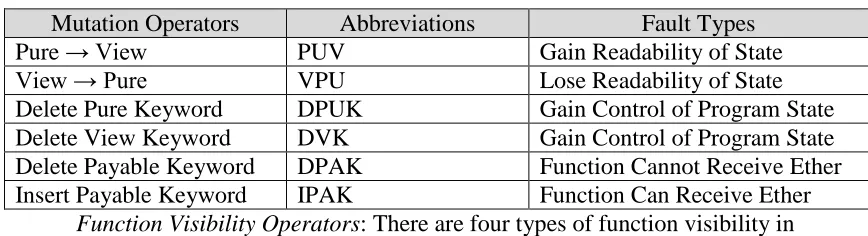
view, and payable. Pure and view functions deal with how the function is allowed to affect the state of the program. Pure functions are ultimately a subset of view functions considering that they are essentially more restrictive in what they can access in terms of the state of the program. Payable functions have no relation to the other two function type keywords; however, they do serve an important purpose in Solidity. By swapping or removing the pure/view keywords, the developer may be able to realize if they are using the keywords incorrectly. They may also notice that a mutation may be live for either of these types of mutations, probably indicating that they are only considering the happy-path scenario for testing this function. The payable function mutation is relatively self-explanatory, as if a test doesn’t recognize that a payable function has been modified, they probably aren’t actually trying to send Ether to the function, which of course it the primary purpose of the modifier keyword. Table 3.6 lists the function type mutation operators.
Table 3.6 Function Type Mutation Operators
Mutation Operators Abbreviations Fault Types
Pure → View PUV Gain Readability of State
View → Pure VPU Lose Readability of State
Delete Pure Keyword DPUK Gain Control of Program State
Delete View Keyword DVK Gain Control of Program State
Delete Payable Keyword DPAK Function Cannot Receive Ether Insert Payable Keyword IPAK Function Can Receive Ether
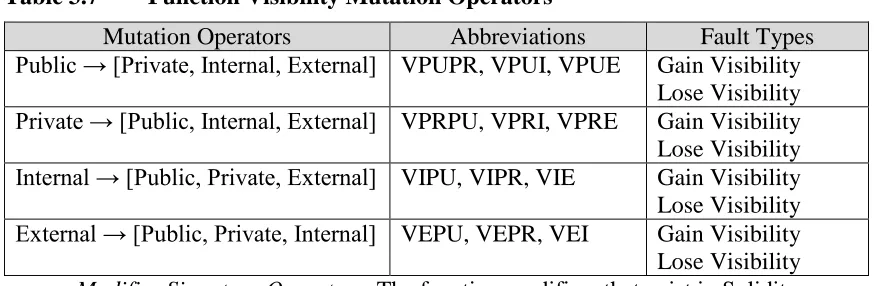
Function Visibility Operators: There are four types of function visibility in
internal functions can be called by the function it is declared in and all contracts that are derived from it. Now, while public and private might seem semantically similar to external and internal functions, they are not. Public functions allow for anyone to access, this is different from external, where only outside transactions and functions can call it. On the other hand, private functions can only be called from the contract that it is declared in, meaning that no derived contracts can access this function. In many cases, the mutation results that come out of these mutation operators are similar to those of the state variable visibility operators. What is meant by this is that the mutation operators will also give similar insight as to how the functions are being tested when compared to the state variables. Table 3.7 lists the Function Visibility operators.
Table 3.7 Function Visibility Mutation Operators
Mutation Operators Abbreviations Fault Types
Public → [Private, Internal, External] VPUPR, VPUI, VPUE Gain Visibility
Lose Visibility
Private → [Public, Internal, External] VPRPU, VPRI, VPRE Gain Visibility
Lose Visibility
Internal → [Public, Private, External] VIPU, VIPR, VIE Gain Visibility
Lose Visibility
External → [Public, Private, Internal] VEPU, VEPR, VEI Gain Visibility
Lose Visibility Modifier Signature Operators: The function modifiers that exist in Solidity are
used to execute code before a function is called. Primarily, these functions are used to check a precondition before the actual function is ran. Now, while these operators are associated with function modifiers, they are not the same as the Chance Function
may result in the function not executing or if a function modifier is removed, it could potentially always run. Because of the unexpected behavior that this change will introduce, there is a high probability for exception disorder to occur because of the unchecked conditions that will ultimately take place because of the mutations.
• Delete Function Modifier (DFM): This mutation operators deletes any modifier
argument associated with a function. This should cause the precondition check to be ignored when the contract is running.
• Insert Modifier on Function (IMF): In the case that there is no modifier argument
attached to a function, while a modifier still exists in a contract, a mutation can occur where a modifier argument is attached to a function.
Library Function Visibility Operators: Libraries are an important part of the
Table 3.8 Library Function Visibility Operators
Mutation Operators Abbreviations Fault Types
Public → [Private, Internal]
LPUPR, LPUI Gain Visibility Lose Visibility Private → [Public,
Internal]
LPRPU, LPRI Gain Visibility Lose Visibility Internal → [Public,
Private]
LIPU, LIPR Gain Visibility Lose Visibility
3.4.4 Inter-Module Level
Determining the behavior is relatively difficult as of now but could be a potential area of interest later on.
3.4.5 Mutation Operator Relationship to Fault Types
The fault types provided by Atzei et al. [3] and discussed in Chapter Two can be replicated by the some of the mutation operators that were designed in Deviant. The fault types we consider are those that can observed within Solidity code itself, namely: call to the unknown, exception disorder, gasless send, type casts, reentrancy, and ether lost in transfer. Table 3.9 lists these fault types along with the associated Solidity-specific mutation operator category that can replicate these faults.
Table 3.9 Fault Types with Associated Mutation Operators
Fault Type Mutation Operator Category
Call to the unknown Address
Exception disorder Address Function
Selfdestruct
Exception-Handling
Gasless send Address Function
Type casts Addresses
Reentrancy Address Function
Ether lost in transfer Address
Selfdestruct
Call to the unknown: Address mutation operators can potentially create call to the
Exception disorder: There are three Solidity-specific mutation operator categories
that can cause an exception disorder to occur: address function, selfdestruct, and
exception-handling. Address function operators can cause an exception disorder to occur typically when modifying between the send and transfer function calls. This is because send returns false on failure, whereas transfer throws an exception. This means that if there is no exception checking done on a send call, then the exception might not be caught and the user of the Solidity application might not be aware that something went wrong. The selfdestruct operators can either insert a selfdestruct statement or remove a selfdestruct statement. In either case, it will cause the contract to either exist or not exist when it shouldn’t. When this happens, a contract may attempt to use the contract that has been incorrectly destroyed from the blockchain, causing an exception that might not make any sense to the developer (e.g. reverting the transaction suddenly). Exception-handling operators either insert or remove exception-Exception-handling statements in the Solidity smart contracts. By doing this, exceptions can either occur or not occur in the
inappropriate place. When this happens, improper exception-handling can cause the program to behave unexpectedly. Also, by introducing exceptions in certain locations, then gas may not be refunded.
Gasless send: Address function operators, specifically modifying transfer to send,
can cause a gasless send to occur. This is because when the send is compiled to EVM bytecode, it is compiled to a call function with a gas stipend of 2,300. Now, since the call function will have no signature, it will invoke the fallback function. If the fallback
able to work around this error, then by using send instead, it will cause an out-of-gas exception to occur when it should not have.
Type casts: Type cast faults occur with the address mutation operators and are
similar to the call to the unknown faults. When a mutation operator such as the Switch Call Expression Casting (SCEC) operator is applied, it takes two instances of addresses being cast to a contract and then swaps them. When this occurs, it is highly likely that it will cause a type cast error. This is because the Solidity compiler cannot check to see if the address contains the actual contract that it is being cast to, rather it can only check the interface of the contract itself. By swapping these contract casts, the two contracts now point to the incorrect contract, causing the contract to have its fallback function invoked when it is called.
Reentrancy: Reentrancy vulnerabilities can occur with address function operators,
more specifically, they can occur when either transfer or send is replaced with the call function. The call function itself is not safe from reentrancy attacks, especially in
used, it will only revert the last transaction that took place, meaning that all the other transactions that took place before it will be considered valid. What this means is that when call replaces send or transfer, it can potentially introduce a reentrancy vulnerability that allows the vulnerable contract’s non-recursive function to be entered recursively.
Ether lost in transfer: Ether lost in transfer faults can happen when an address or
CHAPTER FOUR: IMPLEMENTATION
Chapter Four explains our implementation of Deviant. Section 4.1 details our implementation of the Deviant application, discussing both the Graphical User Interface (GUI) and explaining how we have implemented our architecture in relation to our design in Chapter 3. Section 4.2 addresses the implementation issues that were faced in Deviant.
4.1 Implementation of Deviant
Figure 4.1 Home Page for Deviant GUI
Figure 4.2 Mutation Operators Page for Deviant GUI
The mutant operators in the GUI are divided into their respective categories: statement/expression level, function level, intra-module level, and inter-module level as seen in Figure 4.2. We have divided the mutation operators into their respective
Figure 4.3 Report Page for Deviant GUI
The report page, as seen in Figure 4.3, allows the developer to select the original file from the project that was selected, along with a mutant file that they wish to compare to the original. The report will display the line where the mutation occurred, along with the line number in code where the mutation took place. The bottom section of the report displays the total number of mutants for the selected file, along with the number of killed mutants, live mutants, and mutation score. The report also includes the most common live mutant type along with the most common generated mutant type. It should be noted that the report page does not automatically determine if a mutant is functionally equivalent to the original program. Deviant cannot automatically determine equivalent mutants, instead the developer must evaluate the generated mutant and determine if the mutant is
Deviant is implemented using JavaScript with NodeJS. JavaScript was selected as the primary language for two reasons: the available libraries that exist for the
modification of Solidity source code and the overall support that exists for NodeJS in regards to Solidity. In fact, most of the dApps that are written with Solidity also use a NodeJS portion for things such as its front-end or event-handling. Using NodeJS is also incredibly useful for this project, considering that the Solidity language itself is heavily influenced by JavaScript and shared much of the same syntax and other features.
After all of the mutants have been generated, Deviant then runs the test suites against the mutant versions of the Solidity program files. Truffle is a popular
development environment, testing framework, and asset pipeline for Ethereum [15]. Deviant requires that the provided Solidity projects are developed using the Truffle environment, which for most Solidity projects, is already the case. The reason that Deviant requires Truffle is primarily for automation purposes, without Truffle, the process of mutation testing would be quite cumbersome. Truffle provides a systematic approach to testing smart contracts, while also being the most popular development environment for Solidity. What Deviant actually does with the Truffle project is to actually run the test command for Truffle, while making sure that the appropriate mutant is being compiled instead of the original source code.
Truffle’s testing phase always starts out with the contracts being recompiled. In our case, we insert the mutant into the project’s contract directory and ensure that the mutant is compiled while the original source code is ignored. This process is repeated until every mutant has been ran against the entirety of the test suite, meaning that only mutant is used at a time. Deviant tracks these mutants and then reports the evaluation metrics to the user.
4.2 Implementation Issues
affect the current implementation of their program, ours included. The most noticeable changes in our development process was the syntactic and semantic differences that existed between the different Solidity versions. As explained in Chapter 3, until Solidity 4.24, the constructor in the contract was implemented by using the name of the contract as the function name, whereas it is now defined by using the constructor keyword. In terms of implementation challenges, if a developer were using an earlier version of Solidity, then their old contracts will no longer be compiled by the newer version of the Solidity compiler. To fix this, developers have to ensure that their implementation follows the appropriate syntactic rules in relation to the version of the Solidity compiler that they are using. In our case, this means that we only support Solidity versions that are great than 0.4.0, which for almost all projects should not be an issue. While this
individual change may be small, there are numerous changes that occur between the different Solidity versions.
what we expect, then we do not create the mutation at that point. However, there are still instances where an invalid mutant could be generated. In our application, we have implemented a check that looks for compile-time errors and if one exists, we consider that mutant to be invalid and it is no longer considered in our report.
The constant updates to Solidity not only affect the syntax and semantics of the programming language, but they also affect many of the libraries that are useful for our mutation tool. For instance, the solmeister library that we use has not been updated since 2016, having several new versions of Solidity come out since then. To overcome this problem, we had to modify the project’s own dependencies to ensure that its own
![Figure 2.1 Blocks in the Bitcoin blockchain model [12]](https://thumb-us.123doks.com/thumbv2/123dok_us/1139721.1615732/16.612.161.490.374.464/figure-blocks-bitcoin-blockchain-model.webp)