IJSRSET1731115 | Received : 22 Feb -2017 | Accepted : 28 Feb-2017 | January-February-2017 [(3)1: 536-542]
© 2017 IJSRSET | Volume 3 | Issue 1 | Print ISSN: 2395-1990 | Online ISSN : 2394-4099 Themed Section: Engineering and Technology
536
Image Sharpening Using Fuzzy Logic Based Edge Detection
Nidhi Bhardwaj
Department of Electronics and Communication Engineering, Bhagat Phool Singh Mahila Vishwavidyalaya, Khanpur Kalan, Sonipat, Haryana, India
ABSTRACT
In this study, enhancement of digital images, specifically sharpening of satellite images is presented. A technique called unsharp masking is modified for this task. In unsharp masking, high frequency data is emphasized in an image. In the present investigation, modifiedmethod to extract the high frequency data from the image is used; based on Fuzzy logic based system is used for this task. As soon as the high frequency data is available, it can be engraved over the image to sharpen the edges. A comparative analysis is also provided with conventional operator based edge detection techniques.
Keywords : Edge Detection, Image Sharpening, Fuzzy Logic, Satellite Image Enhancement
I.
INTRODUCTION
Satellite image play a vital role in digital era. Penetration of computers in the field of aerotech which forced the designers to add the capability to see and analyse and to innovate more and more into the domain of electronic vision or image processing. At the level of computational intelligence for electronic vision, many of the algorithms have been developed to extract different types of features from the image such as edges, segments and lot many other types of image features. In order to perceive images correctly, visual enhancement specifically sharpening of digital images is crucial.Various researchers have proposed different algorithms for sharpening of edges in a digital image.
II.
METHODS AND MATERIAL
A. Related Work
In this section a brief overview of work related to present investigation is discussed. The review of literature is presented under four different domains as depicted in Table 1.
Table 1 : Overview of Literature Review
S. No. Parameters Authors
1. Edge Detection in Images
A. Rosenfeld [1970]; A. K. Griffith [1973]; X. Z. Sun[1986] and A. N. Venetsanopoulos [1986]; V. J. Stanger [1991]; H. B.
Mitchell [1992];
GongyuanQu and S. Wood [1998]; Da-Shun Queet al.[1998];
W.BoonchiengandR.Kanjan avanit[2004];LingFeiLianga ndZiLiangPing[2008; ZhongshuiQu and Jianwei
Wang[2010]; Zhang
Rongxueet al. [2012]; GirishChaple and R. D. Daruwala[2014]; Liying Yuan and XueXu [2015]; Vishal Paikaet al. [2013]; FarnazHoseiniet
B. Edge Detection Using Fuzzy LOGIC
Edge is defined as object border, and extracted by features such as graycolor or texture discontinuities. Luminance and geometrical features, lightening condition and noise volume has a great impact on shaping the edge. Edge contains important information of image and provides object's location. Edge is considered an important feature in a digital image and is used for image enhancement, restoration and segmentation [Vishal Paikaet al., 2013]
A. Basics of Edge Detection
Edge detection is a fundamental tool in image processing and computer vision, particularly in the areas of feature detection and feature extraction, which aim at identifying points in a digital image at which the image brightness changes sharply or more formally has discontinuities. The contrast is improved by increasing
the difference across discontinuities of the image components. In order to improve the differences, they have to be detected. The edge detection algorithm is designed to detect and highlight these discontinuities.
The goal of edge detection is to identify pixels in an image which represent edges of the objects present in the image. The usual operation which is used to identify these edges is a first and/or a second derivative measurement. This operation is followed by a thresholding operation which either marks the pixel as an edge pixel or not.
C. Edge detection algorithms
Since the last two decades various edge detection algorithms have been developed and implemented. Primarily, operator based techniques may be grouped into two specific classes [Zhang Ronguxeet al., 2012]
1) Gradient based operators: In these operators, an estimate of the gradient magnitude is obtained using the averaging filter and then, the positions of the edges are estimated. Thus, the maximum and the minimum in the first derivative of the image are analysed to detect the edges. Magnitude of the gradient of image is given using eq. (1).
,
f 2 f 2grad f x y
x y
(1)
The implementation of gradient is done via convolution masks. Various operators which approximate first derivatives have been established which contain separate masks for each direction. These operators are, for example, Canny Operator, Roberts operator, Prewitt operator, Sobel operator etc.
2)Laplacian (zero-crossing) based operators: In this method, second derivative of the image is obtained. This method searches for zero crossings in the second derivative of the image to find edges. The expression for laplacian operator is given using eq. (2).
2
2
2
2 2
, ,
, , f x y f x y
lap f x y f x y
x y
(2)
D. Characteristics of an edge detector
A good edge detection algorithm should possess following characteristics:
S. No. Parameters Authors
2. Image
Sharpening
K. Hedengren [1992]; Y. H. Lee andSoonYoungPark[1990]; S.Guillonet al.[1996]; G. Ramponi [1998]; M. Huang et al. [2002] ; Liu Ying et al. [2008];
BadreddineBouledjfaneet al. [2013]; Shailendra Singh Negieet al. [2014]; Ali Alsamet al. [2015];S.S Bediet al. [2013].
3.
Satellite Image Enhancement
R.Vorobel [1996]; JyotiSinghai and PareshRawat [2007];
BoonwatAttachoo and
PetcharatPattanasethanon [2009]; HaciTaşmazet al. [2012]; Saeed Al Nuaimiet al. [2014]; R. Thriveni and Ramashri [2015].
4. Fuzzy Logic
Based System
Modelling
A.Bala[2010]; A. L.
Choodarathnakaraet
al.[2012];R.Shenbagavalli and
K.Ramar [2013];
DiwakarShrivastava and
VineetRichhariya[2014];P.D Patel et al.[2014]; P.Mishra
and K.L
1) It checks less number of false edges and detection of real edges should be maximum.
2) The marked pixels should be closer to the true edge. 3) Error of detecting more than one response to single
edge (double edges) should be less.
4) To design one edge detector that performs well in several contexts (satellite images, face recognition, medical images, natural images etc.)
E. Fuzzy Logic Based Edge Detection
Fuzzy set theory is powerful mathematical tool for handling imprecision or vagueness. A particular problem that is to be solved is represented in the form of human language can be solved easily with the help of fuzzy sets. So, the extension of classical set theory-'Fuzzy set' becomes robust and flexible. Fuzzy logic is a version of first-order logic which allows the truth of a statement to be represented as a value between 0 and 1, rather than simply True (1) or False (0). This varying degree of values shows the degree of possessiveness of elements to its fuzzy set or simply it shows the fuzziness and is known as membership function. Depending on the values, these functions are classified as Gaussian, triangular, exponential, polynomial etc. Selection of particular function is user defined [FarnazHoseiniet al., 2015].
The edge detection algorithm using fuzzy logic is explained as follows:
1) Image fuzzification
The image that read is gray scale image and data might range from 0 to 255. The data 0 belongs to black pixel of the image and data 255 belongs to while pixel of the image. In order to apply the fuzzy algorithm, data should be in the range of 0 to 1 only. The image data are converted to this range that is known as membership plane, after the image data are transformed from gray-level plane to the membership plane (fuzzification); appropriate fuzzy techniques modify the membership values. This can be a fuzzy clustering, a fuzzy rule-based approach and a fuzzy integration approach.The gradient is computed both in horizontal (X) direction and in vertical (Y) direction.
2) Fuzzy Inference system
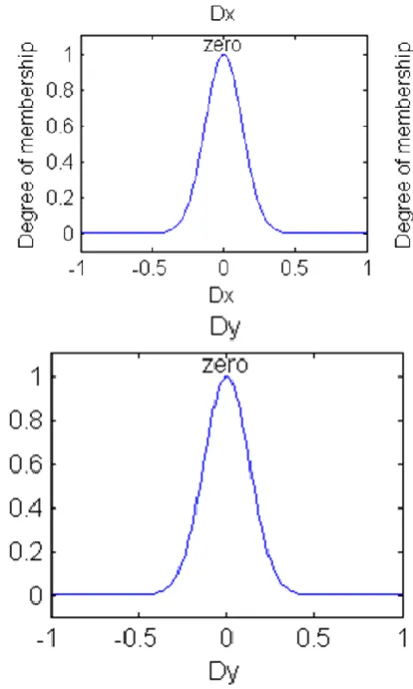
The system implementation was carried out considering that the input image and the output image obtained after defuzzification are both 8-bit quantized; this way, their gray levels are always between 0 and 255. The fuzzy sets were created to represent each variable’s intensities; these sets were associated to the linguistic variables “Black” as background and “White” as Edge. After computing the gradient of the image, the higher value represent edge and lower values, the background. The adopted membership functions for the fuzzy sets associated to the input and to the output are as shown in Fig. 1and 2 respectively.
Figure 1. Input Membership functions (MATLAB)
to separate the values of the blacks and whites and edges of the image. In many image processing applications, expert knowledge is often used to work out the problems. Expert knowledge, in the form of fuzzy if-then rules, is used to deal with imprecise data in fuzzy set theory and fuzzy logic.
Figure 1. Output Membership functions(MATLAB)
3) Fuzzy inference rule
The Inference rule depends on value of the gray level pixels of the fuzzified data set; in this case fuzzified gradient images. Two rules are used based on and-or conditions. In both, gradients are low, the pixel is background. If any of the pixels is high, data is edge data. The powerful feature of these rules is the ability of extract all edges in the processed image directly.
4) Defuzzification
From the side of the fuzzy construction, the input grays is ranged from 0-255 gray intensity, and according to the desired rules the gray level is converted to the values of the membership functions . The Mamdani method was chosen as the defuzzification procedure.
F. Unsharp Masking
Image sharpening using unsharp mask is by far the most popular technique. It has its roots in analog photography where the blurred version of the photo used to be printed together with the negative in the form of registered sandwich. This would increase edge sharpness as well as suppress the noise caused by the film grain which is random for both versions. The name of the procedure comes from the fact that the unsharp version is used as a mask. But the massive popularity of unsharp mask came with the digital photography.
The principle of it is to extract the high frequency components by subtracting the blurred version from the
original (X). This may also be achieved by directly computing the high frequency components using edge detection process. Let us denote it by Xhigh. Once the high frequency components are available, the sharpened image can be computed using equation (3).
Xsharp = X + a Xhigh …..(3)
Steps involved in unsharp masking: The steps are as follows:
Step 1: Extract the high frequency components. Two primary methods are available for this:
a. Subtracting the blurred version of the image (low frequency components) from the original image. b. Using high pass filter/edge detectors
Step 2: Adding the extracted high frequency components to original image.
A modified version of the unsharpmasking process is proposed by changing the method to extract the high frequency components. Instead of subtracting the blurred version of the image (low frequency components) from the original image or using conventional high pass filter/edge detectors, the high frequency components are extracted using Fuzzy Inference System.
III.
RESULTS AND DISCUSSION
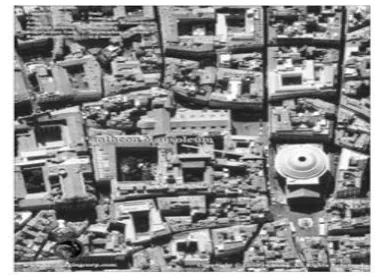
The satellite image used for sharpening algorithm is shown in Fig. 3
Figure 3. Satellite Image [Source:http://www.
satimagingcorp.com/gallery/geoeye-1/geoeye-1-pantheon-rome-italy/]
system is designed whereby inputs are defined as gradient images. Membership function have to be defined for input and output as shown in Fig. 5. Also fuzzy inference rules are created. Let Dx and Dx2 be the gradient images in horizontal direction while Dy and Dy2 be the gradient images in vertical direction.
Figure 4. Gradient Images obtained for the image shown in Figure 3
The inference rules used are:
1. If (Dx is zero) and (Dy is zero) and (Dx2 is zero) and (Dy2 is zero) then (im_out is black)
2. If (Dx is not zero) or (Dy is not zero) or (Dx2 is not zero) or (Dy2 is not zero) then(im_out iswhite).
(a)
(b)
Figure 5. Membership functions (a) for Inputs (b) for Outputs [MATLAB]
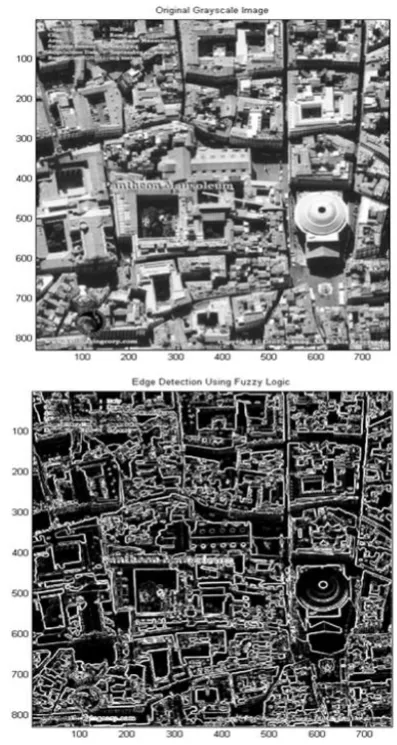
The result of edge detection is shown in Fig. 6. Also, the results are compared with other edge detection techniques as shown in Fig. 7. The detected edges are embossed onto the original image and the results of sharpening are shown in Fig8. Finally, the results are compared with the algorithms in Fig. 9.
Figure 7. Comparison of edge detection techniques
Figure 8. Result of sharpening
Figure 9. Comparison of sharpening techniques
IV.
CONCLUSION
In this paper, a new technique for sharpening of satellite images is presented. First, various concepts related to edge detection in digital images are studied. Then, a comprehensive discussion of fuzzy based edge detection and unsharp masking is provided. Finally, a comparative analysis of proposed technique with other techniques is provided. From various results shown in Fig. 12 and 13, it can be concluded that the proposed technique provides sharpening results far better than the other techniques compared.
V.
REFERENCES
[1]. Mao-Yu Huang, Din-Chang Tseng and M. S. C. Liu, "Wavelet image enhancement based on Teager energy operator," Pattern Recognition, 2002. Proceedings. 16th International Conference on, 2002, pp. 993-996 vol.2.
[2]. L. Ying, N. T. Ming and L. B. Keat, "A Wavelet Based Image Sharpening Algorithm," Computer Science and Software Engineering, 2008 International Conference on, Wuhan, Hubei, 2008, pp. 1053-1056.
[3]. B. Bouledjfane, L. Bennacer and M. S. Kahli, "BEMD-Unsharp Masking for retinal angiography image sharpening," Systems, Signal Processing and
their Applications (WoSSPA), 2013 8th
International Workshop on, Algiers, 2013, pp. 220-225.
[4]. S. S. Negi and Y. S. Bhandari, "A hybrid approach to Image Enhancement using Contrast Stretching on Image Sharpening and the analysis of various cases arising using histogram," Recent Advances and Innovations in Engineering (ICRAIE), 2014, Jaipur, 2014, pp. 1-6.
[5]. A. Alsam, I. Farup and H. J. Rivertz, "Iterative sharpening for image contrast enhancement," Colour and Visual Computing Symposium (CVCS), 2015, Gjovik, 2015, pp. 1-4.
[6]. R. Vorobel, "Contrast enhancement of remotely-sensed images," Mathematical Methods in Electromagnetic Theory, 1996., 6th International Conference on, Lviv, 1996, pp. 472-475.
[7]. J. Singhai and P. Rawat, "Image enhancement method for underwater, ground and satellite images using brightness preserving histogram equalization with maximum entropy," Conference on Computational Intelligence and Multimedia Applications, 2007. International Conference on, Sivakasi, Tamil Nadu, 2007, pp. 507-512.
[8]. B. Attachoo and P. Pattanasethanon, "A new approach for colored satellite image enhancement," Robotics and Biomimetics, 2008. ROBIO 2008. IEEE International Conference on, Bangkok, 2009, pp. 1365-1370.
[9]. H. Taşmaz, H. Demirel and G. Anbarjafari, "Satellite image enhancement by using dual tree complex wavelet transform: Denoising and illumination enhancement," 2012 20th Signal Processing and Communications Applications Conference (SIU), Mugla, 2012, pp. 1-4.
satellite images by optimizing the structural similarity index measure," Communication Systems, Networks & Digital Signal Processing (CSNDSP), 2014 9th International Symposium on, Manchester, 2014, pp. 668-672.
[11]. R. Thriveni and Ramashri, "Edge preserving Satellite image enhancement using DWT-PCA based fusion and morphological gradient,"
Electrical, Computer and Communication
Technologies (ICECCT), 2015 IEEE International Conference on, Coimbatore, 2015, pp. 1-5.
[12]. L. G. Roberts, Machine perception of three dimensional solids, in Optical and Electro-Optical Information Processing (J. Tippett, D. Berkowitz, L. Clapp, C. Koester, A. Vanderburgh, Eds.), M.I.T. Press, 1965, pp. 159-197.
[13]. Sobel, I., Feldman, G., "A 3x3 Isotropic Gradient Operator for Image Processing", presented at the Stanford Artificial Intelligence Project (SAIL), 1968 [14]. J.M.S. Prewitt "Object Enhancement and Extraction" in "Picture processing and Psychopictorics", Academic Press,1970
[15]. J. Canny, "A Computational Approach to Edge Detection," in IEEE Transactions on Pattern Analysis and Machine Intelligence, vol. PAMI-8, no. 6, pp. 679-698, Nov. 1986.
[16]. L. S. Davis, "A Survey of Edge Detection Techniques," Computer. Graphics and Image Processing, Vol.4, No.3, September 1975, pp. 248-270
[17]. A. Rosenfeld, "A nonlinear edge detection technique," in Proceedings of the IEEE, vol. 58, no. 5, pp. 814-816, May 1970.
[18]. A. K. Griffith, "Edge Detection in Simple Scenes Using a Priori Information," in IEEE Transactions on Computers, vol. C-22, no. 4, pp. 371-381, April 1973.
[19]. X. Z. Sun and A. N. Venetsanopoulos, "Nonlinear point operators for edge detection," in Canadian Electrical Engineering Journal, vol. 11, no. 3, pp. 90-103, July 1986.
[20]. V. J. Stanger, "Edge-based combination algorithm applied to multiple restored images," in Electronics Letters, vol. 27, no. 18, pp. 1638-1640, 29 Aug. 1991.
[21]. H. B. Mitchell, "Very fast accurate square-root algorithm for use with gradient edge operators," in Electronics Letters, vol. 28, no. 10, pp. 922-923, 7 May 1992.
[22]. GongyuanQu and S. Wood, "Edge detection using improved morphological gradient,"1998. Conference Record of the Thirty-Second Asilomar
Conference on Signals, Systems & Computers, Pacific Grove, CA, USA, 1998, pp. 954-958 vol.2. [23]. Da-Shun Que, Ling Lu, Hong Wang and Xiao-Dong
Song, "A fast edge detection method based on the correlation of moving images and its application," 2002. 2002 International Conference on Machine Learning and Cybernetics, 2002, pp. 2197-2200 vol.4.
[24]. E. Boonchieng, W. Boonchieng and R.
Kanjanavanit, "Edge-detection and segmentation methods for two-dimensional echocardiograms," Computers in Cardiology, 2004, 2004, pp. 541-544. [25]. L. Liang and Z. Ping, "An Edge Detection
Algorithm of Image Based on Empirical Mode Decomposition," IITA '08. Second International Symposium on Intelligent Information Technology Application, Shanghai, 2008, pp. 128-132.
[26]. Z. Qu and J. Wang, "A color YUV image edge detection method based on histogram equalization transformation," 2010 Sixth International Conference on Natural Computation, Yantai, Shandong, 2010, pp. 3546-3549.
[27]. Z. Rongxue, Z. Tingting, Renna and W. Hongjiang, "Research on image matting technology based on image edge detection," 2012 IEEE International Conference on Industrial Engineering and Engineering Management, Hong Kong, 2012, pp. 1199-1203.
[28]. G. Chaple and R. D. Daruwala, "Design of Sobel operator based image edge detection algorithm on FPGA," 2014 International Conference on Communications and Signal Processing (ICCSP), Melmaruvathur, 2014, pp. 788-792.
[29]. L. Yuan and X. Xu, "Adaptive Image Edge Detection Algorithm Based on Canny Operator," 2015 4th International Conference on Advanced Information Technology and Sensor Application (AITS), Harbin, 2015, pp. 28-31.