Volume 11 Issue 2 2019
DOI: 10.21315/eimj2019.11.2.3
ARTICLE INFO
Submitted: 16-04-2019 Accepted: 15-05-2019 Online: 28-06-2019
CORRESPONDING AUTHOR Dr. Mohd Zarawi Mat Nor, Department of Medical Education, School of Medical Sciences, Health Campus, Universiti Sains Malaysia, 16150 Kubang Kerian, Kelantan, Malaysia | E-mail: [email protected]
INTRODUCTION
Mentoring relationship provides a guidance session to foster the mentees’ professional skills which include academic and non-academic domains (1). Obviously, mentoring service has become a significant exercise in reducing the psychological problems faced by the students (2–7). Even
though these problems can be reduced by referring them to professionals such as clinical psychologists and psychiatrics, the preventive measure through an effective mentoring session is most welcomed.
In higher education institutions, mentoring services are activated by interested academic staff at school level voluntarily. They
To cite this article: Mat Nor MZ, Mohammad JAM, Yaacob NM. The USM mentoring inventory: a construct validity and reliability exercise. Education in Medicine Journal. 2019;11(2):15–26. https://doi.org/10.21315/eimj2019.11.2.3
To link to this article: https://doi.org/10.21315/eimj2019.11.2.3
ABSTRACT
One of the challenges in mentoring relationships is to understand the real issues faced by the mentees. A mechanism has been established to offer a credible mentoring inventory. The aim of the study was to determine the construct validity and reliability index of the Universiti Sains Malaysia Mentoring Inventory (USM-MT-i) among early phase medical students in a Malaysian public medical school. A cross-sectional study was conducted in June 2017 among 208 early phase of the medical students of School of Medical Sciences, Universiti Sains Malaysia. USM-MT-i is a self-administered inventory and was established based on the information gained from the mentors and mentees. The pre-validated inventory entailed 44 primary items. Exploratory factor analysis (EFA) and Cronbach’s alpha reliability analysis were utilised to determine the construct validity and reliability of such inventory. The result revealed three potential constructs with 39 items extracted from the USM-MT-i; academic leadership (19 items), communication skills (12 items) and examination competence (8 items) with factor loading ranges from 0.50–0.77, 0.51–0.80 and 0.65–0.87, respectively. Internal consistency reliability (Cronbach’s alpha) for each domain were 0.95, 0.93 and 0.92, respectively. The overall Cronbach’s alpha was 0.96. The present study promoted that the three factors with 39 items of the USM-MT-i has a good validity and reliability value to survey for mentoring needs among medical students in their early phase.
Keywords: Construct validity, Reliability, Mentoring inventory
The USM Mentoring Inventory: A Construct
Validity and Reliability Exercise
Mohd Zarawi Mat Nor1, Jamilah Al-Muhammady Mohammad1, Najib Majdi Yaacob2
1Department of Medical Education, School of Medical Sciences,
Universiti Sains Malaysia, Malaysia
2Unit of Biostatistics & Research Methodology, School of Medical
carried out to address the questions on the real needs for mentoring programme in the medical school from the perspective of mentees.
The mounting desires of self-management, social management and academic management to foster personal and professional features (17) among the medical students are good indicators that such students need a professional helper who is able to understand the real issues they face (18–20). For that reason, providing a good service of mentoring sessions are necessary. This can be achieved by understanding the issues which should be entertained. Therefore, an accurate and validated assessment tool is welcomed. Despite the importance of such service (17), we do not have a credibility assessment tool which is able to evaluate the need of mentoring from the students’ perspective. Thus, we aimed to assess dimensionality (construct validity) and reliability of the established instrument, which is known as Universiti Sains Malaysia Mentoring Inventory (USM-MT-i). As a result, a null hypothesis was established; the proposed items of the USM-MT-i is one-dimension and the research hypothesis was that the suggested items of the USM-MT-i is multi-dimension.
Scandura and Ragin’s 15-items mentoring questionnaire (21), mentoring profile questionnaire and mentorship effectiveness (22) were actively used in the helping profession. Despite the popularity, these instruments have their limitations. Firstly, it was focused on a general target group, not specific to the medical training as proposed by the current study. Secondly, it was only measuring the impacts of the mentoring process rather than the need of mentoring relationships. Thus, it is hoped that these instruments will close the gap.
In the context of the medical training, the scopes of the mentoring sessions are broader including (i) career advancement (23–24), (ii) personal development, and (iii) professional development (3–5, 7, 25– serve as a mentor to guide mentees in
educational, career and social development areas (8, 9) as well. This is consistent with the United Nations Educational, Scientific and Cultural Organisation (UNESCO) which has addressed three main roles of the students’ affair section in higher education institutions which promote personal, career and education development as well (8–11). To realise these roles, mentors must be knowledgeable and skilful to help them professionally during the mentoring relationship. A previous study revealed that positive impacts of a helping service (e.g. mentoring sessions) has been admitted by the mentees themselves (12–13). One of the reasons is that, the topics discussed during the mentoring sessions met with mentees needs (14).
and focus group discussions with target group and mentors as well. Secondly, the information obtained was clustered based on similarities and differences in a profile of mentoring relationships. Finally, items related to mentoring services were promoted. The evaluation of the content and face validity was completed by five medical educationists who assess the appropriateness of each item. As a response, needed modifications were made grounded based on the feedbacks given. Each item of the USM-MT-i was rated using a five-point rating scale (1 = extremely not needed, 2 = not needed, 3 = less needed, 4 = needed, and 5 = extremely needed) to designate how close the items described the respondent’s need.
Assessment of Construct Validity and
Reliability
A cross-sectional study was done in June 2017 among the early phase medical students of USM to evaluate the construct validity and reliability of USM-MT-i. Inclusion criteria includes all such group of students. The sample size estimation was founded on sample to variable (N:p) ratio of 3:1 (42). Since there were 44 items in the initial questionnaire, the sample size desired was 132. After adding 10% non-response rate, the desired sample size was 134. The early phase of such students was employed as population of the study through convenient sampling technique. Before responding the questionnaire, respondents were informed about the background of the study (e.g. research objectives). Informed consent was taken from the possible respondents. Data was collected using a self-guided questionnaire. Ethical approval for this study was obtained from the School of Medical Sciences and Human Ethical Committee of USM.
Statistical Analysis
Item level characteristics of each item were evaluated by descriptive statistics to examine floor and ceiling effect of each item. To 33). The scopes of services can be attained
through effectice mentoring session (32, 34). Apart from that, the service of the elective guidance, residency applications, and social accountability (35–36) services are offered by such programmes. This is aligned with the services provided by the Canadian Medical School (23, 36–38). At the same time, students need to be fostered about ethical accountability, consistency and trustworthiness, service alignment, social talents, ability for development, flexibility and adaptability, cultural proficiency, oral communication, and collaboration spirit (25, 39–41).
Although many medical students experienced numerous challenging issues during the medical training, not all of them are keen to seek help and share their problems with others partly because there is a lack of a well-constructed tool in alerting them. This has led to a situation where students continuously suffering the problems. Thus, a specific mechanism which concern on the need of mentoring sessions for those students must be highlighted. There are few comparable instruments including counselling services questionnaires which are currently available, yet they are limited, and they were developed based on other’s inspiration and cultures. Consequently, by using those questionnaires, we are unable to represent the accurate data. Therefore, the justifications for conducting this study, stemmed from the efforts to bridge the gap due to lack of existence of such inventory. For that reason, the present study was formulated to assess its construct validity and reliability the USM-MT-i
METHODOLOGY
Development of USM USM-MT-i
RESULTS
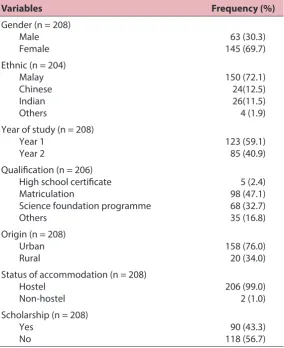
A total of 208 of the USM medical students of the early phase participated in the study. There were females (69.7%) and males (30.3%), Malays (72.1%), Year 1 (59.1%) and majority of them were from the matriculation stream prior to entry (47.1%). In terms of origin, 76% came from urban area, 99% stay at university hostel and 56.7% were not scholarship holders (Table 1).
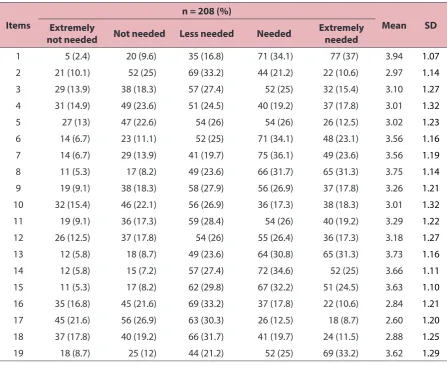
Table 2 showed that the mean score for 44 items range from 2.60 to 4.60 with no floor or ceiling effect. EFA revealed that the initial solution showed Kaiser-Meyer-Olkin value of 0.919 and Bartlett’s Test of Sphericity was significant [χ2 (9275.424)
= 990, P < 0.001] suggestive of sample adequacy for factor analysis. Eigenvalues and scree plot showed that these items determine the construct validity of the
items, the exploratory factor analysis (EFA) was conducted. Kaiser-Meyer-Olkin and Bartlett’s Test of Sphericity were measured to examine the partial relationship amongst items as a suggestive of sample adequacy. Dimensionality of USM-MT-i was assessed by evaluating number of domains by Eigenvalues and scree plot. Based on the number of domains, item selection for each domain was made based on communalities, correlation and factor loading values. Item with factor loading of <0.5 and communalities of <0.3 were rejected. Cronbach’s alpha internal consistency reliability analysis was utilised to measure the reliability of each domain of USM-MT-i. All data entry and statistical analysis process were conducted using IBM SPSS Version 24.0.
Table 1: Profile of participants (n = 208)
Variables Frequency (%)
Gender (n = 208) Male
Female 145 (69.7)63 (30.3)
Ethnic (n = 204) Malay Chinese Indian Others
150 (72.1) 24(12.5) 26(11.5) 4 (1.9) Year of study (n = 208)
Year 1
Year 2 123 (59.1)85 (40.9)
Qualification (n = 206) High school certificate Matriculation
Science foundation programme Others
5 (2.4) 98 (47.1) 68 (32.7) 35 (16.8) Origin (n = 208)
Urban
Rural 158 (76.0)20 (34.0)
Status of accommodation (n = 208) Hostel
Non-hostel 206 (99.0)2 (1.0)
Scholarship (n = 208) Yes
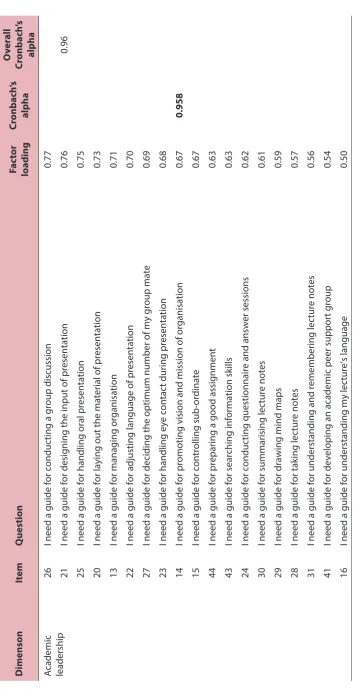
for communication skills and 0.65 to 0.87 for examination competence. Cronbach’s alpha internal consistency reliability of the final USM-MT-i was 0.95 for academic leadership, 0.93 for communication skills and 0.92 for examination competence. The overall Cronbach’s alpha for the final version of USM-MT-i was 0.96. Table 3 depicted the construct validity and reliability of the final version of USM-MT-i
DISCUSSION
The population profile of the present study consistent with the background of the Malaysian medical students different ethnicity, origin and gender. Thus, these landscapes can be considered as consisted of more than one factor. For that
reason, we conclude that the items were not uni-dimension. Varimax Schedule Rotated Component Matrix showed that the items shaped three dimensions which predicted 58.95% of variants of dependent variables (53.41% for Factor 1 and 43.16% for Factors 2 and 3). Five items were rejected chronologically due to factor loading of <0.5 constructing 40 items remain in the final investigation with factor loading range from 0.50 to 0.87.
The 39 items can be accumulated under the construct of academic leadership (19 items), communication skills (12 items) and examination competence (8 items). Factor loading for each domain ranges from 0.50 to 0.77 for academic leadership, 0.51 to 0.80
Table 2: Item level descriptive analysis for USM early phase of medical students’ mentoring inventory
(n = 208)
Items
n = 208 (%)
Mean SD
Extremely
not needed Not needed Less needed Needed Extremely needed
1 5 (2.4) 20 (9.6) 35 (16.8) 71 (34.1) 77 (37) 3.94 1.07
2 21 (10.1) 52 (25) 69 (33.2) 44 (21.2) 22 (10.6) 2.97 1.14
3 29 (13.9) 38 (18.3) 57 (27.4) 52 (25) 32 (15.4) 3.10 1.27
4 31 (14.9) 49 (23.6) 51 (24.5) 40 (19.2) 37 (17.8) 3.01 1.32
5 27 (13) 47 (22.6) 54 (26) 54 (26) 26 (12.5) 3.02 1.23
6 14 (6.7) 23 (11.1) 52 (25) 71 (34.1) 48 (23.1) 3.56 1.16
7 14 (6.7) 29 (13.9) 41 (19.7) 75 (36.1) 49 (23.6) 3.56 1.19
8 11 (5.3) 17 (8.2) 49 (23.6) 66 (31.7) 65 (31.3) 3.75 1.14
9 19 (9.1) 38 (18.3) 58 (27.9) 56 (26.9) 37 (17.8) 3.26 1.21
10 32 (15.4) 46 (22.1) 56 (26.9) 36 (17.3) 38 (18.3) 3.01 1.32
11 19 (9.1) 36 (17.3) 59 (28.4) 54 (26) 40 (19.2) 3.29 1.22
12 26 (12.5) 37 (17.8) 54 (26) 55 (26.4) 36 (17.3) 3.18 1.27
13 12 (5.8) 18 (8.7) 49 (23.6) 64 (30.8) 65 (31.3) 3.73 1.16
14 12 (5.8) 15 (7.2) 57 (27.4) 72 (34.6) 52 (25) 3.66 1.11
15 11 (5.3) 17 (8.2) 62 (29.8) 67 (32.2) 51 (24.5) 3.63 1.10
16 35 (16.8) 45 (21.6) 69 (33.2) 37 (17.8) 22 (10.6) 2.84 1.21
17 45 (21.6) 56 (26.9) 63 (30.3) 26 (12.5) 18 (8.7) 2.60 1.20
18 37 (17.8) 40 (19.2) 66 (31.7) 41 (19.7) 24 (11.5) 2.88 1.25
19 18 (8.7) 25 (12) 44 (21.2) 52 (25) 69 (33.2) 3.62 1.29
and examination competence with all the items loading factor more than 0.5 are aligned with the nature of mentoring service for such group (17). Therefore, all the constructs established were independent of each other which is aligned with the theories of higher education students’ challenges. Apart from that, these items are able to measure the real issues faced by such group of students. Consequently, this inventory can be considered as a valid instrument to be applied to evaluate the mentoring service among the early phase of Malaysian medical students.
representative of the Malaysian medical students’ characteristics. Dimensionality is associated with consistency of the items. It can be considered as the number of mutual features required to account for the association among them. In this study, EFA was utilised to determine dimensionality of the inventory.
The EFA revealed that the outcome with 39 items are applicable with the medical students’ need of mentoring services (17). Interestingly, the emergence of these; academic leadership, communication skills,
Items
n = 208 (%)
Mean SD
Extremely
not needed Not needed Less needed Needed Extremely needed
20 16 (7.7) 22 (10.6) 61 (29.3) 76 (36.5) 33 (15.9) 3.42 1.11
21 14 (6.7) 24 (11.5) 53 (25.5) 86 (41.3) 31 (14.9) 3.46 1.09
22 19 (9.1) 32 (15.4) 55 (26.4) 66 (31.7) 36 (17.3) 3.33 1.20
23 25 (12) 39 (18.8) 62 (29.8) 50 (24) 32 (15.4) 3.12 1.23
24 19 (9.1) 30 (14.4) 54 (26) 73 (35.1) 32 (15.4) 3.33 1.17
25 19 (9.1) 24 (11.5) 49 (23.6) 61 (29.3) 55 (26.4) 3.52 1.25
26 19 (9.1) 31 (14.9) 57 (27.4) 65 (31.3) 36 (17.3) 3.33 1.19
27 25 (12) 30 (14.4) 74 (35.6) 56 (26.9) 23 (11.1) 3.11 1.15
28 15 (7.2) 30 (14.4) 49 (23.6) 58 (27.9) 56 (26.9) 3.53 1.23
29 16 (7.7) 31 (14.9) 47 (22.6) 56 (26.9) 58 (27.9) 3.52 1.25
30 13 (6.3) 29 (13.9) 29 (13.9) 60 (28.8) 77 (37) 3.76 1.26
31 9 (4.3) 16 (7.7) 31 (14.9) 46 (22.1) 106 (51) 4.08 1.16
32 4 (1.9) 19 (9.1) 32 (15.4) 48 (23.1) 105 (50.5) 4.11 1.09
33 8 (3.8) 12 (5.8) 36 (17.3) 57 (27.4) 95 (45.7) 4.05 1.10
34 2 (1) 5 (2.4) 25 (12) 44 (21.2) 132 (63.5) 4.44 0.87
35 6 (2.9) 9 (4.3) 20 (9.6) 61 (29.3) 111 (53.4) 4.27 1.00
36 6 (2.9) 7 (3.4) 20 (9.6) 48 (23.1) 127 (61.1) 4.36 0.99
37 3 (1.4) 4 (1.9) 11 (5.3) 56 (26.9) 134 (64.4) 4.51 0.80
38 0 (0.0) 5 (2.4) 12 (5.8) 49 (23.6) 142 (68.3) 4.58 0.71
39 0 (0.0) 4 (1.9) 10 (4.8) 51 (24.5) 143 (68.8) 4.60 0.67
40 14 (6.7) 16 (7.7) 63 (30.3) 74 (35.6) 41 (19.7) 3.54 1.10
41 15 (7.2) 22 (10.6) 64 (30.8) 73 (35.1) 34 (16.3) 3.43 1.11
42 22 (10.6) 30 (14.4) 58 (27.9) 62 (29.8) 36 (17.3) 3.29 1.22
43 20 (9.6) 24 (11.5) 61 (29.3) 54 (26) 49 (23.6) 3.42 1.24
44 17 (8.2) 21 (10.1) 53 (25.5) 67 (32.2) 50 (24) 3.54 1.20
Table 3:
C
onstruc
t v
alidit
y and in
ter
nal c
onsist
enc
y r
eliabilit
y f
or final v
ersion of USM ear
ly phase of medical studen
ts
’ men
tor
ing in
ven
tor
y (n = 208)
D
imenson
Ite
m
Q
uestion
Fac
tor
loading
Cr
onbach
’s
alpha
O
ver
all
Cr
onbach
’s
alpha
Academic leadership
26
I need a guide for conducting a group discussion
0.77
21
I need a guide for designing the input of presentation
0.76
0.96
25
I need a guide for handling oral presentation
0.75
20
I need a guide for laying out the material of presentation
0.73
13
I need a guide for managing organisation
0.71
22
I need a guide for adjusting language of presentation
0.70
27
I need a guide for deciding the optimum number of my group mate
0.69
23
I need a guide for handling eye contact during presentation
0.68
14
I need a guide for promoting vision and mission of organisation
0.67
0.958
15
I need a guide for controlling sub-ordinate
0.67
44
I need a guide for preparing a good assignment
0.63
43
I need a guide for searching information skills
0.63
24
I need a guide for conducting questionnaire and answer sessions
0.62
30
I need a guide for summarising lecture notes
0.61
29
I need a guide for drawing mind maps
0.59
28
I need a guide for taking lecture notes
0.57
31
I need a guide for understanding and remembering lecture notes
0.56
41
I need a guide for developing an academic peer support group
0.54
16
I need a guide for understanding my lecture’s language
0.50
(
Contin
ued on nex
t page
D
imenson
Ite
m
Q
uestion
Fac
tor
loading
Cr
onbach
’s
alpha
O
ver
all
Cr
onbach
’s
alpha
Communication skill
12
I need a guide for cooperating with group work
0.80
10
I need a guide for respecting group members
0.79
3
I need a guide for managing my time for self-care
0.78
9
I need a guide for being a good group follower
0.76
4
I need a guide for managing my time for my family
0.76
0.937
11
I need a guide for accepting and giving ideas in a group work
0.74
5
I need a guide for managing my time for social life
0.74
6
I need a guide for conducting a group work
0.64
7
I need a guide for leading a group work
0.62
2
I need a guide for managing my time for co-curriculum
0.58
8
I need a guide for being a good group leader
0.56
17
I need a guide for understanding my colleagues’ language
0.51
Examination competence
38
I need a specific technique in answering examination format of short essay questions (SEQ)
0.87
37
I need a specific technique in answering examination format of scenario-based questions (SBQ)
0.85
39
I need a specific technique in answering examination format of objective structured clinical examinations (OSCE)
0.84
36
I need a specific technique in answering examination format of single best answer (SBA)
0.84
0.929
34
I need a specific technique for scoring good marks
0.79
35
I need a specific technique in answering examination format of multiple true false (MTF)
0.71
33
I need a guide for understanding the topic’s learning outcomes
0.70
32
I need a guide for managing my time in examination
0.65
Table 3
(
Contin
ued
REFERENCES
1. Morzinski JA, Diehr S, Bower DJ, Simpson DE. A descriptive, cross-sectional study of formal mentoring for faculty. Fam Med. 1996;28(6):434–8.
2. Laidlaw A, McLellan J, Ozakinci G. Understanding undergraduate student perceptions of mental health, mental well-being and help-seeking behaviour. Studies in Higher Education. 2016;41(12):2156–68. https://doi.org/10.1080/03075079.2015.102 6890
3. Fuad MD, Nasir Al-Zurfi BM, Abdul Qader M, Abu Bakar MF, Elnajeh M, Abdullah MR. Prevalence and risk factors of stress, anxiety and depression among medical students of a private medical university in Malaysia. Education in Medicine Journal. 2015;7(2):52–9. https://doi.org/10.5959/ eimj.v7i2.362
4. Brenneisen MF, Souza SI, Silveira PS, Itaqui LMH, de Souza AR, Campos EP, et al. Factors associated to depression and anxiety in medical students: a multicenter study. BMC Med Educ. 2016;16(1):282. https://doi.org/10.1186/s12909-016-0791-1
5. Sohail N. Stress and academic performance among medical students. J Coll Physicians Surg Pak. 2013;23(1):67–71.
6. Sood M, Ambigga D, Mohd Daher AA, Razali S, Nawawi H, Hashim S, Tahir M. Poor correlation of stress levels and menstrual patterns among medical students. Journal of ASIAN Behavioural Studies. 2017;2(5):73–8. https://doi.org/10.21834/ jabs.v2i5.221
7. Wege N, Muth T, Li J, Angerer P. Mental health among currently enrolled medical students in Germany. Public Health. 2016;132:92–100. https://doi.org/10.1016/j. puhe.2015.12.014
Since the reliability values of the USM-MT-i was high internal consistency (overall Cronbach’s alpha of 0.967) which is considered as a good reliability value (43), it has promised a credible instrument in examining the medical students’ needs of mentoring service. Four validated dimensions found in the inventory have become extra domains for the current instruments. Emergence of communication, self-leadership and learning skills domains are significant to challenge issues faced by the early phase of medical students in helping them to proceed their medical training journey smoothly. The evidence of previous studies on the importance of helping service and better instruments to measure mentoring needs are consistent with the findings of the present study (12–13, 44). Despite the emergence of the previous results, this study has its limitation. Since the study involved a single medical school in Malaysia, the results might be inappropriate to generalise all the Malaysian medical students. Thus, it is suggested to invite other Malaysian medical schools to conduct such study. By doing this, the results will become more valid and credible.
CONCLUSION
The USM-MT-i promised a good index of validity and reliability. It is a valid and reliable instrument to assess the needs of mentoring services among the early phase of Malaysian medical students.
ACKNOWLEDGEMENTS
16. Yusoff MSB, Rahim AF, Noor AR, Yaacob NA, Hussin ZA. Evaluation of medical students’ perception towards the BigSib programme in the School of Medical Sciences, USM. Education in Medicine Journal. 2010;2(1):2–11.
17. Nor ZMM, Yusoff MSB, Rahim AF. Characteristics of mentoring programmes in the early phase of medical training at the Universiti Sains, Malaysia. Journal of Taibah University Medical Sciences. 2017;12(4):343–8. https://doi.org/10.1016/j. jtumed.2017.01.003
18. Nor ZM, Yaacob NN, Mohammad JAM. Dimensionality and reliability of USM pre-clinical medical students’ guidance and counselling needs questionnaire. Journal of Taibah University Medical Sciences. 2019;14(2):123–30. https://doi. org/10.1016/j.jtumed.2019.01.002
19. Brown S. Is counselling necessary? Making the decision to have an abortion: a qualitative interview study. The European Journal of Contraception & Reproductive Health Care. 2013;18(1):44–8. https://doi.or g/10.3109/13625187.2012.750290
20. Pickles KJ, Rhind SM, Miller R, Jackson S, Allister R, Philp J, Waterhouse L, Mellanby RJ. Potential barriers to veterinary student access to counselling and other support systems: perceptions of staff and students at a UK veterinary school. Vet Rec. 2012;170(5):124. https://doi.org/10.1136/ vr.100179
21. Castro SL, Scandura TA, Williams EA. Validity of Scandura and Ragins’ (1993) multidimensional mentoring measure: an evaluation and refinement. Management Faculty Articles and Papers 7. Florida: University of Miami; 2004. http:// scholarlyrepository.miami.edu/management_ articles/7
8. Oluremi FD. Functional guidance and counselling centre in tertiary institution. Journal of International Social Research. 2014;7(31): 696–705.
9. Lunenburg FC. School guidance and counseling services. Journal of Guidance and Counselling. 2010;1(10):1–9.
10. Ozaki CC, Dalpes P, Floyd DL, Ramdin G. The role of student affairs in advancing community college student success: an examination of selected contemporary initiatives. UK: Routledge; 2019.
11. Shadowen NL, Williamson AA, Guerra NG, Ammigan R, Drexler ML. Prevalence and correlates of depressive symptoms among international students: implications for university support offices. Journal of International Students. 2019;9(1):129–48. https://doi.org/10.32674/jis.v9i1.277
12. Stebleton MJ, Soria KM, Huesman RL. First‐generation students’ sense of belonging, mental health, and use of counselling services at public research universities. Journal of College Counseling. 2014;17(1):6–20. https://doi.org/10.1002/ j.2161-1882.2014.00044.x
13. Vescovelli F, Melani P, Ruini C, Ricci Bitti PE, Monti F. University counselling service for improving students’ mental health. Psychol Serv. 2017;14(4):470–80. https:// doi.org/10.1037/ser0000166
14. Russell M. Marketing education: a review of service quality perceptions among international students. International Journal of Contemporary Hospitality Management. 2005;17(1):65–77. https://doi. org/10.1108/09596110510577680
30. Khawaja NG, Stallman HM. Understanding the coping strategies of international students: a qualitative approach. Journal of Psychologists and Counsellors in Schools. 2011;21(2):203–24.
31. Robertson LH, Holleran K, Samuels M. Tailoring university counselling services to aboriginal and international students: Lessons from native and international student centres at a Canadian university. The Canadian Journal of Higher Education. 2015;45(1):122.
32. Ro KEI, Tyssen R, Hoffart A, Sexton H, Aasland OG, Gude T. A three-year cohort study of the relationships between coping, job stress and burnout after a counselling intervention for help-seeking physicians. BMC Public Health. 2010;10(1):213. https://doi.org/10.1186/1471-2458-10-213
33. Azad MC, Fraser K, Rumana N, Abdullah AF, Shahana N, Hanly PJ, Turin TC. Sleep disturbances among medical students: a global perspective. J Clin Sleep Med. 2015;11(1):69–74.
34. Christopher JC, Maris JA. Integrating mindfulness as self‐care into counselling and psychotherapy training. Counselling and Psychotherapy Research. 2010;10(2):114–25. https://doi.
org/10.1080/14733141003750285
35. Ghawji M, Sajid MR, Shaikh AA, Sheriff R, Cahusac P, Alkattan K. Perspectives of students and mentors on a formal mentorship program in Saudi Arabia. International Journal of Medical Education. 2017;8:25–7. https://doi.org/10.5116/ ijme.587a.06f8
36. Howse K, Harris J, Dalgarno N. Canadian national guidelines and recommendations for integrating career advising into medical school curricula. Acad Med. 2017;92(11):1543–8. https://doi. org/10.1097/acm.0000000000001720 22. Estrada M, Estrada L. Creating a faculty and
student mentoring program. In: Kayingo G, Hass VMC, editors. The health professions educator: a practical guide for new and established faculty. New York: Springer Publishing Company; 2017. p. 311. https:// doi.org/10.1891/9780826177186.0029
23. Sun VJ, Yuen M. Career guidance and counselling for university students in China. Int J Adv Couns. 2012;34(3):202–10.
24. Sun VJ, Yuen M, Hao D. Reflections on a university career center in Guangzhou, China. Asian Journal of Counselling. 2012;19(1):97–114.
25. Nor MZM, Yusoff MSB, Rahim AFA. Characteristics of mentoring programmes in the early phase of medical training at the Universiti Sains Malaysia. Journal of Taibah University Medical Sciences. 2017;12(4):343–8. https://doi.org/10.1016/j. jtumed.2017.01.003
26. Russell J, Thomson G, Rosenthal D. International student use of university health and counselling services. Higher Education. 2008;56(1):59–75. https://doi.org/10.1007/ s10734-007-9089-x
27. Pedersen PB. Counselling international students. The Counselling Psychologist. 1991;19(1):10–58. https://doi. org/10.1177/0011000091191002
28. Smith RA, Khawaja NG. A review of the acculturation experiences of international students. International Journal of Intercultural Relations. 2011;35(6):699– 713. https://doi.org/10.1016/j. ijintrel.2011.08.004
41. Adam J, Bore M, McKendree J, Munro D, Powis D. Can personal qualities of medical students predict in-course examination success and professional behaviour? An exploratory prospective cohort study. BMC Med Educ. 2012;12(1):69. https://doi. org/10.1186/1472-6920-12-69
42. Williams B, Brown T, Onsman A. Exploratory factor analysis: a five-step guide for novices. Australasian Journal of Paramedicine. 2012;8(3):1–13. https://doi. org/10.33151/ajp.8.3.93
43. Portney L, Watkins M. Statistical measures of validity. Foundations of clinical research: applications to practice. 3rd ed. Upper Saddle River (NJ): Pearson/Prentice Hall; 2009. p. 644–53.
44. Wallace P. The impact of counselling on academic outcomes: the student perspective. UK: British Association for Counselling and Psychotherapy; 2012. p. 6–11.
37. Talib JA, Salleh A, Amat S, Ghavifekr S, Ariff AM. Effect of career education module on career development of community college students. International Journal for Educational and Vocational Guidance. 2015;15(1):37–55. https://doi.org/10.1007/ s10775-014-9279-x
38. Klonek FE, Wunderlich E, Spurk D, Kauffeld S. Career counselling meets motivational interviewing: a sequential analysis of dynamic counsellor–client interactions. Journal of Vocational Behavior. 2016;94:28–38. https://doi.org/10.1016/j. jvb.2016.01.008
39. Koenig TW, Parrish SK, Terregino CA, Williams JP, Dunleavy DM, Volsch JM. Core personal competencies important to entering students’ success in medical school: what are they and how could they be assessed early in the admission process? Acad Med. 2013;88(5): 603–13. https://doi. org/10.1097/acm.0b013e31828b3389