United Kingdom
Vol. II, Issue 4, 2014
Licensed under Creative Common Page 1
http://ijecm.co.uk/
ISSN 2348 0386
PRIVATE SAVING DETERMINANTS IN BAHRAIN
El-Seoud, Mohamed Sayed Abou
Collage of Business Administration, University of Bahrain, Kingdom of Bahrain
Abstract
The study aims at determining the main factors that affect private saving in kingdom of Bahrain
during the period (1990-2013). The framework for our analysis is derived from the life-cycle
model that has been the standard theory for the explanation of changes in private savings over
time and across countries. The findings support the hypothesis that the private saving rates
have strong inertia, while government saving does not tend to crowd out private saving and the
Ricardian equivalence does not hold. Growth of per capita real income has a positive impact on
the private saving rate, while there is negative impact of current account deficit, Terms of Trade
and dummy variables on private saving rate, while average tariff rate, exchange rate and
demographic variables are statistically insignificant. The study recommends that the focus of
development policy in Bahrain should be to increase the productive base of the economy in
order to promote real income growth and reduce unemployment, also, because public and
private saving rates are complementary, government should therefore no longer embark on
spending sprees under the pretext that saving excess revenue would crowd out private saving.
Keywords: Private saving, life-cycle, Cointegration, Bahrain
This research is financially supported by the Deanship of Scientific Research at the University of Bahrain, Kingdom of Bahrain
.
INTRODUCTION
Private savings in Bahrain economy represent an integral part of national savings, and it is the
most important source of funds to finance capital investment in the real sector, because foreign
capital is mostly invested in production of natural resources like oil and gas. Currently the ratio
of private savings to GDP in Bahrain equals to 39%, which is considered one of the highest
saving/GDP ratios in emerging economies, compared with 20% and 18.6 % in year 2000, and
1990, respectively. Investment behavior witnessed reasonable records, with an average of real
gross fixed capital formulation as a ratio of real GDP to be 23% through the period (1990-2013).
However, about 73% of investment has been only funded from private savings. There is no
Licensed under Creative Common Page 2
achieved growth rate and increase its investment rate. Because of that, an understanding of the
fundamental determinants of saving in Bahrain represents critical importance in order to
formulate policies to raise the private savings rate in line with the needs of economic growth.
The purpose of this paper is to examine the determinants of the private saving rate in
kingdom of Bahrain during the period (1990-2013). The framework for our analysis is derived
from the life-cycle model that has been the standard theory for the explanation of changes in
private savings over time and across countries. The attractiveness of the life cycle model for our
analysis lies on both in its elegant formulation of the effect of growth and the interest rate on
saving, and the flexibility provided for incorporating other relevant theoretical considerations to
form an integrated analytical framework, without changing the basic structure of the model.
Although a vast empirical literature has shed light on various aspects of saving behavior,
several crucial questions remain unanswered with regard to the relevance of policies in raising
the saving rate vis-à-vis the non-policy determinants of saving. From the perspective of policies,
there is need to know the following: What is the magnitude and direction of these variables on
saving? How effective are growth-enhancing policies such as macroeconomic stability and
higher income growth in raising the saving rate? What is the effectiveness of financial
development in rising private saving? Is there a role for fiscal policy in increasing private
saving? What is the impact of interest rate on total saving? Answering these questions would
help to determine what needs to be taken into consideration in order to increase both saving
and investment in Bahrain, this is necessary if economic growth and development is to be
stimulated in Bahrain.
Kingdom of Bahrain is a very appropriate case study of the subject at hand for the
following reasons. First, the saving and investment database of Bahrain is considered relatively
good by developing country standards, and data are available on a comparable basis for a
period of time adequate for systematic econometric investigation. Secondly, Bahrain has also
undergone significant policy transitions relating to the key variables relevant for the analysis,
providing an appropriate setting for a historical analysis of the subject at hand. Finally, saving
performance has figured prominently in the policy debate in Bahrain, but there is no hard
empirical evidence to inform this policy debate.
Rest of the paper is organized as follows: Section two surveys theoretical and empirical
issues on the determinants of saving, drawing on the life-cycle model of saving and
Consumption. Section three discusses the sources of data and estimation procedure of the
study. Section four presents the empirical results. Section five concludes this paper with an
Licensed under Creative Common Page 3
LITERATURE REVIEW
Both theoretical and empirical work on savings, have consistently outlined the major potential
determinants of savings that can be grouped loosely under the headings of income and growth,
demographic structures, the interest rate, macroeconomic stability, government policy, the
extent of financial sector development, uncertainty measures, and external variables. The
life-cycle hypothesis proposed by Modigliani (1986) and extended by Jappelli and Pagano (1994)
provides a theoretical framework of most determinants of saving behavior used in recent
empirical studies. The major argument of the model is that individuals seek to smooth out consumption over time, saving in “good times” to consume in “bad times”. This precautionary
motive for savings fundamentally affects the saving behavior in the economy through a number
of channels. In this section we try to analyze the theoretical framework of these determinants,
followed by some recent empirical studies investigated these factors.
Inertia
It is an observed fact that saving rates generally contain inertia; that is, they are serially
correlated, even after controlling for other factors, therefore, the lagged private saving rate
should be included as a potential determinant of savings in a given year, which implies that
factors that affect saving rates will have larger long term impacts than short-term ones.
Income and Growth
The fundamental assumption of the life-cycle hypothesis is that an individual seeks to maximize
the present value of lifetime utility subject to the budget constraint. The theory predicts that
consumption in a particular period, and thus the decision to save, depends on expectations
about lifetime income. According to this theory, the lifetime of an individual is divided into
working period and retirement period. Individuals are assumed to be net savers during the
working period and dissevers during the retirement period. In the light of that, growth of per
capita income will result in an increase of aggregate saving rate, because it increases the
lifetime earnings and saving of younger age groups relative to older age groups. Thus countries
with higher per capita growth rates are expected to have higher saving ratios than countries with
lower growth rates. However, there is another view indicates that the size of this effect is likely
to decline as per capita income rises and may even become negative for rich countries where
investment opportunities and growth are relatively lower.
Demographic variables
Demographic variables such as: the age distribution of the population, dependency ratios, life
expectancy, labor force participation rate and urbanization rate are the variables commonly
investigated in saving analysis. Private agents will arrange their saving patterns across different
periods of their life. Changes in life expectancy would also influence the saving decisions as it
Licensed under Creative Common Page 4
percentage of elder people in a population would normally decrease the saving rate as they are
not part of the active labor force anymore and represent the part of the population that is
expected to finance their consumption out of their past savings (part of the population that are
expected to dissave). On the other hand, the higher young dependency ratio may have dual
effects on saving and consumption behavior. It may increase the consumption of families for
child care and force families to save for the future expenses of their kids such as their
education. Labor force participation rate reflects the active part of the population and therefore
is expected to increase savings. Urbanization ratio can affect the saving behavior through the
precautionary saving behavior. Increased urbanization is expected to decrease the requirement
for precautionary savings which is more relevant in rural areas since rural population is relatively
more prone to income volatility.
Fiscal Policy
The neo-classical version of the lifecycle model assumes that a decline in government saving
(more budget deficit) will tend to raise consumption and discourage saving by shifting the tax
burden from present to future generations. As a result of that, a decline in government savings
will cause a decline in national savings. There is another view indicates that an increase in
government savings would have no effect on national savings, as it would be completely offset
by a corresponding fall in private savings (The Ricardian Equivalence). According to the
Ricardian Equivalence Hypothesis, it does not matter whether government finances its
expenditure through taxes or by borrowing. The Ricardian Equivalence depends on the
assumption of perfect capital markets, and therefore saving behavior does not experience any
uncertainty. However, if this assumption does not hold, then perfect substitution between public
and private savings will not be achieved.
Interest rate
The life-cycle theory introduced that the net effect of the real interest rate on savings is
ambiguous. The net effect of the real interest rate on savings can be decomposed into two
effects. The substitution effect implies that a higher interest rate increases the current price of
consumption relative to the future price, and thus affecting savings positively. The other effect,
which is called the income effect, indicates that if the household is a net lender, an increase in
the interest rate will increase lifetime income, and so increase consumption and reduce saving.
Therefore, it is expected that the interest rate will have a positive impact on saving ratio only
when the substitution effect dominates the income effect. In developing countries where
financial markets are still not well developed, substitution effect is expected to be much greater
than income effect, and thus the real interest rate is likely to have a net positive impact on
Licensed under Creative Common Page 5
sides of the economy tend to reduce the benefits of an increase in interest rates, and thus the
positive impact on domestic savings may not be achieved.
Macroeconomic uncertainty
Uncertainty and risks about the future give rise to precautionary saving motives for risk-averse
agents. In order to safeguard against future unexpected negative income shocks, individuals
prefer saving today. Since the instability of the economy is synonymous to more frequent
income shocks, it exacerbates the saving motive. Instability in an economy may be proxied by
several variables including growth volatility, real exchange rate volatility, real interest rate
volatility and inflation. In this paper, we use the inflation rate as a proxy for the instability of the
economy and expect this variable to have a positive impact on savings.
External Variables
The external variables that might be relevant to savings are the current account deficit and
terms of trade (TOT). It is supposed that an increase in the current account deficit (foreign
saving) is associated with a partial decline in private saving, as foreign saving may tend to act
as a substitute to domestic saving. Terms of trade represents another external variable that may
have an effect on saving behavior especially for the oil exporters. Positive terms of trade may
result in an increase of savings through the positive effect on wealth and income. The traditional explanation of this relationship is illustrated in the Harberger–Laursen- Metzler hypothesis
(HLM). It assumes that deterioration in terms of trade reduces real income and thus saving. This
hypothesis assumed myopic expectations of consumers. However, recent literature argues that
a change in terms of trade has an ambiguous effect on saving depending on whether the
change in the former is seen to be permanent or temporary. A transitory improvement in terms
of trade causes only a transitory change in income, and thus should lead to higher saving rather
than higher consumption. This conclusion supports the direction of the HLM effect.
Nevertheless; permanent improvement tends to reduce saving as consumers increase their
consumption. Thus, the effect of terms of trade changes on saving depends on whether the
change was anticipated or not.
Financial Development
The degree of financial sector development and the range and availability of financial assets to
suit savers represents another important factor in promoting savings. The expansion of bank
branches and improving the accessibility to banking facilities will result in reducing the cost of
banking transactions, and thus motivate individuals' savings. On the other hand, if financial
institutions are not well organized and stable, savings will be kept in non-monetary terms such
as jewelry and real estate, and this may defeat the main purpose of saving. Therefore, the potential positive effect between the development of the consumer’s credit market and
Licensed under Creative Common Page 6
and other forms of savings in the household asset portfolio. As a result of that, the potential
impact of financial development on private savings seems to be ambiguous.
The empirical studies that examined these determinants in developed or developing
countries took several ways. Some studies have concentrated mainly on fixed-effect models
using OLS estimates to explain the variations in saving performance among countries. Other
studies depended on some robust techniques such as cointegration and integration tests, which
allow for heterogeneity in parameters and dynamics across countries, to examine the long-run
determinants of saving rates. Some of these studies concentrated mainly on interactions
between demographic and saving. Others examined a variety of macroeconomic variables such
as income, real interest rate, and changes in terms of trade, money supply, government
expenditure and openness of economy to capture the main determinants of saving levels. In
addition, other studies used a mixed of demographic and macroeconomic factors. This will be
illustrated as follows.
McKinnon (1973), Shaw (1973) and Giovannini (1985) empirically investigated the
hypothesis that savings respond positively to changes in the real interest rate in Less
Developed Countries (LDCs). They hinge their argument on the fact that the financial markets of
these countries are not well developed, where self-financing and bank loans make up the bulk
of investment funds, accumulation of financial saving is determined more by the desire to invest
than the desire to live on interest income. As a result, the greater part of private saving will be in
the form of cash and near-money assets. Thus, the substitution effect will usually be much
greater than the income effect of an interest rate change. In other word, they pointed out that
the presence of very low responses of aggregate saving to the real interest rate.
In an attempt to investigate the determinants of saving rate in Pakistan, Khan et al
(1994) used a variety of factors that included income, real interest rate, dependency ratio,
foreign capital inflows, foreign aid, changes in TOT and openness of economy. The study found
a strong and positive effect of per capita GNP on national saving. In addition, it was found that
real interest rate, change TOT and openness of the economy positively influenced national
saving. On the other way, debt to GNP ratio and dependency ratio were found to have adverse
impact on national saving. Another empirical study by Doshi(1994) examined the role of life
expectancy as a determinant of saving performance. He demonstrated that life expectancy is a
statistically significant and important factor affecting LDCs saving levels. However, the overall
results were sensitive to the level of development and regional diversity.
Among several other empirical studies, Edwards (1996) examined the process of
determination of saving rates by incorporating some policy-related, demographic, structural and
political variables that possibly determine the saving ratio. Per capita income growth seemed to
Licensed under Creative Common Page 7
that public savings were lower in countries with higher political instability, and public savings
crowded out private savings, but less than proportionately.
Dayal-Ghulati and Thimann (1997) examined empirical determinants of private savings
for a sample of economies in Southeast Asia and Latin America over the period (1975-1995).
They used panel estimations to examine relationship between private saving rates and policy
and non-policy variables. Their results indicated that fiscal policy, particularly social security
arrangements influenced private saving, macroeconomic stability and financial deepening also
appeared as important variables determining saving behavior in the two regions.
Mwega (1997) conducted a comparative analysis of average private saving rates in 15
African countries for the period (1970-1993) and he found a negative and highly significant
coefficient on fiscal balance. Concretely, a 1% increase in government budget surplus was
found to reduce the private saving rate by up to 0.9, implying full Ricardian Equivalence. The
implication is that fiscal balance and private saving are perfect substitutes.
Masson et al (1998) examined the determinants of private savings for a large sample of
industrial and developing countries using both time series and cross-section data. The results
suggested that there was a partial offset to private savings from changes in public saving for
industrial countries, whereas in developing countries demographics and GDP growth were the
most important determinants of private saving rates. In another study, Cardenas and Escobar
(1998) analyzed the determinants of saving in Colombia, the findings reinforced the importance
linkage among national savings, government expenditure and age dependency. The results
concluded that national saving partially responded to temporary changes in output, and higher
government expenditures were associated with lower national saving. The results also indicated
that an increase in age dependency has a significantly negative effect on private saving rates.
Özcan (2000) examined empirical determinants of private saving for a sample of 15
MENA countries. Factors accounted for saving can be summarized as: In MENA region private
saving rates had strong inertia and they were highly serially correlated. The effects of a change
in a given saving determinant were fully realized in longer term than the short term (less than a
year period). The most important findings of this study is that government savings to GPDI ratio
had a negative impact on the saving rate, confirming the claim that government savings would
tend to crowd out private savings. For the MENA countries, increases in government savings
would be offset by reductions in public savings. The findings further indicated that, although
higher government savings crowd out private savings, they did it in a less than one-to-one
manner and the Ricardian equivalence did not hold strictly. From a policy point of view, financial
depth and development measure of MENA region (M2 to GPDI) suggested that countries with
deeper financial systems would tend to have higher private saving rates. Private credit and real
Licensed under Creative Common Page 8
repression. The precautionary motive for saving is supported by the findings that inflation
captures the degree of macroeconomic volatility and has a positive impact on private saving in
the area. The empirical findings presented here indicate a number of variables that affect saving
in the selected MENA countries. They clearly indicated the role of policies pursued by each
country and the complexity of the relationship between saving and other variables that affect
saving.
The extreme-bounds analysis was used by Hussain and Brookins (2001) to examine the
determinants of national savings, based on both cross-sectional and panel data across a large
sample of countries. Their results supported that agricultural share in total output; public saving,
budget balance, and the current account balance were robust in explaining saving behavior.
Sarantis and Stewart (2001) adopted unit root and cointegration tests to examine the long run
determinants of aggregate private saving rates in a dynamic panel of OECD countries during
the post Second World War period. They found strong evidence for the existence of a long-run
equilibrium saving function. Although the results suggested a number of significant determinants
of saving rates, the parameter estimates varied significantly across countries.
Özcan, et al. (2003) investigated the determinants of private saving for Turkey during the
period (1968-1994) using a number of policy and non-policy variables. The findings of the
estimated model supported the hypothesis that the private saving rates have strong inertia. It
was found that the effects of a change in a given saving determinant were fully realized in the
long run rather than in the short run. The findings further indicated that although higher
government savings crowded out private savings, they did it in less than one-to-one manner,
and thus the Ricardian Equivalence did not hold strictly. In addition, income level showed a
positive effect on the private saving rate, however, the growth rate of income was not
statistically significant. Moreover, financial depth and development measure of Turkey
suggested that countries with deeper financial systems tend to have higher private saving rates.
The results also indicated that life expectancy rate tends to have a negative impact on savings.
Furthermore, the precautionary motive for saving was supported by the findings that inflation
captured the degree of macroeconomic uncertainty and had a positive impact on private saving
in Turkey. With regard to external factors, it was found that terms of trade shocks increased
private saving in Turkey. Although the current account deficit represents an important
explanatory variable for the private savings, its effect was insignificant in Turkey.
In another study by Metin_Özcan and Özcan (2005) to examine the relationship between
a variety of macroeconomic variables and private savings. They used a sample of 15 countries in the Middle East and North Africa (MENA) over the period (1981–1994). The estimated results
provided further evidence of the significantly positive effect of the growth rate of income, and per
capita income on private savings. In addition, public savings crowded out private savings only
Licensed under Creative Common Page 9
financial factors, the paper provided evidence that countries with deeper financial systems tend
to have higher private savings. Moreover, macroeconomic stability captured by the inflation rate
was found to have a positive impact on savings.
In Nigeria, Onwioduokit (1998) employed the Error Correction Methodology(ECM) to
examine the effects of financial development on savings mobilization in Nigeria. Their results
reveal that there is no long-run equilibrium relationship between financial depth and domestic
resource mobilization. Another study employed the Error-Correction Methodology by Chete
(1999) who evaluated the determinants of saving, using data from (1973-1993). He found that
financial development and external debt had a negative significant relationship on private
saving, while terms of trade changes and level of income had a positive significant impact on
saving. On the other hand, real interest rate, inflation, public saving and dependency ratio were
all insignificant in the regression.
Also, Nwachukwu, and Egwaikhide(2007) examined the determinants of private saving
in Nigeria. They compared the estimation results of the ECM with those of three conventional
models: partial-adjustment, growth rate and static models. The conclusion is that the ECM
performs much better than the other models. Its results reveal that the saving rate rises with the
level of disposable income but falls with the rate of growth of disposable income. The real
interest rate on bank deposits has a significant negative impact while public saving seems not to
crowd out private saving. Furthermore, external terms of trade, inflation rate and external debt
service ratio have a positive impact on private saving. While Nwachukwu and Odigie (2009),
discussed the trend of Nigerian saving behavior and reviews policy options to increase domestic
saving. They also examined the determinants of private saving in Nigeria during the period covering (1970–2007).The framework for analysis involved the estimation of a saving rate
function derived from the life cycle hypothesis while taking into consideration the structural
characteristics of a developing economy. The study employed ECM procedure which minimized
the possibility of estimating spurious relations, while at the same time retaining long run
information. The results of the analysis showed that the saving rate rose with both the growth
rate of disposable income and the real interest rate on bank deposits. Public saving seemed not
to crowd out private saving; suggesting that government policies aimed at improving the fiscal
balance has the potential of bringing about a substantial increase in the national saving rate.
Finally, the degree of financial depth had a negative but insignificant impact on saving behavior
in Nigerian.
In Jordan, Hallaq (2003) analyzed and examined the determinants of private savings
during the period (1976-2000) using the OLS and the instrumental variable methods. The main
results indicated that the dependency ratio had a negative and significant effect on private
Licensed under Creative Common Page 10
GDP per capita income had a significant positive effect on private savings. Moreover, the development of Jordan consumer’s credit market, the ratio of social security, and welfare public
expenditures to total public expenditures appeared to have positive effects on private savings.
Finally, the real interest rate, inflation rate, and terms of trade were found to have insignificant
impact on the level of private saving in Jordan.
In India, Athukorala and Sen (2004) examined the determinants of private saving during
the period (1954-1998). The methodology used in this study involved the estimation of a saving
rate function derived from the life-cycle model. The results of the estimated model provided an
evidence of a statistically positive effect of the real interest rate, the growth and the level of per
capita income, the spread of banking facilities, and the rate of inflation on domestic saving. On
the other hand, terms of trade and inward remittances by expatriate Indians witnessed a
negative impact on the saving rate. Fiscal policy reported that public saving seemed to be an
imperfect substitute for private saving. The result relating to the inflation rate suggested that
mild inflation seemed to have a positive impact on private saving.
In Oman, Narayan and AL Siyabi, S. (2005) examined the long run and short run effects
of Oman's national savings for the period (1977-2003) using the bounds testing approach to
cointegration. The main findings provided strong evidence that the current account, the
urbanization rate and the money supply had statistically significant impacts on Oman's national
savings in the long run.
George Hondroyiannis (2006) investigated the determinants of aggregate private saving
in European countries employing panel data. The long run saving function is estimated based
on an extended lifecycle hypothesis taking into account the economic and demographic
developments during this period. Along-run saving function sensitive to dependency ratio, old
dependency ratio, liquidity, public finances, real disposable income growth, real interest rate and
inflation is found to exist. The empirical evidence suggests the existence of a long-run saving
function in Europe. The policy implications of such a relationship are presented.
The study of Caroline Van (2009) looked into the evolution and determinants of the saving rate in Turkey, with particular focus on private saving. The data shows that Turkey’s
private saving rate is low compared to other emerging market countries, but this is a recent
Phenomenon. He adopted previous econometric studies on the determinants of the private
saving rate in Turkey and emerging markets in general, and he found out that the recent decline
in private saving could be explained by the recent rapid increase in credit along with sharp
Licensed under Creative Common Page 11
In Ghana, Davis (2013) explored the determinants of private savings in Ghana using the Phillips
and Ouliaris (1990) residual-based tests for cointegration to determine the long run relationship
between private savings and its determinants. Financial liberalization, per capita income and
inflation were found to have a positive and significant relationship with private savings. The
positive and significant coefficient of the fiscal deficit variable confirmed the Ricardian
Equivalence hypothesis in Ghana. There is a strong willingness to save but the capacity to save
is not very robust. Financial liberalization is recommended to be deepened to give financial
institutions room for improved financial packages for increased savings. Growth should be pursued vigorously to improve incomes and hence people’s capacity to save. He concluded
that in spite of the results for fiscal deficits, government must keep its spending within
sustainable limits and invest appropriately.
In Pakistan, Khalil and Haider (2013) explained the determinants of savings in the
process of economic growth by using Autoregressive Distributed Lag Model (ARDL) bound
testing approach for cointegration techniques to check the robustness for long run relationship
and ECM for short run dynamics during the period (1974-2010). They found that the per capita
income inversely related with national saving rate, both in long run and as well in short run
significantly. The exchange rate and inflation rate had a negative impact on national saving but
lagged exchange rate had significantly impact. Because of floating exchange rates and the
decrease in capital controls, the volume of international capital flows in a country had increased
significantly. Trade openness was positive associated with national savings in Pakistan because
trade openness caused to increase the income and welfare of the society via the market
economy. Money supply was positively linked with national saving. The growth of the income
level had negatively related with national savings. Keynesian and permanent income hypothesis
of income and savings was not valid for Pakistan because per capita income and income growth
inverse function of savings at national level.
We can conclude from the previous literature that the determinants of saving performance
are diverse. Most empirical studies emphasized the significant and negative influence of
government savings on the saving rates, confirming the claim that government savings tend to
crowd out private savings. Moreover, direct positive association between GDP growth rate, GDP
per capita growth rate and private savings, indicates that these variables represent the most
important determinants of private and public savings. Interest rate, inflation rate and TOT
appear to have an ambiguous impact on saving levels. Moreover, demographic factors such as
dependency ratio and urbanization rate seem to have a negative effect on private saving rates;
Licensed under Creative Common Page 12
RESEARCH METHODOLOGY
The discussion of literature review suggests a number of factors, which might be important in
determining private saving behavior in Bahrain. The current study utilizes annual data covering
the period (1990-2013). Data is based largely on Central Bank of Bahrain (CBB), National
accounts statistics (various issues), and Economic statistical bulletin (various issues). Some of
the missing observations were updated with comparable data from the World Bank International
Financial Statistics database the International Financial. All the data used are in terms of a
constant local currency unit (2005=100). First, we outline the dependent variables used in our
model, and then we outline the methodology adopted.
So, the model can be represented as follows:
PSt=f (PSt-1,PCRIt,GSt,,RIt,M2t,PLt,CAt,ATRt, EXt, TOTt, DPRt, ODRt,, Dumy) (1)
t=1,2,……..,n
Where:
PSt : Private saving rate (calculated residually by subtracting the gross public
sector savings rate from the gross national savings rate)
PSt-1 : Lagged of private saving rate (Inertia)
PCRIt : Per capita real income growth
GSt : Public saving rate (the surplus or deficit as a percentage of GDP)
RIt : Real interest rate (nominal interest rate - inflation rate)
M2t : Ratio of broad money supply to GDP (as a proxy of financial depth)
PLt : Inflation rate (the annual change in the natural logarithm of the GDP deflator).
CAt : Current account deficit ratio to GDP
ATRt : Average tariff rate as a proxy of trade openness
EXt : Exchange rate
TOTt : Terms of trade ( ratio of export price index to import price index)
DPRt : Dependency ratio
ODRt : Old age dependency ratio
Dumy : Financial Crisis dummy, used to effects of international financial crisis years
on the Bahrain private saving rate. It takes (1) in the years of crisis and (0)
otherwise.
Most macroeconomic time series exhibit substantial co-movement, and thus estimating the
previous model using OLS frequently suffers from the problem of nonstationary regressors and
spurious regressions, which do not reflect the long run relationship but common time trends
(Engle and Granger, 1987). Therefore, in order to investigate the long run effects of the model,
we should first test whether the proposed variables in the equation (1) are stationary or not. This
Licensed under Creative Common Page 13
test is being conducted to indicate that variables under study have unit roots in the level data
based on the following equations:
ΔX=β X t-1 + ∑ µi ΔX t-1+i + ε t (2)
ΔX= α0 + β X t-1 + ∑ µi Δ X t-1-i + εt (3)
ΔX= α0 + β X t-1 + ðt + ∑ µi ΔX t-1-i + εt (4)
Where X is log of the variables series, p is the maximum lag, and ε is the stationary random
error.
The first equation is a test of pure random walk since there is no time trend and intercept. The hypothesis test is to test if β = 0 or not. Equation (4) is being tested in the
begging. In case of rejecting the null, one should go back to test equation (3) and (2), which are
more restricted. In the presence of unit roots, the variables needed to be differenced one year or
more in order for the series to be stationary. The choice of optimum P lag was determined on
the basis of minimizing the Schwarz information criterion to ensure serially uncorrelated
residuals.
The next step is to test for the presence of cointegration among the explanatory
variables by using the Johansen cointegration test (1988) for the study variables that are I(1) in Bahrain. To estimate the cointegration rank and vector, the following ƛ trace and ƛmax statistics
test are being used where:
ƛ trace (r) = -T ∑ Ln (1- ƛi) (5)
ƛmax (r, r+1) = -T Ln(1-ƛ r+1) (6)
for ƛtrace statistics, the null hypothesis is that the number of cointegrating vectors is less than or equal to r, against r =1,2,3,4…, while in case of ƛmas statistics, the null hypothesis is that the
number of cointegrating vectors is less than or equal to r, against r = r + 1.
Having identified the cointegration vector using Johansen, we proceed to investigate the
dynamics of the private saving process by employing ECM. If the results show that the
coefficient of the error-term for the estimated saving equation is both statistically significant and
negative.
Thus, it will rightly act to correct any deviations from long run equilibrium. Specifically, if
actual equilibrium value is too high, the error correction term will reduce it while if it is too low,
the error correction term will raise it.
i-2
P
P
i-2
i-2
P
n
Licensed under Creative Common Page 14
EMPIRICAL RESULTS
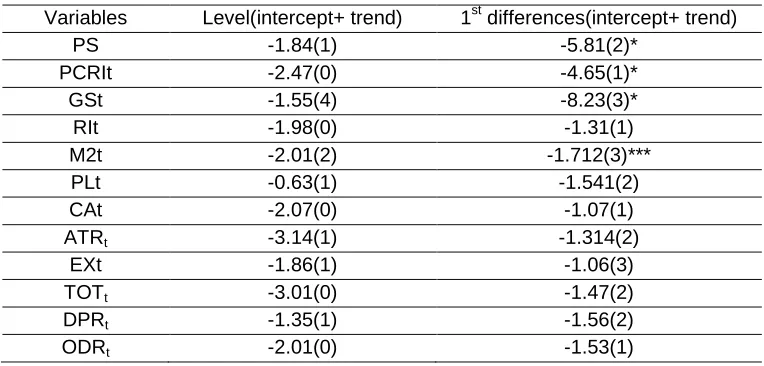
The Augmented Dickey Fuller (ADF) tests are applied to study the unit roots in the variables.
For a given variable and null order, two values are reported in each cell. The first value is the
ADF statistics and the second value in the parenthesis is the longest significant lag with significant t value. Four lags are allowed in each variable’s ADF regression. All regressions
include constant term and time trend. If variables are in their log levels, the sample is 1990-2013
(t=24). If the variables are in their first differences the sample is 1990-2013 (t=23). The results of
these tests are presented in table (1). The results show PSt , PCRIt, GSt and M2t are
integrated of order one I(1). The other variables are stationary at level.
Table (1) ADF test for unit root
Variables Level(intercept+ trend) 1st differences(intercept+ trend)
PS -1.84(1) -5.81(2)*
PCRIt -2.47(0) -4.65(1)*
GSt -1.55(4) -8.23(3)*
RIt -1.98(0) -1.31(1)
M2t -2.01(2) -1.712(3)***
PLt -0.63(1) -1.541(2)
CAt -2.07(0) -1.07(1)
ATRt -3.14(1) -1.314(2)
EXt -1.86(1) -1.06(3)
TOTt -3.01(0) -1.47(2)
DPRt -1.35(1) -1.56(2)
ODRt -2.01(0) -1.53(1)
* ADF critical values at level are: -4.071 at 1%, -3.464 at 5% and -3.158 at 10%. While ADF critical values at first differences are: -2.727 at 1%, -1.964 at 5% and -1.627 at 10%
** The numbers in parentheses are the lag length, which are augmented up to a maximum of 4 lags , The optimal lag length is determined based on Schwarz Information Criterion (SIC).
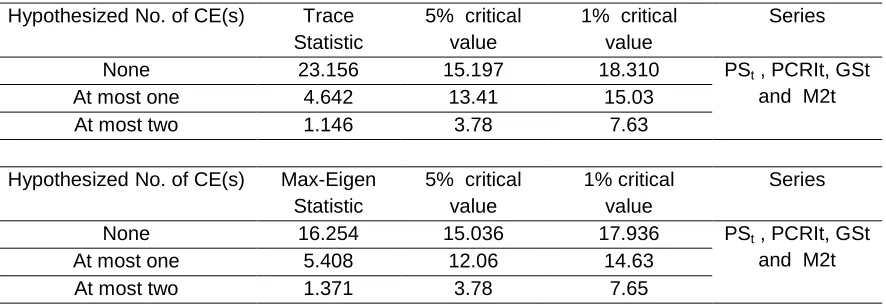
The next step is to carry out the Johansen cointegration test for the study variables that are I(1).
The Trace and Maximum-Eigen cointegration rank tests are reported in table (2) below. A
cursory glance at table (2) reveals that the null hypothesis of no cointegrating equation is
rejected by both tests. While the trace statistic value is shown to be greater than the critical
values at both 5% and 1% levels. Hence, we reject the null hypothesis of no cointegration in
favor of existence of cointegration for all the series at both 5% and 1% levels; the
maximum-Eigen statistic value indicates that one cointegration equation at 5% level of significance, while it
shows no cointegration at 1% level.
The implication is that even though the series: PSt , PCRIt, GSt and M2t are not
individually stationary, a linear combination of the four series was found to be stationary. The
Licensed under Creative Common Page 15
a stable long-run relationship between them and so we can avoid both the spurious and
inconsistent regression problems which otherwise would occur with regression of non-stationary
data series. The existence of cointegrating relationships among the four I(1) variables implies
that the determinants of private saving in Bahrain is most efficiently represented by an error
correction specification.
Table (2) Johansen Panel cointegration (Trace and Maximum Eigen Value Test)
Series 1% critical
value 5% critical
value Trace
Statistic HypothesizedNo. of CE(s)
PSt , PCRIt, GSt and M2t 18.310 15.197 23.156 None 15.03 13.41 4.642 At most one
7.63 3.78
1.146 At most two
Series 1% critical
value 5% critical
value Max-Eigen
Statistic HypothesizedNo. of CE(s)
PSt , PCRIt, GSt and M2t 17.936 15.036 16.254 None 14.63 12.06 5.408 At most one
7.65 3.78
1.371 At most two
*The critical values in the table are copied from Walter Enders, Applied Economic Time Series, Wiley Series in Probability and Statistics, 1995, page 420.
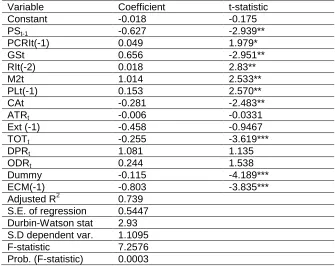
Having identified the cointegrating vector using Johansen, we proceed to investigate the
dynamics of the saving process. Table (3) reports the final parsimonious estimated equation.
The results show that the coefficient of the error-term for the estimated saving equation is both
statistically significant and negative. Thus, it will rightly act to correct any deviations from
long-run equilibrium. The Adjusted R2 is almost 73%, which implies that changes in the explanatory variables explain well over 73% of the variations in private saving rate in Bahrain during the
period (1990-2013). There is no serial autocorrelation given that the Durbin Watson Statistic is
within the acceptable bound. In addition, the probability of the F-statistic suggests that the
model has a very good fit. The results support the previous one that the variables constitute a
Licensed under Creative Common Page 16
Table (3) Estimated Regression Results for the Private Saving Model
Variable Coefficient t-statistic
Constant -0.018 -0.175
PSt-1 -0.627 -2.939**
PCRIt(-1) 0.049 1.979*
GSt 0.656 -2.951**
RIt(-2) 0.018 2.83**
M2t 1.014 2.533**
PLt(-1) 0.153 2.570**
CAt -0.281 -2.483**
ATRt -0.006 -0.0331
Ext (-1) -0.458 -0.9467
TOTt -0.255 -3.619***
DPRt 1.081 1.135
ODRt 0.244 1.538
Dummy -0.115 -4.189***
ECM(-1) -0.803 -3.835***
Adjusted R2 0.739
S.E. of regression 0.5447 Durbin-Watson stat 2.93 S.D dependent var. 1.1095
F-statistic 7.2576
Prob. (F-statistic) 0.0003
*,**,*** indicate statistical significant at 1%,5% 1nd 10% level, respectively
The estimated parameters of the explanatory variables show the following:
- The presence of inertia in private saving rates (PSt-1) in Bahrain is clearly evident from
the empirical results as the coefficient of the lagged private saving rate is negative and highly significant effect on today’s savings rates. The coefficient is about -0.63 indicating
that savings rates clarify a certain degree of persistence.
- The Keynesian absolute income hypothesis is found to hold for saving behavior in
Bahrain. The coefficient for per capita real income growth (PCRIt) is positive and
statistically significant at the 10% level. Thus the Bahrain experience provides support
for the argument that, for countries in the initial stages of development, the level of
income is an important determinant of the capacity to save. In this respect, our results
are consistent with the cross country results of Modigliani (1993), Hussein and Thirlwall
(1999), Loayza et al (2000) and the results for India of Athukorala and Sen (2004). This
implies that the high unemployment rate which results in low disposable income is a
strong impediment in raising the saving rate in Bahrain.
- The result for public saving rate (GSt) points to the fact that the Ricardian Equivalence
Principle does not hold in the case of Bahrain. The coefficient for public saving rate is
both positive and significant effect, thus rejecting any substitutability between public and
private saving in the Bahrain context. Thus, public and private saving rates are
Licensed under Creative Common Page 17
which affirms the importance of budget deficits as a powerful instrument for bringing
about output growth. Our findings are also in line with those obtained by Chete (1999).
- The result for the real interest rate variable (RIt) suggests that the real rate of return on
bank deposits has a statistically significant positive effect on saving behavior in Bahrain.
A 1% increase in RIt is associated with a 0.018 percentage point increase in the private
saving rate. This finding is consistent with the McKinnon–Shaw proposition that, in an
economy where the saving behavior is highly intensive in money and near-money
assets, the direct incentive effect of high real interest rates on saving behavior (income
effect) generally overwhelms the substitution of other assets for financial assets in
response in face of such interest rate changes (substitution effect).
- The financial depth as captured by (M2t) is positive and statistically significant. This
finding confirms our prediction that an increase in "financial depth", proxy by the
increase in the M2/GDP ratio, is likely to be very important in a country like Bahrain,
which is undergoing a financial liberalization process.
- The inflation rate (PLt) has a strong positive effect on the private saving rate. This result
is consistent with the precautionary motive, suggesting that increased macroeconomic
uncertainty induces people to save a larger proportion of their incomes. This is
particularly true for households in developing countries such as Bahrain whose income
prospects are more uncertain than their counterparts in developed countries. While one
might be tempted to conclude that inflation stabilization could have an adverse effect on
saving, it is important to keep in mind that stabilization also affects saving through other
channels that are likely to more than compensate for any negative direct effect of
inflation. In this regard, our result shows that lower inflation raises growth which in turn
increases private saving.
- Current account deficit (CAt) recorded a negative and statistically significant effect on
both the short run and the long run. The results indicate that 1% decrease in current
account deficit leads to 0.28 % point increase in the private saving ratio. An increase in
external saving or the current account deficit is met by a partial decline in private saving,
as external saving may tend to act as a substitute to private saving. This reinforces that
an increase in current account deficit, which is financed by foreign governments rather
than private investors, may have a negative impact on private savings. This heavy
reliance on foreign creditors may raise political economy concerns.
- Despite of average tariff rate (ATRt) is associated with private savings in Bahrain
because trade openness cause to increase the income of the market player, there is
Licensed under Creative Common Page 18
This means that the tariff imposition is not affecting the private saving in Bahrain during
study period.
- The exchange rate (Ext) is statistically insignificant, this because Bahraini dinar is linked
to the U.S. dollar at an exchange rate steady since 1980. The use of large foreign
currency as a pillar of monetary policy arrangement is customary with small open
economies and has proven successful when it is supported by a flexible fiscal policy;
therefore
- The results for TOT point to a strong negative relationship between the terms of trade
change and the private saving rate suggesting that private agents increase saving when
faced with lower future real incomes as a result of terms of trade deterioration. Private
agents in Bahrain seem to consider terms of trade deterioration as a permanent
(negative) shock and their attempts to smooth consumption in face of such perceived
shocks lead to an increase in domestic saving. 1% deterioration in the terms of trade
brings about 0.25 percentage point increase in the private saving rate. At first blush, this
significant (negative) relationship between TOT and the saving rate is surprising for a
country like Bahrain whose dependence on foreign trade (as conventionally measured
by the trade-GDP ratio) is rather low. There are however, strong reasons to believe that
the actual trade dependence of the Bahrain economy (and hence the possible impact of
TOT changes on the economy) would have been much greater than what is suggested
by this conventional measure. As an outcome of the strong commitment to an
import-substitution strategy, throughout most of the period under study Bahrain's imports
remained concentrated in critical developmental inputs, in particular, petroleum,
Aluminum and various inputs to domestic industry for which there were virtually no
domestic substitutes. Given this delicate form of import dependence, the performance of
the economy was extremely vulnerable to import compression at times of TOT shocks.
- Another striking result that emerges from our analysis is that two of the demographic
variables (DPRt and ODRt) are insignificant. This may be due to the fact that, in a
developing country like Bahrain, where the family structure is still quite traditional,
especially, the age dependency ratios are likely to exhibit a picture divergent from the
predictions of pure theory. The most vivid example, probably, is the devotion of a great part of the household’s resources to child rearing, until the children start to earn their
own income, no matter when. This increases the burden of the adults, lessening their chance to save This observation, coupled with the fact that it is seen as the children’s
responsibility to care for the old, brings forth the possibility that the old can be expected
Licensed under Creative Common Page 19
- One of the most results insights that emerge from these estimations is that the
coefficient for the crisis dummy is negative and statistically significant, This means the
world financial crisis -like that happened on 2008- had a negative impact on the private
saving behavior in Bahrain, where private saving growth rate decreased by more than
30% in year 2009 compared with previous year, while it started to increase by 0.06% in
year.
CONCLUSION
The econometric estimates of private saving function for Kingdom of Bahrain covering the
period (1990-2013) are presented and examined in this study. The choice of this period for
analytical purposes was necessitated by the availability of consistent time series data on
numerous macroeconomic variables required for estimating the econometric model of saving
behavior. The findings reveal that private saving is determined by the following factors. First, the
growth of per capita income is found to have positive influence on private savings, especially on
the long run. Second, public saving rate appears to have positive and significant effect on
private saving ratio. This means that public and private saving rates are complementary and
mutually reinforcing. Third, the development of financial market as proxied by the increase in the
M2/GDP ratio shows a positive and significant effect on private savings. Fourth, the real interest
rate, and inflation rate prove to have positive and significant impact on the level of private
savings in Bahrain. Finally, current account deficit recorded and TOT have negative and
statistically significant effect on both the short run and the long run, which imply that external
saving may tend to act as a substitute to private saving.
Accordingly, the study recommends some polices that can be drawn from the analysis as
follows:
- The focus of development policy in Bahrain should be to increase the productive base of
the economy in order to promote real income growth and reduce unemployment. For this
to be achieved, a diversification of resources base is indispensable. This policy thrust
should include the adoption of a comprehensive energy policy, with stable electricity as a
critical factor; the establishment of a viable iron and steel industry; the promotion of
small and medium scale enterprises and a serious effort at improving information
technology.
- Because public and private saving rates are complementary. Government should
therefore no longer embark on spending sprees under the pretext that saving excess
revenue would crowd out private saving. A stop must be put to the sharing of excess oil
revenue among the various tiers of government since this usually has an inflationary
Licensed under Creative Common Page 20
Lastly, it is pertinent to note that though this paper has concentrated on Bahrain, we are of the
opinion that its results can be applied to other Gulf countries not previously studied. They
contain some valuable lessons for informing policy measures in the current thrust towards
greater mobilization of private saving in the Gulf countries.
REFERENCES
Athukorala P., Sen K., (2004) , The Determinants of Private Saving in India, World Development, 32( 3), 491–503.
Caroline Van Rijckeghem, (2009), The Evolution and Determinants of the Turkish Private Saving Rate: What Lessons for Policy?, Economic Research Forum, Research Report Series, 9(1).
Central Bank of Bahrain, Statistical Bulletin: Various Issues.
Chete, Louis. (1999), Macroeconomic Determinants of Private Savings in Nigeria,. Nigerian Institute of Social and Economic Research (NISER), Monograph Series,7.
Dayal-Ghulati and Thimann,(1997), Saving in Southeast Asia and Latin American compared: A search for policy lesion. IMF working paper, 97-110.
Davis Adu Larbi (2013), The Long Run Determinants of Private Domestic Savings in Ghana: A Cointegration Approach, Journal of Economics and Sustainable Developmen, 4(4), 125-136.
Dickey, D.A. and W.A. Fuller, (1981), Likelihood Ratio Statistics for Autoregressive Time Series with a Unit Root”, Econometrica, 49.
Edwards, S. (1996). Why are Latin America’s Savings Rates so Low? an International Comparative Analysis. Journal of Development Economics, 51, 5–44.
Engle, R.F. and C.W.J. Granger,(1987), Cointegration and Error Correction: Representation, Estimation and Testing”, Econometrica,55.
George Hondroyiannis ,(2006), Private saving determinants in European countries: A panel cointegration approach, The Social Science Journal , 43,553–569.
Giovannini, A. (1985), Savings and the Real Interest Rate in LDCs.", Journal of Economic Development, 18: 197-217.
Hallaq, S. (2003), Determinants of Private Savings: The Case of Jordan (1976-2000), Journal of King Saud University, Administrative Sciences, 15(2): 83-94.
Hussein, K. and A. P. Thirlwall (1999), Explaining Differences in the Domestic Savings Ratio Across Countries: A Panel Data Study, Journal of Development Studies, 36: 31-52.
Hussain, M. and O. Brookins (2001), On the Determinant of National Savings: An Extreme Bounds Analysis, Review of World Economics, 137(1): 150-174.
International Financial Statistics database , The World Bank, available at:
http://elibrary-data.imf.org/DataReport.aspx?c=1449311&d=33061&e=169393
Jappelli, T.,&Pagano, M. (1994).Saving, Growth and Liquidity Constraints. Quarterly Journal of Economics,(1), 83–109.
Johansen, S. (1988). Statistical and Hypothesis Testing of Cointegration Vectors. Journal of Economic Dynamics and Control, 12, 231–254.
Khalil A., and Haider M., (2013), Macroeconomic Determinants of National Savings Revisited: A Small Open Economy of Pakistan, World Applied Sciences Journal 21(1),49-57
Khan, A. H., L. Hasan, and A. Malik (1994), Determinants of National Savings Rate in Pakistan, Economia Internazionale, 47(4): 365-82.
Licensed under Creative Common Page 21 Masson, R., T. Bayoumi, and H. Samiei (1998), International Evidence on the Determinants of Private Savings., The World Bank Economic Review, 12(3): 483-501.
McKinnon, R. I. (1973). Money and capital in economic development. Washington, DC: The Brooking Institute.
Metin Özcan , K., and Özcan, Y. Z. (2005), Determinants of Private Savings in the Middle East and North Africa. in: Money and Finance in the Middle East: Missed Opportunities or Future Prospects?, Naime, S. and N. A. Colton eds., Research in Middle east Economics, Amsterdam and Oxford: Elsevier,6, 95-117.
Modigliani, F. (1966). The Life Cycle Hypothesis of Saving: the Demand for Wealth and the Supply of Capital. Social Research, 33, 160–217.
Mwega, Francis. (1997), Saving in Sub-Saharan Africa: A Comparative Analysis, Journal of African Economies. 6(3) (Supplement) 199-228.
Narayan Paresh Kumar and Saud A.L. Siyabi, ( 2005), An empirical investigation of the determinants of Oman's national savings, Economics Bulletin. 3(51): 1-7.
Nwachukwu E., and Egwaikhide O., (2007), An Error-Correction Model of the Determinants of Private Saving in Nigeria, African Economic Society (AES) Conference, Cape Town, South Africa, July.
Özcan, K. (2000), Determinants of Private Savings in the Arab Countries, Iran and Turkey, World Bank MDF3 Conference, Cairo, The World Bank.
---., A. Gunay, and S. Ertac (2003), Determinants of Private Savings Behavior in Turkey, Applied Economics, 25(12): 1405-1416.
Sarantis, N. and C. Stewart (2001), Savings Behavior in OECD Countries: Evidence form Panel Cointegration Tests.", The Manchester School, 69: 22-41.
Shaw, E. (1973). Financial Deepening in Economic Development. Oxford: Oxford University Press.