A Literature Survey on Mood Detection System
Rajneesh SinglaAssistant professor,
UIET, Panjab University, Chandigarh
Abstract :The objective of this research work is that psychological state giving information about some disorders helpful with diagnosis of depression, mania or schizophrenia. The elimination of errors due to reflections in the image has not been implemented but the algorithms used in this project are computationally efficient to resolve errors. Endeavours are also put in this project to enhance the recognition rate of mood detection by adopting unique methodology. In this research work we have accepted five different moods to be recognized are: Happy, Sad, Neutral, Surprise and Fear. Thereafter we represent the most recent Mood detection techniques listing their advantages and disadvantages. Some techniques specified here also improve the efficiency of Mood detection under various illumination and expression condition of face images.
Keywords - Mood detection, PCA, LDA, ICA, elastic bunch method, graph matching, feature matching and template matching.
I. INTRODUCTION
There are a number of difficulties in Mood detection due to the variation of facial expressionacross the human population and to the context-dependent variation even for the same individual. Even we human beings may make mistakes .On the other hand, Mood detection recognition by computer is very useful in many applications such as human behavior interpretation and human-computer inter- face. A Mood detection recognition system needs to solve the following problems: detection and location of faces in a cluttered scene, facial feature extraction, and facial expression classification
Hence the Problem statement is:
A New approach for facial mood detection using Principal component analysis (PCA), Independent Component Analysis (ICA), Linear Discriminant Analysis (LDA)
Detecting mood has several implications in forensic, bioinformatics and physiological applications. There is always a need for developing an expression based profile an above application in real time and on the real time database. So there is an urgent need to address this need based on algorithms which performs the face expression recognization task. In this research work we shall explore relevant algorithms are system for extracting moods of a person and develop a real time system which is optimized for accuracy and computational time. Thus finally the goal of this research work is to develop a new technique for the representation of facial action that more accurately captures the characteristics of facial motion, so that we can employ them in recognition of facial emotions.
The mood detection system provides a new approach for effective facial expression recognition using LDA, ICA and PCA technique. The main goal of this research work is to improve rate of mood detection successfully for principal emotions by using above mentioned techniques.
For any successful solution mood detection must be accurate in particular emotive context. Therefore our proposed solution is based upon multiple subject database having at least seven emotions. This list of emotions with the labeled image is an input to be processed for mood detection. The images are read from the memory to do processing in bulk. These images require huge computational resources, to overcome this limitation and to save computational resources we have implemented dimension reduction techniques. This helps us to create a projected image at minimal expense from which a text image can be matched using a classifier for face recognition corresponding to that mood with respect to that image.
In this above mentioned solution we always take care of the fact that computational time of algorithm should not be hampered and there should be optional time requirement for the program to compute its output.
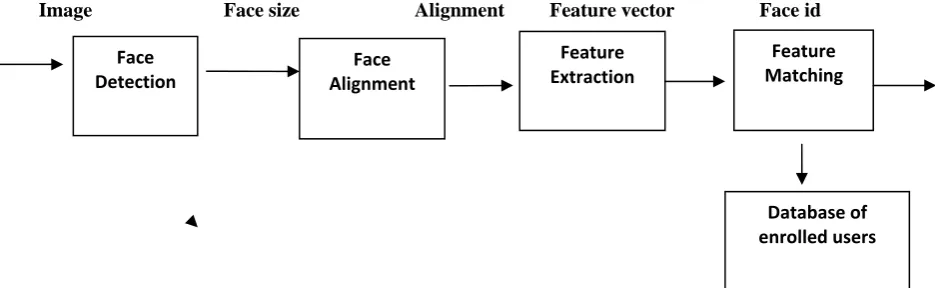
Image Face size Alignment Feature vector Face id
Figure 1. Flow chart showing Mood detection process Face
Detection
Face
Alignment
Feature
Extraction
Feature
Matching
Database of
II. BASIC OF MOOD DETECTION SYSTEM
Facial moods are one of the most powerful, natural, and immediate means for human beings to communicate their emotions and intentions. Facial moods carries crucial information about the mental, emotional and even physical states of the conversation. . It is a desirable feature of the next generation human-computer interfaces. Computers that can recognize facial expressions and respond to the emotions of humans accordingly enable better human-machine communication development of information technology Recognition of facial expression in the input image needs two functions: locating a face in the image and recognizing its expression. We believe recognition of human facial expression by computer is a key to develop such technology. In recent years, much research has been done on machine recognition of human Facial expressions. Conventional methods extract features of facial organs, such as eyes and a mouth and recognize the expressions from changes in their shapes or their geometrical relationships by different facial expressions when we watch two photos of a human face, we can answer which photo shows the facial expression more strongly. Accordingly, as extending the step of facial expression recognition, we think it is important to develop a measurement method of the strength of facial expressions. One of the key remaining
problems in face recognition is to handle the variability in appearance due to changes in pose, expression, and lighting conditions. There has been some recent work in this direction. The increasing progress of communication technology and computer science has led us to expect the importance of facial expression in future human machine interface and advanced communication, such as multimedia and low-bandwidth transmission of facial data In human interaction, the articulation and perception of facial expressions form a communication channel, that is additional to voice and that carries crucial information about the mental, emotional and even physical states of the conversation . Face localization, feature extraction, and modelling are the major issues in automatic facial expression recognition.
III. TECHNIQUES FOR MOOD DETECTION I. PRINCIPAL COMPONENT ANALYSIS (PCA)
Principal component analysis (PCA) is a mathematical procedure that uses an orthogonal transformation to convert a set of observations of possibly correlated variables into a set of values of uncorrelated variables called principal components. The number of principal components is less than or equal to the number of original variables. This transformation is defined in such a way that the first principal component has as high a variance as possible (that is, accounts for as much of the variability in the data as possible), and each succeeding component in turn has the highest variance possible under the constraint that it be orthogonal to (uncorrelated with) the preceding components. Principal components are guaranteed to be independent only if the data set is jointly normally distributed. PCA is sensitive to the relative scaling of the original variables. Depending on the field of application, it is also named the discrete Karhunen–Loeve transform
(KLT), the Hostelling transform or proper orthogonal decomposition (POD).
PCA was invented in 1901 by Karl Pearson. Now it is mostly used as a tool in exploratory data analysis and for making predictive models. PCA can be done by eigenvalue decomposition of a data covariance matrix or singular value decomposition of a data matrix, usually after mean centering the data for each attribute. The results of a PCA are usually discussed in terms of component scores (the transformed variable values corresponding to a particular case in the data) and loadings (the weight by which each standardized original variable should be multiplied to get the component score).
PCA is the simplest of the true eigenvector-based multivariate analyses. Often, its operation can be thought of as revealing the internal structure of the data in a way which best explains the variance in the data. If a multivariate dataset is visualized as a set of coordinates in a high-dimensional data space (1 axis per variable), PCA can supply the user with a lower-dimensional picture, a "shadow" of this object when viewed from its (in some sense) most informative viewpoint. This is done by using only the first few principal components so that the dimensionality of the transformed data is reduced.
PCA is closely related to factor analysis; indeed, some statistical packages (such as Stata) deliberately conflate the two techniques. True factor analysis makes different assumptions about the underlying structure and solves eigenvectors of a slightly different matrix.
II. INDEPENDENT COMPONENT ANALYSIS (ICA) ALGORITHM
statistically independent source variables. ICA provided a more powerful data representation than PCA as its goal was that of providing independent rather than uncorrelated image decomposition and representation.
III. LINEAR DISCRIMINANT ANALYSIS (LDA)
These are methods used in statistics, pattern
recognition and machine learning to find a linear combination of features which characterize or separate two or more classes of objects or events. The resulting combination may be used as a linear classifier, or, more commonly, for dimensionality reduction before later classification.
LDA is closely related to ANOVA (analysis of variance) and regression analysis, which also attempt to express one dependent variable as a linear combination of other features or measurements [1,2]. In the other two methods however, the dependent variable is a numerical quantity, while for LDA it is a categorical variable (i.e. the class label). Logistic regression and probate regression are more similar to LDA, as they also explain a categorical variable. These other methods are preferable in applications where it is not reasonable to assume that the independent variables are normally distributed, which is a fundamental assumption of the LDA method.
LDA is also closely related to principal component analysis (PCA) and factor analysis in that both look for linear combinations of variables which best explain the data[3]. LDA explicitly attempts to model the difference between the classes of data. PCA on the other hand does not take into account any difference in class, and factor analysis builds the feature combinations based on differences rather than similarities. Discriminant analysis is also different from factor analysis in that it is not an interdependence technique: a distinction between independent variables and dependent variables (also called criterion variables) must be made.
LDA works when the measurements made on independent variables for each observation are continuous quantities. When dealing with categorical independent variables, the equivalent technique is discriminant correspondence analysis.
IV. ELASTIC BUNCHGRAPH MATCHING
Face recognition using elastic bunch graph matching is based on recognizing faces by estimating a set of features using a data structure called a bunch graph. Same as for each query image, the landmarks are estimated and located using bunch graph. Then the features are extracted by taking the number of instances of Gabor filters which is called “face graph”. The matching percentage (MSEBGM) is calculated on the basis of similarity between face graphs of database and query image. In 1999, Elastic Bunch Graph Matching was suggested by LaurenzWiskott, Jean-Marc Fellous, Norbert Kruger and Christoph von der Malsburg of University of Southern California. This approach is totally different to Eigenface and Fisherface. It uses elastic bunch graph to automatically locate the fudicial points of the face such as eyes, nose, mouth, etc and recognize the face according to these face features. Elastic Bunch Graph
Matching (EBGM) uses the structure information of a face which reflects the fact that the images of the same subject tend to translate, scale, rotate, and deform in the image plane. It uses the labelled graph, edges are labeled the distance information and nods are labeled with wavelet coefficients in jets. After that this model graph can be used to generate image graph. The model graph can be rotated, scaled, translated and deformed during the matching process. The gabor wavelet transformation is used to produce the local features of the face images. Gabor wavelets are biologically motivated convolution kernels in the shape of plan waves restricted by a Gaussian envelop function, the set of convolution coefficients for kernels of different orientations and frequencies at one image pixel is called a jet. In the Elastic graph matching the basic process is to compare graphs with images and to generate new graphs. In its simplest version a single labeled graph is matched onto an image. A labeled graph has a set of jets arranged in a particular spatial order. A relative set of jets can be selected from the Gaborwavelet transform of the image. The image jets initially have the same relative spatial arrangement as the graph jets, and each image jet relatives to one graph jet. The similarity of the graph with the image then is simply the average jet similarity between image and graph jets. For increase similarity it allows some translation, rotation and distortion up to some extent. In contrast to eigenfaces the elastic bunch graph matching technique treat one vector per feature of faces. The advantage of this is that change or missing any one feature it does not mean that the person will not recognized. The stored data can be easily extended to a database for storage. When a new face images is added, no additional effort is need to modify templates, as it already stored in the database. It is possible to recognized person up to rotation of 22 degrees. Disadvantage of this algorithm is that it is very sensitive to lightening conditions and a lot of graphs have to be placed manually on the face. When the changes in lighting are large, the result will have a significant decrease in the recognition rate.
V. TEMPLATE MATCHING
complexity arises only during the extraction of template. Generally template based techniques outperform as compared to feature based methods. In Karungaruet al. (2004) uses template based genetic algorithm and exposes different results on target image by adjusting the size of the template as preprocessing. The edge detection and YIQ color templates are exploited. The results are taken around the distance measure face recognition approach and comparison is performed with existing methods.
In Anlonget al. (2005) the author works on the grid to construct reliable and proper infrastructure. This method is highly effective for larger databases that solve the problem of face recognition under reasonable computational cost. In Sao and Yegnanarayana (2007) an algorithm is proposed for person verification using template based face recognition method. Primarily, the edginess based face representation is calculated to process one dimensional images. The system is somehow associated with Neural Networks to test the images under varying pose and illumination conditions. Similarly in Wang and Yang (2008) a face detection algorithm is proposed rather than face recognition algorithm as preprocessing steps. Now the advantage is taken from template based algorithm for face detection by constructing a general frame work for hierarchical face detection. The features are extracted using PCA from 2D images. At the end, it concludes that it is good to use template algorithms for face detection because it gives highest recognition rate. Similarly in Leva daet al. (2008) Dynamic Time Warping (DTW) and Long Short Term Memory (LSTM) are investigated under the Neural Network classification in which a single feature template is large enough for feature extraction. It actually implements the gradient based learning algorithm by handling associated gradient problems. The experimental result reveals that both methods perform well for face recognition while the learning strategy gives robust recognition rate. The working of this approach is summed up by saying that further improvements are still required in order to solve the recognition problem that seems to be very common in real world. A simple version of template matching is that a test image represented as a two-dimensional array of intensity values is compared using a suitable metric, such as the Euclidean distance, with a single template representing the whole face.
There are several other more sophisticated versions of template matching on face recognition. One can use more than one face template from different viewpoints to represent an individual's face. A face from a single viewpoint can also be represented by a set of multiple distinctive smaller templates.
The face image of gray levels may also be properly processed before matching. In Bruneli and Poggio automatically selected a set of four features templates, i.e., the eyes, nose, mouth, and the whole face, for all of the available faces. They compared the performance of their geometrical matching algorithm and template matching algorithm on the same database of faces which contains 188 images of 47 individuals. The template matching was superior in recognition (100 percent recognition rate) to geometrical matching (90 percent recognition rate) and was
also simpler. Since the principal components (also known as eigenfaces or eigenfeatures) are linear combinations of the templates in the data basis, the technique cannot achieve better results than correlation, but it may be less computationally expensive .One drawback of template matching is its computational complexity. Another problem lies in the description of these templates. Since the recognition system has to be tolerant to certain discrepancies between the template and the test image, this tolerance might average out the differences that make individual faces unique. In general, template-based approaches compared to feature matching are a more logical approach. In summary, no existing technique is free from limitations. Further efforts are required to improve the performances of face recognition techniques, especially in the wide range of environments encountered in real world
VI. GEOMETRICAL FEATURE MATCHING
Geometrical feature matching techniques are based on the computation of a set of geometrical features from the picture of a face. The overall configuration can be described by a vector which representing the position and size of the main facial features like eyes and eyebrows, nose, mouth, and an outline of face. The primary works on automated face recognition by using geometrical features was done in 1973. Their system achieved 75% recognition rate on a database of 20 people using two images per person, one as the model and the other as the test image. In 1993 R. Bruneli and T. Poggio, automatically extracted a set of geometrical features from the picture of a face, such as nose width and length, mouth position and chin shape. There were 35 features extracted form a 35 dimensional vector. The recognition was then performed with a Bayes classifier. They achieved recognition rate 90% on a database of 47 people.[17] I.J. Cox el at. introduced a mixture-distance technique which achieved 95% recognition rate on a query database of 685 individuals. Each face was represented by 30 manually extracted distances.[20] Reference [21] used Gabor wavelet decomposition to detect feature points for each face image which reduced the storage requirement for the database. Typically, 35-45 feature points per face were generated. Two cost values, the topological cost, and similarity cost, were evaluated. The recognition accuracy of the right person was 86% and 94% of the correct person's faces were in the top three candidate matches. In summary, geometrical feature matching based on precisely measured distances between features may be useful for finding matches in a large database. However, it will be dependent on the accuracy of the feature location algorithms. Disadvantage of current automated face feature location algorithms do not provide a high degree of accuracy and require considerable computational time.
The main aim of this step is to reduce the noise and the input image is converted into a binary one. The second step contains labeling of facial features and then finding the origin of these labeled features. Finally, it calculates the estimated distance used for matching purpose. In Khalid et al. (2008) the author tries to reduce the search space by minimizing the facial features information.
The information is limited by extracting 60 fiducially control points (nose, mouth, eyes etc) of face with different light and expression images. The functional classification of these features is large-scale point of distance and angle measurement. This process achieve 86% recognition rate. In Huiyu and Sadka (2011) the diffusion distance over the calculation of face images is produced. These images describe the shape of Gabor filters which includes the size and extent. In Zhen et al. (2011) presented a recognition approach based on facial geometry. In this approach, first the face image is segmented into multiple facial geometrical domains such as image space and image orientation at different scale. In second step LBP is calculated. The presented approach provides good face representation by exploring facial information from different domains which gives efficient face recognition systems. Similarly in Pavan et al. (2011) presented a geometry based face recognition method which makes use of subspace based models. These models provide geometrical properties of the face space which can assist efficient recognition system for number of image applications. [19]
IV. CONCLUSION
Mood detection is a challenging problem in the field of image processing and computer vision. Because of lots of application in different fields the face recognition has received great attention. The aim of this paper is to explore the area of audio visual mood detection. A wide variety of image processing techniques was developed to meet the mood recognition system requirements. However, there are still many challenges and problems to solve in such systems, especially in the area of their performance and applicability improvement. In this project we proposed PCA, LDA, ICA and Speech Database methods for dimension reduction of different types of facial moods. The proposed algorithm is successfully implemented on Real time database. Experiments results show that algorithm can effectively recognize different emotions by indentifying different feature. You can use any of them as per your requirement and application. You can also work over to improve the efficiency of the discussed algorithms and improve the performance.
REFERENCES
[1] Jigar M. Pandya, Devang Rathod, Jigna J. Jadav,” A Survey of Face Recognition approach”, International Journal of Engineering Research and Applications (IJERA) ISSN: 2248-9622 www.ijera.com Vol. 3, Issue 1, January -February 2013, pp.632- 635 [2] Jyoti S. Bedre ,Shubhangi Sapkal, ”Comparative Study of Face
Recognition Techniques: A Review”, Emerging Trends in Computer Science and Information Technology – 2012(ETCSIT2012) Proceedings published in International Journal of Computer Applications® (IJCA) 12
[3] A. S. Tolba, A.H. El-Baz, and A.A. El-Harby, ” Face Recognition: A Literature Review”, International Journal of Signal Processing 2:2 2006
[4] Sushma Jaiswal, Dr. (Smt.) Sarita Singh Bhadauria, Dr. Rakesh Singh Jadon,” COMPARISON BETWEEN FACE RECOGNITION ALGORITHM-EIGENFACES, FISHERFACES AND ELASTIC BUNCH GRAPH MATCHING”, Volume 2, No. 7, July 2011 Journal of Global Research in Computer Science
[5] Ming-Hsuan Yang, David J. Kriegman and NarendraAhuja, “Detecting Faces in Images: A Survey,” IEEE TRANSACTIONS ON PATTERN ANALYSIS AND MACHINE INTELLIGENCE, VOL. 24, NO. 1, JANUARY 2002
[6] KIRBY, M. AND SIROVICH, L. 1990. “Application of the Karhunen-Loeve procedure for the characterization of human faces”. IEEE Trans. Patt. Anal. Mach. Intell. 12
[7] Li X. and Areibi S.,―”A Hardware/Software codesign approach for Face Recognition”, The 16th,International Conference on Microelectronics, Tunisia,2004
[8] Lin-Lin Huang, Akinobu Shimizu, Yoshihiro Hagihara, Hidefumi Kobatake ,”Face detection from cluttered images using a polynomial neural network”, Elsevier Science 2002
[9] U. KreQel, J. SchRurmann, “Pattern classification techniques based on function approximation, in: H.Bunke, P.S.P. Wang (Eds.), Handbook of Character Recognition and Document Image Analysis”, World Scienti5c, Singapore, 1997, pp. 49–78.
[10] Yue Ming, Qiuqi Ruan, Xiaoli Li, Meiru Mu, ” Efficient Kernel Discriminate Spectral Regression for 3D Face Recognition”, Proceedings Of ICSP 2010
[11] Mohammed Javed, Bhaskar Gupta, ”Performance Comparison of Various Face Detection Techniques” ,International Journal of Scientific Research Engineering & Technology (IJSRET) Volume 2 Issue1 pp 019-0027 April 2013 www.ijsret.org ISSN 2278 – 0882 IJSRET @ 2013
[12] R. A. Fisher, “The Use of Multiple Measurements in Taxonomic Problems”, 1936.
[13] Belhumeur, V., Hespanda, J., Kiregeman, D., 1997,” Eigenfaces vs. fisherfaces: recognition using class specific linear pojection”, IEEE Trans. on PAMI, V. 19, pp. 711-720
[14] Hong Duan, Ruohe Yan, Kunhui Lin, “Research on Face
Recognition Based on PCA”, 978-0-7695-3480-0/08 2008 IEEE. [15] Laurenz Wiskott, Jean-Marc Fellous, Norbert Krüger, and Christoph
von der Malsburg, ―”Face Recognition by Elastic Bunch Graph Matching”, IEEE Transactions on pattern analysis and machine intelligence, Vol. 19, pp. 775-779, No.7 July 1997
[16] K.; Subban, R.; Krishnaveni, K.; Fred, L.; Selvakumar, R.K Nallaperumal, “Human face detection in color images using skin color and template matching models for multimedia on the Web”, Wireless and Optical Communications Networks, 2006 IFIP International Conference on 11-13 April 2006, pp. 5-10
[17] R. Bruneli and T. Poggio, “Face recognition: features versus templates,” IEEE Trans. Pattern Analysis and Machine Intelligence, vol. 15, pp. 1042-1052, 1993.
[18] R.J. Baron, “Mechanism of human facial recognition,” Int'l J. Man Machine Studies, vol. 15, pp. 137-178, 1981.
[19]. R. Singla and S. Jindal., “Comparitive study of dimension reduction techniques for mood detection”, Research Cell: An International Journal of Engineering Sciences Vol.4, pp.45-61, 2011
[20] R. Singla and G. Singh., “Audio Visual mood detection system via using various dimension reduction techniques. IJISET - International Journal of Innovative Science, Engineering & Technology, Vol. 2 Issue 12, December 2015.
[21] R. Singla and G. Singh., “Facial expression recognition via using ICA and PCA technique”. IJISET - International Journal of Innovative Science, Engineering & Technology, Vol. 2 Issue 12, December 2015.
[21] S. Jindal and R Singla,. “A new approach for mood detection via using principal component analysis and fisherface algorithm” Journal of Global Research in Computer Science, Vol. 2, No. 7, pp. 88-92, 2011.
[22] Muhammad Sharif, Research Journal of Applied Sciences, Engineering and Technology 4(23): 4979-4990, 2012,ISSN: 2040- 7467