Page 8
DEVELOPMENT AND DESIGN OF A LOCALIZED LEARNING ENVIRONMENT IN ENTERPRISE SYSTEMS EDUCATION FOR SUB-SAHARAN AFRICA
Frances Weiss, Patrick Wirz, Catharina Zschieck, Klaus Turowski
Otto von Guericke University Magdeburg, Faculty of Computer Science, VLBA Lab, Universitaetsplatz 2, 39106 Magdeburg, Germany
Abstract
All over the world, an increasing number of businesses run enterprise systems (ES) to optimize their workflows, leading to a rise in demand for employees with the required software-specific skills. The Enterprise Systems Education For Africa (ESEFA) project was initiated to establish ES education in study programs at higher education institutions in sub-Saharan Africa. An ES education environment was developed featuring an Africa-specific, modular curriculum which was expected to facilitate a positive learning experience. This paper presents the underlying pedagogical premises of the ESEFA education environment as well as the derived localized curriculum and draws some preliminary conclusions regarding the success of the localization.
Key words: technology-enhanced learning, curriculum development, international project, enterprise systems
1. INTRODUCTION 1.1 Motivation
Enterprise Resource Planning (ERP) systems are a special kind of Enterprise Systems (ES). An ERP system can be seen as a highly integrated, consolidated and interconnected composition of formerly separated business software. It provides the basic information systems infrastructure to support the process and data management of an enterprise. Numerous leading companies view them as a critical prerequisite to thrive in today’s economy and run ERP software to control and optimize their workflows. They benefit from faster, more accurate transactions, improved inventory and financial management, enhanced customer service and retention, better logistics and ease of expansion, among other advantages (Hawking, Stein & Foster 2004; Scholtz, Calitz & Cillier 2013).
Due to the increase of the small to medium-sized enterprise sector in Africa, a growing number of businesses use ERP systems. This leads to a rise in demand for employees with the software-specific skills which are required to handle the high complexity as well as the installation, adaption, maintenance and usage of ERP systems. As a consequence, students must be offered an education which develops their proficiency with both business processes and ERP software – not only to take care of the current shortage of employees with these skills, but also to cover for the future increase of demand (Mahanga & Seymour 2015; Calitz, Greyling & Cullen 2014).
1.2 The ESEFA project
The main objective of the Enterprise Systems Education For Africa (ESEFA) project is to close this gap between the skills offered by higher education graduates and the competencies requested by the industry. Remedying the deficiency of trained ICT personnel with distinguished ERP competencies will help African enterprises in becoming more competitive and productive.
Page 9
The most significant feature is the development of a localized ESEFA curriculum, tailored to the demands of universities in sub-Saharan Africa. The curriculum should conform to multiple requirements: The course design should be highly integrated and consist of adjustable content matching regional market requirements and learning needs. What is more, the curriculum should be designed with a clear and coherent vision of which teaching methods and materials should be used to maximize the learning success of students. Last but not least, the curriculum should reflect the real-life conditions of the business problem at hand as well as culture of the sub-Saharan region in such a way that lecturers and students can relate to the learning material. The fulfilment of these requirements guided the content-wise, pedagogical and technical development of the ESEFA curriculum. The main objective of this paper is to illustrate how the ESEFA team dealt with this localization process.
In order to create a custom-made African curriculum the ESEFA team relied on two other attributes emerging from the focus on sustainability. First, there is a very strong emphasis on the idea of partnerships. The project was initiated as a public private partnership between ES market leader SAP SE with its University Alliances program and the DEG (German Investment and Development Corporation), a subsidiary of the government-owned development bank KfW, both co-financing the project. The project management is jointly conducted by the Magdeburg Research and Competence Cluster (MRCC) for Very Large Business Applications at the Otto von Guericke University Magdeburg (OVGU), which hosts the strategic project management, and the Department of Information Systems at the University of Cape Town (UCT), acting as the ESEFA Centre, which is in charge of the local project operation as well as the coordination and conduct of ESEFA courses. The SAP University Competence Center (UCC), also part of the MRCC, hosts and supports the SAP clients used by ESEFA partner universities. Each institution has clearly defined responsibilities which are carried out in close collaboration. One of the tasks with distributed responsibilities was the main objective of developing the ESEFA curriculum. Each partner contributed their respective strength to achieving this goal: The OVGU had previous experience in developing and implementing ES curricula, and the UCT had knowledge of the local conditions and customs in addition to their ES expertise.
The second distinctive attribute is the strong emphasis on networking and multiplying activities. From the very beginning, the ESEFA project was designed to spread its endeavors to ten countries in different sub-Saharan regions. The idea behind this was twofold: First, no specific area alone should profit from the project’s work. Second, creating a teaching and learning network with people from a diverse range of countries should increase the project’s quality and strengthen its sustainability. This is achieved through joint multi-dimensional research and regional field studies on ES teaching among other things.
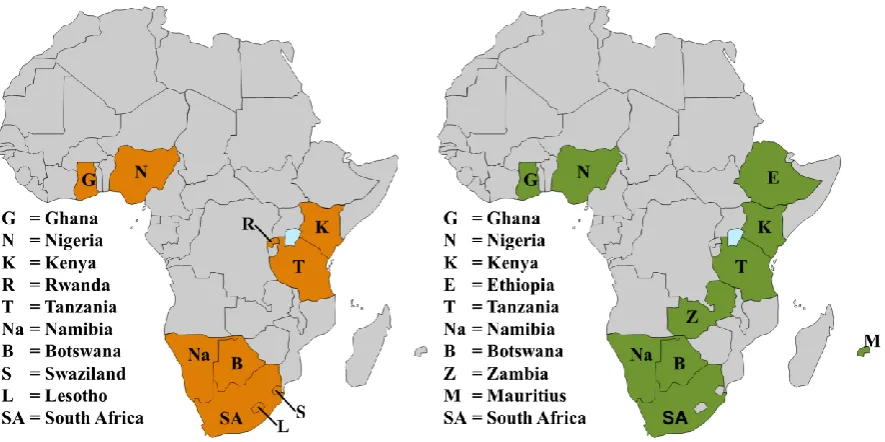
The country selection was a two-step process. In the first step, the OVGU team conducted a study to identify areas with high potential for ERP capacity development (Couzens et al. 2013). Every sub-Saharan country was scrutinized with respect to 23 indicators in five sectors (education, economy, technology, social structure and politics) to create a balanced picture of living standards and learning conditions in these countries. The research results served as the basis for reasonable project management decisions and a sustainable project framework. The data of each indicator were normalized and especially important indicators weighted. The respective values were then added up per country and the weighted average was calculated which resulted in a single value for every country – the “ERP Capacity Development Index” (ERP-CDI). The index facilitated the comparison and ranking of different African countries. After excluding the islands, the ten countries with the top 10 countries were selected and geographically clustered into three hubs: Western-Central, Eastern and Southern Africa (fig. 1).
Page 10
at the end of the project. The ten ESEFA-Partners were the first to try and use the new curriculum. Their feedback was and still is vital to adapt and improve the course design.
In the following, we want to present the considerations behind and the implementation of the ESEFA curriculum. We first address the theoretical learning framework which formed the basis of the curriculum regarding content and pedagogics. We then focus on the various elements of the curriculum design resulting from the pedagogical principles as well as the subsequent technical implementation of the curriculum. Finally, we turn to students’ and teachers’ reactions and perceptions of the ESEFA curriculum with regards to the initial hypothesis.
Fig 1. ERP-CDI selected countries Fig 2. ESEFA selected countries
2. THEORETICAL LEARNING FRAMEWORK – METHODS AND CONCEPTS 2.1 Anchored instructions
Anchored instruction is a type of situated learning. Situated learning environments try to avoid creating “inert knowledge”. The term describes the problem that knowledge gained through traditional instructive, fact-based learning is indeed memorized by the student. However, it is not retrieved and spontaneously used by the learner to solve a practicable application problem. If new information is acquired in meaningful, problem-based learning scenarios, the student is expected to be able to impulsively and readily use the knowledge – even in previously unfamiliar situations (The Cognition and Technology Group at Vanderbilt 1990; Scharnhorst 2001).
The basic idea of the anchored instruction approach is to situate the targeted knowledge concepts and abilities in an explicit learning environment. One way of creating such a space is the use of various micro-contexts, highlighting subsets of a larger problem domain. Another possibility is the formulation of a complex and colorful macro-context which provides an overall setting for sub-problems and case studies. There are several requirements and purposes either kind of context must satisfy to serve as anchors in learning (Choi & Hannafin 1995; The Cognition and Technology Group at Vanderbilt 1990; Scharnhorst 2001).
Page 11
and thereby enhance their learning experience (Choi & Hannafin 1995; The Cognition and Technology Group at Vanderbilt 1990; Scharnhorst 2001). The ESEFA project paid great attention to this matter. First, students work with an actual live ERP system, and second, the real-life company Zambikes, which was specifically selected for the project’s needs, serves as a model for the curriculum narrative and the data in the system.
Second, the learning context must be adequately elaborated. This means there are plenty of data embedded in the setting such that related sub-problems can be identified and solved by the students. In order to do this, students must differentiate between relevant and irrelevant information (Choi & Hannafin 1995; The Cognition and Technology Group at Vanderbilt 1990; Scharnhorst 2001). In the ESEFA curriculum, the Zambikes narrative and the ERP system provide a comprehensive framework. Enriched with a written portrait of the company and a video about its employees and operations, the narrative comprises an abundance of data. The sub-problems to be generated are the various business processes that occur in the company.
Closely connected to this is the third point: The learning environment allows the students to delve into problems from multiple points of view. This facilitates an improved awareness of the circumstances in which acquired knowledge is used to deal with a problem. Students also become more competent at examining questions from different angles (Choi & Hannafin 1995; The Cognition and Technology Group at Vanderbilt 1990; Scharnhorst 2001). In order to finish a business process in the ESEFA setting, the students need to take on different roles in the system and the company, e.g., to perform a procure-to-pay process they “act” both as the finance manager Viera Funjika and the international sales administrator Paul Mulenga, among others.
2.2 Blended learning
Broadly, blended learning can be defined as any learning concept which incorporates elements of technology-based (online) learning and face-to-face instructions. The following definition fits well with ESEFA’s understanding of the term:
“Blended learning is realised in teaching and learning environments where there is an effective integration of different modes of delivery, models of teaching and styles of learning as a result of adopting a strategic and systematic approach to the use of technology combined with the best features of face to face interaction. (Krause, 2007)”
There are a variety of blended learning models with different degrees of technology utilization. This particular arrangement seems to suit the ESEFA project best: Each course comprises lectures and workshops. The students rotate between certain times which are spent in a classroom learning the curriculum by means of face-to-face instructions (i.e., the lecturer presentations), and other times in which they learn in a computer lab (i.e., the workshops and exercises). The lecturer is responsible for both the classroom and lab activities (Connections Learning 2016).
This blended learning model offers substantial benefits. First and foremost, the students get a hands-on experience working with the ERP system instead of only passively seeing its functionalities and processes in presentations and demonstrations from the lecturer. Nonetheless, the teacher’s presence and instructions in the classroom permit an easy first contact with such a complex system and provides on-site help and support. The division between face-to-face instruction and lab time also grants a certain flexibility with the availability of lab hours. This is often crucial since an institution might only have limited computer resources. The utilization of a learning management system (LMS) allows for an uncomplicated administration of a course and the participants (Bath & Bourke 2010).
2.3 Guided learning
Page 12
instructions may still be relevant, but in parts of a course learners gain knowledge by exploring the problem on their own or in groups using the available resources.
Multimedia materials can assist in guiding students on how to advance towards the problem solution or illustrate what to anticipate along the way. This boosts their familiarity with the learning environment and bolsters their procedural, conditional and declarative knowledge. Increasing these competencies decreases physical and cognitive barriers to apply the acquired abilities in real-life situations (Hoffman & Ritchie 1997).
The ESEFA curriculum adheres to these principles, engaging the students in different media while a lecturer is always present to navigate and assist the students.
3. CURRICULUM DESIGN 3.1 Structure
3.1.1 Course content and integration scenarios
In a course, students get to know theoretical and practical aspects of several business processes and how they are mapped into an ERP system. They learn how these systems assist business processes and how they are implemented to align business operations.
The course design adheres to two leading principles: adaptability and relatability. The latter is addressed in the subsequent sections. The former primarily refers to the structure and overall architecture of the curriculum. At its heart lies a core curriculum consisting of five modules, namely, Business Processes, SAP Navigation, Procure-to-Pay, Sales-to-Cash and Inventory Management. The modularization allows the lecturer to place emphasis on certain aspects of the curriculum.
In order to cater to the individual needs of universities and the local market, course integration scenarios have been developed for a number of disciplines. In each discipline stream, the core curriculum is complemented with an introductory module on ES Knowledge, whose content is adjusted the respective scenario, and supplementary modules which deal with discipline-specific matters. In addition, the 5-day short course ES Fundamentals for Business was created comprising of ES Knowledge for Business module and the core curriculum.
3.1.2 Exams and certifications
At the end of a course, students get the opportunity to register for the ES Fundamentals qualification examination. Upon successfully passing the exam, students receive the ES Fundamentals SAP UA Proficiency Certificate. Participation in the exam is optional, nevertheless, getting a qualification issued by SAP UA, as the competent authority, proofs the proficiency with an ERP system, which is well-recognized and sought after by enterprises all over the world.
The qualifying examination is computer-based and online. The respective ESEFA course lecturer determines the time and location of the exam and also proctors it. However, the ESEFA Centre prepares the exam questions and evaluates the answers given by the students.
3.2 The learning environment
Page 13 3.2.1 Conception
Universities worldwide participating in the SAP UA program use a curriculum based on the fictitious company Global Bike Inc. (GBI). The curriculum is equipped with comprehensive learning material and illustrations. It offers a background story of the company and fitting case studies. It was designed to grant a business experience to students, which is as close to real-life as possible. So, the objective of the GBI curriculum is very much the same as for the ESEFA curriculum. Prior to the project, the GBI curriculum also has been the standard curriculum in sub-Saharan African countries.
However, the existing curriculum has a very Euro- and Anglocentric view. GBI was founded by an American and a German who act as Co-CEOs. The company has its headquarters in the USA and Germany where its major customers and vendors are also located. The portfolio also reflects this geographical bias. Even though the GBI curriculum is taught all over the world, the ESEFA project’s goal is to offer African students a more approachable learning experience. Thus, the ESEFA Centre took the existing SAP UA curriculum, adapted it and created a course design mindful of the African context. Now, higher education institutions in sub-Saharan Africa are offered an alternative to the standard GBI curriculum.
The ESEFA curriculum is based on the real-life company Zambikes, located in Lusaka, Zambia. The project team was lucky enough to establish this mutually beneficial collaboration. The real history of this bicycle manufacturer serves as the basis for the story of its model company counterpart in the course narrative, and the company structure has been recreated as master data1 in the ERP system. This lends authenticity to the case studies and workshops, making the subject matter more relatable to students when studying Enterprise Systems.
3.2.2 The Narrative
As part of the module Enterprise Systems Knowledge, every student becomes acquainted with the Zambikes2 case study. It provides an overview of the company’s organizational structure, product portfolio and business processes.
Zambia – as do many other African countries – faces an increasing demand for inexpensive, functional transport solutions, especially in the rural areas. Zambikes is introduced as a bicycle manufacturer founded in 2007 with a mission and a vision: First, the company wants to empower local communities by providing employment and skills development. Second, they want to assist in Zambia’s economic prosperity by creating and supplying high quality, sustainable goods. Third, their products should care for the socio-economic needs of the local people, with special attention to those in rural areas. This strong focus on a social rather than a commercial dimension was one of the key criterions to choose Zambikes as the model company for the ESEFA project. As higher education institutions can influence students’ perception of companies and their social responsibility, Zambikes’ commitment to increase welfare may shape students’ awareness of social issues (Sobczak, Debucquet & Havard 2006).
The product portfolio reflects this obligation towards society. Two basic types of bicycle are produced: On the one hand, the individually customized Bamboo Touring Bike is a high end product manufactured from Zambian bamboo primarily intended for the international market. On the other hand, the rugged steel frame Transport Zambike addresses the need for affordable, practical transportation means. Besides bicycles, Zambikes also offers a cargo trailer known as Zamcart to comfortably carry goods. The company’s most distinct product, however, is the so-called Zambulance – a trailer which equipped with a mattress serves as an ambulance to easily transport patients. Zambikes appreciation for the socio-economic impact of their operations is also mirrored in their procurement policy. Whenever possible,
1 Master data are defined as “[information] about an organization that is relatively static, and can be used to
describe the make-up or assets of an organization.” Examples include data about “customers, products, employees, materials, and suppliers” (SAP SE Terminology Database 2016).
2 Only the ESEFA model company Zambikes is portrayed here. Although the actual company and the ESEFA
Page 14
the company uses regional materials, e.g., the bamboo – which grows all over Zambia – is obtained from local vendors.
Zambikes is controlled by four managers and a foreman and has more than 30 employees who all come from Zambia. The headquarters are based in Lusaka, Zambia’s capital, housing the Logistics and International Sales, Finance and Accounts, Sales and Marketing, Production and Admin Departments. Each department is headed by a department manager. The main production plant is located in Mungwi, Lusaka West. The company is internationally active, producing both for the domestic as well as the export market and procuring raw materials from local and international vendors.
The case study describes Zambikes’ manufacturing strategy as well as their sales and distribution network in more detail, even stating the number of items assembled and sold for each product. Furthermore, their current business processes are thoroughly depicted: The explicit mechanisms of each of the four process types – Procurement of Raw Materials, Sales Process, Production and Inventory Management – are specified, even acknowledging difficulties.
3.3. The learning material
Employing means of blended learning, the ESEFA curriculum offers learning material in various media. This enriches the learning environment, thus improving the “anchors” students exploit to learn.
3.3.1 The storytelling video
A 20-minute video is included into the Business Processes module, augmenting the Zambikes narrative. The video depicts Zambikes’ production facilities in Zambia and several employees manufacturing bicycles. The managing director speaks about Zambikes as a company, its core values and vision. The people and products seen in the video recur in the workshops and lectures by name and picture, boosting the recognition value and providing an additional layer of identification.
The video can be shown as a whole or divided into parts corresponding to the processes of the core curriculum and thus serve as an introduction to a module.
3.3.2 Presentations on business process theory
Slide show presentations are used in the classroom lectures, stating the learning objectives, and lecture overview, explaining the respective business process and its structure in conjunction with its application and appearance in the ERP system along with illustrating the different types of data and views of the program for each process.
3.3.3 The SAP ERP system as a technical learning environment
A workshop is part of every module. During the exercise sessions, the students are in a computer lab, working on an actual SAP ERP system. The system has been configured and customized to fit the Zambikes case study, i.e., it contains the data on processes, products, customers, vendors etc. as presented during the introduction of the company and the subsequent module lectures and workshops.
Carrying out business processes on a live system provides conditions close to reality which enhances the students’ insight on the importance of ES in aiding a company’s workflow.
3.3.4 Workshop documentations
Page 15
comprising the learning objective, the (narrative) scenario, the employees involved, the process description and the expected time needed to complete the entire workshop.
Every workshop consists of a sequence of interconnected exercises and each exercise has a header containing the problem statement (e.g., “Use the SAP Easy Access Menu to display a customer”), the task specification (e.g., “Zambikes has numerous customers both locally and overseas. Display one local customer (Pick & Take)”), the name, position and a drawn picture of the employee responsible for the process step (e.g., “Margret (office/inventory administrator)”) and the expected time needed to complete this step.
The workshop sheet offers explicit instructions on how to execute the task and includes screen shots of the corresponding ERP system screen. The instructions are expressed in such a way that the students can solve the assignment by themselves without any further input from the lecturer.
At the end of each exercise, there are several questions about the process step just undertaken. This tests whether the student has successfully completed the task and gained a deeper understanding of the subject matter. They also indicate which topics and types of questions are relevant for the final examination.
Lecturers also get an additional set of lecturer notes as supportive documents during workshops and for class preparation.
3.3.5 The learning management system
An LMS was developed for the ESEFA project with the aim to easily share and distribute learning material, manage and coordinate courses and exams as well as to create a forum and network for course participants and lecturers.
The ESEFA LMS is based on the Moodle platform, a free open-source course management system, which is widely distributed and used across Africa (Unwin et al. 2009). The ESEFA system was customized and is administrated and maintained by the ESEFA Centre. Course lecturers from other partner universities get access to the learning material and students get permission to take the qualification examination on the platform if they registered for it with the ESEFA Centre. In the future, lecturers and students will get access to the community forum, which is currently in development, and lecturers will also be able to manage the exam registration themselves.
3.4 Technical implementation
The design and development of the technical solution needed to teach the curriculum was an intense collaborative work between the SAP UCC Magdeburg and the ESEFA Centre. After formulating the concept of the Zambikes scenario and designing the Zambikes model company, the next move was to map the model into the ERP system. The procedure essentially consists of two steps: Customizing and System Migration.
Since the Zambikes scenario was fashioned after the GBI model company, the existence of the GBI system customization, could serve as a basis for the ESEFA system customization. The latter is a customizing extension of the former. The country, where the company is located, and the subsequent configuration of the currency and tax rate, are examples of adaptations done during ERP customizing. The first part of this step was the enterprise customizing, i.e., the modification of data associated with the company code and organizational units. The second part was the process customizing, i.e., the definition of workflows (e.g., a sales process by the sales department obviously affects the finance department as well) (Seidler 2010). The ESEFA system customization advanced in three hierarchical stages: It was first developed, then tested and after successful testing finally mastered and released. This step to map the Zambikes model into the ERP system was achieved using manual customizing and transport procedures which transfer all approved system changes from one stage to the next one.
Page 16
comprising the master data needed in the system. This included very detailed information – from the vendors, customers and materials, over to the different types of materials, down to the number and size of hex nuts needed for each bicycle, just to name a few. The table was stored as a csv-file. The ESEFA project employed the Legacy System Migration Workbench (LSMW) as the tool to transfer data from a non-SAP system into the SAP system. The LSMW’s main functions are reading the data, converting them from the source to the target format and importing the data (Seidler 2010). Since many users may simultaneously use the same date (e.g., a raw material) in a client, every data set had to be loaded multiple times into the database of the system. To be precise, there are 1000 copies of each date in the system, numbered consecutively, such that each one can be uniquely identified by its ID and matched to a user accordingly.
4. PRELIMINARY PROJECT EVALUATION AND OUTLOOK
As mentioned in the introduction, everything described in the previous sections was intended to create a localized curriculum which offers (1) high integration and adaptability to regional market and learning needs, (2) teaching methods and materials maximizing learning success, (3) authenticity regarding the local culture and business processes. Further research must be conducted in order to evaluate the impact and quality of the new course design. At this point, no definite conclusion can be drawn as to whether the ESEFA curriculum satisfies these requirements. However, there are some hints which suggest that the project indeed achieved these objectives. Some of these indicators and the research questions which still need to be answered are discussed below.
With respect to the two last mentioned requirements, a preliminary evaluation can be drawn from an already conducted survey. ESEFA course participants were asked to fill out a questionnaire regarding their just completed ESEFA Train-the-Lecturer or respectively Train-the-Student courses. By the end of August, 2015, 78 lecturers and 1183 students had answered.
Concerning the Zambikes scenario, 88 percent of the lecturers answered in the affirmative that “[the] contextualized Zambikes scenario adds didactic value for ES education in Africa”. Students assessed a number of different claims on the same matter. Approximately 93 percent of them answered that “[their] motivation for this course was increased by the Zambikes story” and about 78 percent “[had] been inspired by the Zambikes video”. Nearly 92 percent of students agreed or strongly agreed that “[the] Zambikes scenario was authentic” and essentially as much confirmed that “[the] context provided by the Zambikes business case was helpful to improve my comprehension”.
Regarding the learning success, both students and lecturers also responded favorably. With respect to the workshops, almost 95 percent of the lecturers supported the claim that “[the] selected exercises are beneficial for the understanding of business processes in ES”. Close to 93 percent of the students evaluating exactly the same statement agreed or strongly agreed with this assertion as well.
About 80 percent of lecturers stated that “[they] met [their] individual learning goals” and “know how to integrate the course content into [their] own teaching”. Almost as many “feel comfortable to teach this course [themselves].” Close to 95 percent answered that “[the] course helped to increase [their] understanding of SAP ERP.” Roughly 74 percent of lecturers and around 70 percent of students assessed that they “feel well prepared for the ESEFA ES Fundamentals exam”. Students were also asked how much “[their] knowledge has improved regarding […]” different course contents. Regarding SAP ERP approximately 86 percent, regarding Enterprise Systems almost 88 percent and regarding Business Process more than 89 percent of students responded that their knowledge has somewhat or substantially improved.
Page 17
curricula. Another hypothesis is that the students’ positive perception is in fact based on actually acquired skills and knowledge which an ongoing study of ESEFA participants must confirm.
Currently, the only data available to make any assumptions with regard to the first curriculum requirement are the number of ESEFA courses and participating universities. These very implicit indicators suggest that the developed curriculum serves the purpose of curriculum integration and adaptability to local learning needs. Besides the ten piloting ESEFA university partners, three additional universities have shown an interest in or even already adapted the curriculum (fig. 3). As of May 2016, there have so many courses completed that the number of trained students and lecturers surpassed the initial project goal. While the application of short courses is predominant, the whole spectrum of available course modules and integration scenarios is used by the universities. (fig. 4). These observations indicate that the ESEFA curriculum complies with the integration and adaptability requirement. However, these assumptions must be verified by a qualitative analysis of participating universities’ satisfaction with the curriculum. Questions like “How easy was it to integrate the ESEFA curriculum in your course?” or “How well does the ESEFA curriculum complement other course offers in your study program?” must be answered.
Fig 3. Participating universities (as of May 2016)
Fig 4. Numbers of courses, students and lecturers (as of May 2016)
One way to answer whether the ESEFA curriculum responds to regional market needs is to analyze the “employability” of ESEFA students: Is their employment rate higher than that of other students? Are regional business asking for ESEFA educated personnel? Are businesses which employ such students satisfied with their skills? This is the focus of a current research project which the ESEFA team hopes to finalize this year. Likewise, the question on the long-term impact of an ESEFA education remains open. This too generates new research questions on the effects regarding the career lifecycle of students: Are ESEFA educated students more successful in their jobs or at finding their jobs? Do they enter a business at higher entry positions? Do they earn higher salaries?
Page 18
provision, operation and support of the ESEFA education for existing partner universities and expand the initiative by other higher education institutions.
REFERENCES
Bath, D., Bourke, J. 2010, ‘Getting started with blended learning’, Griffith Institute for Higher Education, Griffith University.
Calitz, A.P., Greyling, J.H. & Cullen, M. 2014, ‘South African industry ICT graduate skills requirements’, Southern African Computer Lecturers' Association, Port Elizabeth, S.A.
Choi, J.I. & Hannafin, M. 1995, ‘Situated cognition and learning environments: roles, structures, and implications for design’, Educational Technology Res. and Development, vol. 43, no. 2, Springer, pp. 53-69.
Connections Learning, n.d., ‘Blended learning: how brick-and-mortar schools are taking advantage of online learning options’, white paper, Pearson, viewed March 10, 2016, <http://www.connectionslearning.com/Libraries/Institutional_Sales/Blended_Learning_Primer__FIN AL_1.pdf>.
Couzens, C., Rosenberger, K., Weiß, F., Wirz, P. & Zschieck, C. 2013, ‘ERP-CDI: Enterprise Resource Planning - Capacity Development Index’, working paper, Otto von Guericke University, viewed June 1, 2016, <http://edoc2.bibliothek.uni-halle.de/hs/urn/urn:nbn:de:gbv:ma9:1-7897>.
Hawking, P., Stein, A. & Foster, S. 2004, ‘Revisiting ERP systems: benefit realization’, Proceedings of the 37th Annual Hawaii International Conference on System Sciences.
Hoffman, B. & Ritchie, D. 1997, ‘Using multimedia to overcome the problems with problem based learning’, Instructional Science, vol. 25, Kluwer Academic Publishers, pp. 97-115.
Mahanga, K.M. & Seymour, L.F. 2015, ‘Enterprise resource planning teaching challenges faced by lecturers in Africa’, in Steyn, J. & van Belle, J.P. (eds) Beyond development. Time for a new ICT4D paradigm? Proceedings of the 9th International Developments Informatics Association conference, pp. 343-353.
SAP SE terminology database 2016, master data, SAP terminology database, viewed March 18, 2016, <sapterm.com>.
Scharnhorst, U. 2001, ‘Anchored instruction: situiertes Lernen in multimedialen Lernumgebungen’, Schweizerische Zeitschrift für Bildungswissenschaften, vol. 23, no. 3, DIPF, pp. 471-492.
Scholtz, B., Calitz, A. & Cilliers, C. 2013, ‘Usability evaluation of a medium-sized ERP system in higher education’, Electronic Journal of Information Systems Evaluation, vol. 16, no. 2, Academic Publishing International Ltd., pp. 148-161.
Seidler, R. 2010, Effizientes Customizing der SAP Student Lifecycle Management: Wie die Branchenlösung SLcM unter Verwendung von BC-Sets, eCATT und Batch-Input zu einer SAP All-In-One-Lösung wird, VDM Publishing.
Sobczak, A., Debucquet G., & Havard, C. 2006, ‘The impact of higher education on students’ and young managers’ perception of companies and corporate social responsibility: an exploratory analysis’, Corporate Governance: The European Journal for Business In Society, vol. 6, no. 4, pp.463-474.
The Cognition and Technology Group at Vanderbilt 1990, ‘Anchored instruction and its relationship to situated cognition’, Educational Researcher, vol. 19, no. 6, Sage Publications, pp. 2-10.