67
A REPUTATION BASED TRUST MODEL FOR MANET USING ENHANCED AODV WITH
TBR ALGORITHM
J.Gautam, B.Sudarsana Gayatri, V. Krithika and S. Shanmuga Priya
Department of IT, Velammal College of Engineering and Technology, Madurai, India,
[email protected], [email protected], [email protected], [email protected]
Abstract
Mobile ad hoc network (MANET) is a local which necessitate more security. The term “ad hoc” refers to self-configuring nodes that do not have a central entity to govern them. Network security plays a decisive role in MANET and the traditional way of providing impedance to the networks through firewalls and encryption software is no longer effective and sufficient. In this paper, a quantitative method based on trust evaluation for detecting malicious nodes in the Mobile ad-hoc network and endowing an optimal path for packet transmission is proposed using Trust based Routing algorithm. The intended system is a behavior anomaly based system which crafts it dynamic, robust, scalable and configurable. The proposed method is verified by running simulations with mobile nodes using the Ad-hoc demand distance vector (AODV) routing called as Enhanced Ad-hoc on-demand distance vector (EAODV).
Index-terms - MANET, Trust, Malicious node, EAODV, TBR
I. INTRODUCTION
Network is the spine for telecommunication, Wi-Fi networks like cellular network. As aftermath of the remarkable exploit of hand held gadgets, Mobile Ad-Hoc Network(MANET)is a thriving technology in today’s scenario. A MANET is a multi-hop temporary proclamation network of cell nodes that can operate with Wi-Fi transmitters and receivers without the assistance of any pre-existing network infrastructure. The nodes are equipped to maneuver freely. They may be able to turn out to be a member of the network or leave the network at any instance since they are self-configuring in nature. Every node can participate in the venture of transferring the packets. The nodes keep up a correspondence through sending packets to distinct nodes within its radio range. Routing comply a chief function in the safety of the entire network. Thus, the operation in MANET bring forth the security issues. The wireless link characteristics are time-varying in nature: There are transmission impediments like fading, path loss, blockage and interference that adds to the
prone behavior of wireless channels. The responsibility of wireless transmission is resisted by various factors.
Packet losses attributable to errors in transmission – MANETs expertise higher packet loss attributable to factors like hidden terminals that ends up in collisions, wireless channel problems (high bit error rate (BER)), interference, frequent breakage in ways caused. A.Trust and its Properties in MANET:
The term Trust Management is known as a separate part of security services in networks and processed that Trust evaluation and management toils the assorted methodology for marking the decipher security policies, endorsement and relationships. Trust management in MANETs is required once collaborating nodes, with no previous interactions, need to determine a network with an appropriate level of trust relationships among them- selves. Additionally, trust management has numerous relevance in several higher cognitive processes like intrusion detection, authentication, access management, key management, uninflected misbehaving nodes for effective routing, and different functions. Trust mana-
gement, trust update, and trust revocation, in MANETs is additionally rather more difficult than in ancient centralized environments. Further, resource constraints usually confine the belief analysis method solely to native data. The dynamic nature and characteristics of MANETs end in uncertainty and wholeness of the trust proof. The contributions of evaluating the belief value is to allow a transparent definition of trust within the communication and networking field, knowing upon the definitions from totally different disciplines and to reveal about the future analysis areas supported the thought of social and psychological feature networks. Some schemes use continuous or separate values to live the extent of trust. for instance, trust is represented by never-ending price in [0, 1] or measured as separate price in [−1, 1]. Threshold based mostly approaches also are wont to live the trust.
Trust process comprise of 3 parts: experience, suges- tion and learning. The experience a part of trust for each hub is straight forwardly measured by their fast neighbors. The trust table is un fold to each single different hub as suggestion a chunk of the trust. B. Overview of AODV:
For enabling security ad-hoc On-Demand Routing (AODV) protocol uses Trust based approach, which overcomes the overhead and select the belief node for its packet transmission.Ad hoc Wi-Fi networks expect no pre-deployed infrastructure is on hand for routing packets end-to-result in a network, and alternatively rely on intermediary node.
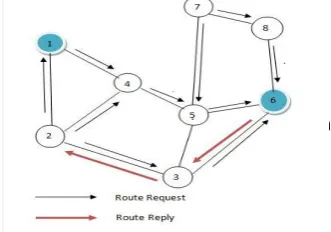
68 Some of the intermediary nodes may act as malicious nodes and most of the attacks will also be carried out using these malicious nodes. These malicious nodes accept the route request, route response or data packets and drops it at the same time sending it to the following node. So these malicious nodes ought to be detected and avoided within the network, because the intention of those malicious nodes is to discontinue the packet exchange between the source and destination. Fig2 explains about path establishment by AODV from source to destination. When a source sends request to destination in many ways, the destination may respond to the source that have shortest path. The first node (1) indicate source and last node (6) indicates destination. II. RELATED WORK
Michael R.Lyu [13] proposed a technique within which novel secure routing protocol for MANET was designed. In this strategy, the concept of a trust model to safeguard routing behaviors within the network layer of MANETs was used.
David B. Johnson [11] projected a way known as Ariadne within which involves attacks against routing in unexpected networks and that we gift the look and performance analysis of a new secure on-demand Ad-hoc network routing protocol.
Kimaya, et al., [9] projected the genuine Routing or Ad-hoc Neworks (ARAN) secure routing protocol that is Associate in Nursing on-demand routing protocol that depends on the employment of digital certificate to identifies and defends all known attacks.
Perkins and Royer [1] contempt a destination sequenced distance vector rule as a variant of distance vector routing technique by that mobile node coope-rative to create Ad-hoc networks for smaller population of mobile nodes.
Chandni Garg1, Prashant Rewagade [14] protocol is conferred that assigns a trust price for every node. Nodes area unit allowed to participate in routing supported their trust values.
Eric Chiejina [15] planned Associate in Nursing appro-ach of the existence of well-known intrusion hindrance mechanisms, like cryptography or authentication, will scale back threats against MANETs, like malicious knowledge modification that aims to cut back know-ledge integrity and confidentiality.
III. PROPOSED METHODLOGY
A. Network simulation:
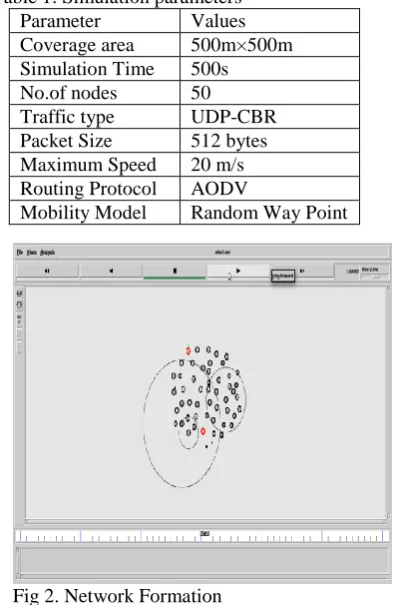
Simulation is regulated using NS2 2.35. Because of the link stability and route lifetime, no route overhead was considered in our simulation. In 500 X 500 area, mobile nodes exist. Square area is used to increase average hop length of a route with relatively small nodes. Every mobile node is, moving based on the mobility data files that were generated by mobility generator module. Several 50 nodes are created. The transmission range is fixed at 100 meters. 100 nodes have destinations and try finding routes to their destination nodes. Maximum speed of node is set to 20 m/sec. The nodes are assigned with an initial position. All nodes do not stop moving and the simulation second is 500 seconds.
Table 1: Simulation parameters Parameter Values Coverage area 500m×500m Simulation Time 500s No.of nodes 50 Traffic type UDP-CBR Packet Size 512 bytes Maximum Speed 20 m/s Routing Protocol AODV
Mobility Model Random Way Point
Fig 2. Network Formation
B. Routing operations in EAODV:
In this novel approach three new fields has been piggybacked into each node’s original routing table viz., positive events, negative events and opinion. Positive events are the efficacious communication times concerning two nodes. Afore mentioned negative events are the disastrous communication between any two entities. Opinion states the node’s belief towards another node’s trustworthiness as defined before. The value of opinion can be calculated per Formula 1. These three fields are the main factors when performing trusted routing in MANET.
Fig 3. Trusted Routing Table
C. Trust Judging Rules:
The proffered trust model is an addendum of the exemplar trust model in subjective logic. In our trust model, opinion is a 3-dimensional metric and is defined as follows:
Definition 1
69 the absence of both belief and disbelief, and sum of these three elements is always 1.
A node in MANET will convene and preserve all the positive and negative evidences concerning the other nodes trustworthiness in MANET, which will be inter-preted in detail in Section 5. With these accumulated evidence, we can hoard the opinion value by exploiting the following mapping equation.
Definition 2 (Mapping). Let T(A,B) = b(A,B)+d(A,B)
+U(A,B) be node A’s opinion about node B’s trust-worthiness in a MANET, and let p and n respectively be the positive and negative evidences collected by node A about node B’s trustworthiness, then T(A,B) can be expressed as a function of p and n according to:
b(A,B) = p/(p+n+2)
d(A,B) = n/(p+n+2) Formula 1. u(A,B) = 2/(p+n+2)
where p is positive packet transmission from A to B, n is negative packet transmission from A to B i.e, the packets that are not possibly delivered to the exact destination.
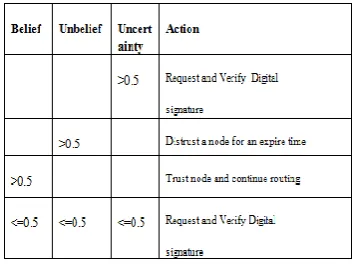
(1) If node A’s opinion towards node B’s trust-worthiness, the first component belief of opinion T(A,B) is larger than 0.5, A will trust B and continue to perform routing related to B.
(2) In node A’s opinion towards node B’s trust-worthiness, if he second component disbelief of opinion T(A,B) is larger than 0.5, A will not trust B and will refuse to performing routing related to B. Accordingly the route entry for B in A’s routing table will be disabled and deleted after an expire time. (3) In node A’s opinion towards node B’s trust-worthiness, if the third component uncertainty of opinion T(A,B) is larger than 0.5, A will request B’s digital signature whenever has interaction (or relation-ship) with B.
(4) In node A’s opinion towards node B’s trust-worthiness, if the three components of opinion T(A,B) are all smaller than or equal to 0.5, A will request B’s digital signature whenever has interaction (or relation-ship) with B
(5) If node B has no route entry in node ’s routing table, ’s opinion about B is initialized as (0,0,1).
Fig 4. Trust Judging Rules
In our proposed methodology, we have enhanced the routing protocol by additionally calculating the belief,
unbelief and uncertainty values before generating the path, which enhances the existing protocol. We have designed a model that identifies the malicious nodes that drops packet while forwarding and calculated the packet loss ratio and end to end delay. The calculated delay value is lower than already existed delay value without any malicious node behavior in the network. These values are made reliable in Enhanced AODV
IV. IMPLEMENTATION OF TRUST BASED ROUTING
Initially the opinion of the node can be calculated using highly trusted and least trusted. First the network form- ation of the node take place. Then comes route establis- hment of every node can be done. While establishing the route, the trust value should be calculated. For that we should obtain the trust table information.
Fig 5. Trust Based Routing
The trust table information may contain three nodes as highly trusted, trusted and least trusted. If the opinion is equal to highly trusted node, then fix the path as opinion and perform the following routing. If the condition is not true, then check whether opinion is equal to trusted value then these nodes provide 50% positive opinion and fix the path as trusted. If the node is less trusted, then discard the route and initiate new path. In the below flow chart, trust value can be calculated as explained above.
70 In our paper categorize the nodes based on trust value such as Highly trusted nodes, trusted nodes, Least trusted nodes.
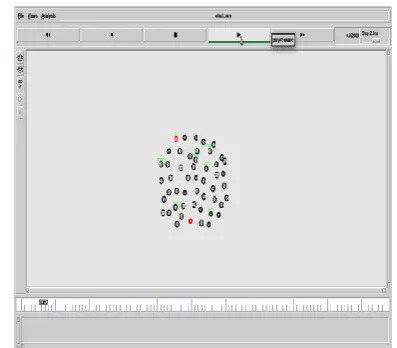
Fig 7. Identification of highly trusted nodes and trusted nodes.
Fig 8. Constructing optimal path from source to destination via trusted nodes
This approach reveals the highly-trusted nodes in a network. Before constructing the path from source to destination it is devoir to make certain the nodes that are about to partake in the routing process are highly trusted nodes. Once the source receives RREP it pioneers trust monitoring scheme that counsels the trust value of every node in the route. The route is firmly established only if all the nodes are highly trusted or nodes that meets the threshold value. If least trusted nodes are located within the recommended route, then the route is ignored and the process is initiated again until the route is optimal. In this degree, since only trusted nodes are granted to partake in the routing process the route will always remain flawless where selfish nodes or malicious nodes are completely isolated from the routing process.
V.PERFORMANCE ANALYSIS
Trust based Routing algorithm generates better packet delivery ratio and throughput than the existing tradi-tional methods. The results are discussed below. Packet
drop due to misbehaving nodes, traffic or congestion is estimated during runtime as shown in the figure 9.
Fig 9. To estimate the run time packet drop due to malicious node
Fig 10. Variation of throughput with time
Fig 11. The relative decrease in packet delivery rate in EAODV
VI.CONCLUSION
An ad-hoc network is a set of limited range of wireless nodes that function in a cooperative manner to increase the overall efficiency of the network. In this Paper, the malicious nodes which are one of the major impact in the network has been identified and a trusted route is established after calculating the belief value and the path is computed using EAODV routing protocol that isolates the malicious nodes from the routing process. This ends up in increased reliability Packet delivery in MANET thereby increasing the quality of service and throughput in the network. This is because EAODV protocol computes the trust values of each node and
0 50 100
10
0
20
0
30
0
40
0
50
0
Th
ro
u
gh
p
u
t
Simulation Time(X10^-3)
THROUGHPUT
EAODV
AODV
DSR
0 20 40 60
100200300400500
N
O Of
Pack
e
t
d
ro
p
Simulation Time (X10^-3)
PACKET DROP RATIO
EAODV
AODV
71 allows only the trusted nodes to get involved in the routing process. Our future work is to implement EAODV protocol for alternate threats in MANET. VII.REFERENCES
[1] C. E. Perkins and E. M. Royer, Ad hoc on-demand distance vector routing. In IEEE Workshop on Mobile Computing Systems and Applications, Pp. 90–100 (1999).
[2] D. Johnson, D. Maltz, Y.-C. Hu, and J. Jetcheva, The dynamic source routing protocol for mobile ad hoc networks. IEEE Internet Draft, March (2001).
[3] Royer, Elizabeth M. and Chai-Keong Toh, A review of current routing protocols for ad hoc mobile wireless networks. Personal Communi-cations IEEE 6(2) 46-55 (1999).
[4] B. Kannhavong, H. nakayama, Y. Nemoto and N. Kato, A survey of routing attacks in mobile ad hoc networks. Wireless communications IEEE 14(5): 85-91 (2007).
[5] Y-C. Hu, A. Perrig and D. Johnson, Wormhole Attacks in Wireless Networks. IEEE JSAC 24(2): 370 – 380 (2006).
[6] Liu, Y., Zhang, R., Shi, J. and Zhang, Y., Traffic inference in anonymous MANETs. Sensor, Mesh and Ad Hoc Communications and Networks (SECON), 7th Annual IEEE Communications Society Conference Pp. 1–9 (2010).
[7] Zapata, Manel Guerrero, Secure ad hoc on-demand distance vector routing. ACM SIGMOBILE Mobile Computing and Communications Review 6(3): 106-107 (2002).
[8] S. Yi, P. Naldurg, and R. Kravets, Security-aware ad hoc routing for wireless networks, Proc. ACM Mobihoc (2001).
[9] Papadimitratos, Panos, and Zygmunt J. Haas, Secure routing for mobile ad hoc networks, the SCS Communication Networks and Distributed Systems modeling and Simulation Conference (CNDS), San Antonio, TX, January 27-31 (2002). [10] Sanzgiri, Kimaya, et al., A secure routing protocol
for ad hoc networks. Network Protocols, Procee-dings. 10th IEEE International Conference on IEEE (2002)
[11] Hu, Yih-Chun, Adrian Perrig and David B. Johnson, Ariadne: A secure on-demand routing protocol for ad hoc networks. Wireless networks 11(1-2): 21-38 (2005).
[12] Abusalah, Loay, AshfaqKhokhar and Mohsen Guizani, A survey of secure mobile ad hoc routing protocols. Communications Surveys & Tutorials, IEEE 10(4): 78-93 (2008).
[13] Li, Xiaoqi, Michael R. Lyu and Jiangchuan Liu, trust model based routing protocol for secure ad hoc networks, Aerospace Conference Proceedings IEEE Vol. 2 (2004).
[14] Chandni Garg1, Prashant Rewagade, Trust Evalua-tion for Detecting Black Hole Attack on AODV Routing Protocol by using Back Propagation Algorithm of Neural Network, Proc. of Int. Conf. on Advances in Computer Science and Applica-tion Pp. 775 - 780 (2013)