An Invitation: Multicultural Art and Visual Learning in
Elementary Education
Christine Woywod
University of Wisconsin – Milwaukee
ABSTRACT
In this article, I recount pivotal encounters that occurred in a course entitled Multicultural Art and Visual Learning during the summer and fall of 2016. I approach this as teacher research, as I personally faced the challenge of how to responsibly engage with Culture Wars as an educator. Through recounting experiences, I extend an invitation to others who are open to the possibility that learning with and through the arts provides students opportunities to make meaningful choices within in their own learning, helps them develop empathy for each other, engages them in challenging dialogues about culture, and prepares them to contribute to life in our democracy and efforts to create a just world.
Figure 3. Black Lives Matter Message over I-43. Overpass Light Brigade, July 22, 2016. Milwaukee, WI. Photo by Joe Brusky. Attribution-Non Commercial. In this article, I recount pivotal encounters that occurred in a course entitled Multicultural Art and Visual Learning (MAVL) during the summer and fall of 2016. I approach this as teacher research (Henderson, Meier, Perry, & Stremmel, 2012), as I personally faced the challenge of how to responsibly engage with Culture Wars as an educator. Avoidance was not an option. Summer 2016 included the Black Lives Matter movement, media representations of police shooting black men and of police being shot at, and tensions and unrest in our own city rooted in segregation, poverty, politics, and inequities (see Figures 2 and 3). Fall 2016 heightened hopes and fears surrounding the presidential election, the environment, and civil rights. It is my hope that through recounting parts of these experiences, I can extend an invitation to others who are open to the possibility that learning with and through the arts provides students opportunities to make meaningful choices within their own learning, helps them develop empathy for each other, engages them in
challenging dialogues about culture, and prepares them to contribute to life in our democracy and efforts to create a just world. Each of the following sections is entitled with a message students in my classes remember.
Figure 2. Solidarity Rally and Protest Surrounding Lost Lives. July 11, 2016. Milwaukee, WI. Photo by Joe Brusky. Attribution-Non Commercial.
In the call for this special issue of the Journal of Cultural Research in
Art Education, the editors noted that the definition of “culture” has
Winner, Veenema, & Sheridan, 2013), such as engaging and persisting through challenging moments, whether they are artistic challenges or conceptual ones. The following section describes some of my own engaging and persisting, as my practice merges art, teaching, and research.
Challenge yourself to shift your
thinking from this... … to this.
“Art can be anything.” “The role of art and the meanings of individual artworks can vary depending on context.”
“Art is important because it gives people a chance to express themselves.”
“Artists explore processes that are interesting and present topics that are important.”
“I’m not good at art.” “There are knowledge and skills that I can learn and practice in order to create effective visual artworks.”
“I don’t understand art.” “There are strategies I can learn to better understand how to respond and connect to a variety of artworks.”
Figure 4. Themes from art education autobiography papers paired with statements that can help students shift to a growth mindset.
Start something. It is your responsibility to do so.
Posts in social media, the news, and even conversations among students during transitions highlighted concerns and fears over current events during summer 2016. Because of my background as an art educator who identifies with visual culture based approaches (Woywod, 2004), I asked my students in MAVL to record information in a four square table over the course of a week, with the intention of later using this as content for an upcoming art making experience. The first square included current events they heard people talking about or discussing online. In the second, students recorded their reactions to the conversations they witnessed, and in the third, how these exchanges made them feel as a future teacher. In the fourth and final square they listed how they wanted to be able to feel as a teacher. The day that we reported back and started to discuss, students first
It’s possible to shift your thinking.
MAVL was designed to meet the needs of education majors preparing for work in urban communities while being accessible to students from a variety of majors who participate in our university’s Cultures & Communities program. It was a logical move because of the art education program’s social justice identity (Cosier & Nemeth, 2010) and work with issue-based approaches aligned with the Cultures & Communities program’s belief that “Learning to work across differences of cultural background and experience is a process essential to intellectual growth and lifelong learning, and ultimately to building a better world” (Cultures & Communities, n.d.). As an instructor, I focus on ways art integration can support multicultural (Au, 2014) and anti-biased (Derman-Sparks & Edwards, 2012) teaching approaches. In my experience, two of the biggest – but certainly not insurmountable – challenges in MAVL are people’s discomfort with their own artistic knowledge and ability and
concerns about when they would actually have time to incorporate art into their future curriculum.
Before considering the ways that experiences in the arts can uniquely support multicultural and anti-biased teaching approaches, it is important to evaluate one’s working definition of art and what prior experiences might have shaped that definition. The following table (Figure 4) summarizes comments I have heard frequently in papers and conversations through several semesters of MAVL. The themes below are paired with statements that I have identified to not only challenge common misconceptions, but also to help students shift their thinking by working with a growth mindset over the course of the semester.
Figures 5 and 6. Front and back views of the ofrenda designed and installed by the Young People’s Resistance Committee, Students for Justice in Palestine, and the Black Student Union. Author photograph.
identified the topic of state spending on building a new arena for the Milwaukee Bucks basketball team and the recently approved plan to divert drinking water out of Lake Michigan to the city of Waukesha, outside of the Great Lakes basin. Both issues brought up controversies about access to resources and potential points of tension between people who will experience benefits and people who will face new challenges as a result of each situation. I was somewhat surprised that no one had brought up events receiving intense coverage in national news that week. After a pause I sensed some hesitation among the group, so I asked my class if anyone within their tables had noted current events involving police. Several students nodded their heads. One student, Annie1, even stated upfront that she would not be able to handle participating if the conversation became graphic or brought up violence. After a few vocal students used their collective knowledge to describe what they heard during the past 24 hours about the shooting of Philandro Castile in Minnesota, I could tell they were trying to do so carefully out of respect for Annie’s request. When there was a pause, Ian stated, “As a teacher, I just don’t think that I should start things that aren’t there.” Somewhat perplexed, I asked, “But isn’t news like this unavoidable? It is constantly popping up on our computers and in our newsfeeds.” Jennifer retorted on behalf of the group, “You just turn it off. I was tired of all the updates [from CNN] so I turned off the notifications on my Apple watch.” The layers of privilege in that statement momentarily stunned me.
I continued to mull over Ian’s statement the rest of the semester. Since I had posed a question about a topic that people were avoiding, had I started something that was not already there? Or perhaps more accurately brought up something that they were not ready to deal with?
Some of the MAVL students pointed out that schools can be safe places for students to take a break from challenging situations at home and that art can even be a reprieve during a tense day. While that can be true, schools are also sites of institutional racism (Rosales, 2016) and harm (National Center for Education Statistics, 2015). As a result, it is necessary for educators to address injustices by implementing counter-storytelling approaches (Whitehead, 2012) and engaging in restorative justice practices (Editors of Rethinking Schools, 2014).
information when presenting their artworks during a midpoint critique. Mark, who initially expressed concerns about taking an art class, persisted and created a portrait of his daughter when she was four years old (Figure 7). Mark explained that the butterflies both represent his memory of his daughter telling him about her favorite insect, and the butterflies he saw while walking in the park shortly after she passed away. Another classmate, Carissa, described in a reflection, “I really felt appreciation towards this project when we went around the room and everyone told their stories about who they were memorializing…you could see the joy on our faces when we talked about how important each person is to us” (personal communication, December, 2016). As an instructor, I knew it was important that the students within each of my classes had a moment in which they could face a common challenge while also seeing the variety of life experiences, values, and concerns within the group.
Figure 7. Mark Van Weelden’s portrait of his daughter, based on a photograph of when she was four years old.
One such moment came up during my fall 2016 classes, near Dia de Los Muertos. Students deepened their multicultural art learning by engaging with a ofrenda collectively designed and installed in the Theatre Building by three student groups in solidarity with each other: the Young People’s Resistance Committee, Students for Justice in Palestine, and the Black Student Union (see Figures 5 and 6). In their artist statement, the creators explained that while Dia de Los Muertos is a traditional holiday, it also demonstrates resistance against forced colonization and eradication of people. They also described that the intention of the ofrenda installation was “to honor the lives lost through systematic inequality, occupation, displacement, warfare and migration.” After a few moments of quiet looking, student volunteers pointed out parts that they thought were interesting and parts about which that they wanted to know more. In wondering, students realized that there are people, events, and issues they needed to learn more about. As student Leslie described in a reflection about this experience, “art can also be a way to raise awareness of issues that are occurring in different communities and bring people together to protest racial and cultural injustices” (personal communication, December, 2016).
Take the time to listen to stories.
they might use contemporary art in their future classrooms. However, in order to become independent and informed learners, students need to be able to explore and talk about issues. Art has a unique role in this, piquing viewers’ curiosity, starting conversations, and making issues visible. For example, Elizabeth started her portrait of Ruth Bader Ginsburg (Figure 8) because she admired many of the decisions the Supreme Court Justice has made regarding civil rights. While this started off as a tribute to a figure of historical importance, Megan
encountered new information during the course of the project: the
Supreme Court Justice’s comments about Colin Kaepernick’s refusal to stand for the national anthem. As a result, Elizabeth decided to slightly break apart the crowns in her background as she finished her work.
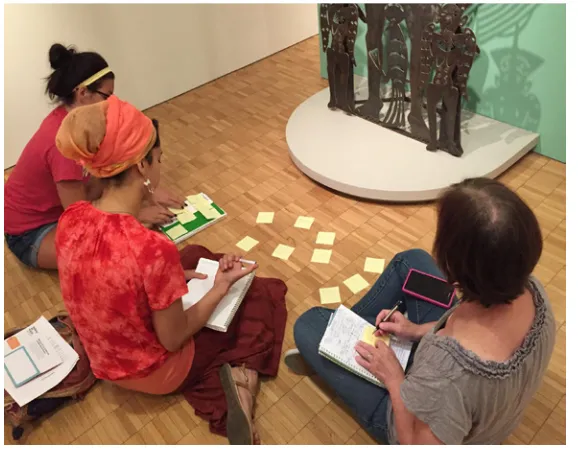
Even the youngest students are able to engage in conversation about what is fair treatment (Carter & Curtis, 2008), and this concept can be investigated in actively creating, responding to, presenting, and connecting with artworks. Sometimes, it cannot be avoided. During the campaigns leading up to the 2016 presidential election, buildings on the very campus where I teach were sites for a nationally televised party debate and visits from both of the final presidential candidates. While exciting, these events displaced students and faculty, offered only limited opportunities for participation, and in one particular instance, inspired protest and art actions. Later, in early field experiences during the first week of November 2016, some of my students were surprised not only by a cooperating teacher’s request for assistance in helping elementary students create posters to encourage their parents and guardians to vote (Figure 9), but also by the students’ eagerness to discuss the upcoming presidential election and their strong opinions about the candidates.
The morning after the 2016 presidential election was surreal. I had been up at 3:00 am that morning, trying to figure out how to help students who would be heading back to field experiences with elementary students who I suspected may be rather upset, based on the previous week’s conversation. As MAVL students came into my classroom for their 8:00 am class, they were oddly silent. Some people were heartbroken, some people may have been excited but somewhat fearful of speaking up because of the opinions they had heard classmates share previously, and some students were just plain tired of all of the hoopla surrounding the election. I started by asking my students if they like to feel respected and if they like to feel heard. They all agreed. I asked them to remember that throughout the day, and challenged them to apply what they have learned so far and Figure 8. Elizabeth Herber’s portrait of Ruth Bader Ginsburg inspired by memes of
the justice as the Notorious R.B.G, a nickname derived from a Tumblr account of the same name.
We can talk about this.
References
Au, W. (2014). Rethinking multicultural education: Teaching for racial and cultural justice. Milwaukee, WI: Rethinking Schools.
Carter, M., & Curtis, D. (2008). Developmental themes, tasks, and goals in anti-bias work. In A. Pelo (Ed.), Rethinking early childhood education (pp. 13-16). Milwaukee, WI: Rethinking Schools.
Cosier, K., & Nemeth, J. (2010). Art teachers as change makers. In T. Anderson, D. Gussak, K. Hallmark, & A. Paul (Eds.), Art education for social justice (pp. 165-171). Reston, VA: National Art Education Association.
Cultures & Communities. (n.d.). Homepage: About Cultures & Communities. Retrieved from http://uwm.edu/cultures-communities/
Derman-Sparks, L., & Edwards, J. (2010). Anti-bias education for young children and ourselves. Washington, D.C.: National Association for the Education of Young Children.
Dweck, C. (2006). Mindset: The new psychology of success. New York, NY: Ballantine Books.
Dweck, C. (2015, September 22). Carol Dweck revisits the ‘growth
mindset.’ Education week. Retrieved from http://www.edweek.org/ew/ articles/2015/09/23/carol-dweck-revisits-the-growth-mindset.html Editors of Rethinking Schools. (2014). Editorial: Restorative justice. Rethinking Schools, 29(1). Retrieved from http://www.rethinkingschools.org/
Goodson, I. (2014). Curriculum, personal narrative, and the social future. New York, NY: Routledge.
Henderson, B., Meier, D., Perry, G., & Stremmel, A. (2012). The nature of teacher research. Voices of practitioners: Teacher research in early childhood education.
Retrieved from https://www.naeyc.org/files/naeyc/file/vop/ Nature%20of%20Teacher%20Research.pdf
Hetland, L., Winner, E., Veenema, S., & Sheridan, K. (2013). Studio thinking 2: The real benefits of art education. New York, NY: Teachers College Press.
Hutzel, K., & Shin, R. (2016). Mini theme information: New culture wars. Retrieved from http://jcrae.org/
National Center for Education Statistics. (2015). Indicators of school crime and safety: 2015. Retrieved from https://nces.ed.gov/
National Coalition for Core Arts Standards. (2014). Philosophical foundations and lifelong goals. Retrieved from http://www.nationalartsstandards.org/ content/resources
create spaces where people felt respected and heard, whether in class, on the street, or in the Union.
Figure 9. Working on a teacher requested “vote” poster in early field experiences. Author photograph.
Conclusion
While the role of art and the meanings of individual artworks can vary depending on context, artists humanize. Producing, presenting, responding to, and connecting with art are humanizing acts.
Multicultural art learning presents opportunities to seek information, feel discomfort and wonder, and participate in dialogues by telling our stories and engaging with points of view other than our own. Through recounting impactful moments within my courses, I described how I worked to face the challenge of responsible engagement with multicultural art learning, which can inform and transform perspectives within Culture Wars. In doing so, I invite educators who participate in sections of Multicultural Art and Visual
Learning – or other courses like it – to approach art experiences with
Plett, H. (2015, March 11). What it means to “hold space” for people, plus eight tips to do it well [Web log post]. Retrieved from http://heatherplett. com/
Rosales, J. (2016, July 2). Challenging institutional racism in education. Retrieved from http://www.nea.org/
Whitehead, J. (2012). Counternarratives: Considering urban students’ voices in art education. In K. Hutzel, F. Bastos, & K. Cosier (Eds.), Transforming city schools through art (pp. 34-42). New York, NY: Teachers College Press.
Wisconsin Department of Public Instruction. (2016). Milwaukee district report card 2015-2016 summary. Retrieved from https://apps2.dpi.wi.gov/ reportcards/