I
What do predators eat for supper'?I
:·
. .
·-Burkes Pass Scenic Reserve predator stomach content
analysis for 2010-2011
by
Emily D. Fountain, Andrew R. Pugh and Mike H. Bowie
ISSN: 1177-6242 (Print) ISSN: 1179-7738 (Digital) ISBN: 978-0-86476-315-0 (Print) ISBN: 978-0-86476-316-7 (Digital)
Lincoln University Wildlife Management Report No. 51
What do predators eat for supper?
Burkes Pass Scenic Reserve predator stomach content analysis
for 2010-2011
by
Emily D. Fountain1, Andrew R. Pugh2 and Mike H. Bowie1
1
Department of Ecology, Lincoln University, PO Box 84, Lincorn 7647 2
Bio-Protection Research Centre, Lincoln University, PO Box 84, Lincoln 7647 [email protected]
[email protected] [email protected]
Prepared for:
Environment Canterbury
What do predators eat for supper?
Burkes Pass Scenic Reserve predator stomach content analysis for 2010-2011
Emily D. Fountain, Andrew R. Pugh and Mike H. Bowie
Abstract
Burkes Pass Scenic Reserve, Mackenzie Basin, New Zealand is home to the only known
population of the critically endangered Canterbury knobbled weevil, Hadramphus tuberculatus.
Major threats to the weevil include introduced predators and habitat loss through weed
invasion, herbivores and fire. This report investigates the stomach contents of predators
trapped in a 185 hectare perimeter around the reserve. Trapping was conducted by
Environment Canterbury from December 2010 to April 2011. The stomachs of hedgehogs,
ferrets, feral cats and stoats were analysed and contents were recorded. Hedgehogs consumed
the highest amount of invertebrates, present in 20%, and ferrets were the most abundant
predator caught; however, no evidence of H. tuberculatus was found in any predator stomachs.
We suggest predator trapping continue as part of future management of the reserve to protect
not only the endangered weevil species but also other fauna including the recently identified
and possibly rare invertebrates and the endemic skink found there.
Introduction
The Canterbury knobbled weevil, Hadramphus tuberculatus (Pascoe 1877) (Coleoptera:
Curculionidae: Molytinae), is perhaps the rarest species in its genus, consisting of only one
known population. Last sighted in the 1920s, it was presumed extinct by the late 1990s and
listed as extinct on the IUCN red list. However, in 2004 it was rediscovered at Burkes Pass
Scenic Reserve, Mackenzie County (Young et al. 2008). Hadramphus tuberculatus is the only
species in the genus to be found in subalpine tussock grasslands rather than coastal habitats.
Based on evidence from Holocene fossils and museum records, it was once distributed
throughout the Canterbury Plains and surrounding hills despite now being confined to only one
region (Kuschel and Worthy 1996).
Monitoring of the weevil population has occurred in 2006, 2007, 2009, 2010, and 2011 using
non-lethal pitfall trapping (Johns 2006, lies 2007, Fountain 2008, Fountain 2013). The results of
monitoring consistently return low population numbers ranging from 6 to 45 individuals in a
season. Hadramphus tuberculatus is considered threatened by habitat modification and
introduced predators. The conservation status of the weevil is critically endangered (Leschen et
al. 2012).
The suite of introduced mammalian species in New Zealand is a well-known threat to
biodiversity. A number of these introduced mammals occur within the Burkes Pass Scenic
Reserve and the surrounding area. Of particular concern, in this context, are those introduced
mammals that may negatively impact on the Canterbury knobbled weevil, either directly or
indirectly. Hedgehogs (Erinaceus europaeus), rats (Rattus spp.), and mice (Mus musculus) are
known to frequently consume invertebrates (Taylor and Thomas 1993, Moss and Sanders 2001,
Ruscoe 2001, Towns and Broome 2003, Jones et al. 2005). These mammals also consume plant
material (Moss and Sanders 2001, Ruscoe 2001, Towns and Broome 2003), with rats also readily
predating upon birds (Brown et al. 2008). Another species in the Hadramphus genus, H.
stilbocarpae, experienced marked declines in population size due to rats (Taylor and Thomas
1993, Towns 2009) indicating rats as a very likely predator of H. tuberculatus. Ferrets (Mustela
furo), stoats (Mustela ermine), and cats (Fe/is catus) mainly prey on vertebrates such as birds,
lagomorphs, and rodents (Langham 1990, Murphy and Dowding 1994, Smith et al. 1995).
However, they are also recorded as consuming invertebrates, particularly insects such as weta
(Langham 1990, Murphy and Dowding 1994, Smith et al. 1995).
Two lagomorphs species rabbits (Oryctolagus cuniculus) and hares (Lepus europaeus), and
Bennett's wallaby (Macropus rufogriseus rufogriseus) are herbivorous (Norbury 2001, Sadleir
and Warburton 2001), and while they are unlikely to actively seek out invertebrates as a food
source, they could accidentally ingest them while consuming foliage. Potentially, these
lagomorphs and wallabies can negatively influence the recruitment of appropriate host plants
for invertebrates, particularly speargrass, Aciphylla aurea, host plant for the Canterbury
knobbled weevil.
Low population levels and the interest created from the rediscovery of the weevil are the basis
behind the predator trapping started by Environment Canterbury (ECan) in 2006-2007 as part
of the Biodiversity Pest Programme. Weevil monitoring, weed control and trapping at Burkes
Pass Scenic Reserve have a collaborative structure including the Department of Conversation
(DOC), Lincoln University (LU), and ECan. The surveying for the weevil and survey equipment is
handled by LU and DOC, weed control and predator trapping within the reserve since 2008 is
handled by DOC. Predator control is conducted by ECan and LU does the predator stomach
content analysis. Originally, ECan trapped within the reserve and 185 hectares of surrounding
pastural land; however, starting in October 2008 DOC Twizel has begun intensive trapping
within the reserve and ECan has continued to trap around the reserve.
This report documents the results of stomach analysis of predators trapped by ECan for the
offer future management suggestions to help reduce the impact of introduced predators not
only on H. tuberculatus but the other valuable biodiversity within Burkes Pass Scenic Reserve.
Methods
Site information: Burkes Pass Scenic Reserve and surrounding area
Burkes Pass Scenic Reserve is a small (12.4 hectare) tussock grassland reserve in the Mackenzie
Basin, South Island (Department of Conservation 2000), and home to the only known
population of H. tuberculatus. At "'700 m altitude, the reserve is situated directly alongside the
main road to Lake Tekapo (SH 78) and surrounded by farms on all sides but one, which is a
small introduced pine plantation. The reserve is a mix of Chionochloa rigida (tall tussock), and
Festuca novae-zelandiae (short tussock) grassland with Discaria toumatou (matagouri), as well
as Aciphylla aurea. The Reserve has an extensive history of burning and livestock grazing
(McEwen 1987), however, in the last 20 years the reserve has only one fire record that occurred
in 2005 and was ignited by a spark from a passing bus. Although extensive trapping for
introduced predators occurs inside and outside the Reserve, and spraying for introduced weeds
within the reserve, the reserve is still heavily grazed by introduced rabbits and wallabies and
has several introduced plant species, including lupins, broom and wilding pines (Department of
Conservation 2000).
Glenrock and Holbrook Station surround the Reserve; both areas are grazed by livestock. A
small extension of the population of weevils is known to be found at Holbrook Station,
discovered by Fountain (2013) in 2009. Holbrook Station has been under tenure review and is
anticipated to become DOC land in 2013. The small pine plantation to the east of the Reserve is
managed by the Mackenzie District Council.
Trapping
Predator trapping occurred 13 December 2010 to 1 April 2011. Livestock was not grazed in the
trapping area while trapping was conducted. Ninety traps and approximately 250 rodent bait
stations were used. Hedgehogs, feral cats, ferrets, stoats, and weasel were targeted by traps
baited with fresh rabbit meat running in a pulsed campaign over a total of 18 nights. Rats and
mice were targeted by Ditrac rodent baits. Trapping was done by independent contractor,
Excell Pest Control Ltd.
Stomach analysis
Frozen stomachs were dissected and contents analysed. If the intestines contained material,
they were also analysed. Trap number, predator species and stomach contents were recorded.
Any invertebrate pieces found were kept and stored in 100% ethanol.
Results
A total of 158 individuals were caught and their stomachs dissected. Of those caught,
hedgehogs accounted for 37% of all predators, ferrets 53%, cats 7%, and stoats 3% (Table 1).
Table 1. Total number of each predator caught during the 2010-11 trapping season.
Predator No. caught
Ferret 84 Hedgehog 58
Cat 11
Stoat 5
Total 158
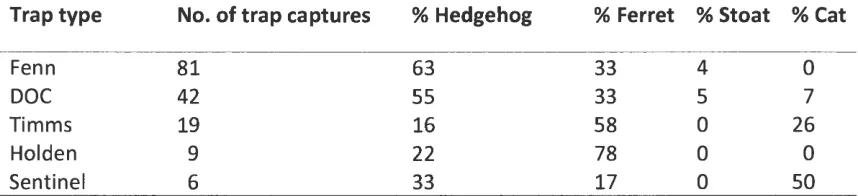
The traps that caught the highest percentage of hedgehogs were the Fenn and DOC traps, while
Timms and Holden traps worked best for ferrets (Table 2). Sentinel traps caught the highest
percentage of cats, while no traps appeared effective for stoats, possibly due to low stoat
numbers (Table 2).
Table 2. The number of trap captures by trap type and percentage of each predator caught by trap type.
Trap type No. of trap captures % Hedgehog % Ferret % Stoat %Cat
Fenn 81 63 33 4 0
DOC 42 55 33 5 7
Timms 19 16 58 0 26
Holden 9 22 78 0 0
Sentinel 6 33 17 0 50
Hedgehogs had the highest percentage of individuals with invertebrate bits in their stomachs
(20%) (Figurel). Cats had the second highest percentage (9%), while only 1% of ferrets had
invertebrate bits (Figure 1). No stoats contained invertebrate bits. Hedgehogs had identifiable
parts of earthworm, grasshoppers, weta, carabids and the manuka chafer beetle resulting in the
most diverse amount of invertebrates consumed. Skinks were predated by all predator species;
consumed the lowest amount of invertebrates with most consuming some type of rodent
indicated by the fur in the stomach and some bits able to be identified as mouse.
25
20
15
10
5
0
Percentage stomach contents
with invertebrate fragments
Hedgehog Ferret Stoat Cat
Figure 1. Four predators trapped adjacent to Burkes Pass Scenic Reserve and the percentage
that contained invertebrate fragments in their stomach contents.
Discussion
Trapping is effective at targeting hedgehogs, cats, mustelids, and rodents whereas poisoning
can target wallabies, rodents and rabbits. Shooting and hunting dogs may also be effective to
kill those predators found at Burkes Pass Reserve; however, in regards to cost-effectiveness and
ease, trapping and poisoning still seem the best options. The Fenn and DOC traps were the
most effective at capturing hedgehogs, the mammal most likely to pose a threat to the
Canterbury knobbled weevil of the animals provided for stomach content analysis in this report.
Since Fenn traps are being phased out due humaneness issues, we recommend they be
replaced with DOC traps which are just as effective in capturing targeted species. Sentinel traps
should continue to be used and possibly be bolstered with additional numbers for catching feral
cats.
The selection of Ditrac rodent baits is to be commended, due to the much shorter half-life of
this toxin and relatively low risk to non-target organisms compared to other anticoagulants
(Fisher et al. 2004, Fisher et al. 2007); however, other compounds are worth consideration such
as those based on cholecalciferol which have further reduced non-target effects (Eason et al.
2000).
As outlined already, rats can be an important invertebrate predator, linked to the decline of H.
stilbocarpae; therefore, having rat stomachs for future analysis is pertinent. Obtaining rat
stomachs may require, for a short time period, more regular checking of the traps when rats
are known to be abundant to ensure their collection before they become too decomposed.
For H. tuberculatus, the availability of A. aurea is crucial to its survival. Although introduced carnivorous predators are controlled within and around the reserve, a substantial problem with
wallabies, rabbits and hares feeding on the Aciphylla may threaten this weevil's long-term
survival. During monitoring of the population from 2009-2011, significant feeding damage on
the A. aurea population has been documented, intensive tracts of land have been dug up, high rabbit numbers have been seen, and also wallabies have been spotted (Fountain, pers. obs.). If
high numbers of herbivorous mammals continues, the A. aurea population may no longer be
able to sustain current numbers of H. tuberculatus in the future. An intensive eradication
programme needs to be created to focus on rabbits, hares, and wallabies. This would also be
beneficial for reducing disturbance to planned restoration plantings of Aciphylla within the
reserve.
The current predator trapping regime should continue to not only protect the future of the H.
tuberculatus but to also protect other endemic species and possibly unidentified, data deficient
species. In 2010, Rowland (2010) collected other invertebrates found in-m-e--Reserve and m
t
n-e---surrounding area. Two new species were identified by Peter Johns, Prodontria sp. and Ho/caspis
sp., and several other invertebrates still remain to be identified. As new species, no information
such as their geographic range or abundance is known so preventing these species from being
consumed would allow time for this information to be gathered. A range of invertebrate parts
were identifiable as grasshopper, weta, carabid, cicada, manuka chafer beetle and earthworms
indicating most large invertebrates are at risk of predation. Additionally, endemic skinks are
being consumed at high numbers, particularly by feral cats, with one cat stomach containing 18
skinks. A continued predator trapping programme would help protect all endemic species from
predation.
Although this report failed to find proof of the Canterbury knobbled weevils in the gut contents
of predators, absence of evidence is not evidence of absence. Given the low population
numbers of the endangered weevil and that its host-plant is hard to access for most predators,
finding identifiable weevil parts is probably unlikely. However, we believe the precautionary
principle should be applied, with trapping and poisoning of potential predators continuing to
Specific Management Recommendations
• Continue predator trapping within and around Burkes Pass Scenic Reserve.
• Phase out Fenn traps and replace with DOC 250 traps.
• If possible, obtain rat stomachs for content analysis.
• Wallaby, hare, and rabbit control within and around the Reserve.
Acknowledgements
We would like to thank Environment Canterbury for provided the funding for this project, in particular Phil Cochrane, but also Brent Glentworth arranging the trapping and stomachs for dissection.
References
Brown, K., H. Moller, J. Innes, and P. Jansen. 2008. Identifying predators at nests of small birds in a New Zealand forest. Ibis 140:274-279.
Department of Conservation. 2000. Policies and Plans: Land Unit: 138011, Burkes Pass Scenic Reserve. Canterbury Conservation Management Strategy.
Eason, C., M. Wickstrom, R. Henderson, L. Milne, and D. Arthur. 2000. Non-target and secondary poisoning risks associated with cholecalciferol. New Zealand Plant Protection 53:299-304. Fisher, P., C. O'Connor, G. Wright, and C. Eason. 2004. Anticoagulant residues in rats and secondary
non-target risk. Department of Conservation.
Fisher, P., E. B. Spurr, S. C. Ogilvie, and C. T. Eason. 2007. Bait consumption and residual concentrations of diphacinone in the Wellington tree weta (Hemideina crassidens)(Orthoptera:
Anostostomatidae). New Zealand Journal of Ecology 31:104.
Fountain, E. D. 2008. The search for Hadramphus tuberculatus and the future of this nationally
endangered weevil. Unpublished report for Lincoln University.
Fountain, E. D. 2013. Time travelling weevils: Unravelling the evolutionary past of Hadramphus using
historical and modern DNA. Lincoln University.
lies, J. 2007. Conservation and biology of the rediscovered nationally endangered Canterbury knobbled weevil, Hadramphus tuberculatus. Unpublished report for Lincoln University.
Johns, P. M. 2006. Burkes Pass Scenic Reserve: Report on the endangered weevil Hadramphus tuberculatus. Unpublished report for Department of Conservation, Christchurch.
Jones, C., K. Moss, and M. Sanders. 2005. Diet of hedgehogs (Erinaceus europaeus) in the upper Waitaki Basin, New Zealand: implications for conservation. New Zealand Journal of Ecology 29:29-35. Kuschel, G. and T. H. Worthy. 1996. Past distribution of large weevils (Coleoptera: Curculionidae) in the
South Island, New Zealand, based on Holocene fossil remains. New Zealand Entomologist 19:15-22.
Langham, N. 1990. The diet of feral cats (Felis catus L.) on Hawke's Bay farmland, New Zealand. New Zealand Journal of Zoology 17:243-255.
Leschen, R. A. B., J. W. M. Marris, R. M. Emberson, J. Nunn, R. A. Hitchmough, and I. A. N. Stringer. 2012.
The conservation status of New Zealand Coleoptera. New Zealand Entomologist 35:91-98. McEwen, W. M. 1987. Ecological Regions and Districts of New Zealand. Number 4. Department of
Conservation, Biological Resource Centre, Wellington.
Moss, K. and M. Sanders. 2001. Advances in New Zealand mammalogy 1990-2000: hedgehog. Journal of the Royal Society of New Zealand 31:31-42.
Murphy, E. C. and J. E. Dowding. 1994. Range and diet of stoats (Mustela erminea) in a New Zealand beech forest. New Zealand Journal of Ecology 18:11-18.
Norbury, G. 2001. Advances in New Zealand mammalogy 1990-2000: lagomorphs. Journal of the Royal Society of New Zealand 31:83-97.
Rowland, S. 2010. The search for Hadramphus tuberculatus in significant patches of Aciphylla in Canterbury, New Zealand. Unpublished Summer Scholar Report. Lincoln University, New Zealand.
Ruscoe, W. 2001. Advances in New Zealand mammalogy 1990-2000: house mouse. Journal of the Royal Society of New Zealand 31:127-134.
Sadleir, R. and B. Warburton. 2001. Advances in New Zealand mammalogy 1990-2000: wallabies. Journal of the Royal Society of New Zealand 31:7-14.
Smith, G., J. Ragg, H. Moller, and K. Waldrup. 1995. Diet of feral ferrets (Mustela furo) from pastoral habitats in Otago and Southland, New Zealand. New Zealand Journal of Zoology 22:363-369. Taylor, R. H. and B. W. Thomas. 1993. Rats eradicated from rugged Breaksea island (170 ha), Fiordland,
New Zealand. Biological Conservation 65:191-198.
Towns, D. 2009. Eradications as reverse invasions: lessons from Pacific rat (Rattus exulans) removals on New Zealand islands. Biological Invasions 11:1719-1733.
Towns, D. R. and K. G. Broome. 2003. From small Maria to massive Campbell: forty years of rat eradications from New Zealand islands. New Zealand Journal of Zoology 30:377-398.