Improved Algorithm for Separating Latent Overlapped
Fingerprints
1
Abhishek Pawar , 2 Mangala Madankar
1 Department of Computer Science and Engineering, G. H. Raisoni College of Engineering, Nagpur University
Nagpur, Maharashtra, India
2 Department of Computer Science and Engineering, G. H. Raisoni College of Engineering, Nagpur University
Nagpur, Maharashtra, India
Abstract -
Latent Overlapped fingerprints are frequently encountered in latent fingerprints lifted from crime scenes. Overlapping occurs when the same location of an object is touched by one or more fingers several times. It is necessary to separate such latent overlapped fingerprints into component fingerprints so that existing fingerprint matchers can recognize them. In fact, fingerprint examiners usually do not collect latent overlapped fingerprints since they are too complicated to process. Thus it is desired to develop an algorithm to separate the overlapped fingerprints into individual fingerprints in order to reduce the labour of fingerprint examiners. A new approach for separating latent overlapped fingerprints are proposed to improve the perfection of the separating algorithms by overcoming the difficiency in principal component analysis (PCA) technique. A new method provides robustness and efficiency to the system.
Keywords - Overlapped Fingerprints, Gabor Filters, Principal Component Analysis, Minutia.
1. Introduction
A fingerprint is the unique feature pattern of one finger. It is an impression of the friction ridges and furrows on all parts of a finger. A ridge is defined as a single curved segment while a valley is the region between two adjacent ridges. Biometrics is the science of uniquely recognizing characteristics of the humans based upon one or more intrinsic physical or behavioral traits. Fingerprint is mostly used trait in biometric recognition. Thanks to its uniqueness and persistence, fingerprint recognition and separation has been successfully deployed in most of the applications, such as entry control, time and forensics, attendance, computer login and airport security. Although fingerprint recognition and separation technology has
advanced rapidly in the past 40 years, there are still some challenging research problems. One of the challenging problem is received little attention in the processing and matching of latent fingerprints. [1]
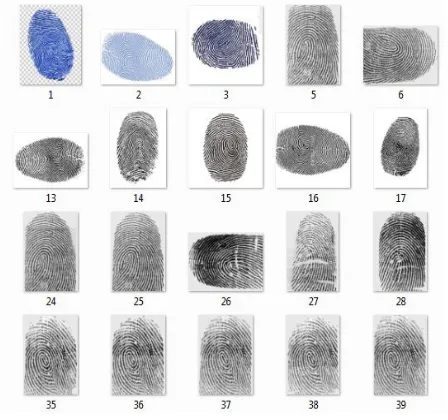
Fig. 1. Different types of fingerprint.
countless sources available for collection, and their established use and collections by law of immigration and enforcement. [2]
A distinctive feature of fingerprint lies in the high degree of difficulty in terms of forgery, along with the fact that fingerprints are specific to every other person. In fact, an outstanding source of entropy is provide by fingerprint, which makes it an excellent candidate for security applications. Users cannot transfer their fingerprint attributes to others as easily as they do with their passwords or cards. [3]
Latent overlapped fingerprints are lifted from surfaces of objects that are accidentally touched by a person. This is attained through a variety of means ranging from simply recording the print to more complex dusting or chemical processing. Compared with fingerprints captured using live scan or inking techniques, automatic feature extraction from latent fingerprints is very difficult due to small finger area, unclear ridge structures, and complex background patterns. [4]
Overlapping occurs when the same location of an object is touched by one or more fingers several times. Thus it is very common at crime scenes. Thus it is necessary to develop an algorithm to separate the overlapped fingerprints into individual fingerprints in order to reduce the labor of fingerprint examiners. [5]
Fig. 2. Latent Overlapped Fingerprint.
The features of the fingerprint are-
• A fingerprint is the reproduction of the fingertip epidermis, produced when a finger is pressed against a smooth surface.
• The most transparent structural characteristic of a fingerprint is its pattern of interleaved ridges and valleys.
Fig. 3. Ridges and valleys on a fingerprint image.
• Valleys and Ridges often run parallel but sometimes they can bifurcate or terminate abruptly.
• The minutia, which is created when valleys and ridges bifurcate or terminate, is important feature for matching algorithms.
Fig. 4. (a) Termination minutia (b) bifurcation minutia (c) termination (white) and bifurcation (grey) minutia.
2. Literature Survey
In 2011, [7] Author Yuan Shi, Jianjiang Feng, Jie Zhou says separated overlapped fingerprints into component fingerprint is very useful in latent They proposed an algorithm for separating overlapped fingerprints, which outperforms the state of the art method in both perfection and efficiency. In addition, their method does not require the information of singular points, and thus costs less human labour. There are still limitations in their method. Initial orientations in the overlapped blocks have a large influence on the separation performance. As a future work, they will explore how to estimate the initial orientation more accurately. The current separation algorithm is not yet fully automatic. The region masks of the two components fingerprints must be marked manually. As another future work, they plan to develop a fully automatic separating algorithm which can estimate the region masks of component fingerprints automatically.
In 2012, [8] Author Qijun Zhao and Anil K. Jain says overlapping latent fingerprints are usually encountered at crime scenes. The identification or verification of component fingerprints, both by AFIS and by latent examiners, is very challenging because of the poor quality, complex background and contaminated ridge structures. They have proposed a model based method for separating overlapping latent fingerprints. This proposed algorithm remodel the orientation field of overlapping fingerprints based on a set of manually marked attributes, including regions of interest, singular points, and orientation cues. Based on the basic model of fingerprint ridge orientation field, the proposed method can simultaneously predict unfamiliar orientations in fingerprints and regularize and real overlapping latent’s demonstrate that the proposed method, compared to state-of-the-art relaxation labelling based method, is more effective, thanks to the manually marked cues and the underlying orientation field models. The fingerprint orientation field models have been commonly used for stabling the estimation of fingerprint ridge orientation field. They employed the models not just for regularization, but also for predicting unknown orientations.
In 2012, [9] Author Yuan Shi, Jianjiang Feng and Jie Zhou says separating overlapped fingerprints into component fingerprints is very useful in latent fingerprint recognition. Although a few preliminary studies on this topic have been published, these algorithms are not robust for realistic latent overlapped fingerprints. They proposed a robust and efficient relaxation labelling algorithm to estimate the component orientation fields of latent overlapped fingerprints. With component orientation field correctly estimated, obtaining component fingerprints becomes a straightforward task. They also proposed two
improved forms of the basic algorithm to better handle two special cases of overlapping:
1) the mated template fingerprint of one component fingerprint is familiar and
2) the two component fingerprints are from the same finger.
Experiments on both simulated and real overlapped fingerprint databases demonstrated that the basic algorithm performs better than the state of the art method in both accuracy and efficiency. The two improved versions of algorithm also perform better than the existing basic algorithm in respective cases. To encourage further research on this important and challenging topic, they have made both the real and simulated overlapped fingerprint databases publicly available. There are still some limitations in this method. Initial orientation estimation has a large influence on the separation performance of the current algorithm. However, it is very hard for local operator (such as local Fourier analysis) to correctly estimate initial orientation from poor quality latent fingerprints. The current algorithm cannot deal with latent images with more than two latent overlapped fingerprints or latent images with two overlapped fingerprints and structured noise. As a future work, they plan to study global fingerprint orientation field model and develop more robust separating algorithms. The current algorithm also does not perform very well if the overlapped region contains singular points. It is mainly because the assumption that the two overlapped orientations should be different does not hold around overlapped singular points. A possible solution is to detect overlapped singular points using a robust singular point detector and then explicitly consider the impact of singular points. Another limitation of the current separation algorithm is that it is not yet fully automatic. The region masks of the two component fingerprints must be marked manually. Our long term goal is to develop a fully automatic separating algorithm which demands no input from human. But because the quality of latent fingerprints varies significantly, it is not practical to develop a single separating algorithm that works for all the latent overlapped fingerprints. Thus, we will also explore more efficient human interaction.
algorithm for latent overlapped fingerprints based on adaptive orientation model fitting. The proposed algorithm requires nothing additional input other than the region masks. The algorithm estimates the initial orientation fields in an elaborate approach and separates the two orientation fields through an iterative correction process, during which the objective function is modified to reduce the impact of redundant structures. The separated off’s are further smoothed via OF models. We test two kinds of polynomial OF models with different orders on the Tsinghua OLF database, which is the only publicly available latent overlapped fingerprint data set currently. Experimental results show that the proposed algorithm performs fare as compared to the state-of-the-art method in terms of accuracy.’
3. Proposed Plan
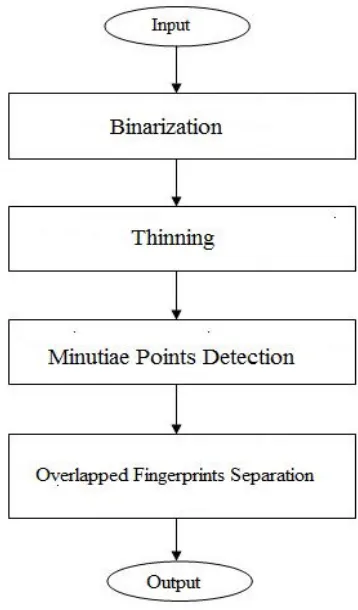
Our proposed plan gives the image of overlapped fingerprint. The following steps are involved in the proposed algorithm are:
a. First, the overlapped fingerprint image is divided into overlapped regions, non-overlapped regions, background regions of the two or more component fingerprints.
b. Second, initial orientation field (OF) (one orientation in the non-overlapped region and two or more orientations in the overlapped region) is estimated using local Fourier analysis.
c. Third, the mixed orientations in the overlapped area are separated into two or more components, one for each of the component fingerprint, by using a relaxation labeling method.
d. Finally, given the separated OFs, the two or more overlapped fingerprints are separated by filtering the latent overlapped fingerprint image with Gabor filters tuned to the OFs respectively.
4. Work Flow Chart of Proposed Plan
Fig. 5. Work flow chart of proposed plan.
5. Implementation
Our implementation consist of the following process: a. Binarization
b. Thinning
c. Minutiae Points Detection d. Overlapped fingerprint separation
5.1 Binarization
In Binarization, the grey scale image is changed to binary image. Binary images are easy to process. The basic principle for converting an image into binary are:
• to decide a threshold value
• then the pixels whose value are more than the threshold are changed to white pixels, and the pixels whose value are below or equal to the threshold value are converted to black pixels. • For better result, instead of calculating the
Then the window is transferred to the next position and image binarization is done. In this way the entire image is converted to binary.
Fig. 6. Binarized image.
5.2 Thinning
Thinning is a morphological operation that is helpful to eliminate selected foreground pixels from binary images. It can be used for several applications, but is particularly handy for skeletonization. In this mode it is commonly used to tidy up the output of edge detectors by lowering all lines to the single pixel thickness. Thinning is normally only applied to binary images, and produces another binary image as output.
Thinning algorithm is a multi-iterative algorithm which eliminates boundary points successively. Suppose goal points (ridge line) are marked as 1, and background points (valley line) are marked as 0. The boundary points are repeatedly operated as follows:
Step 1: Set the center point as H and the eight neighborhood points clockwise around H as H1, H2, ..., H8 as shown in Figure 3. If the following four conditions are satisfied at the same time, point H is deleted.
(a) 2≤N(H)≥6 (b) S(H)=l (c) H1•H3•H5=0 (d) H3•H5•H7=0
Fig. 7. Template of Thinning Algorithm.
where N (H) is the number of the non-zero points around H, and S (H) is the frequency of changes from 1 to 0 according to the sequence of H1, H2, ..., H8, H1. All the points that satisfy the conditions above are marked and deleted when all boundary points are checked.
Step 2. It is same to the first one, except that the condition (c) and (d) are changed as:
(c)H1•H3•H7=0 (d) H1•H5•H7=0
Several iterations should be performed until there is no point meeting these conditions. The ridge's skeleton is made up of the left points. In this way, thinning is done.
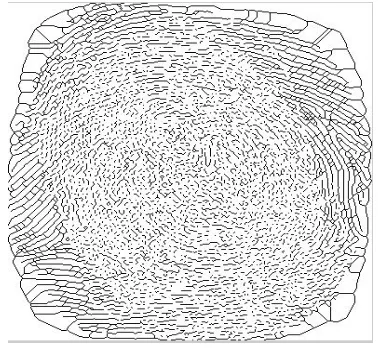
Fig. 8. Thinned Image.
5.3 Minutiae Points Detection
An accurate representation of the fingerprint image is critical to automatic fingerprint recognition or identification systems, because most deployed commercial large-scale systems are depends on the feature-based matching (correlation based techniques have problems as discussed in the previous section). Among all the fingerprint characteristics, minutiae point features with corresponding orientation maps are unique enough to differentiate amongst fingerprints robustly; the minutiae points features representation reduces the complex fingerprint recognition issue to a point pattern matching problem.
Most fingerprint minutiae points extraction methods are thinning-based where the skeletonization process transforms each ridge to one pixel wide.
Minutiae points are detected by: • detecting the end points and
• the end points are selected if they are having a single neighbor and
• the bifurcation points are selected if they have more than two neighbors.
Minutiae marking is done using templates for each 3 x 3 pixel window as follows.
If the central pixel is 1 and has exactly 3 one-value adjacent neighbors, then the central pixel is a ridge branch (Fig. 9).
Fig. 9. Template 1 of minutiae detection.
If the central pixel is 1 and has only 1 one-value adjacent neighbor, then the central pixel is a ridge ending (Fig. 10).
Fig. 10. Template 2 of minutiae detection.
There is one case where a general branch may be triple counted (Fig. 11). Suppose both the uppermost pixel with value 1 and the rightmost pixel with value 1 have another adjacent neighbor outside the 3x3 window due to some left over spikes, so the two pixels can be marked as branches too, but only one branch is located in the small region. Thus this is taken care of.
Fig. 11. Template 3 of minutiae detection.
Fig. 12. Minutiae points.
At this stage false ridge breaks due to insufficient amount of ink & ridge cross connections due to over inking are not totally reduced. Also some of the previous methods introduce some spurious minutia points in the image. So to keep the recognition system uniform these false minutiae need to be eliminated.
Here we first calculate the inter ridge distance R which is the average distance between two adjacent neighboring ridges. For this scan each row to determine the inter ridge distance using the formula:
• If b(bifurcation, termination) < R & the 2 minutia are in the same ridge then remove both of them
• If b(bifurcation, bifurcation) < R & the 2 minutia are in the same ridge them remove both of them • If b(termination, termination) ≈ R & their
directions are coincident with a small angle variation & no other termination is located between the two terminations then remove both of them
• If b(termination, termination) < R & the 2 minutiae are in the same ridge then remove both of them
where b(X, Y) is the distance between 2 minutia points.
5.4 Overlapped Fingerprint Separation
After successfully extracting the set of minutia points of overlapped fingerprint images to be separated, we perform Minutiae Matching of overlapped fingerprint image with the database of individual fingerprint.
We use an iterative ridge alignment algorithm to first align one set of minutiae with respect to other set and then execute an elastic match algorithm to count the number of matched minutiae pairs. When the feature of overlapped fingerprint is recognized and matched with any of the individual fingerprint in the database, then overlapped fingerprint can be separated.
Fig. 13. Separated fingerprints.
6. Results
In our experiments, 75-80 % of overlapped fingerprints samples are separated into individual fingerprints. Thus our proposed plan has 75-80 % accuracy rate as shown in Fig 14.
Fig. 14. Graph for overlapped fingerprint separation accuracy.
The proposed method is much faster than our previous method. The average time of the proposed algorithm (implemented in MATLAB) is about 5 seconds on a PC with 2.93 GHz CPU, while it is around 11 seconds for previous existing method.
7. Conclusions
Earlier there is no more work done on separating overlapped fingerprints. Earlier there is adaptive orientation model which cannot separate more than two fingerprints. Also they are not robust and efficient. The PCA subspace projection is not strong enough to keep the orientation models to be fingerprint-like, which leads some of the separating results not having valid fingerprint flow patterns. It may be possible to implement proposed algorithm for separating latent overlapped fingerprints, several overlapped fingerprints separation algorithms have been proposed. However, they are not yet fully automatic, and different levels of human interventions are required. We proposed the usage of Independent Component Analysis (ICA) to separate latent overlapped fingerprints, but they provided neither algorithm details, nor a thorough experiment. We proposed a model based separation approach, which gives quite a noteworthy matching accuracy. However, this method requires additional manual markups of the orientation clues, which definitely increases the workload of examiners.
fingerprints. As a future study, we plan to study separation of bad quality fingerprints.
Acknowledgments
I would like to express my sincere and deep gratitude to my guide Mrs. Mangala Madankar, Assistant Professor in G. H. Raisoni College of Engineering Nagpur, Nagpur University, Maharashtra for the continuous support for my work. Her guidance helped me in all the time of research and writing of this paper.
References
[1] F. Chen, J. Feng, A. K. Jain, J. Zhou, and J. Zhang, “Separating overlapped fingerprints”, IEEE Trans. Inf. Forensics Security, vol. 6, no. 2, pp. 346–359, Jun. 2011.
[2] Le Hoang Thai and Ha Nhat Tam, “Fingerprint recognition using standardized fingerprint model”, International Journal of Computer Science Issues, Vol. 7, Issue 3, No 7, May 2010.
[3] M. Singh, D. K. Singh, and P. K. Kalra, “Fingerprint separation: An application of ICA”, in Proc. SPIE, Apr. 2008, p. 69820L.
[4] A. Rosenfeld, R. A. Hummel, and S. W. Zucker, “Scene labeling by relaxation operations”, IEEE Trans. Syst. Man, Cybern., vol. SMC-6, no. 6, pp. 420–433, Jun. 1976.
[5] A. Hyvärinen, J. Karhunen, and E. Oja, “Independent Component Analysis”, vol. 46. Hoboken, NJ, USA: Wiley, 2004.
[6] Fanglin Chen, Jianjiang Feng and Jie Zhou, “On separating overlapped fingerprints”, 978-1-4244-7580-3/10/$26.00 ©2010 IEEE.
[7] Yuan Shi, Jianjiang Feng and Jie Zhou, “Separating Overlapped Fingerprints Using Constrained Relaxation Labeling”, 978-1-4577-1359-0/11, 2011.
[8] Q. Zhao and A. K. Jain, “Model based separation of overlapping latent fingerprints”, IEEE Trans. Inf. Forensics Security, vol. 7, no. 3, pp. 904–918, Jun. 2012.
[9] Jianjiang Feng, Yuan Shi, and Jie Zhou, “Robust and Efficient Algorithms for Separating Latent Overlapped Fingerprints”, IEEE Transactions On Information Forensics And Security, Vol. 7, No. 5, October 2012. [10] Ning Zhang, Yali Zang, Xin Yang, Xiaofei Jia, and Jie
Tian, “Adaptive Orientation Model Fitting for Latent Overlapped Fingerprints Separation”, IEEE Transactions On Information Forensics And Security, Vol. 9, No. 10, October 2014.
[11] J. Feng, Y. Shi, and J. Zhou, “Robust and efficient algorithms for separating latent overlapped fingerprints”, IEEE Trans. Inf. Forensics Security, vol. 7, no. 5, pp. 1498–1510, Oct. 2012.
[12] Sangram Bana and Dr. Davinder Kaur, “Fingerprint Recognition using Image Segmentation”, International Journal Of Advanced Engineering Sciences And Technologies Vol No. 5, Issue No. 1, 012 – 023, 2011. [13] Jinwei Gu, Jie Zhou and Chunyu Yang, “Fingerprint
Recognition by Combining Global Structure and Local Cues”, IEEE Transaction On Image Processing, Vol. 15, No. 7, July 2006.
[14] R. Reka and Dr. S. Uma, “Automatic Overlapped Fingerprint Separation”, International Journal of Commerce, Business and Management (IJCBM), Vol. 1, No.1, 2012.
[15] Zin Mar Wini and Myint Myint Sein, “Texture Feature based Fingerprint Recognition for Low Quality Images”, 978-1-4577-1362-0/11, IEEE 2011.
[16] S. Arivazbagan, T.G. Arul Flora and L. Ganesan, “Fingerprint verification using Gabor co-occurrences features”, in: International Conference on Computational Intelligence and Multimedia Applications, pp. 281-285, 2007.