JETIR1512039 Journal of Emerging Technologies and Innovative Research (JETIR) www.jetir.org 223
Study of Process Parameters and Electrode Materials
used in Electro Discharge Machining
1
Jaykumar Mansukhlal Barochiya,
2Vijay D. Jadhav
1Post Graduation Student, 2Professor1Mechanical Engineering Department, 1
Karmaveer Bhaurao Patil College of Engineering, Satara, India
Abstract—Today's global market requires a good quality of the product in minimum time. Electrical discharge machining is an unconventional machining process, which is used when traditional machining process does not meet the necessary requirement effectively and economically. This process is used for machining of hard material and complex shapes. In this process material removal takes place thermo-electrically by a formation of a plasma channel between the workpiece and tool electrode surrounded by a dielectric fluid in the same tank. Determination of process parameters is essential for effective utilization of these parameters and it is also involved with many response parameters. This paper deals with the study of a various process parameters and electrode materials from various literatures in the field of electrical discharge machining. Optimization of machining parameters plays an important role to achieve a best quality product at a reasonable price.
Index Terms— EDM, optimization, process parameters, electrode materials
________________________________________________________________________________________________________
I. INTRODUCTION
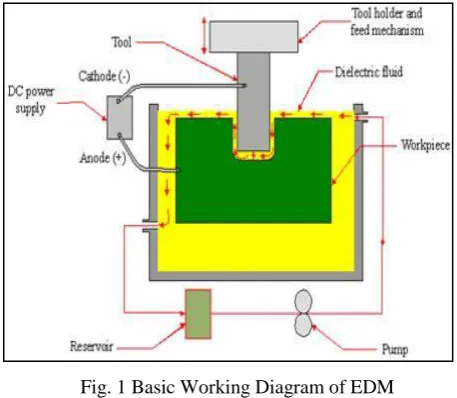
It is advanced thermal based machining process primarily used for machining materials which are difficult to machine with traditional techniques. In 1770, Joseph Priestly, a British first discovered the erosive effects of electrical discharges. In 1943, Soviet researchers B. Lazarenko and N. Lazarenko had described the destructive effect of an electrical discharge, further developed a controlled process for machining materials that are good conductors of electricity. However only electrically conducting, semiconducting materials can be machined by this process. High hardness and high toughness materials are machined by the electrical discharge machining process as it is difficult to be machined by turning, milling, drilling and by so other traditional machining processes. In EDM, there is no physical contact between tool and workpiece. This process is mostly suited for making intricate cavities and contours; these would be difficult to produce with normal machines like grinding end mills or other cutting tools. The shape of the obtained cavity is a replica of the shape of tools. All the conductive material can be worked by EDM. The EDM electrode is the tool that determines the shape of the cavity to be produced. The EDM setup consists of the tank in which the dielectric fluid is filled. Electrode & workpiece submerged into the dielectric fluid. The servo system is commanded by signals from gap voltage sensor system in the power supply, which controls the feed of electrode & workpiece to precisely match the rate of material removal. The power supply is an important part of any EDM system, which transforms the alternating current from the main utility supply into the pulse direct current required to produce the spark discharge at the machining gap. Materials of any hardness can be machined by this process. No burrs are left on a machined surface. One of the main advantages of this process is that thin and brittle components can be machined without distortion. Complex internal shapes can be machined. This process can only be employed in electrically conductive materials. The material removal rate is low. Compared to conventional machining processes this process is overall slow. Unwanted erosion and over cutting of material can occur. A rough surface finishes when at high rates of material removal.
II. WORKINGPRINCIPLEOFEDMPROCESS
JETIR1512039 Journal of Emerging Technologies and Innovative Research (JETIR) www.jetir.org 224 Fig. 1 Basic Working Diagram of EDM
The discharge current is the value of the applied current to the tool during the pulse on time in the EDM. It is one of the most primary input parameters of an electrical discharge machining process. Pulse on time is the time for which the electrode is applied a current during each EDM cycle. The material removal rate is directly proportional to a certain amount of energy applied during pulse on time. Pulse off time is the time waiting for the interval during two pulses on time period. Gap voltage is potential difference applied between the electrode and workpiece.
III. LITERATURESURVEY
A. P. Tiwary et al. (2014) [1] investigated micro-electro-discharge machining process parameters during machining of Ti-6Al-4V using combined methods of RSM and fuzzy technique. Experimentations were carried out on the basis of DOE. To select the most desirable factor level combinations a fuzzy-TOPSIS method was used. The micro-EDM process, which influence MRR, TWR, OC, and taper. Order of micro-EDM process parameters considered in this study in terms of their importance has been observed as a pulse on time, peak current, gap voltage and flushing pressure. The outcome of this research can be utilized in micro manufacturing industries and other researchers to improve the geometrical accuracy and precision of the machined through micro-hole.
Rajesh Khanna et al. (2015) [2] studied the response variables material removal rate and tool wear rate correlate the machining parameters such as a pulse on-time, pulse off-time, and water pressure, in the Electro discharge machining of drilling process of Al-7075. Brass rod of 2 mm diameter was selected as a tool electrode. An experimental plan was planned based on Taguchi method. The optimization results showed that the combination of maximum pulse on-time and minimum pulse off-time gives maximum MRR. Tool wear rate was most significantly affected by pulse on-time, pulse off-time. Multi-quality characteristics for the same material considering material removal rate and tool wear rate were given as under by Taguchi grey relational analysis. The predicted value of grey relational grade is 0.685120. The experimental value at the optimal setting was observed to be 0.0359 mm3/min and 0.252 g/s for MRR and TWR.
Jong Hyuk Jung et al. (2010) [3] studied optimal machining conditions for drilling of a micro-hole of minimum diameter and maximum aspect ratio. The Taguchi method was employed to determine the relations between the machining parameters and the process characteristics. The electrode wear and the entrance and exit clearances had a significant effect on the diameter when the diameter of the electrode is identical of the micro-hole. Grey relational analysis was used to determine the machining parameters affecting the electrode wear and the entrance and exit clearances. Input voltage and the capacitance was found the most significant controlling parameters. A micro-hole of 40μm average diameter and an aspect ratio of 10 could be machined under these conditions.
Yan-Cherng Lin et al. (2009) [4] investigated a novel process of magnetic-force-assisted electrical discharge machining. MRR of the magnetic-assisted EDM were found nearly three times compared to conventional EDM, and the SR was less than that of conventional EDM. The machined surface was found smoother than conventional EDM and surface crack were reduced in magnetic-force-assisted EDM process. ANOVA results indicated that the peak current, pulse duration, and no load voltage were the significant machining parameters that obviously affected the multiple performance characteristics in the magnetic-force-assisted EDM process.
The Anirban Bhattacharya et al. (2012) [5] investigation were carried to identify the appropriate parameter settings for rough and finish machined surface. The MRR was found to be dependent upon pulse off and on time and current. But, SR was significantly affected by pulse on-time, current, and powder and the combined effect of the workpiece, powder, and the electrode. EN31 results in maximum MRR as compared to the other two materials for similar process settings. Copper electrode used with aluminum powder suspended in the dielectric maximized the MRR, were as graphite powder resulted in a lower MRR but improved surface finish. The MRR for H11 was lower than EN31 but significantly higher than HCHCr under similar process condition.
JETIR1512039 Journal of Emerging Technologies and Innovative Research (JETIR) www.jetir.org 225 consistent result. The researcher can attempt to consider the other performance criteria, such as surface waviness, and surface flatness as output parameters in their studies.
T. A. El-Taweel (2009) [7] investigated MRR and TWR in EDM process of CK45 steel using Al–Cu–Si–TiC P/M electrode which were modeled and analyzed through RSM. TiC percent, peak current, dielectric flushing pressure, and pulse on-time were been employed to carry out the experimental study. Al–Cu–Si–TiC P/M electrodes was found more sensitive to peak current and pulse on-time than any other conventional electrodes. Peak current was found to be an important factor affecting both MRR and TWR, were flushing pressure was found to have little effect.
S. Singh (2012) [8] applied the designs of experiments and grey relational analysis approach to optimize parameters for machining of 6061Al/Al2O3p/20P aluminum metal matrix composites. The L18 orthogonal array was planned to determine an optimal setting. Experimental results have shown clearly that the material removal rate, tool wear rate and surface roughness in the EDM process can be improved effectively through the grey relational analysis approach. An optimal combination of machining parameters was determined by grey relational analysis for multiple performance characteristics.
Yu Huang et al. (2013) [9] studied the effect of cutting parameters on surface roughness, material removal rate and average gap voltage in the WEDM of high hardness tool steel YG15, which are experimentally investigated for both rough cutting and finish cutting. On rough cutting the pulse-on time has the important effect on Ra, and the effects of a pulse on time, pulse off time, and cutting feed rate were more important than wire tension, wire speed, and water pressure on MRR. On finish cutting, power and cutting feed rate had the extremely important effect on Ra; and pulse-on time, cutting feed rate, and water pressure were more important than other factors on MRR. The ANOVA for regression analysis indicated that the estimated model for MRR on rough cutting and for Ra on finish cutting were significant.
Thella Babu Rao et al. (2013) [10] investigated compliance of an integrated approach, principal component analysis coupled. Taguchi’s robust theory for simultaneous optimization of correlated multiple responses of wire electrical discharge machining process for machining SiCP reinforced ZC63 metal matrix composites. PCA was used as multi-response optimization technique to derive the composite principal component which acts as the overall quality index in the process. Taguchi’s S/N ratio analysis was applied to optimize the CPC. The derived optimal process responses were confirmed by the experimental validation tests results. The analysis of variance was conducted to find the effects of choosing process variables on the overall quality of the machined component. This methodology could be also applied for different machining process on different materials in different machining conditions so as to automate the machining process based on the chosen optimal values.
IV. EFFECTOFVARIOUSPROCESSPARAMETERSONRESPONSES
Surface roughness decreases when there is a decrease in peak current as well as a pulse on time. For surface roughness peak current and duty cycle are primarily important to maintain it in desired levels. As compared to pulse off time current has the largest effect on the surface roughness. A Less rough surface can be obtained by setting small pulse duration period along with relatively high enough discharge current. Highest current improves material removal rate, but surface roughness and electrode wear rate also increases. With the increase in the pulse off time, the spark contact time within the workpiece decreases and it will decrease the material removal rate. Material removal rate steadily increases with increase in discharge current and duty cycle. At lowest pulse off time tool wear is constant or null, but it decreases with increase in pulse off time. The pulse current only has more influence on electrode wear rate, where a pulse on time has less effect on it. Tool wear rate is lowered by applying low current level with long pulses. Electrode wear is less when the pulse is on and respectively it is null when a pulse is off.
V. COMPARISION OF DIFFERENT ELECTRODE MATERIALS
In early days, metallic electrodes were used mostly then today recently used. The advantage of a metallic electrode is electrical conductivity and mechanical integrity. Disadvantages of these metallic electrodes were they were difficult to fabricate and low cutting speed. Brass has a high degree of stiffness than copper, so it is easier to machine. Brass is mostly used for high-speed small hole machines. Due to poor electrical conductivity for tungsten, it cuts material very slowly then brass and copper. Graphite electrodes are preferred for all sinker EDM applications. Graphite has the low mechanical strength than any other metallic electrodes. Copper has a good structural integrity. Copper generally wear more than the graphite. Graphite has faster speed than copper for roughing and finishing. Likewise, a metallic electrode the graphite does not have to be de-burred, which results in reducing its manufacturing cost. Both copper and graphite tools, average machining voltage has less effect on material removal rate and surface roughness. Increasing discharge current with copper electrode there is a high material rate of removal were as brass gives fine surface finish and normal material removal rate. Copper has the major advantages over graphite due to it performs better in discharge dressing.
VI. DIFFERENT OPTIMIZATION METHODS
JETIR1512039 Journal of Emerging Technologies and Innovative Research (JETIR) www.jetir.org 226 Artificial bee colony algorithm is also a good and successfully applied the method to find out the best optimal process parameters of muli-response. The genetic algorithm is a probabilistic search method that transforms a set of mathematical objects within the associated fitness value, into the new population of offspring objects.
VII. CONCLUSION
The present paper gives a study on optimization of various machining parameters on EDM. From literature review, it is observed that, there is lot of work done on various work pieces which are difficult to be machined by conventional machining. Various electrodes used are graphite, brass, copper and aluminum. For optimization purpose, mostly Taguchi technique is used. But also there are some other techniques used such as Grey relational analysis, Response surface methodology, Genetic algorithm and artificial neutral network. So, from above literature review, it is concluded that materials that are difficult to be machined by traditional machining, can be machined by non-traditional machining i.e.by using Electro Discharge Machining process. Review shows that Optimization is one of the most useful tools used in production sectors to get at the best manufacturing conditions, which is a need for industries towards manufacturing of quality products at lowest cost. Limited work has been done on OHNS materials. OHNS-O2 grade has been machined in electrical discharge machine and has wide applications in the industrial field.
REFERENCES
[1] A.P.Tiwary, B.B Pradhan, B.Bhattacharyya, “Application of multi-criteria decision making methods for selection of micro-EDM process parameters” Adv. Manuf. (2014) 2:251–258
[2] Rajesh Khanna, Anish Kumar, Mohinder Pal Garg, Ajit Singh, Neeraj Sharma, “Multiple performance characteristics optimization for Al 7075 on electric discharge drilling by Taguchi grey relational theory” J Ind Eng Int 29 April 2015
[3] Jong Hyuk Jung, Won Tae Kwon, “Optimization of EDM process for multiple performance characteristics using Taguchi method and Grey relational analysis” Journal of Mechanical Science and Technology 24 (5) (2010) 1083-1090
[4] Yan-Cherng Lin, Ho-Shiun Lee, “Optimization of machining parameters using magnetic-force-assisted EDM based on gray relational analysis” Int J Adv Manuf Technol (2009) 42:1052–1064
[5] Anirban Bhattacharya, Ajay Batish, Gurmail Singh, V. K. Singla, “Optimal parameter settings for rough and finish machining of die steels in powder-mixed EDM” Int J Adv Manuf Technol (2012) 61:537–548
[6] R.Ramakrishnan, L.Karunamoorthy, “Multi response optimization of wire EDM operations using robust design of experiments” Int J Adv Manuf Technol (2006) 29: 105–112
[7] T.A.El-Taweel, “Multi-response optimization of EDM with Al–Cu–Si–TiC P/M composite electrode” Int J Adv Manuf Technol (2009) 44:100–113
[8] S. Singh, “Optimization of machining characteristics in electric discharge machining of 6061Al/Al2O3p/20P composites by grey relational analysis” Int J Adv Manuf Technol (2012) 63:1191–1202
[9] Yu Huang, Wuyi Ming, Jianwen Guo, Zhen Zhang, Guangdou Liu, Mingzhen Li, Guojun Zhang, “Optimization of cutting conditions of YG15 on rough and finish cutting in WEDM based on statistical analyses” Int J Adv Manuf Technol (2013) 69:993–1008
[10] Thella Babu Rao, A.Gopala Krishna, “Simultaneous optimization of multiple performance characteristics in WEDM for machining ZC63/SiCp MMC” Adv. Manuf. (2013) 1:265–275
[11] Puertas, C. J. Luis, “A study on the machining parameters optimization of electrical discharge machining” Journal Material Processing Technology 143-144 (2003) 521-526
[12] Kamaljit Singh Mahal, Navjot Singh Mahal, Kamaldeep Chugh, “Experimental Investigation of Surface Roughness by the Application of Taguchi Method in Electric Discharge Machining” International Journal of Research in Mechanical Engineering & Technology, Vol. 4, Issue 2,October 2014,pp. 53-55.
[13] T.M.Chenthil Jegan, M.Dev Anand, D.Ravindran, “Determination of EDM parameters inAISI202 stainless steel using Grey relational analysis” Procedia Engineering 38 ( 2012 ) 4005 – 4012
[14] Milan Kumar Das, Kaushik Kumar, Tapan Kr. Barman, Prasanta Sahoo, “Application of Artificial bee Colony Algorithm for Optimization of MRR and Surface Roughness in EDM of EN31 tool steel” Procedia Materials Science 6 ( 2014 ) 741 – 751 [15] R.Rajesh, M. Dev Anand, “The Optimization of the Electro-Discharge Machining Process Using Response Surface Methodology and Genetic Algorithms” Procedia Engineering 38 ( 2012 ) 3941 – 3950
[16] Shashikant, Apurba Kumar Roy, Kaushik Kumar, “Effect and optimization of various machine process parameters on the surface roughness in EDM for an EN 19 material using RSM” Procedia Materials Science 5 ( 2014 ) 1702 – 1709
[17] S.Assarzadeh, M.Ghoreishi,“Statistical modeling and optimization of process parameters in electro-discharge machining of cobalt-bonded tungsten carbidecomposite (WC/6%Co)” Procedia CIRP 6 ( 2013 ) 463 – 468
[18] T.Muthuramalingam, B.Mohan, “Application of Taguchi-grey multi responses optimization on process parameters in electro erosion” Measurement 58 (2014) 495–502
[19] P.Narender Singh, K.Raghukandan, B.C.Pai, “Optimization by Grey relational analysis of EDM parameters on machining Al–10%SiCP composites” Journal of Materials Processing Technology 155–156 (2004) 1658–1661
[20] M.Dastagiri, A.Hemantha Kumar, “Experimental Investigation of EDM Parameters on Stainless Steel&En41b” Procedia Engineering 97 ( 2014 ) 1551 – 1564
JETIR1512039 Journal of Emerging Technologies and Innovative Research (JETIR) www.jetir.org 227 [22] B.Venkatesh, Naveen.P, Maurya.B, Shanthi Priya.D , “Experimental investigation of EDM using Electrode Materials Copper, Brass and Chromium Copper for alloy steels” International Journal of Advance Engineering and Research Development volume2,Issue 4, April 2015.
[23] Sushil Kumar Choudhary, Dr. R.S Jadoun, “Current Advanced Research Development of Electric Discharge Machining (EDM): A Review” International Journal of Research in Advent Technology, Vol.2, No.3, March 2014,273-297
[24] Mehul Manoharan, Abhi P. Valera, Shrey M. Trivedi, Kapil S Banker, “Material Removal Rate, Tool Wear Rate and Surface Roughness Analysis of EDM Process” International Journal for Scientific Research & Development,Volume 1,Issue 3, 2013,407-409