www.orientjchem.org
An International Open Access, Peer Reviewed Research Journal
2019, Vol. 35, No.(1): Pg. 308-317
This is an Open Access article licensed under a Creative Commons license: Attribution 4.0 International (CC- BY). Published by Oriental Scientific Publishing Company © 2018
Microwave Assisted Synthesis, Structural Characterization,
Thermal Analysis and Antibacterial Studies of Fe(III), Ni(II)
and Cu(II) Complexes of Sulfanilamide
GARIMA PRAJAPAT*, RAMA GUPTA
1and NARENDER BHOJAK
1*1Department of Chemistry, Government, Engineering College Bikaner, Bikaner-334001, Rajasthan, India. 1Department of Chemistry, Government, Dungar College, Bikaner-334001, Rajasthan, India.
*Corresponding author E-mail: [email protected]
http://dx.doi.org/10.13005/ojc/350137
Received: January 13, 2019; Accepted: February 03, 2019)
ABSTRACT
Mode of coordination of the drug Sulfanilamide has been meticulously studied in its transition metal complexes with Fe(III), Ni(II) and Cu(II). The present study deals with green synthesis of these metallodrug compounds by microwave irradiation. Elemental, spectral and thermal analysis methods have been carried out for the elucidation of structure of complexes and the coordination behaviour of ligating drug with the metal ions. Sulfanilamide is found to exhibit a bidentate behaviour in Fe(III) and Cu(II) complexes, whereas it shows monodentate coordination with Ni(II). Thermogravimetric data (TGA and DTA) have been utilised to evaluate the kinetic and thermodynamic parameters using Coats and Redfern integral equations. Investigation of antibacterial properties of the complexes has been done against E. coli, S. aureus and B. subtilis.
Keywords: Sulfanilamide, Metallodrugs, Microwave Irradiation, Thermogravimetric analysis (TGA), Differential thermogravimetric analysis(DTA) and Coats and Redfern equations.
INTRODUCTION
Sulfanilamide and its derivatives, comprise a group of molecules, known as Sulfonamides ever since the discovery of sulfanilamide in 1939, these molecules are widely used as chemotherapeutic agents known as Sulfa drugs1. In past few decades, transition metal complexes of these drugs have gained much attention as important diagnostic and therapeutic agents. Medicinal inorganic chemistry effectively exploits the coordination properties of the
has been reported on the synthesis and biological studies of these metal-based sulfa drugs in the past 5-10. But research articles on thermal studies of these complexes are still very scarce. Also the literature survey reveals that microwave assisted organic synthesis (MAOS) of transition metal complexes of sulfonamides has been rarely reported.
were monitored by thin layer chromatography (TLC) using silica gel. The complexes finally precipitated down as amorphous solids and were filtered off, washed with distilled water and ethanol and were then dried in desiccators. UV-Vis spectra of sulfanilamide and its complexes were determined using a double beam spectrophotometer of Royal model with quartz cell of 10mm light path and a range of 200-1100 nm, in DMSO solvent, owing to the restricted solubility of the complexes. FTIR spectra for all the complexes were recorded on Bruker Optic Model Alpha (FTIR) (Zn-Se Optics, ATR) (4000-400 cm-1) using KBr disc. Thermogravimetric Analysis (TGA), Derivative Thermogravimetric Analysis (DTG) and Differential Thermal Analysis (DTA) of all the complexes was conducted at a constant heating rate of 10oC/min, using Mettler Toledo (TGA/DSC/ IHT/546) STARe system, within a temperature range of 30-900oC using alumina crucible. The magnetic studies of the complexes have been carried out at room temperature. The antimicrobial investigations of metal drug complexes and their parent drug were conducted against three bacterial strains i.e.
Escherichia coli, Staphylococcus aureus and Bacillus subtilis, by disc diffusion-zone inhibition method, using nutrient Muller Hinton Agar medium (Himedia)13. The inoculated plates were incubated at 37oC and observed at an interval of 24 h with DMSO as solvent. The results obtained in the form of inhibition zones were measured with an accuracy of 0.5mm. N
H2 S O
O
NH2
Fig. 1. Sulfanilamide
The present study deals with microwave irradiation method for the green synthesis of metal complexes of sulfanilamide with Fe(III), Ni(II) and Cu(II) ions. Microwave assisted synthesis involves microwave dielectric heating, and hence has a number of advantages associated with it. As it generates rapid heating of the reactants, the reaction time period as well as the side reactions are greatly reduced, thereby increasing the yield and improving the reproducibility of the reaction11. Sulfanilamide molecule contains three potential donors sites i.e. N atom of aromatic amino group, N atom of sulfonamide group and O atom of sulfonyl group12. Hence, our present work aims to discover elaborately the coordination behaviour of sulfanilamide drug with a few transition metal ions in direction of developing the pharmacodynamics of the drug. Thermal studies of the complexes provide evidential backbone to the spectral findings and also reveals the thermal decomposition behaviour of the complexes within a viable temperature range of 30-900oC. Effect of metallation on the efficacy of sulfanilamide drug as compared to the parent drug molecule has been studied by antibacterial investigations.
MATERIALS AND METHODS
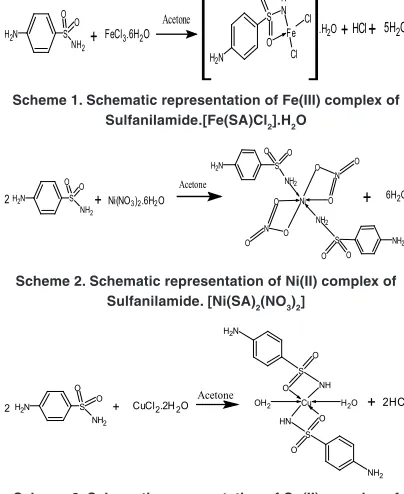
Metal halides, FeCl3.6H2O, Ni(NO3)2.6H2O and CuCl2.2H2O (Himedia), were used and their solutions(1 mmol) were prepared separately in acetone each. The ligand sulfanilamide (Himedia) was separately dissolved in acetone to obtain its solution (3 mmol). The solutions of each metal halide was then separately mixed together with the drug solution and the resultant reaction mixtures were then subjected to microwave irradiation in a domestic microwave oven reactor model KENSTAR - OM20ACF, 2450MHz, at a medium power level of 600 W for about 4 to 5 minutes. The reaction products
N H2 S
O O
NH2+FeCl3.6H2O
Acetone S O O N H Fe Cl Cl N H2
.H2O+HCl
+
5H2OScheme 1. Schematic representation of Fe(III) complex of Sulfanilamide.[Fe(SA)Cl2].H2O
N
H2 S
O O
NH2+Ni(NO3)2.6H2O
Acetone
2 O O
NH2
N
H2 S
O O NH2 Ni S O O NH2 O O N O N O
+
6H2OScheme 2. Schematic representation of Ni(II) complex of Sulfanilamide. [Ni(SA)2(NO3)2]
N
H2 S O
O
NH2
+ CuCl2.2H2O Acetone
N H2 S O NH O S NH2 O O N H
Cu H2O
OH2
2 +2HCl
RESULTS AND DISCUSSION
Synthesis of complexes by the green method of microwave irradiation was found to be very effective. The yields of the complexes prepared were appreciable
and better than those prepared by conventional thermal methods14-17. Also the overall reaction time period consumed in thermal method has was reduced from several hours to few minutes in case of microwave synthesis. The findings are assimilated in Table 1.
Table 1: Physico Chemical Properties Of Sulfanilamide and its metal complexes
Elemental Analysis Complexes Colour and State Melting point Reaction Period Yield% Calcd. (Found)%
(oC) C. M. (H) M. M. (Min) C. M. M. M. C H N
Sulfanilamide Crystalline 162 - - - - 41.81 4.65 16.26
White (40.98) (4.56) (16.3)
[Fe(SA)Cl2].H2O Brown Solid 158 3 4 63 78 22.78 2.85 8.86 (22.58) -2.55 (8.8) [Ni(SA)2(NO3)2] Light Green Solid 175 3 4 62 72 27.32 3.04 15.94 (27.26) -3.09 (15.62) [Cu(SA)2(H2O)2] Dark Brown Solid 198 3 4 64 76 32.58 4.07 12.67
(32.38) (4.50) (12.36) C.M. = Conventional heating method. M.M. = Microwave Irradiation method
Electronic spectra
The recorded UV-Vis spectra of pure drug Sulfanilamide and its Fe(III), Ni(II) and Cu(II) complexes are presented in Fig. 2 and Table 2.
Fig. 2. Electronic Spectra of Sulfanilamide and its metal complexes
The d-d transition bands observed for all the three complexes were very weak and less defined as compared to the strong inter-ligand transitions and the L→M charge transfer bands. In aqueous
solution, phenyl and SO2 groups of sulfanilamide molecule exhibit resonance and merge together to display a single strong absorption band at 265 nm due to π → π* and n → π*transitions. When recorded in DMSO, this characteristic band of sulfanilamide molecule is appears at 300 nm18. Upon complexation this characteristic band shifted, appreciably, towards lower wave lengths and appeared at 270, 282 and 255 nm in Fe(III), Ni(II) and Cu(II) complexes respectively. The decrease in
λmax ensures the coordination of drug molecules with the metal ions and also signifies the decrease of electron delocalization in the sulfanilamide molecule upon complexation to the metal ions. In Fe(III)-Sulfanilamide complex absorption bands at 347 and 500 nm are assignable to L→MCT and 6A
1→4T2 d-d transitions respectively, confirming a tetrahedral environment around iron ion. Ni(II) complex exhibited absorption bands at 344, 420, 490 and 535nm that may be attributed to L→M charge transfer and d-d transitions, i.e. 3A
2g→3T1g(P), 3A2g→3T1g(F) and 3A
2g→3T2g(P) respectively, supporting an octahedral
Table 2: Electronic Spectral And Magnetic Moment data of Sulfanilamide and its metal complexes
Complexes Formula Mass µeff (B.M.) Electronic Spectral Tentative Assignments Expected
Bands (nm) Geometry
Sulfanilamide 172.21 - 300 π→π*, n→π*
-[Fe(SA)Cl2].H2O 316.06 5.89 270, π→π*, n→π* Tetrahedral
347, L→ MCT
500 6A
1→4T2
[Ni(SA)2(NO3)2] 527.11 3.2 282, π→π*, n→π* Octahedral 340, 420, L→MCT, 3A
2g→3T1g(P) 490, 535 3A
2g→3T1g(F), 3A2g→3T2g(F)
[Cu(SA)2(H2O)2] 441.97 1.92 255, π→π*, n→π* Distorted
348, L→ MCT Octahedral
570, 2E
geometry of its complex. Absorption bands that appeared at 348 and 570nm in Cu(II) complex correspond to L→M charge transfer and 2E
g→ 2T
2g transitions respectively, hence suggesting an octahedral geometry around Cu(II). These findings are supported by the magnetic susceptibility data19, given in Table 2.
FTIR spectra
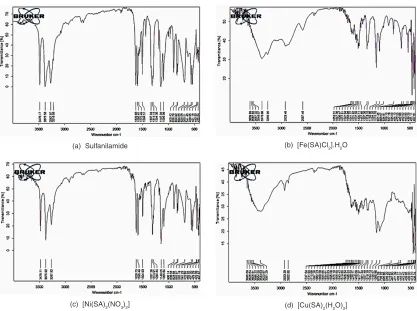
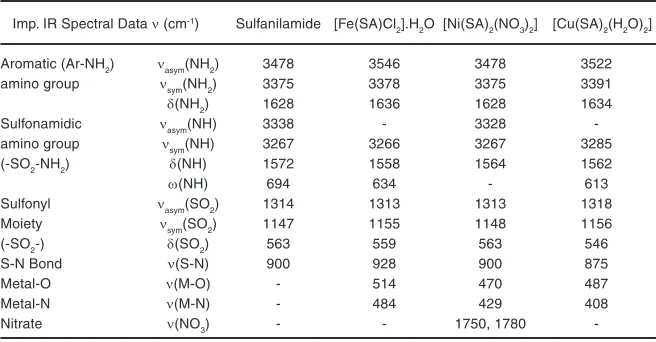
Vibrational frequencies of sulfanilamide drug and all its three complexes have been recorded between 4000 to 400cm-1 and are given in Fig. 3 and Table 3. Important frequencies have been assigned by comparing the IR spectra of complexes with those of pure sulfanilamide and the data provided in the literature20-21. Sulfanilamide is an effective chelating ligand and can behave as monodentate or bidentate through its potential donors sites i.e. primary aromatic amino N atom, sulfonamidic N atom and sulphonyl O atom . The IR spectra of pure sulfanilamide showed two strong bands at 3478 and 3375 cm-1, due to asymmetric and symmetric stretching vibrations of aromatic amino group (Ar-NH2). A weak band
at 3338 cm-1 and an intensely sharp band at 3267 cm-1 are observed due to asymmetric and symmetric stretching vibrations of sulfonamidic amino group (-SO2-NH2) respectively. Sulfonyl moiety (-SO2-) absorbs mainly at 1314, 1147 and 563 cm-1. Primary amino bands for all the three metal complexes have been found to be either unaffected (as in case of Ni(II) -Sulfanilamide complex) or shifted towards higher wave numbers (as in case of Fe(III) and Cu(II) -Sulfanilamide complexes) mainly due to hydrogen bonding with coordinated water or water of crystallization. Broadening of aromatic amino bands above 3500 cm-1 in case of Fe(III) and Cu(II) complexes clearly indicates the presence of water molecules in the complexes22. However, the presence of lattice water or coordinated water was confirmed by the TGA studies of the complexes, mentioned in the thermal analysis section. No such feature was shown in the FT-IR spectrum of Ni(II) complex and hence it may be concluded that it does not contain any form of water in it. Any interaction of metal ions with the aromatic amino group (-NH2) is hence overruled in all the three metal complexes of
(b) [Fe(SA)Cl2].H2O (a) Sulfanilamide
(c) [Ni(SA)2(NO3)2] (d) [Cu(SA)2(H2O)2]
sulfanilamide. In case of Fe(III) and Cu(II) complexes of sulfanilamide, the asymmetric stretching band of sulfonamidic (-NH2) group is missing while the other bands corresponding to this group are substantially weekend and shifted towards lower wave numbers. This clearly signifies the chelation of the drug molecule to the Fe(III) and Cu(II) ion is through deprotonated sulfonamidic N atom. The vibrational bands due to the Sulfonyl moiety in these two complexes are also markedly shifted either to lower or higher wave numbers, confirming its coordination to the metal ions. Hence it can be finally concluded that sulfanilamide molecule is coordinated to Fe(III) and Cu(II) ions via deprotonated sulfonamide N atom and sulfonyl O atom. Also the ν(S-N) bands in both the complexes are shifted substantially to the lower frequencies supporting the above findings.
Iron-chlorine band i.e. ν(Fe-Cl) could
not be recorded within the experimental range of IR recorded for Fe(III) complex of sulfanilamide. FTIR spectrum of Ni(II) complex of sulfanilamide shows the presence of both the sulfonamidic amino bands but they are substantially shifted towards lower wave numbers. This indicates that the drug molecule is coordinated to Ni(II) ion via sulfonamidic N atom without undergoing deprotonation. The IR frequencies of sulfonyl group and the ν(S-N) band are completely unaffected and appeared exactly at the same position as that of free sulfanilamide, hence indicating non coordination of these groups of ligand with Ni(II) ion. This complex also exhibits two new bands around 1750 and 1780 cm-1 that are attributed to the presence of bidentate nitrate group23. The characteristic metal-O and the metal-N vibrational frequencies, i.e. ν(M-O) and ν(M-N) have been recorded for all the three complexes and are given in Table 3.
Table 3: IR Spectral Data of Sulfanilamide and its Complexes
Imp. IR Spectral Data ν (cm-1) Sulfanilamide [Fe(SA)Cl
2].H2O [Ni(SA)2(NO3)2] [Cu(SA)2(H2O)2]
Aromatic (Ar-NH2) νasym(NH2) 3478 3546 3478 3522 amino group νsym(NH2) 3375 3378 3375 3391
δ(NH2) 1628 1636 1628 1634
Sulfonamidic νasym(NH) 3338 - 3328
-amino group νsym(NH) 3267 3266 3267 3285
(-SO2-NH2) δ(NH) 1572 1558 1564 1562
ω(NH) 694 634 - 613
Sulfonyl νasym(SO2) 1314 1313 1313 1318
Moiety νsym(SO2) 1147 1155 1148 1156
(-SO2-) δ(SO2) 563 559 563 546
S-N Bond ν(S-N) 900 928 900 875
Metal-O ν(M-O) - 514 470 487
Metal-N ν(M-N) - 484 429 408
Nitrate ν(NO3) - - 1750, 1780
-Thermal Analysis
The TGA, DTG and DTA thermograms for sulfanilamide and its Fe(III), Ni(II) and Cu(II) complexes are presented in Fig. 4, 5 and 6.
Thermal decomposition of [Fe(SA)Cl2].H2O
The thermal decomposition data of Fe(III) -Sulfanilamide complex supports a three stage decomposition. The first stage of decomposition is attributed to the loss of one molecule of water of hydration with an estimated mass loss of 5.68% (obsd. 7.67%). The DTA curve exhibits a broad endothermic peak for the same. This water molecule is lost very early, within the temperature range 30-120oC, and
a calculated mass loss of 74.81 % (obsd. 72.69%), and a sharp exothermic DTA peak, yielding a black
Fig. 4. Thermogravimetric analysis (TGA), Differential thermal analysis (DTA) and Derivative thermogravimetric (DTG) curves of [Fe(SA)Cl2].H2O
residue of Fe2O3. The mass remained constant thereafter and showed no change till 900oC.
Thermal decomposition of [Ni(SA)2(NO3)2]
The Ni(II)- Sulfanilamide complex showed
a three stage decomposition process with practically no change in mass till 170oC.
Fig. 5. Thermogravimetric analysis (TGA), Differential thermal analysis (DTA) and Derivative thermogravimetric (DTG) curves of [Ni(SA)2(NO3)2]
The complex finally started melting near 180oC, which corresponds to its experimental melting point at 175oC. The melting process is shown by a sharp endothermic peak observed in the DTA curve. Thereafter the complex slowly underwent first stage of decomposition after 270oC with a net mass loss of 17.46% (Calcd. 16.67%), due to the loss of amino phenyl moiety from the ligand. The fragmented metal drug complex then decomposed within a range of 320-380oC with an estimated mass loss of 28.51% (Calcd. 28.57%). This endothermic decomposition step may be attributed to the removal of two nitrate groups. The last step of decomposition (390-600oC), observed a mass loss of 76.01% (calcd. 76.80%)
and showed a broad exothermic peak and final breakdown of the complex to yield a stable dark black residue of NiO.
Thermal decomposition of [Cu(SA)2(H2O)2]
degradation (180-280oC) was observed with an estimated loss of 8.45% (calcd. 8.28%) and a short endothermic peak which can be attributed to the loss of two molecules of coordinated water. The findings are consistent with those of IR spectrum of the complex. Second and third steps of decomposition were observed within temperature range of 280-310oC and 310-350oC respectively, as their endothermic and exothermic peaks overlapped and occurred back to back. The estimated mass loss in the above two steps are 15.8% (Calcd. 15.96%) and
34.17% (Calcd. 33.70%) respectively, possibly due to the loss of ammonia molecule in the second and amino phenyl moiety in the third step respectively. The fourth step of degradation occurred within 350-440oC and corresponds to the loss of a SO
2 molecule with an estimated loss of 48.65% (calcd. 44.26%). Lastly a broad exothermic peak (450-600oC) with the mass loss 82.00% (Calcd.82.01%) displayed the final decomposition of the fragmented complex, to yield a black residue of CuO which remained stable after 600oC.
Fig. 6. Thermoravimetric analysis (TGA), Differential thermal analysis (DTA) and Derivative thermogravimetric (DTG) curves of [Cu(SA)2(H2O)2]
Evaluation of Kinetic and Thermodynamic Parameters
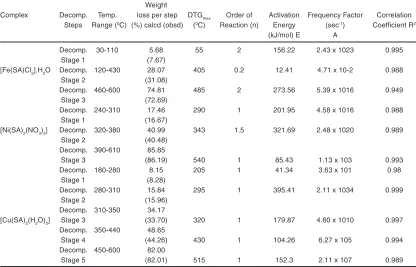
Non-isothermal rate laws can be used for the evaluation of kinetic parameters, such as order of reaction (n), activation energy (E) and frequency factor (A), from the thermoanalytical data. The present study involves utilization of thermogravimetric data (TGA, DTA and DTG curves) to evaluate various kinetic and thermodynamic parameters of metal complexes of Sulfanilamide, for all the stages of decomposition, using graphical method of Coats and Redfern25-26.
Calculation of thermodynamic parameters from the thermal data has been achieved using standard thermodynamic relations given as:
plot, ∆H is the Enthalpy of activation and ∆G is Gibbs free energy. The kinetic and thermodynamic parameters hence derived are presented in and Table 4 and Table 5, respectively. A higher value of activation energy (E) for a particular stage of decomposition signifies the presence of much stable and stronger bonding interaction involved in the decomposing molecule. It may be generalized that the highest activation energies (E) for all the three complexes are mainly observed during the fragmentation of ligand group. A similar order was observed for the values of frequency factor (A) and enthalpy of activation (∆H) in all the steps of thermal degradation. The negative values of entropy of activation (∆S) suggest that the activated complex has a more ordered structure than the reactants. The positive values of gibbs free energy (∆G), confirms the stability of the complexes at room temperature and also that the process of dehydration and thermal decomposition are slower than normal.
Table 4: Thermoanalytic Data and Kinetic Parameters of Sulfanilamide and its metal complexes
Weight
Complex Decomp. Temp. loss per step DTGmax Order of Activation Frequency Factor Correlation Steps Range (0C) (%) calcd (obsd) (0C) Reaction (n) Energy (sec-1) Coefficient R2
(kJ/mol) E A
Decomp. 30-110 5.68 55 2 156.22 2.43 x 10²³ 0.995
Stage 1 (7.67)
[Fe(SA)Cl2].H2O Decomp. 120-430 28.07 405 0.2 12.41 4.71 x 10⁻² 0.988 Stage 2 (31.08)
Decomp. 460-600 74.81 485 2 273.56 5.39 x 10¹⁶ 0.949
Stage 3 (72.69)
Decomp. 240-310 17.46 290 1 201.95 4.58 x 10¹⁶ 0.988
Stage 1 (16.67)
[Ni(SA)2(NO3)2] Decomp. 320-380 40.99 343 1.5 321.69 2.48 x 10²⁰ 0.989 Stage 2 (40.48)
Decomp. 390-610 85.85
Stage 3 (86.19) 540 1 85.43 1.13 x 10³ 0.993
Decomp. 180-280 8.15 205 1 41.34 3.63 x 101 0.98
Stage 1 (8.28)
Decomp. 280-310 15.84 295 1 395.41 2.11 x 1034 0.999 Stage 2 (15.96)
Decomp. 310-350 34.17
[Cu(SA)2(H2O)2] Stage 3 (33.70) 320 1 179.87 4.60 x 10¹⁰ 0.997 Decomp. 350-440 48.65
Stage 4 (44.26) 430 1 104.26 6.27 x 10⁵ 0.994
Decomp. 450-600 82.00
Stage 5 (82.01) 515 1 152.3 2.11 x 10⁷ 0.989
Table 5: Thermoanalytic Data and Thermodyanamic Parameters of Sulfanilamide and its metal complexes
Complex Decomp. Steps Temp. Entropy of Activation Enthalpy of Gibb's Free Energy Range (0C) (J/Kmol) ∆S Activation (kJ/mol) ∆G
(kJ/mol) ∆H
Decomp. Stage 1 30-110 202.01 153.49 87.23
[Fe(SA)Cl2].H2O Decomp. Stage 2 120-430 -162.32 6.77 116.83
Decomp. Stage 3 460-600 73.01 267.26 211.92
Decomp. Stage 1 240-310 68.75 197.26 158.55
[Ni(SA)2(NO3)2] Decomp. Stage 2 320-380 139.58 316.57 230.59
Decomp. Stage 3 390-610 -194.8 78.67 237.04
Decomp. Stage 1 180-280 -219.01 37.86 142.55
Decomp. Stage 2 280-310 406.9 394.1 162.98
[Cu(SA)2(H2O)2] Decomp. Stage 3 310-350 -46.53 174.94 202.53
Decomp. Stage 4 350-440 -141.09 98.42 197.61
Decomp. Stage 5 450-600 -112.8 145.75 234.64
Antibacterial Investigations
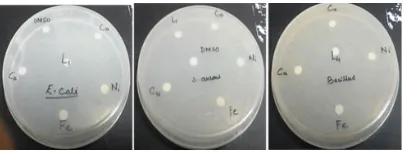
All the three complexes along with their parent drug were tested for antibacterial activities against the bacterial cultures of E.coli, S.aureus
and B.subtilis. The experimental results and data are given in Fig. 9 and in Table 5. In the present study it was found that, whereas Cu(II)-Sulfanilamide complex showed no significant antibacterial activity, the Ni(II)-Sulfanilamide complex proved to be promisingly effective against all the three strains. Fe(III)-Sulfanilamide complex showed prominently enhanced antibacterial activity only against S.
against these bacteria, as compared to the other two metal complexes. Unlike Cu(II) complex, the absence of any form of water molecules in Ni(II) complex renders the aromatic amino group free for effective antimicrobial activity. While Fe(III) complex shows only a moderate effect.
Fig. 7. Biological activity of Sulfanilamide and its metal complexes
CONCLUSION
The present study, discusses the microwave organic synthesis, spectral and magnetic characterization, thermal decomposition studies and antimicrobial studies for Fe(III), Ni(II) and Cu(II) complexes of Sulfanilamide. UV/Vis spectral analyses confirmed the of co-ordination of drug molecules with the metal ions, which was supported by the FTIR spectral data and the magnetic data. On the basis of FTIR and thermal decomposition data, Sulfanilamide drug was found to behave as monodentate as well as bidentate ligand, facilitating six coordinate octahedral geometry around Ni(II) and Cu(II) ions and a four co-ordinate tetrahedral geometry around Fe(III) ion in their sulfanilamide
complexes. The thermoanalytical data and Coats and Redfern graphical method has been utilized for the calculation of kinetic and thermodynamic parameters. The Fe(III), Ni(II) and Cu(II) complexes of sulfanilamide were found to have good stability at lower temperatures and their decomposition started only after their melting. The positive values of gibbs free energy (∆G), indicate that thermal decomposition process for all the complexes is highly non-spontaneous. Thermal degradation followed a multi step decomposition for all the complexes followed by formation of a final stable residue of metal oxide. Biological studies for determining the antimicrobial activities of the complexes were carried against of E.coli, S.aureus and B.subtilis. Among the three complexes, Ni(II)- Sulfanilamide complex proved to be very effective against the three bacterial strains taken. While the efficacy of Fe(III) complex was found only against S.aureus. Cu(II)- sulfanilamide complex did not show any satisfactory resistance against any of the three strains.
CONFLICT OF INTEREST
The authors declare that there is no conflicting interest.
ACKNOwLEDGMENT
This research did not receive any specific grant from funding agencies in the public, commercial, or not-for-profit sectors.
REFERENCES
1. Cunning, D. S.; Guerry, D. Arch. Otolaryngol.,
1941, 34(4), 809-819.
2. Navarro, M.; Vásquez, F.; Sanchez-Delgado, R. A.; Perez, H.; Sinou, V.; Schrevel, J. J. Med. Chem., 2004, 47(21), 5204–5209.
3. Pattan, S. R.; Pawar, S. B.; Vetal, S. S.; Gharate, U. D.; Bhawar, S. B. Indian Drugs., 2012, 49(11), 5-12.
4. McEvoy, G. K. Sulfonamides in american hospital formulary service. Drug Information., 1993, 472. 5. Zahid, H.; Supuran, C. T. Journal of Enzyme
Inhibition and Medicinal Chemistry., 2008,
23(2), 240–251.
6. Adedibu, C. T.; Joshua, A. O. Int. J. Chem. Sci., 2010, 8(3), 1675-1683.
7. Modhavadiya, Orient J. Chem., 2012, 28(2), 921-925.
8. Ahmed M. M. Journal of Molecular Structure.,
2013, 1035, 114–123.
9. Lahtinen, M. Journal of Molecular Structure.,
2014, 1060, 280–290.
10. Radha, S.; Mothila, K. K.; Thamaraichelvan, A.;, Elangovana, Journal of Chemical and Pharmaceutical Research., 2016, 8(8), 202-211. 11. Kappe, C. O.; Dallinger, D. Nat. Rev. Drug
Discovery., 2006, 5, 51-63.
12. Garcia-Raso, A., Fiol, J. J.; Rigo, S.; Lopez-Lopez, A.; Molins, E.; Espinosa, E.
13. Balouiri, M.; Sadiki, M.; Ibnsouda, S. K. Journal of Pharmaceutical Analysis., 2016, 6, 71–79. 14. Prajapat, G.; Gupta, R.; Bhojak, N. Chemical
Science International Journal., 2018, 24(2), 1-13. 15. Prajapat, G.; Rathore, U.; Gupta, R.; Bhojak,
N. AIP Conference Proceedings., 2018, 1953
(080025), 1-5. DOI: 10.1063/1.5032831. 16. Yadav, N.; Bhojak, N. The Int. J. Eng. Sci.,
2013, 2(2), 166-168.
17. Singh, B. K.; Mishra, P.; Prakash, A.; Bhojak, N. Arabian Journal of Chemistry., 2017, 10, S472-S483.
18. Narang, K. K.; Gupta, J. K. Transition Met. Chem., 1977, 2, 181-183.
19. Cotton, F. A.; Wilkinson, G.; Murillo, C. A.; Bochmann, M. Advanced Inorganic Chemistry., 1999, 6th edn. Wiley, New York. 20. Topacli, C.; Topacli, A. Journal of Molecular
Structure., 2003, 644, 145–150.
21. Topacli, C.; Topacli, A. Journal of Molecular
Structure., 2003, 654, 153–159.
22. Nakamoto, K. Infrared and Raman Spectra of Inorganic and Coordination Compounds.,
2009, 6th edn. Wiley, New York
23. Levere, A.B. P.; Mantovani, E.; Ramaswamy, B. S. Canadian Journal Of Chemistry., 1971,
49(11), 1957-1964.
24. Duval, C. Inorganic Thermogravimetric Analysis, 2nd edn. Elsevier Pub. Amsterdam, London, New York., 1963.
25. Coats, A. W.; Redfern, J. P. Nature., 1968,
201(1), 68-69.
26. Vyazovkin, S.; Burnham, AK, Criado, J. M.; Perez-Maqueda, L.A.; Popescu, C.; Sibrrazzuoli, N. Thermochimica Acta., 2011,
520,1–19.
27. Scholar, E. M.; Pratt, W. B. The Antimicrobial Drugs. Oxford University Press., 2000. 28. Anderson, R.; Groundwater, P.; Todd, A.; Worsley,

![Fig. 4. Thermogravimetric analysis (TGA), Differential thermal analysis (DTA) and Derivative thermogravimetric (DTG) curves of [Fe(SA)Cl2].H2O](https://thumb-us.123doks.com/thumbv2/123dok_us/9092993.1444061/6.576.140.440.359.511/thermogravimetric-analysis-differential-thermal-analysis-derivative-thermogravimetric-curves.webp)
![Fig. 6. Thermoravimetric analysis (TGA), Differential thermal analysis (DTA) and Derivative thermogravimetric (DTG) curves of [Cu(SA)2(H2O)2]](https://thumb-us.123doks.com/thumbv2/123dok_us/9092993.1444061/7.576.142.439.254.404/thermoravimetric-analysis-differential-thermal-analysis-derivative-thermogravimetric-curves.webp)