Iran J Public Health, Vol. 47, No.9, Sep 2018, pp.1371-1378
Original Article
Using Image Processing in the Proposed Drowsiness Detection
System Design
Mohsen POURSADEGHIYAN
1,2, *Adel MAZLOUMI
3, Gebraeil NASL SARAJI
3,
Mohammad Mehdi BANESHI
4, Alireza KHAMMAR
5, Mohammad Hossein EBRAHIMI
61. Research Center in Emergency and Disaster Health, University of Social Welfare and Rehabilitation Sciences, Tehran, Iran 2. Psychosis Research Center, University of Social Welfare and Rehabilitation Sciences, Tehran, Iran
3. Dept. of Occupational Health, School of Public Health, International Campus, Tehran University of Medical Sciences, Tehran, Iran
4. Social Determinants of Health Research Center, Yasuj University of Medical Sciences, Yasuj, Iran 5. Dept. of Occupational Health Engineering, School of Health, Zabol University of Medical Sciences, Zabol, Iran 6. Occupational and Environmental Health Research Center, Shahroud University of Medical Sciences, Shahroud, Iran
*Corresponding Author: Email: [email protected]
(Received 17 Jul 2017; accepted 19 Aug 2017)
Introduction
Detecting the levels of drivers’ drowsiness has a key role in reducing the number of fatal injuries in traffic accident. Recent statistics and reports show that 20 to 50 million people are killed or
injured in car crashes all over the world (1). As-sessments conducted by US NHTSA (National Highway Traffic Safety Administration) showed that 100000 car accidents occur every year for Abstract
Background: Drowsiness is one of the underlying causes of driving accidents, which contribute, to many road fatalities annually. Although numerous methods have been developed to detect the level of drowsiness, tech-niques based on image processing are quicker and more accurate in comparison with the other methods. The aim of this study was to use image-processing techniques to detect the levels of drowsiness in a driving simula-tor.
Methods: This study was conducted on five suburban drivers using a driving simulator based on virtual reality laboratory of Khaje-Nasir Toosi University of Technology in 2015 Tehran, Iran. The facial expressions, as well as location of the eyes, were detected by Violla-Jones algorithm. Criteria for detecting drivers’ levels of drowsi-ness by eyes tracking included eye blink duration blink frequency and PERCLOS that was used to confirm the results.
Results: Eye closure duration and blink frequency have a direct ratio of drivers’ levels of drowsiness. The mean of squares of errors for data trained by the network and data into the network for testing, were 0.0623 and 0.0700, respectively. Meanwhile, the percentage of accuracy of detecting system was 93.
Conclusion: The results showed several dynamic changes of the eyes during the periods of drowsiness. The present study proposes a fast and accurate method for detecting the levels of drivers’ drowsiness by considering the dynamic changes of the eyes.
which the drivers’ drowsiness is one of the prin-cipal contributor. These accidents cost over 12.5 billion$ and cause 1550 deaths and 71000 injuries (2). National Sleep Foundation of USA declared that 54% of adult drivers had driven during sleepiness and 28% of these drivers had fallen asleep completely (3). Road Safety Council of Germany (DVR) (Deutsche Verkeh Rswacht) states that 25% of fatal car crashes in highway traffic is due to momentary sleepiness (4). Inves-tigations conducted by the Iranian legal medicine have shown that traffic accidents represent a large number of the country's fatalities. Accord-ing to the reports by this organization, such acci-dents cost over $4 billion annually that is 3.5 times gross domestic product of Iran. Based on the reports represented by police, approximately, 23% of car accidents in Iran was due to drowsy driving and driver fatigue (5, 6).
Having considered such statistics, devising the systems accurately to determine the levels of drivers’ drowsiness is of prime importance in or-der to reduce the number of car accidents. Generally, there three kinds of systems exist to determine the levels of drivers’ fatigue: tech-niques based on physiological signals, techtech-niques based on driver’s performance and techniques based on image processing.
In methods developed based on physiological signals, some electrodes are attached to the body to detect the signals from brain and heart. This method would be irritating and is considered as a nuisance to the drivers (7). In methods developed based on the driver’s performance, much time is required to analyze driver’s performance, which consequently leads to low accuracy. In some cas-es, while the driver falls asleep for a moment, the status of the vehicle does not change, so, the sys-tem is disturbed in detecting micro-sleeps (8). However, methods developed based on image processing are fast and precise to detect drivers’ drowsiness. Fatigue and drowsiness lead to some apparent signs on driver’s face. Interpreting such signals are the principals of the methods devel-oped based on the image processing. In many cases, the first step in image processing is to rec-ognize the facial zone from the received images.
Then, the parameters related to drowsiness such as eyes are recognized and their changes are in-vestigated to detect the levels of sleepiness (9). By photographing the driver and image processing, the visual signals of sleepiness could be detected. Amongst various facial features, eyes are relative-ly of more importance and many studies have been conducted on the processing of the condi-tion of the eyes. For instance, some factors like PERCLOS (Percentage of Eye Closure), duration of eyes closure and the number of blinks were utilized by IR Illuminator to determine the vigi-lance level (10). Drowsiness was detected merely based on PERCLOS. A small camera conducted the observing test detecting the levels of drowsi-ness by the number of eyes blinks and accuracy of 98% (11).
Regarding the importance of detecting the levels of drowsiness precisely without irritating the driver and considering the fact that almost no real time techniques for such purpose have been mentioned in the previous studies, we conducted an investigation of drowsiness by image pro-cessing of professional drivers and observed the movements of their eyes within the sequence of images.
Materials and Methods
is-sues such as fatigue, entails a lot of effort and is highly complex (15,16).
Preparation of the driving simulator
In this research, in order to detect the levels of drowsiness and recording images from the driv-ers, virtual-reality driving simulator was utilized in a room where levels of illumination, noise, and
temperature were controlled., simulator model AKIA-BI 301BI 301 Full was used to conducting the test (Fig.1). The road was a highway with 3 lines, no side details, and the low meander to in-spire drowsiness and designed for 2 h sessions (5).
Fig. 1: Driving simulator model AKIA-BI 301
Protocol of testing
For initiating the test, the driver starts the simula-tor. As the test begins, camera records images of driver’s face. Meanwhile, observer interprets imag-es to recognize the levels drowsinimag-ess. When simu-lator shows the road, crossing test finishes. (Four wheels should exit the road according to the re-searcher’s assessment). For controlling, the light from the vehicles ahead that caused bright light shock leading to reduced subjective sleepiness (17) the oncoming vehicles made use of low beam and the number of them was reduced. In order to con-trol the circadian rhythm, the tests were per-formed between 9 A.M to 12 A.M (18, 12).
Drowsiness detection model
In this part of the research, we developed soft-ware that could receive color frames from the camera placed in front of the driver and calculate coordination of facial details. Finally, by
Fig. 2: Schematic view of driver, camera and image processor
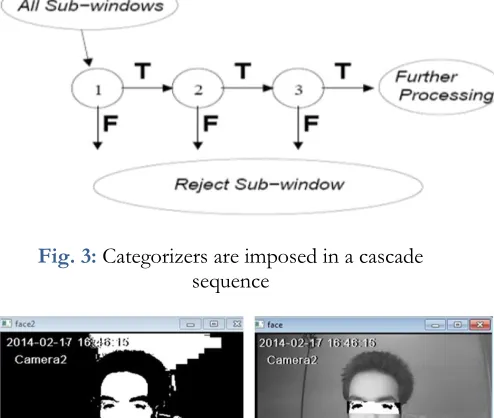
Next, the facial features and location of the eyes are determined by Violla- Jones algorithm (19). For convenience, categorizers are utilized in the cascade sequence (Fig. 3). In this method, driver’s face was detected with regard to the oval shape of the head, hue and the eye sockets. Then, the zone of the eyes was recognized by considering the various changes in derivatives (between pupil and white part of eyes) of the visual information (Fig. 4).
Fig. 3: Categorizers are imposed in a cascade
sequence
Fig. 4: Eyes detection by Violla-Jones algorithm
Finally, to recognize whether eyes are closed or open, images are converted into gray scale for-mat. Then, by calculating the mean of compo-nent V, illumination of images is normalized. Af-terward, image of eyes is converted into binary by determining threshold via OTSU method. This conversion reduces the volume of data. After that, the image is divided into upper and lower part. When eyes are open, due to the color of pupils and eyelash, the ratio of dark pixels in
up-per part of eye is greater than the state of closed eyes because in the case of closed eyes, eyelids with light color cover pupils. In addition to this, in this state eyelash is in the lower part. To im-prove images, combining and extending wear were utilized to remove black spots. Then, the ration of black pixels to the whole pixels was cal-culated in both upper and lower parts. Finally, the ration of these amounts was used to recog-nize whether eyes are open or closed (Fig. 5) the procedure mentioned above: This figure is two sections for differences between open and closed eye.
Fig. 5: The ratio of black pixels in upper part of the image of eye to the black pixels in lower part while eyes
are open (upper section) and closed (lower section)
Results
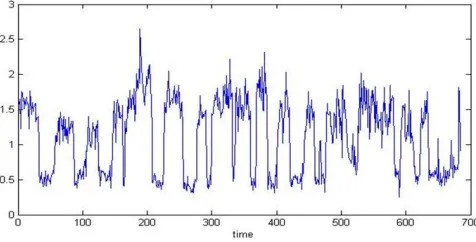
The results of analyzing frames of the eye pro-cessing are shown in Fig. 6 as changes in ratio of black and white pixels in upper and lower parts and compound signal when eyes are closed, open, and recognizing blinks by processing properties. To scale up important changes which are the ba-sis of the upper signal for tracking, this property is multiplied by 3 to be illustrated more obvious in Fig. 6. Fig. 6 shows changes in black pixels in upper part of the image with respect to the lower part. The difference of this ratio of open and closed eyes is significant. By determining an ap-propriate threshold, open and closed eyes are de-tected. Mean of the lower part is appropriate to distinguish open and close eyelids (Fig. 7).
Finally, by finding information on closed or open eyes, blinks frequency and blink duration and by utilizing neural network, level of drowsiness was recognized.
Results from neural network
To determine the levels of drowsiness by eyes signals, MLP neural network with three middle layers (with tansig function) and two inputs (first input: the averages of upper pixels and input: the averages of lower pixels) and one output (level of
drowsiness) were utilized (Fig. 9). Full propaga-tion and decreasing gradient methods were used. The number of training data was 9964 frames recorded from the five drivers' sleepiness.
The network was taught by 1000 epoch. 70% of data and the rest of data (30% of data) for testing were transferred to the network for training. The mean of squares of errors for data trained and was tested by the network were 0.0623 and 0.0700, respectively. Then, the level of accuracy was estimated at 93%.
Fig. 6: Changes in black and white pixels in upper and lower parts of the image in a time interval (during open and
closed eyes and blink detection by these characteristics)
Fig. 8: Rates of PERCLOS and eye blink frequency are shown by blue and green line graphs, respectively
Fig. 9: Regression of neural network pertained to a test to find appropriate neural network
Discussion
Fatigue and drowsiness cause obvious changes in driver’s facial features and expressions and the position of head and eyes. Most of the studies conducted on the effects of fatigue and sleepiness have focused on the dynamic changes of the eyes and their movements during the periods that an individual is fatigued and sleepy. In this research, the level of drivers’ drowsiness was detected by employing an image-processing technique. In comparison with other techniques, this method detects the level drowsiness more accurately. For example, in the technique (20) that employs a color video camera placed directly in front of the driver, eyes are targeted to recognize micro-sleeps. In this research, we presented a method that in addition to the micro-sleeps, blinking (number and characteristics of blinks) is also monitored. While in another research (21) hue and Gabor filter were utilized, we considered the
blink duration and frequency, which are relatively more advantages.
In a research conducted to detect sleepiness in 2008, the driver wore special glasses. A small camera was also placed on the glasses to monitor eyes their movements, only micro-sleep were de-tected, and blinks were considered quantitatively (22).
After detecting open and closed eyes, the criteria of blinking (like blink duration, blink frequency, open and closed eyelids); number of blinks dur-ing one minute, number of long blinks and their means in five minutes were calculated. Obvious-ly, this research considers wider range of data and more criteria and processes more quickly.
set of characteristics to detect one of three states of the mouth (23). Apparent changes of the mouth and eyes, changes in states of head and facial features are targeted to detect driver’s fa-tigue. For example, a system to detect small movements of head MINDS to recognize micro-sleeps and head dropping has been developed (24). In addition, a technique was introduced for detecting facial movements to recognize level of alertness (25).
In the future for detecting fatigue or sleepiness, other criteria like open or closed mouth, move-ments of head and facial features can be taken into account (23,25).
During conducting the tests on drivers by simulator and the software, appropriate illumina-tion and locaillumina-tion of the camera increased the ef-ficacy of method (26). Besides, this method pro-cesses data more quickly and accurately than oth-er methods. High rate of road fatality caused by driver fatigue highlight the importance of this method.
Conclusion
A benefit of the method to detect drowsiness is intelligent sleepiness detection and use of various parameters in a long time and driving back-ground. This advantage leads to detecting drows-iness in early stages and activate the alarm before a car accident occur. However, sleepiness is very complicated to be detected completely only by image processing. Therefore, various aspects of drowsiness were studied in virtual-reality driving simulator laboratory of Khaje Nasir University. Additionally, by using more criteria and obtained information by sensors drowsiness is detected.
Ethical considerations
The approval of Tehran University of Medical Sciences was obtained for conducting the study. All participants were informed about the objec-tives of the study, and their informed consent was obtained.
Acknowledgments
The Research Committee in Tehran University of Medical Sciences International Campus (TUMS- IC) supported this work under Grant number 24957. The authors wish to thank the coopera-tion of all participants in this study and are thank-ful for the intimate help of the Virtual Reality Laboratory staffs of Khaje Nasir Toosi Universi-ty of Technology.
Conflict of Interests
The authors declare that there is no conflict of interest.
References
1. WHO (2009). Global Status Report on Road
Safety Geneva, Switzerland.
https://afro.who.int/sites/default/files/2017 -06/vid_global_status_report_en.pdf
2. Rau P (2005). Drowsy Driver Detection and Warning System for Commercial Vehicle Drivers: Field Operational Test Design, Anal-ysis, and Progress. National Highway Traffic Safety Administration. Washington, DC, USA.
3. Drivers Beware Getting Enough Sleep Can Save Your Life This Memorial Day. National Sleep Foundation (NSF); Arlington, VA, USA: 2010.
4. Husar P (2012). Eyetracker Warns against
Mo-mentary Driver Drowsiness.
https://www.fraunhofer.de/en/press/resear ch-news/2010/10/eye-tracker-driver-drowsiness.html
5. Poursadeghiyan M, Mazloumi A, Saraji GN et al (2017). Determination the levels ofsubjective and observer rating of drowsiness and their associationswith facial dynamic changes. Iran
J Public Health, 46(1):93-102
6. Karchani M, Mazloumi A, Saraji GN et al (2015). Relationship between Subjective Sleepiness and Demographic Characteristics in Night Work Drivers. Advances in Environmental
Biolo-gy, 9(3):1012-1015
Network. Proc. International Conf. on Mecha-tronics and Automation, China. pp.3555-9. 8. Lopar M, Ribarić S (2013). An Overview and
Evaluation of Various Face and Eyes Detec-tion Algorithms for Driver Fatigue Monitor-ing Systems. ProceedMonitor-ings of the Croatian Computer Vision Workshop, Year 1. Zagreb, Coroatia, pp.15-18
https://arxiv.org/ftp/arxiv/papers/1310/13 10.0317.pdf
9. Khan MI, Mansoor AB (2008). Real Time Eyes Tracking and Classification for Driver Fatigue Detection, ICIAR 2008, LNCS 5112, Image Analysis and Recognition, pp: 729-738 10. Bergasa LM, Nuevo J, Sotelo MA, Barea R,
Lopez ME (2006). Real-Time system for monitoring driver vigilance. IEEE trans Intell
Transp Syst, 7 (1): 63-77.
11. Liu D, Sun P, Xiao YQ, Yin Y (2010). Drowsi-ness Detection Based on Eyelid Movement.
Proc. the 2nd International Workshop on
Ed-ucation Technology and Computer Science (ETCS), Wuhan, China, 12–13; pp. 49–52. 12. Karchani M, Mazloumi A, NaslSaraji G et al
(2015). Association of Subjective and Inter-pretive Drowsiness with Facial Dynamic Changes In Simulator Driving. J Res Health
Sci, 15(4): 250-55.
13. Khammar A, Moghimian M, Ebrahimi MH et al (2017). Effects of Bright light shock on sleep-iness and adaptation among night workers of a hospital in Iran. Ann Trop Med Public Health,10(3):595-599.
14. Omidianidost A, Hosseini S, Jabari M et al (2016). The Relationship Between Individual, Occupational Factors And LBP (Low Back Pain) In One Of The Auto Parts Manufactur-ing Workshops Of Tehran In 2015. J Eng
Appl Sci, 11(5):1074-77.
15. Biglari H, Ebrahimi MH, Salehi M et al (2016). Relationship of Occupational Stress to Cardi-ovascular Disease Risk Factors in Drivers. Int
J Occup Med Environ Health, 29(6): 895-901.
16. Azrah K, Poursadeghiyan M, Fani MJ et al (2016). Predicting health risks of exposure to
whole body vibration in the urban taxi driv-ers. JHSW, 6 (3) :59-72.
17. Karchani M, Kakooei H, Yazdi Z, Zare M (2011). Do bright-light shock exposures dur-ing breaks reduce subjective sleepiness in night workers? Sleep Biol Rhythms 9(2): 95-102. 18. Craig A, Tran Y, Wijesuriya N, Boord PA (2006).
A controlled Investigation in to the Psycho-logical Determinants of Fatigue. Biol Psychol, 72 (1): 78-87.
19. Viola P, MJ JONES (2004). Robust real-time face detection. Int J Comput Vis, 57(2):137–54. 20. Singh S, Papanikolopoulos N.P (1999). Monitor-ing driver fatigue usMonitor-ing facial analysis tech-niques, in Proc. Int. Conf. Intelligent Trans-portation Systems, Tokyo, Japan. pp. 314– 318.
21. Rongben W, Lie G, Bingliang T, Lisheng J (2004). Monitoring Mouth Movement for Driver Fatigue or Distraction with One Cam-era, Proc. IEEE intelligent Transportation Sys-tems Conference Washington, D.C., USA. 22. Ryan WJ, Duchowski AT, Birchfield ST (2008).
Limbus/Pupil Switching For Wearable Eye Tracking Under Variable Lighting Condi-tions, Proc. ETRA, symposium on Eye track-ing research & applications Savannah, Geor-gia, pp.61-64
23. Fan X, Yin BC, Sun YF (2009). Yawning detec-tion based on gabor wavelets and LDA. J
Bei-jing Univ Technol, 35(3): 409-413.
24. Yin BC, Fan X, SunYF (2009). Multiscale dy-namic features based driver fatigue detection.
Intern J Pattern Recognit Artif Intell, 23(3): 575-89.
25. Vural E, Cetin M, Ercil A et al (2007). Drowsy Driver Detection through Facial Movement Analysis. International Workshop on Human-Computer Interaction HCI 2007: Human– Computer Interaction pp 6-18.