GLOBAL JOURNAL OF ADVANCED ENGINEERING TECHNOLOGIES AND
SCIENCES
RESULTING DISPLACEMENT OF DIFFERENT COMPONENTS OF
CERAVER-OSTEAL HIP PROSTHESIS FOR THE DIFFERENT DAILY ACTIVITIES OF A
PATIENT
A. Moulgada*, D. Ait Kaci, H. Achache, A. Sahli
*
Department of Mechanical Engineering, Ibn khaldoun University, Tiaret, Algeria
ABSTRACT
Finite element analysis has been used extensively in the study of bone loading and implant performance, such as in the femur. The boundary conditions applied vary widely, generally producing excessive femoral deformation, and although the muscle forces influence femoral deflections and loading, little consideration has been given to the displacement constraints. In our study, which is a dynamic study of this PTH, one drew corresponding displacements from each activity of the patient for each link of the structure, and their consequences on the stability and the risk loosening of implant, by making a comparative interpretation for each component of the PTH which is (Cement; Cortical bone and Implant).In this study deals with the corresponding maximum displacements for each component of the structure.
KEYWORDS: PTH, Displacements, Cement, Stem, Bone.
INTRODUCTION
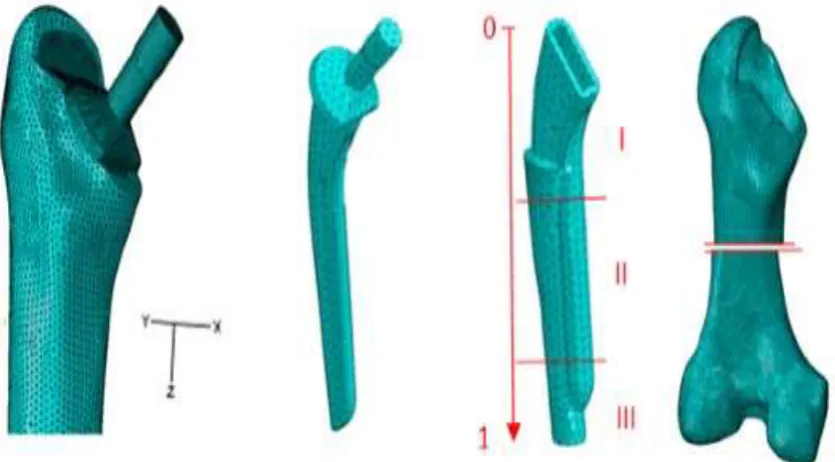
Figure 1: Osteal femur stem
MATERIALS AND METHODS
Model designsFor a three-dimensional solid model of the total hip replacement(THR), there are four major components that have to be modelled:cortical bone, cancellous bone,femoral stem and cement. The complete models were assembled using Solidworks. The three-dimensional solid model assembly of femur, bone-cement and implant was transferred to abaqus Workbench by the direct interface. Abaqus Workbench automatically recognizes the contacts existing between each part and establishes the contact conditions for corresponding contact surfaces.In this work, the Cevever-Osteal model of the cemented total hip arthroplasty is designed (Fig.2).
Figure 2 : Applied forces on the bone-cement–prosthesis assembly
Material properties
Table 1. The artificial hip components material properties [14]
Table2. Maximum loading configurations of the major muscles and dynamic loads [15]
Dynamic Load Fx Fy Fz
Abductàr Muscle 465 695 34.5
Lateral Muscle -7.1 746.3 148.6
Loading and Boundary conditions
The contact forces of the typical patient and their components are illustrated for the nine investigated activities [15]. In this study, for dynamic loads from three activities (normal walking, up stairs and down stairs) were chosen from the hip contact forces (Figure. 3), these loads for a person of 70 kg are illustrated in figure 4. The boundary condition was applied by fixing the distal epiphysis, which is the distal end of the femur that is connected to the knee [16]. The coordinate system used to represent the direction of the forces components is shown Figure 2. The femur is primarily loaded in bending [17]. The cement–bone and cement-stem interfaces were assumed rigidly fixed.
Model Mesh
Finite element analysis (FEA) is a widely used research tool in biomechanics. The model in this study is discretized by using tetrahedral elements. This is because the geometry of the femur is irregular. Tetrahedral elements are better to be suited and adjusted to curved boundaries compared to others elements. Discretizing by using tetrahedral elements with four nodes makes the meshing becomes easier. The complete Osteal model (stem, bone cement and femur) has in total 1223410 elements.
RESULTS AND DISCUSSION
Figure 4 : Displacements Distribution of the stem for differents activities: a- Normal walking, b- Stand up on chair, c- Climbing stairs, d- Down stairs, e- Sit on chair
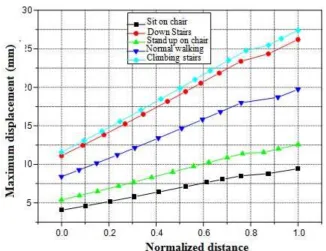
Figure 5 : Graphical representation of the variation of the maximum displacements function to the normalized distance
explained by movement of the patient to ensure activity and walking in the direction of each activity(see fig.5), and we know that according to the initial conditions that the total hip prosthesis has only a recess at the distal portion of the cortical bone; thus the implant has some freedom at its upper and lower part, while for other activities; down stairs also has a displacement resulting quite important especially to the proximal portion of the implant which reaches 26.20mm and 10.97mm at the last point of its distal portion. On the graphical representation of resultant displacement depending on the normalized distance of the implant, there is a uniform growth of the displacement for each activity, ranging from the distal portion to the proximal portion; these gaits show that for every activity it has corresponding moves, so the rising induced stairs significant displacement followed down stairs; then normal walking which also has a maximum displacement of 19.72mm and the lifting of a 12.56mm chair, while the activity of the sit on a chair presents a displacement 9.42mm remaining less important compared to other activities. he resulting movements do not cause any risk of rupture for the implant remains the strongest link of the structure.
Bone
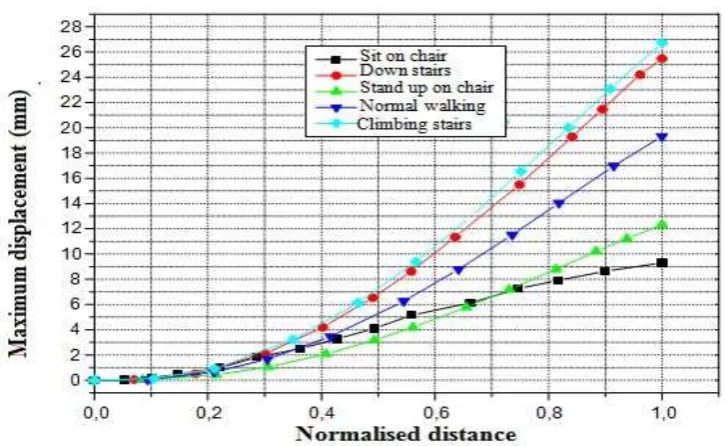
Figure 6 : Displacements Distribution of the bone for different activities: a- Normal walking, b- Stand upon chair, c- Climbing stairs, d- Down stairs, e- Sit on chair
The induced displacement of the bone vary from one activity to another and following the intensities of the forces exerted on total hip replacement. These movements are more remarkable on the proximal portion of the living part of the structure, and to a lesser extent in going towards the medial portion to the distal portion which has no displacement on the last point of its lower part, it is required due to the embedding at the cortical bone on the lower part, it is due to the forces applied to the prosthesis, and these movements are normal because they are induced in the direction of movement of each limb (foot) for one of the activities (see figure7) and are less intense on medial and negligibly in the vicinity of the distal portion to the last point of this distal region which has no movement of the bone caused by initial conditions imposed on the bone (embedding). Therefore, we concluded that the living element of total hip prosthesis rotates an eligible angle to the summit, which is the last point of the distal region of the bone.
Cement
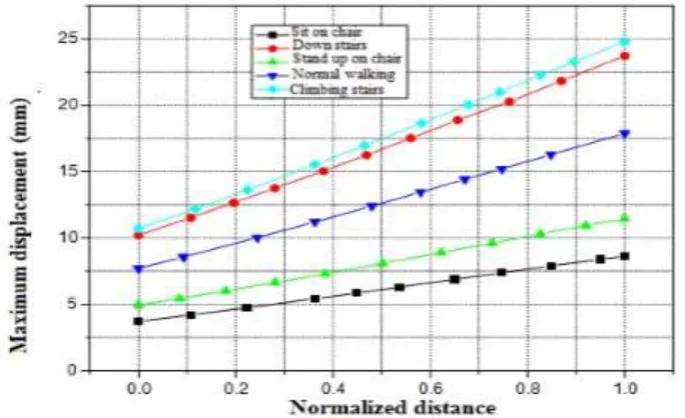
Figure 8 : Displacements Distribution of the cement for different activities: a- Normal walking, b- Stand up on chair, c- Climbing stairs, d- Down stairs, e- Sit on chair
Cement is the most fragile component of the hip prosthesis structure, so the most delicate component forces us to make a very accurate study of its dynamic behavior; and all the factors that influence its stability and the damage; for it has been treated in this chapter its movement during the various daily activities of the total hip prosthesis wearer. In our study, the bone cement knows a maximum displacement of 24.77mm for the activity of climbing stairs proximal half; this movement is strongest by comparing the patient's other activities; this is due to the effort accomplished by the patient up the stairs; and with another travel 23.72mm for descending stairs which also a very painful event for the patient; these movements cause no risk for damage to the cement because these displacements are cement rotations in the direction of movement of each activity, and with a freedom at the distal portion of the cement is not affected by recessed. Concerning the variation curve representative of the maximum resultant displacement according to the normalized distance, it is found that the activity that presents the greater displacement is climbing stairs due to forces applied to the prosthesis which is for a progressive appearance in from the distal region, through the medial region to the proximal region, this is due to the rotation of the femur in the direction of movement proper to each activity; followed by the descent of the stairs which also knows quite significant movements, Note that these gaits have some compatibility linearity for each activity, and a distinct escalation of the distal to the proximal part and these movements do not cause any risk to damage and breakage of the bone cement.
CONCLUSION
The postoperative period the wearer of the total hip replacement remains a primary concern for surgeons who have met a number of concerns and difficulties encountered by some patients; above all, is to adapt the model for each patient, or either by the patient's adaptation to the total hip replacement and during this period of healing and rehabilitation. For this, it is advantageous to make a detailed study in this chapter, to travel by each element of the PTH structure, and all the degrees of freedom for each component of this structure; therefore, our study led us to the following conclusions.
Climbing stairs induced sizeable movements in different parts of the structure, these movements can be explained by ordinary rotations of these items to ensure each own movement for each activity; these different movements from one activity to another, and according to the induced loads for each daily activity of the wearer of PTH.
Down stairs, it also is a worry for the patient because it provides a little more effort to accomplish this activity; other activities; such as, normal walking, sit down and lifting a chair do not present a big problem for the patient. So postage stairs remains the most difficult and most dangerous activity for the wearer of PTH, and induced displacements during these activities do not cause danger on the PTH, as these movements are common.
REFERENCES
[1] Sporer S, Paprosky W. Revision total hip arthroplasty: the limits of fully coated stems. Clin Orthop Relat Res. pp. 203–209, 2003
[2] Morrey BF, Kavanagh BF. Complications with revision of the femoral component of total hip arthroplasty: Comparison between cemented and uncemented techniques. Journal of Arthroplasty. 7:71– 79. doi: 10.1016/0883-5403(92)90035,1992
[3] Mulroy W, Harris W. Revision total hip arthroplasty with use of so-called second-generation cementing techniques for aseptic loosening of the femoral component. A fifteen-year-average follow-up study. J Bone Joint Surg Am;78:325–330,1996
[4] Hodge WA, Andriacchi TP, Galante JO. A relationship between stem orientation and function following total hip arthroplasty. J Arthroplasty;6:229–235. doi: 10.1016/S0883-5403(06)80169-5, 1991
[5] Cheal EJ, Spector M, Hayes WC. Role of loads and prosthesis material properties on the mechanics of the proximal femur after total hip arthroplasty. J Orthop Res. 1992;10:405–422. doi: 10.1002/jor.1100100314.
[6] Ovesen O, Emmeluth C, Hofbauer C, Overgaard S. Revision Total Hip Arthroplasty Using a Modular Tapered Stem With Distal Fixation: Good Short-Term Results in 125 Revisions. J Arthroplasty.25:348– 354. doi: 10.1016/j.arth.2008.11.106, 2010
[7] Regis D, Sandri A, Bartolozzi P. Stem modularity alone is not effective in reducing dislocation rate in hip revision surgery. J Orthop Traumatol. 10:167–171. doi: 10.1007/s10195-009-0076-0, 2009 [8] Bader R, Barbano R, Mittelmeier W. Treatment of recurrent dislocation associated with impingement
after revision total hip arthroplasty. Acta Orthop Belg. 71:98–101, 2005
[9] Charles MN, Bourne RB, Davey JR, Greenwald AS, Morrey BF, Rorabeck CH. Soft-tissue balancing of the hip: the role of femoral offset restoration. Instr Course Lect. 54:131–141,2005
[11]Dorr LD, Wan Z. Causes of and treatment protocol for instability of total hip replacement. Clin Orthop Relat Res. pp. 144–151,1998
[12]Heller MO, Bergmann G, Deuretzbacher G, Claes L, Haas NP, Duda GN. Influence of femoral anteversion on proximal femoral loading: measurement and simulation in four patients. Clin Biomech. 16:644–649.doi: 10.1016/S0268-0033(01)00053-5,2001
[13]A. Moulgada, M. M. Bouziane, B. Bachir Bouiadjra, S. Benbarek,A. Albedah,T. Achour. Finite element simulation of stress distribution in the different components of Ceraver-Osteal hip prosthesis: static and dynamic analysis. ISSN 1392-1207. MECHANIKA. Volume 20(5): 452-459,2014
[14]Nuño N and Avanzolini G. Residual stresses at the stem–cement interface of an idealized cemented hip stem. Journal of Biomechanics, vol 35, pp 849–852, 2002
[15]G. Bergmann, G. Deuretzbacher, M. Hellr, F. Graichen, A. Rohlmann, J. Strauss, G.N. Duda. Hip contact forces and gait patterns from routine activities. Journal of Biomechanics 34 859–871,2001
[16]Bergmann, G., “HIP98”, Free University, Berlin, ISBN 3-9807848-0-0,2001